*** On special – $0.99 – On Special ***

Two novels are on special for $0.99 for the next few weeks.

They are

newechocover5rs

for “Echoes from the Past” go to

https://amzn.to/2CYKxu4

newdevilcvr3

for “The Devil You Don’t” go to

https://amzn.to/2Xyh1ow

Mall shopping can be interesting

I’m wandering through a shopping mall.  Not exactly what you’d expect from a writer looking for ideas.

Not that I came to the mall with that in mind, we have to do some shopping and a visit to the bank.

It’s one of those odd things this writer does, subconsciously looking for characters, character traits, or plots.

One came to me when I saw someone running.  Had they stolen an item and were they running from the store manager?  Were they escaping from a situation?  Perhaps they were just trying to catch up to the rest of their party.

Then, in another corner, not so private from everyone else, a couple is having an argument.  They are young.  There could be any number of subplots going on, were they breaking up?  Had one found out the other was cheating?  Were they married and discovered they were about to have a child they couldn’t afford?

Shopping malls are not exactly places that can be woven into a story unless it’s about teen angst, and there’s a lot of that in the after school hours and k as the night shopping.  I have never understood the need for teens to gather together and wander the halls of a shopping center.  Perhaps it’s just to hang out, whatever that means.

My teens used to gather and go to the cinema.  Years later we discovered they used to get drunk first then go to the cinema and misbehave.  It seemed like one of the passages of rites thing for young people.  Not in my day, but things were different for them.  Nowadays it’s all about drugs and rage parties

Is this the sort of angst that finds it’s way into ya novels even though they have a paranormal and/or fantasy theme.  People are still people no matter what the setting, so are we trying to sort out the problems of youth living in the current perilous times against a mythical background?

So much for finding subplots, now I’m looking at solving the world’s problems. I guess it’s time to go to the bank and solve my own problems and leave the rest to more competent people than myself.

Still, food for thought.  Perhaps a short chat with my 16-year-old granddaughter might make some sense of it.

An excerpt from “Strangers We’ve Become” – Coming Soon

I wandered back to my villa.

It was in darkness.  I was sure I had left several lights on, especially over the door so I could see to unlock it.

I looked up and saw the globe was broken.

Instant alert.

I went to the first hiding spot for the gun, and it wasn’t there.  I went to the backup and it wasn’t there either.  Someone had found my carefully hidden stash of weapons and removed them.

Who?

There were four hiding spots and all were empty.  Someone had removed the weapons.  That could only mean one possibility.

I had a visitor, not necessarily here for a social call.

But, of course, being the well-trained agent I’d once been and not one to be caught unawares, I crossed over to my neighbor and relieved him of a weapon that, if found, would require a lot of explaining.

Suitably armed, it was time to return the surprise.

There were three entrances to the villa, the front door, the back door, and a rather strange escape hatch.  One of the more interesting attractions of the villa I’d rented was its heritage.  It was built in the late 1700s, by a man who was, by all accounts, a thief.  It had a hidden underground room which had been in the past a vault but was now a wine cellar, and it had an escape hatch by which the man could come and go undetected, particularly if there was a mob outside the door baying for his blood.

It now gave me the means to enter the villa without my visitors being alerted, unless, of course, they were near the vicinity of the doorway inside the villa, but that possibility was unlikely.  It was not where anyone could anticipate or expect a doorway to be.

The secret entrance was at the rear of the villa behind a large copse, two camouflaged wooden doors built into the ground.  I move aside some of the branches that covered them and lifted one side.  After I’d discovered the doors and rusty hinges, I’d oiled and cleaned them, and cleared the passageway of cobwebs and fallen rocks.  It had a mildew smell, but nothing would get rid of that.  I’d left torches at either end so I could see.

I closed the door after me, and went quietly down the steps, enveloped in darkness till I switched on the torch.  I traversed the short passage which turned ninety degrees about halfway to the door at the other end.  I carried the key to this door on the keyring, found it and opened the door.  It too had been oiled and swung open soundlessly.

I stepped in the darkness and closed the door.

I was on the lower level under the kitchen, now the wine cellar, the ‘door’ doubling as a set of shelves which had very little on them, less to fall and alert anyone in the villa.

Silence, an eerie silence.

I took the steps up to the kitchen, stopping when my head was level with the floor, checking to see if anyone was waiting.  There wasn’t.  It seemed to me to be an unlikely spot for an ambush.

I’d already considered the possibility of someone coming after me, especially because it had been Bespalov I’d killed, and I was sure he had friends, all equally as mad as he was.  Equally, I’d also considered it nigh on impossible for anyone to find out it was me who killed him because the only people who knew that were Prendergast, Alisha, a few others in the Department, and Susan.

That raised the question of who told them where I was.

If I was the man I used to be, my first suspect would be Susan.  The departure this morning, and now this was too coincidental.  But I was not that man.

Or was I?

I reached the start of the passageway that led from the kitchen to the front door and peered into the semi-darkness.  My eyes had got used to the dark, and it was no longer an inky void.  Fragments of light leaked in around the door from outside and through the edge of the window curtains where they didn’t fit properly.  A bone of contention upstairs in the morning, when first light shone and invariably woke me up hours before I wanted to.

Still nothing.

I took a moment to consider how I would approach the visitor’s job.  I would get a plan of the villa in my head, all entrances, where a target could be led to or attacked where there would be no escape.

Coming in the front door.  If I was not expecting anything, I’d just open the door and walk-in.  One shot would be all that was required.

Contract complete.

I sidled quietly up the passage staying close to the wall, edging closer to the front door.  There was an alcove where the shooter could be waiting.  It was an ideal spot to wait.

Crunch.

I stepped on some nutshells.

Not my nutshells.

I felt it before I heard it.  The bullet with my name on it.

And how the shooter missed, from point-blank range, and hit me in the arm, I had no idea.  I fired off two shots before a second shot from the shooter went wide and hit the door with a loud thwack.

I saw a red dot wavering as it honed in on me and I fell to the floor, stretching out, looking up where the origin of the light was coming and pulled the trigger three times, evenly spaced, and a second later I heard the sound of a body falling down the stairs and stopping at the bottom, not very far from me.

Two assassins.

I’d not expected that.

The assassin by the door was dead, a lucky shot on my part.  The second was still breathing.

I checked the body for any weapons and found a second gun and two knives.  Armed to the teeth!

I pulled off the balaclava; a man, early thirties, definitely Italian.  I was expecting a Russian.

I slapped his face, waking him up.  Blood was leaking from several slashes on his face when his head had hit the stairs on the way down.  The awkward angle of his arms and legs told me there were broken bones, probably a lot worse internally.  He was not long for this earth.

“Who employed you?”

He looked at me with dead eyes, a pursed mouth, perhaps a smile.  “Not today my friend.  You have made a very bad enemy.”  He coughed and blood poured out of his mouth.  “There will be more …”

Friends of Bespalov, no doubt.

I would have to leave.  Two unexplainable bodies, I’d have a hard time explaining my way out of this mess.  I dragged the two bodies into the lounge, clearing the passageway just in case someone had heard anything.

Just in case anyone was outside at the time, I sat in the dark, at the foot of the stairs, and tried to breathe normally.  I was trying not to connect dots that led back to Susan, but the coincidence was worrying me.


A half-hour passed and I hadn’t moved.  Deep in thought, I’d forgotten about being shot, unaware that blood was running down my arm and dripping onto the floor.

Until I heard a knock on my front door.

Two thoughts, it was either the police, alerted by the neighbors, or it was the second wave, though why would they be knocking on the door?

I stood, and immediately felt a stabbing pain in my arm.  I took out a handkerchief and turned it into a makeshift tourniquet, then wrapped a kitchen towel around the wound.

If it was the police, this was going to be a difficult situation.  Holding the gun behind my back, I opened the door a fraction and looked out.

No police, just Maria.  I hoped she was not part of the next ‘wave’.

“You left your phone behind on the table.  I thought you might be looking for it.”  She held it out in front of her.

When I didn’t open the door any further, she looked at me quizzically, and then asked, “Is anything wrong?”

I was going to thank her for returning the phone, but I heard her breathe in sharply, and add, breathlessly, “You’re bleeding.”

I looked at my arm and realized it was visible through the door, and not only that, the towel was soaked in blood.

“You need to go away now.”

Should I tell her the truth?  It was probably too late, and if she was any sort of law-abiding citizen she would go straight to the police.

She showed no signs of leaving, just an unnerving curiosity.  “What happened?”

I ran through several explanations, but none seemed plausible.  I went with the truth.  “My past caught up with me.”

“You need someone to fix that before you pass out from blood loss.  It doesn’t look good.”

“I can fix it.  You need to leave.  It is not safe to be here with me.”

The pain in my arm was not getting any better, and the blood was starting to run down my arm again as the tourniquet loosened.  She was right, I needed it fixed sooner rather than later.

I opened the door and let her in.  It was a mistake, a huge mistake, and I would have to deal with the consequences.  Once inside, she turned on the light and saw the pool of blood just inside the door and the trail leading to the lounge.  She followed the trail and turned into the lounge, turned on the light, and no doubt saw the two dead men.

I expected her to scream.  She didn’t.

She gave me a good hard look, perhaps trying to see if I was dangerous.  Killing people wasn’t something you looked the other way about.  She would have to go to the police.

“What happened here?”

“I came home from the cafe and two men were waiting for me.  I used to work for the Government, but no longer.  I suspect these men were here to repay a debt.  I was lucky.”

“Not so much, looking at your arm.”

She came closer and inspected it.

“Sit down.”

She found another towel and wrapped it around the wound, retightening the tourniquet to stem the bleeding.

“Do you have medical supplies?”

I nodded.  “Upstairs.”  I had a medical kit, and on the road, I usually made my own running repairs.  Another old habit I hadn’t quite shaken off yet.

She went upstairs, rummaged, and then came back.  I wondered briefly what she would think of the unmade bed though I was not sure why it might interest her.

She helped me remove my shirt, and then cleaned the wound.  Fortunately, she didn’t have to remove a bullet.  It was a clean wound but it would require stitches.

When she’d finished she said, “Your friend said one day this might happen.”

No prizes for guessing who that friend was, and it didn’t please me that she had involved Maria.

“Alisha?”

“She didn’t tell me her name, but I think she cares a lot about you.  She said trouble has a way of finding you, gave me a phone and said to call her if something like this happened.”

“That was wrong of her to do that.”

“Perhaps, perhaps not.  Will you call her?”

“Yes.  I can’t stay here now.  You should go now.  Hopefully, by the time I leave in the morning, no one will ever know what happened here, especially you.”

She smiled.  “As you say, I was never here.”


© Charles Heath 2018-2020
Where is that glamorous life of an Author?

I’m currently sitting in my car waiting to pick the grandchildren up from school wondering where that dream of the glamorous life of an author went.

Can it be said that any author leads a glamorous life, except for maybe J K Rowling, James Patterson, and a handful of others?

That dream is of course only a dream.  I did not start this writing caper to become rich and famous or live a glamorous life.  I started It, and it continues in the same vein, that I have a lot of stories in my head that I want to get on paper.

If anyone else wants to read them, then that’s a bonus.  If I happen to make enough money, rather than live high on the hog, an expression my father often used to describe the rich, I would happily invest in programs that get young people reading more.

It also strikes me that it would be difficult to write a literary novel in the vein of Jane Austen or the Bronte sisters, to name a few because modern-day life has no real meaning like it did then.

Instant news, instant communications, and the rest of the country, as well as the world, do close, we can go anywhere, and communicate instantly.  In the days of classic literature, the protagonist’s exchange of letters, and the arduous traveling to another part of the same country would be enough to generate a chapter, or the visit itself could generate several.

But those tales of life were always about people of means, not the ordinary people.  Stories that have the minutiae of daily life do not appeal.  No one wants to read about their lives, they want to be transported to another world where there is no such inanity like cooking, cleaning, washing, and picking up children.

I’m using this time to write another episode or chapter, or, in this case, a blog post.

As any parent will tell you, it is the calm before the storm.

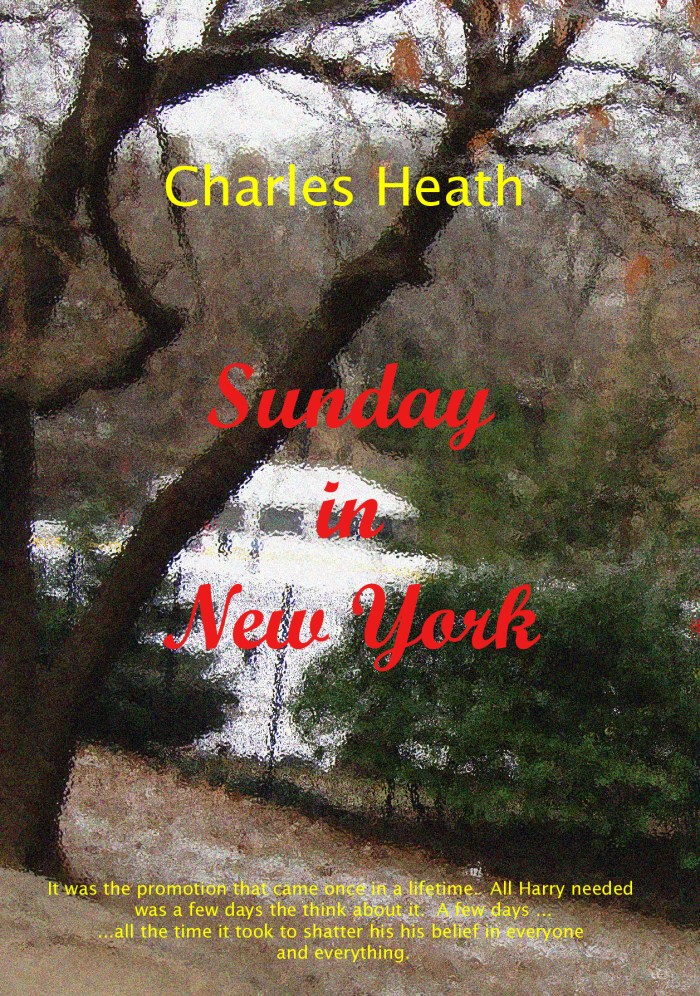
“Sunday in New York”, it’s a bumpy road to love

“Sunday in New York” is ultimately a story about trust, and what happens when a marriage is stretched to its limits.

When Harry Steele attends a lunch with his manager, Barclay, to discuss a promotion that any junior executive would accept in a heartbeat, it is the fact his wife, Alison, who previously professed her reservations about Barclay, also agreed to attend, that casts a small element of doubt in his mind.

From that moment, his life, in the company, in deciding what to do, his marriage, his very life, spirals out of control.

There is no one big factor that can prove Harry’s worst fears, that his marriage is over, just a number of small, interconnecting events, when piled on top of each other, points to a cataclysmic end to everything he had believed in.

Trust is lost firstly in his best friend and mentor, Andy, who only hints of impending disaster, Sasha, a woman whom he saved, and who appears to have motives of her own, and then in his wife, Alison, as he discovered piece by piece damning evidence she is about to leave him for another man.

Can we trust what we see with our eyes or trust what we hear?

Haven’t we all jumped to conclusions at least once in our lives?

Can Alison, a woman whose self-belief and confidence is about to be put to the ultimate test, find a way of proving their relationship is as strong as it has ever been?

As they say in the classics, read on!

Purchase:

http://tinyurl.com/Amazon-SundayInNewYork

Nostalgia

Ever hear someone say it was better in the old days?

I have.

I’ve been guilty of saying it myself.

But, was it?

When I was a child there was no such thing as personal computers and calculators.  Everything came out of books, and maths had to be done in your head.

Holidays were about joining up with other neighbourhood children and making your own entertainment.  I remember for a long time, as a child, we didn’t have television.

It was down to the meadows near the creek to pick blackberries, swim in the water, or raiding new housing estates for offcuts to build a cubby house.

Not like today with television, video players, movies-on-demand, personal computers, game boys, and a plethora of other entertainment choices.

Were we better off back in the old days?

We were in the sun with no idea that sunburn led to cancer and death.  Sunscreen was unheard of, so in that regard maybe not.

In the old days, the only telephones were in the house and were expensive to use.  You could have a coloured phone so long as it was black and made of bakelite.

It was a long time before we had plastic coloured phones or even wall phones.  Those were also the days of telephone boxes, the only way they make a call when away from home.

Now every man and his dog has a mobile phone/computer while on the move.  I know, the dogs keep crashing into me on the street.

And then I also remember my father saying it’s not like the old days, so I had to wonder what he meant.

Perhaps it is an oft-used but less understood lament for a time when we remember we were happy and carefree, those days before mortgages, children, maxed out credit cards, and the children’s mobile phone bills.

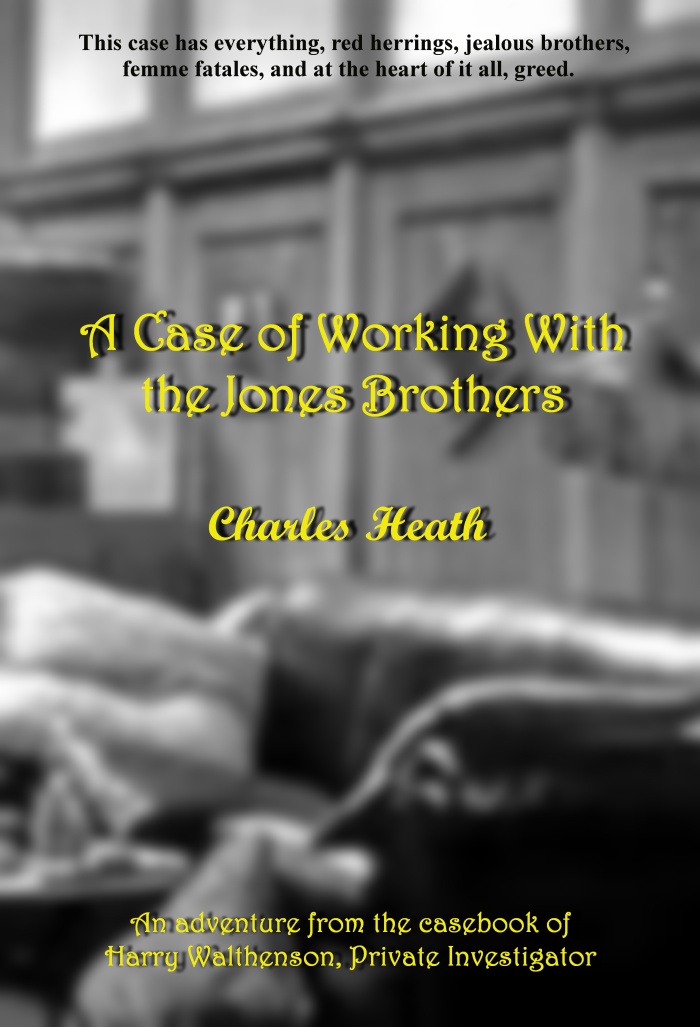
The story behind the story: A Case of Working With the Jones Brothers

To write a private detective serial has always been one of the items at the top of my to-do list, though trying to write novels and a serial, as well as a blog, and maintain a social media presence, well, you get the idea.

But I made it happen, from a bunch of episodes I wrote a long, long time ago, used these to start it, and then continue on, then as now, never having much of an idea where it was going to end up, or how long it would take to tell the story.

That, I think is the joy of ad hoc writing, even you, as the author, have as much idea of where it’s going as the reader does.

It’s basically been in the mill since 1990, and although I finished it last year, it looks like the beginning to end will have taken exactly 30 years.  Had you asked me 30 years ago if I’d ever get it finished, the answer would be maybe?


My private detective, Harry Walthenson

I’d like to say he’s from that great literary mold of Sam Spade, or Mickey Spillane, or Phillip Marlow, but he’s not.

But, I’ve watched Humphrey Bogart play Sam Spade with much interest, and modeled Harry and his office on it.  Similarly, I’ve watched Robert Micham play Phillip Marlow with great panache, if not detachment, and added a bit of him to the mix.

Other characters come into play, and all of them, no matter what period they’re from, always seem larger than life.  I’m not above stealing a little of Mary Astor, Peter Lorre or Sidney Greenstreet, to breathe life into beguiling women and dangerous men alike.


Then there’s the title, like

The Case of the Unintentional Mummy – this has so many meanings in so many contexts, though I image back in Hollywood in the ’30s and ’40s, this would be excellent fodder for Abbott and Costello

The Case of the Three-Legged Dog – Yes, I suspect there may be a few real-life dogs with three legs, but this plot would involve something more sinister.  And if made out of plaster, yes, they’re always something else inside.

But for mine, to begin with, it was “The Case of the …”, because I had no idea what the case was going to be about, well, I did, but not specifically.

Then I liked the idea of calling it “The Case of the Brother’s Revenge” because I began to have a notion there was a brother no one knew about, but that’s stuff for other stories, not mine, so then went the way of the others.


Now it’s called ‘A Case of Working With the Jones Brothers’, finished the first three drafts, and at the editor for the last.

I have high hopes of publishing it in May 2020.  It even has a cover.


PIWalthJones1

Past conversations with my cat – 72

20160921_071506

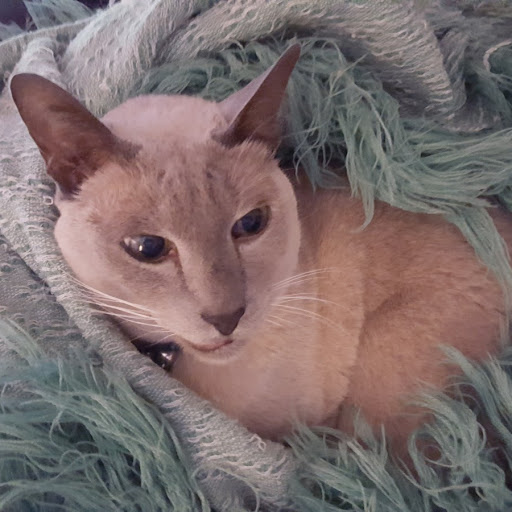
This is Chester.  He’s finally got a starring role in one of my stories.

The thing is, I tried to keep it quiet so he wouldn’t get delusions, but it failed.

I made the mistake of leaving the page with the ‘cat’ part on the screen.  The screen saver should have kicked in, but I think a well-placed paw brought it back to life.

So, the next morning, I come down and see him sitting on the desk, waiting.

It can either be good news or bad news.

“I see you’ve finally written a cat into the plot.”

“It was only a matter of time.  I think you made your case a week ago by sitting on the keyboard until I agreed.  Now, you’re in.”

“Yes.  I see.  Who’s idea was it to call the cat Herman?  I mean to say, really, Herman?”

“I thought it was a great name for a cat.”

“What type of cat is it?”

“I don’t know.  A cat’s a cat isn’t it?”

“Why not a Tonkinese, like me?”

“Alright, I’ll change it.”

“You made him jumpy, skittish even.  I’m not like that.”

“It’s not you in the story.”

“So you’ve found another cat, who is it.  It won’t last long when I get to them.”

Maybe it’s easier to write him out of the story.  I don’t think I can take this criticism.


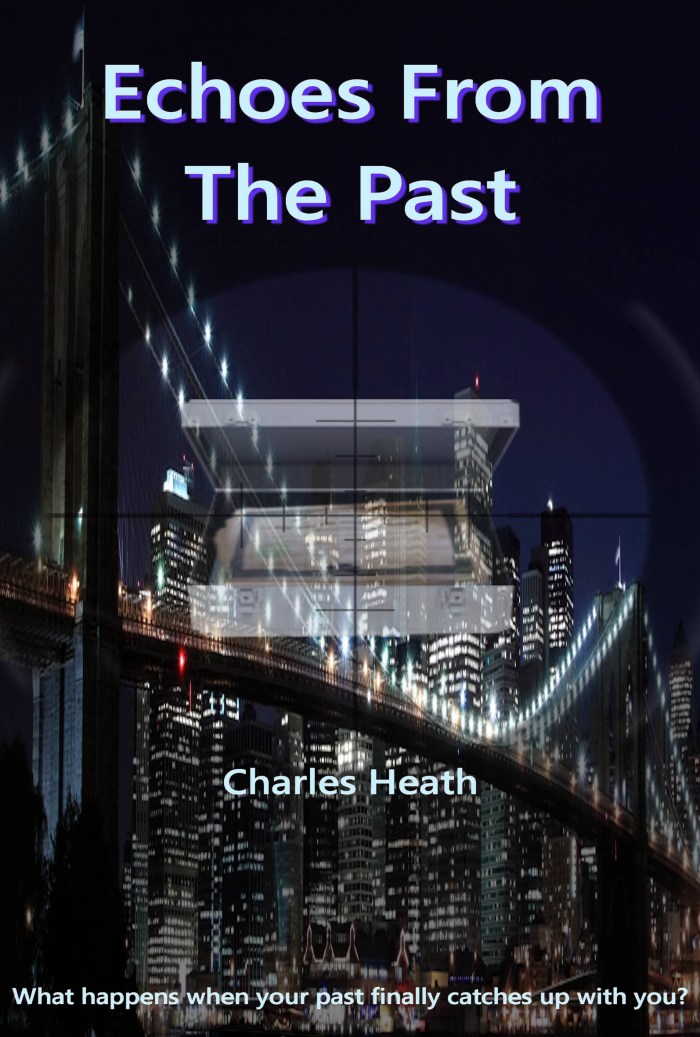
The story behind the story – Echoes from the Past

The novel ‘Echoes from the past’ started out as a short story I wrote about 30 years ago, titled ‘The birthday’.

My idea was to take a normal person out of their comfort zone and led on a short but very frightening journey to a place where a surprise birthday party had been arranged.

Thus the very large man with a scar and a red tie was created.

So was the friend with the limousine who worked as a pilot.

So were the two women, Wendy and Angelina, who were Flight Attendants that the pilot friend asked to join the conspiracy.

I was going to rework the short story, then about ten pages long, into something a little more.

And like all re-writes, especially those I have anything to do with, it turned into a novel.

There was motivation.  I had told some colleagues at the place where I worked at the time that I liked writing, and they wanted a sample.  I was going to give them the re-worked short story.  Instead, I gave them ‘Echoes from the past’

Originally it was not set anywhere in particular.

But when considering a location, I had, at the time, recently been to New York in December, and visited Brooklyn and Queens, as well as a lot of New York itself.  We were there for New Years, and it was an experience I’ll never forget.

One evening we were out late, and finished up in Brooklyn Heights, near the waterfront, and there was rain and snow, it was cold and wet, and there were apartment buildings shimmering in the street light, and I thought, this is the place where my main character will live.

It had a very spooky atmosphere, the sort where ghosts would not be unexpected.  I felt more than one shiver go up and down my spine in the few minutes I was there.

I had taken notes, as I always do, of everywhere we went so I had a ready supply of locations I could use, changing the names in some cases.

Fifth Avenue near the Rockefeller center is amazing at first light, and late at night with the Seasonal decorations and lights.

The original main character was a shy and man of few friends, hence not expecting the surprise party.  I enhanced that shyness into purposely lonely because of an issue from his past that leaves him always looking over his shoulder and ready to move on at the slightest hint of trouble.  No friends, no relationships, just a very low profile.

Then I thought, what if he breaks the cardinal rule, and begins a relationship?

But it is also as much an exploration of a damaged soul, as it is the search for a normal life, without having any idea what normal was, and how the understanding of one person can sometimes make all the difference in what we may think or feel.

And, of course, I wanted a happy ending.

Except for the bad guys.


Get it here:  https://amzn.to/2CYKxu4

newechocover5rs


In a word: Yellow

It was an easy choice from the start, yellow is a colour, in any number of shades from very pale to very dark.

We have yellow egg yolks, yet another y word, and depending on whether the eggs are farmed in cages or free range can dictate the shade of yellow.  Free-range gives the brightest yellow, by the way.

We have yellow cabs, but oddly enough these cabs are orange, not yellow as in this country, though the same may not be the case overseas, particularly in New York.  Good thing they are bright yellow so you can see them coming if you are crossing the road, perhaps illegally.

We have yellow bananas and lemons, probably the most common answers when asked, what is yellow?  That, and perhaps the yellow rose of Texas.

Then there is a more sinister meaning of the word, and it is associated with cowardice, and cowards are said to have a yellow streak down their backs.

If you have yellow fever then you are in a whole world of pain.

You can sometimes have what appears to be yellow skin, a sign of jaundice.

There is a yellow sea, and then there are the yellow pages, sometimes a substitute name for a telephone directory of businesses.

And lastly, an expression that comes out of the past, and not used so much these days, but people from Asia were thought to have yellow skin.