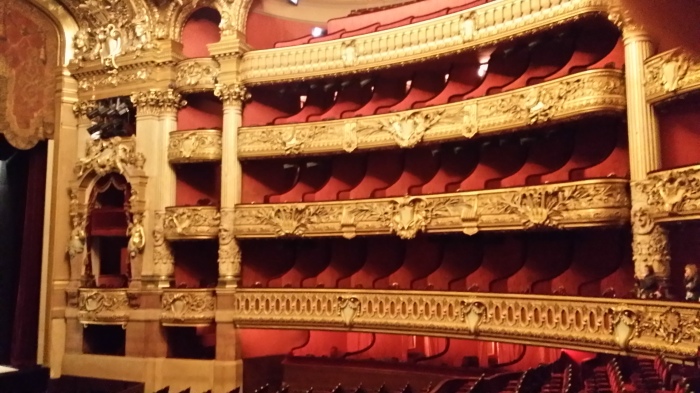
Searching for locations: The Paris Opera House, Paris, France

This was one of the more interesting experiences for the grandchildren as they were, as all young girls are, interested in ballet.

We thoroughly enjoyed our visit which included some time watching ballet practice.

I could not convince anyone to take the elevator back down to the ground floor as it was suspected we might be ‘attacked’ by the ‘phantom’.  Certainly, the elevator was very old and I think at the time it was being repaired.

20140108_124100

Part of the Grand Staircase in Palais Garnier Opera de Paris

20140108_125843

The ceiling above the main staircase.  The ceiling above the staircase was painted by Isidore Pils to depict The Triumph of Apollo, The Enchantment of Music Deploying its Charms, Minerva Fighting Brutality Watched by the Gods of Olympus, and The City of Paris Receiving the Plan of the New Opéra.

20140108_123338

The ceiling of Chagall at the Palais Garnier

On 23 September 1964, the new ceiling of the Opéra Garnier was inaugurated with great pomp.  It was painted by Marc Chagall at the request of André Malraux

20140108_125807

Amphitheatre and Orchestra Pit entrance

20140108_122243

Interior, and doorways to boxes

20140108_123500

Box seats in the auditorium

20140108_123512

Ornate ceilings and columns

20140108_123332

Seating inside the auditorium

20140108_125603

The day we were leaving Paris, was the first night of the Bolshoi Ballet.  My two granddaughters were greatly disappointed at missing out on the opportunity of a lifetime, to see the Bolshoi Ballet at the Paris Opera House.

20140108_123359

But we did get to see the principals practicing.

*** On special – $0.99 – On Special ***

Two novels are on special for $0.99 for the next few weeks.

They are

newechocover5rs

for “Echoes from the Past” go to

https://amzn.to/2CYKxu4

newdevilcvr3

for “The Devil You Don’t” go to

https://amzn.to/2Xyh1ow

Past conversations with my cat – 87

20160903_163858

This is Chester.  He was looking very benign before he left.

Now I can’t find him.

Anywhere.

He’s in none of the usual hiding spots.

He’s not hiding under any of the beds.

He’s not hiding in any of the cupboards.

I’m worried.


He’s planning something.  It might be my demise.  I’m still trying to figure out what he could gain from my death.  Not having to listen to me reading chapters of my books?

That, to him, might be a blessing.

I found a magazine on the floor open at an article entitled, ‘Ways to check if your spouse is trying to kill you’.

It’s got me doubly worried now.

I saw him on the kitchen bench near my coffee cup.

How hard could it be for him to dip his paw into some poison or other and then put it in my coffee cup?

That expressionless expression gives him away.

It’s what he’s not saying that’s telling me everything.

Behind that bland face, there’s the heart of a plotter, plotting something bigger than blowing up parliament by Guy Faulks.

I’m going to keep a very close eye on him.  Very, very close.

When I find where he’s hiding.

“One Last Look”, nothing is what it seems

A single event can have enormous consequences.

A single event driven by fate, after Ben told his wife Charlotte he would be late home one night, he left early, and by chance discovers his wife having dinner in their favourite restaurant with another man.

A single event where it could be said Ben was in the wrong place at the wrong time.

Who was this man? Why was she having dinner with him?

A simple truth to explain the single event was all Ben required. Instead, Charlotte told him a lie.

A single event that forces Ben to question everything he thought he knew about his wife, and the people who are around her.

After a near-death experience and forced retirement into a world he is unfamiliar with, Ben finds himself once again drawn back into that life of lies, violence, and intrigue.

From London to a small village in Tuscany, little by little Ben discovers who the woman he married is, and the real reason why fate had brought them together.

It is available on Amazon here:  http://amzn.to/2CqUBcz

Writing about writing a book – Day 21

I’m back to writing Bill’s backstory, and how he got mixed up in the war, and a few other details which will play out later on.

This will be some of it, in his own words:


I think I volunteered for active duty in Vietnam.

It was either that, or I had been volunteered by my prospective father in law.  I was serving under his command in an Army Camp for some time, and unbeknownst to me for a time, I had been dating his daughter.

The daughter of a General.  It was like that old adage, ‘marrying the bosses daughter’.  Only this boss was the bastard of all bastards.  When he found out, my life became hell.  He told me, as a Corporal, I was far beneath his expectations of the right man for his daughter.  He thought she would be better off with a Colonel.

Then I got my orders.  I was to join the latest batch of nashos on their way to the latest theatre of war.  But before that, Ellen, a woman with a mind of her own, and sometimes daring enough to defy her father, said we should get married, and I being the young fool I did, in a registry office, the day before I left for the war.

I promised to be faithful, as all newly married men did, and that I would come back to her.  We had all heard the stories coming out of South East Asia, where the war was not going so well, for us, or the Americans, and that this was a last-ditch effort.

When we landed, we were greeted by the men leaving.  They were glad to be going home.  And some of the stories, I chose not to believe them.  Nothing could be as bad as they painted it.

Could it?


I’d been trained for war.  I could handle a weapon, several actually, and or I could if I had to kill the enemy.  After all, it was my job.  I was defending Queen and country.

I was a regular soldier, not a nasho.  Not one of the mostly terrified boys who’d hardly reached anything approaching manhood, some all gung-ho, others frightened out of their minds.  As a regular soldier, this was where I was supposed to be.

But being sent to a war to fight, and having to fight, I soon discovered were two very different things.  On the training ground, even training with live ammunition, being shot at, mortared, and chased through the jungles of North Queensland, it was not the same, on the ground in Saigon.

It was relentlessly hot, steamy, raining, and fine.  Or dry and dusty.  But in any of the conditions, it was uncomfortable being hot all the time.  During the day, and during the night.

Then we were sent out to join various units.  Mine was north, where, I wasn’t quite sure, where the motley remains of the group were bolstered by us, new people.  Morale was not good, as we arrived in the torrential rain in an air transport that had seen better days, and notable for two events, the fact we were shot at several times and taking out the first casualty before we arrived, and the near-crash landing when we did.

I soon learned the value of the statement, ‘any landing you walk away from is a good one’.


Yes, seems like a good start to a bad end.  More on this tomorrow while I’m in the mood.


© Charles Heath 2016-2020

An excerpt from “Strangers We’ve Become” – Coming Soon

I wandered back to my villa.

It was in darkness.  I was sure I had left several lights on, especially over the door so I could see to unlock it.

I looked up and saw the globe was broken.

Instant alert.

I went to the first hiding spot for the gun, and it wasn’t there.  I went to the backup and it wasn’t there either.  Someone had found my carefully hidden stash of weapons and removed them.

Who?

There were four hiding spots and all were empty.  Someone had removed the weapons.  That could only mean one possibility.

I had a visitor, not necessarily here for a social call.

But, of course, being the well-trained agent I’d once been and not one to be caught unawares, I crossed over to my neighbor and relieved him of a weapon that, if found, would require a lot of explaining.

Suitably armed, it was time to return the surprise.

There were three entrances to the villa, the front door, the back door, and a rather strange escape hatch.  One of the more interesting attractions of the villa I’d rented was its heritage.  It was built in the late 1700s, by a man who was, by all accounts, a thief.  It had a hidden underground room which had been in the past a vault but was now a wine cellar, and it had an escape hatch by which the man could come and go undetected, particularly if there was a mob outside the door baying for his blood.

It now gave me the means to enter the villa without my visitors being alerted, unless, of course, they were near the vicinity of the doorway inside the villa, but that possibility was unlikely.  It was not where anyone could anticipate or expect a doorway to be.

The secret entrance was at the rear of the villa behind a large copse, two camouflaged wooden doors built into the ground.  I move aside some of the branches that covered them and lifted one side.  After I’d discovered the doors and rusty hinges, I’d oiled and cleaned them, and cleared the passageway of cobwebs and fallen rocks.  It had a mildew smell, but nothing would get rid of that.  I’d left torches at either end so I could see.

I closed the door after me, and went quietly down the steps, enveloped in darkness till I switched on the torch.  I traversed the short passage which turned ninety degrees about halfway to the door at the other end.  I carried the key to this door on the keyring, found it and opened the door.  It too had been oiled and swung open soundlessly.

I stepped in the darkness and closed the door.

I was on the lower level under the kitchen, now the wine cellar, the ‘door’ doubling as a set of shelves which had very little on them, less to fall and alert anyone in the villa.

Silence, an eerie silence.

I took the steps up to the kitchen, stopping when my head was level with the floor, checking to see if anyone was waiting.  There wasn’t.  It seemed to me to be an unlikely spot for an ambush.

I’d already considered the possibility of someone coming after me, especially because it had been Bespalov I’d killed, and I was sure he had friends, all equally as mad as he was.  Equally, I’d also considered it nigh on impossible for anyone to find out it was me who killed him because the only people who knew that were Prendergast, Alisha, a few others in the Department, and Susan.

That raised the question of who told them where I was.

If I was the man I used to be, my first suspect would be Susan.  The departure this morning, and now this was too coincidental.  But I was not that man.

Or was I?

I reached the start of the passageway that led from the kitchen to the front door and peered into the semi-darkness.  My eyes had got used to the dark, and it was no longer an inky void.  Fragments of light leaked in around the door from outside and through the edge of the window curtains where they didn’t fit properly.  A bone of contention upstairs in the morning, when first light shone and invariably woke me up hours before I wanted to.

Still nothing.

I took a moment to consider how I would approach the visitor’s job.  I would get a plan of the villa in my head, all entrances, where a target could be led to or attacked where there would be no escape.

Coming in the front door.  If I was not expecting anything, I’d just open the door and walk-in.  One shot would be all that was required.

Contract complete.

I sidled quietly up the passage staying close to the wall, edging closer to the front door.  There was an alcove where the shooter could be waiting.  It was an ideal spot to wait.

Crunch.

I stepped on some nutshells.

Not my nutshells.

I felt it before I heard it.  The bullet with my name on it.

And how the shooter missed, from point-blank range, and hit me in the arm, I had no idea.  I fired off two shots before a second shot from the shooter went wide and hit the door with a loud thwack.

I saw a red dot wavering as it honed in on me and I fell to the floor, stretching out, looking up where the origin of the light was coming and pulled the trigger three times, evenly spaced, and a second later I heard the sound of a body falling down the stairs and stopping at the bottom, not very far from me.

Two assassins.

I’d not expected that.

The assassin by the door was dead, a lucky shot on my part.  The second was still breathing.

I checked the body for any weapons and found a second gun and two knives.  Armed to the teeth!

I pulled off the balaclava; a man, early thirties, definitely Italian.  I was expecting a Russian.

I slapped his face, waking him up.  Blood was leaking from several slashes on his face when his head had hit the stairs on the way down.  The awkward angle of his arms and legs told me there were broken bones, probably a lot worse internally.  He was not long for this earth.

“Who employed you?”

He looked at me with dead eyes, a pursed mouth, perhaps a smile.  “Not today my friend.  You have made a very bad enemy.”  He coughed and blood poured out of his mouth.  “There will be more …”

Friends of Bespalov, no doubt.

I would have to leave.  Two unexplainable bodies, I’d have a hard time explaining my way out of this mess.  I dragged the two bodies into the lounge, clearing the passageway just in case someone had heard anything.

Just in case anyone was outside at the time, I sat in the dark, at the foot of the stairs, and tried to breathe normally.  I was trying not to connect dots that led back to Susan, but the coincidence was worrying me.


A half-hour passed and I hadn’t moved.  Deep in thought, I’d forgotten about being shot, unaware that blood was running down my arm and dripping onto the floor.

Until I heard a knock on my front door.

Two thoughts, it was either the police, alerted by the neighbors, or it was the second wave, though why would they be knocking on the door?

I stood, and immediately felt a stabbing pain in my arm.  I took out a handkerchief and turned it into a makeshift tourniquet, then wrapped a kitchen towel around the wound.

If it was the police, this was going to be a difficult situation.  Holding the gun behind my back, I opened the door a fraction and looked out.

No police, just Maria.  I hoped she was not part of the next ‘wave’.

“You left your phone behind on the table.  I thought you might be looking for it.”  She held it out in front of her.

When I didn’t open the door any further, she looked at me quizzically, and then asked, “Is anything wrong?”

I was going to thank her for returning the phone, but I heard her breathe in sharply, and add, breathlessly, “You’re bleeding.”

I looked at my arm and realized it was visible through the door, and not only that, the towel was soaked in blood.

“You need to go away now.”

Should I tell her the truth?  It was probably too late, and if she was any sort of law-abiding citizen she would go straight to the police.

She showed no signs of leaving, just an unnerving curiosity.  “What happened?”

I ran through several explanations, but none seemed plausible.  I went with the truth.  “My past caught up with me.”

“You need someone to fix that before you pass out from blood loss.  It doesn’t look good.”

“I can fix it.  You need to leave.  It is not safe to be here with me.”

The pain in my arm was not getting any better, and the blood was starting to run down my arm again as the tourniquet loosened.  She was right, I needed it fixed sooner rather than later.

I opened the door and let her in.  It was a mistake, a huge mistake, and I would have to deal with the consequences.  Once inside, she turned on the light and saw the pool of blood just inside the door and the trail leading to the lounge.  She followed the trail and turned into the lounge, turned on the light, and no doubt saw the two dead men.

I expected her to scream.  She didn’t.

She gave me a good hard look, perhaps trying to see if I was dangerous.  Killing people wasn’t something you looked the other way about.  She would have to go to the police.

“What happened here?”

“I came home from the cafe and two men were waiting for me.  I used to work for the Government, but no longer.  I suspect these men were here to repay a debt.  I was lucky.”

“Not so much, looking at your arm.”

She came closer and inspected it.

“Sit down.”

She found another towel and wrapped it around the wound, retightening the tourniquet to stem the bleeding.

“Do you have medical supplies?”

I nodded.  “Upstairs.”  I had a medical kit, and on the road, I usually made my own running repairs.  Another old habit I hadn’t quite shaken off yet.

She went upstairs, rummaged, and then came back.  I wondered briefly what she would think of the unmade bed though I was not sure why it might interest her.

She helped me remove my shirt, and then cleaned the wound.  Fortunately, she didn’t have to remove a bullet.  It was a clean wound but it would require stitches.

When she’d finished she said, “Your friend said one day this might happen.”

No prizes for guessing who that friend was, and it didn’t please me that she had involved Maria.

“Alisha?”

“She didn’t tell me her name, but I think she cares a lot about you.  She said trouble has a way of finding you, gave me a phone and said to call her if something like this happened.”

“That was wrong of her to do that.”

“Perhaps, perhaps not.  Will you call her?”

“Yes.  I can’t stay here now.  You should go now.  Hopefully, by the time I leave in the morning, no one will ever know what happened here, especially you.”

She smiled.  “As you say, I was never here.”


© Charles Heath 2018-2020

The story behind the story: A Case of Working With the Jones Brothers

To write a private detective serial has always been one of the items at the top of my to-do list, though trying to write novels and a serial, as well as a blog, and maintain a social media presence, well, you get the idea.

But I made it happen, from a bunch of episodes I wrote a long, long time ago, used these to start it, and then continue on, then as now, never having much of an idea where it was going to end up, or how long it would take to tell the story.

That, I think is the joy of ad hoc writing, even you, as the author, have as much idea of where it’s going as the reader does.

It’s basically been in the mill since 1990, and although I finished it last year, it looks like the beginning to end will have taken exactly 30 years.  Had you asked me 30 years ago if I’d ever get it finished, the answer would be maybe?


My private detective, Harry Walthenson

I’d like to say he’s from that great literary mold of Sam Spade, or Mickey Spillane, or Phillip Marlow, but he’s not.

But, I’ve watched Humphrey Bogart play Sam Spade with much interest, and modeled Harry and his office on it.  Similarly, I’ve watched Robert Micham play Phillip Marlow with great panache, if not detachment, and added a bit of him to the mix.

Other characters come into play, and all of them, no matter what period they’re from, always seem larger than life.  I’m not above stealing a little of Mary Astor, Peter Lorre or Sidney Greenstreet, to breathe life into beguiling women and dangerous men alike.


Then there’s the title, like

The Case of the Unintentional Mummy – this has so many meanings in so many contexts, though I image back in Hollywood in the ’30s and ’40s, this would be excellent fodder for Abbott and Costello

The Case of the Three-Legged Dog – Yes, I suspect there may be a few real-life dogs with three legs, but this plot would involve something more sinister.  And if made out of plaster, yes, they’re always something else inside.

But for mine, to begin with, it was “The Case of the …”, because I had no idea what the case was going to be about, well, I did, but not specifically.

Then I liked the idea of calling it “The Case of the Brother’s Revenge” because I began to have a notion there was a brother no one knew about, but that’s stuff for other stories, not mine, so then went the way of the others.


Now it’s called ‘A Case of Working With the Jones Brothers’, finished the first three drafts, and at the editor for the last.

I have high hopes of publishing it in May 2020.  It even has a cover.


PIWalthJones1

Grasping at straws or a pie in the sky?

This is to be willing to do, say, or believe anything that offers even the slightest hope in a desperate situation, even though there is almost no chance for success.

Sound familiar?

We all have a preferred position in any debate, sometimes a pre-conceived notion that we are right and the rest of the world is wrong.

And, just to prove it we will grasp at any straw, no matter how wrong it might be, how big a lie it might be, simply because it fits our narrative.

Politicians are good at it.

Salespeople are too, and they will tell you anything to make a sale.

Seems politicians are little more than salespeople.  Especially when you hold up a foot-thick pile of paper and call it a policy.  Of course, it is.  Look at all this paper!  And you can find it on the internet.

I’ve found incontrovertible truth that aliens have landed on earth many times, and walk amongst us, on the internet too.

Add to the straws the notion that if you throw enough mud some it will stick.

Likewise, if you say the same thing over and over, no matter how wrong it is, people will begin to believe it.

You read it, and see it, and read it again, ten, twenty times a day, over and over until you have been brainwashed.

Nobody repeats the truth, have you noticed that?

The truth usually appears at the bottom of page 17 of a newspaper, buried by the Ford, Ram Truck, and Coca Cola advertisements.

But the lies, the narrative that you are supposed to hear, it comes at you from every angle, papers, magazines, all over the internet, cable channels, everywhere.  It will be on roadside billboards soon.

The CIA and the KGB came up with that little idea.  It’s called brainwashing.

It’s made to sound authentic, that it’s come from ‘experts’, people allegedly with degrees in everything but UFO technology, and because it sounds authoritative, we believe it.

Especially after we’ve been told hundreds of times.

A case in point, I can tell you almost word for word some of the most obnoxious advertisements on television going back 50 years, yes, 50 years, because we were inundated with them, day and night, all the time, for years.

Of course, with fake news and political lies continually being spoken, printed, and hurled at us ad infinitum, no one really knows what the truth is anymore.  I tried looking at the bottom of page 17 for it, but it’s not there.

Like I said, no one is willing to tell the truth more than once.

So, whilst being told by one side that I’m in a vulnerable group and COVID 19 will kill me if I get it, the other side is telling me there’s no such thing as COVID 19 and it’s just an elaborate hoax.

Whoever created this elaborate hoax has done a good job, though, managing to enlist 218 countries worldwide, all their medical authorities, and all of the governments.  That’s some incredible effort.

So, my two cents worth, if every country in the world can partake in a hoax, why can’t they band together in world peace, free trade, and no wars.

Is it a pie in the sky moment?

Or just a little bit idealistic?


“Sunday in New York”, it’s a bumpy road to love

“Sunday in New York” is ultimately a story about trust, and what happens when a marriage is stretched to its limits.

When Harry Steele attends a lunch with his manager, Barclay, to discuss a promotion that any junior executive would accept in a heartbeat, it is the fact his wife, Alison, who previously professed her reservations about Barclay, also agreed to attend, that casts a small element of doubt in his mind.

From that moment, his life, in the company, in deciding what to do, his marriage, his very life, spirals out of control.

There is no one big factor that can prove Harry’s worst fears, that his marriage is over, just a number of small, interconnecting events, when piled on top of each other, points to a cataclysmic end to everything he had believed in.

Trust is lost firstly in his best friend and mentor, Andy, who only hints of impending disaster, Sasha, a woman whom he saved, and who appears to have motives of her own, and then in his wife, Alison, as he discovered piece by piece damning evidence she is about to leave him for another man.

Can we trust what we see with our eyes or trust what we hear?

Haven’t we all jumped to conclusions at least once in our lives?

Can Alison, a woman whose self-belief and confidence is about to be put to the ultimate test, find a way of proving their relationship is as strong as it has ever been?

As they say in the classics, read on!

Purchase:

http://tinyurl.com/Amazon-SundayInNewYork

Writing about writing a book – Day 20

It is a day of rest although writers are ready and able to work on any given day at any hour of the day or night when an idea or thought comes to them.

I’m trying not to think, but that’s not working.

I’ve been going over the reasons for writing the first draft of the book 30 odd years ago and it had something to do with the fact I was working with personal computers and local area networking when both were in their infancy, and I wanted to blend this knowledge into a story.

Of course, I’d always wanted to write thrillers, and this presented the opportunity to use computers as a basis for a worldwide conspiracy.  How easy it is these days to do just that, but back in those days, it was a lot of hard work.

I remember sitting in a meeting when the company I was working for at the time had just implemented a network and personal computer to replace the mainframe and dumb terminals, also looking to leverage the new technologies of spreadsheets and word-processing, effectively making accounts staff more productive, and removing typists and moving into the world of centralized word processing.  It was not a new idea with Wangwriter, but using PC’s was.

One of the departmental managers got up to give his take on the new technology, this about six months after implementation, and after a lot of teething troubles caused mainly by people who were vehemently resisting change, and his message was, it should not be called ‘networking’, but ‘not working’, in reference to the number of times the network went down.

But this is a digression.  Computers are only a part of the story.

The story also goes back to a time when there was a clear demarcation between the management levels.  Management offices were oasis’s whereas the staff worked in a stark desert-like environment.  When one came to work for such an organization, it was with the belief that you start at the bottom, and over time, you work your way up the ladder.  There was, very definitely, class distinction, and the various management levels never mixed, at work or socially, except within their own level.

There were Managers, Assistant Managers, and Manager’s Assistants, a typing pool, a secretary, that young, or old, lady who did so many jobs for their boss, that these days it would be considered demeaning.  They were dedicated to their jobs and irreplaceable.  There was no such person as a Personal Assistant.

Nor was such a thing as sexual harassment.  One company I worked in where one of the Assistant Managers was sexually abusing an office girl, her complaints didn’t get a prosecution as it would now, it just had him transferred to another branch.  Reprehensible, yes, and thankfully no longer a problem, except of course, in Fifty Shades of Grey which apparently condones such behavior.

There were department heads, General Managers, and Board Members.  The upper management level and participants were in a world of their own, one few could ever aspire to.  This is the world in which Transworld, my fictitious (but based on a very real) company lives.

I have to work on my company structure to make sure it is right.

Now I have two charts.  A timeline, for both Bill, and the story, and a hierarchy for the office management and staff.

This is beginning to be more complicated than I thought.


© Charles Heath 2016-2020