Writing can be, should be, ok, why can’t it be a breeze?

It’s Friday again.

Or on this side of the world, it’s actually Saturday morning.

Very, very early in fact.

Very cool too, which is strange for a city near the tropics in early spring.  Also, it’s raining for the first time in a month or so, and we really need the rain.

I survived another week, still working on priorities, and the fact I’m juggling too many stories at once.  You’d think it was easy by now, finding something that resembles a routine.

First, stick to one story at a time, then

Outline the story, write the chapters, bundle it all up and let it stew in the back of your mind for a few months.

In that time, write the blog, work on the 3,4,5, or is it 6 stories being written as episodes.  I wanted to get a feel for what it was like for Charles Dickens all those years ago, writing stories in parts.

Then, after doing that and clearing the mind,

Come back and do the first edit, find all the grammatical errors, fix holes in the plot, make sure the subplots don’t take over, or minor characters steal the limelight.

It’s where a character mysteriously changed name, went from being a son to a nephew, or an aunt was an aunt from the wrong side of the family.  A car that was red is suddenly blue, a man who smokes cigars now hates them, and the Mercedes changed model five times, about the same times as the age of the mother in the story.

Who said art imitates life?

Or was it that I was missing character motivation.  The main character was drifting, much like I am, and I realized there was a little of my circumstances coming across to the story.  Time to push those thoughts to the curb, and fill him with someone else’s ego.

So they’re fixed.  Now it’s the time to cut, slash, and burn.

Back to the blog and episodic stories for another month or so, just to let those new changes swill around.

Piece of cake.

I’ve got this writing thing down!

What story was I working on again????

Being Inspired – the book

Over the past year or so I have been selecting photographs I’ve taken on many travels, and put a story to them.

When I reached a milestone of 50 stories, I decided to make them into a book, and, in doing so, I have gone through each and revised them, making some longer and into short stories.

50 photographs, 50 stories.  I’ve called it, “Inspiration, Maybe”

It will be available soon.

InspirationMaybe1v1

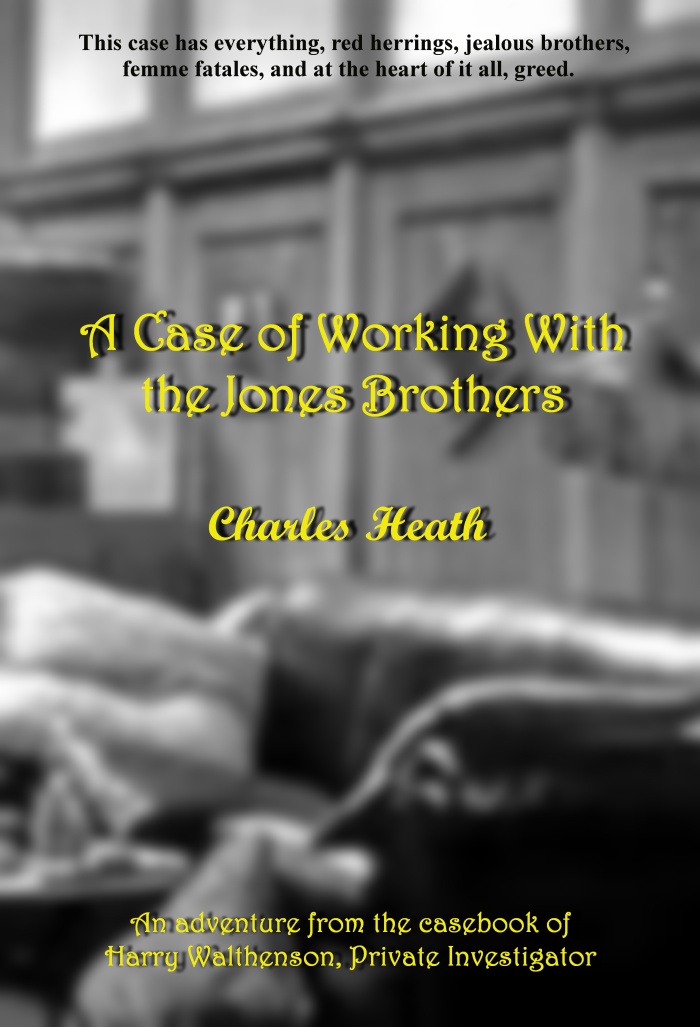
The first case of PI Walthenson – “A Case of Working With the Jones Brothers”

This case has everything, red herrings, jealous brothers, femme fatales, and at the heart of it all, greed.

Coming soon!

PIWalthJones1

Short Story writing: don’t try this at home!

This is not a treatise on how to write short stories.  Everyone has one in them, possibly more, and me, well, it’s how I keep the wolves from the door.

Yes, I read my stories to them and they fall asleep.

Or maybe not, I’m never quite sure what effect anything I write has on anyone.  And, reading a lot of the posts on how to handle bad reviews and rejection, such a recurrent theme, I don’t think I want to.

Ignorance is bliss, is it not?

Well, one day I’m sure something will happen.  It’s probably in the seven stages of writing:


Euphoria

Planning

Research

Writing

Failure

Search for the guilty

Distinction for the uninvolved


I guess you don’t fail if you don’t put it out there.  Searching for the guilty, well, there’s only one person to blame, the editor, and distinction for the uninvolved, didn’t your friend, relation, confidente, significant other, say it wasn’t going to work?

But, despite everything, I like writing short stories and try to produce one in a single sitting.  I try to keep the word count down, but the stories, somehow they just evolve in my head and don’t want to end the main character’s story.

In reality, there is no end to the story unless they die, and then, of course, the story branches off, just like a family tree,

Some stories are so intricate, they need another story to fill in the gaps, and then another because the plot is running through your head at a thousand miles an hour and your fingers won’t stop typing, because if you do, it will all dissipate into thin air like smoke.

Stories can, you know, dissipate like smoke, one minute your mining a rich vein the next, you’ve hit a ton of worthless quartz.

Then all the constraints come into play, nagging at the back of your mind, and you find yourself waking up in a bath of sweat crying out, I didn’t do it, the crime that is, not lose the best 2,000 words you’ve ever written.

But that’s all of those words you write, isn’t it?

But I digress, and I’ll write some more on the subject, what was it again?


Sending a final draft to the editor, isn’t quite the end, is it?

Can you actually say you know the exact moment a story is done, finished, and that’s it?

For me, the end never quite seems to be the end, that point where you finally draw a line in the sand and say, that’s it, I’m done, step away from the typewriter.

But are we ever satisfied the story is done, can we not make one more change, it’s just a little tweak, it won’t take long.

Please!

My editor tolerated three ‘minor’ changes.

Firstly, a change of name for a character

Secondly, consistency of word use, such as times and contractions

Thirdly, I wasn’t happy with the overall story, and it needed some more action.  More writing, more editing, more prevaricating.

It took three weeks to sort out all of those issues, and last night I send the final draft to the Editor.

It’s like watching your child go to school on their first day.  Not knowing what will happen but expecting everything will be fine.

But, knowing me, I’ll probably react to a suggestion, and it will create more words rather than less, or some slight dissatisfaction.

I’m not a perfectionist, far from it, but it is hard to finally let go.

Now the draft is gone, it’s time to work on the second book in the series, which had been over half done.  I need to sit down, read, fix, read more, add or subtract as the case may be, and then continue writing.

I think I’m getting the hang of it.

Until I go to bed trying to sleep and thinking of everything that might need fixing.

Damn.

“The Things We Do For Love” – Coming soon

Is love the metaphorical equivalent to ‘walking the plank’; a dive into uncharted waters?

For Henry the only romance he was interested in was a life at sea, and when away from it, he strived to find sanctuary from his family and perhaps life itself.  It takes him to a small village by the sea, s place he never expected to find another just like him, Michelle, whom he soon discovers is as mysterious as she is beautiful.

Henry had long since given up the notion of finding romance, and Michelle couldn’t get involved for reasons she could never explain, but in the end both acknowledge that something happened the moment they first met.  

Plans were made, plans were revised, and hopes were shattered.

A chance encounter causes Michelle’s past to catch up with her, and whatever hope she had of having a normal life with Henry, or anyone else, is gone.  To keep him alive she has to destroy her blossoming relationship, an act that breaks her heart and shatters his.

But can love conquer all?

It takes a few words of encouragement from an unlikely source to send Henry and his friend Radly on an odyssey into the darkest corners of the red light district in a race against time to find and rescue the woman he finally realizes is the love of his life.

The cover, at the moment, looks like this:

lovecoverfinal1

Being Inspired – the book

Over the past year or so I have been selecting photographs I’ve taken on many travels, and put a story to them.

When I reached a milestone of 50 stories, I decided to make them into a book, and, in doing so, I have gone through each and revised them, making some longer and into short stories.

50 photographs, 50 stories.  I’ve called it, “Inspiration, Maybe”

It will be available soon.

InspirationMaybe1v1

Was it just another surveillance job – Episode 18 – Revised

As we all know, writing by the seat of your pants is almost the same as flying by the seat of your pants, a hazardous occupation.

As it happens, I like writing this way because like the reader, I don’t know what to expect next.

And equally, at times, you can write your self into a corner, much like painting, and then have to go back, make a few changes and//or repairs and then move forward.

It’s part of the writing process, only in this case, the changes occur before you’ve finished the novel, if you finish.  Quite often a lot of writers get only so far, then the manuscript hits the bottom drawer, to be brought out on a distant rainy day.

Or your cat has mocked your writing ability one too many times.

Therefore, we’re winding back to Episode 16, and moving forward once again, from there.  This is episode 18 revised…


Ever had the heart-stopping feeling when you’re in the wrong place, and someone has interrupted you?  Especially if you shouldn’t be there, or that you have no right to be there.

I stood quietly on the inside of the door and hoped whoever the visitor was would go away.  No answer meant no one was home, didn’t it?

Unless…

I heard a key in the door, and it turn in the lock.

I moved quickly to the other side of the door so I would be shielded when the person came into the room.  Too late to get out, I was of two minds what to do.  Hit the visitor over the head and flee, or ask them what they were doing, before they asked me that same question.

Then nothing.

Until a few seconds later I heard a voice, a man, say, “Jan, you’re back.  How was the visit to Philadelphia?”

I heard the slight rattle of Jan taking her hand off the handle and moving away from the door.  “Sad, as all funerals are.  Now, we are left with the house, and my father’s stuff; a huge collection of mostly junk over a long period of time.  Seems he never threw anything out.”

Jan?  Did she live here, with O’Connell?

“Yes, “I’m a bit like that.”

Another tenant, or the building super?

“I made sure Herman was looked after while you were away.  I don’t think he missed you at all?”

She laughed.  “He’s a cat, Fred.  We belong to them, not the other way around.”

“True.  Your friend has not been in for a week or so.”

“I know.  The last message I got from him, he was in Prague, lucky bastard.  He was going to take me with him, but at the last moment, they changed his itinerary.  Perhaps next time.  I was just going to make sure everything was OK, before going home myself.”

“I could look in if you want?”

“No.  Thanks anyway, but last time I was here I left a jacket behind.  Thanks, Fred.”

A moment later I could hear his footsteps heading away, and Jan moved back to the door, and opened it.

I heard the light switch, and then, suddenly, the room was filled with bright light.

The girl was unassuming, stepped into the room, and closed the door behind her.  Before she could take a step, I put a hand over her mouth and an arm around her neck and started squeezing.

Instinctively she started to struggle and call out for help.

I whispered in her ear, “I mean you no harm, but if you struggle, or yell out, it could turn out very bad for you.”

We had been taught how to subdue people without killing them, but that always didn’t go to plan.  There was that instinct to fight back in everyone, and it was sometimes hard not to apply excessive pressure which could, depending on the severity of resistance, see the target asphyxiated, or end up with a broken neck.

She was still struggling, which mean I had to exert more force.

“Stop fighting me or you will harm yourself,” I said, this time in a more forceful whisper.

It had an immediate effect, but I don’t think it was her obedience that caused it.  I gently lowered her to the floor and felt for a pulse.  Unconscious, not dead.  I sighed in relief.  I took a good long look at her so that I would remember what she looked like.  At some point, I was going to have to talk to her.

Then footsteps outside the door.  What else could go wrong?

Then knocking on the door.  Short and sharp.  Followed by, “Jan, are you in there?”

Fred, whoever he was.  What did he want?”

Another knock on the door, this time more urgent.  Damn.  O’Connell’s flat was like a busy store.

I looked around for an escape now there would be no going out the front door.  Not unless I had to disable another person, and assuming if he was the building super, he would not be a small man, so it would take a greater, and noisier, effort to subdue him.

A fire escape, all buildings usually had one down the side of the building, in case of fire.  I went over and checked the windows and found it.  The window needed a little force to open it, but the sound of a key in the door motivated me.

Out the window, close the window again, I made it down the stairs far enough that when I looked up, no one was following me.

That was close.  Too close.


© Charles Heath 2019

Was it just another surveillance job – Episode 17 – Revised

As we all know, writing by the seat of your pants is almost the same as flying by the seat of your pants, a hazardous occupation.

As it happens, I like writing this way because like the reader, I don’t know what to expect next.

And equally, at times, you can write your self into a corner, much like painting, and then have to go back, make a few changes and//or repairs and then move forward.

It’s part of the writing process, only in this case, the changes occur before you’ve finished the novel, if you finish.  Quite often a lot of writers get only so far, then the manuscript hits the bottom drawer, to be brought out on a distant rainy day.

Or your cat has mocked your writing ability one too many times.

Therefore, we’re winding back to Episode 16, and moving forward once again, from there.


Why didn’t it surprise me that Nobbin was playing all ends against the middle if that was the expression?  What really bothered was that he wasn’t prepared to tell me the truth or trust me to help find the missing information.  But he had known I might become interested and do some investigating of my own.

Perhaps Nobbin feared Severin might track me down, as he had, and if I had found the USB, run the list of losing it to his foe.

Nor was it a surprise that someone else, namely Severin, was after the information, and he would have access to everything Nobbin did, and he was equally disadvantaged.  It was either Severin or one of his agents, that was caught in O’Connell’s flat and found ‘Josephine’ there.

I didn’t believe her name was Josephine, or that she lived in the flat next door.  And I didn’t think Severin had found anything going by the way the flat had been turned over, and the fact it looked like no one had lived there.

Having now dealt with both men, I was still on the fence about who was on the right side and who was on the wrong side, or whether they were both of questionable character.  What made it difficult to understand was how Severin could run an operation inside the organisation.  Surely someone knew about it, or from a high level, sanctioned it?

Knowing I would not be interrupted this time, I went back up to the third floor, and into O’Connell’s flat, a simple job since the front door was still unlocked.  The girl had assumed it was no value to them which told me she had already searched the place before being attacked.

Just in case anyone was likely to return, or there was another party interested in O’Connell, I locked the door from the inside.  At least no one had yet crashed through the door, smashing the lock and timber.

I stood in the middle of the main room, and did a slow 360-degree turn, looking at everything intently.  The thing with searches like this, it was more likely the object of any search was hidden in plain sight.  The usual places, such as the freezer, sections of fridges, stashed in bottles or packets in the pantry, under beds, inside mattresses, pillows, or under blankets, or with a form of glue on the inside of televisions or computers would prove fruitless.

We were taught to hide things such as USB sticks where they would be least expected to be found, such as a toy on a keyring, tossed in a bowl of pens, pins, clips, or other small insignificant items that all looked uninteresting.

My first thought was in the pocket of a coat in the closet, but all his clothes were strewn over the floor in the bedroom showing signs of being turned out.  Perhaps the searcher or searchers had thought like me.

There was no keyring in the kitchen or the bedroom, no was there any sort of stand inside the door, a place to put mail, and other items such as keys.  If there were any, they would have been on him when Severin had him killed.  I had not found, not felt, any in his pockets, not unusual for an agent in the field.  If you were captured or killed, you wanted nothing on you that could identify you or what you were doing.

Next I thought, a hidden compartment.  I was not going to predict he had a safe in the flat, but just in case, I did search thoroughly where one might be located.  The cheap watercolour on the wall hid nothing but some discoloured wallpaper.

I checked all the skirting boards, and inside walls of the robes, but there was nothing.  I also checked the robes thoroughly for false backs, or sides, or compartments hidden in the roof.  The floor was made from wood, so I checked to see if there were any loose boards, but in the end, considered that was a ruse used only in the movies and on television.

An hour later, I was no wiser as to where it could be, if at all, in the flat, but, looking around, it was certainly now a little more organised because in checking everything in case the previous searchers had missed anything, I’d put everything neatly in stacks.

And, no, there was nothing under the bed.  The previous searchers had thought of that too.

But, in one corner of the main room, there was a desk that had been completely turned out, papers were strewn everywhere.  There had been a computer, now missing, because there was a cable running from the printer, and a power cable in the wall, both running into thin air.

The papers yielded nothing of interest, other than he was researching a holiday to Russia and Poland. 

For two.

A break.  There was a significant other.  I made a more serious search of the papers that I’d gathered up off the floor and found a shred of a quickly torn up piece of paper, of which only this piece remained.  A name:  Jan, scribbled on it, with half another word ‘ord’.

Did this Jan also live in this block?  Did she work at the same place?  There were a hundred variations of that theme, but it was a start.  He might have trusted the USB to her safekeeping without telling her what it was, and it was possible she didn’t know he was dead.

I’d noticed that O’Connell’s death had been reported as a John Doe on the wrong end of an alleged mugging, the small dismissive paragraph on page seven reported the body was missing when police went to investigate a pool of blood in an alley, along with several other crimes of which police were seeking further information.  That alley hadn’t any CCTV cameras, so Severin knew he could easily shoot O’Connell without anyone knowing it was him.

There was nothing else of interest in the documents, other than the holiday, if it was a holiday, was to be in a month’s time.

My work was done.  I had a lead.  It was time to leave.

Except for one small problem.  Someone was knocking on the door.


© Charles Heath 2019

Was it just another surveillance job – Episode 16 – Revised

As we all know, writing by the seat of your pants is almost the same as flying by the seat of your pants, a hazardous occupation.

As it happens, I like writing this way because like the reader, I don’t know what to expect next.

And equally, at times, you can write your self into a corner, much like painting, and then have to go back, make a few changes and//or repairs and then move forward.

It’s part of the writing process, only in this case, the changes occur before you’ve finished the novel if you finish.  Quite often a lot of writers get only so far, then the manuscript hits the bottom drawer, to be brought out on a distant rainy day.

Or your cat has mocked your writing ability one too many times.

Therefore, we’re winding back to Episode 16, and moving forward once again, from there.


O’Connor seemed to be more affluent than I because he was living in a flat located in an upmarket building.  Getting into the ground floor required a passkey, one I suspect might also be needed to get in the front door of his flat, but I’d worry about that later.

My first problem was that front door, and it was not until a tradesman exited that I took the opportunity to appear to arrive at the same time, pretending to find my card, and brushing past him as he was exiting.  He ignored me, his hands full, being in a hurry.

It took a day and a half of watching the building, waiting for an opportunity.  His flat was on the third floor and although there was an elevator, I took the stairs, hoping that I wouldn’t run into anyone.

Quickly and quietly, and thankfully without seeing another resident, I came out into the passageway, and it was about ten steps to his front door.  Number 37.  Not far away, in one direction, the end of the passage, and numbers 38, 39, and 40.  In the other, four more flats and the end of the corridor.  Windows at either end, perhaps an escape route.  I would not use the elevator if I had to leave in a hurry.

There were two elevators and one staircase.  Both elevators were stationary on the ground floor.

I knocked lightly on the door to number 37.

No answer.

I knocked a little harder on the door.  It was quite solid, and I had to wonder if the knocking sound penetrated the solid wood.

I checked the lock.  Simple to open.  We’d been given instruction by a master locksmith, and I’d brought my tools.

I waited a minute, checked to see if the elevators were still on the ground floor, then picked the lock and was inside within a minute.

Silence.

I felt along the wall for a light switch, usually by the door, and found it, and flicked it on.  The sudden light was almost blinding, but then my eyes adjusted.

Trashed, much the same as my flat.

But, with a difference.

A woman was stretched out on the floor, unmoving.  I could see, from where I was standing, she had been hit on the back of the head and could see the wound, and a trickle of blood through her hair.

Five steps to reach her, I reached down to check for a pulse.

Yes, she was alive.

I shook her gently.  She didn’t react.  I shook her a little more roughly and she stirred, then, as expected, lashed out.

I caught her hands, saying, “I just found you.  I’m not your enemy.”

Of course, considering I was a stranger in what could be her flat without permission, I was not surprised she continued to struggle until I tried being reassuring.  Then she stopped and asked, “Who are you?”

“A friend of O’Connor.  I worked with him.  Something happened to him at work and he said if that happened, I was to come here.  He didn’t say anything about you, though.”

“I live here, in the flat next door.  I heard a noise and came to investigate.  That’s all I remember.”

I helped her up into a sitting position, and, holding her head in her hands, looked around.  “Did you do this?”

“No.  Just got here.  But it’s the same at my place.  The people who did this are looking for something.  By the look of it, they didn’t find it here either.”

“I’ll get a damp cloth for your head.  It doesn’t look serious but there might be a slight concussion that might need attention.”

She felt the back of her head, and, when she touched the wound, gasped, “It hurts though.”

I stood and went over to the kitchenette.  O’Connor was not much of a cook, the benches looked new, and there was nothing out.  I looked in a draw near the sink and found a cloth, still with the price tag on it.  So were several utensils in the drawer.  I ran it under the water, then went back to her, now off the floor and sitting on one of the two chairs.  I handed her the wet cloth and she put it against the injured part of her head.

I made a mental note, it didn’t look like O’Connor had been here long, if at all.  Something was not right here, and if that was the case, I should take care when saying anything to this woman.

“Who are you again?” she asked.

“I worked with him.  My name is irrelevant.  It’s unlikely that he mentioned me to you, or anyone.  It’s the nature of our work.”

“Why should I believe you?  You could be my attacker.”

“If that were the case, why would I still be here trying to be helpful.”

A good question that elicited a curious expression.

“What do you do, what did Oliver do?”

Alarm bells were going off.  Oliver was not O’Connor’s first name.

“Nothing very interesting, I can assure you, and definitely nothing that would warrant this happening.  If it had only been me, I would have not thought any more of it, but since we worked together, and this has also happened to him, it seems we are mixed up in something bad.”

“Where is he, by the way?”

“I was hoping you could tell me.  If you live next door and know him well enough to be here, he might have told you.”

“No.  He never spoke about work.”

She was trying to stand so I helped her up and held on when it looked like she was about to collapse.  Last time I had a knock to the head, I had dizziness for a minute of two.  Her knock had been a lot harder.”

“Are you alright?”  She didn’t look it.

“I will be, I’m sure.”

I let her go, and she took several steps, then gave me a rather hard look.  “Why are you here again?”

“Trying to find my friend.”

“How did you get in here?”

Rather than make her disorientated, the knock must have sharpened her senses.  Time to test a theory. 

“I think we should call the police now, and report the break-in.”

I pulled out my phone.

“Look, I don’t want to get mixed up in this.  You go, and I report this when I get back home.  And, if you find him, tell him Josephine is looking for him.”

As I thought.  She was not able to explain to the authorities why she was in this flat, as I’m sure she believed I couldn’t either.

She started walking towards the door.  My staying any longer would raise her suspicions about me, and any search I was going to do would have to wait.  I opened the door, she walked out, and I followed shutting the door after me.

I left her standing outside the door and headed for the stairs.  A last glance back showed her still where I left her.  I went down to the first landing, then stopped.  It was part of the training, to treat everyone as suspicious.

Then I heard her voice, as she passed the top of the staircase, on her way back to her flat.  “He was here, looking for the files.  No, he’s gone.”  A minute’s silence, then “On my way.”

Another minute, I heard the elevator car arrive on the third floor.

I quickly ran down the stairs to the ground floor and waited at the door until she came out of the elevator, heading for the door.

Then as she passed through the front door, I came out into the foyer just in time to see a car stop out the front, and a familiar face out through the rear window.

Nobbin.


© Charles Heath 2019