“Trouble in Store” – Short stories my way: Adding a catalyst

Just when there’s enough complication in the story, we could leave it there with the current three protagonists and see what happens.

But I like mayhem.

So rather than another customer, it’s time to add a complication; an off duty policeman, or more to the point, policewoman.  A beat cop, if they still exist.

Her back story in a sentence or so:

It had been another long day at the office for Officer Margaret O’Donnell, or, out in the streets, coping with people who either didn’t know or didn’t care about the law.

People who couldn’t cross the road where there were crossings and lights to protect them, silly girls shoplifting on a dare, and boys who thought they were men and could walk on water.

The one they scraped of the road would never get to grow up, and his mother, well, she was not doing another call on a family to give them the bad news.

That was her day.  So far.

What is she doing near the shop?  She lives around the corner.  Perhaps she knows the reputation of the shopkeeper or perhaps not.  It’s not relevant, then, as it is a place she avoids.

Now, she may not have the option.  She sees the shop is still open, past the usual closing time.

Let’s continue:

She came around the corner into the street where she lived and saw the lights were on in the corner store.

She looked at her watch and saw it was ten minutes to midnight.  Long past closing time.  She looked through the window but from the other side of the road and could only see three heads and little else.

Damn, she thought, I’m going to have to check it out.  There were rumors, and she hoped they were not true.

Meanwhile, back in the shop how are the others faring?

The shopkeeper is in an invidious position, he can’t supply the kids with the drugs and get them out, not in front of the customer.

The fact the girl has a gun makes the situation almost impossible.  What would happen if he suggests the customer leave?  Without him, the situation would be simpler.

Alphonse had only a few moments to sum up the situation, and the sum of those deliberations was the remove the only problem, the customer.

He could still salvage this:

The shopkeeper changed his expression to one more placatory, and said quietly to the girl, ‘Look, this is not this chap’s problem.’  He nodded in the direction of the customer.  ‘I’m sure he’d rather not be here, and you would glad of one less distraction.’

He could see she was wavering, she was not holding the gun so steadily, and the longer this dragged on, the more nervous and unpredictable she would become.

And in the longer game, the customer would sing his praises no matter what happened after he left.

The girl looked at Jack.  The shopkeeper was right.  If he wasn’t here this could be over.  But there was another problem.  It didn’t look like Simmo was in any shape to get away.  In fact, this was looking more like a suicide mission.

She waved the gun in his direction.  ‘Get out now, before I change my mind.’

As the gun turned to the shopkeeper, Jack wasn’t going to wait to be asked twice and started sidling towards the door.

What happens next?


And the story for this section, with a few minor changes:


It had been another long day at the office for Officer Margaret O’Donnell, or, out in the streets, coping with people who either didn’t know or didn’t care about the law.

People who couldn’t cross the road where there were crossings and lights to protect them, silly girls shoplifting on a dare, and boys who thought they were men and could walk on water.

The one they scraped of the road would never get to grow up, and his mother, well, she was not doing another call on a family to give them the bad news.

That was her day.  So far.  For now, she was glad to be getting home, putting her feet up, and forgetting about everything until the next morning when it would start all over again.

Coming around that last corner, the home stretch she called it, she was directly opposite the corner shop, usually closed at this hour of the night.  It was not.  The lights were still on.

She looked at her watch and saw it was ten minutes to midnight, and long past closing time.  She looked through the window but from the other side of the road and could only see three heads and little else.

Damn, she thought, I’m going to have to check it out.  There were rumors, and she hoped they were not true.


The shopkeeper changed his expression to one more placatory, and said quietly to the girl, ‘Look, this is not this chap’s problem.’  He nodded in the direction of the customer.  ‘I’m sure he’d rather not be here, and you would glad of one less distraction.’

He could see she was wavering, she was not holding the gun so steadily, and the longer this dragged on, the more nervous and unpredictable she would become.

And in the longer game, the customer would sing his praises no matter what happened after he left.

The girl looked at Jack.  The shopkeeper was right.  If he wasn’t here this could be over.  But there was another problem.  It didn’t look like Simmo was in any shape to get away.  In fact, this was looking more like a suicide mission.

She waved the gun in his direction.  ‘Get out now, before I change my mind.’

As the gun turned to the shopkeeper, Jack wasn’t going to wait to be asked twice and started sidling towards the door.


Next:  Actions have consequences


© Charles Heath 2016-2020

“The Things We Do For Love” – Coming soon

Is love the metaphorical equivalent to ‘walking the plank’; a dive into uncharted waters?

For Henry the only romance he was interested in was a life at sea, and when away from it, he strived to find sanctuary from his family and perhaps life itself.  It takes him to a small village by the sea, s place he never expected to find another just like him, Michelle, whom he soon discovers is as mysterious as she is beautiful.

Henry had long since given up the notion of finding romance, and Michelle couldn’t get involved for reasons she could never explain, but in the end both acknowledge that something happened the moment they first met.  

Plans were made, plans were revised, and hopes were shattered.

A chance encounter causes Michelle’s past to catch up with her, and whatever hope she had of having a normal life with Henry, or anyone else, is gone.  To keep him alive she has to destroy her blossoming relationship, an act that breaks her heart and shatters his.

But can love conquer all?

It takes a few words of encouragement from an unlikely source to send Henry and his friend Radly on an odyssey into the darkest corners of the red light district in a race against time to find and rescue the woman he finally realizes is the love of his life.

The cover, at the moment, looks like this:

lovecoverfinal1

Save, you idiot, save …

It’s late at night and there are twenty other story ideas that are currently running around in my head instead of the story I should be working on.

These ideas are impinging on the current story, and somehow are finding their way onto the page.

Writing, cursing, deleting, re-writing, deleting, cursing.

I’m working on the latest book and it is not going well.  I don’t have writer’s block, I think it is more a case of self-doubt, laced with a healthy dose of second-guessing.  It’s why I can’t concentrate.

It’s why I’m thinking about the next story and not staying on track.

This leads me to be over critical of what I have written and much pressing of the delete key.

Then …

only to realize that an action taken in haste can be regrettable, and makes me feel even more depressed when I realize the deletions are irrecoverable.

Damn.

That is not supposed to happen because the great God Microsoft told me that auto save was running.

But, it appears even God’s can’t save deleted data if it is ‘in between’ saves.

I think I’d be happier in a garret somewhere channeling van Gogh’s rage.

Lesson learned – don’t delete in haste or anger or when tired, save it to a text file so it can be retrieved when sanity returns.

I was not happy with the previous start.  Funny about that, because until a few weeks ago I thought the start was perfect.

What a difference a week makes or is that politics?

Perhaps I should consider adding some political satire.

But I digress…

It seems it’s been like that for a few weeks now, not being able to stick to the job in hand, doing anything but what I’m supposed to be doing.  I recognize the restlessness, I’m not happy with the story as it is, so rather than getting on with it, I find myself writing words just for the sake of writing words.

Any words are better than none, right?

So I rewrote the start, added about a hundred pages and now I have to do a mass of rewriting of what was basically the whole book.

But here’s the thing.

This morning I woke up and looked at the new start, and it has inspired me.

Perhaps all I needed was several weeks of teeth gnashing, and self doubt to get myself back on track.

And, perhaps that first cup of coffee in the morning!

Writing instead of insomnia – 3

Back to the explosion at what was first thought to be at a takeaway.  Certainly, it had been leveled, but so had several other buildings in the near vicinity, but we haven’t got to that part yet.

The boredom of the flight is still giving me an opportunity to explore the opening sequence a little further, where we left our man on the scene under tight police guard.


In five minutes, perhaps less, the whole scene had turned into countless vehicles with red and blue flashing lights, screams from the victims, and yelling from the rescuers.

I was still under police guard, but coming from the other side of the scene, a rather battered and bleeding street policeman came running towards us, stopping short of the man standing back, the one I assumed was in charge.

Tell me you’ve got them, he gasped, then looking from the man in charge to me then back again, looking very concerned.

We have.  He looked very calm and pleased with himself.

What? Him? He nodded in my direction. He was blown up in the blast and from what I saw was chasing the real culprits, two men covered in dust, one of whom was carrying a large duffel bag.

This guy was caught running from the scene.

I decided to add my bit to the discussion. Your car drove straight past them. I can’t see how you missed them.

He was starting to look worried. We were given your exact description from an anonymous tip.

The battered policeman bent over and collapsed to the ground. Two of my captors went towards him, but he motioned them away. Of course, you did, by the two men escaping. Get after them, before it’s too late. And free this guy. He’s got nothing to do with the blast.

After removing the cuffs they jumped back in their car and headed back in the direction they came. Too late now, the two men would be long gone.

I went over to the policeman on the ground just as another ambulance pulled up and as the paramedics got out, I motioned to them to come and attend him.

What happened, I asked him

A bank robbery, the clowns used far too much explosive and almost brought the building down on them. Not so lucky for the neighbors.

He was looking around, then stopped, looking at the place where I’d just been held down. I followed his gaze and then saw what he saw. The cuffs were still on the ground where the man who removed them had obviously dropped them.

His expression changed, and for a moment I thought he was going to explode.

What’s wrong.  Obviously, something was but I couldn’t see it.

The cuffs. We haven’t used those for years now. They weren’t real police.

My mind clicked into gear at the same time as he uttered the words.

They were there to help the others escape whilst holding us both up with a phony arrest. I wonder what they would do if they hadn’t been sent after their fellow robbers.

The battered policeman just sighed and lay down on the pavement and let the paramedics work on him.

Only then did we notice he had a piece of an iron bar sticking out of his side.


Then, of course, people just don’t happen to be in the wrong place at the wrong time.

Or do they?


© Charles Heath 2020

In a word: Peer

It’s not exactly a good word these days, as it has a sinister connotation, much like the word gay, the meaning of which as we know today has nothing to do with what it meant in the past.

Peering at someone could be inferred as looking at someone in a manner that makes them feel uncomfortable.

But, in another sense,  to peer is to look at someone or something with difficulty or without concentration.

A peer can be someone of equal age or social standing as you.

Then there’s peer pressure which is the desire by younger people to be the same as others of the same age or social status.  And it could lead to underage smoking or drinking to fit it with others.

This is not to be confused with the word pier, which is one of the large or small structures that jut out into the sea, the more notable are at Brighton, and Blackpool.

Sometimes you can tie a boat up.

It can also be a tall structure that holds up part of a floor, or roof.

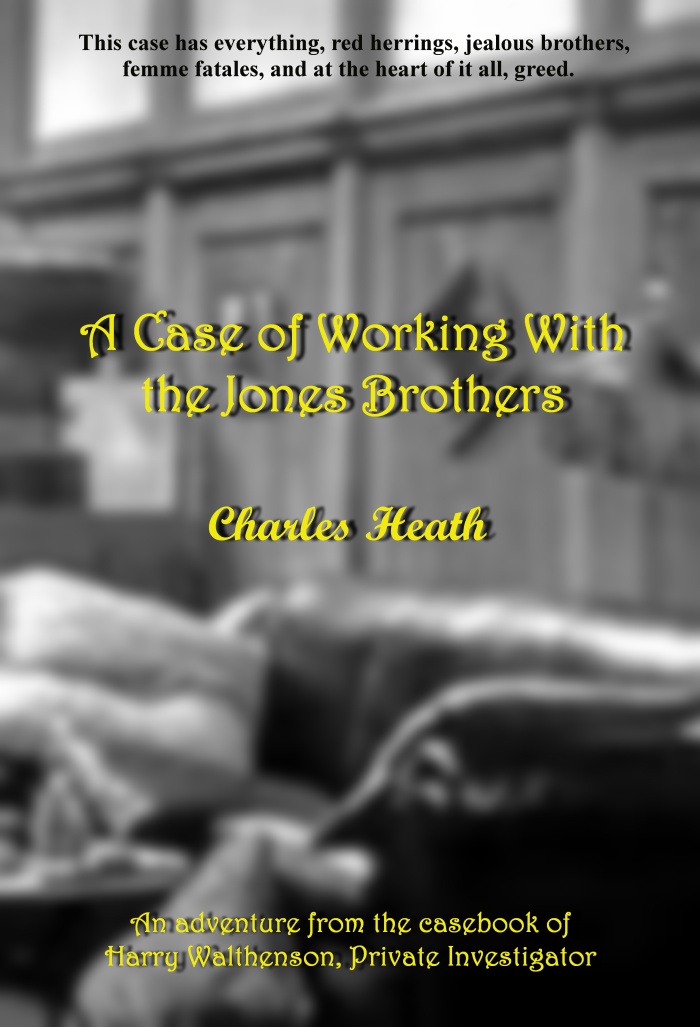
The first case of PI Walthenson – “A Case of Working With the Jones Brothers”

This case has everything, red herrings, jealous brothers, femme fatales, and at the heart of it all, greed.

See below for an excerpt from the book…

Coming soon!

PIWalthJones1


An excerpt from the book:


When Harry took the time to consider his position, a rather uncomfortable position at that, he concluded that he was somehow involved in another case that meant very little to him.

Not that it wasn’t important in some way he was yet to determine, it was just that his curiosity had got the better of him, and it had led to this: sitting in a chair, securely bound, waiting for someone one of his captors had called Doug.

It was not the name that worried him so much, it was the evil laugh that had come after the name was spoken.

Doug what?  Doug the ‘destroyer’, Doug the ‘dangerous’, Doug the ‘deadly’; there was any number of sinister connotations, and perhaps that was the point of the laugh, to make it more frightening than it was.

But there was no doubt about one thing in his mind right then: he’d made a mistake.  A very big. and costly, mistake.  Just how big the cost, no doubt he would soon find out.

His mother, and his grandmother, the wisest person he had ever known, had once told him never to eavesdrop.

At the time he couldn’t help himself and instead of minding his own business, listening to a one-sided conversation which ended with a time and a place.  The very nature of the person receiving the call was, at the very least, sinister, and, because of the cryptic conversation, there appeared to be, or at least to Harry, criminal activity involved.

For several days he had wrestled with the thought of whether he should go.  Stay on the fringe, keep out of sight, observe and report to the police if it was a crime.  Instead, he had willingly gone down the rabbit hole.

Now, sitting in an uncomfortable chair, several heat lamps hanging over his head, he was perspiring, and if perspiration could be used as a measure of fear, then Harry’s fear was at the highest level.

Another runnel of sweat rolled into his left eye, and, having his hands tied, literally, it made it impossible to clear it.  The burning sensation momentarily took his mind off his predicament.  He cursed and then shook his head trying to prevent a re-occurrence.  It was to no avail.

Let the stinging sensation be a reminder of what was right and what was wrong.

It was obvious that it was the right place and the right time, but in considering his current perilous situation, it definitely was the wrong place to be, at the worst possible time.


It was meant to be his escape, an escape from the generations of lawyers, what were to Harry, dry, dusty men who had been in business since George Washington said to the first Walthenson to step foot on American soil, ‘Why don’t you become a lawyer?” when asked what he could do for the great man.

Or so it was handed down as lore, though Harry didn’t think Washington meant it literally, the Walthenson’s, then as now, were not shy of taking advice.

Except, of course, when it came to Harry.

He was, Harry’s father was prone to saying, the exception to every rule.  Harry guessed his father was referring to the fact his son wanted to be a Private Detective rather than a dry, dusty lawyer.  Just the clothes were enough to turn Harry off the profession.

So, with a little of the money Harry inherited from one of his aunts, he leased an office in Gramercy Park and had it renovated to look like the Sam Spade detective agency, you know the one, Spade and Archer, and The Maltese Falcon.

There’s a movie and a book by Dashiell Hammett if you’re interested.

So, there it was, painted on the opaque glass inset of the front door, ‘Harold Walthenson, Private Detective’.

There was enough money to hire an assistant, and it took a week before the right person came along, or, more to the point, didn’t just see his business plan as something sinister.  Ellen, a tall cool woman in a long black dress, or so the words of a song in his head told him, fitted in perfectly.

She’d seen the movie, but she said with a grin, Harry was no Humphrey Bogart.

Of course not, he said, he didn’t smoke.

Three months on the job, and it had been a few calls, no ‘real’ cases, nothing but missing animals, and other miscellaneous items.  What he really wanted was a missing person.  Or perhaps a beguiling, sophisticated woman who was as deadly as she was charming, looking for an errant husband, perhaps one that she had already ‘dispatched’.

Or for a tall, dark and handsome foreigner who spoke in riddles and in heavily accented English, a spy, or perhaps an assassin, in town to take out the mayor.  The man was such an imbecile Harry had considered doing it himself.

Now, in a back room of a disused warehouse, that wishful thinking might be just about to come to a very abrupt end, with none of the romanticized trappings of the business befalling him.  No beguiling women, no sinister criminals, no stupid policemen.

Just a nasty little man whose only concern was how quickly or how slowly Harry’s end was going to be.

© Charles Heath 2019


In a word: Not

You will not go outside, you will not go to the movies.

The word not, when used by your parents when you are a child is the key in the lock keeping you from having fun.

It is the very definition of everything negative, and much harsher than just a plain no.

That you will ‘not…’ has been the gateway for many an exploit or adventure, because anything you have done contrary to the ‘not’ is all that much sweeter.

Until you get into trouble, but, then, isn’t that how you learn life’s lessons?

But if you are a programmer like me, not takes on a whole new meaning in a language like,

‘If not like …. then’

meaning in layman’s terms if something isn’t like a specific value then do something else.

Hang on, isn’t that a bit like reality?

This is not to be confused with the work Knot which is,

A blemish in a piece of wood

The speed of a ship, winds, and sometimes a plane

But basically,

Something you tie to keep your shoes on, or around your finger to remind you to tie your shoes before getting on the 36-knot high-speed ferry made of knotty wood.

It is also something you find in tangled hair and is very painful trying to remove it.

It is also an unpleasant tightness in body muscles and you need a masseuse to get rid of them.

“The Things We Do For Love” – Coming soon

Is love the metaphorical equivalent to ‘walking the plank’; a dive into uncharted waters?

For Henry the only romance he was interested in was a life at sea, and when away from it, he strived to find sanctuary from his family and perhaps life itself.  It takes him to a small village by the sea, s place he never expected to find another just like him, Michelle, whom he soon discovers is as mysterious as she is beautiful.

Henry had long since given up the notion of finding romance, and Michelle couldn’t get involved for reasons she could never explain, but in the end both acknowledge that something happened the moment they first met.  

Plans were made, plans were revised, and hopes were shattered.

A chance encounter causes Michelle’s past to catch up with her, and whatever hope she had of having a normal life with Henry, or anyone else, is gone.  To keep him alive she has to destroy her blossoming relationship, an act that breaks her heart and shatters his.

But can love conquer all?

It takes a few words of encouragement from an unlikely source to send Henry and his friend Radly on an odyssey into the darkest corners of the red light district in a race against time to find and rescue the woman he finally realizes is the love of his life.

The cover, at the moment, looks like this:

lovecoverfinal1

The first case of PI Walthenson – “A Case of Working With the Jones Brothers”

This case has everything, red herrings, jealous brothers, femme fatales, and at the heart of it all, greed.

See below for an excerpt from the book…

Coming soon!

PIWalthJones1


An excerpt from the book:


When Harry took the time to consider his position, a rather uncomfortable position at that, he concluded that he was somehow involved in another case that meant very little to him.

Not that it wasn’t important in some way he was yet to determine, it was just that his curiosity had got the better of him, and it had led to this: sitting in a chair, securely bound, waiting for someone one of his captors had called Doug.

It was not the name that worried him so much, it was the evil laugh that had come after the name was spoken.

Doug what?  Doug the ‘destroyer’, Doug the ‘dangerous’, Doug the ‘deadly’; there was any number of sinister connotations, and perhaps that was the point of the laugh, to make it more frightening than it was.

But there was no doubt about one thing in his mind right then: he’d made a mistake.  A very big. and costly, mistake.  Just how big the cost, no doubt he would soon find out.

His mother, and his grandmother, the wisest person he had ever known, had once told him never to eavesdrop.

At the time he couldn’t help himself and instead of minding his own business, listening to a one-sided conversation which ended with a time and a place.  The very nature of the person receiving the call was, at the very least, sinister, and, because of the cryptic conversation, there appeared to be, or at least to Harry, criminal activity involved.

For several days he had wrestled with the thought of whether he should go.  Stay on the fringe, keep out of sight, observe and report to the police if it was a crime.  Instead, he had willingly gone down the rabbit hole.

Now, sitting in an uncomfortable chair, several heat lamps hanging over his head, he was perspiring, and if perspiration could be used as a measure of fear, then Harry’s fear was at the highest level.

Another runnel of sweat rolled into his left eye, and, having his hands tied, literally, it made it impossible to clear it.  The burning sensation momentarily took his mind off his predicament.  He cursed and then shook his head trying to prevent a re-occurrence.  It was to no avail.

Let the stinging sensation be a reminder of what was right and what was wrong.

It was obvious that it was the right place and the right time, but in considering his current perilous situation, it definitely was the wrong place to be, at the worst possible time.


It was meant to be his escape, an escape from the generations of lawyers, what were to Harry, dry, dusty men who had been in business since George Washington said to the first Walthenson to step foot on American soil, ‘Why don’t you become a lawyer?” when asked what he could do for the great man.

Or so it was handed down as lore, though Harry didn’t think Washington meant it literally, the Walthenson’s, then as now, were not shy of taking advice.

Except, of course, when it came to Harry.

He was, Harry’s father was prone to saying, the exception to every rule.  Harry guessed his father was referring to the fact his son wanted to be a Private Detective rather than a dry, dusty lawyer.  Just the clothes were enough to turn Harry off the profession.

So, with a little of the money Harry inherited from one of his aunts, he leased an office in Gramercy Park and had it renovated to look like the Sam Spade detective agency, you know the one, Spade and Archer, and The Maltese Falcon.

There’s a movie and a book by Dashiell Hammett if you’re interested.

So, there it was, painted on the opaque glass inset of the front door, ‘Harold Walthenson, Private Detective’.

There was enough money to hire an assistant, and it took a week before the right person came along, or, more to the point, didn’t just see his business plan as something sinister.  Ellen, a tall cool woman in a long black dress, or so the words of a song in his head told him, fitted in perfectly.

She’d seen the movie, but she said with a grin, Harry was no Humphrey Bogart.

Of course not, he said, he didn’t smoke.

Three months on the job, and it had been a few calls, no ‘real’ cases, nothing but missing animals, and other miscellaneous items.  What he really wanted was a missing person.  Or perhaps a beguiling, sophisticated woman who was as deadly as she was charming, looking for an errant husband, perhaps one that she had already ‘dispatched’.

Or for a tall, dark and handsome foreigner who spoke in riddles and in heavily accented English, a spy, or perhaps an assassin, in town to take out the mayor.  The man was such an imbecile Harry had considered doing it himself.

Now, in a back room of a disused warehouse, that wishful thinking might be just about to come to a very abrupt end, with none of the romanticized trappings of the business befalling him.  No beguiling women, no sinister criminals, no stupid policemen.

Just a nasty little man whose only concern was how quickly or how slowly Harry’s end was going to be.

© Charles Heath 2019


Short story writing, don’t try this at home (5)

This is not meant to be a treatise on short story writing.  Far be it for me to advise anyone on the subject.  I prefer to say how it is that I do it so you can learn all of the pitfalls in one go.

Now, there’s this thing called continuity, but it covers a whole range of writing sins, most of which I eventually get caught out.  Films sometimes miss a few items, like back in the roman days, there are plane trails in the sky, in a 1920’s period piece, there’s a mobile phone sitting on a desk.

Like one minute the hero has a gun, and the next he’s fighting for his life with a knife, and, hey presto, there’s that gun again.  The error might not be that big but you can’t pull out a weapon you don’t have or wasn’t there in the first place.

Similarly, the hero pulls out a mobile phone, but there’s only one problem, it’s 1980, and there are no mobile phones.  Our problem might be that we are so used to doing and using certain things that we might forget, for a minute or two, that were not available in the past.

The same goes for the fashion of the day.

And my all-time favourite, getting the right make and model of car.

Oh, and just for good measure, back in the old days they used acoustic couplers to attach to phones via a serial port to dial-up not a server, but a BBS, Bulletin Board Service, at a rate of 300 baud, or a little while later, 1,200 baud.

There was no internet in general use.  If you wanted to call the office when out, use a telephone box.  Or carrier pigeon.

And the use of language, there’s a lot of stuff relevant today that was not used back then, and there was a lot of stuff back then that isn’t tolerated now.  Some of it might be hard to get your head around.  It isn’t for me, because I can remember the 1970s and 1980s, but I’m not too sure about allowing some of what happened then to creep into my work.

So, you get the picture.  Try to use the past as the past, or leave it in the past.

Unless it’s a book about time travel, then all bets are off.