In a word: Saw or Sore or Soar

In the first or second instance of the word Sore, we all know this malady can sometimes fester into something a lot worse.

Or that a person could be a sore loser

Or after spending an hour on the obstacle course, they come off very sore and sorry.  I never quite understood why they should be sorry because no one ever apologises to an inanimate object.  Or do they?

Or perhaps he was sore at his friend for not telling him the truth.

Then, there’s another meaning, saw, which can mean the past tense of seeing, that is, I saw them down by the pool.

I could also use a saw, you know, that thing that cuts through wood, steel, plastic, almost anything.  And yes, it’s possible someone might actually saw through a loaf of bread.

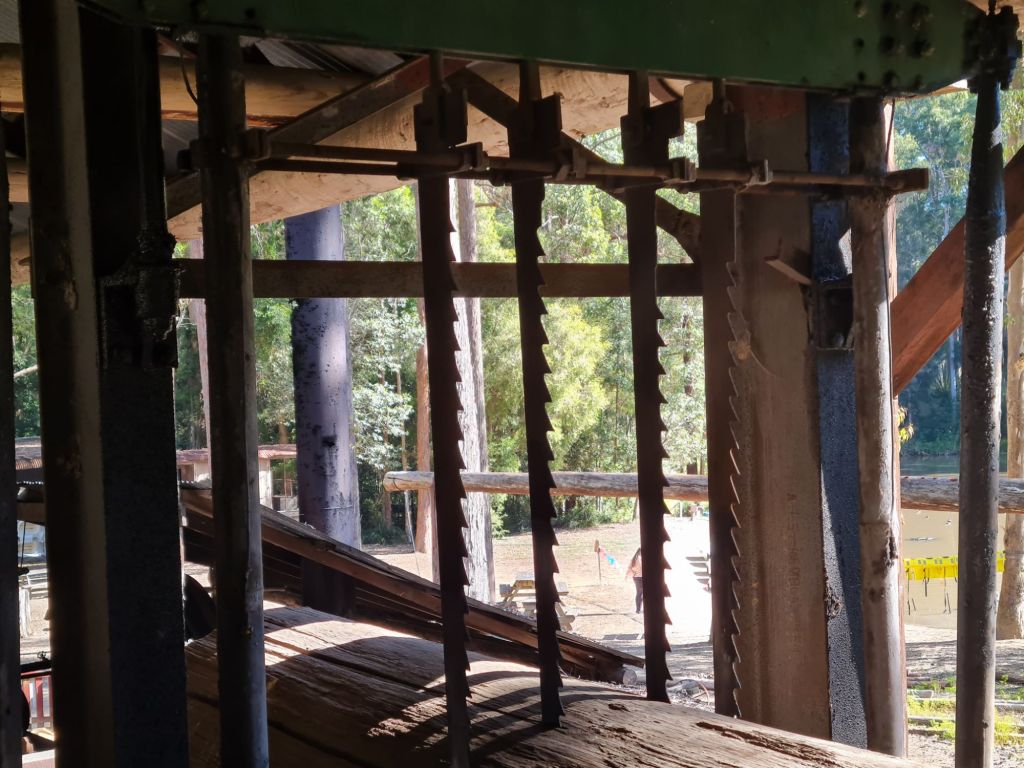
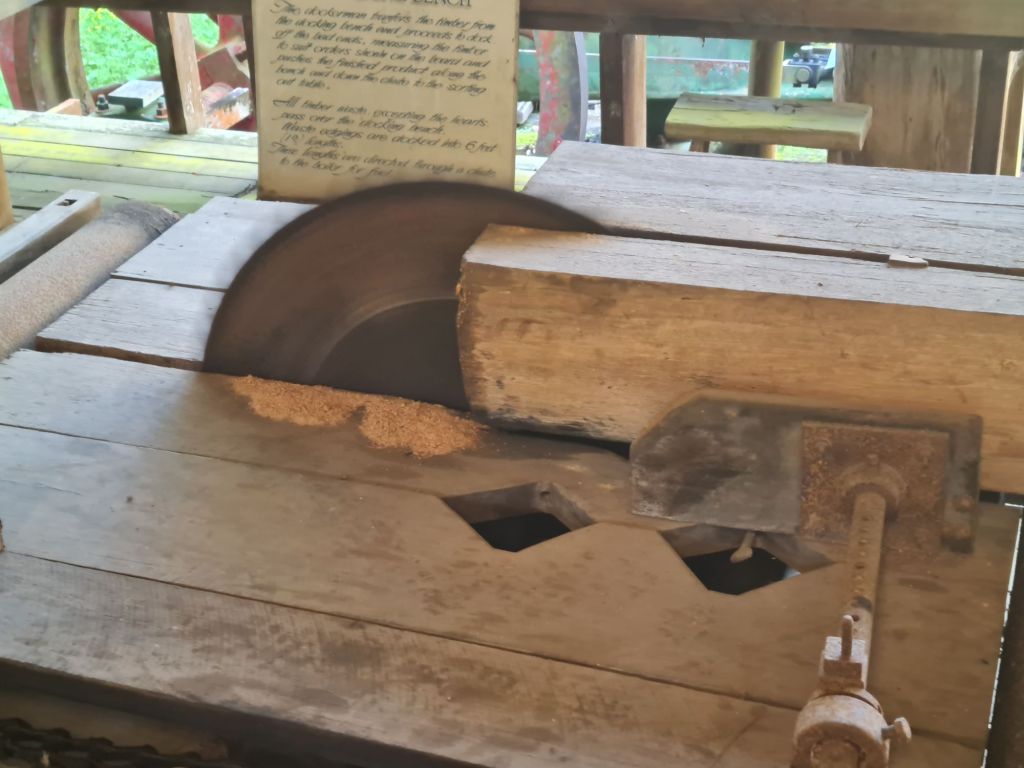
There are hand saws, electric saws, band saws, coping saws, and even a bread knife, all of these have one thing in common, a serrated edge with teeth of different sizes, designed to cut, smoothly or roughly depending on the size.

Add it to bones, and you have Captain Kirk’s description of his medical officer on the Enterprise.  I’m not sure any doctor would like to be addressed as saw-bones.

But then, confusingly in the way only English can do, there’s another word that sounds exactly the same, soar

This, of course, means hovering up there in the heavens, with or without propulsion or oxygen.

Yes, it’s difficult to soar with eagles when you work with turkeys.  I’ve always liked this expression though most of the time people don’t quite understand what it means.

An excerpt from “Strangers We’ve Become” – Coming Soon

I wandered back to my villa.

It was in darkness.  I was sure I had left several lights on, especially over the door so I could see to unlock it.

I looked up and saw the globe was broken.

Instant alert.

I went to the first hiding spot for the gun, and it wasn’t there.  I went to the backup and it wasn’t there either.  Someone had found my carefully hidden stash of weapons and removed them.

Who?

There were four hiding spots and all were empty.  Someone had removed the weapons.  That could only mean one possibility.

I had a visitor, not necessarily here for a social call.

But, of course, being the well-trained agent I’d once been and not one to be caught unawares, I crossed over to my neighbor and relieved him of a weapon that, if found, would require a lot of explaining.

Suitably armed, it was time to return the surprise.

There were three entrances to the villa, the front door, the back door, and a rather strange escape hatch.  One of the more interesting attractions of the villa I’d rented was its heritage.  It was built in the late 1700s, by a man who was, by all accounts, a thief.  It had a hidden underground room which had been in the past a vault but was now a wine cellar, and it had an escape hatch by which the man could come and go undetected, particularly if there was a mob outside the door baying for his blood.

It now gave me the means to enter the villa without my visitors being alerted, unless, of course, they were near the vicinity of the doorway inside the villa, but that possibility was unlikely.  It was not where anyone could anticipate or expect a doorway to be.

The secret entrance was at the rear of the villa behind a large copse, two camouflaged wooden doors built into the ground.  I move aside some of the branches that covered them and lifted one side.  After I’d discovered the doors and rusty hinges, I’d oiled and cleaned them, and cleared the passageway of cobwebs and fallen rocks.  It had a mildew smell, but nothing would get rid of that.  I’d left torches at either end so I could see.

I closed the door after me, and went quietly down the steps, enveloped in darkness till I switched on the torch.  I traversed the short passage which turned ninety degrees about halfway to the door at the other end.  I carried the key to this door on the keyring, found it and opened the door.  It too had been oiled and swung open soundlessly.

I stepped in the darkness and closed the door.

I was on the lower level under the kitchen, now the wine cellar, the ‘door’ doubling as a set of shelves which had very little on them, less to fall and alert anyone in the villa.

Silence, an eerie silence.

I took the steps up to the kitchen, stopping when my head was level with the floor, checking to see if anyone was waiting.  There wasn’t.  It seemed to me to be an unlikely spot for an ambush.

I’d already considered the possibility of someone coming after me, especially because it had been Bespalov I’d killed, and I was sure he had friends, all equally as mad as he was.  Equally, I’d also considered it nigh on impossible for anyone to find out it was me who killed him because the only people who knew that were Prendergast, Alisha, a few others in the Department, and Susan.

That raised the question of who told them where I was.

If I was the man I used to be, my first suspect would be Susan.  The departure this morning, and now this was too coincidental.  But I was not that man.

Or was I?

I reached the start of the passageway that led from the kitchen to the front door and peered into the semi-darkness.  My eyes had got used to the dark, and it was no longer an inky void.  Fragments of light leaked in around the door from outside and through the edge of the window curtains where they didn’t fit properly.  A bone of contention upstairs in the morning, when first light shone and invariably woke me up hours before I wanted to.

Still nothing.

I took a moment to consider how I would approach the visitor’s job.  I would get a plan of the villa in my head, all entrances, where a target could be led to or attacked where there would be no escape.

Coming in the front door.  If I was not expecting anything, I’d just open the door and walk-in.  One shot would be all that was required.

Contract complete.

I sidled quietly up the passage staying close to the wall, edging closer to the front door.  There was an alcove where the shooter could be waiting.  It was an ideal spot to wait.

Crunch.

I stepped on some nutshells.

Not my nutshells.

I felt it before I heard it.  The bullet with my name on it.

And how the shooter missed, from point-blank range, and hit me in the arm, I had no idea.  I fired off two shots before a second shot from the shooter went wide and hit the door with a loud thwack.

I saw a red dot wavering as it honed in on me and I fell to the floor, stretching out, looking up where the origin of the light was coming and pulled the trigger three times, evenly spaced, and a second later I heard the sound of a body falling down the stairs and stopping at the bottom, not very far from me.

Two assassins.

I’d not expected that.

The assassin by the door was dead, a lucky shot on my part.  The second was still breathing.

I checked the body for any weapons and found a second gun and two knives.  Armed to the teeth!

I pulled off the balaclava; a man, early thirties, definitely Italian.  I was expecting a Russian.

I slapped his face, waking him up.  Blood was leaking from several slashes on his face when his head had hit the stairs on the way down.  The awkward angle of his arms and legs told me there were broken bones, probably a lot worse internally.  He was not long for this earth.

“Who employed you?”

He looked at me with dead eyes, a pursed mouth, perhaps a smile.  “Not today my friend.  You have made a very bad enemy.”  He coughed and blood poured out of his mouth.  “There will be more …”

Friends of Bespalov, no doubt.

I would have to leave.  Two unexplainable bodies, I’d have a hard time explaining my way out of this mess.  I dragged the two bodies into the lounge, clearing the passageway just in case someone had heard anything.

Just in case anyone was outside at the time, I sat in the dark, at the foot of the stairs, and tried to breathe normally.  I was trying not to connect dots that led back to Susan, but the coincidence was worrying me.

A half-hour passed and I hadn’t moved.  Deep in thought, I’d forgotten about being shot, unaware that blood was running down my arm and dripping onto the floor.

Until I heard a knock on my front door.

Two thoughts, it was either the police, alerted by the neighbors, or it was the second wave, though why would they be knocking on the door?

I stood, and immediately felt a stabbing pain in my arm.  I took out a handkerchief and turned it into a makeshift tourniquet, then wrapped a kitchen towel around the wound.

If it was the police, this was going to be a difficult situation.  Holding the gun behind my back, I opened the door a fraction and looked out.

No police, just Maria.  I hoped she was not part of the next ‘wave’.

“You left your phone behind on the table.  I thought you might be looking for it.”  She held it out in front of her.

When I didn’t open the door any further, she looked at me quizzically, and then asked, “Is anything wrong?”

I was going to thank her for returning the phone, but I heard her breathe in sharply, and add, breathlessly, “You’re bleeding.”

I looked at my arm and realized it was visible through the door, and not only that, the towel was soaked in blood.

“You need to go away now.”

Should I tell her the truth?  It was probably too late, and if she was any sort of law-abiding citizen she would go straight to the police.

She showed no signs of leaving, just an unnerving curiosity.  “What happened?”

I ran through several explanations, but none seemed plausible.  I went with the truth.  “My past caught up with me.”

“You need someone to fix that before you pass out from blood loss.  It doesn’t look good.”

“I can fix it.  You need to leave.  It is not safe to be here with me.”

The pain in my arm was not getting any better, and the blood was starting to run down my arm again as the tourniquet loosened.  She was right, I needed it fixed sooner rather than later.

I opened the door and let her in.  It was a mistake, a huge mistake, and I would have to deal with the consequences.  Once inside, she turned on the light and saw the pool of blood just inside the door and the trail leading to the lounge.  She followed the trail and turned into the lounge, turned on the light, and no doubt saw the two dead men.

I expected her to scream.  She didn’t.

She gave me a good hard look, perhaps trying to see if I was dangerous.  Killing people wasn’t something you looked the other way about.  She would have to go to the police.

“What happened here?”

“I came home from the cafe and two men were waiting for me.  I used to work for the Government, but no longer.  I suspect these men were here to repay a debt.  I was lucky.”

“Not so much, looking at your arm.”

She came closer and inspected it.

“Sit down.”

She found another towel and wrapped it around the wound, retightening the tourniquet to stem the bleeding.

“Do you have medical supplies?”

I nodded.  “Upstairs.”  I had a medical kit, and on the road, I usually made my own running repairs.  Another old habit I hadn’t quite shaken off yet.

She went upstairs, rummaged, and then came back.  I wondered briefly what she would think of the unmade bed though I was not sure why it might interest her.

She helped me remove my shirt, and then cleaned the wound.  Fortunately, she didn’t have to remove a bullet.  It was a clean wound but it would require stitches.

When she’d finished she said, “Your friend said one day this might happen.”

No prizes for guessing who that friend was, and it didn’t please me that she had involved Maria.

“Alisha?”

“She didn’t tell me her name, but I think she cares a lot about you.  She said trouble has a way of finding you, gave me a phone and said to call her if something like this happened.”

“That was wrong of her to do that.”

“Perhaps, perhaps not.  Will you call her?”

“Yes.  I can’t stay here now.  You should go now.  Hopefully, by the time I leave in the morning, no one will ever know what happened here, especially you.”

She smiled.  “As you say, I was never here.”

© Charles Heath 2018-2022
strangerscover9

“Trouble in Store” – Short Stories My Way:  The re-write – Part 2

Now that I’ve gone through the story and made quite a few changes, it’s time to look at the story

It took a second, perhaps three, to sum up the situation.

A young girl, about 16 or 17, scared, looking sideways at a man on the ground, then Alphonse, and then Jack.  He recognized the gun, a Luger, a German relic of WW2, perhaps her father’s souvenir, or more likely a stolen weapon, now pointing at him then Alphonse, then back to him.

Jack took another second or two to consider if he could disarm her.  No, the distance was too great.  He put his hands out where she could see them.  No sudden movements trying to remain calm, and his heart rate was up to the point of cardiac arrest.  No point in making a bad situation worse.

Pointing with the gun, she said, “Move closer to the counter where I can see you better.”

Everything but her hand was steady as a rock.  The only telltale sign of stress was the bead of perspiration on her brow.  It was 40 degrees Fahrenheit in the shop.

Jack shivered and then did as he was told.

A few seconds more for him to decide she was in the unpredictable category.

“What’s wrong with your friend?”  Jack tried the friendly approach after he’d taken the three steps sideways necessary to reach the counter.

The shopkeeper, Alphonse, who, Jack noted seemed to have aged another ten years in the last few months, spoke instead; “I suspect he’s an addict, looking for a score.  At the end of his tether, my guess, and her to get some money.”

A simple hold-up that had gone wrong.  Wrong time, wrong place, in more ways than one Jack thought, now realizing he had walked into a very dangerous situation.  She didn’t look like a user.  The boy on the ground did, and he looked like he was going through the beginnings of withdrawal.

Oddly, though, Jack had noticed a look pass between the shopkeeper and the girl.

“All you had to do was give us the money, and we wouldn’t be here, now.”  She was glaring back at Alphonse.  “You can still make this right.”

A flicker of memory jumped out of the depths of Jack’s mind, something discussed at the dinner table with their neighbours, something about the shop being a pickup point for drugs.

The boy on the floor, he was not here for money.

Jack thought he’d try another approach.  “Look, I don’t want trouble, and you don’t want trouble.  I’ll go, forget this ever happened.  You might want to do the same.”

The girl looked like she was thinking.  The gun, though, still moved between him and the shopkeeper.

Another assessment of the girl; this was not her real home.  She was from a better class of people, a different part of town.  Caught up in a downward spiral because of her friend on the floor.

Caught in a situation she was not equipped to deal with.

© Charles Heath 2016-2024

The cinema of my dreams – I always wanted to see the planets – Episode 42

We seem to have a spot of bother

The next statement from Number One, “Sir, it seems we have a hostage situation.”

A glance back at the main screen showed the Russian ship’s bridge minus the captain and flickering on, the alien ship’s Captain.

“I didn’t open a channel, Sir,” the comms officer said quickly.

I glared at the alien representative for a few seconds, hoping to convey my displeasure, but I doubted it would have any effect.

Nor was it any surprise to discover that something indeed didn’t add up. 

Potentially we had a very bad situation, facing off an alien vessel with unknown capabilities and weapons, and a ship that was not supposed to exist, having reputedly committed unknown criminal activities.

“General, you might have to make an instant decision, so if the potential threat is life or ship threatening, don’t wait for confirmation.”

“Sir.”

“Code Red, and everyone, report anything no matter how trivial.”

“Number one, a hostage situation is only a hostage situation if the hostage-taker has a hostage.  You get a clear shot, shoot them.”

“There may potentially be casualties, sir.”

“Then at your discretion, but hold that thought until I have a word with our new, so-called, friends.”

“Sir.”

To say I was annoyed was an understatement, but I had to remember that our underlying mission was to make new friends, not enemies.

“Captain,” the alien commander decided now was the moment to speak.

“You have not been quite truthful with us, have you?”

“They did commit crimes, that is the truth.”

“Then why is one of your people holding the captain hostage?”

It only just struck me then that the alien vessel had beamed one of the people onto the Russian ship after the alien ship arrived with us.  But to what purpose?

“To force them to return to the planet where the crimes were committed.  I had no reason to believe you would force the issue.  Our experience with humans is they support each other before they do the right thing.”

“Your experience is narrow-minded, generally supported by few instances, and basically does not define the human race.  Like everyone, we have a bad element, but it doesn’t define who or what we are.  You obviously heard my instructions to my boarding party.  Your turn now to give me a good reason why I should not shoot them?”

“I assume you still want to open diplomatic relations between our worlds?”

“Not at the expense of gunboat diplomacy.”

“I could destroy both your ships.”

“You could try.  If you know as much as you claim to know about humans, you’ll know that we are at our most formidable when our backs are to the wall.  My ship is an unknown quantity to you, which means you have no idea what we are capable of, but if you want yo find out, by all means, try.”

It was hard to keep an even tone when you are terrified.  Our first encounter had been nothing but threats and violence.  Was I no better than the worse of our kind?

Number one was back in my ear, “Sir, the alien and the Captain just disappeared.”

“I would like you to join us on my ship for discussions, Captain.  I’m sure this situation can be resolved amicably.”

“I’d like a skilled diplomatic negotiator with me, and not agreeing will be considered a hostile act.”

Just in case he was intending to beam me aboard his ship.  A nod in the General’s direction showed he knew what to do if the alien tried.

“Send a message to our diplomatic representative to cone to the bridge urgently.”

I preferred this to be done privately so as not to alert the crew.

I had read the file on Margaret Simpson, and it was, to say the least, extraordinary.  Her achievements at getting the most disparate parties to the table spoke for itself, and it surprised me that she would go on what could prospectively be a one-way trip.

I had not yet spoken to her since boarding, but it had been on my list before we ran into an alien species.  Now, that introduction was lost.

She looked exactly as I’d expected, just in the prime of middle age, diminutive, but not overly imposing, but distinctive enough to stop and look when she walked into a room.

“Captain, I can’t say what comes next doesn’t excite me.”

“You got a brief description of events?”

“An alien race, hostile or not, is exactly why I came.”

“Things could go pear-shaped very quickly.”

“You are exactly as described Captain, refreshingly honest, but somehow I don’t think I need to worry too much if you’re coming with me.”

“A perk of the job, I’m afraid.”

I looked at the alien captain on screen.

“Ready.”

© Charles Heath 2021-2022

A long short story that can’t be tamed – I never wanted to be an eyewitness – 7

Seven

Watching the body language of both husband and wife, it was hard to tell who was in charge, but if I had to make a guess, Angelina was in front by a nose.

Who had the most clout in that room, that was Angelina, via her father, Benito?  He might have retired and passed the reins onto his eldest son, but in terms of respect, he had it from all the crime families and syndicates, and was, for all intents and purposes, still a force to be reckoned with.

That was even after he and his eldest son, the heir apparent, decided to go straight.  It was a surprising turn of events for a crime family that had been notorious in its heyday.  Now the family were more involved in banks, shopping malls, casinos, and bearer bonds.

As for their illegal activities, those were shared out among the other three major crime syndicates equally so as to avoid a turf war. It also led to the marriage of convenience between Fabio Latanzio and Benito’s eldest daughter Angelina, mutually profitable for both sides.

At that time, Fabio had just been promoted to understudy his father, the heir apparent for that syndicate.  Fabio was ambitious but respectful, until his father was killed in a suspected hit, which led to a few months of tit for tat killings until Benito brokered an uneasy peace.

That meant Fabio became head of the family, and instead of sitting back and letting others do the work for him, he chose to be hands on.  And three suspicious murders later this he had privately said was to avenge the death of his father, here he was, on the brink of a long jail sentence. 

And the fact that he had allowed himself to be broken free of custody was a tell take sign that he knew he was both guilty of the crime, and that he was looking at a long sentence in jail.

Then there was the other undeniable fact, he had sent in a team to kill me.  If he was innocent, why would he bother?

Amy had been watching the family reunion with interest. She too, saw the signs of a rift which she could use against him.

She sat down when they went onto silence each on a separate side of the room, the air between them could be cut with a knife.  Benito, no doubt would be very angry at the turn of events, and of Fabio’s behaviour.  It was common knowledge that Benito thought him too big for his boots.

“Happy families, eh,” I said.

“That’s the trouble with absolute power, you tend to think after a while that you are untouchable.  He’s about to find just how wrong he is.  And, if we’re lucky we might yet get to find out who his high-level police contact is.”

That of course was something else I learned very quickly that a few, a very few cops were corrupt, and one in particular, the one that ratted me out.

It was a bit of a shock to discover that your safety really couldn’t be guaranteed, particularly when a high-profile criminal was involved, like Latanzio.

It was a can of worms she really didn’t want to open, but those who had helped Fabio stay free as long as he had, it was her intention to find out who it was and make sure they were punished.

It was determination I had seen only intensify since the attacking the hotel, and an escape after seeing several colleagues either killed or injured.

To me, sitting there watching the man who had ordered a hit on me and very nearly succeeded, and being able to observe the whole operation around his capture was, to say the least, fascinating.

It would be interesting to see how Latanzio reacted.

The least expected reaction was a steady pounding on the door, accompanied by yelling, Latanzio wanted to speak to the person in charge.

We watched him for a few minutes, and it looked like Amy wanted him angry, very angry, before she had him taken to an interview room.

She was expecting trouble, because he was not cuffed now, with two men collecting him, and two in the shadows with instructions to shoot a tranquilizer dart into him if he misbehaved.

The passageway was also set up so we could watch him, and there was definite proof he was seriously considering tackling the escort and making a break for it.  Amy could see the signs, but watching his escort, there were very aware of what he might do.

But in the end, he didn’t try to escape.

Not yet.

He was sent into the room, one guard outside, the other inside the door.  He kept what looked like a truncheon visible so the Latanzio would think twice about considering his odds against one rather than two.

For me, I might get past the first but not the second.  Any sensible person could see the odds stacked against them.

Amy stood up.  “Time to have a first pass at him.  Wish me luck.”

She didn’t need luck.  So far her plan was working.

Two minutes, perhaps three, passed before I saw her enter the room.  Latanzio has stopped pacing and had finally sat.  I could see him evaluation the possibility of using her as leverage to escape.

Whatever happened, the guards were instructed to kill him, irrespective of hostages.  It was a hard call, but everyone in the team chose to be there.

She sat but did not speak.  It was up to him to make the first move.

It didn’t take long.

“Just what exactly is going on here?  Who organised this?”

She took a moment to look him up and down, the sort of look that could make another, more ordinary person, squirm.  Latanzio was unmoved.

“The who, as I said before, is irrelevant.  The what is because we are putting the rest of your journey together, and it’s taking some time.  With one person it’s easy, with four it is more difficult.”

“Then forget about the family.  They’re safe.  No one will dare touch them.  I should be your most pressing case.”

Interesting that, if politely put, the rat thinks only of himself.

“You should realise that your wife and children will suffer the consequences of your actions if you leave them behind, so according to my instructions, you all go, or no one goes.”

“What does that mean?”

I thought it was obvious, but I was beginning to think Latanzio was not as clever as I thought he was.

“You don’t want to find out.”

“Is Benito behind this?  This smells like something he would do. More about saving his daughter than worrying about me.  He needs me.”

From what Amy’s sources had learned in the last few hours, the opposite was true.  Benito had put a contract out on him.  It hadn’t helped Fabio’s cause that she had leaked the fact Fabio was cheating on his daughter.

“Not since he was told about Gabrielle.  It is why we had to bring her in, too.  So, Benito is not your benefactor, he had, in fact, put a contract out on your head.  You should be thankful we got you out of jail, or you’d be dead by now.”

I could see his mind working, taking in what she had just told him and processing it.

Amy decided to add another variable.  “You have to decide who you want to go with you, Angelina or Gabrielle.  It can’t be both.”

There were a few seconds delay like a conversation being conducted from the earth to the moon

The he said, ” What will happen to those left behind?”

“I’m sure you know exactly what will happen.  The problem is, if you hadn’t shot that fool in the street in front of a witness, we wouldn’t be in this situation.”

“That witness is dead.  There is no witness.”

She shook her head.  ” No, Mr Latanzio, he is not dead.  You had to take on a very resourceful man, not your average Joe, nor by a long shot.  Special forces, or marines, or something I’m told, and he hasn’t taken it very well that you sent in a team to kill him.  It’s another mess were going to have to clean up.  All in all, you were given a simple job to do, and instead, let your ego and stupidity get us to this point.  You should realise my first instruction was to get you out and then put a bullet in your head.  I might still do it.  My people have been instructed to shoot you if you try anything.  That also means if you die, so does Angelina, Gabrielle, and your children.  My instructions are very clear.”

She stood, signalling the interview was at an end.

“You now have to make a decision.  Who would you like to see now?”

“Gabrielle.”

Angelina was going to be very impressed with her husband when Amy told her.

©  Charles Heath 2024

Writing about writing a book – Day 12

Today, I’ve decided on doing a little research, and this means giving the internet and Google a good workout.

I need some information about the Vietnam War.

So, as a start, I type in the words ‘Vietnam War’ into Google.

This returns: About 699,000,000 results (0.83 seconds)

Wikipedia says “The Vietnam War, also known as the Second Indochina War, and in Vietnam as the Resistance War Against America or simply the American War, was a conflict that occurred in Vietnam, Laos, and Cambodia from 1 November 1955 to the fall of Saigon on 30 April 1975”

OK, so this gives me the broadest outline.  What I need is details, so it’s a matter of where to start.  This means to start with, when did troops get sent from both Australia and the United States for service.  It seems the US sent troops from 1964 to 1969, and Australia between August 1965 and March 1966.  This gives me a starting point, because our main character is Australian, and somehow gets seconded to the Americans.

January 1972, the war ends.

Now we need to know

  •  where the bases were
  • where the battle zones were
  • methods of transportation
  • what happened to prisoners of war
  • rest and recreation points
  • CIA involvement (which will no doubt be impossible to find evidence)
  • what happened to soldiers injured in battle

It’s a list that will get longer and may require a reading list, and first-hand accounts.

It looks like it’s going to be a long day.

Searching for locations – Port Macquarie – Day 5 – Part 4

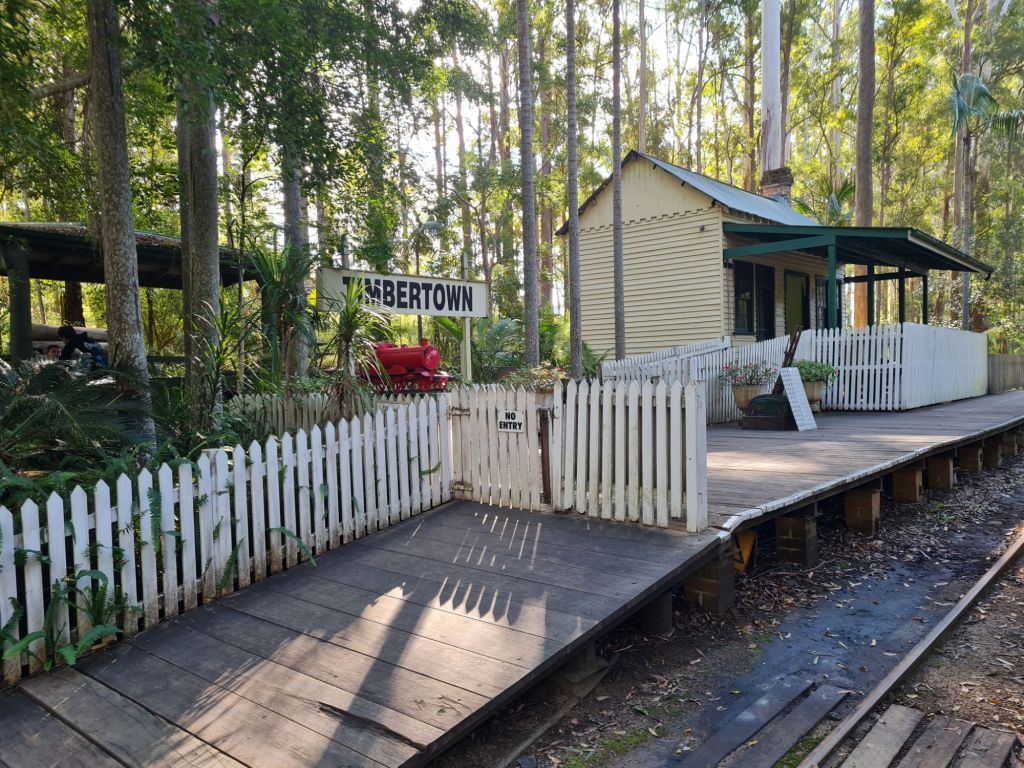
Timber town – The Steam Train

The station

It was almost an anticlimax waiting for the train to arrive, and, heralded by several whistles, it did not disappoint.

Whilst not as large as the real commuter railway engines, it didn’t matter.  It arrived with three colourful carriages, and everyone was waiting to jump on board.

Just for show, the driver reversed the train through the station, then brought it back slowly so everyone could get a photo moment of the train arriving at the station.

Then, everyone was aboard, and we were off.  It was a large circular track that went around the outskirts of the whole Timbertown site.

It was slow in places. The engine was pulling quite a load, and at least once it felt like it was going to stop.

But, no, we made it.  Towards the end there was a large trestle bridge.

The train travels over 595 mm tracks for 2.4 km.  It also travels over the longest 595 mm gauge trestle bridge in the southern hemisphere.

The locomotive, number 12271, built by John Fowler and Co, a company that found a niche building narrow gauge equipment for the cane fields, was built in 1910 and recently had its 125th birthday.

The locomotive, also known as the Green Hornet, worked most of its life at the Macknade Sugar Mill near Ingham in northern Queensland, before being sold to Timbertown.

It was restored to working order in March 2022.

I feel asleep in front of the computer screen

And when I woke up, I realised that I had just had a very bad dream. Or don’t they call bad dreams nightmares?

Can you diagnose yourself as having depression?

Of course, if you were to tell someone else, in one of these very serious tones, “I think I have depression” they will ask you what you’ve got to be depressed about.

It’s a good question. My first answer would be, “why did the doctor put me on antidepressants?” You know the stuff they give you, some derivative of serapax,

Then, if you tell anyone you’re on that stuff, they turn around and tell you just how bad it is and get off it right now.

That’s all very well, but you tell them you still have depression, and so the argument goes on.

But…

These days, they use low doses of antidepressants to manage pain, and in my case back pain. The first pill they gave me was Lyrica, which slowly took my memory away so that I couldn’t remember what anyone had said earlier in the day.

I thought I had early onset Alzheimer’s, or worse, dementia.

So I got off that, got the pain back, and moved to antidepressants. Now I’m seeing things.

That might help with the imagination for writing stories sometimes, but telling people you see the patterns on tiles moving is not a good start to any conversation.

Back to depression, though. It might be caused by being locked down and not being able to go anywhere, but that has never bothered me because I hate going out.

It might be a result of my childhood coming back to haunt me, and, believe me, you would not want the childhood I had, but it’s a maybe. A lot of old people find their past creeping up on them, and what happened 60 years ago seems more relevant than what happened 60 minutes ago.

You might think you’re badly done by, that everyone else is responsible for the mess you made of your life, if it is indeed a mess, but no, that isn’t true. My life is exactly what it’s meant to be, though how I got here remains the biggest of mysteries.

It’s why I’m writing the autobiography of a very ordinary nobody.

OK, that might be a hint, thinking I’m a nobody. After all, when I go out I always feel like I’m invisible.

A friend of mine tells me he always cries when there’s a sad part of a film on, and that’s his determination of depression.

I do too, but I don’t think it’s that.

After all, I did psychology and should understand the nuances of the human psyche, what makes us happy, what makes us sad, what makes us us.

So, rightly or wrongly I’ve stopped taking the antidepressants.

If suddenly my blog suddenly stops, you’ll know I’ve made the wrong decision.

“Sunday in New York”, a romantic adventure that’s not a walk in the park!

“Sunday in New York” is ultimately a story about trust, and what happens when a marriage is stretched to its limits.

When Harry Steele attends a lunch with his manager, Barclay, to discuss a promotion that any junior executive would accept in a heartbeat, it is the fact his wife, Alison, who previously professed her reservations about Barclay, also agreed to attend, that casts a small element of doubt in his mind.

From that moment, his life, in the company, in deciding what to do, his marriage, his very life, spirals out of control.

There is no one big factor that can prove Harry’s worst fears, that his marriage is over, just a number of small, interconnecting events, when piled on top of each other, points to a cataclysmic end to everything he had believed in.

Trust is lost firstly in his best friend and mentor, Andy, who only hints of impending disaster, Sasha, a woman whom he saved, and who appears to have motives of her own, and then in his wife, Alison, as he discovered piece by piece damning evidence she is about to leave him for another man.

Can we trust what we see with our eyes or trust what we hear?

Haven’t we all jumped to conclusions at least once in our lives?

Can Alison, a woman whose self-belief and confidence is about to be put to the ultimate test, find a way of proving their relationship is as strong as it has ever been?

As they say in the classics, read on!

Purchase:

http://tinyurl.com/Amazon-SundayInNewYork

Searching for locations – Port Macquarie – Day 5 – Part 3

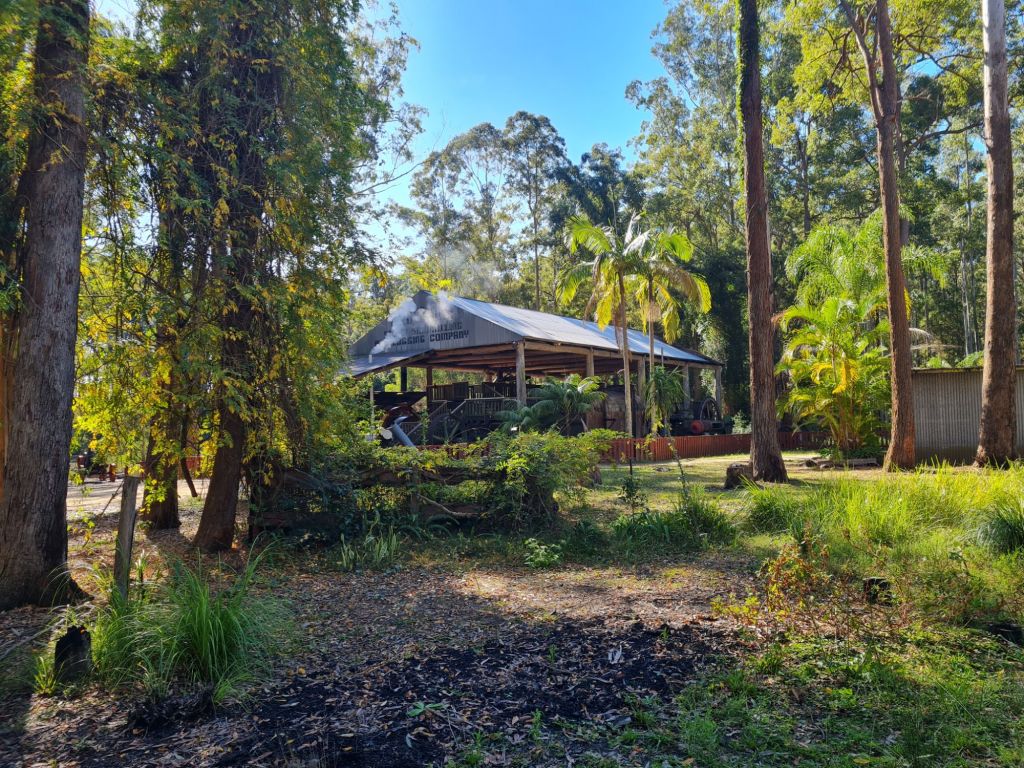
The timber mill

This timber mill was typical of the time, the mid to late 1800’s and into the 1900’s. It could be assembled and disassembled quite quickly and moved to where the wood was being felled.

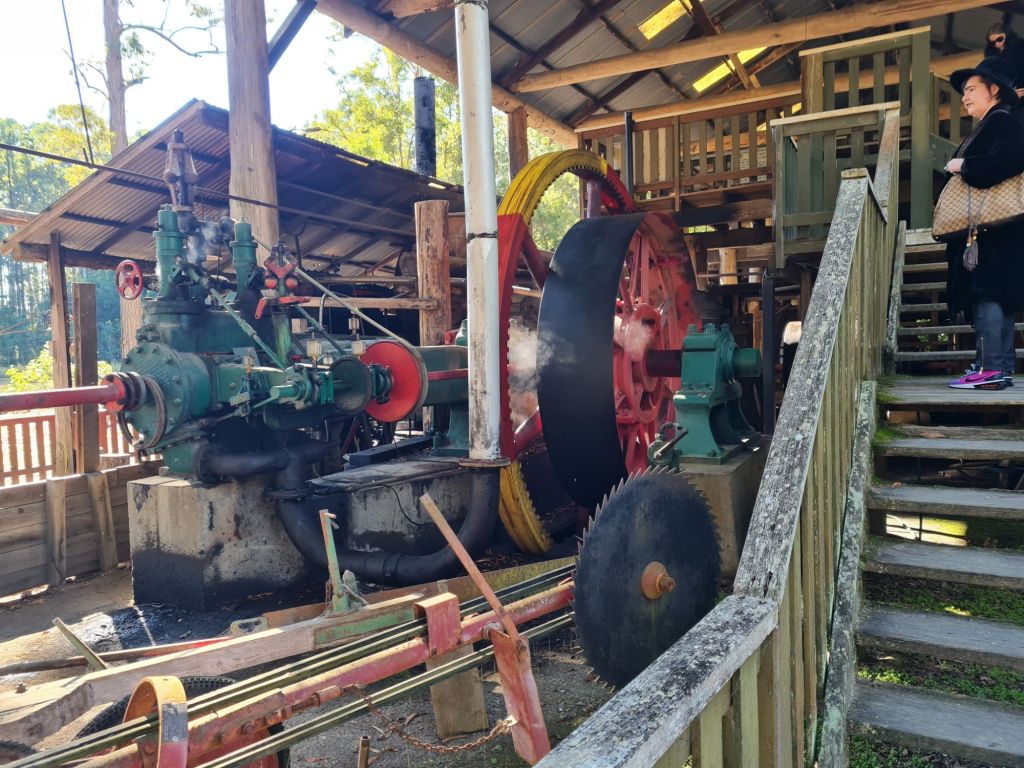
It was run by a single portable steam engine which made it possible to have a mill near where the trees were being felled

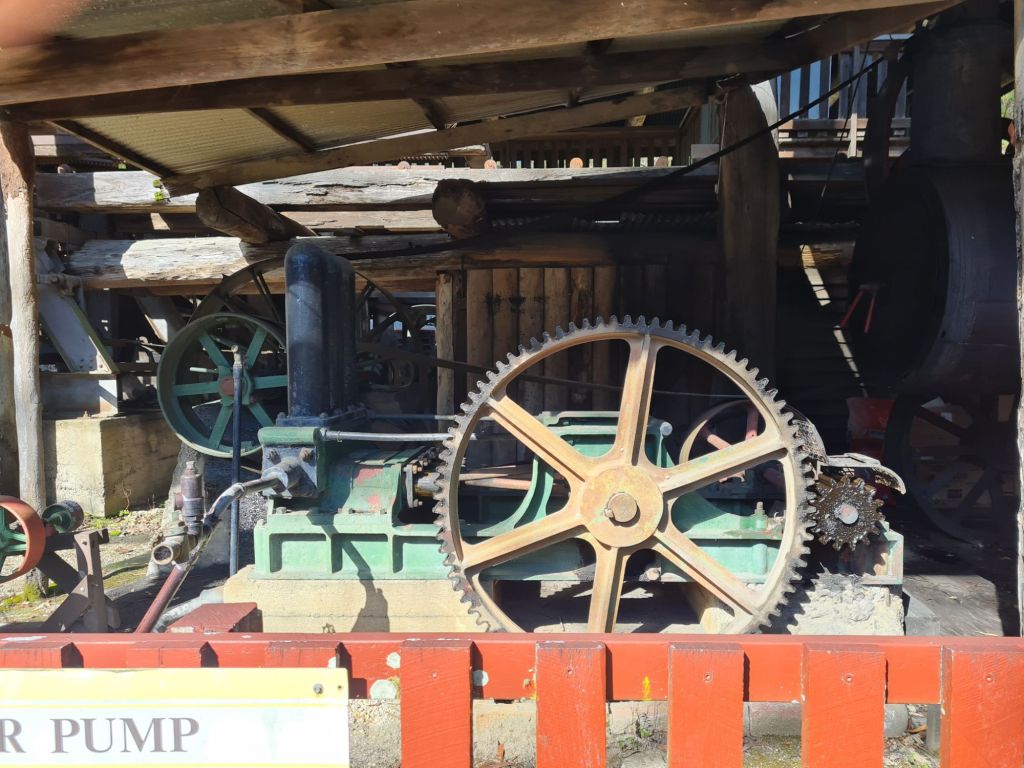
The engine drives vertical and horizontal saw blades by a series of belts and driveshafts