Skeletons in the closet, and doppelgangers

A story called “Mistaken Identity”

How many of us have skeletons in the closet that we know nothing about? The skeletons we know about generally stay there, but those we do not, well, they have a habit of coming out of left field when we least expect them.

In this case, when you see your photo on a TV screen with the accompanying text that says you are wanted by every law enforcement agency in Europe, you’re in a state of shock, only to be compounded by those same police, armed and menacing, kicking the door down.

I’d been thinking about this premise for a while after I discovered my mother had a boyfriend before she married my father, a boyfriend who was, by all accounts, the man who was the love of her life.

Then, in terms of coming up with an idea for a story, what if she had a child by him that we didn’t know about, which might mean I had a half-brother or sister I knew nothing about. It’s not an uncommon occurrence from what I’ve been researching.

There are many ways of putting a spin on this story.

Then, in the back of my mind, I remembered a story an acquaintance at work was once telling us over morning tea, that a friend of a friend had a mother who had a twin sister and that each of the sisters had a son by the same father, without each knowing of the father’s actions, both growing up without the other having any knowledge of their half brother, only to meet by accident on the other side of the world.

It was an encounter that in the scheme of things might never have happened, and each would have remained oblivious of the other.

For one sister, the relationship was over before she discovered she was pregnant, and therefore had not told the man he was a father. It was no surprise the relationship foundered when she discovered he was also having a relationship with her sister, a discovery that caused her to cut all ties with both of them and never speak to either from that day.

It’s a story with more twists and turns than a country lane!

And a great idea for a story.

That story is called ‘Mistaken Identity’.

The cinema of my dreams – It continued in London – Episode 40

Safe in an anonymous hotel

There was no time for an explanation, picking up on the urgency in my tone.  They gathered up a few belongings because I added they couldn’t come back, and, after Cecelia and I tossed the work phones on the kitchen bench, we headed down the stairs to the basement.

By the time the call with Alfie ended, I realized that we were just supposed to find her, Rodby had a whole other team on standby ready to ‘extract’ her.  And, if I was not mistaken, it would be against her will if she didn’t want to go with them.  It was why she greeted us with a gun, she knew what might happen.

Perhaps she knew the Rodby’s better than I did.

Like certain parts of London various groups of building basements were used by the defence forces and government offices, and the one Juliet was staying in might have been one because the basement was connected to another and another, and it felt like it had once been offices, given the green walls, arrows and exit signs, and overhead lighting.

At the end, we came out into a narrow alley between buildings and not far from that, Russell Square underground.  Just before descending, Cecilia gave me a new phone.  She had brought another two burner phones, acting on instinct, or perhaps knowing how much of a maverick I was.  Or she had simply changed roles, and become a maverick of her own.

We took the train to the one place I thought, for the moment, to be the safest.  Heathrow airport, and on the way, Cecelia booked two rooms at the hotel nearest to the underground station.  Five more people, some with bags would not look out of place.  But just Cecelia and I checked in with other IDs, and took a room each, and the others wandered up after us.

Almost an hour and a half later we were sitting in the room Cecelia booked for her and me, both with a second bedroom, but this one had a dining area.  She smiled at me when I realised there were two rooms.

“Now, I’m going to assume that you will trust me to a certain degree, and when I say I have no idea what is going on, except that it has to do with the Burkhardt family, there’s an inheritance that needs to be claimed in a few days, and there’s someone trying to assassinate Juliet, who appears to be a direct descendant of the count and an eligible heir.”

I looked at Vittoria, who was still very confused with the turn of events, and probably evaluating whether I could be trusted or not.  “I now believe you are Juliet’s mother.”  Now that mother and daughter were sitting side by side, the similarities between them.

Vittoria and the countess were sharing another pizza that Celecia had ordered up through room service, along with several bottles of red wine.  Juliet went over to the kitchenette, opened one, and poured five glasses.

It was not a bad wine, perhaps an Italian Sangiovese.

Juliet remained standing and looked at her mother.  “Even I’m confused at the moment.  When do you and the countess become friends?”

“We have been for quite some time, particularly after I realised she had nothing to do with my banishment.  That was the count, at the behest of his mother, who has been the true villain in both our lives.”  

Vittoria looked at her daughter, “I’ve come to realize the threats against all of us are the work of that vile woman.  This is the third or fourth attempt on your life, I’ve been attacked twice, and now the countess just escaped from what I perceive to be a threat, instigated by her.”

“Are you saying my old friend is working with her?  I hardly think she knows who the old woman is.  And assuming that she doesn’t, what other reason would she have to do with what just happened.”  She looked at me, “You came to the opera with us, so you must know her.”

“Not because I was a friend of the family, I’m not.  I think now I was asked along for a very specific reason, one she might not have been privy to, but that her husband, my old employer, was.  And my experience over the years is that nothing to do with him is ever straightforward.”

“Are you one of his people now?”  The way she said it, it sounded like she considered me a hatchet man.

“No, not exactly, nor is Cecelia.  We just do this and that from time to time.  I thought I was in retirement, Cecelia is in between acting roles, and he simply asked us to find you.”

“Then if you were seeking the countess, how did you know about me, and turn up at the conference hall, coincidentally when an assassin tried to kill me?”  Juliet made a good argument.

“I may have done a little research.  The countesses feud with Vittoria, and the uncovering of photographs, one of which had the teen version of you with your mother, Vittoria, at the Chateau in Sorrento, the same Chateau where the countess resides.  Sometimes we get lucky.  I was surprised though Juliet, given your history.  I didn’t bring them, and, by the way, I was the one who nearly got shot and killed.”

I could see Vittoria shaking her head.  “If you can make the distinction, then others can too.  Neither of us are now safe.  At least I can discount orange ribbon girl.  I knew she was tailing me, and I thought I lost her.”

Cecelia smiled.  “You wish.  Top of my class for surveillance.

I thought I would add a little spice to the conversation, “Why did you give the impression you’ve been trying to kill the countess?”

That brought a look of consternation from both.  The countess answered, “Only for the sake of appearances, and to keep the rest of the family away from the idea that we had joined forces, which is the only way we’re going to keep them from realizing we know more about them than they think we do.”

“But not enough to stop them from trying to stop both of you and now all three of you, from claiming the inheritance?”

“It is actually all of the business.  The Count held all the shares.  It was his, passed down from his father, and all he had to do with the rest of the family members was give them jobs.  That ownership would be passed to me, or any children of ours if there were any.  We could not, but he told me on his death bed there was one.”

“Juliet.”

“Whose mother was the woman he wanted to marry but was not allowed to, but whom he had got pregnant and promised to look after.  Nobility and their secrets.  But he also told his brother, Alessandro, who in turn told the mother, who really is a nasty piece of work.  She made it perfectly clear to me before I came to London that it would be for the best if I did not attend the signing of the inheritance papers in a few days’ time.  If I chose not to, I would be given a house to live in and a large sum of money for my helpfulness.  It is the reason I got away from the hotel the night of the opera, because I believe Alessandro had arranged for me to be kidnapped, or worse.”

“Who would get the assets, if not you?” I asked.

“As per the provisions of the will, Alessandro who is the next male heir, who had arrived at the hotel and was waiting in my room to see me.  I understand it would not be good business for the company to be run by a woman.  Especially one without any experience and had been sent to make sure it didn’t happen.”

“That story about a bitter rival?”

“It was always Alessandro.  I had first met him, and we had one date before I was swept up by the Count and taken away from him.  He never forgave me for passing him over.  He had always expected his older brother would marry for love and let him take over the business.”

“And you suspected he was there to remove you when he knew that with the girl the count had confessed existed with a stronger claim?  I doubt that was why he was there.  You are not a threat to them.  Not according to the terms of the will.”

The countess glared at me.  “How do you know this?”

“Let’s just say I know.”  I turned back to Vittoria.  “Why were you trying to get close to Alessandro, surely he knew you were his brother’s former lover?”

“To be honest, I have no idea.  Perhaps I have changed since those early days.  I was surprised she didn’t recognise me from the time I spent with the Count.  It was mostly to find out what they were planning, but he wasn’t that interested in me, or would he talk about the family.  Perhaps he knew I had a romantic attachment to his brother all those years ago, though at times he seemed too stupid to know what day it was.  He couldn’t run the business; if you want an opinion, it is the old woman who wants it and nothing ever stands in her way.  She is ruthless.  I wouldn’t be surprised if she killed the count.  And now she is after my beautiful daughter.”

“Well, we can’t let that happen.”

The whole story was a tangled web of deceit and lies, just the sort of stuff that really old families like the Burkehardt’s were.  And typically the old women were the matriarchs that kept everything going.

But I wasn’t so sure Alessandro was as stupid as Vittoria made out.

“How do you two know each other?”  Vittoria’s gaze went from me back to Juliet.

Juliet answered.  “He was injured and spent time in hospital.  I was there working on rehabilitation programmes, and I drew the short straw.  We spent a lot of time together, it went on for a little after he was discharged, and then my world exploded.  We ran into each other recently when I got into some trouble with an old acquaintance who used my stepbrother as leverage.  Evan got him freed and sorted the problem.  We didn’t get back together.”

“And yet you speak so fondly of him?”

I hoped Vittoria was not one of those match-making mothers.

“He saved my brother, and me.  That’s it.”

And to prevent any more discussion, I said, “We need to formulate a plan that gets you to Italy as soon as possible but not by conventional means.  Rodby is already all over the trains, planes, and ferries.”

“What other way is there?”

“Where there’s a will there’s a way.  I’ll let you know tomorrow.”

© Charles Heath 2023

The 2am Rant: If it’s Tuesday, it must be Belgium

And probably would be, if I was away on holidays in Europe, simply because I’ve always wanted to be in Belgium on a Tuesday just so I could use that line.

By the way, it’s out of a movie, but I’m not sure which one.  Obviously, it wasn’t that great if I can’t remember it.

But…

Searching for locations for my stories takes a lot of time and effort, using Google Earth and other means, like street view.  Finding houses or apartments required a great deal of real estate research, almost to the point of buying a property.

Is there any better way to see the street it’s in, the neighbours, the neighbourhood, and inside the house and gardens?  Almost as if you lived there, which of course you do in the story.

In reality, I’m in Canada on the Trans-Canada Highway heading towards Banff, on icy roads in winter.  Yes, that’s where we were this year in early January, getting a feel for the place, the roads, the weather, the people, and the places.

Cold, yes.  Atmospheric, yes, exciting, double yes.  Sometimes research is really fun, well, I don’t call it that, otherwise everyone else will think it was not the birthday treat that it was meant to be.

And was.

My wife’s 65th birthday will be one she certainly will never forget.

So..,

Writing is proceeding better now that I’ve knuckled down.  The Trans-Canada experience has been translated into a story attached to a photo and will be posted soon

The treasure hunt has taken shape, now that it’s moved beyond the initial two episodes, and we’re digging in for the long haul.  New players and contingency plans.  Evil will be lurking behind and under every rock.

And as for the helicopter crash and its aftermath, this morning, a new idea and direction came to me, and this saw frantic scribble notes before I lost it.  At least, I was not in the shower this time.

It’s going to have three parts, the first is nearly done, the second, clearly formed in my mind, the third, well, isn’t that always about retribution or revenge?

We shall see.

And the Being Inspired series just got 39 and 40 written, and ready to be published.

What I learned about writing – Trunk stories – those stories you never seem to finish

Yes, the ones that end up in a dark corner of the writing room, if you have one, simply because the ideas ran out, or the next move wasn’t clear.

I have stories like that, quite a few actually, and every now and then I rummage, find one, and make the centre of my next NaNoWriMo project. And since NaNoWriMo comes around twice a year, it means two have done stories come in from the cold.

But, this idea of picking up a story you wrote a long while ago but never finished, mainly because something was missing, is a good one, and recently, while I was away, and trying not to work on a new project I found this story I wrote about thirty years ago, and actually did get to the end, but it wasn’t the end I wanted.

So, each night I read a few chapters and made notes.

Then, at the end of the story, I could see what the problem was; it needed to have closure with another event that was overshadowing the life of the protagonist. I had at some point written in a new character and hadn’t quite got the details right.

There was a hint of a resolution at the end, but it had been hastily put together, or if I knew myself back then, I had written the end long before I got to it, and failed to maintain the plotlines to support it.

Or maybe it just meant that the story had been running around inside my head for the intervening thirty years and now I knew what to write, or how I was going to get to that end.

It needed a lot of rewriting, and in the end, it virtually ends up as two stories, related but independent of each other.

Yes, I have piles of trunk stories, and yes, I do go back a little earlier than thirty years, and yes, some of them become projects that are completed to the first or second draft.

365 Days of writing, 2026 – 126

Day 126 – The ‘we need a plan, and not enough time’ scenario

The Parkinson’s Paradox: Why You Need to Fake a Deadline to Actually Start Writing

If you gave a writer an entire year to finish a novel, they wouldn’t produce a masterpiece. They would produce a year’s worth of frantic, last-minute scribbling—preceded by eleven months of intense research into the mating habits of Victorian earthworms and the tactical evolution of the 1920s cheese grater.

It’s the writer’s curse: Parkinson’s Law.

The law states that work expands to fill the time available for its completion. If you have all the time in the world, the task becomes bloated, abstract, and paralyzingly heavy. We don’t write because we have time; we write because we have run out of it.

But what happens when the deadline is invisible? What do you do when you are your own boss, your own editor, and your own project manager? If you’re waiting for the “perfect moment” or the “clear schedule” to start your work, you are waiting for a ghost.

To produce, you must manufacture urgency. You have to trick your brain into believing the ship is sinking. Here is how to create an artificial “plan and not enough time” scenario to force your creativity into the light.

1. The “Public Humiliation” Pact

Nothing creates a sense of scarcity like the fear of looking incompetent. Put your money—or your pride—where your mouth is. Use a site like StickK or simply text a friend: “If I don’t send you 500 words by 5:00 PM today, I am Venmoing you $50.”

When the stakes move from “I’d like to do this” to “I am losing actual currency,” your brain stops dilly-dallying and starts typing.

2. The “Short Window” Sprint (The Pomodoro on Steroids)

We often procrastinate because the task feels infinite. To fix this, trap yourself in a corner. Tell yourself: I am going to work for exactly 45 minutes. When the timer hits zero, I am closing the laptop, regardless of whether I finished the sentence.

By creating an artificial endpoint, you turn writing into a sprint rather than a marathon. You no longer have the “luxury” of overthinking that paragraph structure because you only have six minutes left to get it down.

3. The “Accountability Partner” Ambush

Schedule a meeting or a check-in with someone before the work is actually ready. If you tell an editor or a writing buddy, “I’ll have the draft sent over by Thursday at lunch,” you have created an external deadline.

The pressure isn’t just about finishing; it’s about showing up. When you know someone is waiting for your email, the temptation to surf the internet loses its lustre.

4. The “Zero-Draft” Rule

Part of the reason we procrastinate is that we treat every writing session like a final draft. We edit as we go, which kills our momentum.

Instead, force an artificial “time crunch” by committing to a Zero Draft. Tell yourself you have to finish the entire piece in one sitting because “you’re leaving for the airport” (or whatever metaphor works for you). This forces you to ignore the inner critic and focus entirely on velocity. You can fix the typos later; you can’t fix a blank page.

The Bottom Line

Creativity thrives on constraints. When you have all the time in the world, you have no incentive to be decisive.

Stop waiting for the right moment. The right moment is a myth. The “perfect time” is an illusion that keeps you trapped in the cycle of research, surfing, and doodling. Stop playing the long game. Create a trap, set a timer, and make yourself run out of time.

You’ll find that when your back is against the wall, you don’t just write—you soar.

Searching for locations: From Zhengzhou to Suzhou by train, and the Snowy Sea Hotel, Suzhou, China

For the first time on this trip, we encounter problems with Chinese officialdom at the railway station, though we were warned that this might occur.

We had a major problem with the security staff when they pulled everyone over with aerosols and confiscated them. We lost styling mousse, others lost hair spray, and the men, their shaving cream.  But, to her credit, the tour guide did warn us they were stricter here, but her suggestion to be angry they were taking our stuff was probably not the right thing to do.

As with previous train bookings, the Chinese method of placing people in seats didn’t quite manage to keep couples traveling together, together on the train.  It was an odd peculiarity which few of the passengers understood, nor did they conform, swapping seat allocations.

This train ride did not seem the same as the last two and I don’t think we had the same type of high-speed train type that we had for the last two.  The carriages were different, there was only one toilet per carriage, and I don’t think we were going as fast.

But aside from that, we had 753 kilometers to travel with six stops before ours, two of which were very large cities, and then our stop, about four and a half hours later.  With two minutes this time, to get the baggage off the team managed it in 40 seconds, a new record.

After slight disorientation getting off the train, we locate our guide, easily found by looking for the Trip-A-Deal flag.  From there it’s a matter of getting into our respective groups and finding the bus.

As usual, the trip to the hotel was a long one, but we were traveling through a much brighter, and well lit, city.

As for our guide, we have him from now until the end of the tour.  There are no more train rides, we will be taking the bus from city to city until we reach Shanghai.  Good thing then that the bus is brand new, with that new car smell.  Only issue, no USB charging point.

The Snowy Sea hotel.  

It is finally a joy to get a room that is nothing short of great.  It has a bathroom and thus privacy.

Everyone had to go find a supermarket to purchase replacements for the confiscated items.  Luckily there was a huge supermarket just up from the hotel that had everything but the kitchen sink.

But, unlike where we live, the carpark is more of a scooter park!

It is also a small microcosm of Chinese life for the new more capitalistic oriented Chinese.

The next morning we get some idea of the scope of high-density living, though here, the buildings are not 30 stories tall, but still just as impressive.

These look like the medium density houses, but to the right of these are much larger buildings

The remarkable thing about this is those buildings stretch as far as the eye can see.

In a word: Yellow

It was an easy choice from the start, yellow is a colour, in any number of shades from very pale to very dark.

We have yellow egg yolks, yet another y word, and depending on whether the eggs are farmed in cages or free range, can dictate the shade of yellow.  Free-range gives the brightest yellow, by the way.

We have yellow cabs, but oddly enough, these cabs are orange, not yellow, as in this country, though the same may not be the case overseas, particularly in New York.  Good thing they are bright yellow so you can see them coming if you are crossing the road, perhaps illegally.

We have yellow bananas and lemons, probably the most common answers when asked, what is yellow?  That, and perhaps the yellow rose of Texas.

Then there is a more sinister meaning of the word, and it is associated with cowardice, and cowards are said to have a yellow streak down their backs.

If you have yellow fever, then you are in a whole world of pain.

You can sometimes have what appears to be yellow skin, a sign of jaundice.

There is a yellow sea, and then there are the yellow pages, sometimes a substitute name for a telephone directory of businesses.

And lastly, an expression that comes out of the past, and not used so much these days, but people from Asia were thought to have yellow skin.

An excerpt from “Amnesia”, a work in progress

I remembered a bang.

I remembered the car slewing sideways.

I remember another bang, and then it was lights out.

When I opened my eyes again, I saw the sky.

Or I could be underwater.

Everything was blurred.

I tried to focus, but I couldn’t. My eyes were full of water.

What happened?

Why was I lying down?

Where was I?

I cast my mind back, trying to remember.

It was a blank.

What, when, who, why and where are questions I should easily be able to answer. These are questions any normal person could answer.

I tried to move. Bad, bad mistake.

I did not realise the scream I heard was my own. Just before my body shut down.

“My God! What happened?”

I could hear, not see. I was moving, lying down, looking up.

I was blind. Everything was black.

“Car accident; hit a tree, sent the passenger flying through the windscreen. Pity to poor bastard didn’t get the message that seat belts save lives.”

Was I that poor bastard?

“Report?” A new voice, male, authoritative.

“Multiple lacerations, broken collar bone, broken arm in three places, both legs broken below the knees, one badly. We are not sure of internal injuries, but ruptured spleen, cracked ribs and pierced right lung are fairly evident, x-rays will confirm that and anything else.”

“What isn’t broken?”

“His neck.”

“Then I would have to say we are looking at the luckiest man on the planet.”

I heard the shuffling of pages.

“OR1 ready?”

“Yes. On standby since we were first advised.”

“Good. Let’s see if we can weave some magic.”

Magic.

It was the first word that popped into my head when I surfaced from the bottom of the lake. That first breath, after holding it for so long, was sublime, and, in reality, agonising.

Magic, because it seemed like I’d spent a long time underwater.

Or somewhere.

I tried to speak but couldn’t. The words were just in my head.

Was it night or was it day?

Was it hot, or was it cold?

Where was I?

Around me, it felt cool.

It was incredibly quiet. No noise except for the hissing of air through an air-conditioning vent. Or that was the sound of pure silence.  And with it the revelation that silence was not silent. It was noisy.

I didn’t try to move.

Instinctively, somehow, I knew not to.

A previous unpleasant experience?

I heard what sounded like a door opening, and noticeably quiet footsteps slowly came into the room. They stopped. I could hear breathing, slightly laboured, a sound I’d heard before.

My grandfather.

He had smoked all his life until he was diagnosed with lung cancer. But for years before that, he had emphysema. The person in the room was on their way down the same path. I could smell the smoke.

I wanted to tell whoever it was the hazards of smoking.

I couldn’t.

I heard a metallic clanging sound from the end of the bed. A moment later, the clicking of a pen, then writing.

“You are in a hospital.” A female voice suddenly said. “You’ve been in a bad accident. You cannot talk or move; all you can do, for the moment, is listen to me. I am a nurse. You have been here for 45 days and just came out of a medically induced coma. There is nothing to be afraid of.”

She had a very soothing voice.

Her fingers stroked the back of my hand.

“Everything is fine.”

Define fine, I thought. I wanted to ask her what ‘fine’ meant.

“Just count backwards from 10.”

Why?

I didn’t reach seven.

Over the next ten days, that voice became my lifeline to sanity. Every morning, I longed to hear it, if only for the few moments she was in the room, those few waking moments when I believed she, and someone else who never spoke, were doing tests. I knew it had to be someone else because I could smell the essence of lavender. My grandmother had worn a similar scent.

It rose above the disinfectant.

She was another doctor, not the one who had been there the day I arrived. Not the one who had used some ‘magic’ and kept me alive.

It was then, in those moments before she put me under again, that I thought, what if I was paralysed? It would explain a lot. A chill went through me.

The next morning, she was back.

“My name is Winifred. We don’t know what your name is, not yet. In a few days, you will be better, and you will be able to ask us questions. You were in an accident, and you were very severely injured, but I can assure you there will be no lasting damage.”

More tests, and then when I expected the lights to go out, they didn’t. Not for a few minutes more. This was how I would be integrated back into the world. A little bit at a time.

The next morning, she came later than usual, and I’d been awake for a few minutes. “You have bandages over your eyes and face. You had bad lacerations to your face and glass in your eyes. We will know more when the bandages come off in a few days. Your face will take longer to heal. It was necessary to do some plastic surgery.”

Lacerations, glass in my eyes, car accidents, plastic surgery. By logical deduction, I knew I was the poor bastard thrown through the windscreen. It was a fleeting memory from the day I was admitted.

How could that happen?

That was the first of many startling revelations. The second was the fact that I could not remember the crash. Equally shocking, in that same moment, was the fact that I could not remember before the crash either, or only vague memories after.

But the most shattering of all these revelations was the one where I realised I could not remember my name.

I tried to calm down, sensing a rising panic.

I was just disoriented, I told myself. After 45 days in an induced coma, it had messed with my mind, and it was only a temporary lapse. Yes, that’s what it was, a temporary lapse. I will remember tomorrow. Or the next day.

Sleep was a blessed relief.

The next day I didn’t wake up feeling nauseous. I think they’d lowered the pain medication. I’d heard that morphine could have that effect. Then, how could I know that but not who I am?

Now I knew Winifred, the nurse, was preparing me for something unbelievably bad. She was upbeat and soothing, giving me a new piece of information each morning. This morning, “You do not need to be afraid. Everything is going to be fine. The doctor tells me you are going to recover with little scarring. You will need some physiotherapy to recover from your physical injuries, but that’s in the future. We need to let you mend a little bit more before then.”

So, I was not going to be able to leap out of bed and walk out of the hospital any time soon. I don’t suppose I’d ever leapt out of bed, except as a young boy. I suspect I’d sustained a few broken bones. I guess learning to walk again was the least of my problems.

But there was something else. I picked it up in the timbre of her voice, a hesitation, or reluctance. It sent another chill through me.

This time, I was left awake for an hour before she returned.

This time, sleep was restless.

Scenes were playing in my mind, nothing I recognised, and nothing lasting longer than a glimpse. Me. Other people, I didn’t know. Or I knew them and couldn’t remember them.

Until they disappeared, slowly like the glowing dot in the centre of the computer screen, before finally fading to black.

The morning the bandages were to come off, she came in early and woke me. I had another restless night, the images becoming clearer, but nothing recognisable.

“This morning, the doctor will be removing the bandages over your eyes. Don’t expect an immediate effect. Your sight may come back quickly, or it may come back slowly, but we believe it will come back.”

I wanted to believe I was not expecting anything, but I was. It was human nature. I did not want to be blind as well as paralysed. I had to have at least one reason to live.

I dozed again until I felt a gentle hand on my shoulder. I could smell the lavender; the other doctor was back. And I knew the hand on my shoulder was Winifred’s. She told me not to be frightened.

I was amazed to realise at that moment, I wasn’t.

I heard the scissors cutting the bandages.

I felt the bandage being removed and the pressure coming off my eyes. I could feel the pads covering both eyes.

Then a moment when nothing happened.

Then the pads are gently lifted and removed.

Nothing.

I blinked my eyes, once, twice. Nothing.

“Just hold on a moment,” Winifred said. A few seconds later, I could feel a cool towel wiping my face, and then gently wiping my eyes. There was ointment or something else in them.

Then a flash. Well, not a flash, but like when a light is turned on and off. A moment later, it was brighter, not the inky blackness of before, but a shade of grey.

She wiped my eyes again.

I blinked a few more times, and then the light returned, and it was like looking through water, at distorted and blurry objects in the distance.

I blinked again, and she wiped my eyes again.

Blurry objects took shape. A face looking down on me, an elderly lady with a kindly face, surely Winifred, who was smiling. And on the opposite side of the bed, the doctor, a Chinese woman of indescribable beauty.

I nodded.

“You can see?”

I nodded again.

“Clearly?”

I nodded.

“Very good. We will just draw the curtains now. We don’t want to overdo it. Tomorrow we will be taking off the bandages on your face. Then, it will be the next milestone. Talking.”

I couldn’t wait.

When morning came, I found myself afraid. Winifred had mentioned scarring; there were bandages on my face. I knew, but wasn’t quite sure how I knew, I wasn’t the most handsome of men before the accident, so this might be an improvement.

I was not sure why I didn’t think it would be the case.

They came at mid-morning, the nurse, Winifred, and the doctor, the exquisite Chinese. She was the distraction, taking my mind off the reality of what I was about to see.

Another doctor came into the room before the bandages were removed, and he was introduced as the plastic surgeon who had ‘repaired’ the ravages of the accident. It had been no easy job, but, with a degree of egotism, he did say he was one of the best in the world.

I found it hard to believe that if he were, he would be at a small country hospital.

“Now just remember, what you might see now is not how you will look in a few months.”

Warning enough.

The Chinese doctor started removing the bandages. She did it slowly and made sure it did not hurt. My skin was very tender, and I suspect still bruised, either from the accident or the surgery, I didn’t know.

Then it was done.

The plastic surgeon gave his work a thorough examination and seemed pleased with it. “Coming along nicely,” he said to the other doctor. He issued some instructions on how to manage the skin, nodded to me, and I thanked him before he left.

I noticed Winifred had a mirror in her hand and was reticent in using it. “As I said,” she said, noticing me looking at the mirror, “what you see now will not be the result. The doctor said it was going to heal with little scarring. You have been extremely fortunate that he was available. Are you ready?”

I nodded.

She showed me.

I tried not to be reviled at the red and purple mess that used to be my face. At a guess, I would have to say he had to put it all back together again, but not knowing what I looked like before, I had no benchmark. All I had was a snippet of memory that told me I was not the tall, dark, and handsome type.

And I still could not talk. There was a reason; he had worked in that area too. Just breathing hurt. I think I would save up anything I had to say for another day. I could not even smile. Or frown. Or grimace.

“We’ll leave you for a while. Everyone needs a little time to get used to the change. I suspect you are not sure if there has been an improvement in last year’s model. Well, time will tell.”

A new face?

I could not remember the old one.

My memory still hadn’t returned.

©  Charles Heath  2024-2026

Searching for locations: The Erqi Memorial Tower, Zhengzhou, China

A convoluted explanation on the reasons for this memorial came down to it being about the deaths of those involved in the 1923 Erqi strike, though we’re not really sure what the strike was about.

So, after a little research, this is what I found:

The current Erqi Tower was built in 1971 and was, historically, the tallest building in the city. It is a memorial to the Erqi strike and in memory of Lin Xiangqian and other railway workers who went on strike for their rights, which happened on February 7, 1923.

It has 14 floors and is 63 meters high. One of the features of this building is the view from the top, accessed by a spiral staircase, or an elevator, when it’s working (it was not at the time of our visit).

There seems to be an affinity with the number 27 with this building, in that

  • It’s the 27th memorial to be built
  • to commemorate the 27th workers’ strike
  • located in the 27th plaza of Zhengzhou City.

We drive to the middle of the city where we once again find traveling in kamikaze traffic more entertaining than the tourist points

When we get to the drop-off spot, it’s a 10-minute walk to the center square where the tower is located on one side. Getting there we had to pass a choke point of blaring music and people hawking goods, each echoing off the opposite wall to the point where it was deafening. Too much of it would be torture.

But, back to the tower…

It has 14 levels, but no one seemed interested in climbing the 14 or 16 levels to get to the top. The elevator was broken, and after the great wall episode, most of us are heartily sick of stairs.

The center square was quite large but paved in places with white tiles that oddly reflected the heat rather than absorb it. In the sun it was very warm.

Around the outside of two-thirds of the square, and crossing the roads, was an elevated walkway, which if you go from the first shops and around to the other end, you finish up, on the ground level, at Starbucks.

This is the Chinese version and once you get past the language barrier, the mixology range of cold fruity drinks are to die for, especially after all that walking. Mine was a predominantly peach flavor, with some jelly and apricot at the bottom. I was expecting sliced peaches but I prefer and liked the apricot half.

A drink and fruit together was a surprise.

Then it was the walk back to the meeting point and then into the hotel to use the happy house before rejoining the kamikaze traffic.

We are taken then to the train station for the 2:29 to our next destination, Suzhou, the Venice of the East.

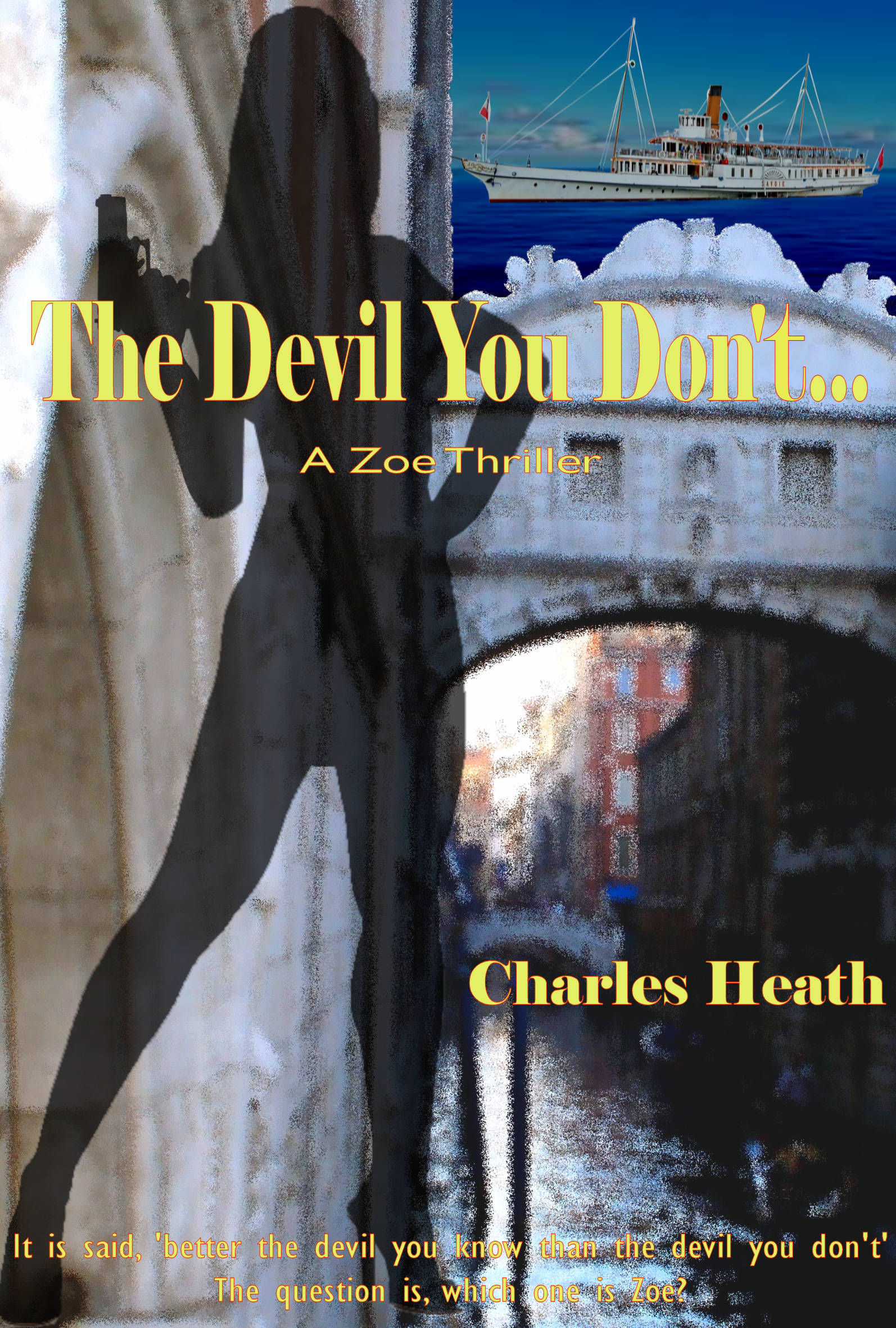
“The Devil You Don’t”, she was the girl you would not take home to your mother!

Now only $0.99 at https://amzn.to/2Xyh1ow

John Pennington’s life is in the doldrums. Looking for new opportunities, and prevaricating about getting married, the only joy on the horizon was an upcoming visit to his grandmother in Sorrento, Italy.

Suddenly he is left at the check-in counter with a message on his phone telling him the marriage is off, and the relationship is over.

If only he hadn’t promised a friend he would do a favour for him in Rome.

At the first stop, Geneva, he has a chance encounter with Zoe, an intriguing woman who captures his imagination from the moment she boards the Savoire, and his life ventures into uncharted territory in more ways than one.

That ‘favour’ for his friend suddenly becomes a life-changing event, and when Zoe, the woman who he knows is too good to be true, reappears, danger and death follow.

Shot at, lied to, seduced, and drawn into a world where nothing is what it seems, John is dragged into an adrenaline-charged undertaking, where he may have been wiser to stay with the ‘devil you know’ rather than opt for the ‘devil you don’t’.

newdevilcvr6