“Trouble in Store” – Short stories my way:  Adding some back story for clarity

I have reworked the first part of the story with a few new elements about the characters and changed a few of the details of how the characters finish up in the shop before the policewoman makes her entrance.

This is part of the new first section is the one that involves the shopkeeper`:


This wasn’t the shopkeeper’s first hold up.  In fact, over the years there had been a dozen.  But only one got reported to the police, and that was only because the robber was shot and killed.

He’d taken a bullet that night, too, which, from the police point of view, made him a concerned citizen simply defending himself.

The rest had been scared off by the double-barrel shotgun he kept under the counter for just such emergencies.

The young punk who came into the shop with his girlfriend had pulled out the pistol and told him if he reached for the shotgun he’d shoot him.  The kid looked unstable and he’d backed away.

When the kid collapsed, he should have gone for the shotgun, but instead, he thought he could get to the gun before the girl realized what was happened.  She wasn’t an addict and clearly looked like she was only along for the ride.  Her expression, when the kid pulled out the gun told him she’d known nothing about her partner’s true intentions.

But, he wasn’t fast enough, and she had the gun pointing at him before he’d got past the counter.

From one pair of unpredictable hands to another.

Like the girl, he was just as surprised when the customer burst in the door, just before closing time.

The situation might have been salvageable before the customer came in the door, getting the girl to go along with the robbery being about money, but there was no denying what the kid on the floor’s problem was.

Damn.

He had to try and salvage the situation simply because there was a lot of money involved, and other people depending on him.  He looked at the boy, on the floor, then the girl.

“Listen to me, young lady, you would be well advised to let this man go as he suggests.  And, please put the gun down before someone gets hurt.  Your friend needs medical help and I can call an ambulance.”

The girl switched her attention back to him.  “No one’s going anywhere, so just shut the hell up and let me think.”

The storekeeper glanced over at the customer. 

He’d seen him come into the shop once or twice, probably lived in the neighborhood, the sort who’d make a reliable witness, either a lawyer or an accountant.  Not like most of the residents just beyond the fringe of respectability.

If only he hadn’t burst into the shop when he did.

© Charles Heath 2016-2020

Memories of the conversations with my cat – 98

As some may be aware, but many not, Chester, my faithful writing assistant, mice catcher, and general pain in the neck, passed away some years ago.

Recently I was running a series based on his adventures, under the title of Past Conversations with my cat.

For those who have not had the chance to read about all of his exploits I will run the series again from Episode 1

These are the memories of our time together…

20160903_163902

This is Chester.  He’s now over having the grandchildren staying with us.

As part of the COVIS 19 restrictions in place, the grandchildren cannot go to school.

However, because their parents are both working (which is very fortunate as so many others are not) they have asked us to look after them.

So, they arrive Sunday night, stay the whole week, and go back home on Friday.  It means they are homeschooling, so the internet is taking a beating, I have to feed them, morning tea, lunch. After school snack at three and then dinner.

Chicken nuggets, pies, and shoestring chips can only go so far, and, no, he does not like scraps from their plates.

And having to cater for four rather than two means a gentle shift in logistics.  More shopping for food, having to do the washing every day, tormenting the cat.

OK, that last part is where Chester comes in, or, rather, he stays hidden away.

Remember that phobia he has when the grandchildren are around?

Now they’re here semi-permanently, he’s in hiding, and coming out only for food and water.

And to let me know just how displeased he is.

He wants his domain back.

Pity I haven’t told him yet they’re going to be back next week.


The cinema of my dreams – Was it just another surveillance job – Episode 64

This story is now on the list to be finished so over the new few weeks, expect a new episode every few days.

The reason why new episodes have been sporadic, there are also other stories to write, and I’m not very good at prioritizing.

But, here we are, a few minutes opened up and it didn’t take long to get back into the groove.

Things are about to get complicated…


There were so many pieces to this puzzle that most of it defied logic.

According to Quigley/O’Connell, Severin and Maury were the security guards at the lab where the USB secrets originated.  Their job had been to make sure the data wasn’t stolen and failed miserably.  But the inference was made that they had helped the person smuggle the data out.

At that time the data was stolen by a male scientist and put on the USB.  That scientist had a wife, Anna. Sometime after the data removal, the male scientist was murdered, and Anna, his wife, got a hold of the USB.

Quigley/O’Connell also asserted that he believed Severin and Maury helped her smuggle the data out of the facility.  Was it possible she was having an affair with one or the other, possibly Severin.  He seemed the more potential candidate.

So fact: data is stolen, data finds its way to Anna, and Severin let her leave the complex with the data.

The next question:  when did the data go up for sale, or, as Quigley/O’Connell said, become available for the newspapers to bid on?  And, following that, when did Dobbin find out, and use O’Connell to arrange for the purchase and delivery of the data.

That then led to when Severin and Maury realised that Anna had double-crossed them because that would be the only reason why they would set up an oversight surveillance team to follow the man they assumed was going to buy the data from Anna.

Why was there a six-month hiatus?  Was it because Anna had to stay in hiding until the ruckus about the theft blew over.  Did the owners of the lab actually tell anyone what had happened?  No, it seems.

So, need to find out why it took six months to seal the deal.

Next fact, Severin’s surveillance operation swings into action when O’Connell; goes to pick up the data.  The date was specific because it had been on Severin’s calendar at the training facility.

The surveillance goes awry.

The café where the meeting is to take place explodes when a bomb goes off.  O’Connell did not go in and was spared.  Whoever was in the café was thought to be killed and the USB was lost.  Later analysis of the CCTV footage at the time showed Anna rising from the ashes.  She still has the USB.

But…

Everyone believed because O’Connell survived the explosion, he had obtained the USB and became the focus of their attention.  And forces the continuation of the surveillance operation, when I tracked him to an alley where he was shot and killed.

Question:  How did the sniper know to be at that alley for the shot?

It is at this point that O’Connell advises he is working for Dobbin.  Thus, Dobbin knows about the USB and the history of it.  Dobbin had arranged to meet O’Connell at that alley, and had he been killed by the sniper or not, was taking him away.  Dobbin no doubt discovers at this point there is no USB in O’Connell’s hands.

Inference:  Dobbin was tracking O’Connell.  He had to be, to know where he was and for his squad to get there so quickly.

New Twist:  O’Connell discovered something about Dobbin, and disappears, presumably to re-hook up with Anna, who is now Josephine.  Dobbin employs me to find O’Connell and the USB but doesn’t say why O’Connell had gone rogue.

Assumption:  Josephine/Anna kills both Severin and Maury.  Why then does she torture Maury before killing him.  He doesn’t have the USB or any information useful to her.

Fact:  Dobbin has Jan on secondment from MI6.  Why, and for what purpose.  Jan is also working with Severin.  Why?  Dobbin says she is using initiative, but what is she after?

Supposition, did Jan kill Severin and Maury.  Based on what I saw at the park when I went to see him, it looked like Jan, but when we caught her, she furiously denied the accusation.  A good act or the truth? 

And if it wasn’t her, then who did kill them, and then more recently O’Connell, and why?

Fact:  Anna still had both the USBs and was running.

Fact:  O’Connell was with Anna up to the point where he was killed.  Logically it had to be Anna, not wanting to share the five million.  Greed trumps common sense.

What was left out of all of this was Monica and what she knew of and was party to, along with her operative, Joanne.  She had always been lurking on the fringe of my investigation, but I was beginning to think I’d been tiled by Joanne the whole time.

They were not in the room, so I had only the people in front of me to fill in the gaps.

© Charles Heath 2020-2023

Writing a book in 365 days – 261

Day 261

A quote by George Sand…

“I knew human nature well enough to depict it; in short, that all of the small tasks of which I was capable, literature, properly speaking, was the one that offered the most chance of success as a profession and – let us not mince words – was the way to earn my bread.”

When the Muse Meets the Mortgage: The Unromantic Truth of My Literary Calling

We’ve all heard the romanticized tales of artists, poets, and writers – struck by inspiration, driven by an insatiable passion, toiling away in garrets for the sheer love of their craft. While there’s undeniable truth to the passion part, there’s another, often unspoken, dimension to the creative life that an ancient, surprisingly honest quote brings into sharp focus:

“I knew human nature well enough to depict it; in short, that all of the small tasks of which I was capable, literature, properly speaking, was the one that offered the most chance of success as a profession and – let us not mince words – was the way to earn my bread.”

Let’s unpack this gem, because it speaks volumes about the pragmatic, often unromantic, journey of finding one’s professional purpose, especially in the arts.

The Unseen Power of Observation

“I knew human nature well enough to depict it.” This isn’t vanity; it’s a profound self-awareness, the very bedrock of a good writer. It speaks to an innate empathy, a keen eye for detail, and an understanding of the intricate dance of human emotions, motivations, and contradictions. Before words can flow, understanding must exist. This is the writer’s superpower: to see beyond the surface, to connect dots, and to translate the universal human experience into relatable narratives.

Many of us possess this kind of observational skill to varying degrees. We notice things others miss. We’re the friends people come to for advice because we “just get it.” For some, this skill is a social asset; for others, it’s the quiet engine of a potential career.

The Litany of “Small Tasks”

“All of the small tasks of which I was capable…” This is where most of us live, isn’t it? We shuffle through life, picking up skills, trying on different hats. We might be competent at a dozen different things – organizing, problem-solving, number-crunching, designing. We can do them, often well enough. But there’s a difference between capability and calling, between competence and conviction.

This phrase beautifully captures the process of elimination. It’s the quiet concession that while we might be able to handle a variety of “small tasks,” none of them ignite that spark, none of them feel like the one. It’s a realistic appraisal of one’s diverse but perhaps diffuse talents, paving the way for the singular realization.

Literature: The Most Probable Path to “Success”

“…literature, properly speaking, was the one that offered the most chance of success as a profession…” This is the pivotal moment. It’s not just about what you love to do, but what you can actually succeed at. And success, in this context, isn’t necessarily about fame or fortune, but about creating a sustainable livelihood from your distinct abilities.

For our anonymous author, the ability to depict human nature wasn’t just a passion; it was a skill that, when applied to literature, offered genuine professional viability. It wasn’t a whimsical choice but a strategic one. “Properly speaking” suggests a serious commitment to the craft – not just dabbling, but mastering the tools, understanding the market (even if that market was different centuries ago), and treating it as a legitimate profession.

It challenges the modern narrative that “following your passion” is enough. Sometimes, passion needs a sturdy bridge of practicality to cross into a career.

Let’s Not Mince Words: Earning My Bread

“…and – let us not mince words – was the way to earn my bread.” This is the mic drop. The raw, beautiful, and utterly human truth. Stripped of all artistic pretense, it comes down to survival. To put food on the table. To pay the rent.

This isn’t a cynical statement; it’s an honest one. For many creatives, the initial lure of their chosen field might be passion or talent, but the sustained effort, the diligent practice, and the strategic career decisions are often fueled by the fundamental need to make a living. There’s immense dignity in earning your bread through your craft, through the very expression of your unique insights and abilities.

The Modern Resonance

This centuries-old observation still holds remarkable power today. How many of us choose our careers not just because we love them, but because through them, we are best equipped to contribute, to find a sense of purpose, and yes, to earn our living?

Perhaps your “literature” isn’t writing stories, but is:

  • Designing elegant user interfaces because you understand human interaction.
  • Building innovative software because you can conceive of efficient systems.
  • Teaching complex subjects because you excel at simplifying knowledge.
  • Crafting beautiful objects because you have an eye for form and function.

The lesson is clear: true professional fulfillment often lies at the intersection of what you’re genuinely good at, what you find meaningful, and what can realistically sustain you. It’s less about a lightning bolt of inspiration and more about a thoughtful, pragmatic assessment of your unique place in the world, and how best to earn your bread with the gifts you possess.

So, what’s your “literature”? What’s the one thing, among all the small tasks you’re capable of, that truly offers you a chance at success, and allows you to earn your bread, no mincing of words required?

Searching for locations: A trip to Newark, New Jersey. USA

That meant we had to make the journey from New York to New Jersey, by train.  It involved the underground, or as New Yorkers call it, the subway, from Columbus Circle which by any other name was really, 80th street, to 34th street which apparently was the New Jersey jump-off point for us to get overground, well a lot of it was overground. So, were we going uptown or downtown?

Apparently, it was downtown, and to 34th Street on the A train.

You would not think this to be a difficult task, but for people not used to the subway, and where they were going other than some internet derived instructions, but without the help of a man at the station, just getting tickets may have stopped us dead in our tracks.  With his help, we determined the return fare for three of us and then get through the turnstile onto the platform.

We get on the A train, but soon discover it was not stopping at all stations.  There was for a few minutes, a little apprehension we might just simply bypass our station.  Luckily we did not.

Now, finding your way to the New Jersey transit part of Penn station might appear to be easy, on paper, but once there, on the ground, and mingling with the other passengers which all seemed to be purpose going somewhere, it took a few moments to realize we had to follow the New Jersey transit signs.

This led to a booking hall where luckily we realized we needed to buy more tickets, then find the appropriate platform, and then get on the right train, all of which, in the end, was not difficult at all.

Maybe on the return trip, it might be.

At Newark Penn station it was momentarily confusing because the exit was not readily in sight, so it was a case of following the majority of other passengers who’d got off the train.

This led us to exit onto the street under the train tracks.  Luckily, having been before to Prudential Stadium to buy the tickets, we knew what the stadium looked like and roughly where it was, so it was a simple task to walk towards it.

We were early, so it was a case of finding a restaurant to get dinner before the game. So was a great many others, and we passed about 6 different restaurants that looked full to overflowing before we stopped at one called Novelty Burger and Bar.

It looked inviting, and it was not crowded.

It was yet another excuse to have a hamburger and beer, both of which seemed to be a specialty in American.  I could not fault either.

And soon after we arrived, this restaurant too was full to overflowing.  Thankfully there were other Maple Leaf fans there because being in a room full of opposition teams supports can be quite harrowing.

That was yet to come when we finally got to the stadium.  I was not expecting a lot of Maple Leaf fans.
We went to this game with high hopes.  New Jersey Devils were not exactly at the top of the leader board, and coming off the loss in Toronto, this was make or break for whether we would ever go to another game.

It’s remarkable in that all the Ice Hockey stadiums are the same.  Everyone has an excellent view of the game, the sound systems are loud, and the fans passionate. Here it seems to be a thing to ride on the Zambonis.
At the front door they were handing out figurines of a Devil’s past player, and it seems a thing that you get a handout of some sort at each game.  At Toronto we got towels. And, finally, we were in luck.

The Maple Leafs won.

And it was an odd feeling to know that even though their team lost, there did not seem to be any rancor amount the fans and that any expectation of being assaulted by losing fans was totally unfounded, unlike some sporting events I’ve been to.

Perhaps soccer should take a leaf out of the ice hockey playbook.

That also went for taking public transport late at night.  I did not have any fears about doing so, which is more than I can say about traveling at night on our own transport system back home.

Oh, and by the way, there are train conductors who still come to every passenger to collect or stamp their tickets.  No trusting the passenger has paid for his trip here.  And, if you don’t have a ticket, I have it on good authority they throw you off the train and into the swamp.  Good thing then, we had tickets.

It was, all in all, a really great day.

What I learned about writing: What’s that coming out of left field?

The Unscheduled Genius: Why Your Best Ideas Always Arrive at the Worst Time

Ever notice how the universe, especially the creative part of it, seems to have a mischievous sense of humor? You meticulously plan your “creative time” – perhaps a tranquil morning, a dedicated hour in your study, or a quiet walk designed to invite inspiration. You set the stage, dim the lights, perhaps even put on some Ravel. And what happens? Crickets. Or worse, a sudden surge of thoughts about what you need from the grocery store.

But then, just when you’re least prepared, least expecting it, and frankly, least wanting it… bing!

The Myth of the “Planned” Muse

We try, don’t we? We attempt to “train our thoughts.” Like you, I’ve tried to cultivate that sacred shower routine, where warm water and the hum of the fan are supposed to unlock the subconscious. Or that quiet spot in the lounge, by the window, away from the digital din. It’s an idyllic vision of creative flow.

You close your eyes, drift along to classical music, patiently waiting for the imagination to kick in. You can’t force it, you know this. It’s a delicate dance, a subtle invitation. But more often than not, the muse remains stubbornly elusive, probably off having a coffee with procrastination.

Modern Life’s Cruel Interventions

And just when you do manage to carve out a moment of potential quiet, the modern world intervenes with a jarring cacophony. That quiet spot by the window? Now it’s a battleground against the relentless chime of the phone, those infuriating scam calls threatening to sever your internet, your telephone – practically every wire that comes into the house. Don’t you just hate that? It’s enough to make you disconnect everything, not just from the internet, but from society itself!

It’s ironic, isn’t it? We create these zones of peace, only for them to be invaded by the very chaos we’re trying to escape.

The “Bing!” Moment: A Master of Inconvenience

The truly infuriating part is that you weren’t even considering a new idea. You’re like me; you’ve already got so many books, so many projects “on the go” that the thought of another one feels like a mild existential threat. But the sad truth is, you have no control over it.

And then it happens.

Five minutes to three. After a frantic call announcing yet another storm in a teacup. You’re racing out the door, setting the alarm, locking the door, keys in hand, mind a whirlwind of imminent tasks and minor crises. Your focus is entirely on the next urgent thing. And then… bing.

The idea is there. Out of left field. Fully formed, shimmering in front of you, a complete narrative arc or a brilliant solution to a plot hole you hadn’t even realized existed. It’s a cruel joke of the brain, choosing the most inconvenient stage for its grand unveiling.

Embracing the Chaos (and Your Phone)

So, what’s a creative soul to do in this beautifully messy dance with inspiration? You adapt. You become a ninja of spontaneous capture. That phone, once a source of incessant distraction and scammer threats, transforms into your saving grace.

Good thing modern technology enables us to speak and drive, to solve all manner of crises and record nascent masterpieces on the go. You’re dictating plot points into your voice notes while navigating traffic, sketching characters mentally during a grocery run, or outlining an entire scene while waiting for the kettle to boil.

Perhaps the trick isn’t to force inspiration into our meticulously planned schedules, but to be ready for it when it inevitably ambushes us. The muse, it seems, thrives on the unexpected, on the edges of chaos, on the very moments when our minds are momentarily released from the rigid confines of expectation.

So next time an idea strikes while you’re battling traffic, dodging scammers, or mid-sprint to an appointment, don’t fight it. Embrace the “bing!” and know you’re not alone in this beautiful, chaotic journey.

Take that, Superman, Batman, Spiderman! We may not fly, but we can capture genius on the run. And let’s be honest, that’s a superpower all its own.

An excerpt from “Amnesia”, a work in progress

I remembered a bang.

I remembered the car slewing sideways.

I remember another bang, and then it was lights out.

When I opened my eyes again, I saw the sky.

Or I could be underwater.

Everything was blurred.

I tried to focus but I couldn’t. My eyes were full of water.

What happened?

Why was I lying down?

Where was I?

I cast my mind back, trying to remember.

It was a blank.

What, when, who, why and where, are questions I should easily be able to answer. These are questions any normal person could answer.

I tried to move. Bad, bad mistake.

I did not realise the scream I heard was my own. Just before my body shut down.

“My God! What happened?”

I could hear, not see. I was moving, lying down, looking up.

I was blind. Everything was black.

“Car accident; hit a tree, sent the passenger flying through the windscreen. Pity to poor bastard didn’t get the message that seat belts save lives.”

Was I that poor bastard?

“Report?” A new voice, male, authoritative.

“Multiple lacerations, broken collar bone, broken arm in three places, both legs broken below the knees, one badly. We are not sure of internal injuries, but ruptured spleen, cracked ribs and pierced right lung are fairly evident, x-rays will confirm that and anything else.”

“What isn’t broken?”

“His neck.”

“Then I would have to say we are looking at the luckiest man on the planet.”

I heard the shuffling of pages.

“OR1 ready?”

“Yes. On standby since we were first advised.”

“Good. Let’s see if we can weave some magic.”

Magic.

It was the first word that popped into my head when I surfaced from the bottom of the lake. That first breath, after holding it for so long, was sublime, and, in reality, agonising.

Magic, because it seemed like I’d spent a long time underwater.

Or somewhere.

I tried to speak but couldn’t. The words were just in my head.

Was it night or was it day?

Was it hot, or was it cold?

Where was I?

Around me, it felt cool.

It was incredibly quiet. No noise except for the hissing of air through an air-conditioning vent. Or that was the sound of pure silence.  And with it the revelation that silence was not silent. It was noisy.

I didn’t try to move.

Instinctively, somehow, I knew not to.

A previous unpleasant experience?

I heard what sounded like a door opening, and noticeably quiet footsteps slowly came into the room. They stopped. I could hear breathing, slightly laboured, a sound I’d heard before.

My grandfather.

He had smoked all his life until he was diagnosed with lung cancer. But for years before that he had emphysema. The person in the room was on their way, down the same path. I could smell the smoke.

I wanted to tell whoever it was the hazards of smoking.

I couldn’t.

I heard a metallic clanging sound from the end of the bed. A moment later the clicking of a pen, then writing.

“You are in a hospital.” A female voice suddenly said. “You’ve been in a bad accident. You cannot talk, or move, all you can do, for the moment, is listen to me. I am a nurse. You have been here for 45 days and just came out of a medically induced coma. There is nothing to be afraid of.”

She had a very soothing voice.

Her fingers stroked the back of my hand.

“Everything is fine.”

Define fine, I thought. I wanted to ask her what ‘fine’ meant.

“Just count backwards from 10.”

Why?

I didn’t reach seven.

Over the next ten days, that voice became my lifeline to sanity. Every morning, I longed to hear it, if only for the few moments she was in the room, those few waking moments when I believed she, and someone else who never spoke, were doing tests. I knew it had to be someone else because I could smell the essence of lavender. My grandmother had worn a similar scent.

It rose above the disinfectant.

She was another doctor, not the one who had been there the day I arrived. Not the one who had used some ‘magic’ and kept me alive.

It was then, in those moments before she put me under again, that I thought, what if I was paralysed? It would explain a lot. A chill went through me.

The next morning, she was back.

“My name is Winifred. We don’t know what your name is, not yet. In a few days, you will be better, and you will be able to ask us questions. You were in an accident, and you were very severely injured, but I can assure you there will be no lasting damage.”

More tests, and then when I expected the lights to go out, they didn’t. Not for a few minutes more. This was how I would be integrated back into the world. A little bit at a time.

The next morning, she came later than usual, and I’d been awake for a few minutes. “You have bandages over your eyes and face. You had bad lacerations to your face, and glass in your eyes. We will know more when the bandages come off in a few days. Your face will take longer to heal. It was necessary to do some plastic surgery.”

Lacerations, glass in my eyes, car accidents, plastic surgery. By logical deduction, I knew I was the poor bastard thrown through the windscreen. It was a fleeting memory from the day I was admitted.

How could that happen?

That was the first of many startling revelations. The second was the fact I could not remember the crash. Equally shocking, in that same moment was the fact I could not remember before the crash either, or only vague memories after.

But the most shattering of all these revelations was the one where I realised, I could not remember my name.

I tried to calm down, sensing a rising panic.

I was just disoriented, I told myself. After 45 days in an induced coma, it had messed with my mind, and it was only a temporary lapse. Yes, that’s what it was, a temporary lapse. I will remember tomorrow. Or the next day.

Sleep was a blessed relief.

The next day I didn’t wake up feeling nauseous. I think they’d lowered the pain medication. I’d heard that morphine could have that effect. Then, how could I know that but not who I am?

Now I knew Winifred the nurse was preparing me for something unbelievably bad. She was upbeat, and soothing, giving me a new piece of information each morning. This morning, “You do not need to be afraid. Everything is going to be fine. The doctor tells me you are going to recover with little scarring. You will need some physiotherapy to recover from your physical injuries, but that’s in the future. We need to let you mend a little bit more before then.”

So, I was not going to be able to leap out of bed and walk out of the hospital any time soon. I don’t suppose I’d ever leapt out of bed, except as a young boy. I suspect I’d sustained a few broken bones. I guess learning to walk again was the least of my problems.

But there was something else. I picked it up in the timbre of her voice, a hesitation, or reluctance. It sent another chill through me.

This time I was left awake for an hour before she returned.

This time sleep was restless.

Scenes were playing in my mind, nothing I recognised, and nothing lasting longer than a glimpse. Me. Others, people I didn’t know. Or I knew them and couldn’t remember them.

Until they disappeared, slowly like the glowing dot in the centre of the computer screen, before finally fading to black.

The morning the bandages were to come off she came in early and woke me. I had another restless night, the images becoming clearer, but nothing recognisable.

“This morning the doctor will be removing the bandages over your eyes. Don’t expect an immediate effect. Your sight may come back quickly, or it may come back slowly, but we believe it will come back.”

I wanted to believe I was not expecting anything, but I was. It was human nature. I did not want to be blind as well as paralysed. I had to have at least one reason to live.

I dozed again until I felt a gentle hand on my shoulder. I could smell the lavender; the other doctor was back. And I knew the hand on my shoulder was Winifred’s. She told me not to be frightened.

I was amazed to realise at that moment, I wasn’t.

I heard the scissors cutting the bandages.

I felt the bandage being removed, and the pressure coming off my eyes. I could feel the pads covering both eyes.

Then a moment when nothing happened.

Then the pads are gently lifted and removed.

Nothing.

I blinked my eyes, once, twice. Nothing.

“Just hold on a moment,” Winifred said. A few seconds later I could feel a cool towel wiping my face, and then gently wiping my eyes. There was ointment or something else in them.

Then a flash. Well, not a flash, but like when a light is turned on and off. A moment later, it was brighter, not the inky blackness of before, but a shade of grey.

She wiped my eyes again.

I blinked a few more times, and then the light returned, and it was like looking through water, at distorted and blurry objects in the distance.

I blinked again, and she wiped my eyes again.

Blurry objects took shape. A face looking down on me, an elderly lady with a kindly face, surely Winifred, who was smiling. And on the opposite side of the bed, the doctor, a Chinese woman of indescribable beauty.

I nodded.

“You can see?”

I nodded again.

“Clearly?”

I nodded.

“Very good. We will just draw the curtains now. We don’t want to overdo it. Tomorrow we will be taking off the bandages on your face. Then, it will be the next milestone. Talking.”

I couldn’t wait.

When morning came, I found myself afraid. Winifred had mentioned scarring, there were bandages on my face. I knew, but wasn’t quite sure how I knew, I wasn’t the most handsome of men before the accident, so this might be an improvement.

I was not sure why I didn’t think it would be the case.

They came at mid-morning, the nurse, Winifred, and the doctor, the exquisite Chinese. She was the distraction, taking my mind off the reality of what I was about to see.

Another doctor came into the room before the bandages were removed, and he was introduced as the plastic surgeon who had ‘repaired’ the ravages of the accident. It had been no easy job, but, with a degree of egotism, he did say he was one of the best in the world.

I found it hard to believe, if he were, that he would be at a small country hospital.

“Now just remember, what you might see now is not how you will look in a few months.”

Warning enough.

The Chinese doctor started removing the bandages. She did it slowly and made sure it did not hurt. My skin was very tender, and I suspect still bruised, either from the accident or the surgery, I didn’t know.

Then it was done.

The plastic surgeon gave his work a thorough examination and seemed pleased with his work. “Coming along nicely,” he said to the other doctor. He issued some instructions on how to manage the skin, nodded to me, and I thanked him before he left.

I noticed Winifred had a mirror in her hand and was reticent in using it. “As I said,” she said noticing me looking at the mirror, “what you see now will not be the result. The doctor said it was going to heal with little scarring. You have been extremely fortunate he was available. Are you ready?”

I nodded.

She showed me.

I tried not to be reviled at the red and purple mess that used to be my face. At a guess, I would have to say he had to put it all back together again, but not knowing what I looked like before, I had no benchmark. All I had was a snippet of memory that told me I was not the tall, dark, and handsome type.

And I still could not talk. There was a reason, he had worked in that area too. Just breathing hurt. I think I would save up anything I had to say for another day. I could not even smile. Or frown. Or grimace.

“We’ll leave you for a while. Everyone needs a little time to get used to the change. I suspect you are not sure if there has been an improvement in last year’s model. Well, time will tell.”

A new face?

I could not remember the old one.

My memory still hadn’t returned.

©  Charles Heath  2024

Searching for locations: A typical diner, New York. USA

We decided to have lunch in a traditional Diner.

On an early morning walk, I discovered the Brooklyn Diner, a small restaurant tucked away in a street not far from Columbus Circle, perhaps a piece of history from the American past.

After all, if you’re going to take in the sights, sounds, and food of a country what better way to do it than visiting what was once a tradition.

This one was called the Brooklyn Diner.  It had a combination of booths and counter sit down, though the latter was not a very big space, so we opted for a booth.

The object of going to a Diner is the fact they serve traditional American food, which when you get past the hot dogs and hamburgers and fries, takes the form of turkey and chicken pot pies among a variety of other choices.

Still looking for a perfectly cooked turkey, something I’ve never been able to do myself, I opted for the Teadition Turkey Lunch, which the menu invitingly said was cooked especially at the diner and was succulent.  I couldn’t wait.

We also ordered a hamburger, yes, yet another, and a chicken pot pie, on the basis the last one I had in Toronto was absolutely delicious (and cooked the same way since the mid-1930s)

While waiting we got to look at a slice of history belonging to another great American tradition, Baseball, a painting on the wall of the Brooklyn Dodgers at Ebbets field, long since gone from their home.

The Turnkey lunch looked like this

which didn’t seem to be much, and had this odd pasta slice on the plate, but the turkey was amazing and lived up to the menu description.

The Chicken Pot Pie looked like this

And looked a lot larger in reality than the photo shows.

But, sadly while it was not bad, it was a little dry, and could possibly do with using the more succulent thigh part of the chicken.

All of this was washed down by Long Island Ice Teas and Brooklyn Lager.

AS for the Diner experience, it’s definitely a 10 out of 10 for me.

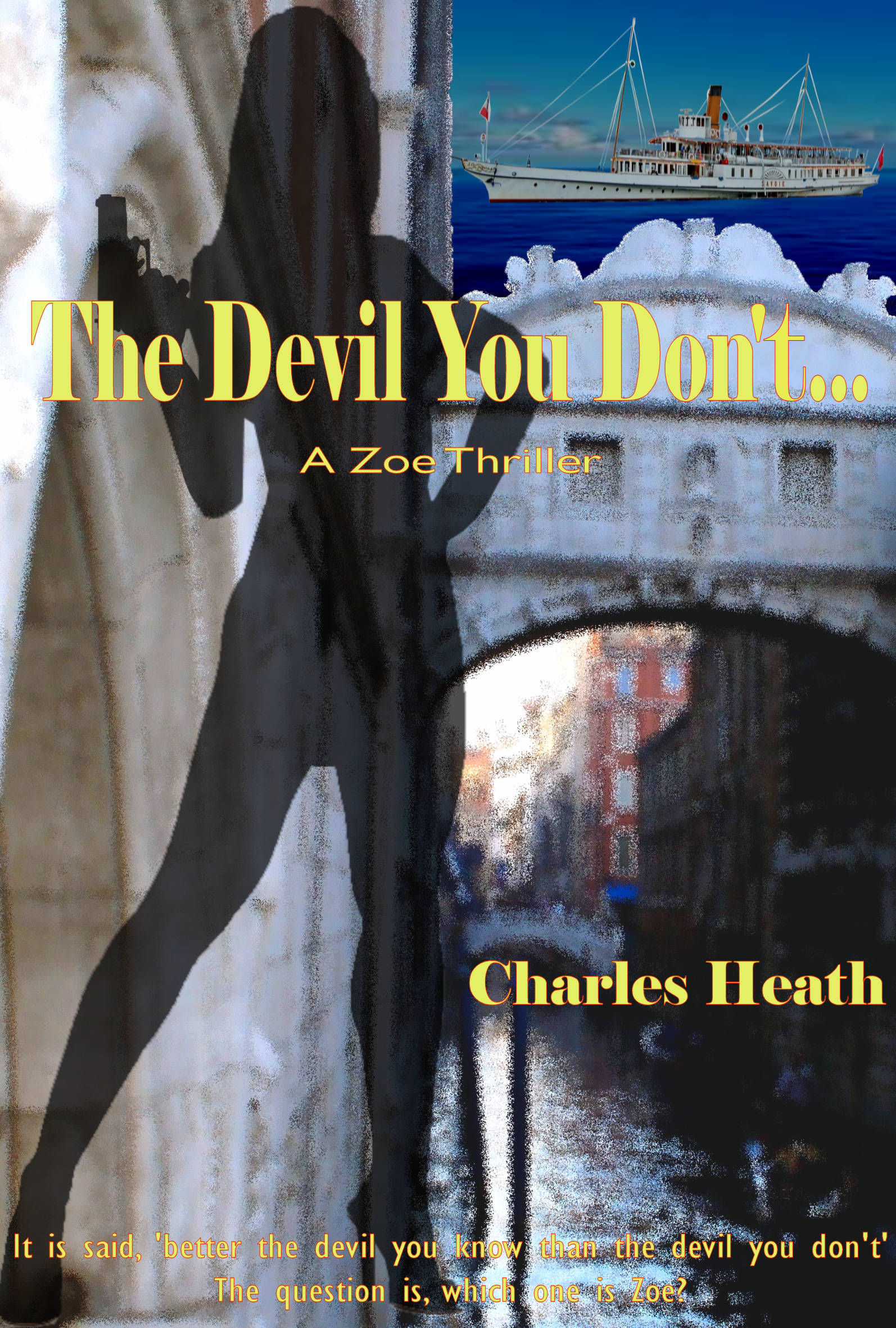
“The Devil You Don’t”, she was the girl you would not take home to your mother!

Now only $0.99 at https://amzn.to/2Xyh1ow

John Pennington’s life is in the doldrums. Looking for new opportunities, and prevaricating about getting married, the only joy on the horizon was an upcoming visit to his grandmother in Sorrento, Italy.

Suddenly he is left at the check-in counter with a message on his phone telling him the marriage is off, and the relationship is over.

If only he hadn’t promised a friend he would do a favour for him in Rome.

At the first stop, Geneva, he has a chance encounter with Zoe, an intriguing woman who captures his imagination from the moment she boards the Savoire, and his life ventures into uncharted territory in more ways than one.

That ‘favour’ for his friend suddenly becomes a life-changing event, and when Zoe, the woman who he knows is too good to be true, reappears, danger and death follow.

Shot at, lied to, seduced, and drawn into a world where nothing is what it seems, John is dragged into an adrenaline-charged undertaking, where he may have been wiser to stay with the ‘devil you know’ rather than opt for the ‘devil you don’t’.

newdevilcvr6

Writing a book in 365 days – 261

Day 261

A quote by George Sand…

“I knew human nature well enough to depict it; in short, that all of the small tasks of which I was capable, literature, properly speaking, was the one that offered the most chance of success as a profession and – let us not mince words – was the way to earn my bread.”

When the Muse Meets the Mortgage: The Unromantic Truth of My Literary Calling

We’ve all heard the romanticized tales of artists, poets, and writers – struck by inspiration, driven by an insatiable passion, toiling away in garrets for the sheer love of their craft. While there’s undeniable truth to the passion part, there’s another, often unspoken, dimension to the creative life that an ancient, surprisingly honest quote brings into sharp focus:

“I knew human nature well enough to depict it; in short, that all of the small tasks of which I was capable, literature, properly speaking, was the one that offered the most chance of success as a profession and – let us not mince words – was the way to earn my bread.”

Let’s unpack this gem, because it speaks volumes about the pragmatic, often unromantic, journey of finding one’s professional purpose, especially in the arts.

The Unseen Power of Observation

“I knew human nature well enough to depict it.” This isn’t vanity; it’s a profound self-awareness, the very bedrock of a good writer. It speaks to an innate empathy, a keen eye for detail, and an understanding of the intricate dance of human emotions, motivations, and contradictions. Before words can flow, understanding must exist. This is the writer’s superpower: to see beyond the surface, to connect dots, and to translate the universal human experience into relatable narratives.

Many of us possess this kind of observational skill to varying degrees. We notice things others miss. We’re the friends people come to for advice because we “just get it.” For some, this skill is a social asset; for others, it’s the quiet engine of a potential career.

The Litany of “Small Tasks”

“All of the small tasks of which I was capable…” This is where most of us live, isn’t it? We shuffle through life, picking up skills, trying on different hats. We might be competent at a dozen different things – organizing, problem-solving, number-crunching, designing. We can do them, often well enough. But there’s a difference between capability and calling, between competence and conviction.

This phrase beautifully captures the process of elimination. It’s the quiet concession that while we might be able to handle a variety of “small tasks,” none of them ignite that spark, none of them feel like the one. It’s a realistic appraisal of one’s diverse but perhaps diffuse talents, paving the way for the singular realization.

Literature: The Most Probable Path to “Success”

“…literature, properly speaking, was the one that offered the most chance of success as a profession…” This is the pivotal moment. It’s not just about what you love to do, but what you can actually succeed at. And success, in this context, isn’t necessarily about fame or fortune, but about creating a sustainable livelihood from your distinct abilities.

For our anonymous author, the ability to depict human nature wasn’t just a passion; it was a skill that, when applied to literature, offered genuine professional viability. It wasn’t a whimsical choice but a strategic one. “Properly speaking” suggests a serious commitment to the craft – not just dabbling, but mastering the tools, understanding the market (even if that market was different centuries ago), and treating it as a legitimate profession.

It challenges the modern narrative that “following your passion” is enough. Sometimes, passion needs a sturdy bridge of practicality to cross into a career.

Let’s Not Mince Words: Earning My Bread

“…and – let us not mince words – was the way to earn my bread.” This is the mic drop. The raw, beautiful, and utterly human truth. Stripped of all artistic pretense, it comes down to survival. To put food on the table. To pay the rent.

This isn’t a cynical statement; it’s an honest one. For many creatives, the initial lure of their chosen field might be passion or talent, but the sustained effort, the diligent practice, and the strategic career decisions are often fueled by the fundamental need to make a living. There’s immense dignity in earning your bread through your craft, through the very expression of your unique insights and abilities.

The Modern Resonance

This centuries-old observation still holds remarkable power today. How many of us choose our careers not just because we love them, but because through them, we are best equipped to contribute, to find a sense of purpose, and yes, to earn our living?

Perhaps your “literature” isn’t writing stories, but is:

  • Designing elegant user interfaces because you understand human interaction.
  • Building innovative software because you can conceive of efficient systems.
  • Teaching complex subjects because you excel at simplifying knowledge.
  • Crafting beautiful objects because you have an eye for form and function.

The lesson is clear: true professional fulfillment often lies at the intersection of what you’re genuinely good at, what you find meaningful, and what can realistically sustain you. It’s less about a lightning bolt of inspiration and more about a thoughtful, pragmatic assessment of your unique place in the world, and how best to earn your bread with the gifts you possess.

So, what’s your “literature”? What’s the one thing, among all the small tasks you’re capable of, that truly offers you a chance at success, and allows you to earn your bread, no mincing of words required?