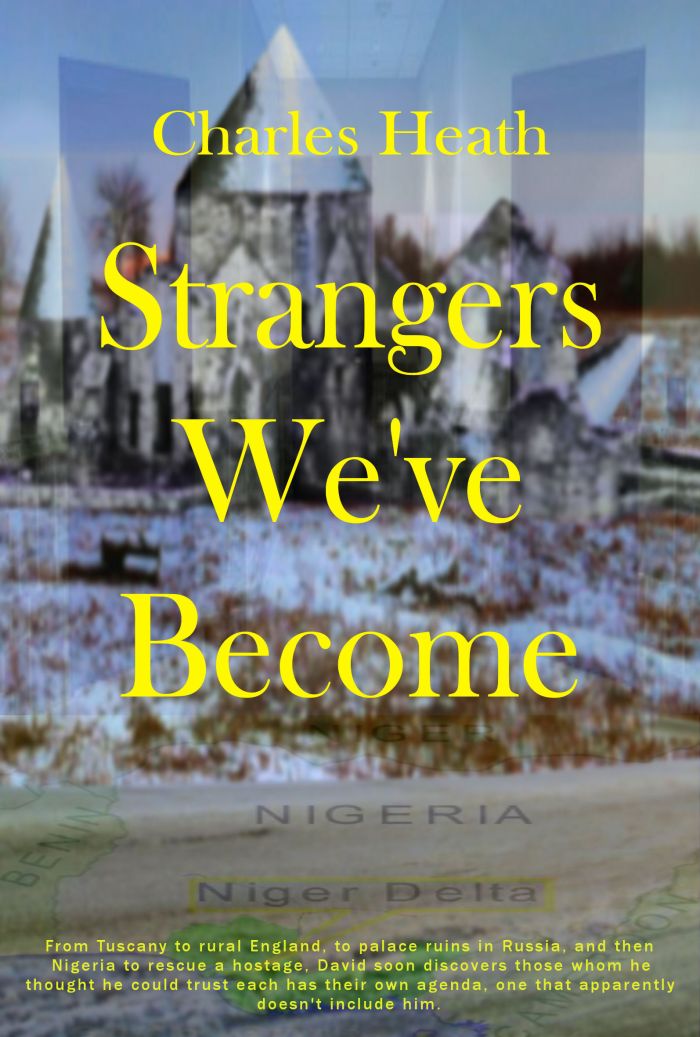
An excerpt from “Strangers We’ve Become” – Coming Soon

I wandered back to my villa.

It was in darkness.  I was sure I had left several lights on, especially over the door so I could see to unlock it.

I looked up and saw the globe was broken.

Instant alert.

I went to the first hiding spot for the gun, and it wasn’t there.  I went to the backup and it wasn’t there either.  Someone had found my carefully hidden stash of weapons and removed them.

Who?

There were four hiding spots and all were empty.  Someone had removed the weapons.  That could only mean one possibility.

I had a visitor, not necessarily here for a social call.

But, of course, being the well-trained agent I’d once been and not one to be caught unawares, I crossed over to my neighbor and relieved him of a weapon that, if found, would require a lot of explaining.

Suitably armed, it was time to return the surprise.

There were three entrances to the villa, the front door, the back door, and a rather strange escape hatch.  One of the more interesting attractions of the villa I’d rented was its heritage.  It was built in the late 1700s, by a man who was, by all accounts, a thief.  It had a hidden underground room which had been in the past a vault but was now a wine cellar, and it had an escape hatch by which the man could come and go undetected, particularly if there was a mob outside the door baying for his blood.

It now gave me the means to enter the villa without my visitors being alerted, unless, of course, they were near the vicinity of the doorway inside the villa, but that possibility was unlikely.  It was not where anyone could anticipate or expect a doorway to be.

The secret entrance was at the rear of the villa behind a large copse, two camouflaged wooden doors built into the ground.  I move aside some of the branches that covered them and lifted one side.  After I’d discovered the doors and rusty hinges, I’d oiled and cleaned them, and cleared the passageway of cobwebs and fallen rocks.  It had a mildew smell, but nothing would get rid of that.  I’d left torches at either end so I could see.

I closed the door after me, and went quietly down the steps, enveloped in darkness till I switched on the torch.  I traversed the short passage which turned ninety degrees about halfway to the door at the other end.  I carried the key to this door on the keyring, found it and opened the door.  It too had been oiled and swung open soundlessly.

I stepped in the darkness and closed the door.

I was on the lower level under the kitchen, now the wine cellar, the ‘door’ doubling as a set of shelves which had very little on them, less to fall and alert anyone in the villa.

Silence, an eerie silence.

I took the steps up to the kitchen, stopping when my head was level with the floor, checking to see if anyone was waiting.  There wasn’t.  It seemed to me to be an unlikely spot for an ambush.

I’d already considered the possibility of someone coming after me, especially because it had been Bespalov I’d killed, and I was sure he had friends, all equally as mad as he was.  Equally, I’d also considered it nigh on impossible for anyone to find out it was me who killed him because the only people who knew that were Prendergast, Alisha, a few others in the Department, and Susan.

That raised the question of who told them where I was.

If I was the man I used to be, my first suspect would be Susan.  The departure this morning, and now this was too coincidental.  But I was not that man.

Or was I?

I reached the start of the passageway that led from the kitchen to the front door and peered into the semi-darkness.  My eyes had got used to the dark, and it was no longer an inky void.  Fragments of light leaked in around the door from outside and through the edge of the window curtains where they didn’t fit properly.  A bone of contention upstairs in the morning, when first light shone and invariably woke me up hours before I wanted to.

Still nothing.

I took a moment to consider how I would approach the visitor’s job.  I would get a plan of the villa in my head, all entrances, where a target could be led to or attacked where there would be no escape.

Coming in the front door.  If I was not expecting anything, I’d just open the door and walk-in.  One shot would be all that was required.

Contract complete.

I sidled quietly up the passage staying close to the wall, edging closer to the front door.  There was an alcove where the shooter could be waiting.  It was an ideal spot to wait.

Crunch.

I stepped on some nutshells.

Not my nutshells.

I felt it before I heard it.  The bullet with my name on it.

And how the shooter missed, from point-blank range, and hit me in the arm, I had no idea.  I fired off two shots before a second shot from the shooter went wide and hit the door with a loud thwack.

I saw a red dot wavering as it honed in on me and I fell to the floor, stretching out, looking up where the origin of the light was coming and pulled the trigger three times, evenly spaced, and a second later I heard the sound of a body falling down the stairs and stopping at the bottom, not very far from me.

Two assassins.

I’d not expected that.

The assassin by the door was dead, a lucky shot on my part.  The second was still breathing.

I checked the body for any weapons and found a second gun and two knives.  Armed to the teeth!

I pulled off the balaclava; a man, early thirties, definitely Italian.  I was expecting a Russian.

I slapped his face, waking him up.  Blood was leaking from several slashes on his face when his head had hit the stairs on the way down.  The awkward angle of his arms and legs told me there were broken bones, probably a lot worse internally.  He was not long for this earth.

“Who employed you?”

He looked at me with dead eyes, a pursed mouth, perhaps a smile.  “Not today my friend.  You have made a very bad enemy.”  He coughed and blood poured out of his mouth.  “There will be more …”

Friends of Bespalov, no doubt.

I would have to leave.  Two unexplainable bodies, I’d have a hard time explaining my way out of this mess.  I dragged the two bodies into the lounge, clearing the passageway just in case someone had heard anything.

Just in case anyone was outside at the time, I sat in the dark, at the foot of the stairs, and tried to breathe normally.  I was trying not to connect dots that led back to Susan, but the coincidence was worrying me.

A half-hour passed and I hadn’t moved.  Deep in thought, I’d forgotten about being shot, unaware that blood was running down my arm and dripping onto the floor.

Until I heard a knock on my front door.

Two thoughts, it was either the police, alerted by the neighbors, or it was the second wave, though why would they be knocking on the door?

I stood, and immediately felt a stabbing pain in my arm.  I took out a handkerchief and turned it into a makeshift tourniquet, then wrapped a kitchen towel around the wound.

If it was the police, this was going to be a difficult situation.  Holding the gun behind my back, I opened the door a fraction and looked out.

No police, just Maria.  I hoped she was not part of the next ‘wave’.

“You left your phone behind on the table.  I thought you might be looking for it.”  She held it out in front of her.

When I didn’t open the door any further, she looked at me quizzically, and then asked, “Is anything wrong?”

I was going to thank her for returning the phone, but I heard her breathe in sharply, and add, breathlessly, “You’re bleeding.”

I looked at my arm and realized it was visible through the door, and not only that, the towel was soaked in blood.

“You need to go away now.”

Should I tell her the truth?  It was probably too late, and if she was any sort of law-abiding citizen she would go straight to the police.

She showed no signs of leaving, just an unnerving curiosity.  “What happened?”

I ran through several explanations, but none seemed plausible.  I went with the truth.  “My past caught up with me.”

“You need someone to fix that before you pass out from blood loss.  It doesn’t look good.”

“I can fix it.  You need to leave.  It is not safe to be here with me.”

The pain in my arm was not getting any better, and the blood was starting to run down my arm again as the tourniquet loosened.  She was right, I needed it fixed sooner rather than later.

I opened the door and let her in.  It was a mistake, a huge mistake, and I would have to deal with the consequences.  Once inside, she turned on the light and saw the pool of blood just inside the door and the trail leading to the lounge.  She followed the trail and turned into the lounge, turned on the light, and no doubt saw the two dead men.

I expected her to scream.  She didn’t.

She gave me a good hard look, perhaps trying to see if I was dangerous.  Killing people wasn’t something you looked the other way about.  She would have to go to the police.

“What happened here?”

“I came home from the cafe and two men were waiting for me.  I used to work for the Government, but no longer.  I suspect these men were here to repay a debt.  I was lucky.”

“Not so much, looking at your arm.”

She came closer and inspected it.

“Sit down.”

She found another towel and wrapped it around the wound, retightening the tourniquet to stem the bleeding.

“Do you have medical supplies?”

I nodded.  “Upstairs.”  I had a medical kit, and on the road, I usually made my own running repairs.  Another old habit I hadn’t quite shaken off yet.

She went upstairs, rummaged, and then came back.  I wondered briefly what she would think of the unmade bed though I was not sure why it might interest her.

She helped me remove my shirt, and then cleaned the wound.  Fortunately, she didn’t have to remove a bullet.  It was a clean wound but it would require stitches.

When she’d finished she said, “Your friend said one day this might happen.”

No prizes for guessing who that friend was, and it didn’t please me that she had involved Maria.

“Alisha?”

“She didn’t tell me her name, but I think she cares a lot about you.  She said trouble has a way of finding you, gave me a phone and said to call her if something like this happened.”

“That was wrong of her to do that.”

“Perhaps, perhaps not.  Will you call her?”

“Yes.  I can’t stay here now.  You should go now.  Hopefully, by the time I leave in the morning, no one will ever know what happened here, especially you.”

She smiled.  “As you say, I was never here.”

© Charles Heath 2018-2022

strangerscover9

Top 5 sights on the road less travelled – Crete

Crete is a large island with many stunning locations that are far from the main tourist crowds. To help you on your road less travelled, here are five “next best” places and activities offering unique and authentic Cretan experiences.


1. Loutro: The Car-Free Seaside Village

Loutro is one of Crete’s most idyllic hidden gems, tucked away on the southwest coast. It is famously accessible only by boat or on foot, ensuring its protected, tranquil, and car-free atmosphere.

  • What makes it “Road Less Travelled”: The inability to drive directly to the village makes it a natural barrier to mass tourism. It feels like a remote, car-free island escape.
  • Activity: Relax on the small pebble beach, swim in the turquoise waters of the Libyan Sea, or use it as a base to hike to nearby coastal attractions.

2. Sarakina Gorge: The Hidden Canyon

While Samaria Gorge is famous and crowded, the Sarakina Gorge (sometimes called Sarantapichos Gorge) offers a shorter, equally stunning, and much less-trafficked hiking adventure in southeastern Crete, near the village of Mithi.

  • What makes it “Road Less Travelled”: It’s often overlooked by tourists heading to the larger, better-known gorges, offering a raw, untouched hiking experience.
  • Activity: Hike through the narrow canyon. Be prepared for a challenging trek that involves crossing the riverbed and may require wading through water in some sections, depending on the season.

3. Xerokampos: The Unspoilt Beaches of the East

Located on the far eastern coast of Crete, Xerokampos is a small, quiet settlement known for its collection of unspoilt, undeveloped beaches. The drive there is winding and remote, contributing to its solitude.

  • What makes it “Road Less Travelled”: Its remote location requires a dedicated drive on mountain roads, meaning few constructions and a distinct lack of crowds, even during high season.
  • Activity: Enjoy pristine sand and crystal-clear waters on a truly secluded beach day. The landscape is unique, with mountains dropping down to the sea.

4. The Abandoned Village of Aradaina: An Atmospheric Ghost Town

Near the Sfakia region in western Crete, the village of Aradaina was deserted in 1948 following a tragic family vendetta. Today, it stands as an atmospheric ghost town overlooking the dramatic Aradena Gorge.

  • What makes it “Road Less Travelled”: It is a haunting historical site, not a resort or commercial centre, offering a quiet, slightly eerie, and historically rich stop.
  • Activity: Stroll through the narrow paths and empty stone houses to experience the region’s complex history. You can access it via a long metal bridge that spans the canyon.

5. Agrotouristic Village of Vamos: Authentic Cultural Immersion

The traditional village of Vamos, 25km southeast of Chania, is a pioneer in eco-tourism. A collective of locals has committed to preserving its authentic character and offering traditional experiences.

  • What makes it “Road Less Travelled”: This is a chance to move beyond sightseeing and participate in the local, daily life of the island.
  • Activity: Stay in a preserved old mansion, take part in local activities like making bread in a wood-fired oven, picking olives, or learning to prepare raki, the local pomace brandy.

Another excerpt from ‘Betrayal’; a work in progress

My next destination in the quest was the hotel we believed Anne Merriweather had stayed at.

I was, in a sense, flying blind because we had no concrete evidence she had been there, and the message she had left behind didn’t quite name the hotel or where Vladimir was going to take her.

Mindful of the fact that someone might have been following me, I checked to see if the person I’d assumed had followed me to Elizabeth’s apartment was still in place, but I couldn’t see him. Next, I made a mental note of seven different candidates and committed them to memory.

Then I set off to the hotel, hailing a taxi. There was the possibility the cab driver was one of them, but perhaps I was slightly more paranoid than I should be. I’d been watching the queue, and there were two others before me.

The journey took about an hour, during which time I kept an eye out the back to see if anyone had been following us. If anyone was, I couldn’t see them.

I had the cab drop me off a block from the hotel and then spent the next hour doing a complete circuit of the block the hotel was on, checking the front and rear entrances, the cameras in place, and the siting of the driveway into the underground carpark. There was a camera over the entrance, and one we hadn’t checked for footage. I sent a text message to Fritz to look into it.

The hotel lobby was large and busy, which was exactly what you’d want if you wanted to come and go without standing out. It would be different later at night, but I could see her arriving about mid-afternoon, and anonymous among the type of clientele the hotel attracted.

I spent an hour sitting in various positions in the lobby simply observing. I had already ascertained where the elevator lobby for the rooms was, and the elevator down to the car park. Fortunately, it was not ‘guarded’ but there was a steady stream of concierge staff coming and going to the lower levels, and, just from time to time, guests.

Then, when there was a commotion at the front door, what seemed to be a collision of guests and free-wheeling bags, I saw one of the seven potential taggers sitting by the front door. Waiting for me to leave? Or were they wondering why I was spending so much time there?

Taking advantage of that confusion, I picked my moment to head for the elevators that went down to the car park, pressed the down button, and waited.

The was no car on the ground level, so I had to wait, watching, like several others, the guests untangling themselves at the entrance, and an eye on my potential surveillance, still absorbed in the confusion.

The doors to the left car opened, and a concierge stepped out, gave me a quick look, then headed back to his desk. I stepped into the car, pressed the first level down, the level I expected cars to arrive on, and waited what seemed like a long time for the doors to close.

As they did, I was expecting to see a hand poke through the gap, a latecomer. Nothing happened, and I put it down to a television moment.

There were three basement levels, and for a moment, I let my imagination run wild and considered the possibility that there were more levels. Of course, there was no indication on the control panel that there were any other floors, and I’d yet to see anything like it in reality.

With a shake of my head to return to reality, the car arrived, the doors opened, and I stepped out.

A car pulled up, and the driver stepped out, went around to the rear of his car, and pulled out a case. I half expected him to throw me the keys, but the instant glance he gave me told him was not the concierge, and instead brushed past me like I wasn’t there.

He bashed the up button several times impatiently and cursed when the doors didn’t open immediately. Not a happy man.

Another car drove past on its way down to a lower level.

I looked up and saw the CCTV camera, pointing towards the entrance, visible in the distance. A gate that lifted up was just about back in position and then made a clunk when it finally closed. The footage from the camera would not prove much, even if it had been working, because it didn’t cover the life lobby, only in the direction of the car entrance.

The doors to the other elevator car opened, and a man in a suit stepped out.

“Can I help you, sir? You seem lost.”

Security, or something else. “It seems that way. I went to the elevator lobby, got in, and it went down rather than up. I must have been in the wrong place.”

“Lost it is, then, sir.” I could hear the contempt for Americans in his tone. “If you will accompany me, please.”

He put out a hand ready to guide me back into the elevator. I was only too happy to oblige him. There had been a sign near the button panel that said the basement levels were only to be accessed by the guests.

Once inside, he turned a key and pressed the lobby button. The doors closed, and we went up. He stood, facing the door, not speaking. A few seconds later, he was ushering me out to the lobby.

“Now, sir, if you are a guest…”

“Actually, I’m looking for one. She called me and said she would be staying in this hotel and to come down and visit her. I was trying to get to the sixth floor.”

“Good. Let’s go over the the desk and see what we can do for you.”

I followed him over to the reception desk, where he signalled one of the clerks, a young woman who looked and acted very efficiently, and told her of my request, but then remained to oversee the proceeding.

“Name of guest, sir?”

“Merriweather, Anne. I’m her brother, Alexander.” I reached into my coat pocket and pulled out my passport to prove that I was who I said I was. She glanced cursorily at it.

She typed the name into the computer, and then we waited a few seconds while it considered what to output. Then, she said, “That lady is not in the hotel, sir.”

Time to put on my best-confused look. “But she said she would be staying here for the week. I made a special trip to come here to see her.”

Another puzzled look from the clerk, then, “When did she call you?”

An interesting question to ask, and it set off a warning bell in my head. I couldn’t say today, it would have to be the day she was supposedly taken.

“Last Saturday, about four in the afternoon.”

Another look at the screen, then, “It appears she checked out Sunday morning. I’m afraid you have made a trip in vain.”

Indeed, I had. “Was she staying with anyone?”

I just managed to see the warning pass from the suited man to the clerk. I thought he had shown an interest when I mentioned the name, and now I had confirmation. He knew something about her disappearance. The trouble was, he wasn’t going to volunteer any information because he was more than just hotel security.

“No.”

“Odd,” I muttered. “I thought she told me she was staying with a man named Vladimir something or other. I’m not too good at pronouncing those Russian names. Are you sure?”

She didn’t look back at the screen. “Yes.”

“OK, now one thing I do know about staying in hotels is that you are required to ask guests with foreign passports their next destination, just in case they need to be found. Did she say where she was going next?” It was a long shot, but I thought I’d ask.

“Moscow. As I understand it, she lives in Moscow. That was the only address she gave us.”

I smiled. “Thank you. I know where that is. I probably should have gone there first.”

She didn’t answer; she didn’t have to, her expression did that perfectly.

The suited man spoke again, looking at the clerk. “Thank you.” He swivelled back to me. “I’m sorry we can’t help you.”

“No. You have more than you can know.”

“What was your name again, sir, just in case you still cannot find her?”

“Alexander Merriweather. Her brother. And if she is still missing, I will be posting a very large reward. At the moment, you can best contact me via the American Embassy.”

Money is always a great motivator, and that thoughtful expression on his face suggested he gave a moment’s thought to it.

I left him with that offer and left. If anything, the people who were holding her would know she had a brother, that her brother was looking for her, and equally that brother had money.

© Charles Heath – 2018-2025

Writing a book in 365 days – 330

Day 330

Crafting Believable, Powerful Female Protagonists Without Alienating Your Readers

In recent years, the demand for strong, dynamic female protagonists has surged. Audiences are rejecting outdated, passive female characters and instead championing stories where women take the lead. But as writers, how do we create compelling, powerful female heroes without veering into caricature or alienating readers who crave authenticity and relatability? A powerful protagonist isn’t about being the “strongest,” “toughest,” or “most fearless” at all costs. It’s about building a character who feels real—flawed, complex, and driven by something deeper than a checklist of “strong traits.” Here’s how to strike that balance.


1. Power ≠ Perfection: Give Her Flaws

One of the biggest pitfalls in creating “strong” female characters is making them infallible. Perfection is unrelatable. A woman who never doubts herself, never stumbles, and never shows vulnerability is not powerful—she’s a robot.

Take Daenerys Targaryen (Game of Thrones) as an example. Her early portrayal as the “Mother of Dragons,” a noble, idealistic leader, made her relatable. Her later arc, while controversial, was memorable because it humanized her: her rage, her mistakes, and the consequences of her ambition made her a complex character, not just a “warrior queen.”

The lesson: Strength is not the absence of weakness. A powerful female protagonist should struggle with fears, insecurities, or ethical dilemmas. Let her fail. Let her grow. Imperfection makes her human.


2. Motivate Her Power: What Does She Want?

Why is she powerful? What drives her? A compelling protagonist doesn’t exist in a vacuum; her strengths and flaws should serve her goals and the story’s stakes.

Consider Hermione Granger (Harry Potter). Her intelligence is not just a trait—it’s the engine of her character. She’s driven by a love of learning, a desire to prove herself, and a fierce loyalty to her friends. Her “strength” is in how she uses her knowledge, not just in being “smarter than everyone else.”

The lesson: Give her a clear, grounded motivation. Whether it’s protecting her family, righting a wrong, or proving her worth, her power should be deeply tied to her emotional core.


3. Balance Strength With Relatability

A powerful protagonist doesn’t have to be a one-woman army. Her strength can be emotional, intellectual, or moral. It just needs to resonate with her world and the challenges she faces.

For instance, Eleanor Shellstrop (The Good Place) is powerful in her wit, resilience, and ability to connect with others—even when she’s flawed, selfish, or insecure. Her journey from self-centeredness to heroism is far more engaging than if she’d been written as a “perfect” woman from the start.

The lesson: Let her power reflect the story’s context. In a thriller, it might be resourcefulness under pressure. In a romance, it might be emotional honesty. In a fantasy, it might be leadership or magical skill.


4. Avoid the “Manhater” Trap

A powerful female character doesn’t need to prove her strength by rejecting or defying men. In fact, this trope often backfires, reducing her to a caricature of feminism. A character who is simply “angry at men” without deeper motivation is not empowering—she’s unappealing.

Take Pepper Potts (Iron Man) as a contrast. She’s a smart, capable leader who runs a global tech empire, but her relationship with Tony Stark isn’t a subplot about “dominating men” or “rejecting them.” She’s focused on her own growth and doing the right thing, which is far more compelling.

The lesson: Her relationships with other characters (including men) should serve the story, not act as a crutch for “her being strong.” Let her have autonomy and agency separate from gender dynamics.


5. Give Her a Unique Voice and Perspective

Powerful protagonists often have strong wills, but their personalities need to be distinctive and nuanced. A “strong” character isn’t just loud or bold—they might be quiet, observant, or introspective. Their voice should reflect who they are.

Consider Rey (Star Wars: The Force Awakens). Her strength isn’t just in wielding a lightsaber—it’s in her selflessness, perseverance, and quiet determination to do good in a galaxy full of chaos. Her journey resonates because it’s not about brute force, but about heart.

The lesson: Let her personality shine. Is she a strategic thinker, a passionate advocate, or a pragmatic problem-solver? Her voice should reflect this, making her memorable without being performative.


6. Context Matters: Tailor Her Power to the Setting

A powerful female protagonist should be shaped by her world. In a medieval fantasy, her strength might be in diplomacy or magic. In a modern workplace drama, it might be in negotiation or resilience under pressure.

Take Katsa (Graceling), whose physical strength is both a gift and a curse in a rigid, hierarchical society. Her power is tied to her culture’s values and prejudices, making her struggle universal.

The lesson: Research and build her power around her environment. How does her strength interact with the world’s rules, norms, and conflicts?


The Key to Universal Appeal: Depth Over Stereotype

A powerful female protagonist isn’t defined by how many obstacles she “overcomes” or how many people she outmaneuvers. It’s about how deeply readers connect with her humanity. Avoid reducing her to a symbol of “strength”; instead, make her a real person with relatable struggles, unique goals, and a voice that lingers long after the story ends.

By grounding her in authenticity, you’ll create a character who isn’t just “strong”—they’re unforgettable.

What makes a female protagonist memorable to you? Share your favourites in the comments!


“Sunday in New York”, a romantic adventure that’s not a walk in the park!

“Sunday in New York” is ultimately a story about trust, and what happens when a marriage is stretched to its limits.

When Harry Steele attends a lunch with his manager, Barclay, to discuss a promotion that any junior executive would accept in a heartbeat, it is the fact his wife, Alison, who previously professed her reservations about Barclay, also agreed to attend, that casts a small element of doubt in his mind.

From that moment, his life, in the company, in deciding what to do, his marriage, his very life, spirals out of control.

There is no one big factor that can prove Harry’s worst fears, that his marriage is over, just a number of small, interconnecting events, when piled on top of each other, points to a cataclysmic end to everything he had believed in.

Trust is lost firstly in his best friend and mentor, Andy, who only hints of impending disaster, Sasha, a woman whom he saved, and who appears to have motives of her own, and then in his wife, Alison, as he discovered piece by piece damning evidence she is about to leave him for another man.

Can we trust what we see with our eyes or trust what we hear?

Haven’t we all jumped to conclusions at least once in our lives?

Can Alison, a woman whose self-belief and confidence is about to be put to the ultimate test, find a way of proving their relationship is as strong as it has ever been?

As they say in the classics, read on!

Purchase:

http://tinyurl.com/Amazon-SundayInNewYork

In a word: Scene

This is an easy one.

It’s a part of a book or film which covers a single event, and predominantly with a set group of characters.

It could also mean it might relate to a particular genre that you like, as in,

I’m part of the jazz scene or the symphonic scene, though I think it had a more sinister context back in the late 60s early 70s.

A scene could also be a landscape (especially in art)

Then, of course, the last thing you want is a child to make a scene in front of others, in a display of temper, or bad manners

This is not to be confused with seen, as in, you should be seen and not heard, an oft used expression by a parent.

You could be seen, especially in places where you were not meant to be, or, conversely, make sure you are seen by the ‘right’ people in the ‘right’ places

Have you seen my dictionary, it’s quite large and heavy

I have seen his bad qualities

I have seen better days, though at the moment I can’t remember when

I have seen them all, sometimes seemingly impossible, but it is generated by exasperation, and generally more like I’ve seen everything now!


“Echoes From The Past”, the past doesn’t necessarily stay there


What happens when your past finally catches up with you?

Christmas is just around the corner, a time to be with family. For Will Mason, an orphan since he was fourteen, it is a time for reflection on what his life could have been, and what it could be.

Until a chance encounter brings back to life the reasons for his twenty years of self-imposed exile from a life only normal people could have. From that moment Will’s life slowly starts to unravel and it’s obvious to him it’s time to move on.

This time, however, there is more at stake.

Will has broken his number one rule, don’t get involved.

With his nemesis, Eddie Jamieson, suddenly within reach, and a blossoming relationship with an office colleague, Maria, about to change everything, Will has to make a choice. Quietly leave, or finally, make a stand.

But as Will soon discovers, when other people are involved there is going to be terrible consequences no matter what choice he makes.

https://amzn.to/2CYKxu4

newechocover5rs

Third son of a Duke – The research behind the story – 12

All stories require some form of research, quite often to place a character in a place at a particular time, especially if it is in a historical context. This series will take you through what it was like in 1914 through 1916.

The Red Line to the Pyramids: Logistics and Experience of Troop Movement from Port Said to Cairo Camps, Mid-1915

I. Strategic Context: Egypt as the Entrepôt of Empire in Mid-1915

The logistical chain supporting British and Imperial forces in the Middle Eastern Theatre during the First World War hinged entirely on the operational capacity of Egypt. By mid-1915, following the initial influx of Australian and New Zealand forces in late 1914, Egypt had solidified its position as the critical staging ground for Allied operations.1 General Sir John Maxwell, with headquarters in Cairo, administered martial law across the entire region, encompassing the Suez Canal and the Egyptian Delta.2 Meanwhile, the complex command structure included the Levant Base, responsible for administering forces destined for Gallipoli and Mesopotamia, with its headquarters located in Alexandria.2

The Dual Pressures on Infrastructure

Mid-1915 represented a period of immense strain on Egyptian infrastructure due to simultaneous military requirements. Firstly, the Suez Canal remained a major defensive priority. Although the Ottoman raid on the Canal had been repelled in January and February 1915, the threat necessitated maintaining heavy garrisons of British and Indian troops along its entire length, supported by continuous supply lines.3 Secondly, the ongoing, brutal Gallipoli campaign required constant reinforcement, casualty rotation, and supply shipment, all coordinated from Egypt by the Mediterranean Expeditionary Force (MEF).1

The continuous rotation of troops and materials through Egyptian ports meant that the rail and road networks were inherently militarised. The critical logistical determination governing the movement of a newly arrived soldier from Port Said toward Cairo was logistical prioritisation. Because the Ottoman threat had only recently receded from the Canal front, military doctrine dictated that forward-area supply and reinforcement movements—carrying ammunition, food, and urgent personnel to the Canal Zone near Ismailia—always took precedence over troop trains moving personnel back toward the relative safety of the Cairo training camps.7 This operational necessity inevitably introduced friction and delays into the transfer schedule for new arrivals.

II. Phase 1: Arrival and Initial Processing at Port Said

Port Said, strategically situated at the northern entrance of the Suez Canal, served as one of the two primary Egyptian ports (the other being Alexandria) utilised by the British war machine. It was a vital gateway for disembarking personnel, horses, guns, and general supplies destined for the various Egyptian camps and for onward movement to the Dardanelles and other theatres 3

The Disembarkation Sequence: Ship-to-Shore Transfer

The scale of military transport far exceeded the existing peacetime commercial capacity of the port infrastructure. Evidence indicates that large troopships frequently dropped anchor offshore, often “about five miles from shore”.8 Direct disembarkation was typically not possible for large numbers of troops simultaneously, necessitating a logistical bottleneck: the transfer of men and matériel from the deep-draught transports to the quayside using smaller craft.

This transfer relied heavily on specialised vessels, primarily lighters, which are flat-bottomed barges essential for moving troops and stores between ship and shore.9 This included purpose-built craft, such as the specialised “X-lighters” designed initially for the Gallipoli campaign, which were later dispersed throughout the Mediterranean theatre, including Egypt.10 The reliance on lighters confirms a structural limitation in the port’s ability to handle the enormous volume of massed transports and heavy equipment arriving daily. Disembarking an entire troopship in this manner was a slow, multi-hour process that formed the soldier’s uncomfortable introduction to the theatre, adding significant time to the overall journey (estimated between 4 to 12 hours depending on port congestion and troop readiness).9

Marshalling and Initial Control

Upon reaching the quayside, troops were immediately subject to military authority and directed to temporary marshalling areas. An army camp, likely used by the Australian Light Horse, was known to be established on the edge of Port Said town, indicating an immediate holding facility near the railhead.11 The city itself, a thriving commercial hub adjacent to the Canal, was also a bustling environment, surrounded by local traders and “Side Shows” hoping to profit from the soldiers.12

The immediate experience for the soldier included stringent military oversight, particularly regarding health. By early 1915, the prevalence of venereal disease (VD) among Imperial troops was alarming commanders, leading to dedicated hospital wards and strict quarantine measures.13 Newly arrived soldiers received explicit lectures on hygiene and were warned that specific areas of the city were designated “out of bounds”.13 This imposition of social control reflected the immediate institutional concern about maintaining troop fitness amidst the moral and economic environment of Port Said, which, like other major Egyptian cities, featured restricted red-light districts.1

Once processed, the personnel, perhaps still on foot or utilising local short-haul vehicles, were marched or ferried the short distance to the Egyptian State Railways (ESR) terminus in Port Said, ready for the main leg of the journey toward Cairo.14

III. Phase 2: The Strained Corridor—Rail Transit to Cairo

The primary mode of transport from the Canal Zone cities to the interior of the Nile Delta was the Egyptian State Railways (ESR). The military relied heavily on this network, with British staff coordinating closely with ESR officials, whose dedication was noted by senior officers.15

The Critical Rail Route and Operational Constraints

The relevant rail route from Port Said did not run directly to Cairo, but followed a critical logistical corridor: it ran south along the west bank of the Suez Canal, passing through Qantara and linking up at Ismaïlia—a major military hub containing Moascar Camp and Sector II defence headquarters 3—before heading west across the desert plateau to Cairo.2 This line was indispensable for supporting the Suez Canal defences and relied on the adjacent Sweet Water Canal for vital steam engine water stops and supply points, underscoring its dual strategic importance.2

The logistical prioritisation in mid-1915 meant that the single railway line linking Cairo to the Canal Zone was perpetually strained. The movement of troops toward the training areas was secondary to the needs of the active front. Freight trains carrying military supplies, equipment, and ammunition for the Canal defence and forward deployment received priority right-of-way.7 This condition caused troop trains carrying personnel to be frequently delayed, shunted, or forced to wait for priority clearances, particularly around congested hubs like Ismaïlia, leading to significantly extended transit times compared to civilian schedules. The management and operation of this singular, vital infrastructure artery were thus central to the British colonial war administration, placing military needs, and not passenger comfort, first.

The total rail distance from Port Said to Cairo is approximately 191 kilometres.17 Given the operational friction, the frequent stops, and the subordination to supply logistics, the troop train journey would have been protracted, analytically estimated to take between 6 to 10 hours from the railhead to Cairo Central Station.

The Human Experience of Wartime Rail Transit

The physical environment of the mid-1915 transit was arguably the most immediate and severe challenge faced by the soldiers. Mid-summer temperatures in Egypt frequently exceeded $40^\circ\mathrm{C}$.18 Soldiers noted that the days were “invariable bright and warm under the influence of the sun that scorches the skins,” warning that discarding a hat for even a moment risked “being sent to hospital with a raging headache”.19

Troops traveled long distances in basic carriages, exposed to the unrelenting heat, dust, and dehydration.20 The physical punishment of the journey was severe, often causing troops to arrive in Cairo already exhausted, increasing their vulnerability to various camp diseases.21 The strategic assessment of travel conditions often recommended that military columns sleep during the day and travel at night to mitigate the heat, a practice that might have been applied to troop train scheduling depending on the urgency of movement.18

The journey also provided a stark visual of the militarised landscape, as the train traversed defence sectors along the Canal, guarded by Indian lancers and protected by armoured trains.4 This transit solidified the soldier’s understanding that they were operating in a highly protected, yet still threatened, combat zone adjacent to the front line.

Table 1 summarises the key logistical phases and the expected duration of the transfer under mid-1915 wartime conditions.

Table 1: Logistical Phases and Estimated Timeframe (Port Said to Mena Camp)

Phase of TransitLikely Transport MethodKey Activity/ChallengeApprox. Duration (Mid-1915)
Ship-to-ShoreLighters/TugsDisembarkation of troops/stores, initial processing at quay.4 to 12 hours 8
Port Said MarshallingFoot/Local TransportAdministrative checks, waiting for rail slot and clearance.2 to 6 hours 11
Port Said to Cairo CentralEgyptian State Railway (ESR) Troop Train (191km)Slower transit; delays due to Canal supply priority and heat.6 to 10 hours 2
Cairo Central to Mena CampExtended Tramway LineUrban transit and suburban extension to Giza camp.1 to 2 hours 22
Total Transfer TimeN/AExcluding major external logistical/scheduling delays13 to 30+ hours

IV. Phase 3: Cairo Central Station and the Final Mile to Training Camp

The arrival point for the heavy rail journey was Cairo Central Station.24 From here, the soldiers, typically arriving as large unit groups, had to undertake the final stage of the journey to the massive training facilities located on the outskirts of the city.

Primary Destination: Mena Camp

Mena Camp, situated approximately 10 miles (16 kilometers) west of the center of Cairo, near the Giza Pyramids and the Sphinx, was the principal staging and training camp utilized by the Australian and New Zealand Army Corps (ANZAC) and other Imperial forces in 1915.13 The camp was chosen for its vast space, capable of accommodating unlimited troops for maneuvers, with the Pyramids providing a distinctly Egyptian backdrop.25 At its peak, Mena hosted around 25,000 soldiers.13

The Logistical Apex: The Tramway Solution

The movement of thousands of men and their light equipment from the Central Railway Station to Mena Camp utilised an ingenious adaptation of civilian infrastructure: the Cairo tramway system. In late 1914 and early 1915, following the rapid decision to reroute troops from England to Egypt due to overcrowded British camps 13, British staff in Egypt set contractors to work specifically extending the civilian tramlines directly to the prospective Mena depot.23

This extension was a demonstration of the improvisational militarisation of civilian infrastructure. The use of an electric tramway, rather than attempting to mobilise sufficient motor transport or relying solely on marching columns, provided a high-volume, cost-effective, and fixed-route system necessary to link the rail terminal directly to the remote desert camp.23 Historical accounts confirm that troops arriving at Cairo Station were transferred to Mena Camp “by tram”.22 This mass transit solution allowed the military command to maintain rapid deployment capacity from the heart of the city to the training grounds near Giza.

The final leg of the journey offered a sharp cultural contrast. The tram would have traveled through the dense, crowded, cosmopolitan districts of Cairo before suddenly giving way to the vast, dusty expanse of the desert surrounding the pyramids.

Secondary Destinations

While Mena was the primary training camp near Cairo in 1915, other large British military sites were also critical logistical nodes. For instance, the Heliopolis Camp, located in the eastern suburbs, was home to the Royal Flying Corps and included No. 1 Australian General Hospital, which requisitioned the large Heliopolis Palace Hotel.6 Heliopolis, too, was served by the city’s extensive electric tram system, confirming the tram network’s overarching role in troop distribution across the greater Cairo area.27

V. The Experience of Arrival: Climate, Discipline, and Social Friction

The soldier arriving at a Cairo camp in mid-1915 entered a volatile environment defined by extremes of climate and social tension.

Environmental Acclimatisation and Health Crisis

Mid-1915 represented the worst possible time for acclimatisation. The combination of intense heat, dry desert dust, and poor sanitation fostered an environment where disease flourished. Soldiers experienced physical exhaustion from the heat, and training was often strenuous—eight hours a day, six days a week, marching in heavy gear across the desert sands.6 Personal accounts from the period describe troops suffering from dysentery (“the squirts”) and heat-related illnesses, noting that the combination of heat and flies (present “in millions”) guaranteed “a good crop of disease”.29 Even at Mena, the 300-bed stationary hospital was quickly overwhelmed with venereal patients by early 1915.13 Water supply, though addressed by the rapid laying of pipes to the camps, remained a persistent logistical priority across the desert campaigns.21

Discipline and the Crisis of the “Wazzer”

For the newly arrived soldier, the cultural experience of Cairo was immediately juxtaposed with strict military control. Cairo was notorious among commanders for being a place where men were “subjected to more terrible temptations” than anywhere else, leading to efforts by organisations like the YMCA to establish recreation huts near major tram stops to distract soldiers from “immoral pursuits”.31

This conflict between troop escapism and military attempts at control peaked precisely during the mid-1915 period. The infamous “Battles of the Wazzer”—violent clashes between Australian troops and local residents/business owners in the Wagh el-Birka red-light district—occurred specifically in May and June 1915.1 This period of civil-military volatility required constant security. Military Police (picquets) patrolled the slums at night, arresting drunken men and those overstaying leave.12

The underlying tension was exacerbated by cultural mistrust. Imperial troops, particularly Australians, often viewed local Egyptians (“Gyppos”) as “devious and conniving,” reinforcing an authoritarian separation.13 The social friction was compounded by the institutional management of vice, including the army’s setting up of specific brothels under the Medical Corps’ oversight to try and control the VD epidemic.13

The convergence of the extreme physical hardship imposed by the mid-summer heat and the lack of traditional military discipline among certain Imperial troops created a volatile psychological environment that exploded into civil unrest. The climate acted as a pressure multiplier, thinning patience and heightening the need for escapism among troops already facing disease and exhaustion, which contributed directly to the violence witnessed in the city during May and June of 1915.

Table 2 outlines the simultaneous environmental and social challenges faced by troops completing the transit in mid-1915.

Table 2: Environmental and Social Impediments to Transit (Mid-1915)

Impediment CategorySpecific ChallengeOperational/Experiential Impact
ClimateExtreme Heat ($40^\circ\mathrm{C}$+) and DustPhysical exhaustion, heat stroke, reliance on night movement, rapid dehydration 2
HealthWidespread Disease (VD, Dysentery)Dedicated hospital capacity overflow; restricted leave areas; need for strict hygiene briefings 13
Social Friction“Battles of the Wazzer” (May/June 1915)Volatile urban environment; strict MP patrols necessary; high risk of confrontation 1
Logistical PrioritySupply Strain on ESRDelays in troop trains as rail prioritised movements of equipment and supplies to the Suez Canal defence zone 7

VI. Summary and Expert Conclusion

The transit of a soldier from a troopship arriving at Port Said to a British army camp near Cairo, such as Mena Camp, in mid-1915 was a multi-modal logistical operation spanning over 13 to 30 hours, shaped profoundly by wartime necessity and climate.

The initial phase involved the necessary inefficiency of ship-to-shore movement, relying on lighters due to the port’s structural constraints and congestion. The second phase, the rail journey, was defined by the strategic priority placed on securing the Suez Canal, ensuring that troop trains were inherently secondary to supply movements, resulting in a slow, punishing passage across the desert under extreme heat. Finally, the last mile showcased the ingenuity of the British logistical corps, which successfully militarised existing civilian infrastructure by rapidly extending the Cairo tramway system to provide high-volume personnel transport directly from the rail terminus to the vast training grounds outside the city.

The overall effectiveness of the British logistical system—its capacity to rapidly adapt to the unanticipated deployment to Egypt and incorporate the ESR and city tramways—was impressive. However, this efficiency came at a direct cost to the individual soldier. The harsh mid-summer climate, combined with basic accommodations, led to immediate and high rates of disease and exhaustion. Furthermore, the cultural dislocation and the institutional failure to effectively manage troop leisure time contributed directly to heightened social friction, culminating in significant clashes like the “Battles of the Wazzer.” The journey to camp, therefore, served not merely as a transfer, but as a jarring, high-stress initiation into the unique physical and social dynamics of the Egyptian theatre, preparing the soldier for the imminent, brutal reality of combat operations.

“Bloody hell…” – a short story

The cell phone’s insistent and shrill ring dragged my mind away from the crossword, and after a fairly mild curse, I picked it up.

Sidney, my brother.  Odd he was calling me at this hour of the night.

“What,” I barked into the microphone.

“That’s no way to speak to your baby brother.”  His smooth tones rarely reached a screaming point, which was often the reason why mine did.

And who calls the younger brother ‘baby’ brother these days?

“What do you want?”

A hesitation.  He was in trouble again; I could feel it.

“Can you come down to the bar?  I seem to have left my wallet at home.”  Sheepish, and just enough to stop me from yelling at him.  It was not the first time, nor would it be the last.

“I told you the last time was the last time.”

“Just this once, please?”

I shook my head.  That was probably my biggest fault, giving in to him.  After our mother had died, and our father had to work, it was left to me to bring him up.  He was going to be the death of me yet.  “Where?”

“The usual place.”

I was surprised because the last I’d heard they’d banned him from going in there.  It was only a twenty-minute walk from my apartment, but, late at night, and in winter, there was snow in the air.  And the odd snowflake falling, a prelude to much worse.

About a hundred yards from the bar I had a shiver go down my spine.  I’d not had that for a long time, not since school, and the trouble with Wiley, the school bully.  Wiley had graduated to the local thug, done a few stints in jail, and last I heard he had been sent down for a few years for an assault.

I stopped and took a moment.  Perhaps karma was trying to tell me something.

I shrugged.  Just in my imagination.  I reached the door, took a moment then went in.  He was standing by the bat looking a little apprehensive.  He was in more trouble than just not paying his bar bill.

Close up I could see the fear in his expression.  “Bloody hell, Sid, what have you done now?”

“A problem that he insists his older brother would be happy to pay for.”

I knew that voice and felt instant dread.

Wiley.

In the flesh, and not looking very happy at all.

© Charles Heath 2020-2021

The 2am Rant: It’s still raining

It suits my mood and is bound to affect my writing.

There are days when you write like you feel.

Wet and miserable.

But as a major contradiction, I actually like the rain. The pattering of raindrops on the roof and on the leaves of the foliage outside the window, the droplets running down the glass of the windows.

It has a calming effect

Then there is the wind.

It can have the un-nerving effect, sort of like the wailing of a banshee.

Or a sort of humming sound as it blows through the electricity lines.

Or has the effect, of a cold day, of cutting through your clothes and chilling you to the bone, more so if you are soaking wet.

Or when the wind blows the rain sideways, and you can feel it on your skin like a shower of frozen icicles.

It’s the sort of weather for staying inside, rugged up by the fire with a large cup or mug of hot tea and cookies, reflecting on when the good weather will return.

It reminds me of a set of allegories I read about a long time ago,

Winter – sad

Spring – hope

Summer – happy

Autumn – reflective

Perhaps it is a little early for me to be reflective, because where I live, Autumn is just around the corner.

Oh well, it’s time to get back to work!