Top 5 sights on the road less travelled – Brussels

Experiential Counter-Mapping: Identifying the Next Five Nodes of Authentic Discovery in Brussels, Beyond the Touristic Saturation

Abstract

Traditional tourism models often lead to the homogenization of urban experience, obscuring authentic local narratives in favour of standardised, high-volume attractions. This paper critiques this phenomenon within the context of Brussels, a city frequently reduced to political (EU) and monumental (Grand-Place) iconography. Employing a methodology rooted in spatial critique and experiential archaeology, this study identifies five critical nodes of engagement that constitute the ‘road less travelled.’ These locations—the Cauchie House, the Abattoir Market of Anderlecht, the Cemetery of Laeken, the Riches Claires Quarter, and the Museum of the Fantastic—are analysed for their capacity to foster a deeper ‘sense of place’ and provide counter-narratives to the dominant tourist script. The findings offer a functional counter-map for niche tourism research, urban cultural policy, and the traveller seeking genuine phenomenological immersion in Brussels’ complex identity.


1. Introduction: The Cartography of Obfuscation

The concept of the ‘road less travelled’ is a critical response to the spatial saturation characterising contemporary mass tourism (MacCannell, 1976). In major European capitals, the concentration of tourist movement inevitably produces an urban palimpsest where local life is marginalised by visitor infrastructure. Brussels, the de facto capital of the European Union, suffers from a duality: it is simultaneously intensely global and deeply localised, yet tourist flows rarely penetrate beyond the central polygon.

This paper addresses the gap between the celebrated icons of Brussels and its myriad authentic micro-environments. Our objective is to delineate five specific, non-obvious attractions that serve as points of resistance to touristic homogenization. These selections are chosen not merely for their novelty, but for their structural capacity to reveal historical, social, and architectural layers often invisible to the transient visitor. This research posits that true urban discovery requires an intentional shift from the consumption of spectacle to the immersion in marginal and historical spaces.

2. Theoretical Framework and Methodology

2.1 The Authentic and the Anti-Spectacle

The theoretical underpinning of this analysis draws heavily from the concepts of the Flâneur (Baudelaire; Benjamin, 1982), who navigates the urban space with deliberate aimlessness, and the pursuit of ‘authenticity’ (Wang, 1199). Authenticity here is defined not as an untouched, pristine state, but as a space where local residents predominantly shape the environment and narrative, minimising the performative elements designed solely for the external gaze.

Furthermore, the paper utilises the concept of heterotopia (Foucault, 1986)—spaces that function as counter-sites, mirroring and yet contesting the spaces around them. The identified locations are heterotopic in nature, offering temporary escapes from the normative routes of the city.

2.2 Selection Criteria

The five locations were chosen based on a qualitative multi-criteria assessment designed to prioritise genuine local context and historical depth over ease of access or mainstream popularity:

  1. Low Visibility Index (LVI): Minimal mention in standard commercial guidebooks (LVI > 0.8).
  2. High Local Density (HLD): Spaces primarily utilised by residents for daily life, commerce, or reflection (HLD > 0.7).
  3. Architectural or Historical Singularity: Possessing a unique, specific lineage or design that deviates from generic European norms.
  4. Sensory Richness: Providing diverse inputs (smell, sound, social texture) is essential for embodied urban phenomenology.

3. Findings: The Five Nodes of Brussel’s Counter-Map

The following five destinations represent significant departures from the conventional Brussels itinerary, offering profound opportunities for experiential engagement.

3.1 Node 1: The Cauchie House (Maison Cauchie) – Art Nouveau/Déco Transition

Located in the Etterbeek municipality, the Cauchie House stands as a monument to the Belgian Art Nouveau and nascent Art Déco movements, yet remains largely unknown outside specialized architectural circles. Designed and inhabited by architect Paul Cauchie in 1905, the façade is a sophisticated canvas of allegorical sgraffito, a technique where a surface layer is scratched away to reveal colored layers beneath.

Unlike the readily accessible works of Victor Horta, the Cauchie House is characterised by its domestic scale and the intimate, often ephemeral, nature of its public access (typically open only one weekend per month). This forced scarcity elevates the site from mere attraction to an object of deliberate visitation, rewarding the traveller who pursues genuine architectural pilgrimage. It illuminates Brussels’ lesser-known role as a laboratory for early 20th-century design innovation, transcending the city’s medieval core narrative.

3.2 Node 2: The Anderlecht Abattoir Market (Marché des Abattoirs) – Economic Geography and Sensory Immersion

The Abattoir market, situated in the working-class Cureghem district of Anderlecht, is arguably the most visceral and powerful example of Brussels’ economic and cultural diversity. Operating chiefly on Friday, Saturday, and Sunday, it functions as a critical nexus of commerce, history, and community life. The site encompasses the historical abattoir complex, protected by stunning 19th-century metalwork market halls.

This location presents a sharp contrast to the sanitised tourism of the centre. Researchers engaging with this space encounter a complex sensory environment characterised by multilingual chatter (often Arabic, Turkish, and French), and the raw economic exchange of food, livestock, and goods. It offers a vital counterpoint to the EU narrative, grounding the visitor in the immediate realities of contemporary urban provisioning and immigration-driven cultural shifts. Its exploration is a direct engagement with Brussels’ socio-economic periphery.

3.3 Node 3: The Cemetery of Laeken (Cimetière de Laeken) – Historical Reflection and Necropolis Art

While major cities possess cemeteries of note, the Cimetière de Laeken is distinct due to its historical connection to the Belgian monarchy (located adjacent to the Royal Domain) and its remarkable collection of funerary art, particularly the covered galleries and crypts. Often overshadowed by the better-known Père Lachaise in Paris, Laeken offers a serene, elevated space that synthesises social history and landscape architecture.

The centrepiece is the unique complex of underground galleries and the “Grotto of the Statue of the Dying Christ.” Visiting Laeken is a contemplative experience, offering panoramic views of the city that place the Royal Palace and Atomium in context. As a necropolis, it serves as a powerful historical archive, detailing the fortunes and failures of Brussels’ 19th and early 20th-century elite, away from the bustling urban center.

3.4 Node 4: The Riches Claires Quarter and the Béguinage Church – Urban Contradiction

The Riches Claires quarter (“Rijke Klaren”) lies just west of the Bourse, a micro-district often traversed but rarely explored. This area represents a complex urban palimpsest, juxtaposing historic poverty, bohemian chic, and architectural remnants. The focal point is the magnificent Église Saint-Jean-Baptiste au Béguinage (St. John the Baptist at the Beguinage).

This Baroque masterpiece, with its unusual triple-gable façade, stands hidden amongst highly dense, often gritty urban blocks. The Beguinage itself speaks to the historical organisation of religious and social life in Brussels, tracing a timeline from medieval seclusion to modern urban integration. Exploring this node highlights the abrupt shifts in Brussels’ social geography—walking from the highly polished central streets into the narrow, often shadowed alleys reveals the city’s inherent contradictions and layered history of settlement and displacement.

3.5 Node 5: The Museum of the Fantastic (Musée du Fantastique) – Niche Culture and Surrealism

Brussels is globally known for its embrace of surrealism (Magritte) and fantasy (comic art). However, the small, privately run Musée du Fantastique in the Saint-Gilles municipality offers an eccentric, curated deep dive into the world of fantastic art, myth, and the unusual. Its collection, housed in a modest residential building, focuses on the ephemeral, the folkloric, and the grotesque.

As a high-LVI, high-specificity institution, it provides a crucial counter-narrative to officially sanctioned cultural narratives. The museum’s scale and personal curation immerse the visitor in a space of concentrated imagination, reflecting the enduring local cultural appreciation for the bizarre and the slightly macabre—a tradition that extends from the Flemish Masters to post-war Belgian comics.

4. Conclusion: Implications for Experiential Urbanism

The identification of these five non-obvious destinations in Brussels provides empirical support for the theoretical assertion that authentic urban experience resides at the periphery of mainstream tourist infrastructure. The Cauchie House offers architectural intimacy; the Abattoir Market provides socio-economic immersion; Laeken offers historical reflection; the Riches Claires quarter reveals spatial contradiction; and the Museum of the Fantastic provides niche cultural insight.

For urban planners and tourism researchers, these findings underscore the need to promote distributed visitation models that leverage the cultural assets of diverse municipal districts (Etterbeek, Anderlecht, Laeken, Saint-Gilles). By intentionally decentralising experience, cities like Brussels can mitigate the pressures of overtourism in their historical centres while enriching the visitor’s perception of the city’s multifaceted identity. Ultimately, traversing the ‘road less travelled’ is not just a matter of finding new locations, but of adopting a methodological posture aligned with deep, contextual engagement.
What I Learned about writing – That our education does not define us

It’s the early hours of the morning here, and I’m feeling philosophical, instead of being sleepy and going to bed.

It’s probably the problem most writers face when working on a novel, short story, blog post, or other writing project.

The other day, a thought ran through my mind: whether my first school was still standing and, if so, would it remember me?

Probably not.  I went there in 1958, I think, when I was five.  I stayed there till I finished Grade six and then moved on to secondary school.

In those days, we could stay at secondary school till Form four and then, if we were 15 or over, we could leave.  I went to a technical school, i.e. one that taught a trade, rather than going to a High School, which was for the more academically minded and who would go on to University.

But in my day, you had to have rich parents to get into a University, and we were decidedly poor.  It was a technical trade for me, and becoming a builder was to be my lot in life.

I wasn’t very good and sheet metal, the precursor to plumbing, or machine shop practice, the forerunner to being a mechanic, or technical drawing, the forerunner to being a draughtsman

I could have just as easily been a farmer or gardener; it too was on the curriculum.

Where is this going?

Oh, yes.  My old primary school.  Yes, it’s still there, and it still looks like the gothic nightmare it used to be.  Gothic or not, I guess those years in that school were good, and I don’t seem to have any bad memories, except. of course, of the teachers, but that’s only natural.

secondary school, that was a nightmare, so different, and much like going to university, with different classes, different teachers, different rooms, and a lot of other kids who were older, larger, meaner, and made the navigation of early teens an annabilus horribilis four times over.

So the question did my education define me?

No.  I was a builder for a while, but my aspirations led me towards office work, the sort where you start at the bottom and languish there till you’re noticed.

Failing that, you work for a relative, then get headhunted, watch that opportunity slip away, and become an IT teacher who leads to computer programming.

But, as they say, always have a backup plan.

Yep!  Writing.  Been doing it since I was fifteen.

Now, those years I was at school have provided me with a diverse collection of people who have become characters in my stories, and I’m still waiting for the knock on the door from the process server to tell me one of them finally recognised him or herself and didn’t like my impression of them.

Hasn’t happened yet.

Inspiration, maybe – Volume 1

50 photographs, 50 stories, of which there is one of the 50 below.

They all start with –

A picture paints … well, as many words as you like.  For instance:

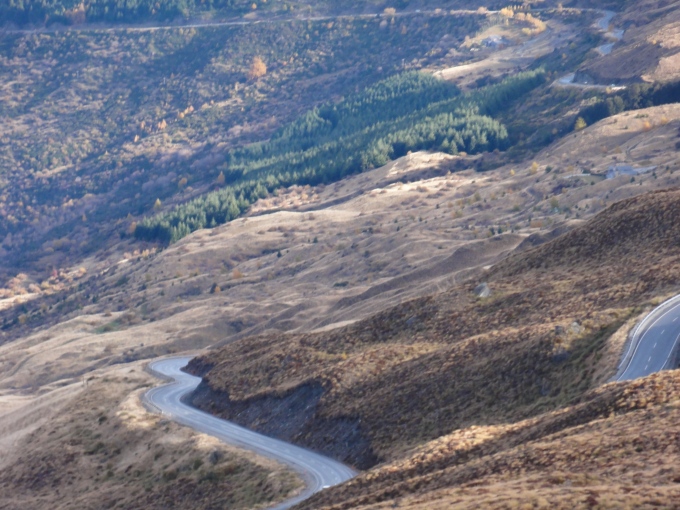
lookingdownfromcoronetpeak

And the story:

It was once said that a desperate man has everything to lose.

The man I was chasing was desperate, but I, on the other hand, was more desperate to catch him.

He’d left a trail of dead people from one end of the island to the other.

The team had put in a lot of effort to locate him, and now his capture was imminent.  We were following the car he was in, from a discrete distance, and, at the appropriate time, we would catch up, pull him over, and make the arrest.

There was nowhere for him to go.

The road led to a dead-end, and the only way off the mountain was back down the road were now on.  Which was why I was somewhat surprised when we discovered where he was.

Where was he going?

“Damn,” I heard Alan mutter.  He was driving, being careful not to get too close, but not far enough away to lose sight of him.

“What?”

“I think he’s made us.”

“How?”

“Dumb bad luck, I’m guessing.  Or he expected we’d follow him up the mountain.  He’s just sped up.”

“How far away?”

“A half-mile.  We should see him higher up when we turn the next corner.”

It took an eternity to get there, and when we did, Alan was right, only he was further on than we thought.”

“Step on it.  Let’s catch him up before he gets to the top.”

Easy to say, not so easy to do.  The road was treacherous, and in places just gravel, and there were no guard rails to stop a three thousand footfall down the mountainside.

Good thing then I had the foresight to have three agents on the hill for just such a scenario.

Ten minutes later, we were in sight of the car, still moving quickly, but we were going slightly faster.  We’d catch up just short of the summit car park.

Or so we thought.

Coming quickly around another corner we almost slammed into the car we’d been chasing.

“What the hell…” Aland muttered.

I was out of the car, and over to see if he was in it, but I knew that it was only a slender possibility.  The car was empty, and no indication where he went.

Certainly not up the road.  It was relatively straightforward for the next mile, at which we would have reached the summit.  Up the mountainside from here, or down.

I looked up.  Nothing.

Alan yelled out, “He’s not going down, not that I can see, but if he did, there’s hardly a foothold and that’s a long fall.”

Then where did he go?

Then a man looking very much like our quarry came out from behind a rock embedded just a short distance up the hill.

“Sorry,” he said quite calmly.  “Had to go if you know what I mean.”

I’d lost him.

It was as simple as that.

I had been led a merry chase up the hill, and all the time he was getting away in a different direction.

I’d fallen for the oldest trick in the book, letting my desperation blind me to the disguise that anyone else would see through in an instant.

It was a lonely sight, looking down that road, knowing that I had to go all that way down again, only this time, without having to throw caution to the wind.

“Maybe next time,” Alan said.

“We’ll get him.  It’s just a matter of time.”

© Charles Heath 2019-2021

Find this and other stories in “Inspiration, maybe”  available soon.

InspirationMaybe1v1

Top 5 sights on the road less travelled – Gibraltar

Beyond the Cable Car: 5 Hidden Gems on Gibraltar’s Road Less Travelled

Gibraltar. The name conjures images of majestic apes, historic sieges, and a giant limestone Rock rising dramatically from the sea. And while every visitor should absolutely ride the cable car and say hello to the famous Barbary Macaques, the true magic of the peninsula lies just slightly off the beaten path.

If you’ve taken the scenic route and arrived in Gibraltar ready for deeper exploration—the kind that moves beyond the immediate tourist hotspots—you are in luck.

For the adventurous traveller hitting the “road less travelled,” here are five exceptional experiences in Gibraltar that offer history, nature, and true local flavour.


1. Conquer the Mediterranean Steps

Most tourists ascend the Rock via the cable car or a minibus tour. The road less travelled? The Mediterranean Steps (or “Med Steps”). This is not a casual stroll; it is a challenging, historic, and utterly breathtaking climb.

Starting near Jew’s Gate at the southern end of the Upper Rock Nature Reserve, this 1,800-meter-long cliffside path winds along the eastern flank, utilizing old military communication lines. You will navigate steep, rugged trails, carved stone steps, and winding tunnels.

Why it’s a hidden gem: The Med Steps provide unparalleled views of the Strait of Gibraltar, the Spanish Costa del Sol, and the coast of North Africa. Because it is physically demanding, you will share the route primarily with dedicated hikers, offering moments of profound solitude far above the crowds. It’s a truly immersive historical and natural experience that bypasses the busiest attractions.

Pro Tip: Start early in the morning before the sun gets too high, and carry plenty of water. Access to the Upper Rock requires a Nature Reserve ticket.


2. Escape to the Alameda Botanic Gardens

After the intensity of climbing the Rock or navigating the bustling Main Street, every traveller needs an oasis of calm. The Alameda Botanic Gardens, situated just below the southern entrance to the city centre, is Gibraltar’s quiet, verdant answer.

Established in 1816 by the then Governor of Gibraltar, General Sir George Don, these gardens are a meticulously maintained subtropical paradise featuring exotic plants, ancient trees, and stunning water features. The atmosphere here is entirely different from the rest of Gibraltar—it’s peaceful, shady, and deeply romantic.

Why it’s a hidden gem: It’s often overlooked in favour of faster-paced attractions. Locals frequent the gardens, but few tourists allocate enough time to wander its many paths, discover the historic cannon displays, or simply listen to the fountains. It’s the perfect place to grab a coffee, sit beneath a giant dragon tree, and reflect on the history surrounding you.


3. Delve into the Depths of the WWII Tunnels

Everyone knows about the Great Siege Tunnels—an incredible feat of 18th-century engineering. But Gibraltar’s subterranean world expanded exponentially during World War II, and exploring the lesser-known WWII Tunnels offers a deeper, grittier historical perspective.

This extensive network, built to house an entire garrison and store massive amounts of supplies, tells the story of how the Rock served as a crucial nerve centre for Allied operations. These tunnels are a stark, fascinating maze where you can truly appreciate the strategic importance of Gibraltar.

Why it’s a hidden gem: While the Great Siege Tunnels are easier to access, the WWII tunnels provide a more immersive and less crowded experience. They vividly illustrate the scale of human effort needed to defend this small territory during global conflict. Look out for the old hospital wards and control centres—it feels like stepping into a preserved time capsule.


4. Experience the Local Charm of Catalan Bay (La Caleta)

Tucked away on the eastern side of the Rock, sheltered from the westerly winds and the main port activity, lies the vibrant, pastel-hued fishing village of Catalan Bay (La Caleta).

This beautiful cove is distinctly different from the rest of Gibraltar. Historically settled by Genoese fishermen in the 18th century, it has retained a unique, tight-knit community feel. The beach is wonderfully accessible, offering soft sand and clear waters, while the handful of traditional seafood restaurants provide some of the best, most authentic dining experiences on the peninsula.

Why it’s a hidden gem: It requires a short drive or bus journey away from the hustle of Main Street, meaning many day-trippers miss it entirely. If you want to sample fresh catch-of-the-day while enjoying a tranquil seaside atmosphere and watching the local families gather, this is your spot. It feels more Mediterranean resort than busy military outpost.


5. Take a Dolphin Safari in the Bay

While the Rock is Gibraltar’s defining geographical feature, its surrounding waters are rich with life. For a truly memorable and natural experience that moves the focus from the land to the sea, book a Dolphin Safari in the Bay of Gibraltar.

The Bay is one of the best locations in the world for spotting wild dolphins. Companies operate safe, ethical tours where you have an excellent chance of encountering large pods of Common, Striped, and Bottlenose dolphins feeding and playing near the Strait.

Why it’s a hidden gem: It offers a completely different perspective of Gibraltar—viewed from the water. More importantly, it’s a pure wildlife experience that connects you with the vibrant marine ecosystem of the Strait. Watching dozens of dolphins leaping and riding the wake of the boat is a breathtaking natural spectacle often overshadowed by the terrestrial attractions.


Ready to Trace the Road Less Travelled?

Gibraltar offers so much more than its famous profile suggests. By venturing beyond the immediate tourist circuit, you unlock layers of military history, natural beauty, and local charm that define this unique territory.

So pack your walking shoes, grab your camera, and prepare to discover the Gibraltar that many miss. Which hidden gem will you seek out first?


What are your favourite spots beyond the Apes? Share your Gibraltar hidden gems in the comments below!

First Dig Two Graves

A sequel to “The Devil You Don’t”

Revenge is a dish best served cold – or preferably so when everything goes right

Of course, it rarely does, as Alistair, Zoe’s handler, discovers to his peril. Enter a wildcard, John, and whatever Alistair’s plan for dealing with Zoe was dies with him.

It leaves Zoe in completely unfamiliar territory.

John’s idyllic romance with a woman who is utterly out of his comfort zone is on borrowed time. She is still trying to reconcile her ambivalence, after being so indifferent for so long.

They agree to take a break, during which she disappears. John, thinking she has left without saying goodbye, refuses to accept the inevitable, calls on an old friend for help in finding her.

After the mayhem and being briefly reunited, she recognises an inevitable truth: there is a price to pay for taking out Alistair; she must leave and find them first, and he would be wise to keep a low profile.

But keeping a low profile just isn’t possible, and enlisting another friend, a private detective and his sister, a deft computer hacker, they track her to the border between Austria and Hungary.

What John doesn’t realise is that another enemy is tracking him to find her too. It could have been a grand tour of Europe. Instead, it becomes a race against time before enemies old and new converge for what will be an inevitable showdown.

Writing a book in 365 days – 314

Day 314

The happy ending debate

The Happy Ending Debate: Is It All About Where You Stop the Story?

We’ve all been there. Lost in a book, glued to a screen, investing our emotions in characters and their journeys. As the story nears its end, a quiet hope stirs within us: Please, let them be happy. We crave resolution, comfort, and the satisfaction of knowing that, in this fictional world at least, good triumphs and love prevails.

But should every story culminate in a neat, tidy, and unequivocally happy ending? And more profoundly, is the ‘happiness’ of an ending simply a matter of where the author chooses to draw the final curtain?

The Allure of the Sunny Conclusion

There’s no denying the power and appeal of a happy ending. They offer:

  • Escapism: Life is often messy and unpredictable. Stories with joyous resolutions provide a much-needed mental break, a reminder that things can turn out well.
  • Hope: They validate our belief in perseverance, the triumph of good over evil, and the idea that our own struggles might eventually lead to brighter days.
  • Satisfaction: A happy ending can feel like a reward for the emotional investment we’ve made, a pleasant closure to a captivating experience.

From classic fairy tales to blockbuster rom-coms, these endings serve a vital purpose, leaving us with a warm feeling and a sense that balance has been restored.

The Unflinching Gaze of Reality

However, limiting all narratives to happy conclusions would be a disservice to the vast spectrum of human experience. Sometimes, stories need to:

  • Reflect Reality: Life isn’t always fair, and not every conflict resolves harmoniously. Stories that acknowledge pain, loss, and unresolved tension can be incredibly powerful and resonant.
  • Provoke Thought: Tragic or ambiguous endings often linger longer in the mind, prompting deeper reflection on themes, choices, and consequences.
  • Offer Catharsis: Witnessing a character’s journey through suffering, even if it doesn’t end happily, can be a form of emotional release and understanding for the audience.
  • Teach and Warn: Some stories serve as cautionary tales or explorations of the darker sides of humanity, and a happy ending would undermine their core message.

Think of literary classics, historical dramas, or poignant independent films – their power often lies in their refusal to sugarcoat the human condition.

The Art of the Final Frame: Where Do You Stop?

This brings us to the most intriguing part of the debate: Is a happy ending simply a matter of narrative framing?

Consider this: Is a character’s failure truly the end, or is it merely the lowest point before a potential rise? Is a bittersweet goodbye truly sad, or is it a necessary step towards individual growth and new beginnings?

  • Life is Continuous: In reality, our stories don’t stop. A “happy ending” might just be a moment of respite before the next challenge, and a “tragic ending” could be the catalyst for profound change in others.
  • The Power of Hope: An ending doesn’t have to be happy to be hopeful. A character might face immense loss, but the final scene could show them finding a glimmer of purpose, taking a first step towards healing, or inspiring others to carry on. This isn’t happiness in the traditional sense, but it offers forward momentum.
  • The Reader’s Imagination: Sometimes, an author intentionally leaves an ending open, trusting the audience to imagine what comes next. What feels unresolved to one person might feel like an invitation for possibility to another. The “end” of the story is merely where the author stops narrating; the characters’ lives, in our minds, continue.
  • Satisfying vs. Happy: A story can have a satisfying ending without being strictly happy. It can be satisfying because it feels earned, logical, and true to the characters and themes, even if it’s painful or melancholic.

Crafting the Right Conclusion

Ultimately, whether a story should have a happy ending isn’t a universal rule, but a deliberate choice. It depends on:

  • The Genre: Rom-coms and fairytales thrive on happiness; noir and tragedies demand a different tone.
  • The Story’s Purpose: Is it meant to uplift, entertain, challenge, or reflect?
  • The Characters’ Journeys: Does a happy ending feel organic and earned, or forced and unrealistic, given what the characters have endured and become?

So, should every story have a happy ending? Probably not. But should every story offer some form of resolution, be it hopeful, cathartic, or thought-provoking? Absolutely.

The true magic lies in the storyteller’s ability to know precisely where to stop, leaving us not necessarily with boundless joy, but with a feeling that the journey was complete, meaningful, and true – even if the sun isn’t shining quite so brightly in that final frame.


What do you think? Do you prefer happy endings, or do you find more satisfaction in realistic or even tragic conclusions? Share your thoughts in the comments below!

An excerpt from “Strangers We’ve Become” – Coming Soon

I wandered back to my villa.

It was in darkness.  I was sure I had left several lights on, especially over the door so I could see to unlock it.

I looked up and saw the globe was broken.

Instant alert.

I went to the first hiding spot for the gun, and it wasn’t there.  I went to the backup and it wasn’t there either.  Someone had found my carefully hidden stash of weapons and removed them.

Who?

There were four hiding spots and all were empty.  Someone had removed the weapons.  That could only mean one possibility.

I had a visitor, not necessarily here for a social call.

But, of course, being the well-trained agent I’d once been and not one to be caught unawares, I crossed over to my neighbor and relieved him of a weapon that, if found, would require a lot of explaining.

Suitably armed, it was time to return the surprise.

There were three entrances to the villa, the front door, the back door, and a rather strange escape hatch.  One of the more interesting attractions of the villa I’d rented was its heritage.  It was built in the late 1700s, by a man who was, by all accounts, a thief.  It had a hidden underground room which had been in the past a vault but was now a wine cellar, and it had an escape hatch by which the man could come and go undetected, particularly if there was a mob outside the door baying for his blood.

It now gave me the means to enter the villa without my visitors being alerted, unless, of course, they were near the vicinity of the doorway inside the villa, but that possibility was unlikely.  It was not where anyone could anticipate or expect a doorway to be.

The secret entrance was at the rear of the villa behind a large copse, two camouflaged wooden doors built into the ground.  I move aside some of the branches that covered them and lifted one side.  After I’d discovered the doors and rusty hinges, I’d oiled and cleaned them, and cleared the passageway of cobwebs and fallen rocks.  It had a mildew smell, but nothing would get rid of that.  I’d left torches at either end so I could see.

I closed the door after me, and went quietly down the steps, enveloped in darkness till I switched on the torch.  I traversed the short passage which turned ninety degrees about halfway to the door at the other end.  I carried the key to this door on the keyring, found it and opened the door.  It too had been oiled and swung open soundlessly.

I stepped in the darkness and closed the door.

I was on the lower level under the kitchen, now the wine cellar, the ‘door’ doubling as a set of shelves which had very little on them, less to fall and alert anyone in the villa.

Silence, an eerie silence.

I took the steps up to the kitchen, stopping when my head was level with the floor, checking to see if anyone was waiting.  There wasn’t.  It seemed to me to be an unlikely spot for an ambush.

I’d already considered the possibility of someone coming after me, especially because it had been Bespalov I’d killed, and I was sure he had friends, all equally as mad as he was.  Equally, I’d also considered it nigh on impossible for anyone to find out it was me who killed him because the only people who knew that were Prendergast, Alisha, a few others in the Department, and Susan.

That raised the question of who told them where I was.

If I was the man I used to be, my first suspect would be Susan.  The departure this morning, and now this was too coincidental.  But I was not that man.

Or was I?

I reached the start of the passageway that led from the kitchen to the front door and peered into the semi-darkness.  My eyes had got used to the dark, and it was no longer an inky void.  Fragments of light leaked in around the door from outside and through the edge of the window curtains where they didn’t fit properly.  A bone of contention upstairs in the morning, when first light shone and invariably woke me up hours before I wanted to.

Still nothing.

I took a moment to consider how I would approach the visitor’s job.  I would get a plan of the villa in my head, all entrances, where a target could be led to or attacked where there would be no escape.

Coming in the front door.  If I was not expecting anything, I’d just open the door and walk-in.  One shot would be all that was required.

Contract complete.

I sidled quietly up the passage staying close to the wall, edging closer to the front door.  There was an alcove where the shooter could be waiting.  It was an ideal spot to wait.

Crunch.

I stepped on some nutshells.

Not my nutshells.

I felt it before I heard it.  The bullet with my name on it.

And how the shooter missed, from point-blank range, and hit me in the arm, I had no idea.  I fired off two shots before a second shot from the shooter went wide and hit the door with a loud thwack.

I saw a red dot wavering as it honed in on me and I fell to the floor, stretching out, looking up where the origin of the light was coming and pulled the trigger three times, evenly spaced, and a second later I heard the sound of a body falling down the stairs and stopping at the bottom, not very far from me.

Two assassins.

I’d not expected that.

The assassin by the door was dead, a lucky shot on my part.  The second was still breathing.

I checked the body for any weapons and found a second gun and two knives.  Armed to the teeth!

I pulled off the balaclava; a man, early thirties, definitely Italian.  I was expecting a Russian.

I slapped his face, waking him up.  Blood was leaking from several slashes on his face when his head had hit the stairs on the way down.  The awkward angle of his arms and legs told me there were broken bones, probably a lot worse internally.  He was not long for this earth.

“Who employed you?”

He looked at me with dead eyes, a pursed mouth, perhaps a smile.  “Not today my friend.  You have made a very bad enemy.”  He coughed and blood poured out of his mouth.  “There will be more …”

Friends of Bespalov, no doubt.

I would have to leave.  Two unexplainable bodies, I’d have a hard time explaining my way out of this mess.  I dragged the two bodies into the lounge, clearing the passageway just in case someone had heard anything.

Just in case anyone was outside at the time, I sat in the dark, at the foot of the stairs, and tried to breathe normally.  I was trying not to connect dots that led back to Susan, but the coincidence was worrying me.

A half-hour passed and I hadn’t moved.  Deep in thought, I’d forgotten about being shot, unaware that blood was running down my arm and dripping onto the floor.

Until I heard a knock on my front door.

Two thoughts, it was either the police, alerted by the neighbors, or it was the second wave, though why would they be knocking on the door?

I stood, and immediately felt a stabbing pain in my arm.  I took out a handkerchief and turned it into a makeshift tourniquet, then wrapped a kitchen towel around the wound.

If it was the police, this was going to be a difficult situation.  Holding the gun behind my back, I opened the door a fraction and looked out.

No police, just Maria.  I hoped she was not part of the next ‘wave’.

“You left your phone behind on the table.  I thought you might be looking for it.”  She held it out in front of her.

When I didn’t open the door any further, she looked at me quizzically, and then asked, “Is anything wrong?”

I was going to thank her for returning the phone, but I heard her breathe in sharply, and add, breathlessly, “You’re bleeding.”

I looked at my arm and realized it was visible through the door, and not only that, the towel was soaked in blood.

“You need to go away now.”

Should I tell her the truth?  It was probably too late, and if she was any sort of law-abiding citizen she would go straight to the police.

She showed no signs of leaving, just an unnerving curiosity.  “What happened?”

I ran through several explanations, but none seemed plausible.  I went with the truth.  “My past caught up with me.”

“You need someone to fix that before you pass out from blood loss.  It doesn’t look good.”

“I can fix it.  You need to leave.  It is not safe to be here with me.”

The pain in my arm was not getting any better, and the blood was starting to run down my arm again as the tourniquet loosened.  She was right, I needed it fixed sooner rather than later.

I opened the door and let her in.  It was a mistake, a huge mistake, and I would have to deal with the consequences.  Once inside, she turned on the light and saw the pool of blood just inside the door and the trail leading to the lounge.  She followed the trail and turned into the lounge, turned on the light, and no doubt saw the two dead men.

I expected her to scream.  She didn’t.

She gave me a good hard look, perhaps trying to see if I was dangerous.  Killing people wasn’t something you looked the other way about.  She would have to go to the police.

“What happened here?”

“I came home from the cafe and two men were waiting for me.  I used to work for the Government, but no longer.  I suspect these men were here to repay a debt.  I was lucky.”

“Not so much, looking at your arm.”

She came closer and inspected it.

“Sit down.”

She found another towel and wrapped it around the wound, retightening the tourniquet to stem the bleeding.

“Do you have medical supplies?”

I nodded.  “Upstairs.”  I had a medical kit, and on the road, I usually made my own running repairs.  Another old habit I hadn’t quite shaken off yet.

She went upstairs, rummaged, and then came back.  I wondered briefly what she would think of the unmade bed though I was not sure why it might interest her.

She helped me remove my shirt, and then cleaned the wound.  Fortunately, she didn’t have to remove a bullet.  It was a clean wound but it would require stitches.

When she’d finished she said, “Your friend said one day this might happen.”

No prizes for guessing who that friend was, and it didn’t please me that she had involved Maria.

“Alisha?”

“She didn’t tell me her name, but I think she cares a lot about you.  She said trouble has a way of finding you, gave me a phone and said to call her if something like this happened.”

“That was wrong of her to do that.”

“Perhaps, perhaps not.  Will you call her?”

“Yes.  I can’t stay here now.  You should go now.  Hopefully, by the time I leave in the morning, no one will ever know what happened here, especially you.”

She smiled.  “As you say, I was never here.”

© Charles Heath 2018-2022

strangerscover9

In a word: Sheet

Well, we all know what a sheet is, it’s one of those things you put on a bed.  A bottom sheet, a fitted sheet, a top sheet, flannelette sheet.

It could also be a piece of paper, e.g. pass me a sheet of paper please, only to get in reply, what size?

There can be a sheet of flames, best if you see one get away as fast as you can.

Of course, that fire can be put out by rain sheeting down.

You can have a sheet map, that is one that opens out.  Funny how you can never get them folded back the same way.  And a problem when you’re in a car and open it out – hang on, I can’t see out the window!

That lake is a lovely sheet of water, very still just as the sun comes up, and then, what a reflection.  Great if you are a landscape painter.

Then there’s sheet metal, did that in school and wasn’t very good at it.

If you’re a philatelist, then there’s always a sheet of stamps, might be worth something in a hundred years’ time.

Then, if it is worth millions, you might turn white as a sheet with shock.

But the best of all, if you drink too much it is said you are ‘two sheets to the wind’.

When you’re given another chance, it is like being given a clean sheet.

And another form might be to do with sailing when you sheet a sail, which is to say you are making it either tauter or less taut.

English can be confusing sometimes, can’t it?

Another excerpt from ‘Betrayal’; a work in progress

My next destination in the quest was the hotel we believed Anne Merriweather had stayed at.

I was, in a sense, flying blind because we had no concrete evidence she had been there, and the message she had left behind didn’t quite name the hotel or where Vladimir was going to take her.

Mindful of the fact that someone might have been following me, I checked to see if the person I’d assumed had followed me to Elizabeth’s apartment was still in place, but I couldn’t see him. Next, I made a mental note of seven different candidates and committed them to memory.

Then I set off to the hotel, hailing a taxi. There was the possibility the cab driver was one of them, but perhaps I was slightly more paranoid than I should be. I’d been watching the queue, and there were two others before me.

The journey took about an hour, during which time I kept an eye out the back to see if anyone had been following us. If anyone was, I couldn’t see them.

I had the cab drop me off a block from the hotel and then spent the next hour doing a complete circuit of the block the hotel was on, checking the front and rear entrances, the cameras in place, and the siting of the driveway into the underground carpark. There was a camera over the entrance, and one we hadn’t checked for footage. I sent a text message to Fritz to look into it.

The hotel lobby was large and busy, which was exactly what you’d want if you wanted to come and go without standing out. It would be different later at night, but I could see her arriving about mid-afternoon, and anonymous among the type of clientele the hotel attracted.

I spent an hour sitting in various positions in the lobby simply observing. I had already ascertained where the elevator lobby for the rooms was, and the elevator down to the car park. Fortunately, it was not ‘guarded’ but there was a steady stream of concierge staff coming and going to the lower levels, and, just from time to time, guests.

Then, when there was a commotion at the front door, what seemed to be a collision of guests and free-wheeling bags, I saw one of the seven potential taggers sitting by the front door. Waiting for me to leave? Or were they wondering why I was spending so much time there?

Taking advantage of that confusion, I picked my moment to head for the elevators that went down to the car park, pressed the down button, and waited.

The was no car on the ground level, so I had to wait, watching, like several others, the guests untangling themselves at the entrance, and an eye on my potential surveillance, still absorbed in the confusion.

The doors to the left car opened, and a concierge stepped out, gave me a quick look, then headed back to his desk. I stepped into the car, pressed the first level down, the level I expected cars to arrive on, and waited what seemed like a long time for the doors to close.

As they did, I was expecting to see a hand poke through the gap, a latecomer. Nothing happened, and I put it down to a television moment.

There were three basement levels, and for a moment, I let my imagination run wild and considered the possibility that there were more levels. Of course, there was no indication on the control panel that there were any other floors, and I’d yet to see anything like it in reality.

With a shake of my head to return to reality, the car arrived, the doors opened, and I stepped out.

A car pulled up, and the driver stepped out, went around to the rear of his car, and pulled out a case. I half expected him to throw me the keys, but the instant glance he gave me told him was not the concierge, and instead brushed past me like I wasn’t there.

He bashed the up button several times impatiently and cursed when the doors didn’t open immediately. Not a happy man.

Another car drove past on its way down to a lower level.

I looked up and saw the CCTV camera, pointing towards the entrance, visible in the distance. A gate that lifted up was just about back in position and then made a clunk when it finally closed. The footage from the camera would not prove much, even if it had been working, because it didn’t cover the life lobby, only in the direction of the car entrance.

The doors to the other elevator car opened, and a man in a suit stepped out.

“Can I help you, sir? You seem lost.”

Security, or something else. “It seems that way. I went to the elevator lobby, got in, and it went down rather than up. I must have been in the wrong place.”

“Lost it is, then, sir.” I could hear the contempt for Americans in his tone. “If you will accompany me, please.”

He put out a hand ready to guide me back into the elevator. I was only too happy to oblige him. There had been a sign near the button panel that said the basement levels were only to be accessed by the guests.

Once inside, he turned a key and pressed the lobby button. The doors closed, and we went up. He stood, facing the door, not speaking. A few seconds later, he was ushering me out to the lobby.

“Now, sir, if you are a guest…”

“Actually, I’m looking for one. She called me and said she would be staying in this hotel and to come down and visit her. I was trying to get to the sixth floor.”

“Good. Let’s go over the the desk and see what we can do for you.”

I followed him over to the reception desk, where he signalled one of the clerks, a young woman who looked and acted very efficiently, and told her of my request, but then remained to oversee the proceeding.

“Name of guest, sir?”

“Merriweather, Anne. I’m her brother, Alexander.” I reached into my coat pocket and pulled out my passport to prove that I was who I said I was. She glanced cursorily at it.

She typed the name into the computer, and then we waited a few seconds while it considered what to output. Then, she said, “That lady is not in the hotel, sir.”

Time to put on my best-confused look. “But she said she would be staying here for the week. I made a special trip to come here to see her.”

Another puzzled look from the clerk, then, “When did she call you?”

An interesting question to ask, and it set off a warning bell in my head. I couldn’t say today, it would have to be the day she was supposedly taken.

“Last Saturday, about four in the afternoon.”

Another look at the screen, then, “It appears she checked out Sunday morning. I’m afraid you have made a trip in vain.”

Indeed, I had. “Was she staying with anyone?”

I just managed to see the warning pass from the suited man to the clerk. I thought he had shown an interest when I mentioned the name, and now I had confirmation. He knew something about her disappearance. The trouble was, he wasn’t going to volunteer any information because he was more than just hotel security.

“No.”

“Odd,” I muttered. “I thought she told me she was staying with a man named Vladimir something or other. I’m not too good at pronouncing those Russian names. Are you sure?”

She didn’t look back at the screen. “Yes.”

“OK, now one thing I do know about staying in hotels is that you are required to ask guests with foreign passports their next destination, just in case they need to be found. Did she say where she was going next?” It was a long shot, but I thought I’d ask.

“Moscow. As I understand it, she lives in Moscow. That was the only address she gave us.”

I smiled. “Thank you. I know where that is. I probably should have gone there first.”

She didn’t answer; she didn’t have to, her expression did that perfectly.

The suited man spoke again, looking at the clerk. “Thank you.” He swivelled back to me. “I’m sorry we can’t help you.”

“No. You have more than you can know.”

“What was your name again, sir, just in case you still cannot find her?”

“Alexander Merriweather. Her brother. And if she is still missing, I will be posting a very large reward. At the moment, you can best contact me via the American Embassy.”

Money is always a great motivator, and that thoughtful expression on his face suggested he gave a moment’s thought to it.

I left him with that offer and left. If anything, the people who were holding her would know she had a brother, that her brother was looking for her, and equally that brother had money.

© Charles Heath – 2018-2025

NANOWRIMO – November 2025 – Day 26

The Third Son of a Duke

Back on the ship, a different ship, smaller but no less fast, our protagonist is going to Egypt, and joining the war via the Mena Camp, the place where many Australian soldiers passed through on their way to Gallipoli, and back again in injured, there or elsewhere in Egypt.

There were special operations of a sort, not on the same scale as in WW2, but the offices of which were in a hotel in Cairo, which to me seems about right.  If you’re going to do something, it should be done in style.

I have invented this mission, borne out of the plane ride our protagonist took from Winton to Brisbane, one that I’m sure the British already were doing in part, the aerial observation of the German lines and mapping the various sites for their guns to lay down a barrage.

His idea is to create, among what would seem to the Germans as a pre-eminent attack on their trenches, before the soldiers went over the top to attack.

That, of course, was a cause of many deaths, the machine guns waiting.

His idea was if anything novel and he was going to put it into practice.  After he undergoes more training, earns a commission, and gets attached to a squad of returning men, after rests in Egypt.  There are few left of the original group, and now bolstered with replacements, they battle hardened veterans are a battle-hardened group with stories to tell.

To be honest, after reading firsthand accounts, I don’t know how they survived, ot remained sane after the war ended.

1870 words, for a total of 43115 words.