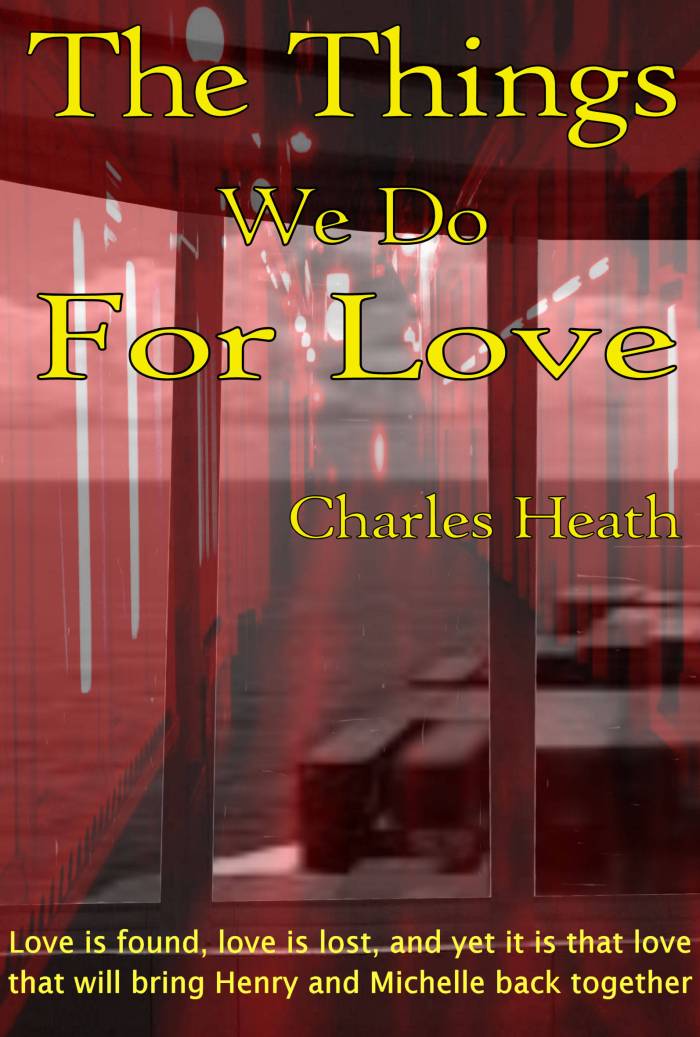
An excerpt from “The Things We Do For Love”; In love, Henry was all at sea!

In the distance, he could hear the dinner bell ringing and roused himself.  Feeling the dampness of the pillow, and fearing the ravages of pent-up emotion, he considered not going down but thought it best not to upset Mrs. Mac, especially after he said he would be dining.

In the event, he wished he had reneged, especially when he discovered he was not the only guest staying at the hotel.

Whilst he’d been reminiscing, another guest, a young lady, had arrived.  He’d heard her and Mrs. Mac coming up the stairs and then shown to a room on the same floor, perhaps at the other end of the passage.

Henry caught his first glimpse of her when she appeared at the door to the dining room, waiting for Mrs. Mac to show her to a table.

She was in her mid-twenties, slim, with long brown hair, and the grace and elegance of a woman associated with countless fashion magazines.  She was, he thought, stunningly beautiful with not a hair out of place, and make-up flawlessly applied.  Her clothes were black, simple, elegant, and expensive, the sort an heiress or wife of a millionaire might condescend to wear to a lesser occasion than dinner.

Then there was her expression; cold, forbidding, almost frightening in its intensity.  And her eyes, piercingly blue and yet laced with pain.  Dracula’s daughter was his immediate description of her.

All in all, he considered, the only thing they had in common was, like him, she seemed totally out of place.

Mrs. Mac came out of the kitchen, wiping her hands on her apron.  She was, she informed him earlier, chef, waitress, hotelier, barmaid, and cleaner all rolled into one.  Coming up to the new arrival she said, “Ah, Miss Andrews, I’m glad you decided to have dinner.  Would you like to sit with Mr. Henshaw, or would you like to have a table of your own?”

Henry could feel her icy stare as she sized up his appeal as a dining companion, making the hair on the back of his neck stand up.  He purposely didn’t look back.  In his estimation, his appeal rating was minus six.  Out of a thousand!

“If Mr. Henshaw doesn’t mind….”  She looked at him, leaving the query in mid-air.

He didn’t mind and said so.  Perhaps he’d underestimated his rating.

“Good.”  Mrs. Mac promptly ushered her over.  Henry stood, made sure she was seated properly and sat.

“Thank you.  You are most kind.”  The way she said it suggested snobbish overtones.

“I try to be when I can.”  It was supposed to nullify her sarcastic tone but made him sound a little silly, and when she gave him another of her icy glares, he regretted it.

Mrs. Mac quickly intervened, asking, “Would you care for the soup?”

They did, and, after writing the order on her pad, she gave them each a look, imperceptibly shook her head, and returned to the kitchen.

Before Michelle spoke to him again, she had another quick look at him, trying to fathom who and what he might be.  There was something about him.

His eyes, they mirrored the same sadness she felt, and, yes, there was something else, that it looked like he had been crying?  There was a tinge of redness.

Perhaps, she thought, he was here for the same reason she was.

No.  That wasn’t possible.

Then she said, without thinking, “Do you have any particular reason for coming here?”  Seconds later she realized she’d spoken it out loud, had hadn’t meant to actually ask, it just came out.

It took him by surprise, obviously not the first question he was expecting her to ask of him.

“No, other than it is as far from civilization, and home, as I could get.”

At least we agree on that, she thought.

It was obvious he was running away from something as well.

Given the isolation of the village and lack of geographic hospitality, it was, from her point of view, ideal.  All she had to do was avoid him, and that wouldn’t be difficult.

After getting through this evening first.

“Yes,” she agreed.  “It is that.”

A few seconds passed, and she thought she could feel his eyes on her and wasn’t going to look up.

Until he asked, “What’s your reason?”

Slightly abrupt in manner, perhaps, because of her question and how she asked it.

She looked up.  “Rest.  And have some time to myself.”

She hoped he would notice the emphasis she had placed on the word ‘herself’ and take due note.  No doubt, she thought, she had completely different ideas of what constituted a holiday than he, not that she had said she was here for a holiday.

Mrs. Mac arrived at a fortuitous moment to save them from further conversation.

Over the entree, she wondered if she had made a mistake coming to the hotel.  Of course, there had been no conceivable way she could know that anyone else might have booked the same hotel, but realized it was foolish to think she might end up in it by herself.

Was that what she was expecting?

Not a mistake then, but an unfortunate set of circumstances, which could be overcome by being sensible.

Yet, there he was, and it made her curious, not that he was a man, by himself, in the middle of nowhere, hiding like she was, but for quite varied reasons.

On discreet observance, whilst they ate, she gained the impression his air of light-heartedness was forced, and he had no sense of humour.

This feeling was engendered by his looks, unruly dark hair, and permanent frown.  And then there was his abysmal taste in clothes on a tall, lanky frame.  They were quality but totally unsuited to the wearer.

Rebellion was written all over him.

The only other thought crossing her mind, and incongruously, was he could do with a decent feed.  In that respect, she knew now from the mountain of food in front of her, he had come to the right place.

“Mr. Henshaw?”

He looked up.  “Henshaw is too formal.  Henry sounds much better,” he said, with a slight hint of gruffness.

“Then my name is Michelle.”

Mrs. Mac came in to take their order for the only main course, gather up the entree dishes, and then return to the kitchen.

“Staying long?” she asked.

“About three weeks.  Yourself?”

“About the same.”

The conversation dried up.

Neither looked at the other, rather at the walls, out the window, towards the kitchen, anywhere.  It was, she thought, unbearably awkward.

Mrs. Mac returned with a large tray with dishes on it, setting it down on the table next to theirs.

“Not as good as the usual cook,” she said, serving up the dinner expertly, “but it comes a good second, even if I do say so myself.  Care for some wine?”

Henry looked at Michelle.  “What do you think?”

“I’m used to my dining companions making the decision.”

You would, he thought.  He couldn’t help but notice the cutting edge of her tone.  Then, to Mrs. Mac, he named a particular White Burgundy he liked, and she bustled off.

“I hope you like it,” he said, acknowledging her previous comment with a smile that had nothing to do with humour.

“Yes, so do I.”

Both made a start on the main course, a concoction of chicken and vegetables that were delicious, Henry thought when compared to the bland food he received at home and sometimes aboard my ship.

It was five minutes before Mrs Mac returned with the bottle and two glasses.  After opening it and pouring the drinks, she left them alone again.

Henry resumed the conversation.  “How did you arrive?  I came by train.”

“By car.”

“Did you drive yourself?”

And he thought, a few seconds later, that was a silly question, otherwise she would not be alone, and certainly not sitting at this table. With him.

“After a fashion.”

He could see that she was formulating a retort in her mind, then changed it, instead, smiling for the first time, and it served to lighten the atmosphere.

And in doing so, it showed him she had another more pleasant side despite the fact she was trying not to look happy.

“My father reckons I’m just another of ‘those’ women drivers,” she added.

“Whatever for?”

“The first and only time he came with me I had an accident.  I ran up the back of another car.  Of course, it didn’t matter to him the other driver was driving like a startled rabbit.”

“It doesn’t help,” he agreed.

“Do you drive?”

“Mostly people up the wall.”  His attempt at humour failed.  “Actually,” he added quickly, “I’ve got a very old Morris that manages to get me where I’m going.”

The apple pie and cream for dessert came and went and the rapport between them improved as the wine disappeared and the coffee came.  Both had found, after getting to know each other better, their first impressions were not necessarily correct.

“Enjoy the food?” Mrs. Mac asked, suddenly reappearing.

“Beautifully cooked and delicious to eat,” Michelle said, and Henry endorsed her remarks.

“Ah, it does my heart good to hear such genuine compliments,” she said, smiling.  She collected the last of the dishes and disappeared yet again.

“What do you do for a living,” Michelle asked in an off-hand manner.

He had a feeling she was not particularly interested, and it was just making conversation.

“I’m a purser.”

“A what?”

“A purser.  I work on a ship doing the paperwork, that sort of thing.”

“I see.”

“And you?”

“I was a model.”

“Was?”

“Until I had an accident, a rather bad one.”

“Oh, I’m sorry.”

So that explained the odd feeling he had about her.

As the evening wore on, he began to think there might be something wrong, seriously wrong with her because she didn’t look too well.  Even the carefully applied makeup, from close, didn’t hide the very pale, and tired look, or the sunken, dark-ringed eyes.

“I try not to think about it, but it doesn’t necessarily work.  I’ve come here for peace and quiet, away from doctors and parents.”

“Then you will not have to worry about me annoying you.  I’m one of those fall-asleep-reading-a-book types.”

Perhaps it would be like ships passing in the night and then smiled to himself about the analogy.

Dinner over, they separated.

Henry went back to the lounge to read a few pages of his book before going to bed, and Michelle went up to her room to retire for the night.

But try as he might, he was unable to read, his mind dwelling on the unusual, yet compellingly mysterious person he would be sharing the hotel with.

Overlaying that original blurred image of her standing in the doorway was another of her haunting expressions that had, he finally conceded, taken his breath away, and a look that had sent more than one tingle down his spine.

She may not have thought much of him, but she had certainly made an impression on him.

…

© Charles Heath 2015-2024
lovecoverfinal1

The Cinema of My Dreams – It ended in Sorrento – Episode 62

When you least expect it

…

After an hour passed, and no one had come looking for our intruder, darkness had fallen, the mother had taken the three children off in the car, and the people in the house had all left, leaving Dicostini to sit at the table reading a newspaper.

He didn’t seem to be too interested in running or working on his farm.  Maybe if he took more of an interest, it might be turning over a profit.

Behind me, I could hear our would-be assailant stirring and finding himself very tightly bound and gagged.  I turned around.  “If you know what’s good for you, I’d go back to sleep.  Either way, make any noise I will shoot you.”  I held up the silenced gun and waved it for emphasis.

“You do realise he has seen us, don’t you?”

“Do you want me to shoot him?”

“Well, you know what he’s going to do when he gets free.”

I did, but I wasn’t going to tell her.  I’d sent a text message to Alfie and he would be collected the moment we left the clearing.

Another hour passed when I noticed a shadow behind Dicostini who, now, had slumped forward, perhaps asleep.  The shadow materialised into a human form, and then a woman.  When the pale light from a wall lamp shone on her face, I recognised it instantly.

The fake countess.

She shook him by the shoulder, and when he roused, he stood and looked like he was yelling at her.

Juliet came over and lay down next to me.  “What’s happening?”

“The fake countess just came out of the woodwork.  That’s our cue?”

“For what?”

“Storming the battlements.  Taking no prisoners.  Or perhaps just ask a few questions and reasonably expect answers.”

I stood and dismantled the rifle and put the parts back in the case. 

“Grab the bag, we’re on the clock.”

“What about him?”  She nodded in the man’s direction.  His eyes told the story, he didn’t like being tied up like that.

“Hopefully he’s learned a valuable lesson, don’t go blundering around in the undergrowth.”

We stowed the gun and bag in the car and headed back towards the farmhouse by a different route.  It was dark enough that we didn’t have to try too hard to stay in the shadows.

Lucking Juliet had thought to wear black.

“When we stopped behind the wall of one of the outhouses, I could hear her in my ear, “So, do I get a gun?”

“No.”

“What do I do when the shit hits the fan?”

“The same as me.  Duck.”

She punched me, which was not unexpected.

We made it to the back of the house, and to a window that looked in over an open-plan living area.  We had heard voices as we approached the house, now they were clearer we could see them.

“…part of staying out of sight didn’t you get?”  Dicostini was angry.

“In that little hole, you put me in?”

“You’re safe there, for the time being.”

“They know, you know.  It’s just a question of whether they’ve told Von Burkhardt.”

“Do you want me to go over there and ask?”

“You should have killed them all when you had the chance, not just the son and the father.  Like everything else you’ve done, this is going to end up an utter failure.”

He was going to say something but didn’t.  Instead, filled with pent-up rage, he hit her.  I thought it had been with an open hand, but it was a fist, and so hard she spun sideways, hit her head on the solid wooden table with a sickening thud and then just flopped like a rag doll on the ground.

So engrossed in watching those events unfold, I forgot about Juliet and suddenly felt what might be the barrel of a gun in my back.

Juliet!

© Charles Heath 2023

The cinema of my dreams – Was it just another surveillance job – Episode 63

This story is now on the list to be finished so over the new few weeks, expect a new episode every few days.

The reason why new episodes have been sporadic, there are also other stories to write, and I’m not very good at prioritizing.

But, here we are, a few minutes opened up and it didn’t take long to get back into the groove.

Things are about to get complicated…


Two events happened simultaneously.

The door opened, a figure dressed in black appears and Jennifer grabbed her from behind and took her weapon then shoved her to the ground in the middle of the room, at the same time the USBs exploded in the microwave oven.

I went over to the figure and removed the balaclava, whilst Jennifer closed the door after a quick glance outside.

It was Jan. Why wasn’t I surprised.

“Just whose side are you on,” she said, grimacing, and holding her shoulder after it hit the floor very hard.

“You’re lucky it was Jennifer.  If it had been me, I might have strangled you by accident.  Why are you here?”

“The same as you?”

“No, in this flat.  I never told you anything about Jo.”

Jan looked over at the other woman sitting up against the wall, not exactly looking too well now.  She would need an ambulance soon.  Jan, probably sooner.

“It might have prevented this if you had.  It’s probably the only reason why you’re still alive, we needed you to lead us to her.  That’s Anna, isn’t it?”

“Yes.”

“And the data drives?”

“Kind of destroyed, which is where such information should end up.”

“It was not yours to do that.”

“No.  But left in the hands of people like you, where would it end up?  I’m sorry, but with all the lies and deception going on, I couldn’t trust anyone to do the right thing.”

My phone rang.

I looked at the screen.  Private number.  No prizes for guessing who.

“Dobbin?”

“What is going on in there?”

“Target practice.  Want to come and join the fun?”

“Is Jan alright?”

“She’ll live for now, but she is going to need medical assistance soon.  It’s up to you.”

“I’m coming up?”

“If you bring anyone else, they’re dead.”  I hung up.

I went over to the microwave, took out the remnants of the drives and flushed them down the toilet.  Just in case.

When I came back there was a knock on the door.

“I’ll get it,” I said to Jennifer.  “But if there is anyone else, shoot them.

Gun ready, I opened the door.  He had his hands where I could see them.  “Come in and join the fun.”

Jennifer had him covered, just in case.

I closed the door.

Dobbin looked at Anna.  He knew who she was.

“O’Connell is next door, dead.  Did Jan shoot him?”

“Hello, I’m in the room, Sam.  I did not.”

“Why do I find that hard to believe?”

“You have this all wrong, Sam.  We are not the bad guys,” Dobbin said.

“Well, if you are, and you’re lying, which is about all you have done since I first met you, you won’t be.  The USBs have been destroyed.”

Of course, in that instant, I realised that I may have been played again.  Anna had given up the location too easily, despite the threats of bodily harm, which if push came to shove, I might not have followed through on.  And if Anna surmised that, what was to stop her from having decoys just in case she was found?  Come to think of it, she didn’t seem very disappointed when I destroyed them.

A woman capable of torturing and murder was capable of anything, and she had proven herself very capable so far.

And, worse, Dobbin didn’t seem too upset at the news.

This was rapidly becoming a no-win situation.

…

© Charles Heath 2020-2023

A photograph from the inspirational bin – 60

What story does it inspire?

…

…

What does a photograph of a wall conjure up?

If it’s a bad day, then the answer to that is nothing. Looking at a bare wall is like examining the whys and wherefores of writer’s block.

Some days the ideas just can’t find their way to the surface. Other days, they come out of left field, and some, well, you have to wonder where they came from.

For instance…

There is that eternal device in stories that fuels many a story, how does a person get murdered in a room with no windows, a single door, and it is locked from the inside, with the key in the lock.

The simple answer, there has to be a hatch, in the floor or in the wall.

Yes, there’s a secret panel – or on thorough checking, there is not. But there has to be, and so we just about pull the wall apart looking for the secret entrance.

Maybe if there were shelves in front of the wall, we could have the classic shelf door.

Is it possible that the murderer could somehow pass through the wall? We could have people postulating that the killer was able to rearrange their molecules so he or she could pass through.

Scientifically impossible.

But, there again, we are writing fiction. Anything is possible.

I like my idea better, the killer arrived in a time machine. I’ve often wondered just how much damage we could do if we could travel in time, backwards or forwards, but the more I think about it, time travel could only be into the past, because the future hasn’t been written yet.

So that’s my premise, as the main character, as the detective. The story is trying to convince everyone else, and that I’m not stark staring mad.

Writing a book in 365 days – 48

Day 48

Heartbreak as inspiration

…

It’s the one feeling we never want to feel, and yet we can experience it in various forms, many times during our lifetime.

Reading the average Mills and Book, there are always large doses of heartbreak, whether it is at the start when the girl expects that a particular dinner date is a proposal, but instead is the breakup, to the middle where misinterpretation of events with exes or rivals sends one or the other into a heartbreaking spiral.

it depends on the story you want to tell. You can have a spy story with an incidental affair that might lead to something more interesting, only to have one or the other caught in the crossfire. I remember one particular James Bond film where Mrs Bond was killed in a drive-by.

I must say the actress playing her was my favourite at the time, and I was very, very unhappy.

Undoubtedly, a break-up and the memories of that relationship could lead to writing a compelling narrative, and in fact, some of the more starker memories of my own have been translated into several stories and one book. So far.

Something else I realised, quite a number of autobiographies I have read have touched on the subject in many different ways, some benefitting from the experience, others finding it hard to get over, particularly when it is a first love. They are the most potent, and the most painful when it comes to an end.

How would we survive without what we now take for granted?

There is a saying ‘you don’t know what you’ve got till it’s gone’.

For a long time, in days before the current technological age, I didn’t really understand what that meant.

Until now.

How many times, in the last few days have I heard the question, “Where’s my mobile phone?”.

It seems we can lose almost anything else but, without the phone, we are completely lost.

The same now applies to all of our household appliances.

Then, the other day I heard, “We aren’t able to do very much because the microwave oven is broken.”

How did we manage in the days before we had such devices?  I know my grandmother used to have a wood stove and cooked everything, bread, meat, fish, vegetables, cakes, puddings, even made a cup of tea with that stove.

I don’t think I ever had a cup of coffee at her house, but I have a lot of memories of some amazing food.  No such thing as electric kitchen appliances, or a microwave oven, not in that house.

We had the same experience ourselves when one of the fridge/freezer units broke down, and severely restricted what we could cook and store, especially the freezer.

And perhaps that’s the problem.  We take so many things for granted and live a life that is centered around convenience.

What would happen if those conveniences were taken away?

Certainly, for me, I know, what it’s like to lose the use of a kitchen appliance and having to improvise, but I’m not sure how we would react if we had a real catastrophe, like having no electricity.

We try not to think about what it would be like, just a short blackout is enough to frighten us.

But, I haven’t lost my phone yet.

Let’s hope it never happens.

“What Sets Us Apart”, a mystery with a twist

David is a man troubled by a past he is trying to forget.

Susan is rebelling against a life of privilege and an exasperated mother who holds a secret that will determine her daughter’s destiny.

They are two people brought together by chance. Or was it?

When Susan discovers her mother’s secret, she goes in search of the truth that has been hidden from her since the day she was born.

When David realizes her absence is more than the usual cooling off after another heated argument, he finds himself being slowly drawn back into his former world of deceit and lies.

Then, back with his former employers, David quickly discovers nothing is what it seems as he embarks on a dangerous mission to find Susan before he loses her forever.

Find the kindle version on Amazon here:  http://amzn.to/2Eryfth

whatsetscover

An excerpt from “If Only” – a work in progress

Investigation of crimes doesn’t always go according to plan, nor does the perpetrator get either found or punished.

That was particularly true in my case.  The murderer was incredibly careful in not leaving any evidence behind, to the extent that the police could not rule out whether it was a male or a female.

At one stage the police thought I had murdered my own wife though how I could be on a train at the time of the murder was beyond me.  I had witnesses and a cast-iron alibi.

The officer in charge was Detective First Grade Gabrielle Walters.  She came to me on the day after the murder seeking answers to the usual questions like, when was the last time you saw your wife, did you argue, the neighbors reckon there were heated discussions the day before.

Routine was the word she used.

Her fellow detective was a surly piece of work whose intention was to get answers or, more likely, a confession by any or all means possible.  I could sense the raging violence within him.  Fortunately, common sense prevailed.

Over the course of the next few weeks, once I’d been cleared of committing the crime, Gabrielle made a point of keeping me informed of the progress.

After three months the updates were more sporadic, and when, for lack of progress, it became a cold case, communication ceased.

But it was not the last I saw of Gabrielle.

The shock of finding Vanessa was more devastating than the fact she was now gone, and those images lived on in the same nightmare that came to visit me every night when I closed my eyes.

For months I was barely functioning, to the extent I had all but lost my job, and quite a few friends, particularly those who were more attached to Vanessa rather than me.

They didn’t understand how it could affect me so much, and since it had not happened to them, my tart replies of ‘you wouldn’t understand’ were met with equally short retorts.  Some questioned my sanity, even, for a time, so did I.

No one, it seemed, could understand what it was like, no one except Gabrielle.

She was by her own admission, damaged goods, having been the victim of a similar incident, a boyfriend who turned out to be an awfully bad boy.  Her story varied only in she had been made to witness his execution.  Her nightmare, in reliving that moment in time, was how she was still alive and, to this day, had no idea why she’d been spared.

It was a story she told me one night, some months after the investigation had been scaled down.  I was still looking for the bottom of a bottle and an emotional mess.  Perhaps it struck a resonance with her; she’d been there and managed to come out the other side.

What happened become our secret, a once-only night together that meant a great deal to me, and by mutual agreement, it was not spoken of again.  It was as if she knew exactly what was required to set me on the path to recovery.

And it had.

Since then, we saw each about once a month in a cafe.   I had been surprised to hear from her again shortly after that eventful night when she called to set it up, ostensibly for her to provide me with any updates on the case, but perhaps we had, after that unspoken night, formed a closer bond than either of us wanted to admit.

We generally talked for hours over wine, then dinner and coffee.  It took a while for me to realize that all she had was her work, personal relationships were nigh on impossible in a job that left little or no spare time for anything else.

She’d always said that if I had any questions or problems about the case, or if there was anything that might come to me that might be relevant, even after all this time, all I had to do was call her.

I wondered if this text message was in that category.  I was certain it would interest the police and I had no doubt they could trace the message’s origin, but there was that tiny degree of doubt, about whether or not I could trust her to tell me what the message meant.

I reached for the phone then put it back down again.  I’d think about it and decide tomorrow.

© Charles Heath 2018-2020

‘What Sets Us Apart’ – A beta readers view

There’s something to be said for a story that starts like a James Bond movie, throwing you straight in the deep end, a perfect way of getting to know the main character, David, or is that Alistair?

A retired spy, well not so much a spy as a retired errand boy, David’s rather wry description of his talents, and a woman that most men would give their left arm for, not exactly the ideal couple, but there is a spark in a meeting that may or may not have been a setup.

But as the story progressed, the question I kept asking myself was why he’d bother.

And, page after unrelenting page, you find out.

Susan is exactly the sort of woman to pique his interest.  Then, inexplicably, she disappears.  That might have been the end to it, but Prendergast, that shadowy enigma, David’s ex-boss who loves playing games with real people, gives him an ultimatum, find her or come back to work.

Nothing like an offer that’s a double-edged sword!

A dragon for a mother, a sister he didn’t know about, Susan’s BFF who is not what she seems or a friend indeed, and Susan’s father who, up till David meets her, couldn’t be less interested, his nemesis proves to be the impossible dream, and he’s always just that one step behind.

When the rollercoaster finally came to a halt, and I could start breathing again, it was an ending that was completely unexpected.

I’ve been told there’s a sequel in the works.

Bring it on!

…

The book can be purchased here:  http://amzn.to/2Eryfth

…

Writing a book in 365 days – 48

Day 48

Heartbreak as inspiration

…

It’s the one feeling we never want to feel, and yet we can experience it in various forms, many times during our lifetime.

Reading the average Mills and Book, there are always large doses of heartbreak, whether it is at the start when the girl expects that a particular dinner date is a proposal, but instead is the breakup, to the middle where misinterpretation of events with exes or rivals sends one or the other into a heartbreaking spiral.

it depends on the story you want to tell. You can have a spy story with an incidental affair that might lead to something more interesting, only to have one or the other caught in the crossfire. I remember one particular James Bond film where Mrs Bond was killed in a drive-by.

I must say the actress playing her was my favourite at the time, and I was very, very unhappy.

Undoubtedly, a break-up and the memories of that relationship could lead to writing a compelling narrative, and in fact, some of the more starker memories of my own have been translated into several stories and one book. So far.

Something else I realised, quite a number of autobiographies I have read have touched on the subject in many different ways, some benefitting from the experience, others finding it hard to get over, particularly when it is a first love. They are the most potent, and the most painful when it comes to an end.