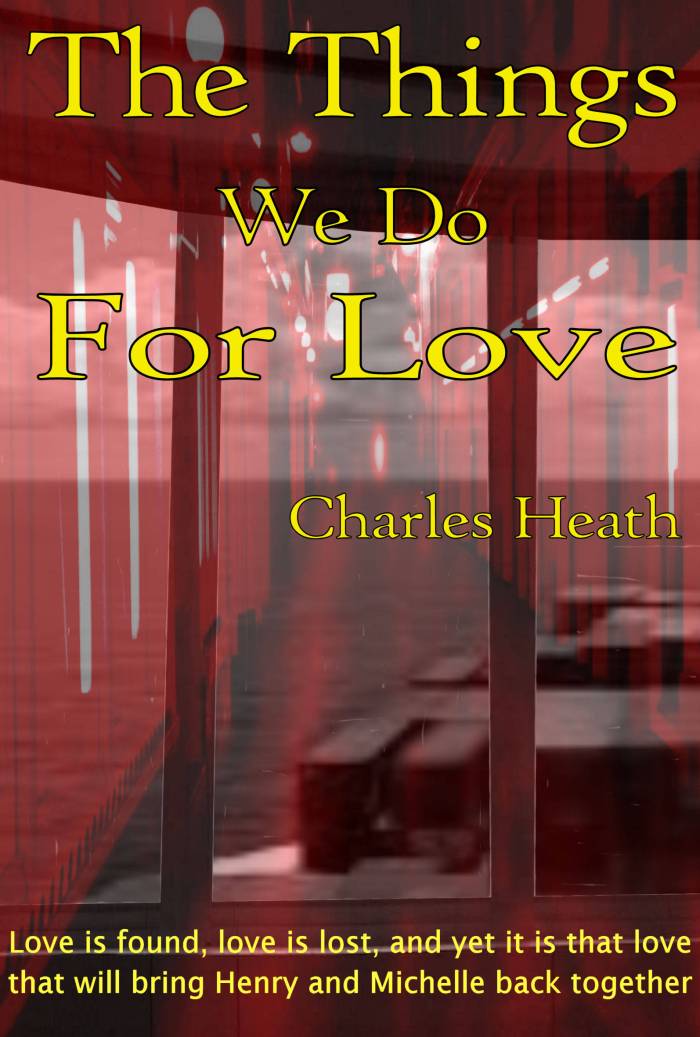
An excerpt from “The Things We Do for Love”; In love, Henry was all at sea!

In the distance, he could hear the dinner bell ringing and roused himself.  Feeling the dampness of the pillow, and fearing the ravages of pent-up emotion, he considered not going down but thought it best not to upset Mrs. Mac, especially after he said he would be dining.

In the event, he wished he had reneged, especially when he discovered he was not the only guest staying at the hotel.

Whilst he’d been reminiscing, another guest, a young lady, had arrived.  He’d heard her and Mrs. Mac coming up the stairs and then shown to a room on the same floor, perhaps at the other end of the passage.

Henry caught his first glimpse of her when she appeared at the door to the dining room, waiting for Mrs. Mac to show her to a table.

She was in her mid-twenties, slim, with long brown hair, and the grace and elegance of a woman associated with countless fashion magazines.  She was, he thought, stunningly beautiful with not a hair out of place, and make-up flawlessly applied.  Her clothes were black, simple, elegant, and expensive, the sort an heiress or wife of a millionaire might condescend to wear to a lesser occasion than dinner.

Then there was her expression; cold, forbidding, almost frightening in its intensity.  And her eyes, piercingly blue and yet laced with pain.  Dracula’s daughter was his immediate description of her.

All in all, he considered, the only thing they had in common was, like him, she seemed totally out of place.

Mrs. Mac came out of the kitchen, wiping her hands on her apron.  She was, she informed him earlier, chef, waitress, hotelier, barmaid, and cleaner all rolled into one.  Coming up to the new arrival she said, “Ah, Miss Andrews, I’m glad you decided to have dinner.  Would you like to sit with Mr. Henshaw, or would you like to have a table of your own?”

Henry could feel her icy stare as she sized up his appeal as a dining companion, making the hair on the back of his neck stand up.  He purposely didn’t look back.  In his estimation, his appeal rating was minus six.  Out of a thousand!

“If Mr. Henshaw doesn’t mind….”  She looked at him, leaving the query in mid-air.

He didn’t mind and said so.  Perhaps he’d underestimated his rating.

“Good.”  Mrs. Mac promptly ushered her over.  Henry stood, made sure she was seated properly and sat.

“Thank you.  You are most kind.”  The way she said it suggested snobbish overtones.

“I try to be when I can.”  It was supposed to nullify her sarcastic tone but made him sound a little silly, and when she gave him another of her icy glares, he regretted it.

Mrs. Mac quickly intervened, asking, “Would you care for the soup?”

They did, and, after writing the order on her pad, she gave them each a look, imperceptibly shook her head, and returned to the kitchen.

Before Michelle spoke to him again, she had another quick look at him, trying to fathom who and what he might be.  There was something about him.

His eyes, they mirrored the same sadness she felt, and, yes, there was something else, that it looked like he had been crying?  There was a tinge of redness.

Perhaps, she thought, he was here for the same reason she was.

No.  That wasn’t possible.

Then she said, without thinking, “Do you have any particular reason for coming here?”  Seconds later she realized she’d spoken it out loud, had hadn’t meant to actually ask, it just came out.

It took him by surprise, obviously not the first question he was expecting her to ask of him.

“No, other than it is as far from civilization, and home, as I could get.”

At least we agree on that, she thought.

It was obvious he was running away from something as well.

Given the isolation of the village and lack of geographic hospitality, it was, from her point of view, ideal.  All she had to do was avoid him, and that wouldn’t be difficult.

After getting through this evening first.

“Yes,” she agreed.  “It is that.”

A few seconds passed, and she thought she could feel his eyes on her and wasn’t going to look up.

Until he asked, “What’s your reason?”

Slightly abrupt in manner, perhaps, because of her question and how she asked it.

She looked up.  “Rest.  And have some time to myself.”

She hoped he would notice the emphasis she had placed on the word ‘herself’ and take due note.  No doubt, she thought, she had completely different ideas of what constituted a holiday than he, not that she had said she was here for a holiday.

Mrs. Mac arrived at a fortuitous moment to save them from further conversation.

Over the entree, she wondered if she had made a mistake coming to the hotel.  Of course, there had been no conceivable way she could know that anyone else might have booked the same hotel, but realized it was foolish to think she might end up in it by herself.

Was that what she was expecting?

Not a mistake then, but an unfortunate set of circumstances, which could be overcome by being sensible.

Yet, there he was, and it made her curious, not that he was a man, by himself, in the middle of nowhere, hiding like she was, but for quite varied reasons.

On discreet observance, whilst they ate, she gained the impression his air of light-heartedness was forced, and he had no sense of humour.

This feeling was engendered by his looks, unruly dark hair, and permanent frown.  And then there was his abysmal taste in clothes on a tall, lanky frame.  They were quality but totally unsuited to the wearer.

Rebellion was written all over him.

The only other thought crossing her mind, and incongruously, was he could do with a decent feed.  In that respect, she knew now from the mountain of food in front of her, he had come to the right place.

“Mr. Henshaw?”

He looked up.  “Henshaw is too formal.  Henry sounds much better,” he said, with a slight hint of gruffness.

“Then my name is Michelle.”

Mrs. Mac came in to take their order for the only main course, gather up the entree dishes, and then return to the kitchen.

“Staying long?” she asked.

“About three weeks.  Yourself?”

“About the same.”

The conversation dried up.

Neither looked at the other, rather at the walls, out the window, towards the kitchen, anywhere.  It was, she thought, unbearably awkward.

Mrs. Mac returned with a large tray with dishes on it, setting it down on the table next to theirs.

“Not as good as the usual cook,” she said, serving up the dinner expertly, “but it comes a good second, even if I do say so myself.  Care for some wine?”

Henry looked at Michelle.  “What do you think?”

“I’m used to my dining companions making the decision.”

You would, he thought.  He couldn’t help but notice the cutting edge of her tone.  Then, to Mrs. Mac, he named a particular White Burgundy he liked, and she bustled off.

“I hope you like it,” he said, acknowledging her previous comment with a smile that had nothing to do with humour.

“Yes, so do I.”

Both made a start on the main course, a concoction of chicken and vegetables that were delicious, Henry thought when compared to the bland food he received at home and sometimes aboard my ship.

It was five minutes before Mrs Mac returned with the bottle and two glasses.  After opening it and pouring the drinks, she left them alone again.

Henry resumed the conversation.  “How did you arrive?  I came by train.”

“By car.”

“Did you drive yourself?”

And he thought, a few seconds later, that was a silly question, otherwise she would not be alone, and certainly not sitting at this table. With him.

“After a fashion.”

He could see that she was formulating a retort in her mind, then changed it, instead, smiling for the first time, and it served to lighten the atmosphere.

And in doing so, it showed him she had another more pleasant side despite the fact she was trying not to look happy.

“My father reckons I’m just another of ‘those’ women drivers,” she added.

“Whatever for?”

“The first and only time he came with me I had an accident.  I ran up the back of another car.  Of course, it didn’t matter to him the other driver was driving like a startled rabbit.”

“It doesn’t help,” he agreed.

“Do you drive?”

“Mostly people up the wall.”  His attempt at humour failed.  “Actually,” he added quickly, “I’ve got a very old Morris that manages to get me where I’m going.”

The apple pie and cream for dessert came and went and the rapport between them improved as the wine disappeared and the coffee came.  Both had found, after getting to know each other better, their first impressions were not necessarily correct.

“Enjoy the food?” Mrs. Mac asked, suddenly reappearing.

“Beautifully cooked and delicious to eat,” Michelle said, and Henry endorsed her remarks.

“Ah, it does my heart good to hear such genuine compliments,” she said, smiling.  She collected the last of the dishes and disappeared yet again.

“What do you do for a living,” Michelle asked in an off-hand manner.

He had a feeling she was not particularly interested, and it was just making conversation.

“I’m a purser.”

“A what?”

“A purser.  I work on a ship doing the paperwork, that sort of thing.”

“I see.”

“And you?”

“I was a model.”

“Was?”

“Until I had an accident, a rather bad one.”

“Oh, I’m sorry.”

So that explained the odd feeling he had about her.

As the evening wore on, he began to think there might be something wrong, seriously wrong with her because she didn’t look too well.  Even the carefully applied makeup, from close, didn’t hide the very pale, and tired look, or the sunken, dark-ringed eyes.

“I try not to think about it, but it doesn’t necessarily work.  I’ve come here for peace and quiet, away from doctors and parents.”

“Then you will not have to worry about me annoying you.  I’m one of those fall-asleep-reading-a-book types.”

Perhaps it would be like ships passing in the night and then smiled to himself about the analogy.

Dinner over, they separated.

Henry went back to the lounge to read a few pages of his book before going to bed, and Michelle went up to her room to retire for the night.

But try as he might, he was unable to read, his mind dwelling on the unusual, yet compellingly mysterious person he would be sharing the hotel with.

Overlaying that original blurred image of her standing in the doorway was another of her haunting expressions that had, he finally conceded, taken his breath away, and a look that had sent more than one tingle down his spine.

She may not have thought much of him, but she had certainly made an impression on him.

© Charles Heath 2015-2024

lovecoverfinal1

In a word: Stern

It’s what I’d always expected of my teachers, having to stand up the front of the classroom and look like they were in control.

These days, not so much, but back in my day, teachers, and particularly the men, were to be feared, and stern expressions were the features of an effective teacher.

So, in this context, it means a hardness or severity of manner.

Whilst in a sense that was frightening to us kids, another form of the word also can be used to express a forbidding or gloomy appearance.

Grandfathers also have that stern look, but it’s more forbidding, more authoritarian, more severe, more austere, well, you get the picture.  A six-year-old would be trembling in his or her boots.

There again, in facing up to either possibility above, you could stand firm with a stern resolve not to buckle under the pressure.

Of course, not a good idea if you’re facing a tank (with a stern-looking tank master)

Then…

If you’re standing at the end of the boat, not the front, but the rear, you would be standing at the stern of the boat, or ship.

Oddly, when issuing instructions to go in reverse, not something you would say if you were on the bridge, you would instead say, or possibly yell, full speed astern, because you’re about to hit an iceberg.

Or some idiot in a jet ski who likes to think he or she can beat the bullet (or 65,000 tonnes of a ship that has very little mobility).

“One Last Look”, nothing is what it seems

A single event can have enormous consequences.

A single event driven by fate, after Ben told his wife Charlotte he would be late home one night, he left early, and by chance discovers his wife having dinner in their favourite restaurant with another man.

A single event where it could be said Ben was in the wrong place at the wrong time.

Who was this man? Why was she having dinner with him?

A simple truth to explain the single event was all Ben required. Instead, Charlotte told him a lie.

A single event that forces Ben to question everything he thought he knew about his wife, and the people who are around her.

After a near-death experience and forced retirement into a world he is unfamiliar with, Ben finds himself once again drawn back into that life of lies, violence, and intrigue.

From London to a small village in Tuscany, little by little Ben discovers who the woman he married is, and the real reason why fate had brought them together.

It is available on Amazon here:  http://amzn.to/2CqUBcz

NANOWRIMO – November 2025 – Day 4

The Third Son of a Duke

So, here’s the quandary that research can dump on you.  Trains in 1914 traditionally left from Fenchurch Street Station for Tilbury, but there is other evidence that special Tilbury trains ran from Paddington.  What do you pick for your story?

The thing is, once you start poking around, looking for dated photos of the dock at Tilbury that was at the end of the railways, the fact that there was a shed when the shipping agents were waiting for baggage that wasn’t sent ahead. And passengers who would show their tickets and be directed to the correct gangway, if, of course, the ship was tied up at the wharf, because there is evidence that the ships were moored off the pier and people were taken by tender to the ship.

What is the truth, what is inferred, what is known?  Research sometimes can leave you with an incomplete picture.

Then, we have to get the passengers aboard the ship, boarded by the correct gangway for their class, because the class system was alive and well in Edwardian England, and then, well, you get the picture.  Travelling on a state-of-the-art 10,000-ton vessel that took about 1400 passengers, much have been some undertaking.

How I would have loved to have been there in person.

1245 words, for a total of 6225 words.

Writing about writing a book – Day 19

I’m still working on the sequence of flashbacks for the story, filling out the back story to how Bill became associated with a man called Colonel Davenport.

It is important to remember that while Davenport may have begun with good intentions, it was not difficult to go slowly mad given the conditions.  This character, Davenport, runs a multitude of operations within the war zone, turning a huge profit and setting up a business for when the war ended.

Bill meets his Davenport’s cronies and then the man himself.  Life is not what it seems, and working for him is not a guarantee of safety, so Bill not only has to watch out for the enemy but also those with whom he also works.


Part 3 – In the Service of Davenport

Davenport and punishment

Busted mission, the first threat to Davenport

Manilow’s death – and how he got there

More on Manilow, the night before his death

Taken to rendezvous with Davenport’s boss

Identify Davenport by ‘sniveling morons’

Sniper – killing Ellen’s father – set up

Sniper – Killing Ellen’s father, execution

Planes and death


Bill gets to meet an interesting cast of characters, not the least of which is Davenport’s right-hand men, and a very unlucky lad who was supposed to see through his tour in the command station far from the war zone, and who is connected to a person close to him.

He was also unwittingly involved in a murder, one set up by Davenport, and one designed to keep his silence.


Part 4 – The Lead up to Capture, and in a POW camp

The object that Davenport is seeking

After R & R revoked, retrieved by Davenport for the last mission

Capture by Cho’s forces, delivered by Davenport’s men

In the POW Camp, and the arrival of Cho

Day of Rescue from Cho

Ellen and Jacobson after rescue in the hospital


Bill’s safety may have been assured had he simply toed the line, but, while on a secret mission with Davenport’s men, he sees an opportunity to take some evidence of Davenport’s activities, as an act of self-preservation.

Of course, he doesn’t reckon with the ruthlessness of Davenport and ends up in a camp where Bill is handed over to the chief interrogator, a friend of Davenport’s.  There is no doubt what Cho’s mission is.

But, like all seemingly simple plans, it doesn’t go the way Davenport wants, Bill does not talk, and is eventually rescued.


Part 5 – Post Rescue and Transworld

Employment at Transworld, then first interrogation via Collins

In hospital immediately after being shot

Davenport in my hospital room, post being shot

Recognize Jorgenson


Davenport discovers Bill was rescued, and that is has lost his memory of all the time in his service, so just in case Bill does, one day, remember, he will be there to get the answers, and the missing information.

It is almost a story within a story, and maybe one day will be published as such.

At least now I have some idea of how to work the much larger story into the flashbacks, as a prelude to what happens to Bill once he realizes who is behind everything that is happening at Transworld.


© Charles Heath 2015-2020

The cinema of my dreams – I never wanted to go to Africa – Episode 27

Our hero knows he’s in serious trouble.

The problem is, there are familiar faces and a question of who is a friend and who is foe made all the more difficult because of the enemy, if it was the enemy, simply because it didn’t look or sound or act like the enemy.

Now, it appears, his problems stem from another operation he participated in.


It took almost an hour to recover.  Monroe didn’t come looking for me, so I think they knew it would take some time for me to get my legs back.

And it felt good to stand under the hot shower for twenty-odd minutes, letting the warmth of the water sink into my bones and clear my head.

And think.

How long had Bamfield have an eye on me?  It was a question that sprung to mind the moment I saw him in the desert camp.  I’d heard if you were transferred to one of his commands, at some point, it was not because it was another posting, it was because he wanted you there.

I’d been specially selected by Bamfield personally, out of the preliminary training camp, to further my military career under his oversight.  I’d made it very clear from the outset that I was not interested in a commission, that I preferred the lower ranks.  Officers were a different breed, and I’d not been cut from that cloth.  Bamfield had admitted as much when I was first interviewed by him, and several other’s on what I soon discovered was his selection panel.

They were charged by him to find the best of the best.

And at that first interview, I’d disagreed with his assessment.  I’d been in trouble before, and the military was the only place I could go if I didn’t want to serve a stretch in jail.  Perhaps it was that innate ability of mine to seek out and become embroiled in trouble that caught his attention.

Certainly over time he and his instructors had honed those skills to a more refined set that, in civilian life, would set me up for a long stay in prison.  It begged the question of what I was going to do with myself after the military had finished with me, a question I hadn’t really thought about until I’d been shunted to my last post in a training school of sorts.

I realised now that it had been Bamfield sidelining me until an operation crying out for my particular talents came along.

That disastrous operation with Treen.

Was it his?  Or was it someone else who pulled it together, and he just provided the manpower.  It had been the first major active offshore operation I’d been on.  There’d been a few skirmishes along the way, but that was the first, and in a zone where I don’t think we were meant to be operating.

That had, I thought, been the sole purview of the CIA, and if I looked back on what had happened, there was no doubt the two agents we were supposed to pull out were CIA operatives, it had got too hot for them to stay, and they had clandestinely called for help.

It begged another question, was Bamfield CIA or working with the CIA, with or without the military hierarchy knowing?

The thing is, if it had been pulled off, as expected, no one would be any the wiser in that country, but once they found out, by whatever means it happened, the proverbial had hit the fan.  It goes hand in hand with trusting people on the ground who were purportedly working against their country’s regime, for better or worse.

That country had a ‘friendly’ government, that had been ‘supported’ and then been deposed in the usual coup by the military, and, afterwards, the new hardliners got the benefit of those times when the country was a friendly and had military hardware and knowledge to wage war clandestinely or otherwise with its neighbours, given willingly.

Lessons hadn’t been learned after a particular middle east debacle.  Maybe lessons would never be learned.  Just look at the number of times had relations turned sour after a coup and agents had to hastily withdraw.  It seems that my visit had been at the end of another of those ‘diplomatic’ missions that had gone wrong.

If this was such a case, I was about to find out.

© Charles Heath 2019

Writing a book in 365 days – My Story 44

The end is not the place to start finding plot holes

Third Edit, Big Plot Hole? It’s a Gift, Not a Disaster (and How to Fix It!)

You’re deep into your third edit. The words are starting to gleam, the narrative arc feels solid, and you can almost taste that “FIN” key. Then it hits you. A moment, a scene, a fundamental piece of your carefully constructed world… and it makes no sense.

Your stomach drops. Your heart sinks. A gaping, undeniable plot hole stares back at you from the page, like a canyon you somehow missed seeing until now. “Third edit?!” you scream internally. “How could I have missed this? My book is fundamentally broken! I’m a fraud! It’s over!”

Stop. Breathe. You’re not alone, and this isn’t the end. In fact, finding a big plot hole late in the game is not a disaster – it’s an opportunity.

Why You Absolutely Should NOT Panic

Let’s talk you off the ledge, writer. Here’s why this unexpected discovery is actually a good thing:

  1. You Found It! This is the single most important reason not to panic. Imagine if a reader found it after publication. Ouch. You, the diligent author, caught it before it became a problem for anyone else. Give yourself a pat on the back for your keen editorial eye.
  2. It Means You’re Getting Better. Spotting a plot hole on the third edit, rather than the first, shows your critical faculties are sharpening. You’re viewing your work with fresh, more discerning eyes, like a seasoned detective.
  3. It’s Fixable (Seriously). Very few plot holes are truly unfixable without rewriting the entire book. Most can be patched, rewoven, or even transformed into something stronger.
  4. It Can Make Your Story Stronger. Often, fixing a plot hole isn’t just about patching a flaw; it’s about deepening character motivation, adding a surprising twist, or solidifying your world-building in a way you hadn’t considered before. What felt like a weakness can become a new strength.
  5. It Happens to Everyone. Every single writer, from debut authors to multi-published bestsellers, grapples with plot logic. Stories are complex beasts, and human brains are fallible. This is part of the process.

How to Fix That Pesky Plot Hole: A Step-by-Step Guide

Okay, now that we’ve established your book isn’t doomed, let’s roll up our sleeves.

Step 1: Disengage and Diagnose

  • Step Away: The worst thing you can do is try to fix it immediately while you’re still in “panic mode.” Go for a walk, make some tea, watch an episode of your favorite show. Let your subconscious marinate.
  • Pinpoint the Genesis: Identify the exact moment or decision where the logic breaks. Is it a character doing something illogical? A timeline inconsistency? A magical rule being broken? A piece of information that shouldn’t exist yet?
  • Trace the Impact: How far does this plot hole ripple through your story? What other scenes, character motivations, or plot points does it implicitly invalidate? Don’t just look at the hole; look at what falls into it.

Step 2: Brainstorm Solutions (No Bad Ideas Yet!)

Get out a fresh notebook or open a blank document. For 15-20 minutes, just write down any idea that comes to mind, no matter how silly or impossible.

  • “Character X secretly had a twin!” (Probably too much, but write it down.)
  • “The magic system actually has this obscure loophole!”
  • “That scene never happened, it was a dream!” (Again, likely not the best, but capture it.)
  • “What if Character Y’s motivation was actually Z, which explains the moment?”
  • “Could I add a short scene earlier to explain this?”
  • “What if I just cut that entire problematic subplot?”

The goal here is quantity, not quality. Don’t filter.

Step 3: Employ Your Writer’s Toolbox

Now, let’s get strategic with some common plot-hole-fixing techniques:

  1. The Foreshadow/Setup: This is often the cleanest solution. Can you add a small detail, a throwaway line, an earlier scene, or even a brief internal thought a few chapters (or even many chapters) before the plot hole appears, that subtly explains or justifies it?
    • Example: If your character can suddenly fly, have them dream about flying earlier, or overhear a strange comment about ancient powers.
  2. Reverse-Engineer the Logic: What needs to be true for the problematic moment to work? Can you build that truth into your world or character history?
    • Example: Character had to be at Location A, but they were established at Location B. What if the journey from B to A is shorter than you thought? Or what if there’s a secret tunnel? Or what if they sent a proxy?
  3. Deepen Character Motivation: Often, a plot hole stems from a character making an inconsistent or illogical choice. Can you:
    • Give them a secret motivation for that action?
    • Add internal conflict or external pressure that forces their hand?
    • Show them making a flawed, very human decision under stress?
    • Sometimes a character’s mistake IS the plot point.
  4. World-Building Expansion/Clarification: If the hole is due to inconsistencies in your magic system, technology, or societal rules, can you:
    • Add a new rule or caveat that explains it?
    • Clarify an existing rule?
    • Show a character misunderstanding or misinterpreting a rule?
  5. The “Consequences” Approach: Instead of trying to erase the illogical moment, what if you embrace it and explore its consequences? The plot hole becomes a new catalyst for conflict.
    • Example: If a character’s decision was illogical, what are the immediate, negative repercussions? How do they deal with the fallout? This can be incredibly rich for storytelling.
  6. Information Management: Did you give the reader too much or too little information at a crucial point?
    • Too much: Can you withhold a detail for longer to maintain suspense and prevent the reader from spotting the flaw too soon?
    • Too little: Can you provide a key piece of information subtly earlier to make the problematic moment click into place?
  7. The Pruning Shears: Is the problematic scene, character, or subplot truly essential? Sometimes, the most elegant solution is to simply remove the offending element entirely. If it’s creating more problems than it solves, it might not belong.

Step 4: Implement and Re-read (with a Partner if Possible)

Once you’ve chosen a solution, carefully integrate it. This might mean adding a few lines, a paragraph, or even rewriting a small scene. Then, read through the entire section, or even the whole manuscript again, specifically looking for new inconsistencies your fix might have created.

If you have a trusted beta reader or critique partner, this is an excellent time to get their eyes on it. Explain the original plot hole and your proposed solution, and ask them if it now makes sense and feels organic.

You Got This.

Finding a big plot hole on your third edit isn’t a sign of failure; it’s a badge of honor. It means you care enough about your story, and your readers, to make it the absolute best it can be. Embrace the challenge, apply these strategies, and watch as that gaping chasm transforms into a seamlessly integrated, stronger part of your narrative.

Searching for locations: The Bund, Shanghai, China

The Bund

The architecture along the Bund or Waitan is a living museum of the colonial history of the 1800s.  The area centers on a section of Zhongshan Road within the former Shanghai International Settlement.

The word bund means an embankment or an embanked quay.   It was initially a British settlement; later the British and American settlements were combined in the International Settlement.

The Bund is a mile-long stretch of waterfront promenade along the Huangpu River. There are 52 buildings of various architectural styles, including Gothic, baroque, and neoclassical styles. The area is often referred to as “the museum of buildings”.

Building styles include Romanesque Revival, Gothic Revival, Renaissance Revival, Baroque Revival, Neo-Classical or Beaux-Arts, as well as a number in Art Deco style.

Having seen these buildings initially the night before, mostly lit up, our viewing this morning was from the land side, and particularly interesting in that the colonial architecture was really fascinating considering their location, but not surprising given Shanghai’s history.  A lot of these buildings would be more at home in London, that out in the far east.

The Bund waterfront is about two kilometers long and impossible to cover in the time allowed for this part of the tour.

There was just enough time to get photos of the waterfront and the old buildings.

Some of these buildings had odd shapes, like one on the far right that looks like a bottle opener.

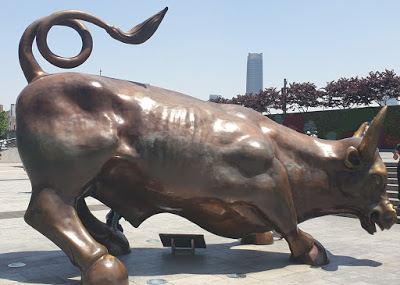
And, for some odd reason, a bull.

On the other side of the water, the sights that had been quite colorful the night before, were equally impressive though somewhat diminished by the haze.

What I learned about writing – There is never enough time for reading

And the point is, there should be.

To me, reading is an essential part of a writer’s life.  We see what others write, we see how others write, and we see what they write about.

It is an education in itself on the genre we eventually want to write for.  Call it homework, or very pleasant homework.

But…

Between everything else I have to do around the house, the time set aside for writing, the time set aside for maintaining social media, the time set aside for family, is there any time left?

About an hour before I go to sleep, though that time is considerably shortened if the book is boring.

Fortunately, quite often they are not.

The other problem is the intervals between new books from my favorite authors is getting less as they take on co-writers, such as James Patterson and Clive Cussler.   And even more are now getting co-authors which means my to be read list is getting longer and longer.

It seems the only time I can steal more than an hour away is when I go away on holiday.  This we try to do several times a year, and this year we’ll be going to Melbourne, and then a week in Tasmania.

There’s only one other problem involved, the fact books are so much cheaper there, and I’ll be buying more.

Damn.  It’s a never-ending cycle.

But, at the moment, the list reads like this,

Len Camarda, The Seventh Treasure

Edgar Wallace, The Clue of the new Pin

Nicola Upson, Nine Lessons

Matt Gallagher, Youngblood

Sam Peters, From Darkest Skies

And, of course, about a hundred others.

As odd as it sounds I’m looking forward to the few hours in the plane seeing many airlines are now doing away with inflight entertainment.  I’m sure food will be next.

Harry Walthenson, Private Detective – the second case – A case of finding the “Flying Dutchman”

What starts as a search for a missing husband soon develops into an unbelievable story of treachery, lies, and incredible riches.

It was meant to remain buried long enough for the dust to settle on what was once an unpalatable truth, when enough time had passed, and those who had been willing to wait could reap the rewards.

The problem was, no one knew where that treasure was hidden or the location of the logbook that held the secret.

At stake, billions of dollars’ worth of stolen Nazi loot brought to the United States in an anonymous tramp steamer and hidden in a specially constructed vault under a specifically owned plot of land on the once docklands of New York.

It may have remained hidden and unknown to only a few, if it had not been for a mere obscure detail being overheard …

… by our intrepid, newly minted private detective, Harry Walthenson …

… and it would have remained buried.

Now, through a series of unrelated events, or are they, that well-kept secret is out there, and Harry will not stop until the whole truth is uncovered.

Even if it almost costs him his life.  Again.