50 photographs, 50 stories, of which there is one of the 50 below.
They all start with –
A picture paints … well, as many words as you like. For instance:
And the story:
It was once said that a desperate man has everything to lose.
The man I was chasing was desperate, but I, on the other hand, was more desperate to catch him.
He’d left a trail of dead people from one end of the island to the other.
The team had put in a lot of effort to locate him, and now his capture was imminent. We were following the car he was in, from a discrete distance, and, at the appropriate time, we would catch up, pull him over, and make the arrest.
There was nowhere for him to go.
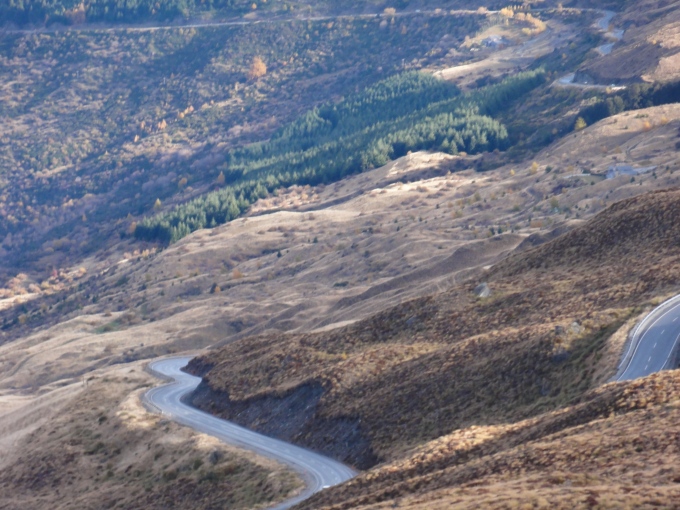
The road led to a dead-end, and the only way off the mountain was back down the road were now on. Which was why I was somewhat surprised when we discovered where he was.
Where was he going?
“Damn,” I heard Alan mutter. He was driving, being careful not to get too close, but not far enough away to lose sight of him.
“What?”
“I think he’s made us.”
“How?”
“Dumb bad luck, I’m guessing. Or he expected we’d follow him up the mountain. He’s just sped up.”
“How far away?”
“A half-mile. We should see him higher up when we turn the next corner.”
It took an eternity to get there, and when we did, Alan was right, only he was further on than we thought.”
“Step on it. Let’s catch him up before he gets to the top.”
Easy to say, not so easy to do. The road was treacherous, and in places just gravel, and there were no guard rails to stop a three thousand footfall down the mountainside.
Good thing then I had the foresight to have three agents on the hill for just such a scenario.
Ten minutes later, we were in sight of the car, still moving quickly, but we were going slightly faster. We’d catch up just short of the summit car park.
Or so we thought.
Coming quickly around another corner we almost slammed into the car we’d been chasing.
“What the hell…” Aland muttered.
I was out of the car, and over to see if he was in it, but I knew that it was only a slender possibility. The car was empty, and no indication where he went.
Certainly not up the road. It was relatively straightforward for the next mile, at which we would have reached the summit. Up the mountainside from here, or down.
I looked up. Nothing.
Alan yelled out, “He’s not going down, not that I can see, but if he did, there’s hardly a foothold and that’s a long fall.”
Then where did he go?
Then a man looking very much like our quarry came out from behind a rock embedded just a short distance up the hill.
“Sorry,” he said quite calmly. “Had to go if you know what I mean.”
I’d lost him.
It was as simple as that.
I had been led a merry chase up the hill, and all the time he was getting away in a different direction.
I’d fallen for the oldest trick in the book, letting my desperation blind me to the disguise that anyone else would see through in an instant.
It was a lonely sight, looking down that road, knowing that I had to go all that way down again, only this time, without having to throw caution to the wind.
Every time I close my eyes, I see something different.
I’d like to think the cinema of my dreams is playing a double feature but it’s a bit like a comedy cartoon night on Fox.
But these dreams are nothing to laugh about.
Once again there’s a new installment of an old feature, and we’re back on the treasure hunt.
The passage heading towards the marina was littered with fallen rocks, timber beams, and roofing material. Much of the damage was in this wing, where the marina had started falling apart.
It was a problem with the foundations. A long and costly investigation had found that the marinas foundations had been inadequately built on a shifting base, made worse by the seasonal water flow.
It was interesting to learn that the event that caused the start of the problems had not occurred in a hundred years, but had been noted in an early newspaper report, and only that it was a phenomenon,
No one at the time had any interest in building there, and it was understood when the navy built its marina, there was no mention of anything untoward happening that would preclude the construction.
And, over the life of the project, nothing had happened. It was why, when the mall was being touted, no one really knew anything about flooding because it hadn’t happened in living memory. That only came later, after the damage was done.
We reached the end of the passageway and found the stairs leading up to the walkway around the marina was closed off. Someone had pulled a board away and we could peer through the crack.
There was daylight beyond, and we could see the large cracks in the staircase, and along the walls either side. There were two sets of stairs up both at the end of a mall passageway, and, in between, there were steps down into the carpark. To one side of that was an elevator lobby, but the elevators would not be working.
But, just out of curiosity, I pressed the button. The light came on, but nothing happened, and, a second later, it went out again.
I looked up, but Boggs had not moved from the top of the stairs.
These steps were not blocked by a barricade, but there would be some difficulty stepping over masonry that had fallen from the roof, which now had a gaping crack and a few pieces of concrete missing. I could see the steel reinforcing and it was rusting.
A few years, all of it would eventually come down.
“You sure this is safe,” I asked.
“Been here a few times. I reckon it hasn’t changed much in years.”
He was looking at the map again, and I peered over his shoulder. The stairs were there but looking down we could only see as far as the landing. There were cracked and broken tiles everywhere, and the handrail had been bent severely out of shape by a boulder now wedged in the rail.
Boggs put the map in his back pocket and said, “Follow me.” He started walking slowly down the stairs, flashing his cell phone light ahead so we could see if there were any hazards.
At the landing, we looked further down the stairs, and these were cleaner. Also, the wall which kept the marina out had a crack in it, and it was damp which meant water was seeping in. The smell was of mold, and I wondered if that could be good for our health.
I followed him down to the first level of the carpark. In the distance, looking back towards the front entrance of the mall, way in the distance was the slatted entrance gates, light seeping in through the cracks.
Between us and those gates were several cars, crushed by a huge concrete beam that had fallen on them. I remembered, then, that there had been a husband and wife in one of the cars at the time and they’d been killed. Their children had been luckier, the youngest had to go to the restroom, and that minute delay had saved them.
Still, it would not be good seeing your parents killed in front of your eyes.
“This place is giving me the creeps,” I said and shuddered.
They said there were ghosts, and I now believed them.
“What are we looking for?: I asked.
“Evidence of the underground river.”
“That would be long gone by now, since they built this lot over it, and some of it falling into it.”
“We shall see.”
He then went down the next flight of steps to the bottom carpark, and I followed. There was less debris on this level, but it was much darker down here, and with only Boggs’ cell phone light, we couldn’t see much else.
“That’s strange,” Boggs said, having taken a dozen or so steps to the right.
“What is?” I wondered what his definition of the word strange was.
“There’s supposed to be an open section here where the wall fell away, pushed by the water flow last time it flooded. The report said that a section here wasn’t anchored properly with formwork, hence the ease in which it was moved.”
I looked at the wall. It seemed to be still intact to me.
Boggs pulled out a pocketknife and tapped it against the surface.
The false concrete chipped and fell away, and a closer inspection showed stippled plaster over plywood, very damp plywood. Boggs extracted a knife and worked on the wall, clearing a foot square, the damp plaster easily peeling away.
A false wall, one that no one would think twice about if they were not looking for it.
Boggs then scraped sideways until the blade hit metal, then he scraped around it until a gate-type bolt was exposed. It didn’t have a lock. It was rusted shut, so Boggs found a rock and hit it a few times, shaking it loose. He opened it, then tugged on it.
Was he expecting a door to open?
“Give us some help here.”
We both pulled on it, and it gave way, showering us in plaster pieces. At least we weren’t smothered in dust.
As it opened, light flooded in, almost blinding me.
I let Boggs open it the rest of the way while my eyes adjusted.
Then I tentatively looked out.
From where we were standing, we could see the two levels of the marina walkway, broken away at this end above the doorway, and a big hole in the side wall of what was the marina pool. We could see, and smell the seawater, and beyond, the ocean.
Looking down, there was a sheer drop of about 30 feet, and under us, there was an opening. At that 30 feet was flowing water, and through the water, I thought I could see clothes.
“Is that a body down there?”
It looked like one.
“No. Don’t think so. Someone probably threw a clothed dummy down there for fun, once when this was open. I’d say it was closed up to make the place safer. Anyway, we’ll soon find out. We’re going down to have a look.”
For a story that was conceived during those long boring hours flying in a steel cocoon, striving to keep away the thoughts that the plane and everyone in it could just simply disappear as planes have in the past, it has come a long way.
Whilst I have always had a fascination in what happened during the second world war, not the battles or fighting, but in the more obscure events that took place, I decided to pen my own little sidebar to what was a long and bitter war.
And, so, it continues…
The new leader of the resistance was the woman, Martina, best if I didn’t know her last name. Fair enough. There had been a necessary restructure after the infiltration, and untimely deaths of over half their number.
When I asked what happened to the former leader, I learned that he, and all but five other members were captured and taken to the castle. They were now, for all intents and purposes, double agents, working for the Thompson at the castle.
The remaining five, of which Giuseppe and Martina belonged, had been forced to hide, dodging the men sent from the castle to hunt them down and kill them.
It was both the lack of reporting from the castle, followed by a message received regarding a possible traitor inside the resistance we had received in London, that set everything in motion, including my arrival to ascertain what was happening within the resistance group, and also at the castle. Until that information reached us, there had been no reason to suspect that anything was wrong, and that the plans set in place to facilitate the defection of useful German scientists and, in some cases, high ranking officers, or that it had been infiltrated and to put it bluntly, original members had been killed and replaced.
I hadn’t realised who was in charge until the paratroopers had arrived and I’d become a prisoner. Part of my brief had also been to verify the layout of the castle in accordance with old plans we had found using my archaeology background as a front, and Id managed to explore certain areas before Thompson had become suspicious and basically stopped me. I’d searched part of the lower levels of the castle, but hadn’t got as far as the dungeons, where I eventually discovered becoming one myself, they were keeping many more prisoners.
I hadn’t long enough in the dungeons to discover whether any of the prisoners were part of the original team sent, whether there were any defectors being still held there, except for two that I’d seen, and definitely one I talked to, but there had to be more.
And, now that I’d found the remaining members of the resistance, it was my intention to return to rescue then, and retake the castle. What was going to make it difficult, if not impossible, was the fact there were only five, and they were all busy trying not to get caught. Still, I had to try, and I asked Martina if it was possible to get everyone together for a meeting.
Martina just laughed. Whether it was my request or my plan to retake the castle was the cause of her mirth.
“With what?” she said incredulously, “there are only five of us left, and we spend most of our time keeping one step ahead of the turncoats.”
“How many of them are there?”
“Too many, led by that bastard Francesco. He didn’t like taking orders from a woman, thought we’d picked the wrong side, especially when the Germans killed about fifty of the villagers when we refused to give ourselves up. They killed his wife and mother after he refused to send them away.”
That didn’t seem right to me, to align yourself with that sort of enemy, not after what they had done. Except there was no telling what anyone might do in the face of such an adversary, or circumstances. But I had to ask, “Why would they?”
“They’ve got hostages from the village up there, in the dungeons. That’s how they turned them.”
Damn. I was not going to be able to turn them back, not when the lives of their friends, even family, was being threatened.
“Is that the case for those who didn’t surrender?”
“No. Our relatives left when we could see what was going to happen.”
“So, the problem we have is, freeing the hostages, freeing the soldiers if there are any of the original group, retake the castle, and get the pipeline working again.” And, I thought to myself, pull off seven miracles in fifteen minutes.
I was putting forward what was for all intents and purposes impossible.
“There’s more,” she said. “There is a high-value scientist coming, last advice was that he was in transit from Germany to here. We know, and they know, courtesy of Francesco. They want him captured; we want him safely delivered to the submarine waiting to take him to England. He’s due in three days, and he doesn’t know the castle’s allegiances have changed.”
“Then we’ll have to intercept him.”
“Yes, but we don’t know what he looks like, but we do have a code name. Francesco and the castle don’t have that, only his real name.”
A name I saw on a highly confidential document on Forster’s desk the day he briefed me on my current mission. Blackfoot. I thought it was an operation. I think that was the code name for the defector.
“Blackfoot?”
“How did you know?”
“A lucky guess.”
The question I had was, why didn’t he tell me about it? Did he think I was going to get captured and tortured?
“Well, you’re right. But it means Francesco and his men are going to be looking extra hard for us, because without that codename, as soon as they fail to confirm their identity to him, he will kill himself rather than go back, which I’m guessing will be their least preferred option. And to make matters worse, London’s orders are quite specific, this man must be delivered alive. He has critical information they need, and which will hasten the end of the war”
“Then I think we should tell London the nature of our situation and see what they come up with.”
This book has finally come back from the Editor, so this month it is going to get a second revision, a second draft for the editor, and beta readers.
And so it begins…
…
So, we have a mission, and we have the players.
…
We let it play out. People die, and others escape. If you escape, knowing that someone is trying to kill you, what is the first thing to happen in the spy world?
A debriefing.
Searching for the reasons why and coming to conclusions can result in accusations. Or at worst, the survivors are blamed for those that didn’t. I hesitate to say it was like in the first days of flying aeroplanes, if it crashed, it was pilot error, not the plane.
The unthinkable happens, the survivor is fired, and the researcher/briefer is sent to their own version of a debriefing to find out what went wrong. At least, that is what everyone thinks happened.
What actually did was far more sinister, and our man who was fired, with a little help, launched his own investigation. It is coincidental that he was in a relationship with the researcher right up until the briefing when she broke it off.
But what follows makes a very interesting story, and highlights the fact that in the shadowy world of intelligence gathering, everyone lies, everyone has an agenda, and not everyone has the best interests of their country at heart.
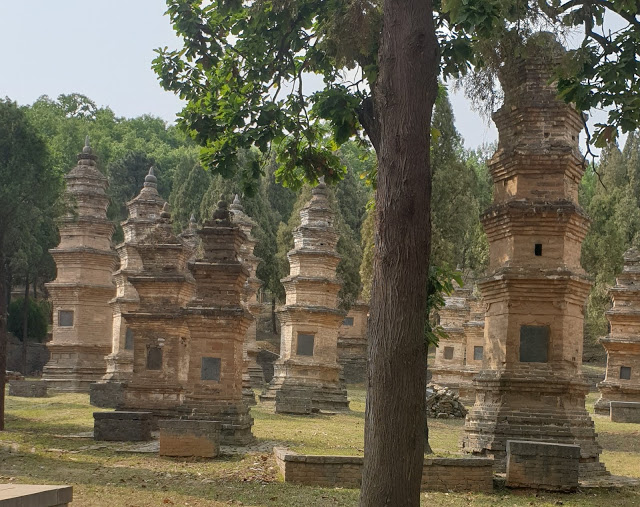
After another exhausting walk, by now the heat was beginning to take its toll on everyone, we arrived at the pagoda forest.
A little history first:
The pagoda forest is located west of the Shaolin Temple and the foot of a hill. As the largest pagoda forest in China, it covers approximately 20,000 square meters and has about 230 pagodas build from the Tang Dynasty (618-907) to the Qing Dynasty (1644-1911).
Each pagoda is the tomb of an eminent monk from the Shaolin Temple. Graceful and exquisite, they belong to different eras and constructed in different styles. The first pagoda was thought to be built in 791.
It is now a world heritage site.
No, it’s not a forest with trees it’s a collection of over 200 pagodas, each a tribute to a head monk at the temple and it goes back a long time. The tribute can have one, three, five, or a maximum of seven layers. The ashes of the individual are buried under the base of the pagoda.
The size, height, and story of the pagoda indicate its accomplishments, prestige, merits, and virtues. Each pagoda was carved with the exact date of construction and brief inscriptions and has its own style with various shapes such as a polygonal, cylindrical, vase, conical and monolithic.
This is one of the more recently constructed pagodas
There are pagodas for eminent foreign monks also in the forest.
From there we get a ride back on the back of a large electric wagon
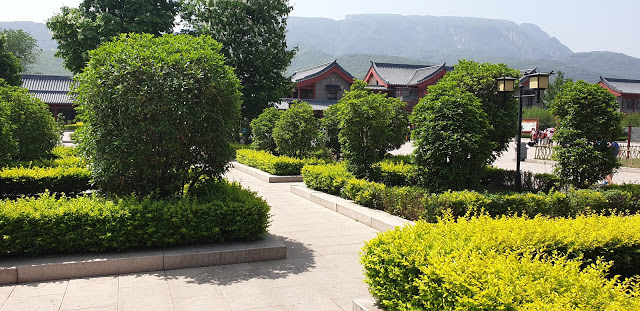
to the front entrance courtyard where drinks and ice creams can be bought, and a visit to the all-important happy place.
As accomplished as we can be at putting words on paper, what is it that makes it so difficult to sit in a chair with a camera on you, and saying words rather than writing them?
Er and um seem to crop up a lot in verbal speech.
OK, it was a simple question; “What motivates you to write?”
Damn.
My brain just turned to mush, and the words come out sounding like a drunken sailor after a night out on the town.
The written answer to the question is simple; “The idea that someone will read what I have written, and quite possibly enjoy it; that is motivation enough.”
It highlights the difficulties of the novice author.
Not only are there the constant demands of creating a ‘brand’ and building a ‘following’, there is also the need to market oneself, and the interview is one of the more effective ways of doing this.
If only I can settle the nerves.
I mean, really, it is only my granddaughter who is conducting the interview, and the questions are relatively simple.
The trouble is, I’ve never had to do it before, well, perhaps in an interview for a job, but that is less daunting. That usually sticks to a predefined format.
Here the narrative can go in any direction. There are set questions, but the interviewer, in her inimitable manner, can sometimes slide a question in out of left field.
For instance, “Your character Zoe the assassin, is she based on someone you know, or an amalgam of other characters you’ve read about or seen in movies?”
That was an interesting question, and one that has several answers, but the one most relevant was; “It was the secret alter ego of one of the women I used to work with. I asked her one day if she wasn’t doing what she was, what she would like to do. It fascinated me that other people had a desire to be something more exotic in an alter ego.”
Of course, the next question was about what I wanted to be in an alter ego.
50 photographs, 50 stories, of which there is one of the 50 below.
They all start with –
A picture paints … well, as many words as you like. For instance:
And, the story:
Have you ever watched your hopes and dreams simply just fly away?
Everything I thought I wanted and needed had just left in an aeroplane, and although I said I was not going to, i came to the airport to see the plane leave. Not the person on it, that would have been far too difficult and emotional, but perhaps it was symbolic, the end of one life and the start of another.
But no matter what I thought or felt, we had both come to the right decision. She needed the opportunity to spread her wings. It was probably not the best idea for her to apply for the job without telling me, but I understood her reasons.
She was in a rut. Though her job was a very good one, it was not as demanding as she had expected, particularly after the last promotion, but with it came resentment from others on her level, that she, the youngest of the group would get the position.
It was something that had been weighing down of her for the last three months, and if noticed it, the late nights, the moodiness, sometimes a flash of temper. I knew she had one, no one could have such red hair and not, but she had always kept it in check.
And, then there was us, together, and after seven years, it felt like we were going nowhere. Perhaps that was down to my lack of ambition, and though she never said it, lack of sophistication. It hadn’t been an issue, well, not until her last promotion, and the fact she had to entertain more, and frankly I felt like an embarrassment to her.
So, there it was, three days ago, the beginning of the weekend, and we had planned to go away for a few days and take stock. We both acknowledged we needed to talk, but it never seemed the right time.
It was then she said she had quit her job and found a new one. Starting the following Monday.
Ok, that took me by surprise, not so much that it something I sort of guessed might happen, but that she would just blurt it out.
I think that right then, at that moment, I could feel her frustration with everything around her.
What surprised her was my reaction. None.
I simply asked where who, and when.
A world-class newspaper, in New York, and she had to be there in a week.
A week.
It was all the time I had left with her.
I remember I just shrugged and asked if the planned weekend away was off.
She stood on the other side of the kitchen counter, hands around a cup of coffee she had just poured, and that one thing I remembered was the lone tear that ran down her cheek.
Is that all you want to know?
I did, yes, but we had lost that intimacy we used to have when she would have told me what was happening, and we would have brainstormed solutions. I might be a cabinet maker but I still had a brain, was what I overheard her tell a friend once.
There’s not much to ask, I said. You’ve been desperately unhappy and haven’t been able to hide it all that well, you have been under a lot of pressure trying to deal with a group of troglodytes, and you’ve been leaning on Bentley’s shoulder instead of mine, and I get it, he’s got more experience in that place, and the politics that go with it, and is still an ally.
Her immediate superior and instrumental in her getting the position, but unlike some men in his position he had not taken advantage of a situation like some men would. And even if she had made a move, which I doubted, that was not the sort of woman she was, he would have politely declined.
One of the very few happily married men in that organisation, so I heard.
So, she said, you’re not just a pretty face.
Par for the course for a cabinet maker whose university degree is in psychology. It doesn’t take rocket science to see what was happening to you. I just didn’t think it was my place to jump in unless you asked me, and when you didn’t, well, that told me everything I needed to know.
Yes, our relationship had a use by date, and it was in the next few days.
I was thinking, she said, that you might come with me, you can make cabinets anywhere.
I could, but I think the real problem wasn’t just the job. It was everything around her and going with her, that would just be a constant reminder of what had been holding her back. I didn’t want that for her and said so.
Then the only question left was, what do we do now?
Go shopping for suitcases. Bags to pack, and places to go.
Getting on the roller coaster is easy. On the beginning, it’s a slow easy ride, followed by the slow climb to the top. It’s much like some relationships, they start out easy, they require a little work to get to the next level, follows by the adrenaline rush when it all comes together.
What most people forget is that what comes down must go back up, and life is pretty much a roller coaster with highs and lows.
Our roller coaster had just come or of the final turn and we were braking so that it stops at the station.
There was no question of going with her to New York. Yes, I promised I’d come over and visit her, but that was a promise with crossed fingers behind my back. After a few months in t the new job the last thing shed want was a reminder of what she left behind. New friends new life.
We packed her bags, three out everything she didn’t want, a free trips to the op shop with stiff she knew others would like to have, and basically, by the time she was ready to go, there was nothing left of her in the apartment, or anywhere.
Her friends would be seeing her off at the airport, and that’s when I told her I was not coming, that moment the taxi arrived to take her away forever. I remember standing there, watching the taxi go. It was going to be, and was, as hard as it was to watch the plane leave.
So, there I was, finally staring at the blank sky, around me a dozen other plane spotters, a rather motley crew of plane enthusiasts.
Already that morning there’s been 6 different types of plane depart, and I could hear another winding up its engines for take-off.
People coming, people going.
Maybe I would go to New York in a couple of months, not to see her, but just see what the attraction was. Or maybe I would drop in, just to see how she was.
As one of my friends told me when I gave him the news, the future is never written in stone, and it’s about time you broadened your horizons.
We walked another umpteen miles from the exhibition to a Chinese restaurant that is going to serve us Chinese food again with a beer and a rather potent pomegranate wine that has a real kick. It was definitely value for money at 60 yuan per person.
But perhaps the biggest thrill, if it could be called that, was discovering downstairs, the man who discovered the original pieces of a terracotta soldier when digging a well. He was signing books bought in the souvenir store, but not those that had been bought elsewhere.
Some of is even got photographed with him. Fifteen minutes of fame moment? Maybe.
After lunch, it was off to the station for another high-speed train ride, this time for about two and a half hours, from X’ian to Zhangzhou dong.
It’s the standard high-speed train ride and the usual seat switching because of weird allocation issues, so a little confusion reigns until the train departs at 5:59.
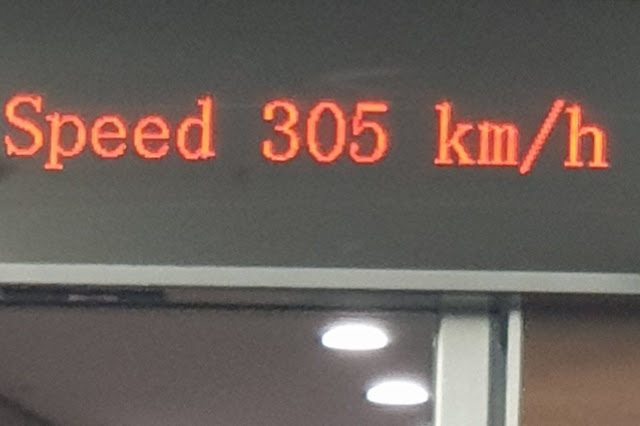
Once we were underway it didn’t take long before we hit the maximum speed
Twenty minutes before arrival, and knowing we only have three minutes to get off everyone is heading for the exit clogging up the passageway. It wasn’t panic but with the three-minute limit, perhaps organized panic would be a better description.
As it turned out, with all the cases near the door, the moment to door opened one of our group got off, and the other just started putting cases on the platform, and in doing so we were all off in 42 seconds with time to spare.
And this was despite the fact there were about twenty passengers just about up against the door trying to get in. I don’t think they expected to have cases flying off the train in their direction.
We find our way to the exit and our tour guide Dannie. It was another long walk to the bus, somewhat shabbier from the previous day, no leg room, no pocket, no USB charging point like the day before. Disappointing.
On the way from the station to the hotel, the tour guide usually gives us a short spiel on the next day’s activities, but instead, I think we got her life history and a song, delivered in high pitched and rapid Chinglish that was hard to understand.
Not at this hour of the night to an almost exhausted busload of people who’d had enough from the train. Oh, did I forgot the singing, no, it was an interesting rendition of ‘you are my sunshine’.
The drive was interesting in that it mostly in the dark. There was no street lighting and in comparison to X’ian which was very bright and cheerful, this was dark and gloomy.
Then close to the hotel our guide said that if we had any problems with the room, she would be in the lobby for half an hour.
That spoke volumes about the hotel they put us in.
This book has been sitting in the ‘to-be-done’ tray, so this month it is going to get the final revision.
And so it begins…
…
What’s a spy story without an insidious plot?
…
So, the world of the spy is usually in the most expensive clothes, the most expensive cars, staying in six-star hotels, high rolling in the best casinos, in the company of very beautiful women. Also let’s not forget they can shoot with almost any weapon from a Luger to a sniper rifle, to a portable land-to-air missile launcher, they can fly any sort of plane or helicopter, and to finance all this, a briefcase full of money, six different passports, and whatever documents might be needed in a crunch situation.
Let’s not forget that he or she is an expert in martial arts and self-defence, and the notion of taking on six assailants at once does not faze them one bit.
Yes, larger than life.
But do they have to be? I mean, at some point our agent has to be a newbie in the field, after months and months of training in all the essential things they need to know.
That first job in the field.
Will they succeed, or will they be found out and killed before they draw their second breath?
This story starts out as a first mission of a newbie, and the fact that from the moment he is on the ground in the target zone, everything goes wrong. He is still working on the premise that those who sent him had researched the mission and planned for a basic safe working space. After all, it was a matter of going in, getting the target, and getting out. Since no one else was supposed to know they were coming, it should have been simple.