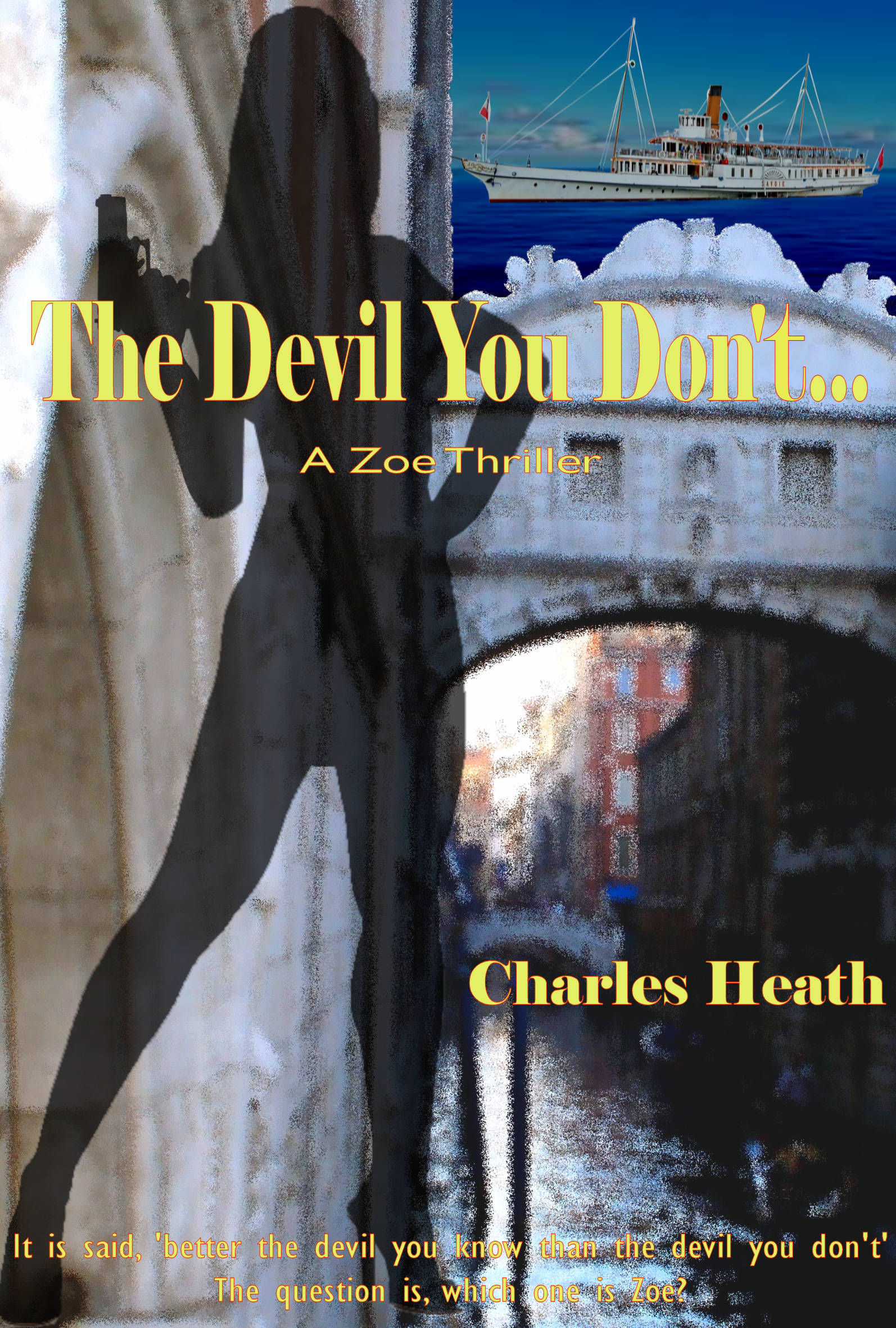
‘The Devil You Don’t’ – A beta reader’s view

It could be said that of all the women one could meet, whether contrived or by sheer luck, what are the odds it would turn out to be the woman who was being paid a very large sum to kill you?

John Pennington is a man who may be lucky in business, but not so lucky in love. He has just broken up with Phillipa Sternhaven, the woman he thought was the one, but relatives and circumstances, and perhaps because she was a ‘princess’, may also have contributed to the end result.

So, what do you do when you are heartbroken?

That is a story that slowly unfolds, from the first meeting with his nemesis on Lake Geneva, all the way to a hotel room in Sorrento, where he learns the shattering truth.

What should have been solace after disappointment turns out to be something else entirely, and from that point, everything goes to hell in a handbasket.

He suddenly realises his so-called friend Sebastian has not exactly told him the truth about a small job he asked him to do, the woman he is falling in love with is not quite who she says she is, and he is caught in the middle of a war between two men who consider people becoming collateral damage as part of their business.

The story paints the characters, cleverly displaying all their flaws and weaknesses. The locations add to the story at times, taking me back down memory lane, especially to Venice, where, in those back streets, I confess it’s not all that hard to get lost.

All in all, a thoroughly entertaining story with, for once, a satisfying end.

…

Available on Amazon here: https://amzn.to/2Xyh1ow

…

The cinema of my dreams – I always wanted to write a war story – Episode 46

For a story that was conceived during those long boring hours flying in a steel cocoon, striving to keep away the thoughts that the plane and everyone in it could just simply disappear as planes have in the past, it has come a long way.

Whilst I have always had a fascination with what happened during the second world war, not the battles or fighting, but in the more obscure events that took place, I decided to pen my own little sidebar to what was a long and bitter war.

And, so, it continues…

——

When Carlo heard the shot, he stopped his ‘interrogation’ and sent a soldier over to investigate.  To avoid getting shot inadvertently, I came out of the woods with my hands up, and, thankfully, was instantly recognized.

I went over to the barn and looked at the man on the ground.  “Do he have anything to say?”

“No.”

The other man, awaiting ‘interrogation’ was visibly shaken by the events.  Two dead including Leonardo, and one a bloody pulp on the ground, with a very angry Carlo standing over him, his outlook was very bleak.

“You speak English,” I asked him.

“Yes.”

“Who are you?”

“Alberto, sir.  I didn’t agree with anything Fernando did.  A few of us refused to kill any of the villagers.  That was Fernando.  He was the one who beat up the women.”

“You could have stopped him.”

“You know the bastard, Carlo.  Not even you could, and you tried.”

Carlo grunted.  To make sure the men on the ground were dead, he shot them again, and emptied his gun into Fernando, adding a curse with each bullet.

I glared at Alberto.  “Pick a side.”

“I’m with you.  There are several others, back in the castle.  We would be able to help if you were planning an attack.”

“The last person who told me that is out there in the woods with a bullet in his head.  I’m sorry, but I don’t believe you.”

“We can help.”

“And, you will.  When we decide to go, we’ll take you with us.  You double-cross us, the Carlo gets his five minutes.  You try to run away, Carlo will hunt you down and kill you.  Understood?”

He nodded.

“Fernando?”  The man sent to find the defectors had come back.

I shot him before he could make any sort of move, just as he realized what had happened.

I motioned to the soldiers to get the defectors, who, hearing the shots, had started to flee.  Two shots in the air stopped them.  Two of them were small children, who would not have survived if they’d been taken to the castle.

All four were visibly frightened by what they’d seen, and of what their fate might be.  I assured them, they were now in safe hands, and we were going not to the castle, but to a different place.  Desperate people in a desperate situation, I couldn’t imagine where they’d come from, or their journey from Germany with nothing on a promise of safety taken at face value.

“We go to the castle now,” Carlo asked.

“Soon.  We need a plan.  Let’s go back and make one.  But, yes.  We go to the castle now.”

Storming the castle might have worked if I had a hundred men, not about ten. Granted Carlo would be the equivalent of another five, but in a hail of bullets, he would not last long.

I had to put myself in Wallace’s shoes and figure out how he would defend the castle once he realized Jackerby and the resistance members were dead.

Panic would be my first thought.  Then, when rational thought returned, block off all the known entrances and exits, and post sentries outside.  We had about twenty men to deal with, but a dozen were hardened battle soldiers, and that would make a difference.  The fact they were inside covering most of the entrance points would make the job harder.

If we had to use the known entrances.

When the time came, they were going to get a surprise because Carlo knew of two others no one but he, and the owners of the castle, were the only ones who knew about them.

But, first, we had to even the odds if possible.

For that, one of Blinky’s team was a sniper, and with him was a sniper rifle and suppressor which meant we would be able to pick off the sentries without anyone hearing the bullets coming for them.

We were only going to get one shot at it because once Wallace discovered the sentries, he wouldn’t post anymore, and would know of our intent.

But, in the end, none of that mattered. 

We just got a short communication that Meyer was in Florence and his arrival would be in two days’ time.  We were charged with making sure he arrived safely and passed into the pipeline.  The only issue with that was that we needed the castle to complete the process.

That meant we had to move up the plans  to retake the castle, and there were always problems when details were missed.  We had the advantage in our knowledge of the castle and its underground passageways, but would that be enough?

Then there was the surprise.  It had just been learned that a very high-ranking Nazi officer was coming to the castle to personally take Meyer back to the fatherland.  That meant we had to be in the castle when he arrived, so he could be sent back home for interrogation.

Both men, it appeared, had the capacity to turn the tide of the war in our favour.

Blinky simply shrugged when he got the news, then said, “We could do with some more men.”

Stating the obvious.

“It’s the war, you know.  Shortages of everything.”

“Didn’t envisage this at Prep school, did we?  Seems the world was a different place, but my father said it couldn’t last.”

“Nothing ever does.  It’s going to be interesting when this ends if it ends.  There are days I wake up and I can’t remember what it was like, before all this.”

”Well, maybe we get this done, and it’ll be a step closer.  At least, we have to believe that.”

I nodded.  “Good pep talk.  As I remember, you were always trying to talk me into doing something stupid.”

Carlo had been listening to us was a puzzled look.  “Are all you English like you two?”

Blinky answered.  “No.  We’re unique.”

Clearly, he had no idea what that meant.  Blinky was going to try and explain but instead, shrugged.  “Let’s go kill some Germans.”

That Carlo did understand.

——-

© Charles Heath 2020-2022
The cinema of my dreams – I always wanted to go on a treasure hunt – Episode 47

Here’s the thing…

Every time I close my eyes, I see something different.

I’d like to think the cinema of my dreams is playing a double feature but it’s a bit like a comedy cartoon night on Fox.

But these dreams are nothing to laugh about.

Once again there’s a new installment of an old feature, and we’re back on the treasure hunt.

…

“A hundred square miles, that must have run up the coast close to Patterson’s Reach?” I asked.

Patterson’s reach was about five miles to the north, a small town, where there was little fishing done and allegedly a lot of ferrying drugs being dropped off by large ships coming along the offshore shipping lanes.  No one could prove it, and every trap set by the coast guard had failed to find any evidence.  That meant that someone was tipping them off.

It was also the domain of the Cossatino’s who discouraged anyone else from living there.  It was said that Cossatino owned all of the lands the town sat on and the people who lived there worked for him.

“Only as far as Patterson’s reach and then inland for about 20 miles, about as far as the Faultline and perhaps the closest point between the foothills and the sea.  Ormiston had bought all the land thinking that the treasure was buried on it.  You see, he had a map too, long before Boggs senior had started forging them for the Cossatino’s.”

And in hearing that it begged the question, who had first found the original map?  If Cossatino found it, then getting Boggs senior to forge a lot of useless maps would hide where it really was.

What if Boggs ‘original’ map was yet another elaborate forgery, given to him by Cossatino to create others?  I put that thought to one side.

I wondered if Boggs had been to see her, to get some background.  If there was going to be an expert on the treasure, if it existed or not, she would know.  In fact, she probably knew old man Ormiston.

“Does that map still exist?”

“Perhaps.  It was not found in his effects after he died.  Spent his last years in an asylum.  It wasn’t not finding the treasure, or losing his fortune that sent him mad, it was Alzheimer’s, poor old man.  Whatever documents that were found when his relatives cleaned the place out were brought to the library to be stored, cataloged at some point, and one day when someone decides to write a history of the area, no doubt they want to see the collection.”

“I couldn’t look at the papers?”

“Are you interested in writing a local history.  I’m sure your hunt for the treasure and the many fruitless other expeditions looking for it would make a very entertaining chapter.”

“Maybe I will.”

If that was what it took to look at the documents.  There might be something interesting to be found.  Especially if he kept a diary.  I thought it best not to ask, and fuel suspicions.

“Elmer said there might be relations of Ormiston still around here?”

“Yes, I did say that which I now regret.  There are, but I don’t know who they are.  I knew his wife’s family name was Maunchen, and that the Maunchens came from California originally, and there’s nothing to say they didn’t go back.  Certainly, the wife would be deceased by now, and they had three daughters, all of whom would have married, and changed names.  You’d have to go digging through wedding records in at least a dozen parishes.  If you were thinking of investigating.”

“Sound like too much hard work.  Besides, the treasure doesn’t; exist.  I’m only helping Boggs to keep him from doing something stupid.”

“Like father, like son, unfortunately.  You do realize the father made some outlandish claim in the hotel one night that he had found the clue to where the treasure was buried.   Trouble was, he was prone to making outlandish claims, and by that time, a drunkard.  He went missing the next day, and has never been seen since.”

“You think he found it?”

“No.  But I’m guessing someone thought he had and killed him trying to find out.  We’ll never know.”

“A lesson to be learned then.  I’ll keep an eye on Boggs junior just in case he’s thinking of making an equally outlandish claim.”

“You do that.”

She opened a drawer and pulled out a form and handed it to me.

“What’s this for?”

“A request to look at the archives.  You have to register, and I have to give you a special card, the key to the history of Arkwon County.”

Where it said signature, I signed it.

“You fill out the rest.  When do you want me to pick up the card?”

“Monday next week.  In the meantime, be careful.”

She said it like she knew I would be walking into trouble.

…

© Charles Heath 2020

The 2am Rant: I was just getting started when…

You know how it goes, you just get into a writing rhythm when the phone rings and it’s another of those pesky scam calls.

Or in my case not one but three, so far.

The first has to do with the NBN, which is Australia’s laughable answer to world-class internet, and which is, in reality, a complete stuff up that cost us, the taxpayers, 50 billion dollars, and for nothing.

Most nights during the peak hours, you cannot continuously stream without breaks, pixelation, or just nothing at all.  World-class?  I’m afraid not.  Perhaps I should relocate to Romania where I hear, the internet is much faster and more reliable.

Enough with the rant, the call this time around was the NBN scam, where they try logging into your computer and stealing everything, including banking information, credit card information, and the rest of your life, if it’s possible.

I have no life so they would be badly disappointed.

The second scam call is for solar panels.  Yes, they are selling solar panels, but they are the junk no one else wants, years out of date, and then charge three times what they’re worth, even when you get the government rebate.

I’ve got solar panels already, so I don’t care.  I just put the phone on the other side of the desk and let them prattle on.  They get the message eventually.

The next is for raffle tickets.  It generally relates to some form of charity, in which the caller goes through the charity’s functions chapter and verse and then tries to hit you up for ten tickets at a discounted price.

Sounds legit.  Yes, I’ve heard of the charity.  Yes, I know what it does.

But…

It’s not the real charity calling, but some scammer trying to get your credit card details, along with that all-important 3 digit cvc number.

Not today Josephine, or whatever your name was.

I’ve got an app on my phone that tells me if the caller is a scammer, and this one had red lights flashing and a large red ‘fraud’ stamped across it.

An hour later, all thoughts are gone.

I suppose I better have some lunch and try again later.

What I Learned About Writing – Why Your Aspirational Stories May Be Turning Audiences Away (And How to Fix It)

“If you can’t explain it simply, you haven’t understood it well enough.” – Albert Einstein

In the world of blogging, the line between “inspiring” and “incomprehensible” is razor‑thin. You’ve probably heard the old adage: “Tell a dream, lose a reader.” It’s a warning, not a destiny. In this post we’ll unpack why lofty, abstract storytelling can actually drive readers away, and we’ll give you a concrete roadmap to keep those dreams alive and keep your audience glued to the page.


1. The Allure of the “Dream” Narrative

Every great brand, influencer, or thought‑leader has a vision—a big picture that fuels their work. Think of Elon Musk’s Mars colony, Simon Sinek’s “Start With Why,” or a startup’s promise to “revolutionise the way people travel.”

These dreams:

  • Create emotional resonance – they tap into hopes, fears, and aspirations.
  • Differentiate the voice – a compelling vision makes you stand out in a sea of generic how‑tos.
  • Provide long‑term direction – they guide content strategy, product roadmaps, and community building.

So why would sharing a dream ever backfire?


2. When Dreams Become “Dream‑Noise”

Dream‑Heavy SymptomWhy It Turns Readers Off
Vague, lofty language (e.g., “We aim to reshape humanity”)Readers can’t picture the concrete outcome.
All‑talk, no‑action (no steps, no proof)The audience feels you’re all hype, no substance.
Ignoring the audience’s needs (talking about your mission without linking to their problems)Readers wonder, “What’s in it for me?”
Over‑long, meandering storiesAttention spans are limited; the main point gets lost.
Lack of relatable examplesPeople connect with stories they can see themselves in.

These pitfalls cause a cognitive overload: the brain wants a clear mental model, not a cloud of abstract promises. When that model is missing, the reader disengages—often before the first paragraph ends.


3. The Science Behind the Drop‑Off

  • Attention Span: Studies show the average online reader spends only 8‑10 seconds scanning a piece before deciding to stay or leave.
  • Cognitive Fluency: The brain prefers information that’s easy to process. When you bombard readers with nebulous concepts, they experience mental friction and instinctively retreat.
  • Emotional Alignment: Readers stay when they feel the story resonates with their own goals. A dream that feels distant creates an emotional gap—and gaps drive exits.

4. Turning Dream‑Talk Into Reader‑Retention Gold

Below is a step‑by‑step framework that lets you share your grand vision without losing traction.

Step 1: Anchor the Dream in a Tangible Problem

Instead of: “We’ll change the way the world thinks about sustainability.”
Try: “Every year, 1.2 billion tons of plastic end up in oceans. Our platform gives brands a zero‑waste packaging solution that cuts that number by 30 % within two years.”

Why it works: Readers instantly see the stakes and how your dream addresses a real pain point.

Step 2: Break the Vision into Three Concrete Milestones

MilestoneTimeframeReader Benefit
Prototype LaunchQ2 2025Early adopters get 20 % discount & co‑design input
Beta ScalingQ4 2025Access to analytics dashboards to track waste reduction
Full Roll‑outQ2 2026Certification as a “Zero‑Waste Partner” for marketing

Why it works: Short, numbered milestones make the journey digestible and create mini‑wins that keep readers invested.

Step 3: Weave a Relatable Human Story

  • Introduce a protagonist (real or fictional) who embodies the reader.
  • Show their struggle with the problem.
  • Demonstrate how the solution (your dream) changes their life in measurable terms.

Example: “When Maya, a boutique owner in Austin, switched to our biodegradable sleeves, she cut packaging costs by $3,200 in six months and saw a 12 % lift in repeat customers.”

Step 4: Use Concrete Data & Social Proof

  • Include stats, testimonials, or case studies that prove the dream is already moving.
  • Visuals (infographics, before/after photos) reduce abstraction and boost credibility.

Step 5: End With a Clear Call‑to‑Action (CTA) Aligned to the Dream

  • “Join our pilot program and be among the first to showcase a waste‑free storefront.”
  • “Download the free roadmap that walks you through the first step of going plastic‑free.”

Why it works: The CTA transforms inspiration into a next step—the bridge from dream to action.


5. Real‑World Examples: Dream‑Talk Done Right

BrandDream StatementHow They Ground ItResult
Patagonia“We’re in business to save our home planet.”Constantly shares specific initiatives (e.g., 1% for the Planet, repair kits, supply‑chain transparency).Loyal community of 4M+ activists; consistent sales growth.
Airbnb“Belong anywhere.”Provides concrete stories of hosts and guests, clear guidelines for community standards, and data on economic impact.150 M+ users, $5B+ annual revenue.
Tesla“Accelerate the world’s transition to sustainable energy.”Regularly releases measurable milestones (Model 3 production numbers, Supercharger network expansion).Valuation > $1 trillion, massive media buzz.

Notice how each brand starts with a bold dream, but immediately anchors it in specific, relatable, and data‑driven details. The dream becomes a promise you can see, feel, and act upon.


6. Quick Checklist: Is Your Dream Story Reader‑Friendly?

  •  Problem‑First – Do you start with the reader’s pain point?
  •  Three‑Step Roadmap – Is the vision broken into digestible milestones?
  •  Human Hook – Is there a relatable protagonist?
  •  Concrete Evidence – Do you back up claims with data or testimonials?
  •  Clear CTA – Does the post end with a next step tied to the dream?

If you tick four or more boxes, you’re on the right track. If not, it’s time to rewrite.


7. Takeaway: Dream Boldly, Write Clearly

Your audience craves big ideas—but only when those ideas are presented in a way that feels real, relevant, and actionable. The mantra becomes:

“Tell a dream, keep the reader.”

By anchoring ambition in concrete problems, breaking it into bite‑size milestones, and wrapping it in human stories, you turn a lofty vision into a magnetic narrative that inspires and converts.


Ready to Test This On Your Next Post?

  1. Draft your dream statement.
  2. Apply the five‑step framework above.
  3. Run a quick A/B test: original vs. revised version.
  4. Measure dwell time, scroll depth, and CTA clicks.

Share your results in the comments—let’s learn from each other’s journeys toward dreaming and delivering.

Happy writing, and may your dreams never lose a reader again!

365 Days of Writing, 2026 – 201

Day 201 – Where do the words come from?

…

“I Swallowed the World and It Came Out as Words”: The Immortal Legacy of Martha Gellhorn

There are writers who sit in quiet rooms, crafting worlds from the safety of imagination. And then there are writers like Martha Gellhorn.

To read Gellhorn is to understand that writing, at its absolute best, is not merely an art form—it is an act of digestion and survival. Famously reflecting on her life as one of the twentieth century’s greatest war correspondents, she once wrote: “I swallowed the world and it came out as words.”

It is a staggering metaphor. It suggests a writer who didn’t just observe history from a distance; she consumed it, absorbed its toxic realities, felt its crushing weight, and then metabolised it onto the page.

In this post, we’re going to explore the profound meaning behind Gellhorn’s iconic quote, look at her extraordinary life on the front lines, and discover what modern writers and seekers can learn from her voracious appetite for truth.


The Appetite of a Witness: What It Means to “Swallow the World”

Most people spend their lives trying to filter out the harshness of the world. We look away from conflict, sanitise our news feeds, and build comfortable cocoons.

Martha Gellhorn did the exact opposite. With a fierce, unblinking gaze, she threw herself directly into the maw of global catastrophe.

When Gellhorn said she swallowed the world, she was describing radical empathy paired with relentless curiosity. She didn’t parachute into a war zone to file a quick story and catch the next flight out. She lived with the refugees, shivered in the trenches, smelled the cordite, and witnessed the devastation wrought on ordinary human beings.

  • Spain (1937): She covered the Spanish Civil War alongside Ernest Hemingway (her future husband), focusing not on the grand strategy of generals, but on the terror of civilians cowering under fascist bombing raids.
  • Normandy (1944): Denied press accreditation as a woman, she smuggled herself onto a hospital ship on D-Day, locking herself in a bathroom until she could step ashore as a stretcher-bearer to witness the carnage firsthand.
  • Dachau (1945): She was among the first journalists to enter the Dachau concentration camp, producing dispatches that captured the silent, skeletal horror of the Holocaust with devastating clarity.

To swallow the world means to refuse numbness. It means taking in the suffering, the beauty, the politics, and the paradoxes of the human experience without spitting out the bitter parts.


The Alchemical Process: When It “Came Out as Words”

Swallowing the world is only the first half of the equation. The true alchemy lies in the second: “…and it came out as words.”

For Gellhorn, writing was not about ego or personal branding. It was a moral imperative. The things she ingested—the injustice, the bravery, the institutional failures—had to be transformed into language, or they would tear her apart from the inside.

Her prose style was the direct result of this digestion process:

  • Relentlessly Direct: She had no patience for flowery adjectives or intellectual posturing. When you are writing from the ruins of Madrid or the liberated ashes of Europe, fluff is a luxury you cannot afford.
  • Deeply Human-Centric: While male contemporaries often focused on hardware, tactics, and troop movements, Gellhorn focused on the cook, the mother, the child, and the soldier. Her words gave faces to statistics.
  • Unapologetically Outspoken: Gellhorn believed that “objectivity” was often a coward’s excuse for neutrality in the face of evil. Her words always took a side—the side of the victim, the oppressed, and the truth.

Her writing wasn’t manufactured in a vacuum; it was forced out of her by the sheer gravity of what she had witnessed.


Why Gellhorn’s Legacy Matters Today

In our modern digital landscape, we are constantly “swallowing the world.” Through smartphones, social media algorithms, and 24-hour news cycles, we ingest a firehose of global trauma, outrage, and information every single day.

Yet, much of this digital consumption leaves us feeling hollow, paralysed, and cynical. Why? Because we consume without metabolising. We scroll, but we do not create; we react, but we rarely reflect.

Martha Gellhorn’s legacy offers a powerful antidote to modern burnout and information fatigue:

  1. Be Present: You cannot write about—or understand—the world if you view it only through a screen. Engage with reality directly, deeply, and without filters.
  2. Find Your Purpose: Gellhorn didn’t write to be famous; she wrote because bearing witness was her duty. Anchor your creative output in something larger than yourself.
  3. Honor the Truth: In an era of misinformation and spin, Gellhorn’s uncompromising commitment to factual, boots-on-the-ground reality is a masterclass for journalists and content creators alike.

Final Thoughts: What Have You Swallowed Today?

Martha Gellhorn lived a life that was staggering in its scope, courage, and output. She didn’t just report on history; she ingested it, digested it, and left behind a body of work that continues to challenge and inspire.

Her famous quote leaves us with a lingering, provocative question as writers, creators, and human beings:

What kind of world are you swallowing—and what are your words doing with it?

If we dare to open our eyes and truly take in the reality around us, our words, too, might carry the weight, the passion, and the undeniable truth of a life fully lived.


Did this quote by Martha Gellhorn resonate with you? Who are your favourite literary war correspondents or truth-tellers? Let us know in the comments below!

…

Top 5 sights on the road less travelled – Valletta

Discover Valletta’s Hidden Gems: A Road Less Travelled Through Malta’s Capital

If you’ve ever visited Valletta, you know it’s a city of grandeur: a UNESCO World Heritage site with Baroque splendour, ancient fortresses, and sweeping sea views. But beyond the bustling Barrakka Gardens and the famed St. John’s Co-Cathedral lies a Valletta waiting to be discovered—one filled with quiet courtyards, local secrets, and lesser-known stories. For travellers seeking an off-the-beaten-path experience, here are five extraordinary ways to explore a different side of this Maltese gem.


1. Step into Valletta’s Creative Heart: St. James Cavalier Centre for Creativity

Tucked into a centuries-old Inquisitor’s Palace, the St. James Cavalier Centre for Creativity is a vibrant hub of contemporary art, culture, and community. Originally built in the 16th century, this striking white fortress was once a prison and a site of secret executions. Today, it’s transformed into a lively arts venue, hosting exhibitions, street food festivals, and live performances. Wander through its hidden courtyards and sun-dappled archways, where the past and present collide. It’s a must-visit for artists, history buffs, and anyone craving Valletta’s modern soul.


2. Unearth History Beneath Your Feet: Valletta Underground Tour

Did you know Valletta is built atop a network of ancient tunnels and hidden chambers? The Mysterious Valletta Tour offers a fascinating journey into the city’s subterranean secrets. Follow your guide through forgotten catacombs, medieval wine cellars, and wartime bunkers, learning how these underground spaces shaped Malta’s history. It’s a cool (literally) alternative to the city’s sunlit streets—and perfect for curious minds.


3. Savour the Quiet: Lower Barrakka Gardens

While the Upper Barrakka Gardens are a beloved panoramic spot, the Lower Barrakka Gardens offer a quieter, more intimate view of the Grand Harbour. Less crowded and steeped in history, these gardens were once a secret meeting place for merchants and dignitaries. Stroll through the lush, sunlit pathways, enjoy the distant lapping of waves, and snap a photo without the backdrop of crowds.


4. Explore Dark History: The Inquisitor’s Palace

For a gripping dive into Malta’s religious and legal past, the Inquisitor’s Palace is a hauntingly fascinating stop. This 16th-century fortress served as the seat of the Catholic Inquisition in Malta, and its eerie cells and torture chambers provide a sobering glimpse into a turbulent era. While it’s a bit off the typical tourist circuit, the exhibits and guided tours offer rich storytelling and a chance to reflect on Malta’s complex history.


5. Wander Local Lanes: Strada San Domenico and Triq l-Antika

Swap the well-trodden Royal Road for a meander through Strada San Domenico, a charming artisans’ street filled with workshops for glassblowers, weavers, and chocolate makers. Nearby, Triq l-Antika (Antique Street) is a narrow lane bursting with tiny shops selling Maltese lace, handmade soaps, and vintage souvenirs. For lunch, duck into a family-run café like Café Rui or Café del Sol and savour pastizzi (Maltese pastries) and strong Malta coffee, just like the locals do.


Conclusion: Valletta’s Delightful Detours

Valletta thrives on balance—its grandeur and its intimacy, its history and its innovation. By venturing beyond the well-known landmarks, you’ll uncover a city that’s rich in culture, stories, and small-town charm. Whether you’re exploring hidden gardens, sipping coffee in artisan lanes, or descending into ancient tunnels, Valletta’s road less travelled promises unforgettable memories. So next time you’re in Malta’s capital, let curiosity lead the way.

Ready to explore Valletta’s hidden side? Pack your walking shoes and an adventurous spirit—there’s more to discover than meets the eye!

In a word: Piece

Aside from the fact that it really means part of something else, we’ve got to remember that it is one of those ‘i before e except after c’ things.

I have a piece of the puzzle.  Well, maybe not.  You know what it’s like when you’re assembling a 1,000 piece jigsaw puzzle.  Yes, you get to the end and one piece is missing.

You’re so angry you want to give someone a piece of your mind.

Just remember not to give too many people pieces or you will become mindless.

We might be listening to a musical piece, which can be a movement, I think, in a symphony

Or we might piece together the parts of a child’s toy, especially on that night before Christmas when everything can and will go wrong.  I’ve been there and done that far too many times.

I’ve been known to move a chess piece incorrectly, no, come think of it, I’m always doing that

Some people call a gun a piece.

This is not to be confused with the word peace, which means something else, and hopefully, everyone will put away their pieces (guns) and declare peace.

And, every Sunday, at the church, there’s always an opportunity to say to the people around you ‘peace be with you’.

I wonder if that works very well if the person standing next to you is your enemy?

“The Things we do for Love”, the story behind the story

This story has been ongoing since I was seventeen, and just to let you know, I’m 72 this year.

Yes, it’s taken a long time to get it done.

Why, you might ask.

Well, I never gave it much interest because I started writing it after a small incident when I was 17, and working as a book packer for a book distributor in Melbourne

At the end of my first year, at Christmas, the employer had a Christmas party, and that year, it was at a venue in St Kilda.

I wasn’t going to go because at that age, I was an ordinary boy who was very introverted and basically scared of his own shadow and terrified by girls.

Back then, I would cross the street to avoid them

Also, other members of the staff in the shipping department were rough and ready types who were not backwards in telling me what happened, and being naive, perhaps they knew I’d be either shocked or intrigued.

I was both adamant I wasn’t coming and then got roped in on a dare.

Damn!

So, back then, in the early 70s, people looked the other way when it came to drinking, and of course, Dutch courage always takes away the concerns, especially when normally you wouldn’t do half the stuff you wouldn’t in a million years

I made it to the end, not as drunk and stupid as I thought I might be, and St Kilda being a salacious place if you knew where to look, my new friends decided to give me a surprise.

It didn’t take long to realise these men were ‘men about town’ as they kept saying, and we went on an odyssey.  Yes, those backstreet brothels where one could, I was told, have anything they could imagine.

Let me tell you, large quantities of alcohol and imagination were a very bad mix.

So, the odyssey in ‘The things we do’ was based on that, and then the encounter with Diana. Well, let’s just say I learned a great deal about girls that night.

Firstly, not all girls are nasty and spiteful, which seemed to be the case whenever I met one. There was a way to approach, greet, talk to, and behave.

It was also true that I could have had anything I wanted, but I decided what was in my imagination could stay there.  She was amused that all I wanted was to talk, but it was my money, and I could spend it how I liked.

And like any 17-year-old naive fool, I fell in love with her and had all these foolish notions.  Months later, I went back, but she had moved on, to where no one was saying or knew.

Needless to say, I was heartbroken and had to get over that first loss, which, like any 17-year-old, was like the end of the world.

But it was the best hour I’d ever spent in my life and would remain so until I met the woman I have been married to for the last 48 years.

As Henry, he was in part based on a rebel, the son of rich parents who despised them and their wealth, and he used to regale anyone who would listen about how they had messed up his life

If only I’d come from such a background!

And yes, I was only a run away from climbing up the stairs to get on board a ship, acting as a purser.

I worked for a shipping company and they gave their junior staff members an opportunity to spend a year at sea working as a purser on a cargo ship that sailed between Melbourne, Sydney and Hobart in Australia.

One of the other junior staff members’ turn came, and I would visit him on board when he would tell me stories about life on board, the officers, the crew, and other events. These stories, which sounded incredible to someone so impressionable, were a delight to hear.

Alas, by that time, I had tired of office work and moved on to be a tradesman at the place where my father worked.

It proved to be the right move, as that is where I met my wife.  Diana had been right; love would find me when I least expected it.

…

lovecoverfinal1

Top 5 sights on the road less travelled – Skopje

5 Off-the-Beaten-Path Things to Do in Skopje: Discover the Hidden Soul of North Macedonia

When you think of Skopje, North Macedonia’s capital, you might picture the iconic Stone Bridge, the towering statue of Alexander the Great, or the eclectic mix of neoclassical and Ottoman architecture. But beyond the postcard-perfect landmarks lies a lesser-known side of Skopje—quiet alleyways, artistic havens, and authentic local experiences that most tourists miss. If you’re craving something deeper than the typical itinerary, lace up your walking shoes and step off the beaten path. Here are five unique and local-favourite things to do in Skopje that will give you a genuine taste of the city’s soul.


1. Roam the Artist’s Quarter in Čair’s Hidden Courtyards

Tucked away in the bustling Čair neighbourhood—a mosaic of cultures and communities—you’ll find Skopje’s underground art scene thriving in unexpected places. Move past the main streets and into the quiet, ivy-covered courtyards where local artists convert old Ottoman-era houses into studios, galleries, and impromptu exhibition spaces.

Visit during the Čair Fest (if your trip aligns in summer) or simply wander during daylight hours. Knock gently—many artists welcome curious visitors with a warm Zdravo and a cup of Turkish coffee. These intimate encounters offer a refreshing contrast to commercial galleries and reveal the creative heartbeat of the city.

Pro Tip: Bring cash—many artworks are for sale at surprisingly reasonable prices.


2. Hike to Kale Fortress at Sunrise (and Skip the Crowds)

While the medieval Kale Fortress is a popular attraction, most tourists visit midday when the heat and crowds peak. Instead, set your alarm and hike up from the Old Bazaar at sunrise. The path is steep but short, and as you climb through dew-kissed cobblestones, you’ll likely have the ancient ramparts all to yourself.

Watching the city slowly awaken from this vantage point—mist rising off the Vardar River, minarets silhouetted against a peach-colored sky—is pure magic. Plus, you’ll spot resident cats napping in sunlit nooks and hear only birdsong and the occasional call to prayer.

Bonus: Bring a thermos of strong Macedonian coffee and enjoy a quiet moment in history.


3. Discover the Forgotten Macedonian Railway Museum

Tucked behind the main train station and often overlooked, this modest museum is a goldmine for history buffs and train enthusiasts. Inside a converted 1920s depot, vintage locomotives, archival photographs, and meticulously restored railcars tell the story of Balkan railway development.

Curator Ljubčo, a retired engineer with decades of experience, often volunteers his time—and his stories. He’ll regale you with tales of cross-border journeys during Yugoslavia, smuggled contraband, and the secret role trains played during political upheavals.

Why it’s special: It’s personal, unpolished, and deeply nostalgic—no admission fee, just gratitude.


4. Sip Mint Tea in a Hidden Hammam Garden

Tucked behind a plain doorway near the Old Bazaar, Čarši Hamam—once a bustling Ottoman bath—now hosts a tranquil tea garden few know about. While the structure remains unrestored, locals and expats have claimed the inner courtyard as a peaceful retreat.

Pull up a wooden stool, order a glass of warm mint tea or rakija infused with quince, and listen to live acoustic music on weekend evenings. The crumbling tile walls, dappled sunlight, and scent of rosewater create an atmosphere that feels centuries old and refreshingly current.

Insider detail: The entrance is easy to miss—look for a faded green archway between two spice stalls.


5. Take a Ferry to the “Island” (Gazi Baba’s Secret Retreat)

Just a short bus ride from the city centre, the Vardar River widens into a calm stretch dotted with a little-known artificial island known locally as “Ostrvo” (The Island). Locals flock here on weekends to escape the urban buzz, lounging on grassy banks, grilling pljeskavica, or swimming cautiously in calmer eddies.

For a unique experience, hop on a hand-rowed wooden ferry operated by a retired fisherman named Tome. For just 50 denars (less than $1), he’ll ferry you across, offering a quick history lesson en route. Once there, enjoy fresh kiselo mleko (yogurt drink) from a pop-up stand and watch local fishermen mend their nets.

Best time to go: Late afternoon on a weekday—fewer people, golden light, unforgettable views.


Final Thoughts: Skopje Rewritten

Scopje is often misunderstood—a city caught between epochs, aesthetics, and identities. But for those willing to wander beyond the curated city centre, it reveals itself in murmurs: a poet reading in a courtyard, a whiff of rose oil from an open window, the rhythmic clang of a blacksmith’s hammer.

These five experiences aren’t just “things to do”—they’re invitations to connect. To slow down. To listen. To become part of Skopje’s quiet, unfolding story.

So next time you’re in town, skip the statue selfies (at least for a morning) and let the city surprise you. The road less travelled in Skopje isn’t just scenic—it’s soul-stirring.


Have you discovered your own hidden gem in Skopje? Share your offbeat adventures in the comments below!