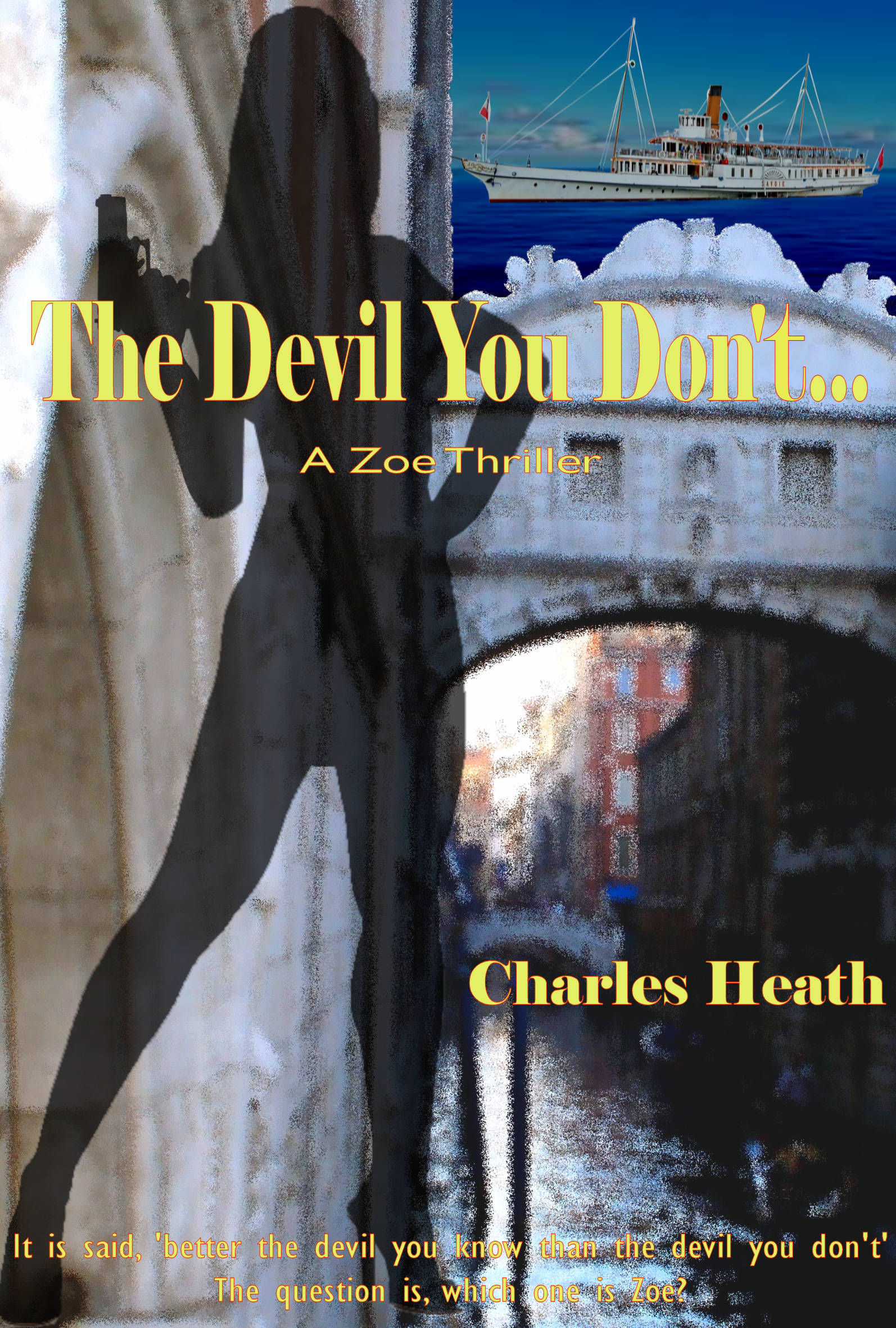
The first case of PI Walthenson – “A Case of Working With the Jones Brothers”

This case has everything, red herrings, jealous brothers, femme fatales, and at the heart of it all, greed.

See below for an excerpt from the book…

Coming soon!

PIWalthJones1

An excerpt from the book:

When Harry took the time to consider his position, a rather uncomfortable position at that, he concluded that he was somehow involved in another case that meant very little to him.

Not that it wasn’t important in some way he was yet to determine, it was just that his curiosity had got the better of him, and it had led to this: sitting in a chair, securely bound, waiting for someone one of his captors had called Doug.

It was not the name that worried him so much, it was the evil laugh that had come after the name was spoken.

Doug what? Doug the ‘destroyer’, Doug the ‘dangerous’, Doug the ‘deadly’; there was any number of sinister connotations, and perhaps that was the point of the laugh, to make it more frightening than it was.

But there was no doubt about one thing in his mind right then: he’d made a mistake. A very big. and costly, mistake. Just how big the cost, no doubt he would soon find out.

His mother, and his grandmother, the wisest person he had ever known, had once told him never to eavesdrop.

At the time he couldn’t help himself and instead of minding his own business, listening to a one-sided conversation which ended with a time and a place. The very nature of the person receiving the call was, at the very least, sinister, and, because of the cryptic conversation, there appeared to be, or at least to Harry, criminal activity involved.

For several days he had wrestled with the thought of whether he should go. Stay on the fringe, keep out of sight, observe and report to the police if it was a crime. Instead, he had willingly gone down the rabbit hole.

Now, sitting in an uncomfortable chair, several heat lamps hanging over his head, he was perspiring, and if perspiration could be used as a measure of fear, then Harry’s fear was at the highest level.

Another runnel of sweat rolled into his left eye, and, having his hands tied, literally, it made it impossible to clear it. The burning sensation momentarily took his mind off his predicament. He cursed and then shook his head trying to prevent a re-occurrence. It was to no avail.

Let the stinging sensation be a reminder of what was right and what was wrong.

It was obvious that it was the right place and the right time, but in considering his current perilous situation, it definitely was the wrong place to be, at the worst possible time.

It was meant to be his escape, an escape from the generations of lawyers, what were to Harry, dry, dusty men who had been in business since George Washington said to the first Walthenson to step foot on American soil, ‘Why don’t you become a lawyer?” when asked what he could do for the great man.

Or so it was handed down as lore, though Harry didn’t think Washington meant it literally, the Walthenson’s, then as now, were not shy of taking advice.

Except, of course, when it came to Harry.

He was, Harry’s father was prone to saying, the exception to every rule. Harry guessed his father was referring to the fact his son wanted to be a Private Detective rather than a dry, dusty lawyer. Just the clothes were enough to turn Harry off the profession.

So, with a little of the money Harry inherited from one of his aunts, he leased an office in Gramercy Park and had it renovated to look like the Sam Spade detective agency, you know the one, Spade and Archer, and The Maltese Falcon.

There’s a movie and a book by Dashiell Hammett if you’re interested.

So, there it was, painted on the opaque glass inset of the front door, ‘Harold Walthenson, Private Detective’.

There was enough money to hire an assistant, and it took a week before the right person came along, or, more to the point, didn’t just see his business plan as something sinister. Ellen, a tall cool woman in a long black dress, or so the words of a song in his head told him, fitted in perfectly.

She’d seen the movie, but she said with a grin, Harry was no Humphrey Bogart.

Of course not, he said, he didn’t smoke.

Three months on the job, and it had been a few calls, no ‘real’ cases, nothing but missing animals, and other miscellaneous items. What he really wanted was a missing person. Or perhaps a beguiling, sophisticated woman who was as deadly as she was charming, looking for an errant husband, perhaps one that she had already ‘dispatched’.

Or for a tall, dark and handsome foreigner who spoke in riddles and in heavily accented English, a spy, or perhaps an assassin, in town to take out the mayor. The man was such an imbecile Harry had considered doing it himself.

Now, in a back room of a disused warehouse, that wishful thinking might be just about to come to a very abrupt end, with none of the romanticized trappings of the business befalling him. No beguiling women, no sinister criminals, no stupid policemen.

Just a nasty little man whose only concern was how quickly or how slowly Harry’s end was going to be.

© Charles Heath 2019-2024

In a word: Flight

There is a saying, if God wanted us to fly then he would have given us wings.

Unfortunately, he didn’t, so we do not get to know what it’s like to be in flight,

Unless…

We take an aeroplane, which usually has a flight number such as QF607, or in conversation, ‘I’ll be taking the 6 o’clock flight’.

If someone runs away, then we say they have taken flight.

If we roll back a few years, say about 80, to World War 2, flight tales on a whole new meaning.

It refers to a group of planes, in one case a number of spitfires, or,

The man in charge, a flight lieutenant, also colloquially known as ‘flight’.

This is not be confused with the word flite which has several very obscure meanings,

First, it means to quarrel or argue, or engage in a debate, and

Second, to make a complaint.

But one that sticks in my my mind is Flyte, from Brideshead Revisited.  they were a very interesting family.

‘Sunday in New York’ – A beta reader’s view

I’m not a fan of romance novels but …

There was something about this one that resonated with me.

This is a novel about a world generally ruled by perception, and how people perceive what they see, what they are told, and what they want to believe.

I’ve been guilty of it myself as I’m sure we all have at one time or another.

For the main characters Harry and Alison there are other issues driving their relationship.

For Alison, it is a loss of self-worth through losing her job and from losing her mother and, in a sense, her sister.

For Harry, it is the fact he has a beautiful and desirable wife, and his belief she is the object of other men’s desires, and one in particular, his immediate superior.

Between observation, the less than honest motives of his friends, a lot of jumping to conclusions based on very little fact, and you have the basis of one very interesting story.

When it all comes to a head, Alison finds herself in a desperate situation, she realises only the truth will save their marriage.

But is it all the truth?

What would we do in similar circumstances?

Rarely does a book have me so enthralled that I could not put it down until I knew the result. They might be considered two people who should have known better, but as is often the case, they had to get past what they both thought was the truth.

And the moral of this story, if it could be said there is one, nothing is ever what it seems.

Available on Amazon here: amzn.to/2H7ALs8

Third son of a Duke – The research behind the story – 22

All stories require some form of research, quite often to place a character in a place at a particular time, especially if it is in a historical context. This series will take you through what it was like in 1914 through 1916.

There are historical records and evidence that the RMS Orontes did leave Australian ports carrying passengers in April 1915. While the ship was later formally requisitioned as a troopship, it continued to operate on the Australia-UK mail and passenger service during the early part of the war, though under significantly changed conditions. 

The April 1915 voyage of the RMS Orontes 

  • Brisbane departure: The Orontes left Brisbane on April 4, 1915.
  • Adelaide stop: On April 16, 1915, the ship stopped in the Outer Harbor at Port Adelaide. An article in the newspaper The Advertiser reports that after a few hours’ stay to take on mail and some passengers, the ship continued its “homeward” voyage.
  • Passengers and purpose: The Adelaide newspaper also noted that among the passengers on this specific sailing were 22 medical men and 29 nurses headed for England, highlighting the wartime nature of the travel. 

An itinerary for the April 1915 voyage

Based on the available records, here is a likely itinerary for the RMS Orontes on its April 1915 voyage from Australia to London:

  • Early April 1915: The ship likely originated its journey in the eastern states of Australia.
  • April 4, 1915: Departed Brisbane.
  • Mid-April 1915 (before April 16): Departed from Sydney and Melbourne.
  • April 16, 1915: Made a brief stop at Adelaide’s Outer Harbor to take on mail and some passengers before continuing on.
  • Late April 1915: Called at Fremantle, as was standard for the UK-Australia route. In March 1915, the Orontes had stopped at Fremantle, suggesting it was part of its regular route.
  • En route via Port Said: The Orient Line’s Australia route, which the Orontes served, traveled via the Suez Canal and Port Said. A stop here was standard for fueling and logistics, and it also put the vessel in the heart of a war zone, increasing the danger of the journey.
  • Mid-May 1915: The ship would have continued its journey through the Mediterranean and around the Iberian Peninsula to its final destination in London. 

Key takeaway

While the voyage was not under a formal military requisition like later in the war, the circumstances were profoundly shaped by World War I. Travel was far from routine, with a heavy emphasis on essential service and mail delivery. The presence of medical personnel bound for England highlights the military undertones of even seemingly “civilian” voyages during this period. 

Follow that cab… – A short story

Nothing ever good comes from eavesdropping.

Or, so my mother said, once, with such feeling that I suspect she had some experience of having done so. It might explain the enmity between her and her older sister, the aunt we never saw.

Except all that changed when I received an odd email from a woman who claimed to be that very aunt.

We had all been warned about scams that came from dubious sources online, and this initially struck me as one. I would need more information before I answered.

That meant poking the bear, that is, asking my mother about her sister.

And coming right out with the words she hoped she’d never heard.

“Aunt Guenivere sent me an email, asking if we could meet. It seems she wants to meet the nephew she hasn’t seen since I was born. What happened to you two?”

It brought a look of total hatred in return.

“You would be wise not to respond. That woman is just plain evil.”

“You do realise that a statement like that makes it even more imperative that I should meet her. If you’re not going to tell me what happened, I’m sure she will.”

“Then if you must, you must.”

It wasn’t resignation but suppressed rage. Whatever had happened, it was something she believed no one would believe her, or understand, least of all me.

With that, she stood and walked out of the room, leaving me with the ominous feeling that it would be the last time I saw her.

After verifying that my so-called aunt was Aunt Guenivere, I arranged a meeting in a public place, a tea room in Queens. And it wasn’t going to be hard to recognise her, she would just be an older version of my mother.

I knew this because I had found a photograph of my mother and her two sisters, all of whom looked very much alike. I’d known about the younger sister, who had died in an accidental car crash many years before, and what my mother regarded as a wasted life.

I saw her about the same time she saw me.

And she just made it to the table when her cell phone rang. She smiled, put a hand up and asked for a moment, and then went back outside. I watched her walk up and down, slowly at first, but I could see the conversation was getting heated.

After a few minutes, I went outside to see if I could be of any assistance.

Apparently not. One look was enough, and I knew what it meant. At least her sister and my mother shared the same facial expressions when angry.

Then the conversation ended. I thought, for a moment, she was going to throw the phone on the ground, and only just managed to stop herself.

Instead, she came over and said. “I’m sorry, but something has come up and I have to go. I’ll call you.”

With that, she waved down a taxi, one stopped, and she jumped in.

Another pulled in behind her taxi and, on the spur of the moment, said with a flourish, “Follow that cab.”

The driver turned to look at me and then said, “You’re kidding.”

I held up a hundred-dollar note and said, seriously, “This is yours if you don’t lose it.”

Incentive enough.

It was a lot easier to follow that taxi than I thought. We caught up and the first set of lights and then proceeded to miss every second intersection as if the universe knew I needed to keep her in sight.

All the way to the Upper West Side and a very expensive apartment block. I paid the cabbie and jumped out, just in time to see a very familiar figure join my aunt.

My father.

And they didn’t look like people who didn’t know each other, or who were at war.

They remained outside the apartment block, and I could see my father had arrived by cab, and it was waiting for him.

I got as close as I could, hidden effectively behind the bushes that lined the building entrance. They were speaking loudly, which surprised me

“What the hell were you thinking?” he said, not angrily, but I could tell he was agitated.

“I was thinking it was time someone told him the truth.”

What truth?

“You know what Evelyn thinks of that, and I do too. You made an agreement.”

“I’ve changed my mind. After all, he is my son, not hers.”

—–

© Charles Heath 2020-2025

The 2am Rant: I find myself in a very strange world

And I don’t know how I got here. I have a sneaking suspicion that I stepped through a portal, only I didn’t recognise it as one until I reached this side.

I say this side because the world I’m in now is not the world I remember from a while back, well, perhaps a year or so. Time passes very slowly here.

Before everything made sense, China didn’t hate us, and we had just finished touring some of the most remarkable sights of that very country.

There was no coronavirus and I didn’t fear for my life, and the fact I had a compromised immune system didn’t matter a hoot, except for the constant pain in my lower back and hands, the result of psoriatic arthritis going berserk as I get older.

My grandchildren were in school, alternately loving and hating it, and every Friday I would get one from school and she would tell me how her world was hell, and I had no idea what it was like.

Another would start all her sentences with ‘basically’, and the other would end hers with ‘like’.

I would lament the fact our schools no longer teach proper English, and we could sit around and talk about the YA novel I was writing for them, and that they were the characters in this mythical kingdom. And, yes, they are princesses, if not crotchety one day, and all smiles and goodness the next.

And, in an instant, that whole world was blown away.

Am I angry? I was. A year is too long to be mad at everyone and everything.

Have I a different outlook on life? Yes, I live every day as if it was my last, because the truth is, it just might be.

Can I travel anywhere? No. There’s too much risk in a world where few people under the age of 65 care about consequences.

Is there a reason to live? You may well ask.

I have thought about this often, lying awake in bed every morning, asking myself why I would bother getting up. I can’t go anywhere, I can’t do very much.

But…

We have here an almost remarkable record in keeping the coronavirus at bay, so we have some freedom. We can’t leave the country, and every other month a state or two closes its borders, so travelling outside the state is too risky. The schools are back, and I resumed pick-up duties last Friday, and, yes, the sweetness of the complaints about school life is like music to my ears.

Have I a reason to live? Yes. There are three girls, and grandchildren, one 13, one 16, and one 19. The 13-year-old is in the first year of secondary school, the 16-year-old lamenting the fourth year of secondary school, and the 19-year-old is about to embark on the terrors of tertiary education. She can also drive herself, a shred of independence that has changed her outlook, going from a child to someone more mature.

I hadn’t realized how much their lives were in such a constant state of change. Nor had I realized how much they prefer to tell me about it rather than their parents.

So, the answer to that deep and meaningful question is, is there a reason to live?

Yes. We can have so many things we think are essential to living our lives taken away, but in the end, they are all but superficial. You can lose a car, some of your mobility, a house, or any sort of chattel, but they are insignificant. What matters most, and always will, is family. I’m lucky, and indeed, extremely grateful, to have mine so near.

Now I suppose I should be getting to bed. Tomorrow, I have just been informed, I’m rostered on in what is known as ‘poppy’s taxi’.

And ready to hear the next enthralling episode of school life these days.

Writing a book in 365 days – 339

Day 339

Unlock Your Potential: The Power of Joining a Writer’s Group

Writing is often a solitary pursuit. Hunched over a keyboard, staring at a blank page, or lost in the quiet hum of creativity—these moments define the life of a writer. But what if there was a way to transform isolation into inspiration? Enter writers’ clubs, workshops, or writing groups: vibrant communities that offer more than just feedback. They become the bedrock of growth, connection, and resilience for writers at any stage of their journey. Let’s explore the transformative benefits of joining such a group.


1. Constructive Feedback and a Fresh Perspective

One of the most immediate benefits of joining a writing group is the constructive feedback you receive. While self-editing is essential, external perspectives can unveil blind spots. For example, a fellow writer might notice an inconsistency in a character’s motivation or suggest a pacing adjustment you hadn’t considered. Workshops often foster a culture of honesty and kindness, helping you refine your work with specific, actionable insights.

Moreover, reading others’ work exposes you to diverse styles, genres, and techniques. This cross-pollination of ideas can spark creativity and broaden your own writing toolkit.


2. Motivation, Accountability, and Discipline

The writing process can be inconsistent. Deadlines slip, self-doubt creeps in, and distractions abound. A writer’s group provides structure and accountability. Regular meetings, shared writing goals (like word counts or drafting timelines), and peer encouragement create a rhythm that keeps you on track.

Imagine committing to write 500 words a week, knowing your group will check in on your progress. Suddenly, the task feels personal and collaborative. The shared energy of a room (or virtual space) filled with fellow writers can reignite your passion on even the toughest days.


3. Learning and Skill Development

Writing groups often double as learning hubs. Many workshops include writing exercises, mini-lessons on grammar or storytelling techniques, or guest speakers who share industry tips. For instance, a member might lead a session on dialogue writing, or the facilitator could guide a critique focused on character development.

Even informal exchanges—discussing a favourite novel or dissecting a challenging scene—can deepen your understanding of the craft. The more you engage, the sharper your skills become.


4. Networking and Collaboration Opportunities

Connections matter. By joining a writing group, you become part of a network of like-minded individuals. These relationships can lead to collaborations—co-authoring a story, editing each other’s manuscripts, or even finding a publishing agent through introductions.

Additionally, many groups host or share information about contests, publications, or local literary events. For emerging writers, these opportunities can be invaluable for visibility and growth.


5. Emotional Support and Validation

Writing is an emotionally charged endeavour. Rejection letters, “fix-it” feedback, and the pressure to publish can wear you down. A writer’s group offers emotional support, a safe space to vent, celebrate small wins, and process setbacks.

Feeling part of a community combats the isolation many writers face. Sharing your struggles with others who “get it” fosters resilience and reminds you that your voice matters.


6. Access to Resources and Creative Stimulation

Many groups curate resources: writing prompts, book recommendations, or even shared tools like grammar checkers. Some offer access to exclusive workshops or masterclasses. Online groups, in particular, can connect you to global experts and trends in the literary world.

The collaborative brainstorming sessions are gold, too. A tired plot idea revived by a group member’s unexpected twist, or a new genre explored through peer encouragement—these moments keep creativity alive.


7. Building Confidence and Overcoming Self-Doubt

Imposter syndrome is common among writers. Hearing peers praise your work or admit they struggle with similar doubts can be incredibly validating. Over time, the supportive environment of a writing group helps you trust your voice and embrace your unique style.

Additionally, sharing your writing aloud in a group setting helps build confidence in your work—and your ability to receive feedback without defensiveness.


Find Your Tribe: Where to Start

Still unsure? Begin by searching for local writing groups through libraries, community centres, or platforms like Meetup and Eventbrite. If in-person isn’t possible, online writing communities (e.g., Reddit’s r/writing, Scribophile) offer equally rich interactions. For the bold, consider starting your own group!


Final Thoughts

A writer’s group isn’t just a place to “get feedback.” It’s a village of collaborators, cheerleaders, and mentors who help you grow both personally and professionally. By joining such a community, you invest in your craft—and your confidence. So, take the leap. Share your work, lean on others, and watch your writing thrive in ways you never imagined.

What’s your favourite benefit of a writing group? Share your experiences in the comments below!

Ready to connect? Explore local or online writing groups today and unlock the power of collective creativity. 📝

Top 5 sights on the road less travelled – Ankara

Off the Beaten Path: Top 5 Alternative Things to Do in Ankara

Ankara, the capital city of Turkey, is often overshadowed by its more popular counterpart, Istanbul. However, this vibrant city has a rich history, cultural significance, and a plethora of exciting activities to offer. While many tourists flock to the Anıtkabir, the Museum of Anatolian Civilisations, and the Kocatepe Mosque, there’s more to Ankara than meets the eye. In this blog post, we’ll delve into the top 5 alternative things to do in Ankara, taking you on a road less travelled.

1. Explore the Hamamönü District

Tucked away in the heart of the city, the Hamamönü District is a charming neighbourhood that showcases Ankara’s Ottoman heritage. This historic district is filled with beautifully restored 19th-century Ottoman houses, quaint shops, and traditional Turkish cafes. Visitors can wander through the narrow streets, admire the architecture, and experience the local culture. Don’t miss the opportunity to try some traditional Turkish delight and coffee at one of the many cafes in the area.

2. Visit the Ankara Castle

Perched atop a hill in the Ulus district, the Ankara Castle offers breathtaking panoramic views of the city. This ancient fortress dates back to the 7th century and has been occupied by various civilisations, including the Romans, Byzantines, and Ottomans. While the castle itself is impressive, the surrounding neighbourhood is also worth exploring, with its narrow streets, historic mosques, and traditional shops.

3. Discover the Turkish Aerospace Museum

For aviation enthusiasts and families alike, the Turkish Aerospace Museum is a hidden gem. Located near the Etimesgut Air Base, this museum showcases a vast collection of aircraft, including historic planes, helicopters, and even a spaceship. With interactive exhibits and a play area for kids, this museum is an excellent alternative to the more traditional attractions in Ankara.

4. Wander through the Gençlik Park

The Gençlik Park, which translates to “Youth Park,” is a tranquil oasis in the heart of the city. This beautiful park offers a peaceful escape from the hustle and bustle of Ankara, with its lush greenery, walking trails, and picturesque lake. Visitors can rent a boat and enjoy a relaxing ride, or simply sit back and enjoy the scenery. The park also hosts various events and festivals throughout the year, making it a great place to experience local culture.

5. Explore the Söğütözü District’s Street Art

Ankara’s Söğütözü District is a hub for street artists, with vibrant murals and graffiti adorning the walls of buildings. This up-and-coming neighbourhood is a great place to explore, boasting an eclectic mix of boutiques, cafes, and restaurants. Visitors can take a self-guided walking tour to discover the unique street art, which reflects the city’s modern and artistic side. Be sure to check out the iconic “Ankara” mural, which has become a popular spot for Instagram-worthy photos.

In conclusion, Ankara is a city that offers much more than the usual tourist attractions. By venturing off the beaten path, visitors can experience the authentic culture, history, and beauty of this vibrant city. Whether you’re interested in history, art, nature, or simply exploring a new neighbourhood, Ankara has something to offer. So, take a road less travelled and discover the hidden gems of Ankara – you won’t be disappointed!

What I learned about writing – It’s easy to get distracted

Started to write a post, get so far, and another theme or idea slips in, and demands to be written first?

I’m on this nostalgia kick, simply because when I turned on the TV to catch up with the latest news, it was on a channel that shows old movies.

In case you don’t realize it, I love old movies, not just those from Hollywood, but also from Britain.

What was on?

An American in Paris.

Well, it had to be one of my favourites, even though I’m not a great fan of Gene Kelly, the sheer majesty of the music more than makes up for the story in between.

Could it be said, then, this was from the golden years of Hollywood? Such bright and cheerful movies such as Singing in the Rain, and An American in Paris, perhaps exemplify the Hollywood musical.

Years before, Fred Astaire and Ginger Rogers were the quintessential musical stars, followed by the likes of Judy Garland and Deanna Durbin, and later Bing Crosby and Frank Sinatra. A couple of musicals, in particular, comes to mind, firstly the Wizard of Oz and then High Society.

Moving forward to more modern times, several stand out in the 1960s, My Fair Lady and Sound of Music. By this time theatregoers were dining on the superb talents of Rogers and Hammerstein, and Learner and Lowe. Of the former, musicals such as Carousel, South Pacific, and The King and I were on my list of favourites.

Even later still in the 1970s, there is Funny Girl, and Hello Dolly, which have a connection to the past with its director, none other than, yes, Gene Kelly.

But it seems once the 60s had passed the notion of the Hollywood blockbuster musical had gone, and we were left with clip shows like That’s Entertainment, put together while Gene Kelly and Fred Astaire were still alive. We still had the film versions of the stage plays, but the lustre had, somehow, gone.

Perhaps it will return, who knows, after all, everything old is usually new again, it just takes time to go full circle.

An excerpt from “Echoes from the Past”

Available on Amazon Kindle here:  https://amzn.to/2CYKxu4

With my attention elsewhere, I walked into a man who was hurrying in the opposite direction.  He was a big man with a scar running down the left side of his face from eye socket to mouth, and who was also wearing a black shirt with a red tie.

That was all I remembered as my heart almost stopped.

He apologized as he stepped to one side, the same way I stepped, as I also muttered an apology.

I kept my eyes down.  He was not the sort of man I wanted to recognize later in a lineup.  I stepped to the other side and so did he.  It was one of those situations.  Finally getting out of sync, he kept going in his direction, and I towards the bus, which was now pulling away from the curb.

Getting my breath back, I just stood riveted to the spot watching it join the traffic.  I looked back over my shoulder, but the man I’d run into had gone.  I shrugged and looked at my watch.  It would be a few minutes before the next bus arrived.

Wait, or walk?  I could also go by subway, but it was a long walk to the station.  What the hell, I needed the exercise.

At the first intersection, the ‘Walk’ sign had just flashed to ‘Don’t Walk’.  I thought I’d save a few minutes by not waiting for the next green light.  As I stepped onto the road, I heard the screeching of tires.

A yellow car stopped inches from me.

It was a high powered sports car, perhaps a Lamborghini.  I knew what they looked like because Marcus Bartleby owned one, as did every other junior executive in the city with a rich father.

Everyone stopped to look at me, then the car.  It was that sort of car.  I could see the driver through the windscreen shaking his fist, and I could see he was yelling too, but I couldn’t hear him.  I stepped back onto the sidewalk, and he drove on.  The moment had passed and everyone went back to their business.

My heart rate hadn’t come down from the last encounter.   Now it was approaching cardiac arrest, so I took a few minutes and several sets of lights to regain composure.

At the next intersection, I waited for the green light, and then a few seconds more, just to be sure.  I was no longer in a hurry.

At the next, I heard what sounded like a gunshot.  A few people looked around, worried expressions on their faces, but when it happened again, I saw it was an old car backfiring.  I also saw another yellow car, much the same as the one before, stopped on the side of the road.  I thought nothing of it, other than it was the second yellow car I’d seen.

At the next intersection, I realized I was subconsciously heading towards Harry’s new bar.   It was somewhere on 6th Avenue, so I continued walking in what I thought was the right direction.

I don’t know why I looked behind me at the next intersection, but I did.  There was another yellow car on the side of the road, not far from me.  It, too, looked the same as the original Lamborghini, and I was starting to think it was not a coincidence.

Moments after crossing the road, I heard the roar of a sports car engine and saw the yellow car accelerate past me.  As it passed by, I saw there were two people in it, and the blurry image of the passenger; a large man with a red tie.

Now my imagination was playing tricks.

It could not be the same man.  He was going in a different direction.

In the few minutes I’d been standing on the pavement, it had started to snow; early for this time of year, and marking the start of what could be a long cold winter.  I shuddered, and it was not necessarily because of the temperature.

I looked up and saw a neon light advertising a bar, coincidentally the one Harry had ‘found’ and, looking once in the direction of the departing yellow car, I decided to go in.  I would have a few drinks and then leave by the back door if it had one.

Just in case.

© Charles Heath 2015-2020

newechocover5rs