Inspiration, maybe – Volume 1

50 photographs, 50 stories, of which there is one of the 50 below.

They all start with –

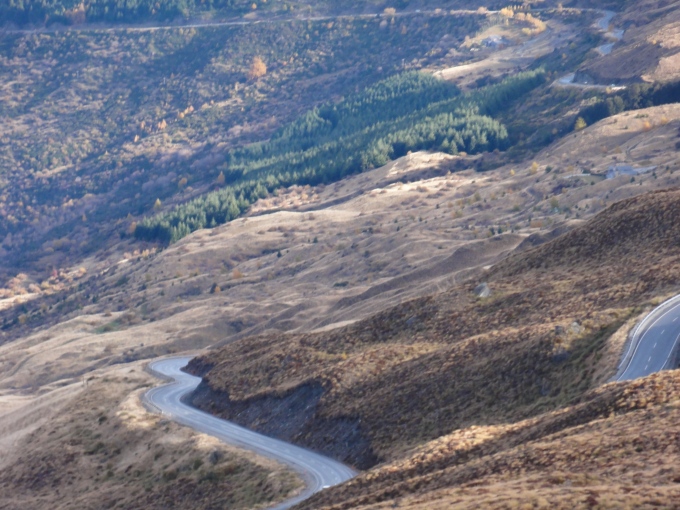
A picture paints … well, as many words as you like.  For instance:

lookingdownfromcoronetpeak

And the story:

It was once said that a desperate man has everything to lose.

The man I was chasing was desperate, but I, on the other hand, was more desperate to catch him.

He’d left a trail of dead people from one end of the island to the other.

The team had put in a lot of effort to locate him, and now his capture was imminent.  We were following the car he was in, from a discrete distance, and, at the appropriate time, we would catch up, pull him over, and make the arrest.

There was nowhere for him to go.

The road led to a dead-end, and the only way off the mountain was back down the road were now on.  Which was why I was somewhat surprised when we discovered where he was.

Where was he going?

“Damn,” I heard Alan mutter.  He was driving, being careful not to get too close, but not far enough away to lose sight of him.

“What?”

“I think he’s made us.”

“How?”

“Dumb bad luck, I’m guessing.  Or he expected we’d follow him up the mountain.  He’s just sped up.”

“How far away?”

“A half-mile.  We should see him higher up when we turn the next corner.”

It took an eternity to get there, and when we did, Alan was right, only he was further on than we thought.”

“Step on it.  Let’s catch him up before he gets to the top.”

Easy to say, not so easy to do.  The road was treacherous, and in places just gravel, and there were no guard rails to stop a three thousand footfall down the mountainside.

Good thing then I had the foresight to have three agents on the hill for just such a scenario.

Ten minutes later, we were in sight of the car, still moving quickly, but we were going slightly faster.  We’d catch up just short of the summit car park.

Or so we thought.

Coming quickly around another corner we almost slammed into the car we’d been chasing.

“What the hell…” Aland muttered.

I was out of the car, and over to see if he was in it, but I knew that it was only a slender possibility.  The car was empty, and no indication where he went.

Certainly not up the road.  It was relatively straightforward for the next mile, at which we would have reached the summit.  Up the mountainside from here, or down.

I looked up.  Nothing.

Alan yelled out, “He’s not going down, not that I can see, but if he did, there’s hardly a foothold and that’s a long fall.”

Then where did he go?

Then a man looking very much like our quarry came out from behind a rock embedded just a short distance up the hill.

“Sorry,” he said quite calmly.  “Had to go if you know what I mean.”

I’d lost him.

It was as simple as that.

I had been led a merry chase up the hill, and all the time he was getting away in a different direction.

I’d fallen for the oldest trick in the book, letting my desperation blind me to the disguise that anyone else would see through in an instant.

It was a lonely sight, looking down that road, knowing that I had to go all that way down again, only this time, without having to throw caution to the wind.

“Maybe next time,” Alan said.

“We’ll get him.  It’s just a matter of time.”

© Charles Heath 2019-2021

Find this and other stories in “Inspiration, maybe”  available soon.

InspirationMaybe1v1

Searching for locations: Shanghai, China, by night.

When we arrive at the embarkation site we find at least 100 buses all lined up and parked, and literally thousands of Chinese and other Asians streaming through the turnstiles to get on another boat leaving earlier than ours.

Buses were just literally arriving one after the other stopping near where we were standing with a dozen or so other groups waiting patiently, and with people were everywhere it could only be described as organized chaos.

Someone obviously knew where everyone was supposed to go, and when it was our turn, we joined the queue.  There were a lot of people in front of us, and a lot more behind, so I had to wonder just how big the boat was.

We soon found out.

And it was amusing to watch people running, yes, they were actually running, to get to the third level, or found available seating.  Being around the first to board, we had no trouble finding a seat on the second level.

I was not quite sure what the name of the boat was, but it had 3 decks and VIP rooms and it was huge, with marble staircases, the sort you could make a grand entrance on.  The last such ornate marble staircase we had seen was in a hotel in Hong Kong, and that was some staircase.

But who has marble staircases in a boat?

We’re going out across the water as far as the Bund and then turn around and come back about 30 to 40 minutes.   By the time everyone was on board, there was no room left on the third level, no seats on the second level nor standing room at the end of the second level where the stairs up to the third level were.

No one wanted to pay the extra to go into the VIP lounge.

We were sitting by very large windows where it was warm enough watching the steady procession of the colored lights of other vessels, and outside the buildings.

It was quite spectacular, as were some of the other boats going out on the harbor.

All the buildings of the Bund were lit up

And along that part of the Bund was a number of old English style buildings made from sandstone, and very impressive to say the least.

On the other side of the harbour were the more modern buildings, including the communications tower, a rather impressive structure.

I had to go to the rear of the vessel to get a photo, a very difficult proposition given here was no space on the railing, not even on the stairs going up or down.  It was just luck I managed to get some photos between passengers heads.

And, another view of that communications tower:

There was no doubt this was one of the most colourful night-time boat tours I’ve ever been on.  Certainly, when we saw the same buildings the following day, they were not half as spectacular in daylight.

I never did get up to the third level to see what the view was like.

An excerpt from “Strangers We’ve Become” – Coming Soon

I wandered back to my villa.

It was in darkness.  I was sure I had left several lights on, especially over the door so I could see to unlock it.

I looked up and saw the globe was broken.

Instant alert.

I went to the first hiding spot for the gun, and it wasn’t there.  I went to the backup and it wasn’t there either.  Someone had found my carefully hidden stash of weapons and removed them.

Who?

There were four hiding spots and all were empty.  Someone had removed the weapons.  That could only mean one possibility.

I had a visitor, not necessarily here for a social call.

But, of course, being the well-trained agent I’d once been and not one to be caught unawares, I crossed over to my neighbor and relieved him of a weapon that, if found, would require a lot of explaining.

Suitably armed, it was time to return the surprise.

There were three entrances to the villa, the front door, the back door, and a rather strange escape hatch.  One of the more interesting attractions of the villa I’d rented was its heritage.  It was built in the late 1700s, by a man who was, by all accounts, a thief.  It had a hidden underground room which had been in the past a vault but was now a wine cellar, and it had an escape hatch by which the man could come and go undetected, particularly if there was a mob outside the door baying for his blood.

It now gave me the means to enter the villa without my visitors being alerted, unless, of course, they were near the vicinity of the doorway inside the villa, but that possibility was unlikely.  It was not where anyone could anticipate or expect a doorway to be.

The secret entrance was at the rear of the villa behind a large copse, two camouflaged wooden doors built into the ground.  I move aside some of the branches that covered them and lifted one side.  After I’d discovered the doors and rusty hinges, I’d oiled and cleaned them, and cleared the passageway of cobwebs and fallen rocks.  It had a mildew smell, but nothing would get rid of that.  I’d left torches at either end so I could see.

I closed the door after me, and went quietly down the steps, enveloped in darkness till I switched on the torch.  I traversed the short passage which turned ninety degrees about halfway to the door at the other end.  I carried the key to this door on the keyring, found it and opened the door.  It too had been oiled and swung open soundlessly.

I stepped in the darkness and closed the door.

I was on the lower level under the kitchen, now the wine cellar, the ‘door’ doubling as a set of shelves which had very little on them, less to fall and alert anyone in the villa.

Silence, an eerie silence.

I took the steps up to the kitchen, stopping when my head was level with the floor, checking to see if anyone was waiting.  There wasn’t.  It seemed to me to be an unlikely spot for an ambush.

I’d already considered the possibility of someone coming after me, especially because it had been Bespalov I’d killed, and I was sure he had friends, all equally as mad as he was.  Equally, I’d also considered it nigh on impossible for anyone to find out it was me who killed him because the only people who knew that were Prendergast, Alisha, a few others in the Department, and Susan.

That raised the question of who told them where I was.

If I was the man I used to be, my first suspect would be Susan.  The departure this morning, and now this was too coincidental.  But I was not that man.

Or was I?

I reached the start of the passageway that led from the kitchen to the front door and peered into the semi-darkness.  My eyes had got used to the dark, and it was no longer an inky void.  Fragments of light leaked in around the door from outside and through the edge of the window curtains where they didn’t fit properly.  A bone of contention upstairs in the morning, when first light shone and invariably woke me up hours before I wanted to.

Still nothing.

I took a moment to consider how I would approach the visitor’s job.  I would get a plan of the villa in my head, all entrances, where a target could be led to or attacked where there would be no escape.

Coming in the front door.  If I was not expecting anything, I’d just open the door and walk-in.  One shot would be all that was required.

Contract complete.

I sidled quietly up the passage staying close to the wall, edging closer to the front door.  There was an alcove where the shooter could be waiting.  It was an ideal spot to wait.

Crunch.

I stepped on some nutshells.

Not my nutshells.

I felt it before I heard it.  The bullet with my name on it.

And how the shooter missed, from point-blank range, and hit me in the arm, I had no idea.  I fired off two shots before a second shot from the shooter went wide and hit the door with a loud thwack.

I saw a red dot wavering as it honed in on me and I fell to the floor, stretching out, looking up where the origin of the light was coming and pulled the trigger three times, evenly spaced, and a second later I heard the sound of a body falling down the stairs and stopping at the bottom, not very far from me.

Two assassins.

I’d not expected that.

The assassin by the door was dead, a lucky shot on my part.  The second was still breathing.

I checked the body for any weapons and found a second gun and two knives.  Armed to the teeth!

I pulled off the balaclava; a man, early thirties, definitely Italian.  I was expecting a Russian.

I slapped his face, waking him up.  Blood was leaking from several slashes on his face when his head had hit the stairs on the way down.  The awkward angle of his arms and legs told me there were broken bones, probably a lot worse internally.  He was not long for this earth.

“Who employed you?”

He looked at me with dead eyes, a pursed mouth, perhaps a smile.  “Not today my friend.  You have made a very bad enemy.”  He coughed and blood poured out of his mouth.  “There will be more …”

Friends of Bespalov, no doubt.

I would have to leave.  Two unexplainable bodies, I’d have a hard time explaining my way out of this mess.  I dragged the two bodies into the lounge, clearing the passageway just in case someone had heard anything.

Just in case anyone was outside at the time, I sat in the dark, at the foot of the stairs, and tried to breathe normally.  I was trying not to connect dots that led back to Susan, but the coincidence was worrying me.

A half-hour passed and I hadn’t moved.  Deep in thought, I’d forgotten about being shot, unaware that blood was running down my arm and dripping onto the floor.

Until I heard a knock on my front door.

Two thoughts, it was either the police, alerted by the neighbors, or it was the second wave, though why would they be knocking on the door?

I stood, and immediately felt a stabbing pain in my arm.  I took out a handkerchief and turned it into a makeshift tourniquet, then wrapped a kitchen towel around the wound.

If it was the police, this was going to be a difficult situation.  Holding the gun behind my back, I opened the door a fraction and looked out.

No police, just Maria.  I hoped she was not part of the next ‘wave’.

“You left your phone behind on the table.  I thought you might be looking for it.”  She held it out in front of her.

When I didn’t open the door any further, she looked at me quizzically, and then asked, “Is anything wrong?”

I was going to thank her for returning the phone, but I heard her breathe in sharply, and add, breathlessly, “You’re bleeding.”

I looked at my arm and realized it was visible through the door, and not only that, the towel was soaked in blood.

“You need to go away now.”

Should I tell her the truth?  It was probably too late, and if she was any sort of law-abiding citizen she would go straight to the police.

She showed no signs of leaving, just an unnerving curiosity.  “What happened?”

I ran through several explanations, but none seemed plausible.  I went with the truth.  “My past caught up with me.”

“You need someone to fix that before you pass out from blood loss.  It doesn’t look good.”

“I can fix it.  You need to leave.  It is not safe to be here with me.”

The pain in my arm was not getting any better, and the blood was starting to run down my arm again as the tourniquet loosened.  She was right, I needed it fixed sooner rather than later.

I opened the door and let her in.  It was a mistake, a huge mistake, and I would have to deal with the consequences.  Once inside, she turned on the light and saw the pool of blood just inside the door and the trail leading to the lounge.  She followed the trail and turned into the lounge, turned on the light, and no doubt saw the two dead men.

I expected her to scream.  She didn’t.

She gave me a good hard look, perhaps trying to see if I was dangerous.  Killing people wasn’t something you looked the other way about.  She would have to go to the police.

“What happened here?”

“I came home from the cafe and two men were waiting for me.  I used to work for the Government, but no longer.  I suspect these men were here to repay a debt.  I was lucky.”

“Not so much, looking at your arm.”

She came closer and inspected it.

“Sit down.”

She found another towel and wrapped it around the wound, retightening the tourniquet to stem the bleeding.

“Do you have medical supplies?”

I nodded.  “Upstairs.”  I had a medical kit, and on the road, I usually made my own running repairs.  Another old habit I hadn’t quite shaken off yet.

She went upstairs, rummaged, and then came back.  I wondered briefly what she would think of the unmade bed though I was not sure why it might interest her.

She helped me remove my shirt, and then cleaned the wound.  Fortunately, she didn’t have to remove a bullet.  It was a clean wound but it would require stitches.

When she’d finished she said, “Your friend said one day this might happen.”

No prizes for guessing who that friend was, and it didn’t please me that she had involved Maria.

“Alisha?”

“She didn’t tell me her name, but I think she cares a lot about you.  She said trouble has a way of finding you, gave me a phone and said to call her if something like this happened.”

“That was wrong of her to do that.”

“Perhaps, perhaps not.  Will you call her?”

“Yes.  I can’t stay here now.  You should go now.  Hopefully, by the time I leave in the morning, no one will ever know what happened here, especially you.”

She smiled.  “As you say, I was never here.”

…

© Charles Heath 2018-2022
strangerscover9

Writing a book in 365 days – 92

Day 92

Writing Exercise – multiple views of the same event

…

I was given the brief to interview the witnesses regarding a theft, in plain sight, of a backpack from a university student who was engaged in conversation outside a cafe. I had been asking for more responsibility, and this, I was told, was the first test.

It was a simple set of questions: ask the witnesses what they saw and any means of identifying the thief.

Witness 1: Winifred Atkins, age 67

“What did you see?” was the first question.

“Not a lot. But…”

She looked the helpful sort, with a ready smile, some might call mischievous.

“There were six of them, students or teenagers perhaps. Pity they didn’t know how to dress properly, but these days, you know, anything goes.”

I nodded. I was sure the next witness would see them in an entirely different light.

“Anyway, they were talking, or maybe arguing. I could see the victim, the one who had her bag taken, was getting annoyed at the others. Something about a boy, but, then, isn’t it always at that age?”

“Is that what drew your attention to the group?”

“That, and that one of the other girls called her a rather bad name. It upset her, and that’s where the arguing started. It was distracting.”

“The victim was distracted?”

“No, I was. That’s why, when my attention was on the two of them, one almost trying to strangle the other, and I think I would too given the language, that’s when the thief came and went so quickly it was a blur.”

“From where?”

“Inside the cafe. By now, everyone was watching the two girls trying to strangle each other and the boys egging them on. Someone should strangle them. That’s when he picked up the bag as he walked past, and no one at that table noticed. No one. Not surprised.”

“Can you describe the thief?”

“Young, their age or a little older, hat covering his face, clothes shabby, those jeans with cuts in them, sandshoes, green t-shirt.”

“Any identifying marks?”

“None I could see. Only saw him for a fraction of a second; the fight was getting heated. That’s all I’ve got.”

…

That was the first. The second witness was Janet Wakely, aged 15.

“What did you see?”

“A fight. Some girl called the other girl a slut, and they went at it. I would have videoed it and posted it on the Internet, but I know you lot would have got in a twist over it.”

My boss would. I would have been able to use it as evidence. Pity.

“Then…”

“The victim wasn’t a very nice person, stealing that other girl’s boyfriend. Maybe you could charge her with theft.”

I tried to explain that the law didn’t work like that; it had to be a criminal offence like stealing property, like the girl’s backpack. “Did you see it happen?”

“Some old guy came out of the cafe with a coffee, walked past the table, and just picked it up. They were all carrying on so, they never noticed a thing. Brazen.”

“Can you describe the thief?”

“Oldish, about 30, maybe 40, you know. Levis, Nike shoes, the expensive sort, and one of them expensive polo shirts, you know, with the horse emblem. He had a hat with a maple leaf, which was odd for someone in this country to wear; maybe he was a foreigner.”

At least, at the end, she said he had gone up the same street as the previous witness.”

…

I made a call to our IT person and asked if any video had been posted on social media, guessing that my previous witness had, in fact, filmed the whole argument and posted it, and I was right.

And viewing it, I wasn’t surprised that both of them were wrong. A man had come out of the cafe, but he had walked straight past them. It was one of the boys at the table who had detached himself at the high point of the fight and taken the backpack while all their attention was focussed on the fight.

…

©  Charles Heath  2025

“Sunday in New York”, a romantic adventure that’s not a walk in the park!

“Sunday in New York” is ultimately a story about trust, and what happens when a marriage is stretched to its limits.

When Harry Steele attends a lunch with his manager, Barclay, to discuss a promotion that any junior executive would accept in a heartbeat, it is the fact his wife, Alison, who previously professed her reservations about Barclay, also agreed to attend, that casts a small element of doubt in his mind.

From that moment, his life, in the company, in deciding what to do, his marriage, his very life, spirals out of control.

There is no one big factor that can prove Harry’s worst fears, that his marriage is over, just a number of small, interconnecting events, when piled on top of each other, points to a cataclysmic end to everything he had believed in.

Trust is lost firstly in his best friend and mentor, Andy, who only hints of impending disaster, Sasha, a woman whom he saved, and who appears to have motives of her own, and then in his wife, Alison, as he discovered piece by piece damning evidence she is about to leave him for another man.

Can we trust what we see with our eyes or trust what we hear?

Haven’t we all jumped to conclusions at least once in our lives?

Can Alison, a woman whose self-belief and confidence is about to be put to the ultimate test, find a way of proving their relationship is as strong as it has ever been?

As they say in the classics, read on!

Purchase:

http://tinyurl.com/Amazon-SundayInNewYork

In a word: Sheet

Well, we all know what a sheet is, it’s one of those things you put on a bed.  A bottom sheet, a fitted sheet, a top sheet, flannelette sheet.

It could also be a piece of paper, e.g. pass me a sheet of paper please, only to get in reply, what size?

There can be a sheet of flames, best if you see one get away as fast as you can.

Of course, that fire can be put out by rain sheeting down.

You can have a sheet map, that is one that opens out.  Funny how you can never get them folded back the same way.  And a problem when you’re in a car and open it out – hang on, I can’t see out the window!

That lake is a lovely sheet of water, very still just as the sun comes up, and then, what a reflection.  Great if you are a landscape painter.

Then there’s sheet metal, did that in school and wasn’t very good at it.

If you’re a philatelist, then there’s always a sheet of stamps, might be worth something in a hundred years’ time.

Then, if it is worth millions, you might turn white as a sheet with shock.

But the best of all, if you drink too much it is said you are ‘two sheets to the wind’.

When you’re given another chance, it is like being given a clean sheet.

And another form might be to do with sailing when you sheet a sail, which is to say you are making it either tauter or less taut.

English can be confusing sometimes, can’t it?

“Echoes From The Past”, the past doesn’t necessarily stay there


What happens when your past finally catches up with you?

…

Christmas is just around the corner, a time to be with family. For Will Mason, an orphan since he was fourteen, it is a time for reflection on what his life could have been, and what it could be.

Until a chance encounter brings back to life the reasons for his twenty years of self-imposed exile from a life only normal people could have. From that moment Will’s life slowly starts to unravel and it’s obvious to him it’s time to move on.

This time, however, there is more at stake.

Will has broken his number one rule, don’t get involved.

With his nemesis, Eddie Jamieson, suddenly within reach, and a blossoming relationship with an office colleague, Maria, about to change everything, Will has to make a choice. Quietly leave, or finally, make a stand.

But as Will soon discovers, when other people are involved there is going to be terrible consequences no matter what choice he makes.

https://amzn.to/2CYKxu4

newechocover5rs

The cinema of my dreams – I never wanted to go to Africa – Episode 39

Our hero knows he’s in serious trouble.

The problem is, there are familiar faces and a question of who is a friend and who is foe made all the more difficult because of the enemy, if it was the enemy, simply because it didn’t look or sound or act like the enemy.

Now, it appears, his problems stem from another operation he participated in, and because of it, he has now been roped into what might be called a suicide mission.


“Are there?  How many should I have?”

The only way he could know there was not a full complement as if he had been told by someone how many people were in our group from the outset.  I looked at Jacobi, and he shrugged.

“This is not a good time to be playing games, Sergeant James.”

The guards gripped their weapons a little tighter and looked ready to use them.

“The only one playing games here would be you.  It would be irrelevant if I had more or I had fewer people here because you have more than enough to cover us, and then some.  But you would agree it would be imprudent for me to put all my eggs in one basket as it were, and yes, there are several others, but they are waiting for me to call them, further down the track.  Not to put too fine a point on it, distrust works both ways.  We don’t come back, I can assure you, your losses will be bigger than ours.  Oh, and a word of advice, don’t go looking for them, not unless you want good men to die needlessly.”

Tough talk, and could get us killed, but I was hoping that until he had the diamonds in his hands, he would humor me.  A minute or so passed where I assumed he was making a calculation on what the odds were, then he shrugged.  There was merit in what I’d told him.  Monroe and Shurl had plenty of ammunition and would have a foxhole that wouldn’t be over-run or penetrated.

“I think you might be right, so let’s not get bogged down in an argument that’s going nowhere.  We have what you want, and you have what we want.  Let’s go inside and talk.”

Was that a sigh of relief moment?  Perhaps.  But it was clear he needed us out of the way before his men could search the cars.  I was happy to let him think he had the upper hand.

“Lead the way.”

We all filed into the building and sat down around a large table.  There were bottles of water out, and we might have drunk from them but I could see the seal had been broken on min so it looked like we would be going thirsty.

The commander drank from his, no doubt as a gesture that the water was safe.  None of my people were buying it.

“I’ll kick it off,” I said.  “Are our people in good health?”

“Of course.  Healthy enough to walk out of here of their own accord.  Did you bring the compensation with you?”

“I did.”

“Can I see it?”

“Can I see our people.”

Friendly, and time-consuming double talk.  I could see he was waiting impatiently.  “All in good time.  “Did you have any trouble getting here?” he asked casually.  “I heard there were some local militias on the road collecting road taxes earlier today.”

“If there was, we didn’t see any.  Smooth run, except for the state of the roads.  I hope the road taxes those people are collecting are to fix the roads.”

He smiled.  “It is what it is.  This is the Democratic Republic of the Congo, not the United States of America.  Things are done differently here.  We put the people first, and the roads second.”

There was a discreet knock on the door, followed by a cowering man coming into the room and walking up behind the commander.  He took a few seconds to whisper into his ear, during which the commander’s expression turned very dark.

I had to assume that they had found all the weapons we had left for them to find, and not done a very close inspection to find those we did not want them to find.  It was a bold assumption and could make a difference once we left, and if we were attacked.  I was sure that was part of the message the man had relayed to his commander.

The man almost ran out of the building, slamming the door behind him.

The commander looked at me.  “Where are the diamonds?”

That was as direct as he could get.

“At this point, that’s for me to know until I’m assured you intend to honor your part of the agreement.  Searching our cars for the diamonds tells me you are not a man to be trusted, and, you should have realized in making that discovery, you’re not dealing with fools.”

The dark expression eased, and he tried to look like the man who held all the cards.  He probably did, but it would be interesting to see to what extent he would press his advantage.  We had nothing to lose, though it didn’t send a very good message to the team that I was willing to sacrifice them.  This was after all supposed to be a suicide mission.

“What’s to stop me from just shooting your people one by one until you tell me.”

“The same reason I told you at the gate.  You will lose a lot more than I will.  Something you might not be aware of is that the people who sent me have control over satellites.  You might not be familiar with satellite technology, but be assured that we are being observed, and have been on this little odyssey.  It also means that they, sitting in a bunker somewhere in the world, also have access to nasty drones, you know, the sort that leaves craters where villages and settlements once were.  This place would not withstand a direct hit, and there would be no one left alive after it.  Killing any or all of us will incur wrath you really don’t want to deal with.  Put simply, if I don’t drive out of here with my people within half an hour this whole area will become an uninhabitable crater.”

Bamfield had said as one option, not that he could order such a strike, was to threaten them with a drone strike.  I hadn’t done that in as many words, but the commander looked as though he got the inference.

“You could do that anyway.”

“I could, but that’s not the way I work.  For some odd reason. The people I work for seem to think you might be useful to them in the future, and Jacobi here will be happy to stay and talk about it.  Now, the clock is ticking.”

He took a moment, then stood.  “Let’s go meet your people then.”


Ⓒ Charles Heath  2020

The cinema of my dreams – I always wanted to write a war story – Episode 39

For a story that was conceived during those long boring hours flying in a steel cocoon, striving to keep away the thoughts that the plane and everyone in it could just simply disappear as planes have in the past, it has come a long way.

Whilst I have always had a fascination with what happened during the second world war, not the battles or fighting, but in the more obscure events that took place, I decided to pen my own little sidebar to what was a long and bitter war.

And, so, it continues…

…

Leonardo was a fool, not that any of those who followed him would say that to his face, but all of them knew it and accepted that he made the best leader.

The reason for that, they all knew if anything went wrong, then the leader would be the first to be held accountable.

They all also knew that what Leonardo had done to Martina and Chiara, and the cold-blooded murder of the villagers, justifying it by saying they were collaborators, was also wrong, and had refused to take part in it.

Leonardo just thought they didn’t have the stomach to do what was necessary, failing to realize he was committing a crime, war or not.

Alberto, arguably the next man to take over the resistance group if anything happened to Leonardo, was nominally second in command and was there because he had the respect of the men, far more than their current leader.

He was the one who suspected there was something wrong at the castle, that the British soldiers there were not quite doing what they said they were there for.  He had seen, even directed, Germans seeking sanctuary in England in exchange for information, come, but not go.  Not like they did in the beginning.

And that man called Atherton, the one who arrived just before the paratroopers, he was British, and they had captured him.  The talk was that he was a German collaborator, but Alberto wasn’t convinced.

But, not having the full allegiance of all the resistance fighters, he could not say anything or try to organize the men to be more careful in their approach to those at the castle.  Leonardo still held sway with them. 

For now.

.

The Italians had their own section of the cells in the dungeons where they stayed, Leonardo, deeming it not safe in the village.  Alberto agreed because he had made several forays down there, only to discover that Leonardo would be shot on sight if he showed his face there again.  Some resistance they made, he thought, where they didn’t have the confidence of their own people.

Leonardo was up supping with the devil, as Alberto had been known to say, put of Leonardo’s earshot, and several of the men were resting.  The others, more loyal to Leonardo were in the cellar cell drinking their way through the wine stock and were most likely drunk and passed out.

Alberto didn’t care for the vintage, a subject that he was well versed in because before the war he had worked for the family of winemakers.  The wines stored, he had recognized when they’d first discovered them, as being of inferior quality, and had been left there rather than throwing it away.  Leonardo would not have known the difference.

“Something is not right.”  A voice from the corner, belonging to a man named Bolini, broke his reverie.  The truth was, he was tired and wished it were all done with.

“What makes you say that?” He asked.

“Killing the villagers.  What did they do wrong, other than just trying to survive?  It’s what we’re all trying to do.  It’s not our war.”

“You know what it’s like, stuck in the middle.  It’s a bit like the in-laws.  You don’t want them, but you’re stuck with them.”

“In-laws.  Don’t get me started.”  The other, a man named Christo, weighed in.  

“You do realize we may be held accountable for what happened back at the village,” Bolini had obviously been thinking about the repercussions.

“We brought the only witnesses here, and they sure as hell aren’t going to last long.  Not after what Leonardo did to them.”

“That’s possible, but we all know what happened.”

“But there are others outside who also know what happened, and if we want to keep out of trouble, we are going to have to take care of them,” Bolini said.

Alberto hadn’t quite got through considering the ramifications of what Fernando just did, and the fact they’d helped him.  Bolini was right, even if they hadn’t been as reckless, they were still going to be tarred with the same brush.

And Atherton was still out there.

The trouble with trying to clean up a mess is that eventually there’s a bigger mess to deal with.  Maybe it was time to get rid of Fernando.

The man called Wallace, the one who seemed to be in charge, came around the corner and stopped when he saw Alberto.

“Where’s your leader?”

Alberto pointed his head in the direction of the wine cellar.

Wallace shook his head, knowing what that meant.  “Tell him he’s got another pickup.  Two hours in the village.  A family, with two children.  Tell him to sober up, and if he doesn’t in time, you have my permission to shoot him.”

Surely the man wasn’t serious.

“Well, what are you sitting around for?  Get moving.”

Wallace cast a disapproving glance over the three, shook his head again, and left.

…

© Charles Heath 2020-2021

A to Z Blog Challenge – April 2025b – O

…

O is for — Or else.  It all depends on who actually says it

…

When my older brother used to say ‘or else’, it usually meant that if I didn’t do what he asked, I would find myself on the end of my father’s idea or corporal punishment.

I hated my brother for all of my teenage years and then some.

What I learned from it was that everything I did had consequences, mostly those I didn’t like, even if what I did wasn’t bad.  Someone could always put a spin on them so that it sounded a lot worse than the actual outcome

It was the reason why, in the end, I did nothing of consequence, and it meant that by the time I reached the pivotal age of forty, I had done nothing with my life.

No special girl, no marriage and divorce, a run-down car, a rented rubbish pile that could be called an apartment, and nothing of any consequence.

I was always with one foot out the door.  No attachments to people or possessions, and to a certain degree, free as a bird.

And I might have stayed that way if I had not answered a phone call and stayed in one place long enough to receive a letter and an invitation.

To a high school reunion.

Josie Brixton, another name for the nemesis Josephine, was the one girl i hated more than my brother.  It might have been because they were boyfriend and girlfriend all through high school, and she tormented me as much, if not worse, than he did.

They had their prom moment; I wished them well and then promptly packed a small bag and ran away from home.  They had driven me to it, and with no support or relief from my parents, I no longer wanted to be part of that family.

I had a plan, as good a plan as a seventeen-year-old could come up with.  I was going to find a jog on a ship and sail the seven seas until I could forget about the people who made my life impossible.

Of course, if it had been the late nineteenth or early twentieth century, that plan would have worked well, but in the twenty-first century.  Instead I hopped on a train until a ticket inspector threw me off, in a small rural town in a place I’d never hear of, and when I asked at the nearest hotel where I could find a room, he directed me to a farm about six miles put of town, a farm always looking for workers.

The farmer, an old and lonely man, wife recently deceased and children gone, couldn’t pay much but offered a room, one his son had lived in until he left, and a job doing chores he couldn’t do himself, for the prove of a room and food.   And a slice of the profits, if there were any.

I stayed for ten years.

No one asked where I came from. No one was really interested in who I was, and that suited me fine.  I stayed until he died.  Then, the children returned and fought over the inheritance.  Five greedy, horrible children whom I left to sort themselves out.  I read later that one shot the other four and then went to prison for the rest of his life.

Clearly, he had more problems than I did.

Twenty-three years later, I was on the other side of the country, a cleaner in an old hospital, working the night shift.

I made the mistake of never getting rid of my old phone number, and that was how Josephine found me.  It was a number that seemed familiar but not a family one.  I never spoke to any of them again.

“Hello?”

“I’m looking for a man named Christopher Blunt.”  The voice sounded familiar, too.

“Speaking.”

I heard a sharp intake of breath, then, ” My God, you are alive?”

“Last I looked.”  Then I recognised the voice and its little tonal inflections.  Josephine, the kitchen from hell.

I disconnected the call.  I never wanted to speak to her again, either.  More than likely, she was married to my brother, and he was definitely on my “I don’t want to see” list.

The phone rang again, the same number.  I ignored it and then switched off the phone.  No one ever rang me, but that was more likely because I never gave anyone my number.

But over the next seven days, I mulled over why she would be calling me.  When I told Wally, my daytime counterpart, at the shift change, he said in his usual philosophical way, “Things happen for a reason.”

He was probably right.

My brother was missing, making my life miserable.

In a moment of weakness, I answered the phone again.

Before I could get a word in, she said, “Don’t  hang up.”

I said, in my best taciturn manner, “Then don’t call me.  The fact I haven’t called you or anyone for twenty-three years should be a clear enough reason.”

“You caused a great deal of concern.  No one knew what happened to you.  We all believed you had been kidnapped and killed.  Or worse.  We had the sheriff, the county police, the state troopers, and then the FBI.  Your parents were suspects for years, and your brother spent time in jail until he could prove his innocence.  I guess, in a sense, they all deserved it.  Even I was terrible to you.”

I shrugged.  No apology would ever make up for what they did to me.

“Who are you calling?”

“A reunion at the high school.  They’re bulldozing it and putting up a shopping mall.  Last chance to relive those happy school memories.”

It was probably the line she used on all the ex-students.  None of my memories were happy.  “If that’s the selling point, you lost me.  The only reason I’d come back is to drive the bulldozer.  With the whole class inside.  Do you really want someone like me there?”

“Everyone’s changed, you know.”

“My brother would never change.”

“Your brother is dead.  Heart attack.  You leaving destroyed everything I’d planned, so maybe I’m just as angry at you as you are with us.”

Well, if I’d planned to piss her off, it worked.  “Then it’s the last I’ll hear about this reunion.  Goodbye Josephine.”

I disconnected the call and then lamented the fact I had managed not to think about any pf them for years and how easily it was to get riled up at just the thought of them.  Right then, I didn’t think I could ever get past that horrible part of life and the people who had made it so.

Of course, life would be simple if we could forget the sins of the past.  I dated a psychiatrist a long time ago, and she attempted to analyse me.  Practise for when she took up practise.

She eventually decided I was a hopeless case and that I needed yo confront those sins of the past.  I just ignored her, but over the years, I had considered going home and then decided I wouldn’t.

Now, perhaps after twenty-three years, it was time.

In the end, it wasn’t a hard decision.  The hospital management told me I could no longer accumulate my leave and told me I had to take it.  All three months of it.

I got in the beat-up car and headed for my hometown, halfway across the country, not knowing if the car would make it.

It did, as far as the city limits, my town now a lot larger than it used to be.  Passing the city limits sign, I picked up a sheriff’s car, and it followed me with lights flashing until I pulled over.

Just what I needed: a speeding ticket.  Only I wasn’t speeding. I was meticulously careful not to show interest.  Actions always had consequences.

Then I watched the deputy get out of the car, adjust his gun, put his hat on, check his reflection in the side window, and then walk towards the driver’s side of my car.

I watched him in the side mirror until, within a few feet, I recognised the face.  Older now,  still the same.  “Bucky Winchester.”  Bucky because he gut bucked off the artificial rodeo bull at the hotel not far from the same city limits I’d just passed.

There was a lot more to that story.

The man’s expression changed, and I knew it was him.  “My God, you’re Christopher Blunt.  You’re dead.”

“Then I can drive off with no charge to answer.”

“Clearly, you’re not dead.  Where have you been?”

“Anywhere but here.”

“Why?”

“Fuck, Bucky, maybe you and the rest of the football teams made my life hell.”

“You were not the only one.  Hell, your brother wouldn’t let us treat you as badly as the others.  Get out of the car.”

“Why?”  Bucky was mean back then. Maybe he was still just as mean.

“Because it’s easier for you to shown me your licence and registration.”

“What was I doing wrong?”

“Nothing, but I still gave to check.”

I shrugged and then got out.  I showed him the documents.

“You been in Maine?”

It was there on licence.

“Among other places.”

“Never thought of coming home?”

“Nope.  Didn’t want to see you lot again.”

“And yet you’re here?  Why?”

“Reunion.”

“There’s going to be a lot of familiar faces, not all of them happy to see you.”

“Then you might have to earn your salary.”

He looked up and down, then stood defensively, hand on gun but still holstered.

“Perhaps it would be for the best that you get back in your vehicle, turn around, and go back to where you came from.  Or else.”

Sound advice from his point of view.  “Or else what, Bucky?”

“I’ll arrest you and put you in jail for the duration.”

The squared soldier look, the very ugly, angry expression he had on his face, and the degree of belligerence I knew he had within him made him look formidable.

Except I knew his weakness.

“Then come and do it, Bucky.”

Boy to man, there was no change in what essentially the definitive schoolyard bully was.

He shrugged.  “You asked for it!”

…

©  Charles Heath  2025