Yes, I see the lighthouse, what’s it doing all the way out there? The thing is, these places are sometimes so remote, I start thinking I should rent one for 6 months and then, without any distractions, I’ll get the blasted book finished.
Until there’s a shipwreck, of course!
Light is of course light, duh. Turn on the switch and let there be light.
Hang on, didn’t someone else say that, millennia ago? Someone famous? It’s on the tip of my tongue.
No! It’s not cyanide…
So, whilst we need it to see everything, it has another meaning…
My, that’s a light load your carrying today, which means not very heavy.
Or, that’s a light-coloured jumper, which means pale.
Oh, and did you light the fire?
And, after you light the fire, do you light out to a safe haven in light traffic because really it was arson, and you got a light sentence the last time enabling you to do it again.
If you are trying to rob someone, then it was a kilo light.
And after a long hard struggle, did you light upon the correct answer?
This is not to be confused with another similar word, lite.
It seems this is only used for describing low-calorie drinks and food, such as lite beer, which seems to me to be a lazy way of not using light
Still, there’s not much other use of the word except as a suffix -lite, but then you’d have to mention -lyte as well.
The message here – just use the damn word light and be done with it.
The problem is, there are familiar faces and a question of who is a friend and who is foe made all the more difficult because of the enemy, if it was the enemy, simply because it didn’t look or sound or act like the enemy.
Now, it appears, his problems stem from another operation he participated in, and because of it, he has now been roped into what might be called a suicide mission.
“That was far to bloody easy.” I heard Monroe’s voice come over the radio, not long after we left the camp.
“It was a bit easier than I thought. But I did make it quite clear if we didn’t all leave in one piece we’d reduce his camp to rubble with everyone in it.”
“He knows the territory. Something’s waiting for us out here.”
Something indeed.
Back at the camp, not only had the commander’s men search for the hidden weapons, and, when everyone checked, were still there, they had also taken off the crates with the film equipment. I was not sure what the commander was intending to do with the equipment, but what disappointed me was the fact we hadn’t taken the time to rescue the rocket launcher.
Now the commander had it.
If he bothered to search the crates properly. I suspect he was yet to do so. What we had rescued and successfully hidden were the C4 explosives and detonators. They might come in useful at the airstrip.
Just before we reached the fork in the road, where we would be turning left to head towards the airfield, and surprisingly had not run into any of the commander’s men, we stopped and let Monroe and Shurl out to make a sweep towards the airstrip, not too far away.
I also called up Mobley to see how he was.
The Colonel answered. “Everything is under control now.”
I didn’t like the sound of that. “What happened?”
“The kidnappers send out a team to intercept us on the way to the airstrip. It wasn’t a stretch to imagine they would know what we were planning because they’d know we would not be retracing out steps to Uganda. Got them before they got a shot off. I suspect there are Government troops at the airstrip, it’s too important to let anything happen to rich foreigners coming to see their wildlife reserve. There are several troop carriers, and we’ve seen a few men on the outskirts patrolling. There’s several at the gate if you could call it that.”
“Is there a plane there?”
“As it happens there is. A grand old DC3. It’s not a charter plane, so I’m guessing it belongs to an overentitled American big game hunter or the photographic variety. At least I’m hoping that’s the case.”
“What do you recommend?”
“Not to storm the field. You’re going to have to find another means of getting here, preferably without any fanfare.”
My first choice was to go in and get out, with as little firefight as possible, particularly in case they started shooting at the plane. If I was reading between the lines properly, the Colonel was telling me there were more troops there than we could handle quickly and quietly.
“Very good. Can you get sight on just how many troops are there, and if you can see who’s in charge?”
“Will try.”
Monroe had been standing next to me during the exchange.
“Three in place, two more on the perimeter, if we can cover as many as possible, you might be able to take the rest from the inside.”
Secreting the weapons again, maybe. It was a possibility, but going in with hidden weapons, and then found by the guards at the gate, who would be more efficient and careful searchers than the kidnappers, it would create hostility and itchy trigger fingers.
“No. We have to find some way of letting them feel as though they have complete control of the situation. They know we’re coming; the commander would have told them.” The only reason why he was still the cat who ate the canary. He might even have told them he had some men waiting as the first line of defense.
The airstrip commander would then know we were armed and relatively dangerous.
It was time for yet another dangerous gambit.
I picked up the radio. “Colonel?”
A second later, “Sergeant?”
“Whatever happens in the next twenty minutes or so, just ignore it. It’s not much of a plan, but it will get us onto the field.”
“And then?”
“Hopefully some divine intervention.”
Monroe looked skeptical. “You’re going to just drive up to the gate and surrender?”
“Not exactly. It won’t be fait accompli until we reach the terminal, or hanger, or whatever the commander has set up as headquarters. They’ll have most of our weapons, yes. But they won’t have all of us.”
“No. But they’ll know we have a sniper, so one of you are going to have to allow yourself to be captured, just to ease their minds.”
“Leaving one of us and Mobley and the Ugandans. Can we trust them?”
“I hope so, otherwise this could go badly. But, today, I’m an optimist. We’ve got this far.”
Trying to show more confidence in the plan that I had. It was always a worry when you had to trust people you didn’t know. That had been the problem the last time. At least this time we had managed to get the hostages. It was always going to be a problem getting them out.
Monroe gave me one of her special, you’re a fool, looks. “I hope you know what you’re doing.” She then nodded in Shurl’s direction and they disappeared into the bush again.
I gestured to Davies to come over.
“Did you find out what sort of plane it is?”
“Hopefully. The Colonel tells men there’s a DC3 off the airstrip. I assume you can fly one.”
She smiled, the first time since this operation had started. “Sure can. I spent three summers putting one back together. My dad has a sort of airplane museum. A DC3, a DC4, and a Lancaster, a very sorry looking Lancaster at that. Shouldn’t be a problem.”
“Then try to not get shot.”
“Do my very best not to.”
Once again, it was time to go. Going into the unknown was getting to be the norm, but hopefully, this would be the last time. I didn’t consider it wise to advise the hostages, they had their own problems to worry about.
For a story that was conceived during those long boring hours flying in a steel cocoon, striving to keep away the thoughts that the plane and everyone in it could just simply disappear as planes have in the past, it has come a long way.
Whilst I have always had a fascination with what happened during the second world war, not the battles or fighting, but in the more obscure events that took place, I decided to pen my own little sidebar to what was a long and bitter war.
And, so, it continues…
——
Jackerby trusted no one. He had been given orders by someone further up the ranks than Wallace and his people, someone who suspected that some or all of the Englishmen turned German turned Englishmen were traitors.
The only men he could trust fully were those who had come with him in the glider, a dozen at most. It’s why he had just completed a secret briefing with his second in command who would take over the operation if anything happened to him.
Not that it would, but he liked the idea of being prepared, and humoring the others into believing they were essential to the operation. Eckhardt would be a good man in a crisis, battle scarred from the Russian front, and glad to be on this operation for obvious reasons.
He would do anything Jackerby asked, even kill Wallace and Johannsen if he was required to.
That might yet be necessary because Wallace didn’t seem interested in going after Atherton which made him think that Wallace wasn’t all that he appeared to be. Atherton was a thorn in their operation and had to be eliminated. The fact Wallace and Johannsen didn’t agree with him raised suspicions as to their motives.
Was there ultimately going to be a triple cross?
He had been lurking in the shadows when Wallace gave the drunken fool Leonardo his orders to go down to the village. More defectors. Jackerby couldn’t understand why anyone would want to leave the Reich, especially when they were winning the war, and, if it were up to him, he’d executer the lot of them not send them back.
But, orders were orders.
He went back to Eckhardt and told him he was going down to the village to observe Leonardo and his team in action, and that he was in charge of the men in his absence.
Eckhardt, on the other hand, knew that Jackerby, if he could find a way that would not cause them trouble, was going to eliminate Leonardo because they were a liability. The plan was once Leonardo and his men were gone, Jackerby would take over rounding up the defectors. Or, more to the point, they would go missing before reaching the castle. There was only one that mattered, the rest were dead weight. And once the prize had been captured, Jackerby would escort him home and collect the kudos for himself and his men.
The ultimate prize; leave to reunite briefly with their families and a cushy job in Berlin, away from the horrors of war in the trenches.
Leonardo and the five others that made up the resistance left the castle by one of the underground tunnels. Leonardo knew of two, both of them shown to him by Carlo. He knew that Carlo knew where more were, but Carlo was not particularly helpful at the best of times.
He also knew Carlo might be stupid enough to storm the castle, especially after what Leonardo had done to Martina, and, when it hadn’t happened, he suspected Atherton had appealed to him to wait.
Atherton, too, he knew had some idea of the layout of the castle, have been told to keep an eye on Atherton when he first arrived because he was reportedly an archaeologist. Leonardo had, and reported back to Wallace that it appeared Atherton had been surveying the castle. He had simply been told to keep Atherton under surveillance, and make notes of any discoveries, and particularly what Atherton was doing.
He had, not that it amounted to much. Not when he realized Leonardo was following him. Leonardo decided not to tell Wallace Atherton had rumbled him, just that he was roaming the passages looking for something.
It had worked so far and kept Wallace off his back, but it wasn’t going to last.
Bottom line, Leonardo had to find and kill Atherton before any trouble started, otherwise, it would be his neck on the block.
Jackerby followed.
It wasn’t hard to follow Leonardo because he and his man were the last people to know what stealth was. He could hear them crashing through the forest between the castle and the village up to 250 meters away, he was making so much noise.
But, Jackerby thought, perhaps Leonardo didn’t need to worry about alerting his presence to Atherton, not if he was already working with him.
To Jackerby and his paranoia, it made sense. Maybe he was going to meet with Atherton right now and do a deal with the defectors. How many others had turned up at the village in the last week or so, and never made it to the castle?
He was right, Jackerby told himself, not to trust them. Everyone, in the end, was an enemy of the Reich.
It took 20 minutes to reach the outskirts of the village, and when Jackerby could see the edge of the woods, and the barn and remains of the farmhouse just the other side of the tree line, he dropped back, found a suitable observation point, and waited.
Leonardo and his men had stopped at the back of the barn, and one of his men was about to go find the defectors. The rest of Leonardo’s men would wait with him, and surprise their guests, before taking them back to the castle.
As far as “Jackerby was concerned, they would never reach the castle, and this time, he would take care of Leonardo, and the others.
It would be easy to say that Atherton had killed all the members of the resistance, and then got killed himself in a shootout with Jackerby. It was a plausible reason for all the deaths, though he would have to come up with a suitable excuse for leaving the castle and following Leonardo and his men when Wallace had expressly forbidden it.
Wallace.
Perhaps if he got his hands on Atherton he’d ask him if Wallace was a traitor.
Q is for – Qualms – that state of uneasiness that cannot be explained
…
It would be true to say that Harry Cressey had turned the company’s fortunes around with some of the most interesting programs I’d ever seen.
In the beginning, when they were first mooted by the owner of the company, the current fifth-generation department store owner, I had to, and a lot of others had, reservations.
But when they were implemented one by one, and they worked, we stopped looking at the man and looked at the result.
It was no mean feat to turn around a lame duck and turn it into more than just a financial success.
It was the theme if a two page spread in the local newspaper was anything to go by, a story that encapsulated a managing director and a board of directors under pressure, a chance meeting and appointment of a financial consultant, Trevor Alexander Frederick Hall, and a fairytale ending for a company and quite literally the city we all lived in.
It was literally the difference between living in a vibrant, small town, single industry city or a ghost town.
Barnaby Oswald, the owner, an older photo that didn’t the stress of age, Trevor Hall, a recent photo beaming like the all conquering hero he was, the main office building and factories, an early photo and one as it was now, after a recent facelift, and a photo of about a thousand of the staff all looking like they had just been given a millions dollars each.
I’d been away the day the shot of the staff was taken
“What’s wrong with that photo?”
Alison came into my office and threw herself into the seat opposite my desk. The clock on the wall behind her said one minute to eight.
Sane time every morning.
“Nothing. All hail the hero of the hour.”
She snorted. That was usually reserved for the hapless Barnaby Oswald, her uncle. No, she wasn’t the boss’s daughter, but she was close enough.
“Look at that photo of Hall and tell me what you see.”
“An urbane middle-aged success story.”
I’d suffered her comments in the indubitable Mr Hall, humouring her because I thought, like quite a few others, there was no way he could save the sinking ship.
We were all wrong.
“Take a closer look.”
She had never told me what she really thought of him other than she had reservations. But Alison was the sort of woman who had reservations about nearly everyone.
Her uncle had muscled her father out of the business and sent him to an early grave. Hall, to her, was just the latest of a long list of follies. Just look at how the business went from success to the Titanic in seven years.
I took a closer look. The photo was too grainy and of low resolution to discern anything, but one thing I did notice was that his eyes were too close together.
“The newspaper photo doesn’t do him justice?”
She frowned at me. “He’s a villain; I’m sure of it. I did a search on the internet, and he didn’t exist five years ago. In fact, he simply appeared out of the blue, popping up in a Fortune 500 company, then a meteoric rise to partner in one of the most prestigious finance and banking corporations. His reference letter was so glowing; to me, it’s the sort of letter a place writes to get rid of him.”
“Or that he is that good.”
Out of the corner of my eye, I could see Trevor with Barnaby, their usual chat at the end of the day before going home. He had looked over and seen Alison with me, and I thought I also saw him sigh.
I had little to do with him, so I was not an expert. Alison had been his first PA and lasted a week. She never said what caused their parting, but there were rumours.
She went to say something but stopped when she saw him coming over.
He stopped at the door. “Ashley, isn’t it?”
“Or ‘hey you’ perhaps more often than it should. I go by either.”
Barnaby called all of the Admin assistants on this floor ‘Hey, you’. He wasn’t good at names to faces or being polite, for that matter.
“Yes.” He turned to Alison. “You were asked not to come up here.”
“After hours, Trevor, and I am an Oswald, and this is my birthright, not yours.” There was no mistaking the antagonistic tone. “Your silly rules only apply during business hours. After that, I can see whoever I want.”
“Be that as it may, just not up here. Now, please leave, or do I have to call security?”
She glared at him, went to say something, then just shrugged. “Whatever.”
Then she got up, nodded at me, and left.
“Sorry you had to witness that, but she has been causing trouble. And apparently, she doesn’t like me.” He shrugged. “Be careful when you’re with her. She does not have the interests of the company in mind.”
What could I say to that?
“Understood.”
A warning was given, and he left. I went back to the paper, but it was too difficult to concentrate. Alison was stuck in my mind, and it was not exactly for the right reasons. I had always liked her, but she had never been as interested in me.
Damn her.
I walked slowly down the stairs a few minutes after Hall had left and came put onto the carpark on one side of the main office building to see Hall drive off in his Mustang, bought for him as a gift for his work in saving the company.
It was a car I’d always wanted but knew I could never afford. Another of those pipe dreams I had.
My car, farthest from the front door and now alone in the pleb section, was different tonight for one reason. Alison was sitting on the trunk.
Why would she be sitting on my car? How did she know what car I owned, let alone where I parked it.
She smiled when she saw me. “Ashley.”
I stopped two or three steps away from her. “Alison. To what do I owe the honour of this visit?”
“Don’t you mean, why is Trevor so worked up about me?”
“It’s above my pay grade, Alison. Everything is above my pay grade, including you.”
“Didn’t that little tirade if his fuel some qualms about him in your mind? I mean, who says that stuff about the boss’s niece? Why would I not have the interests of the company at heart? It is my family’s business, after all.”
I shrugged. “It’s none of my business.”
“It would be if the whole thing came tumbling down like a house of cards.”
“Is it?”
“That’s beside the point.”
Another of the admin assistants, like me, had told me early on that courting ideas about Alison was like wrestling alligators. She was, he said, dangerous and had caused a few admin assistants to get fired.
She slid off the back of the car into my space. She was close, too close for comfort. I had dreamed about looking into her eyes, but now, it scared me.
“You like me, don’t you?”
She gave me a penetrating look that was unsettling.
“Can I plead the fifth amendment?”
She smiled, leaned forward, and kissed me on the cheek. “I like you too. But inevitably, people I like seem to only want the boss’s daughter and the kudos that goes with it. Is that what you want?”
We were standing under a light and would make an interesting view if anyone was still working on this side of the building. The lights were still on, and it would be mostly cleaners. Overtime was banned unless absolutely necessary.
“Nobody cares what I want, Alison, and least of all you. I don’t know what’s going on with you and Trevor; I don’t want to know.”
“Then I’ll say my piece, and then I’ll go. Day three, one am in the boardroom, Trevor Hall raped me. I threatened to go to the police. He simply said if I did, he would expose my family’s true business dealings that caused all the problems. I laughed at him, and the next thing I knew, my father was dead. It was not a suicide. He has a grip on this place, and he’s bleeding it dry. He is a monster, and he needs to be stopped. And now I have nowhere else to go.”
Tears were forming in her eyes. I believed she believed every word she said. I also knew she was very manipulative.
“If you don’t have any qualms about Treveor Hall, you should. By this time next year, there will be nothing left of this place for my uncle, for me, our family, you, and everyone else. It’ll be in a non-extradition country with the remarkable Trever Hall.”
It was a good story. It had all the elements of truth in it, and it could be believable.
I pulled out my phone and dialled the one number on the screen.
She looked surprised.
When a voice answered, I said, “You were right. She knows.”
Silence then, “You know what to do.” The line went dead.
Perhaps not in the beginning, but as time passed, yes.
In my younger years, as an awkward child who didn’t fare well in school, with the sort of boys who treated the weaker kids with aggression, and at home where we were victims of domestic violence, it became necessary to immerse myself in another world than the one that I lived in.
That’s when I began to invent different lives, mostly generated from reading books morning, noon and night and spending any spare time in the school library, anywhere other than in the schoolyard.
Those books fuelled my imagination. I could be anyone else other than who I was, go anywhere, and do anything. The Secret Seven, The Famous Five, Biggles, Billy Bunter, all those characters that today would never get a fair chance.
Soon, those imaginings became scribbles, and the first story I wrote was one of a spy landing on a distant beach in another country and executing a mission which, when I look back, was rather strange, but it kept me busy.
Then a thousand or so books later, fuelled by Alistair MacLean, Hammond Innes, James Patterson, Clive Cussler, Steve Berry, David Baldacci, and countless others, I improved my writing skills, the story became more focussed and less childish, and I decided thrillers were the go.
And when romance didn’t seem to work out all that well, I decided to write myself into one, imagining how it would be. For that, I devoured a few Mills and Boons, but when it came time to write a similar story, it got half way then veered into thriller territory.
I think, in that first effort, I was not the hero, but the forever tired, always battling to stay alive and discovering the love of his life, found ways they could not be together. A bit like real life at times.
My latest effort, I used to read stories for my grandchildren, and then foolishly one night told her I would write a better fair tale. After 11 years, much toiling and excuses for not having it done, I have finished it. 3 volumes, 1,000 plus pages, it is an epic.
Did I always want to be a writer?
Maybe I did and just didn’t realise it back when I was too young to know.
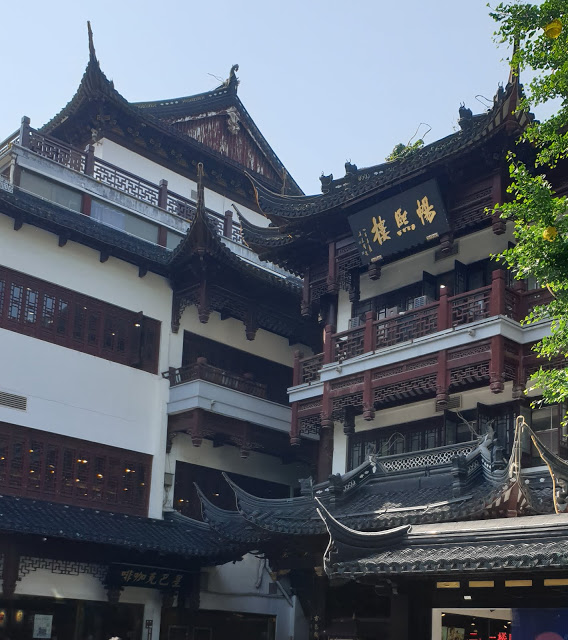
The old Shanghai refers to a small area of Shanghai that used to be walled in and remained that way until about 1912 when all but a small section of the wall was demolished. With the advent of the concessions, Old Shanghai became the administrative center until later when it became a shopping complex.
Now it has many restored historical buildings as well as new buildings in a somewhat traditional style that has become one of Shanghai’s main tourist attractions, housing many shops and restaurants.
The “Old Town” is not exclusively old, as you still have a chance to take in the atmosphere if you wander into the quaint side streets.
But, on first viewing walking down the street towards the complex, I’m not sure I’d go as far as to say this is in reality old Shanghai, except for what appears to be a true representation of it architecturally.
The buildings, which are shops and restaurants, are set out symmetrically, with streets, alleyways, and squares which may prove that it was specially built for the tourists, and no mechanized traffic.
Anyway…
The buildings are magnificent, and a photographer’s delight, and you’d finish up having hundreds of photos by the time you leave. All the buildings are exquisite representations of traditional Chinese architecture.
As for buying stuff, remember if you’re not Chinese you have the sucker tourist stamp on your forehead, so be prepared to walk away if the vendors will not bargain.
Nothing here is worth the price tag and in our group discounts like from 130 RMB to 50 RMB and from 1 for 1,200 to 2 for 950 RMB are common.
Here common t-shirts that we can get for 3 dollars back home start at 150 RMB which is roughly 35 dollars. It’s that kind of market.
We end up is a tea room, on the third floor of the meeting point below, and discover all the tour guides sitting around a table counting money, and I have to say it’s the most $50 notes I’ve ever seen in one place. It is, we were told, where they discussed ‘strategy’.
There are still the endless questions on what actually happened from the moment the call came that there was a skier on the top of the mountain in distress.
And why the helicopter was called in, and everything that happened around that one decision. It was, of course, the prerogative of the officer in charge of the ski patrol, at the time Edward.
The question was, was he supposed to be in charge when the two other brothers were out in the field? That raised another question: Why were the two assigned together when the standing orders were only one could be in the field and the other on standby?
How did the Air Force send a newish pilot on a mission that hw had not flown before? It was not good policy to not have an experienced pilot on hand
He was going to go up to the top of the mountain and see for himself, but on memory of the his years in the patrol, it was not that difficult to get to the spot where from the top ski lift, and if that was the case, then the avalanche was preventable.
It was going to be another interesting report when the final assessment was completed. He would have to try and get the parliament to call for a royal commission. Of course, raking over the coals might be the last thing needed, especially since the resort was closed while the slopes were regroomed.
The country needed a quick, blameless answer and reopened the resort for obvious financial reasons, aside from the employment and services it generated.
The novel ‘Echoes from the past’ started out as a short story I wrote about 30 years ago, titled ‘The birthday’.
My idea was to take a normal person out of their comfort zone and led on a short but very frightening journey to a place where a surprise birthday party had been arranged.
Thus the very large man with a scar and a red tie was created.
So was the friend with the limousine who worked as a pilot.
So were the two women, Wendy and Angelina, who were Flight Attendants that the pilot friend asked to join the conspiracy.
I was going to rework the short story, then about ten pages long, into something a little more.
And like all re-writes, especially those I have anything to do with, it turned into a novel.
There was motivation. I had told some colleagues at the place where I worked at the time that I liked writing, and they wanted a sample. I was going to give them the re-worked short story. Instead, I gave them ‘Echoes from the past’
Originally it was not set anywhere in particular.
But when considering a location, I had, at the time, recently been to New York in December, and visited Brooklyn and Queens, as well as a lot of New York itself. We were there for New Years, and it was an experience I’ll never forget.
One evening we were out late, and finished up in Brooklyn Heights, near the waterfront, and there was rain and snow, it was cold and wet, and there were apartment buildings shimmering in the street light, and I thought, this is the place where my main character will live.
It had a very spooky atmosphere, the sort where ghosts would not be unexpected. I felt more than one shiver go up and down my spine in the few minutes I was there.
I had taken notes, as I always do, of everywhere we went so I had a ready supply of locations I could use, changing the names in some cases.
Fifth Avenue near the Rockefeller center is amazing at first light, and late at night with the Seasonal decorations and lights.
The original main character was a shy and man of few friends, hence not expecting the surprise party. I enhanced that shyness into purposely lonely because of an issue from his past that leaves him always looking over his shoulder and ready to move on at the slightest hint of trouble. No friends, no relationships, just a very low profile.
Then I thought, what if he breaks the cardinal rule, and begins a relationship?
But it is also as much an exploration of a damaged soul, as it is the search for a normal life, without having any idea what normal was, and how the understanding of one person can sometimes make all the difference in what we may think or feel.
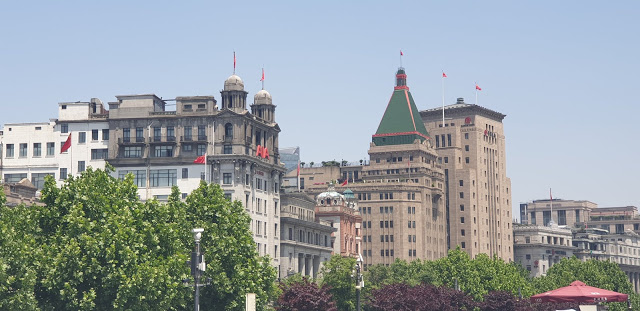
The architecture along the Bund or Waitan is a living museum of the colonial history of the 1800s. The area centers on a section of Zhongshan Road within the former Shanghai International Settlement.
The word bund means an embankment or an embanked quay. It was initially a British settlement; later the British and American settlements were combined in the International Settlement.
The Bund is a mile-long stretch of waterfront promenade along the Huangpu River. There are 52 buildings of various architectural styles, including Gothic, baroque, and neoclassical styles. The area is often referred to as “the museum of buildings”.
Building styles include Romanesque Revival, Gothic Revival, Renaissance Revival, Baroque Revival, Neo-Classical or Beaux-Arts, as well as a number in Art Deco style.
Having seen these buildings initially the night before, mostly lit up, our viewing this morning was from the land side, and particularly interesting in that the colonial architecture was really fascinating considering their location, but not surprising given Shanghai’s history. A lot of these buildings would be more at home in London, that out in the far east.
The Bund waterfront is about two kilometers long and impossible to cover in the time allowed for this part of the tour.
There was just enough time to get photos of the waterfront and the old buildings.
Some of these buildings had odd shapes, like one on the far right that looks like a bottle opener.
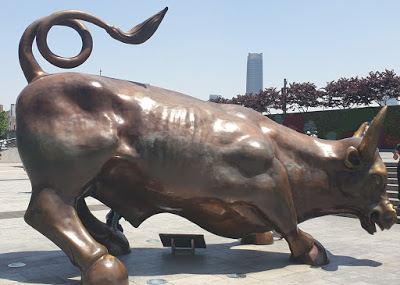
And, for some odd reason, a bull.
On the other side of the water, the sights that had been quite colorful the night before, were equally impressive though somewhat diminished by the haze.
This case has everything, red herrings, jealous brothers, femme fatales, and at the heart of it all, greed.
See below for an excerpt from the book…
Coming soon!
An excerpt from the book:
When Harry took the time to consider his position, a rather uncomfortable position at that, he concluded that he was somehow involved in another case that meant very little to him.
Not that it wasn’t important in some way he was yet to determine, it was just that his curiosity had got the better of him, and it had led to this: sitting in a chair, securely bound, waiting for someone one of his captors had called Doug.
It was not the name that worried him so much, it was the evil laugh that had come after the name was spoken.
Doug what? Doug the ‘destroyer’, Doug the ‘dangerous’, Doug the ‘deadly’; there was any number of sinister connotations, and perhaps that was the point of the laugh, to make it more frightening than it was.
But there was no doubt about one thing in his mind right then: he’d made a mistake. A very big. and costly, mistake. Just how big the cost, no doubt he would soon find out.
His mother, and his grandmother, the wisest person he had ever known, had once told him never to eavesdrop.
At the time he couldn’t help himself and instead of minding his own business, listening to a one-sided conversation which ended with a time and a place. The very nature of the person receiving the call was, at the very least, sinister, and, because of the cryptic conversation, there appeared to be, or at least to Harry, criminal activity involved.
For several days he had wrestled with the thought of whether he should go. Stay on the fringe, keep out of sight, observe and report to the police if it was a crime. Instead, he had willingly gone down the rabbit hole.
Now, sitting in an uncomfortable chair, several heat lamps hanging over his head, he was perspiring, and if perspiration could be used as a measure of fear, then Harry’s fear was at the highest level.
Another runnel of sweat rolled into his left eye, and, having his hands tied, literally, it made it impossible to clear it. The burning sensation momentarily took his mind off his predicament. He cursed and then shook his head trying to prevent a re-occurrence. It was to no avail.
Let the stinging sensation be a reminder of what was right and what was wrong.
It was obvious that it was the right place and the right time, but in considering his current perilous situation, it definitely was the wrong place to be, at the worst possible time.
It was meant to be his escape, an escape from the generations of lawyers, what were to Harry, dry, dusty men who had been in business since George Washington said to the first Walthenson to step foot on American soil, ‘Why don’t you become a lawyer?” when asked what he could do for the great man.
Or so it was handed down as lore, though Harry didn’t think Washington meant it literally, the Walthenson’s, then as now, were not shy of taking advice.
Except, of course, when it came to Harry.
He was, Harry’s father was prone to saying, the exception to every rule. Harry guessed his father was referring to the fact his son wanted to be a Private Detective rather than a dry, dusty lawyer. Just the clothes were enough to turn Harry off the profession.
So, with a little of the money Harry inherited from one of his aunts, he leased an office in Gramercy Park and had it renovated to look like the Sam Spade detective agency, you know the one, Spade and Archer, and The Maltese Falcon.
There’s a movie and a book by Dashiell Hammett if you’re interested.
So, there it was, painted on the opaque glass inset of the front door, ‘Harold Walthenson, Private Detective’.
There was enough money to hire an assistant, and it took a week before the right person came along, or, more to the point, didn’t just see his business plan as something sinister. Ellen, a tall cool woman in a long black dress, or so the words of a song in his head told him, fitted in perfectly.
She’d seen the movie, but she said with a grin, Harry was no Humphrey Bogart.
Of course not, he said, he didn’t smoke.
Three months on the job, and it had been a few calls, no ‘real’ cases, nothing but missing animals, and other miscellaneous items. What he really wanted was a missing person. Or perhaps a beguiling, sophisticated woman who was as deadly as she was charming, looking for an errant husband, perhaps one that she had already ‘dispatched’.
Or for a tall, dark and handsome foreigner who spoke in riddles and in heavily accented English, a spy, or perhaps an assassin, in town to take out the mayor. The man was such an imbecile Harry had considered doing it himself.
Now, in a back room of a disused warehouse, that wishful thinking might be just about to come to a very abrupt end, with none of the romanticized trappings of the business befalling him. No beguiling women, no sinister criminals, no stupid policemen.
Just a nasty little man whose only concern was how quickly or how slowly Harry’s end was going to be.