In a word: Bar

There’s more than one way … er, perhaps it’s better to say, there are many ways to use the word bar, which is not bad for a three-letter word.

Bar, the one you associate with drinks, in hotels, restaurants and we’ll, just bars.

Probably the best type of bar you might find me in is a Sports Bar, where you can snack on buffalo wings a tall glass of beer and watch with ice hockey in winter or baseball in summer.

It’s one I use from time to time when asked, what will we do, and the reply is often let’s go to a bar.  The best bars are underground, dark and dingy, full of eclectic people, with a band playing almost passable music or better still jazz

Bar, as in the legal variety

There are so many legal references to using bar, that the one that I am most familiar with is being admitted to the bar which means that you can now practice law.

Raising the bar, if that’s possible, where the bar is that imaginary level which offers sinks very low.  When someone says they’re going to try and raise the bar, you may be assured there will be a long battle ahead, simply because people generally find it hard to change.

Bar, as in we are not going to let you in here.  Yes, this is the irksome one where you find yourself, often for reasons unknown, barred from somewhere or something.  This may also be referred to by saying everyone may enter bar you.  

Bar, as in an iron bar, the sort that is sometimes used as a blunt force object by villains to remind the victim they owe any one of a loan shark, bookie or the mafia.  God help you if it is all three.

There are also iron bars of a different sort, those that are set in concrete outside a window most likely in a prison where the objective is to prevent escape.

It gives rise to an old expression, that person should be behind bars.

Then there is just a bar, such as a bar of gold, which I’m sure we’d all like to have stashed away, but not necessarily in the mattress, or the more common variety, a chocolate bar, which I have one now.  What’s your favorite?

And just to add to the list of meanings you can always refer to sashes or stripes as bars.

Confused?  Well, there’s still music, and the bane of yachtsmen, sand bars but I think we’ll leave it there.

Welcome to the English language
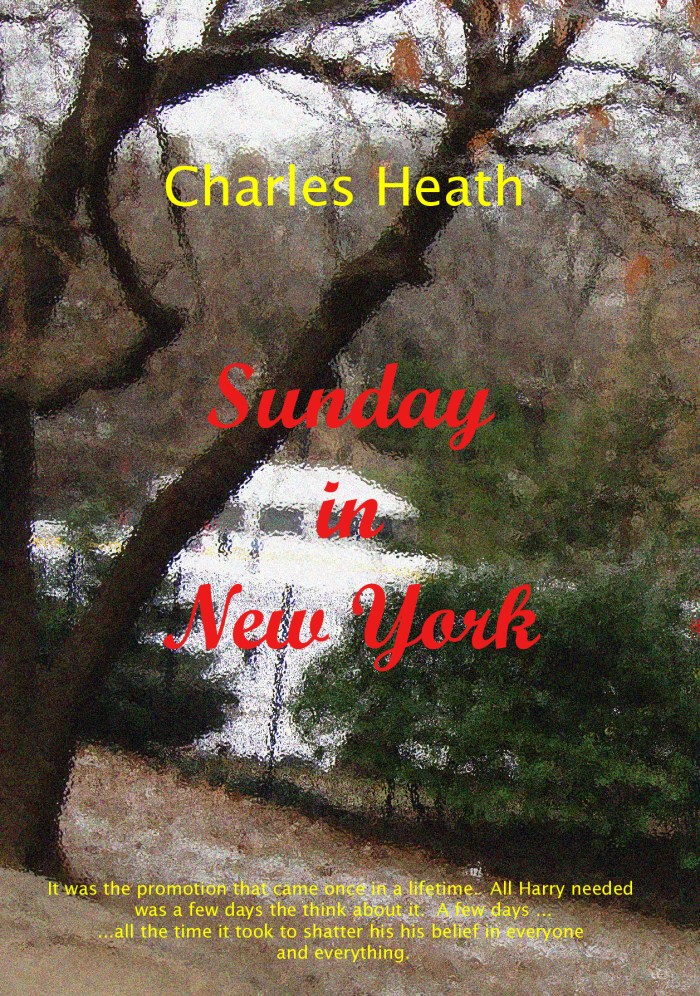
“Sunday in New York”, a romantic adventure that’s not a walk in the park!

“Sunday in New York” is ultimately a story about trust, and what happens when a marriage is stretched to its limits.

When Harry Steele attends a lunch with his manager, Barclay, to discuss a promotion that any junior executive would accept in a heartbeat, it is the fact his wife, Alison, who previously professed her reservations about Barclay, also agreed to attend, that casts a small element of doubt in his mind.

From that moment, his life, in the company, in deciding what to do, his marriage, his very life, spirals out of control.

There is no one big factor that can prove Harry’s worst fears, that his marriage is over, just a number of small, interconnecting events, when piled on top of each other, points to a cataclysmic end to everything he had believed in.

Trust is lost firstly in his best friend and mentor, Andy, who only hints of impending disaster, Sasha, a woman whom he saved, and who appears to have motives of her own, and then in his wife, Alison, as he discovered piece by piece damning evidence she is about to leave him for another man.

Can we trust what we see with our eyes or trust what we hear?

Haven’t we all jumped to conclusions at least once in our lives?

Can Alison, a woman whose self-belief and confidence is about to be put to the ultimate test, find a way of proving their relationship is as strong as it has ever been?

As they say in the classics, read on!

Purchase:

http://tinyurl.com/Amazon-SundayInNewYork

The cinema of my dreams – I always wanted to write a war story – Episode 11

For a story that was conceived during those long boring hours flying in a steel cocoon, striving to keep away the thoughts that the plane and everyone in it could just simply disappear as planes have in the past, it has come a long way.

Whilst I have always had a fascination in what happened during the second worlds war, not the battles or fighting, but in the more obscure events that took place, I decided to pen my own little sidebar to what was a long and bitter war.

And, so, it continues…


There were tyre tracks leading up to the doorways from trucks that had recently made deliveries, or taken people away, maybe.

It was a short lane leading to another narrow roadway which I could see led away towards the front of the castle and the main road.  It was not part of the original castle and the track had been made recently, no doubt because of the need for secrecy.

We went across the laneway and continued into the trees where we would have enough coverage to reach the stream, it was a stream now but in winter I was sure it would be a river and able to allow a boat to navigate. 

Jack seemed to know where he was going, but he, like me, probably just wanted to get as far away from the castle as we could.  The undergrowth was denser as we approached the stream bank, and I had to pick my way carefully, and as quietly as I could.

It had sounded like a herd of elephants passing by.

At the stream edge, I looked at the water level.  Not very deep, and in places just thinly connected pools of stagnant water.  A boat could not be launched, not even a small rowboat.

I had previously committed a map of the area to memory, and I remembered the stream lead towards the village, veering off in two directions about half a mile before it got there.  I wanted the right branch, which I was hoping had more water in it, and hoping I might find a house with a boat.

Jack seemed nervous, coming up to me and moving his head, as if to say, let’s get moving. 

He was right.  I had no doubt it wouldn’t be long before they found me missing.

I had no idea who my saviour was, or why he had helped, but I was sure he was one of the men who’d parachuted in the day before.  How had my superior, if it was him, manage to get a man to infiltrate that group?

Or was it something else?

Had this been orchestrated so they could let me lead them to the other members of the resistance, and take care of that problem.  I doubted, with the compartmentalisation that ? would have insisted on, that the whole resistance in this area had been caught and neutralised.

Damn.

I hadn’t thought that far, or consider the possibility.

I would have to be careful.

I stopped, and immediately Jack came over to me.  His eyes were telling me, no stopping.  

Unfortunately, I would have to, and, worse, might have to backtrack to test my theory.

I knelt down beside him.  “Sorry.  I have to go back a little to see if we’re being followed.  You stay here and keep an eye open.”

He just looked at me.  Perhaps he only understood German.

I started moving back the way I had come, and he followed.  I stopped, he stopped.   Then I heard it, a laugh, and the cracking of a dry branch.  I’d been trying to avoid them.

There was a sort of track beside the stream we’d been following.  It wasn’t very distinguishable because I didn’t think it had been used in years, and it was hard to say if it was one that led from the castle to the village, but if I was to guess, it probably was the means for the castle owner to take a shortcut, as the crow flies.

No point going back now, we headed in the opposite direction, with haste, until we reached a small offshoot of the stream that leads into the woods, but there was no path beside it, so obviously there was nothing of interest along it.  I slid down into the stream and walked on the rocks in the water along the offshoot.

I hoped it covered my tracks.

Jack and I managed to get about twenty yards along, having in the last five, pick our way through the undergrowth, to a point where it stopped at the side of a hill.  Water ran down the hillside into the stream, but not today.  It was dry, but it would be a different story if it was raining, and with the rocky outcrop I suspected there might be something akin to a waterfall.

At least it proved cover and my pursuers would have to climb through the undergrowth to get to me, and then they would have to contend with Jack.

I could only hope they just kept on going.


© Charles Heath 2019

The first attempt is exactly that, a first draft

That’s what it feels like after you’ve put words on paper.

The story is there waiting to be written, I know where it’s coming from, and I know where I want it to go, but the words are not working.

I read it once, yuk, I read it twice, and it’s begging me to press the delete button.

Now!

This is how it looks:

My life was going nowhere.  If I took a step back and took a good, long, hard look at it, what could I say was the one defining moment?

There was no defining moment.

I’d bounced around schools till the day I decided I was not cut out to learn anything more, or perhaps the teachers had given up trying to impart knowledge.  Whatever the reason, I dropped out of college and drifted.  Seasonal labourer, farmhand, factory worker, night watchman.

At least now I had a uniform and looked like I’d made something of myself.

Until I went home.

My parents were distinctly disappointed I was not married with children.

My overachieving brother always said I was a loser and would never make anything of myself.

My ultra-successful sister, married into a very wealthy family, had the regulation 2.4 children and lived in the lap of luxury, mostly pretended I didn’t exist, didn’t invite me to the wedding, and I had yet to meet the husband and children.  I guess she was ashamed of me.

This year I was avoiding going home.

This year I volunteered to work during the holidays.

Yep, time to walk away and do something entirely different, like wrapping Christmas presents, my second favourite job to mowing the lawn.  Maybe if I contrive an accident with the lawnmower …

Back in front of the page, an idea pops into my head some hours later.  The story continues:

It was 3 a.m. and it was like standing on the exact epicentre of the South Pole.  I’d just stepped from the warehouse into the car park.

The car was covered in snow.  The weather was clear now, but more snow was coming.

A white Christmas?  That’s all I needed.  I hoped I remembered to put the antifreeze in my radiator this time.

As I approached my car, the light went on in an SUV parked next to mine.  The door opened and what looked like a woman was getting out of the car.

“Graham?”

It was a voice I was familiar with, though I hadn’t heard it for a long time.

My ultra-successful sister, Penelope.  She was leaning against her car door, and from what I could see, she didn’t look too well.

“What do you want?”

“Help.”

My help, I was the last person to help her or anyone for that matter.  But curiosity got the better of me.  “Why?”

“Because my husband is trying to kill me.”

With that said, she slid down the side of the car, and I could see, in the arc lamps lighting the car park, a trail of blood.

To be honest, it needs some more thought.  It’s got the makings of a story, but the MC shouldn’t come across as a hopeless case, he just needs to be, in part, a victim of circumstances, some of which he has to own.

But, as they say, anything on paper is better than nothing on paper.  Tomorrow, or the next day, I will edit and rewrite and see what happens.

Stay tuned.

© Charles Heath 2020-2025

The 2am Rant: It’s cold out there

But…

It is, but it isn’t.  Oddly enough after two weeks in temperatures ranging from -21 to 7 degrees Fahrenheit, I think I’m finally used to it.

My early morning walk after leaving the hotel is both for exercise and exploring.

Looking for locations, observing people, watching and learning what it’s like to live, work, and hang out in a city like New York.

It’s so much more interesting than where I come from.  There it would be impossible to spin a story in such a small city.  You need to be able to hide in plain sight among millions of people over a very large area that encompasses Manhattan, Brooklyn, Queens, and everything else in-between and beyond.

I was looking at going to a Walmart in Secaucus, about three and a half miles from my hotel in Manhattan.  Three and a half miles.  In my city that’s way beyond the limits of the city and in the outer suburbs.

Here I can spin a tale that could live within the confines of 35th street, 85th street, 2nd Avenue and 10th Avenue, and have so much material, I could probably write a trilogy.

Pity is, I won’t be here long enough to gather enough background.

Still, it’s like being in literary seventh heaven.

I’ve written one book based in New York, I’m sure another is currently writing itself in my head and will be on paper over the next year.

Then, maybe I’ll be back.

Writing a book in 365 days – My Story

Time to move on – perhaps a sequel?

The Second Chapter: To Sequel or Not to Sequel?

Every writer dreams of publishing the book—the novel that captures hearts, lands on bestseller lists, and finally sees their name in print. But once the final page is turned and the final edit approved, a new question often creeps in, quiet but persistent: What about a sequel? Or a prequel?

For some, the journey doesn’t end with one book. For others, the idea of expanding their world feels unnecessary or even overwhelming. So where’s the line? Does every author have a second book in them? And more importantly, how do we know when a standalone story deserves to become a series?

Does Everyone Have a Second Book In Them?

In short—yes, but maybe not the same way.

Every storyteller has more tales to tell. Whether it’s within the same universe, through new characters, or a return to old favourites—there’s always more to explore. But here’s the truth: having a second story idea isn’t the same as having a necessary sequel.

A sequel shouldn’t exist simply because the first book sold well. It must earn its place. It should deepen the themes, evolve the characters, or expand a world in a way that feels organic—not forced. A prequel, meanwhile, must offer something the original didn’t: untold motivations, hidden histories, or emotional context that reframes the entire narrative.

Not every book needs to be part of a trilogy. In fact, some of the most powerful stories are those that end with finality. Consider The Great Gatsby or To Kill a Mockingbird. These stories are complete, and their strength lies in closure. Adding a sequel wouldn’t enhance them—it might even dilute their impact.

When Do You Know a Story is Meant to Be More Than One?

The shift from standalone to series often starts unconsciously.

Maybe it’s a character whose arc feels unfinished. Perhaps it’s a world so richly imagined that the first book only scratched the surface. Or it could be a central conflict that can’t be fully resolved in one narrative arc.

Here are a few signs your book might be destined for more:

  • Your characters won’t let you go. They start speaking in your head again. They have unfinished business—even if they don’t realise it yet.
  • The world feels alive. Readers ask, “What happens next?” or “What was it like before?” That curiosity is a signal.
  • The stakes grow beyond the personal. If the first book dealt with individual survival, but the world itself is now at risk—congratulations, you’ve laid the foundation for a series.
  • You’ve left intentional threads. Foreshadowing a larger mythology, introducing mysterious factions, or dropping cryptic lore can all be clues you’re building for more.

Timing matters too. Some authors plan series from the start—George R.R. Martin mapped out A Song of Ice and Fire with multiple volumes in mind. Others, like J.K. Rowling, realised the story was bigger than expected only after Harry Potter and the Philosopher’s Stone exploded in popularity.

But here’s the secret: you don’t have to know from page one. You can begin writing a standalone and let the story tell you where it wants to go. Trust the process. Listen to your instincts. And don’t rush to monetize your success with a sequel that isn’t ready.

How Long Before We Begin?

That depends on why you want to return.

If the story is still burning in you—go ahead. Start drafting ideas, notes, and character journals. But if you’re writing a sequel just because fans demand it or you feel obligated, take a breath. Step away.

Many authors benefit from a cooling-off period. A year. Two. Time to reflect, gain perspective, and return with fresh eyes. Think of it this way: your first book was a discovery. Your sequel should be deeper, wiser, and more intentional.

Some writers begin thinking about a sequel during the final edits of Book One. Others wait until they’ve written something entirely new. There’s no right timeline—only the right reason.

Final Thoughts: Is a Second Book Necessary?

No. But it can be meaningful.

A sequel or prequel shouldn’t be a cash grab or a filler. It should feel inevitable—like the story demanded continuation. Whether it’s one more chapter in an epic saga or a deep dive into a character’s past, the second book must stand on its own merit.

So ask yourself:

  • Does this story need more?
  • Am I returning for the right reasons?
  • Do I have something meaningful to add?

If the answer is yes—then welcome to the next chapter. Your audience is waiting. And who knows? Maybe your second book will be the one that changes everything.

Now, tell me—do you have a sequel in you?

What I learned about writing – Your writing will often reflect how you feel

Nothing I write makes any sense; it doesn’t fit, it doesn’t progress the story, and they are just words on a piece of paper.  Perhaps it’s those moments of despair that are holding me back, those thoughts that begin to swirl in your head when the dream you had in your head becomes very different from what happens in reality.

And this is the problem, there are so many people out there that say, ‘dare to dream’, or ‘today it’s a dream, tomorrow it is reality’.

Is it?

For some, those with the state of mind, the drive, and the confidence to pull it off, it might be, but for the rest of us, and that’s a lot of people trying to head down that same path f success, it’s a lot harder.

And you can bet those seminar or conference speakers have pocketed the thousands of dollars they got for the gig, and have moved on to the next group of … well, let’s not give them a name.

I wish I could stand up in front of 200 budding authors and tell them, in the same bright breezy manner, that they are on the way to success, just follow the ten proven steps, but I can’t.  I know how hard that road is.

Like starting a farm, you don’t just walk onto the land, say you’re going to be a farmer, and magically everything happens.  It doesn’t.  It’s bloody hard work, and a lot of it, with heartbreak, setbacks, and sometimes even a disaster.

It’s the same with writing.

You don’t sit at the typewriter, in front of a notebook, or a computer screen, and it all just comes together.  It doesn’t.

For some, it might be, but for the rest of us, it’s a long, hard road just to get some form of recognition.  And even then, like in the movies, fame can be fleeting, gone in the blink of an eye.

You have to produce, trying to produce creates pressure, pressure creates depression, and well. You get the picture, it’s a bit like the cycle of life.

OK, whinge over.

Time to get back to work.


Top 5 sights on the road less travelled – Boston

Discovering Boston’s Hidden Gems: Five Unforgettable Experiences Off the Beaten Path

When most visitors to Boston think about things to do, they immediately gravitate toward the Freedom Trail, Fenway Park, or the Boston Tea Party Ships. While these attractions are iconic, Boston’s charm lies just as much in its hidden corners—places where history, nature, and culture blend seamlessly, far from the usual tourist crowds. If you’re ready to explore the city’s “road less travelled,” here are five exceptional, off-the-grid experiences that promise unforgettable memories.


1. Wander the Bulfinch Place Rooftop Gardens

Tucked above Massachusetts General Hospital in the Back Bay, the Bulfinch Place Rooftop Gardens offer a serene escape in the heart of the city. This hidden green space, created on a 19th-century hospital complex, features winding paths, sculptural art, and panoramic views of Boston’s skyline. Originally designed in the 1980s as a therapeutic space for patients and staff, the gardens are free to the public and perfect for a peaceful afternoon stroll. Pro tip: Visit at dusk to see the city lights sparkle beneath the glass canopy.


2. Step into Literary History at the Boston Athenaeum

Nestled on Beacon Hill since 1807, the Boston Athenaeum is a lesser-known treasure for book lovers and culture enthusiasts. Known as “the oldest indoor public park in America,” the Athenaeum houses over 100,000 rare books, art collections, and a stunning Reading Garden hidden within its labyrinthine halls. While not a traditional museum, it welcomes the public for guided tours (available online). The view from its iconic stone staircase overlooking the Charles River is photo-worthy and feels worlds away from the bustling city below.


3. Discover the Mapparium at the Mary Baker Eddy Library

While the Christian Science Church’s downtown campus is impressive, its crown jewel is the Mapparium—a three-story stained-glass map of the world. Completed in 1932, this architectural marvel is one of the few three-dimensional geographic globes in the world. Visitors step inside the structure, where light filters through vibrant glass panels, casting a kaleidoscope of colours. The Mapparium’s blend of art, history, and science makes it a unique stop for families and curious travellers alike. Admission is free, with timed ticketing recommended.


4. Explore the Arnold Arboretum in Jamaica Plain

Jamaica Plain’s Arnold Arboretum, established in 1872, is a 281-acre botanical wonderland that’s both a sanctuary and a living museum. Managed by Harvard University, the arboretum showcases over 15,000 plant species from around the globe, arranged in ecological landscapes that invite leisurely exploration. It’s a favourite among locals for jogging, sketching, or birdwatching. Don’t miss the Japanese pagoda or the historic glass-greenhouse complex. Pro tip: Visit during cherry blossom season (April) for a view straight out of a postcard.


5. Unwind at the Westin Hotel’s Secret Courtyard

Though the Westin Copley in the Back Bay is a luxury hotel, few know about its lush, tranquil courtyard hidden behind a French chateau-style façade. Designed by renowned horticulturist Piet Oudolf, the courtyard features waterfalls, stone arches, and a mosaic-tiled fountain. It’s a perfect spot for a quiet lunch or to enjoy the city’s skyline in a peaceful setting. While not entirely public, hotel guests can access the space, and locals often enjoy it through nearby cafes with courtyard views.


Hidden Boston: A City Beyond the Guidebooks

Boston’s beauty isn’t just in its landmarks but in the stories whispered through its hidden gardens, literary sanctuaries, and tranquil oases. These five experiences offer a different lens to view the city—one that prioritises serenity, curiosity, and local charm over crowds and checklists. Next time you’re in Boston, let the road less travelled show you its quiet magic.

Final Tip: Download the Boston.com “Off the Beaten Path” app or follow local guidebooks for more quirky stops, like the quirky Leather District’s historic tanneries turned boutiques or the Somerville Theatre, a 1920s movie palace outside downtown. Boston waits, eager to surprise you.

“Echoes From The Past”, the past doesn’t necessarily stay there


What happens when your past finally catches up with you?

Christmas is just around the corner, a time to be with family. For Will Mason, an orphan since he was fourteen, it is a time for reflection on what his life could have been, and what it could be.

Until a chance encounter brings back to life the reasons for his twenty years of self-imposed exile from a life only normal people could have. From that moment Will’s life slowly starts to unravel and it’s obvious to him it’s time to move on.

This time, however, there is more at stake.

Will has broken his number one rule, don’t get involved.

With his nemesis, Eddie Jamieson, suddenly within reach, and a blossoming relationship with an office colleague, Maria, about to change everything, Will has to make a choice. Quietly leave, or finally, make a stand.

But as Will soon discovers, when other people are involved there is going to be terrible consequences no matter what choice he makes.

https://amzn.to/2CYKxu4

newechocover5rs

Top 5 sights on the road less travelled – Washington State

Discover Washington’s Hidden Treasures: A Road Less Travelled Adventure

Washington State is often synonymous with bustling cities, iconic peaks like Mount Rainier, and the majestic Olympic Peninsula. But for those who crave a deeper, more authentic connection with the Pacific Northwest, a quieter side of Washington awaits—off the crowded highways and beyond the usual tourist map. If you’re ready to trade the familiar for the extraordinary, here are five must-experience adventures on Washington’s road less travelled.


1. Stehekin: The Remote Gateway to North Cascades Wilderness

Tucked deep within North Cascades National Park, Stehekin is a place only accessible by boat or floatplane. This secluded 360-square-mile paradise feels like stepping into a living canvas of alpine peaks, glacial lakes, and ancient forests.

Why It’s Special: With no cars allowed, the only way to reach this hidden gem is via a 2.5-hour boat ride from Wenatchee. Once there, the hiking is legendary—trails like the Skyline and Cascade Loop offer jaw-dropping views, while Lake Chelan’s turquoise waters invite kayaking or picnics. Stay at the cozy Stehekin Resort, where lodging includes meals prepared from local ingredients.

Tip: Best visited May–October. Pack layers; the mountain climate can shift quickly.


2. Methow Valley: Wild Beauty and Cultural Gems

Nestled in the North Cascades, the Methow Valley is a playground for nature lovers and culture seekers alike. Often dubbed “One of America’s Last Frontiers,” this region blends dramatic scenery with a quirky, artsy vibe.

Why It’s Special: Drive Highway 2 through wildflower meadows and pine forests to towns like Winthrop and Twisp. Hike the iconic Hidden Lake Trail in North Cascades National Park, or horseback ride along the Methow River. Don’t miss the Methow Arts Trail, which connects galleries, studios, and local markets in towns like Trout Lake and Pateros.

Tip: Visit in late spring for wildflower blooms and in the fall for incredible fall foliage.


3. Palouse Region: A Sea of Scrolling Gold and Green

The Palouse—a region spanning southeast Washington and Idaho—is a surreal blend of rolling hills, historic prairie landscapes, and vibrant college towns. Known for its wheat fields and kaleidoscopic sunsets, this area feels like a step into a different world.

Why It’s Special: Follow the Palouse to Cascades Trail for scenic drives with panoramic views of the bluffs. Hunt for quirky “Cereal Box Art” dotting the hillsides, and explore the charming college town of Pullman, home to Washington State University. Don’t miss the Palouse High Prairie—a UNESCO Biosphere Reserve—and the nearby Tumwater Falls Park in Cle Elum.

Tip: Visit in the spring or fall for the most colourful landscapes.


4. Cispus Falls: A Secret Waterfall Oasis

For a true off-grid adventure, head to Cispus Road in the Gifford Pinchot National Forest. This 26-mile gravel road is a haven for those seeking seclusion, with lush evergreen forests, cascading waterfalls, and natural springs.

Why It’s Special: Park at the trailhead and walk to Cispus Falls, where icy water plunges into a perfect-pool swimming hole. Further down the road, discover Pine Creek Falls and hidden swimming spots. The area is a favourite among locals but remains largely undiscovered by tourists.

Tip: Prepare for rough terrain—four-wheel drive is recommended. Visit in summer for warmer water and hiking conditions.


5. San Juan Islands: Slow Life on Lopez Island

While the San Juan Islands are a popular stop for ferry rides, Lopez Island offers a serene alternative to the bustling Friday Harbour. This car-free island (except for a few local vehicles) invites you to slow down and savour the pace of island life.

Why It’s Special: Rent a bike or hike to Gold Beach, where you can kayak, birdwatch, or simply relax. Visit the American Museum of Wine in the quaint village of Lopezport, or join a farm-to-table tour at Lopez Island Creamery. Night owls will love stargazing—light pollution here is so low that the Milky Way seems to touch the ground.

Tip: Take the Washington State Ferries from Anacortes or Clinton.


Conclusion: Embrace the Road Less Travelled

Washington’s lesser-known corners offer more than just stunning landscapes—they tell stories of the state’s rich history, thriving ecosystems, and resilient communities. Whether you’re hiking through Stehekin’s alpine silence, biking the Palouse’s golden hills, or floating above Cispus Falls, these adventures promise moments of serenity and discovery. So, next time you’re planning a road trip, veer off the map and let the unexpected lead the way. The road less travelled is waiting to surprise you.

Final Tip: Always check local regulations and trail conditions before heading out. Share the trail, pack out trash, and respect the land—because these hidden gems are worth protecting for future travellers.

Where will your next detour take you?