Searching for locations: Washington DC, USA

Washington is a city with bright shiny buildings and endless monuments, each separated by a long walk or a taxi ride if you can find one.

We might have picked the wrong day, shortly after New Year’s Day when the crowds were missing along with everything else.  Or, conversely, it was probably the right time to go, when we didn’t have to battle the crowds.

Sunny but very cold, the walking warmed us up.

First stop was the Lincoln Memorial

DSC00833

It was built to honor the 16th President of the United States, Abraham Lincoln.

It is located on the western end of the National Mall in Washington, D.C., across from the Washington Monument.

DSC00834

The building is in the form of a Greek Doric temple and contains a large seated sculpture of Abraham Lincoln and inscriptions of two well-known speeches by Lincoln.

The next stop was the Washington Monument

DSC00840

The Washington Monument is an obelisk on the National Mall in Washington, D.C., built to commemorate George Washington. Construction of the monument began in 1848 and not completed until 1888.  It was officially opened October 9, 1888.


We then took a taxi ride to the Jefferson Memorial

DSC00851

This monument is dedicated to Thomas Jefferson (1743–1826), one of the most important of the American Founding Fathers as the main drafter and writer of the Declaration of Independence.

Construction of the building began in 1939 and was completed in 1943.

The bronze statue of Jefferson was added in 1947.

What I learned about writing: Even my Grandmother’s eerie house was fuel for the imagination

The Highway to Yesterday: When Progress Paves Over Memory

There’s a phrase we hear often: “the march of progress.” It conjures images of innovation, growth, and moving forward. And often, it’s a good thing, bringing advancements that improve our lives. But sometimes, this relentless march brings with it a different kind of change – one that paves over the past, transforming what we held dear into something unrecognizable.

I’ve been thinking a lot about this lately, prompted by a landscape that used to be… something else entirely.

I remember a time, long ago now, when ‘country’ truly meant country. Our holidays at my grandmother’s house, nestled just outside Melbourne, were expeditions into a different world. The drive itself was part of the magic. A comfortable half-hour journey, winding through stretches of open farmland, punctuated by small, charming towns – Beaconsfield, Officer, Berwick – each an oasis amidst the green. Today? That same route is a continuous sprawl of houses, a testament to metropolitan expansion, where those ‘oases’ are now just another indistinguishable part of the urban fabric.

But it was Grandma’s house that truly held the enchantment. A rambling, grand old place on extensive grounds, it was a universe waiting to be explored. Gardens, multiple garages overflowing with forgotten treasures, a huge workshop – it was a child’s paradise. One Christmas, my brother and I, armed with a sense of adventure and a few rusty tools, decided to become archaeological explorers. We unearthed a magnificent fountain, hidden beneath years of overgrowth, clearly once the centerpiece of a grand display. It felt like discovering our very own secret garden, complete with a sprawling, mysterious fernery.

Then there were the internal explorations. A whole wing of bedrooms, each a time capsule. I recall an ancient iron bedstead, so high off the ground we had to climb into it, easily a century old. And in another, the faint, lingering presence of my Uncle – a formidable, towering man whom, in our youthful imaginations, we first mistook for an ogre straight out of a Grimm’s fairy tale. The way his heavy footsteps would ‘clomp’ through the silent house after dark still sends a shiver of delicious apprehension down my spine.

But the march, as it always does, continued. And today, all of it is gone. That sprawling house, those secret gardens, the workshop, the echoes of my uncle’s footsteps – replaced. Not by new homes, not by another suburb, but by the relentless concrete and asphalt of a multi-lane highway, carving an alternate coastal route between Melbourne and Sydney. The very ground where those precious memories were made now carries the weight of countless cars, indifferent to the history beneath their tires.

All that remains are the vivid, precious memories of a time that will never return. They are treasures far more valuable than any physical object, etched permanently in the mind’s eye.

The march of progress is inevitable. It brings necessary change, growth, and sometimes, undeniable improvements. But it also exacts a cost, often unseen by those building the future. It’s a powerful reminder to cherish the present, to imbue the places we love with meaning, and to hold onto the stories that define us, because one day, they might be all that’s left.

And for me? It’s provided a rich soil, a fertile ground, for a whole new pile of stories, waiting to be told.

The first case of PI Walthenson – “A Case of Working With the Jones Brothers”

This case has everything, red herrings, jealous brothers, femme fatales, and at the heart of it all, greed.

See below for an excerpt from the book…

Coming soon!

PIWalthJones1

An excerpt from the book:

When Harry took the time to consider his position, a rather uncomfortable position at that, he concluded that he was somehow involved in another case that meant very little to him.

Not that it wasn’t important in some way he was yet to determine, it was just that his curiosity had got the better of him, and it had led to this: sitting in a chair, securely bound, waiting for someone one of his captors had called Doug.

It was not the name that worried him so much, it was the evil laugh that had come after the name was spoken.

Doug what? Doug the ‘destroyer’, Doug the ‘dangerous’, Doug the ‘deadly’; there was any number of sinister connotations, and perhaps that was the point of the laugh, to make it more frightening than it was.

But there was no doubt about one thing in his mind right then: he’d made a mistake. A very big. and costly, mistake. Just how big the cost, no doubt he would soon find out.

His mother, and his grandmother, the wisest person he had ever known, had once told him never to eavesdrop.

At the time he couldn’t help himself and instead of minding his own business, listening to a one-sided conversation which ended with a time and a place. The very nature of the person receiving the call was, at the very least, sinister, and, because of the cryptic conversation, there appeared to be, or at least to Harry, criminal activity involved.

For several days he had wrestled with the thought of whether he should go. Stay on the fringe, keep out of sight, observe and report to the police if it was a crime. Instead, he had willingly gone down the rabbit hole.

Now, sitting in an uncomfortable chair, several heat lamps hanging over his head, he was perspiring, and if perspiration could be used as a measure of fear, then Harry’s fear was at the highest level.

Another runnel of sweat rolled into his left eye, and, having his hands tied, literally, it made it impossible to clear it. The burning sensation momentarily took his mind off his predicament. He cursed and then shook his head trying to prevent a re-occurrence. It was to no avail.

Let the stinging sensation be a reminder of what was right and what was wrong.

It was obvious that it was the right place and the right time, but in considering his current perilous situation, it definitely was the wrong place to be, at the worst possible time.

It was meant to be his escape, an escape from the generations of lawyers, what were to Harry, dry, dusty men who had been in business since George Washington said to the first Walthenson to step foot on American soil, ‘Why don’t you become a lawyer?” when asked what he could do for the great man.

Or so it was handed down as lore, though Harry didn’t think Washington meant it literally, the Walthenson’s, then as now, were not shy of taking advice.

Except, of course, when it came to Harry.

He was, Harry’s father was prone to saying, the exception to every rule. Harry guessed his father was referring to the fact his son wanted to be a Private Detective rather than a dry, dusty lawyer. Just the clothes were enough to turn Harry off the profession.

So, with a little of the money Harry inherited from one of his aunts, he leased an office in Gramercy Park and had it renovated to look like the Sam Spade detective agency, you know the one, Spade and Archer, and The Maltese Falcon.

There’s a movie and a book by Dashiell Hammett if you’re interested.

So, there it was, painted on the opaque glass inset of the front door, ‘Harold Walthenson, Private Detective’.

There was enough money to hire an assistant, and it took a week before the right person came along, or, more to the point, didn’t just see his business plan as something sinister. Ellen, a tall cool woman in a long black dress, or so the words of a song in his head told him, fitted in perfectly.

She’d seen the movie, but she said with a grin, Harry was no Humphrey Bogart.

Of course not, he said, he didn’t smoke.

Three months on the job, and it had been a few calls, no ‘real’ cases, nothing but missing animals, and other miscellaneous items. What he really wanted was a missing person. Or perhaps a beguiling, sophisticated woman who was as deadly as she was charming, looking for an errant husband, perhaps one that she had already ‘dispatched’.

Or for a tall, dark and handsome foreigner who spoke in riddles and in heavily accented English, a spy, or perhaps an assassin, in town to take out the mayor. The man was such an imbecile Harry had considered doing it himself.

Now, in a back room of a disused warehouse, that wishful thinking might be just about to come to a very abrupt end, with none of the romanticized trappings of the business befalling him. No beguiling women, no sinister criminals, no stupid policemen.

Just a nasty little man whose only concern was how quickly or how slowly Harry’s end was going to be.

© Charles Heath 2019-2024

Searching for locations: New York, USA

After arriving latish from Toronto, and perhaps marginally disappointed that while in Toronto, the ice hockey didn’t go our way, we slept in.

Of course, the arrival was not without its own problems. The room we were allocated was on the 22nd floor and was quite smallish. Not a surprise, but we needed space for three, and with the fold-out bed, it was tight but livable.

Except…

We needed the internet to watch the Maple Leafs ice hockey game. We’d arrive just in time to stream it to the tv.

But…

There was no internet. It was everywhere else in the hotel except our floor.

First, I went to the front desk and they directed me to call tech support.

Second, we called tech support and they told us that the 22nd-floor router had failed and would get someone to look at it.

When?

It turns out it didn’t seem to be a priority. Maybe no one else on the floor had complained

Third, I went downstairs and discussed the lack of progress with the night duty manager, expressing disappointment with the lack of progress.

I also asked if they could not provide the full service that I would like a room rate reduction or a privilege in its place as compensation.

He said he would check it himself.

Fourth, after no further progress, we called the front desk to advise there was still no internet. This time we were asked if we wanted a room on another floor, where the internet is working. We accepted the offer.

The end result, a slightly larger, less cramped room, and the ability to watch the last third of the Maple Leaf’s game. I can’t remember if we won.

We all went to bed reasonably happy.

After all, we didn’t have to get up early to go up or down to breakfast because it was not included in the room rate, a bone of contention considering the cost.

I’ll be booking with them directly next time, at a somewhat cheaper rate, a thing I find after using a travel wholesaler to book it for me.

As always every morning while Rosemary gets ready, I go out for a walk and check out where we are.

It seems we are practically in the heart of theaterland New York. Walk one way or the other you arrive at 7th Avenue or Broadway.

Walk uptown and you reach 42nd Street and Times Square, little more than a 10-minute leisurely stroll. On the way down Broadway, you pass a number of theatres, some recognizable, some not.

Times Square is still a huge collection of giant television screens advertising everything from confectionary to TV shows on the cable networks.

A short walk along 42nd street takes you to the Avenue of the Americas and tucked away, The Rockefeller center and its winter ice rink.

A few more steps take you to 5th Avenue and the shops like Saks of Fifth Avenue, shops you could one day hope to afford to buy something.

In the opposite direction, over Broadway and crossing 8th Avenue is an entrance to Central Park. The approach is not far from what is called the Upper West Side, home to the rich and powerful.

Walk one way in the park, which we did in the afternoon, takes you towards the gift shop and back along a labyrinth of laneways to 5th Avenue. It was a cold, but pleasant, stroll looking for the rich and famous, but, discovering, they were not foolish enough to venture out into the cold.

Before going back to the room, we looked for somewhere to have dinner and ended up in Cassidy’s Irish pub. There was a dining room down the back and we were one of the first to arrive for dinner service.

The first surprise, our waitress was from New Zealand.

The second, the quality of the food.

I had a dish called Steak Lyonnaise which was, in plain words, a form of mince steak in an elongated patty. It was cooked rare as I like my steak and was perfect. It came with a baked potato.

As an entree, we had shrimp, which in our part of the world are prawns, and hot chicken wings, the sauce is hot and served on the side.

The beer wasn’t bad either. Overall given atmosphere, service, and food, it’s a nine out of ten.

It was an excellent way to end the day.

‘Sunday in New York’ – A beta reader’s view

I’m not a fan of romance novels but …

There was something about this one that resonated with me.

This is a novel about a world generally ruled by perception, and how people perceive what they see, what they are told, and what they want to believe.

I’ve been guilty of it myself as I’m sure we all have at one time or another.

For the main characters Harry and Alison there are other issues driving their relationship.

For Alison, it is a loss of self-worth through losing her job and from losing her mother and, in a sense, her sister.

For Harry, it is the fact he has a beautiful and desirable wife, and his belief she is the object of other men’s desires, and one in particular, his immediate superior.

Between observation, the less than honest motives of his friends, a lot of jumping to conclusions based on very little fact, and you have the basis of one very interesting story.

When it all comes to a head, Alison finds herself in a desperate situation, she realises only the truth will save their marriage.

But is it all the truth?

What would we do in similar circumstances?

Rarely does a book have me so enthralled that I could not put it down until I knew the result. They might be considered two people who should have known better, but as is often the case, they had to get past what they both thought was the truth.

And the moral of this story, if it could be said there is one, nothing is ever what it seems.

Available on Amazon here: amzn.to/2H7ALs8

Writing a book in 365 days – 256/257

Days 256 and 257

Writing exercise

“The only thing standing between them and disaster was…”

Under the harsh studio lights, and the glare of a specially selected audience who had been firing questions at me for at least half an hour, and longer than I was told to expect, I felt a runnel of sweat run down the side of my face and into the gap between my neck and the collar of the shirt.

I was told that the audience wanted to know exactly how we had pulled off a miracle. The moderator had told the story, and a story it was, because I hardly recognised it as what had actually happened. It was not the story that had been approved. I had been given twenty minutes’ notice, the story had changed, given a script to read, and then I protested that it was nothing like what had happened.

I was told the truth was too unpalatable, and the audience would not like it.

Of course not. No one did. But someone had to cut the head off the snake, and the team I was assigned to had that job. We were one of ten. Everyone had a job to do that was vital to the end result. Ours was not that important; six of the eight members died, and the other living member declined to come on the show. I now knew why.

“Should I repeat the question?” The moderator was exuding calm, but I could see that she was getting impatient.

She had survived the purge, the person who had been the previous regime’s media spokesperson, who, not three months before, was standing up at press conferences trying to explain away the various nefarious events in what had been described as ‘simple speak’, so called because us citizens were basically ‘simple’.

I was very aware of the contribution this person had made, despite the lies and grovelling, telling everyone that she was a victim, much the same as all of us. A victim married to a high-up official in the previous regime, who lived in a mansion, ate the best food, and had holidays at the finest international resorts. We knew exactly who she was.

“Before this circus began, you asked me if I thought being a murderer was the best way to achieve a change of government.”

“I beg your pardon?”

“Emmaline Wharton. That is your real name, isn’t it?”

“No. I don’t know who this Emmaline Wharton is, but it isn’t me.”

There was a screen behind us, one that displayed the name of the show, and her most recent name, “Janice Saunders.” She had reverted to one of her pre-marriage names, considering that reminding people she was married to a tyrant wasn’t good for her new public image.

During the introduction monologue, a series of photographs showed the groups, the planning, and various shots taken during the operation in which I had participated. I had no idea until now when those photographs were shown that we had an embedded media representative along; he was certainly not introduced to us, and we would have declined because of the danger.

Uppermost in my mind was how he survived when six of us didn’t.

When I mentioned her name, the screen changed, and a photograph of the moderator, much younger but easily recognisable, was flashed on the screen. When she heard several gasps from the audience, she looked around.

“That’s…”

“Not you? Since you’ve been telling lies for nearly six years now, it’s no surprise that you can’t stop. When you specifically asked for one of the two remaining survivors of our operation to come on this show, you knew the other chap wouldn’t, which left me. I refused, but you had insisted. Why?”

I gave her my curious expression. I should have been angry, but after I thought about it, I decided it would be an interesting exercise. She had not been home with her husband when the designated team had arrived to take him into custody. There was just a single suitcase at the door, and no one else in the house, leading to the conclusion that she had been tipped off and had made her getaway earlier.

Imagine our surprise when she turned up at headquarters and proclaimed she had been working for us all the time. Yes, someone had, but we had believed that person had been found and killed a few days before the takeover. She had the credentials and materials to prove it was her, and no one, having seen the spy in their midst, only her communications, had taken her at her word.

I didn’t believe it for one moment. I knew she was the one responsible for the death of six very good people and the attempt on the other person’s life. It took me three months to convince them she was a traitor, still working for her previous masters in exile, the ones who had also been tipped off and escaped.

“Your story of bravery under extreme circumstances needs to be rejoiced.”

She said it so glibly. I was astonished by how quickly her tune had changed, from a puppet for an evil regime, to the voice of the people in the new.

“Even though it was me who killed your husband?”

Yes, there was just a flicker of recognition, that look behind those hooded eyes, of pure hatred.

“Because he was evil, yes. He forced me to say all those things, you know my story.”

“Your story is just that, Emmaline. A story. Just to be clear, my government wants to take you into custody. For some crazy reason, they believe you’ll give up the location of the fifteen members of the previous government who escaped. You and I both know that will never happen.”

On both sides of the stage, several members of the police had moved into position to prevent her escape.

“You’re wrong. I am not that person. I am the one who helped you; all of you make the change happen.”

The calm facade was starting to crumble.

“OK,” I said, “If that is the case, tell me your real name, the name of the spy within their midst.”

“No one knew my real name. It was one of the requirements I insisted on before joining your organisation. No way I could be tracked, because if you did, they would find out.”

“I know your real name. It’s not Emmaline Wharton, though that was one of about twenty you used when younger. You had a criminal record that read like a James Patterson thriller. So, once again, what is the real name of our spy?”

She was now in full-blown panic. If she did know the name, then it would be proof that she had been at the poor girl’s interrogation. We had only recently found her remains outside the prison block in an unmarked grave under freshly laid concrete, along with thirty others.

“Emily McGovern. They will find me and kill me. I need protection from them.”

I shook my head. An anonymous tip had been received a week before the takeover, that the creature sitting next to me had been the one to put a bullet in the real Emily’s head when she hadn’t given them anything about the upcoming takeover.

An eye for an eye.

A shot rang out, and I watched her die. It didn’t make me feel any better, but at last my sister, Emily, had got her justice.

©  Charles Heath  2025

An excerpt from “Echoes from the Past”

Available on Amazon Kindle here:  https://amzn.to/2CYKxu4

With my attention elsewhere, I walked into a man who was hurrying in the opposite direction.  He was a big man with a scar running down the left side of his face from eye socket to mouth, and who was also wearing a black shirt with a red tie.

That was all I remembered as my heart almost stopped.

He apologized as he stepped to one side, the same way I stepped, as I also muttered an apology.

I kept my eyes down.  He was not the sort of man I wanted to recognize later in a lineup.  I stepped to the other side and so did he.  It was one of those situations.  Finally getting out of sync, he kept going in his direction, and I towards the bus, which was now pulling away from the curb.

Getting my breath back, I just stood riveted to the spot watching it join the traffic.  I looked back over my shoulder, but the man I’d run into had gone.  I shrugged and looked at my watch.  It would be a few minutes before the next bus arrived.

Wait, or walk?  I could also go by subway, but it was a long walk to the station.  What the hell, I needed the exercise.

At the first intersection, the ‘Walk’ sign had just flashed to ‘Don’t Walk’.  I thought I’d save a few minutes by not waiting for the next green light.  As I stepped onto the road, I heard the screeching of tires.

A yellow car stopped inches from me.

It was a high powered sports car, perhaps a Lamborghini.  I knew what they looked like because Marcus Bartleby owned one, as did every other junior executive in the city with a rich father.

Everyone stopped to look at me, then the car.  It was that sort of car.  I could see the driver through the windscreen shaking his fist, and I could see he was yelling too, but I couldn’t hear him.  I stepped back onto the sidewalk, and he drove on.  The moment had passed and everyone went back to their business.

My heart rate hadn’t come down from the last encounter.   Now it was approaching cardiac arrest, so I took a few minutes and several sets of lights to regain composure.

At the next intersection, I waited for the green light, and then a few seconds more, just to be sure.  I was no longer in a hurry.

At the next, I heard what sounded like a gunshot.  A few people looked around, worried expressions on their faces, but when it happened again, I saw it was an old car backfiring.  I also saw another yellow car, much the same as the one before, stopped on the side of the road.  I thought nothing of it, other than it was the second yellow car I’d seen.

At the next intersection, I realized I was subconsciously heading towards Harry’s new bar.   It was somewhere on 6th Avenue, so I continued walking in what I thought was the right direction.

I don’t know why I looked behind me at the next intersection, but I did.  There was another yellow car on the side of the road, not far from me.  It, too, looked the same as the original Lamborghini, and I was starting to think it was not a coincidence.

Moments after crossing the road, I heard the roar of a sports car engine and saw the yellow car accelerate past me.  As it passed by, I saw there were two people in it, and the blurry image of the passenger; a large man with a red tie.

Now my imagination was playing tricks.

It could not be the same man.  He was going in a different direction.

In the few minutes I’d been standing on the pavement, it had started to snow; early for this time of year, and marking the start of what could be a long cold winter.  I shuddered, and it was not necessarily because of the temperature.

I looked up and saw a neon light advertising a bar, coincidentally the one Harry had ‘found’ and, looking once in the direction of the departing yellow car, I decided to go in.  I would have a few drinks and then leave by the back door if it had one.

Just in case.

© Charles Heath 2015-2020

newechocover5rs

In a word: Line

The English language has some marvelous words that can be used so as to have any number of meanings

For instance,

Draw a line in the sand

We would all like to do this with our children, our job, our relationships, but for some reason, the idea sounds really good in our heads, but it never quite works out in reality. What does it mean, whatever it is, this I’d where it ends or changes because it can’t keep going the way it is.

Inevitably it leads to,

You’ve crossed the line

Which at some point in our lives, and particularly when children, we all do a few times until, if we’re lucky we learn where that line is. It’s usually considered 8n tandem with pushing boundaries.

Of course, there is

A line you should never cross

And I like to think we all know where that is. Unfortunately, some do not and often find their seemingly idyllic life totally shattered beyond repair. An affair from either side of a marriage or relationship can do that.

You couldn’t walk a straight line if you tried

While we might debate what straight might mean in this context, for this adaptation it means staying on the right side of legality. Some people find a life of crime more appealing than doing honest days work.

This goes hand in hand with,

You’re spinning me a line

Which means you are being somewhat loose with the truth, perhaps in explaining where you’ve been and what you’ve been doing. I think sometimes liars forget they need to have good memories.

Then there are the more practical uses of the word, such as

I have a new line of products

Is that a new fishing line?

Those I think most of us get, but it’s the more ambiguous that we have trouble with. Still, ambiguity is a writer’s best friend and we can make up a lot of stuff from just using one word.

Inspiration, maybe – Volume 1

50 photographs, 50 stories, of which there is one of the 50 below.

They all start with –

A picture paints … well, as many words as you like.  For instance:

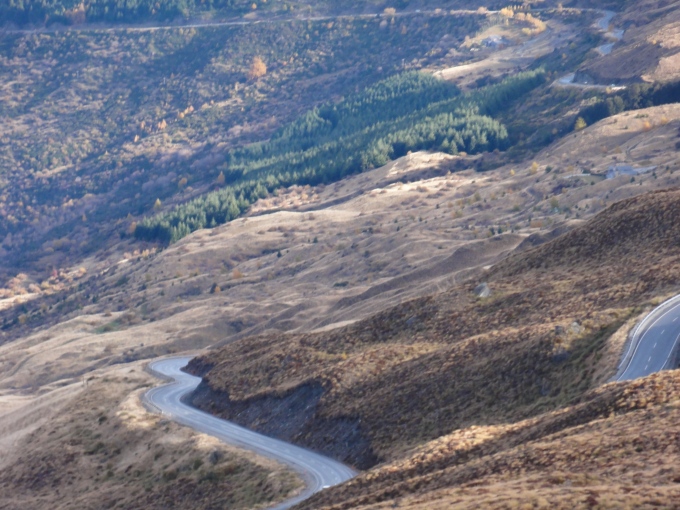
lookingdownfromcoronetpeak

And the story:

It was once said that a desperate man has everything to lose.

The man I was chasing was desperate, but I, on the other hand, was more desperate to catch him.

He’d left a trail of dead people from one end of the island to the other.

The team had put in a lot of effort to locate him, and now his capture was imminent.  We were following the car he was in, from a discrete distance, and, at the appropriate time, we would catch up, pull him over, and make the arrest.

There was nowhere for him to go.

The road led to a dead-end, and the only way off the mountain was back down the road were now on.  Which was why I was somewhat surprised when we discovered where he was.

Where was he going?

“Damn,” I heard Alan mutter.  He was driving, being careful not to get too close, but not far enough away to lose sight of him.

“What?”

“I think he’s made us.”

“How?”

“Dumb bad luck, I’m guessing.  Or he expected we’d follow him up the mountain.  He’s just sped up.”

“How far away?”

“A half-mile.  We should see him higher up when we turn the next corner.”

It took an eternity to get there, and when we did, Alan was right, only he was further on than we thought.”

“Step on it.  Let’s catch him up before he gets to the top.”

Easy to say, not so easy to do.  The road was treacherous, and in places just gravel, and there were no guard rails to stop a three thousand footfall down the mountainside.

Good thing then I had the foresight to have three agents on the hill for just such a scenario.

Ten minutes later, we were in sight of the car, still moving quickly, but we were going slightly faster.  We’d catch up just short of the summit car park.

Or so we thought.

Coming quickly around another corner we almost slammed into the car we’d been chasing.

“What the hell…” Aland muttered.

I was out of the car, and over to see if he was in it, but I knew that it was only a slender possibility.  The car was empty, and no indication where he went.

Certainly not up the road.  It was relatively straightforward for the next mile, at which we would have reached the summit.  Up the mountainside from here, or down.

I looked up.  Nothing.

Alan yelled out, “He’s not going down, not that I can see, but if he did, there’s hardly a foothold and that’s a long fall.”

Then where did he go?

Then a man looking very much like our quarry came out from behind a rock embedded just a short distance up the hill.

“Sorry,” he said quite calmly.  “Had to go if you know what I mean.”

I’d lost him.

It was as simple as that.

I had been led a merry chase up the hill, and all the time he was getting away in a different direction.

I’d fallen for the oldest trick in the book, letting my desperation blind me to the disguise that anyone else would see through in an instant.

It was a lonely sight, looking down that road, knowing that I had to go all that way down again, only this time, without having to throw caution to the wind.

“Maybe next time,” Alan said.

“We’ll get him.  It’s just a matter of time.”

© Charles Heath 2019-2021

Find this and other stories in “Inspiration, maybe”  available soon.

InspirationMaybe1v1

“Trouble in Store” – Short Stories my way: The end of the story

The stage is set for the big finale, though I’m not quite sure how ‘big’ it’s going to be.

Jack is ready to go having been given the green light by the girl with the gun.  It seems collateral damage is not on the agenda for her, though he does admit to himself she is between that proverbial rock and a hard place.

The storekeeper still has a plan, shaky at best, to regain hold of the situation, once the customer is out of the shop.  Nervy or not, he doesn’t think she had the capability to pull the trigger.  He knows what sort of person it takes to do that, and she isn’t one of them.

The policewoman is not sure what to expect but thinks that surprise is on her side, and whatever is going on, she will be able to resolve it.  She has her weapon drawn and ready to use.  She had yet to shoot anyone with it

The girl is at the point of no return, that point where she had nothing left to lose.  Anything she had before was gone, destroyed by the choices she’d made.  No one ever handed out a manual on how you should live your life, or provide a list of people you should avoid, and her father’s prophetic words the last time they men came home with a thud, ‘your life is defined by the choices you make’.

She was not going to jail so it was going to be death or glory.


Now read on:


Jack had heard there were moments where, in a split second, your whole life flashes before your eyes.  He did, and what he saw he didn’t like.

But, then, neither was he very happy about the fact he was nearly out the door before the policewoman on the other side crashed into him and sent him sprawling to the floor.

That was about the same fraction of a second he heard the gun go off, twice, or so he thought and knew he was a dead man, waiting for the bullet.

Another fraction of a second passed as the policewoman tried to unravel the mess they’d become, and at that moment in time felt the tugging at his sleeve and then, as if in slow motion, the sound of the glass door disintegrating behind him.


Annalisa was quite prepared to let the customer go.

She kept one eye on the shopkeeper and one on the customer, sidling towards the door.  The gun was ready to shoot the first person who made a wrong move.

Or so she told herself.  It was getting heavy in her hand, she was shaking almost uncontrollably now, and was getting more and more frightened of the consequences.  She didn’t think, if she aimed, she could hit the side of a barn let alone a person standing ten feet away from her.

The customer reached the door.

At exactly the moment he put his hand 0on the door handle to open the door, another person was pushing the door, trying to make their way in.

With force.

She saw the blue cap, guess it was the police, though she hadn’t heard the siren, but also guessed the shopkeeper might have a silent alarm.

Damn.

A single shot, instantly in the direction of the door, not necessarily aimed at the two people now collapsing to the floor in a tangled mess, but at the door itself.

The impact, yet another guess, might shatter the glass and make it easier to escape.

After one more job.

The hell with Simmo.  He’d dragged her down the rabbit hole far enough.  Simmo knew her first name, that she had rich parents, but nothing else.  Besides, he was in such bad shape she didn’t think he’d recover.

The shopkeeper had no idea who she was, it was the first time she’d been to his shop, and now, after a few weeks with Simmo, not ever her mother would recognize her.

She swiveled the gun and aimed it at the shopkeeper and pulled the trigger.,  One less dealer in the city was good news not bad.

She saw it hit, not exactly where, but it caused him to twist and start falling to the ground, at the same time letting out a very loud scream.  Panic or anger?

She wasn’t waiting to find out.

A last glance at Simmo, now down for the count, she ran for the door, past the two on the floor, what she could now see was a policewoman with her weapon drawn, but unable to use it.

She crashed through the remainder of the glass shards put into the street and ran.

In the distance she could hear a police car coming, siren blaring.  A warning if there was ever one to run harder, up the road, down an alley, out into another street, then down into the subway.

Gone.


It took fifteen seconds to disentangle herself from the customer, pushing him away, and getting to her feet, weapon aimed.

At nothing but air.

The girl had gone, and then she had the vague recollection of a shadow passing her as she was facing the other way getting to her feet.

And running out the door.

Five more valuable seconds as her brain processed this piece of information before it issued the command to go out the door and see which way she went.

Another ten seconds to get out the door, and see the police car coming from the same direction she had earlier, screeching to a halt outside the shop, a car door opening, and an officer getting out.

Margaret was guessing at the driver to drive down the road where she guessed the girl had run, managing to yell breathlessly at the office getting out, “She’s gone that way,” and pointing.

The officer relayed the message and closed the door as the car sped off.

“What happened?”

“Shots fired by a woman, more a girl, in the process of a robbery.”

She ran back inside the officer following.

The customer had moved to a corner and was standing, testing his limbs, with an expression that said he was amazed he was still alive.

“Over behind the counter.  She shopkeeper.  He was standing there.”

The policeman rounded the end of the counter and looked down.  “He’s here.  It’s not looking good.”

Margaret didn’t hear him.  She was calling an ambulance.


Next:  Perhaps some editing


© Charles Heath 2016-2020