Another excerpt from “Strangers We’ve Become” – A sequel to ‘What Sets Us Apart’

It was the first time in almost a week that I made the short walk to the cafe alone.  It was early, and the chill of the morning was still in the air.  In summer, it was the best time of the day.  When Susan came with me, it was usually much later, when the day was much warmer and less tolerable.

On the morning of the third day of her visit, Susan said she was missing the hustle and bustle of London, and by the end of the fourth she said, in not so many words, she was over being away from ‘civilisation’.  This was a side of her I had not seen before, and it surprised me.

She hadn’t complained, but it was making her irritable.  The Susan that morning was vastly different to the Susan on the first day.  So much, I thought, for her wanting to ‘reconnect’, the word she had used as the reason for coming to Greve unannounced.

It was also the first morning I had time to reflect on her visit and what my feelings were towards her.  It was the reason I’d come to Greve: to soak up the peace and quiet and think about what I was going to do with the rest of my life.

I sat in my usual corner.  Maria, one of two waitresses, came out, stopped, and there was no mistaking the relief in her manner.  There was an air of tension between Susan and Maria I didn’t understand, and it seemed to emanate from Susan rather than the other way around.  I could understand her attitude if it was towards Alisha, but not Maria.  All she did was serve coffee and cake.

When Maria recovered from the momentary surprise, she said, smiling, “You are by yourself?”  She gave a quick glance in the direction of my villa, just to be sure.

“I am this morning.  I’m afraid the heat, for one who is not used to it, can be quite debilitating.  I’m also afraid it has had a bad effect on her manners, for which I apologise.  I cannot explain why she has been so rude to you.”

“You do not have to apologise for her, David, but it is of no consequence to me.  I have had a lot worse.  I think she is simply jealous.”

It had crossed my mind, but there was no reason for her to be.  “Why?”

“She is a woman, I am a woman, she thinks because you and I are friends, there is something between us.”

It made sense, even if it was not true.  “Perhaps if I explained…”

Maria shook her head.  “If there is a hole in the boat, you should not keep bailing but try to plug the hole.  My grandfather had many expressions, David.  If I may give you one piece of advice, as much as it is none of my business, you need to make your feelings known, and if they are not as they once were, and I think they are not, you need to tell her.  Before she goes home.”

Interesting advice.  Not only a purveyor of excellent coffee, but Maria was also a psychiatrist who had astutely worked out my dilemma.  What was that expression, ‘not just a pretty face’?

“Is she leaving soon?” I asked, thinking Maria knew more about Susan’s movements than I did.

“You would disappoint me if you had not suspected as much.  Susan was having coffee and talking to someone in her office on a cell phone.  It was an intense conversation.  I should not eavesdrop, but she said being here was like being stuck in hell.  It is a pity she does not share your love for our little piece of paradise, is it not?”

“It is indeed.  And you’re right.  She said she didn’t have a phone, but I know she has one.  She just doesn’t value the idea of getting away from the office.  Perhaps her role doesn’t afford her that luxury.”

And perhaps Alisha was right about Maria, that I should be more careful.  She had liked Maria the moment she saw her.  We had sat at this very table, the first day I arrived.  I would have travelled alone, but Prendergast, my old boss, liked to know where ex-employees of the Department were, and what they were doing.

She sighed.  “I am glad I am just a waitress.  Your usual coffee and cake?”

“Yes, please.”

Several months had passed since we had rescued Susan from her despotic father; she had recovered faster than we had thought, and settled into her role as the new Lady Featherington, though she preferred not to use that title, but go by the name of Lady Susan Cheney.

I didn’t get to be a Lord, or have any title, not that I was expecting one.  What I had expected was that Susan, once she found her footing as head of what seemed to be a commercial empire, would not have time for details like husbands, particularly when our agreement made before the wedding gave either of us the right to end it.

There was a moment when I visited her recovering in the hospital, where I was going to give her the out, but I didn’t, and she had not invoked it.  We were still married, just not living together.

This visit was one where she wanted to ‘reconnect’ as she called it, and invite me to come home with her.  She saw no reason why we could not resume our relationship, conveniently forgetting she indirectly had me arrested for her murder, charges both her mother and Lucy vigorously pursued, and had the clone not returned to save me, I might still be in jail.

It was not something I would forgive or forget any time soon.

There were other reasons why I was reluctant to stay with her, like forgetting small details, an irregularity in her character I found odd.  She looked the same, she sounded the same, she basically acted the same, but my mind was telling me something was not right.  It was not the Susan I first met, even allowing for the ordeal she had been subjected to.

But, despite those misgivings, there was no question in my mind that I still loved her, and her clandestine arrival had brought back all those feelings.  But as the days passed, I began to get the impression my feelings were one-sided and she was just going through the motions.

Which brought me to the last argument, earlier, where I said if I went with her, it would be business meetings, social obligations, and quite simply her ‘celebrity’ status that would keep us apart.  I reminded her that I had said from the outset I didn’t like the idea of being in the spotlight, and when I reiterated it, she simply brushed it off as just part of the job, adding rather strangely that I always looked good in a suit.  The flippancy of that comment was the last straw, and I left before I said something I would regret.

I knew I was not a priority.  Maybe somewhere inside me, I had wanted to be a priority, and I was disappointed when I was not.

And finally, there was Alisha.  Susan, at the height of the argument, had intimated she believed I had an affair with her, but that elephant was always in the room whenever Alisha was around.  It was no surprise when I learned Susan had asked Prendergast to reassign her to other duties. 

At least I knew what my feelings for Alisha were, and there were times when I had to remember she was persona non grata.  Perhaps that was why Susan had her banished, but, again, a small detail; jealousy was not one of Susan’s traits when I first knew her.

Perhaps it was time to set Susan free.

When I swung around to look in the direction of the lane where my villa was, I saw Susan.  She was formally dressed, not in her ‘tourist’ clothes, which she had bought from one of the local clothing stores.  We had fun that day, shopping for clothes, a chore I’d always hated.  It had been followed by a leisurely lunch, lots of wine and soul searching.

It was the reason why I sat in this corner; old habits die hard.  I could see trouble coming from all directions, not that Susan was trouble or at least I hoped not, but it allowed me the time to watch her walking towards the cafe in what appeared to be short, angry steps; perhaps the culmination of the heat wave and our last argument.

She glared at me as she sat, dropping her bag beside her on the ground, where I could see the cell phone sitting on top.  She followed my glance down, and then she looked unrepentant back at me.

Maria came back at the exact moment she was going to speak.  I noticed Maria hesitate for a second when she saw Susan, then put her smile in place to deliver my coffee.

Neither spoke nor looked at each other.  I said, “Susan will have what I’m having, thanks.”

Maria nodded and left.

“Now,” I said, leaning back in my seat, “I’m sure there’s a perfectly good explanation as to why you didn’t tell me about the phone, but that first time you disappeared, I’d guessed you needed to keep in touch with your business interests.  I thought it somewhat unwisethat you should come out when the board of one of your companies was trying to remove you, because of what was it, an unexplained absence?  All you had to do was tell me there were problems and you needed to remain at home to resolve them.”

My comment elicited a sideways look, with a touch of surprise.

“It was unfortunate timing on their behalf, and I didn’t want you to think everything else was more important than us.  There were issues before I came, and I thought the people at home would be able to manage without me for at least a week, but I was wrong.”

“Why come at all.  A phone call would have sufficed.”

“I had to see you, talk to you.  At least we have had a chance to do that.  I’m sorry about yesterday.  I once told you I would not become my mother, but I’m afraid I sounded just like her.  I misjudged just how much this role would affect me, and truly, I’m sorry.”

An apology was the last thing I expected.

“You have a lot of work to do catching up after being away, and of course, in replacing your mother and gaining the requisite respect as the new Lady Featherington.  I think it would be for the best if I were not another distraction.  We have plenty of time to reacquaint ourselves when you get past all these teething issues.”

“You’re not coming with me?”  She sounded disappointed.

“I think it would be for the best if I didn’t.”

“Why?”

“It should come as no surprise to you that I’ve been keeping an eye on your progress.  You are so much better doing your job without me.  I told your mother once that when the time came I would not like the responsibilities of being your husband.  Now that I have seen what it could possibly entail, I like it even less.  You might also want to reconsider our arrangement, after all, we only had a marriage of convenience, and now that those obligations have been fulfilled, we both have the option of terminating it.  I won’t make things difficult for you if that’s what you want.”

It was yet another anomaly, I thought; she should look distressed, and I would raise the matter of that arrangement.  Perhaps she had forgotten the finer points.  I, on the other hand, had always known we would not last forever.  The perplexed expression, to me, was a sign she might have forgotten.

Then, her expression changed.  “Is that what you want?”

“I wasn’t madly in love with you when we made that arrangement, so it was easy to agree to your terms, but inexplicably, since then, my feelings for you changed, and I would be sad if we parted ways.  But the truth is, I can’t see how this is going to work.”

“In saying that, do you think I don’t care for you?”

That was exactly what I was thinking, but I wasn’t going to voice that opinion out loud.  “You spent a lot of time finding new ways to make my life miserable, Susan.  You and that wretched friend of yours, Lucy.  While your attitude improved after we were married, that was because you were going to use me when you went to see your father, and then almost let me go to prison for your murder.”

“I had nothing to do with that, other than to leave, and I didn’t agree with Lucy that you should be made responsible for my disappearance.  I cannot be held responsible for the actions of my mother.  She hated you; Lucy didn’t understand you, and Millie told me I was stupid for not loving you in return, and she was right.  Why do you think I gave you such a hard time?  You made it impossible not to fall in love with you, and it nearly changed my mind about everything I’d been planning so meticulously.  But perhaps there was a more subliminal reason why I did because after I left, I wanted to believe, if anything went wrong, you would come and find me.”

“How could you possibly know that I’d even consider doing something like that, given what you knew about me?”

“Prendergast made a passing comment when my mother asked him about you; he told us you were very good at finding people and even better at fixing problems.”

“And yet here we are, one argument away from ending it.”

I could see Maria hovering, waiting for the right moment to deliver her coffee, then go back and find Gianna, the café owner, instead.  Gianna was more abrupt and, for that reason, was rarely seen serving the customers.  Today, she was particularly cantankerous, banging the cake dish on the table and frowning at Susan before returning to her kitchen.  Gianna didn’t like Susan either.

Behind me, I heard a car stop, and when she looked up, I knew it was for her.  She had arrived with nothing, and she was leaving with nothing.

She stood.  “Last chance.”

“Forever?”

She hesitated and then shook away the look of annoyance on her face.  “Of course not.  I wanted you to come back with me so we could continue working on our relationship.  I agree there are problems, but it’s nothing we can’t resolve if we try.”

I had been trying.  “It’s too soon for both of us, Susan.  I need to be able to trust you, and given the circumstances, and all that water under the bridge, I’m not sure if I can yet.”

She frowned at me.  “As you wish.”  She took an envelope out of her bag and put it on the table.  “When you are ready, it’s an open ticket home.  Please make it sooner rather than later.  Despite what you think of me, I have missed you, and I have no intention of ending it between us.”

That said, she glared at me for a minute, shook her head, then walked to the car.  I watched her get in and the car drive slowly away.

No kiss, no touch, no looking back. 

© Charles Heath 2018-2025

strangerscover9

In a word: Great

Or is it grate?

Is it possible to mix the two up?  I don’t think so.

Great usually means: everything is great, or good, or excellent, whatever degree of goodness you want to put to it.

It could also mean something else, like:  Well, you were a great help! when in fact you want to say how useless they were.

Large or little.

Like all creatures great and small,  Why not say big or small.  Big doesn’t quite have the same effect.

Of course, you could be a great person, well, what I really mean is distinguished.  Besides, great could mean way above average, too.  Or grand, or impressive, the list goes on.

And haven’t we all, at some time had a great-aunt.  No not the good one, the ‘great’ one, denoting her seniority, not necessarily how nice she is.


As for the other grate, we can build a fire in it.

Or add an ‘un’ in front and ‘ful’ at the end, to denote what parents sometimes think of their children

Or get a block of cheese and ‘grate’ it into small shreds.

Or speak in a voice that grates on your nerves, possibly by that great-aunt.

“The Things We Do For Love”

Would you give up everything to be with the one you love?

Is love the metaphorical equivalent to ‘walking the plank’; a dive into uncharted waters?

For Henry, the only romance he was interested in was a life at sea, and when away from it, he strived to find sanctuary from his family and perhaps life itself.  It takes him to a small village by the sea, a place he never expected to find another just like him, Michelle, whom he soon discovers is as mysterious as she is beautiful.

Henry had long since given up the notion of finding romance, and Michelle couldn’t get involved for reasons she could never explain, but in the end, both acknowledge that something happened the moment they first met.  

Plans were made, plans were revised, and hopes were shattered.

A chance encounter causes Michelle’s past to catch up with her, and whatever hope she had of having a normal life with Henry, or anyone else, is gone.  To keep him alive she has to destroy her blossoming relationship, an act that breaks her heart and shatters his.

But can love conquer all?

It takes a few words of encouragement from an unlikely source to send Henry and his friend Radly on an odyssey into the darkest corners of the red-light district in a race against time to find and rescue the woman he finally realizes is the love of his life.

The cover, at the moment, looks like this:

lovecoverfinal1

Is love the metaphorical equivalent to ‘walking the plank’; a dive into uncharted waters?

For Henry, the only romance he was interested in was a life at sea, and when away from it, he strived to find sanctuary from his family and perhaps life itself.  It takes him to a small village by the sea, s place he never expected to find another just like him, Michelle, whom he soon discovers is as mysterious as she is beautiful.

Henry had long since given up the notion of finding romance, and Michelle couldn’t get involved for reasons she could never explain, but in the end, both acknowledge that something happened the moment they first met.  

Plans were made, plans were revised, and hopes were shattered.

A chance encounter causes Michelle’s past to catch up with her, and whatever hope she had of having a normal life with Henry, or anyone else, is gone.  To keep him alive she has to destroy her blossoming relationship, an act that breaks her heart and shatters his.

But can love conquer all?

It takes a few words of encouragement from an unlikely source to send Henry and his friend Radly on an odyssey into the darkest corners of the red-light district in a race against time to find and rescue the woman he finally realizes is the love of his life.

The cover, at the moment, looks like this:

lovecoverfinal1

“Trouble in Store” – Short stories my way: Character refinement

I have reworked the first part of the story with a few new elements about the characters and changed a few of the details of how the characters finish up in the shop before the policewoman makes her entrance.

This is part of the new first section is the one that involves Annalisa, and her boyfriend, Simmo:


Annalisa looked at the two men facing her.

Simmo, the boy on the floor, had told her that the shopkeeper would be a pushover, he was an old man who’d just hand over the drugs, rather than cause trouble for himself.

Where Simmo had discovered what the shopkeeper’s true vocation, dispensing drugs to the neighborhood addicts, she didn’t know, but it was not the first place like this they had visited.

She had always known Simmo had a problem, but he had assured her he had it under control.  Until a month ago, when he had tried something new.

It had changed him.

The breaking point came earlier that day when, seeing how sick he was, she threatened to leave.  It brought out the monster within him, and he threatened to kill her.  Not long after he had changed into a whimpering child pleading with her to stay, that he hadn’t meant anything he’d said before.

All he needed was one more ‘score’ to get his ‘shit’ together, and he would do as she asked, and find help.

She believed him.

He said he knew a place not far from the apartment, a small shop where what he needed was available, and said he had the money.

That should have been the first sign he was not telling the truth because she had been funding his habit until her parents cut off the money supply.  She suspected her father had put a private detective on to find her, had, and reported back, and rather than make a scene, just cut her off so she would have to come home or starve.  Her father was no better than Simmo.

And, as soon as they stepped into the shop, Simmo pulled out the gun,

Instead of the shopkeeper cowered like Simmo said he would, he had laughed at them and told them to get out.  Simmo started ranting and waving the gun around, then all of a sudden collapsed. 

There was a race for the gun which spilled out of Simmo’s hand, and she won. 

That was just before the customer burst into the shop.

It had been shortly before closing time.  Simmo had said there would be no one else around.

Wrong again.

Now she had another problem to deal with, a man who was clearly as scared shitless as she was.

This was worse than any bad hair day, or getting out of the wrong side of bed day, this was, she was convinced, the last day of her life.

She heard a strange sound come from beside her and looked down.  There was a trickle of blood coming out of his mouth and Simmo was making strange sounds like he was choking.

Any other time she might have been concerned, but the hard reality of it was, Simmo was never going to change.  She was only surprised at the fact it took so long for her to realize it.

As for the man standing in front of her, she was safe from the shopkeeper with him around, so he would have to stay.

“No.  Stay.”

Another glance at the shopkeeper told her she had made the right decision, his expression said it all.  Gun or no gun, the moment she was alone with him, he would kill her.


© Charles Heath 2016-2020

Memories of the conversations with my cat – 97

As some may be aware, but many not, Chester, my faithful writing assistant, mice catcher, and general pain in the neck, passed away some years ago.

Recently I was running a series based on his adventures, under the title of Past Conversations with my cat.

For those who have not had the chance to read about all of his exploits I will run the series again from Episode 1

These are the memories of our time together…

20161008_135142

This is Chester

Still hiding away.

Like any wise, old, skeptical cat, he’s not believing the good news.

We do not have a COVID 19 case in our house. Of course, we had to wait an agonizing 24 hours before we got the good news by phone.

It shows that our testing labs are getting through the tests, of which I heard in the news there were about 4,000, with only 10 or so new cases countrywide.

Queensland had none overnight, so if our case had been positive, we would have been in the news for al; the wrong reasons.

So, after broadcasting the news, that is, walking up and down the passage saying it was safe to come out, there’s still no sign of him.

But…

I have a cunning plan.

I bought a can of his absolute favorite food.

Come dinner time I’m putting it out.


Of course, food trumps fear every time.

He walks past me on his way to the tasty treats, the tail movements indicating he is not a happy cat.

The things I have to suffer at the hands of you humans, he mutters.

So, I say casually, we have guests for dinner.

He stops, turns his head in that dismissive manner of his.
What else can you do to me?

COVID 19, Grandchildren, I suppose you’re going to let me outside.

Do you want to go outside?

With COVID 19 lurking on every corner?

It’s under control.

Right. I’ve been watching TV. You do realize there’s good news and fake news, and there’s more of the latter than the former.

So, he’s going with the confuse the poor human with blather.

It’s working. I say, Go back into hiding. I was quite enjoying the silence.

After dinner, he says, ending the conversation with the angry tail swish. Yes, we are not amused.

The cinema of my dreams – Was it just another surveillance job – Episode 63

This story is now on the list to be finished so over the new few weeks, expect a new episode every few days.

The reason why new episodes have been sporadic, there are also other stories to write, and I’m not very good at prioritizing.

But, here we are, a few minutes opened up and it didn’t take long to get back into the groove.

Things are about to get complicated…


Two events happened simultaneously.

The door opened, a figure dressed in black appears and Jennifer grabbed her from behind and took her weapon then shoved her to the ground in the middle of the room, at the same time the USBs exploded in the microwave oven.

I went over to the figure and removed the balaclava, whilst Jennifer closed the door after a quick glance outside.

It was Jan. Why wasn’t I surprised.

“Just whose side are you on,” she said, grimacing, and holding her shoulder after it hit the floor very hard.

“You’re lucky it was Jennifer.  If it had been me, I might have strangled you by accident.  Why are you here?”

“The same as you?”

“No, in this flat.  I never told you anything about Jo.”

Jan looked over at the other woman sitting up against the wall, not exactly looking too well now.  She would need an ambulance soon.  Jan, probably sooner.

“It might have prevented this if you had.  It’s probably the only reason why you’re still alive, we needed you to lead us to her.  That’s Anna, isn’t it?”

“Yes.”

“And the data drives?”

“Kind of destroyed, which is where such information should end up.”

“It was not yours to do that.”

“No.  But left in the hands of people like you, where would it end up?  I’m sorry, but with all the lies and deception going on, I couldn’t trust anyone to do the right thing.”

My phone rang.

I looked at the screen.  Private number.  No prizes for guessing who.

“Dobbin?”

“What is going on in there?”

“Target practice.  Want to come and join the fun?”

“Is Jan alright?”

“She’ll live for now, but she is going to need medical assistance soon.  It’s up to you.”

“I’m coming up?”

“If you bring anyone else, they’re dead.”  I hung up.

I went over to the microwave, took out the remnants of the drives and flushed them down the toilet.  Just in case.

When I came back there was a knock on the door.

“I’ll get it,” I said to Jennifer.  “But if there is anyone else, shoot them.

Gun ready, I opened the door.  He had his hands where I could see them.  “Come in and join the fun.”

Jennifer had him covered, just in case.

I closed the door.

Dobbin looked at Anna.  He knew who she was.

“O’Connell is next door, dead.  Did Jan shoot him?”

“Hello, I’m in the room, Sam.  I did not.”

“Why do I find that hard to believe?”

“You have this all wrong, Sam.  We are not the bad guys,” Dobbin said.

“Well, if you are, and you’re lying, which is about all you have done since I first met you, you won’t be.  The USBs have been destroyed.”

Of course, in that instant, I realised that I may have been played again.  Anna had given up the location too easily, despite the threats of bodily harm, which if push came to shove, I might not have followed through on.  And if Anna surmised that, what was to stop her from having decoys just in case she was found?  Come to think of it, she didn’t seem very disappointed when I destroyed them.

A woman capable of torturing and murder was capable of anything, and she had proven herself very capable so far.

And, worse, Dobbin didn’t seem too upset at the news.

This was rapidly becoming a no-win situation.

© Charles Heath 2020-2023

Writing a book in 365 days – 260

Day 260

Turning your real-life experiences into a story, and then with a great deal of luck, into a legendary film.

From Your Life to the Legendary Silver Screen: The Audacious Quest for Cinematic Immortality

We’ve all seen them – those incredible films that resonate deep within our souls, stories so potent and true, you just know they must have sprung from the messy, magnificent wellspring of real life. Think “Schindler’s List,” “127 Hours,” “The Pursuit of Happyness,” “Erin Brockovich.” These aren’t just great movies; they’re cultural touchstones, etched into our collective consciousness.

And who hasn’t, at some point, looked at a pivotal moment in their own life – a harrowing challenge, an unlikely triumph, a profound transformation – and thought, “Now that would make an amazing movie.”

The leap from your personal experience to a legendary film is, let’s be honest, vast. It’s akin to catching lightning in a bottle, then harnessing its power to illuminate the world. It requires a potent blend of authenticity, craft, perseverance, and indeed, a great deal of luck. But understanding the steps, the possible path, can turn a fleeting thought into a focused ambition.

Here’s how one might embark on this audacious, often miraculous, journey:


Step 1: Harvesting Your Truth – The Origin Story

Before you even think about a script, you must dive deep into your own experience. This isn’t just recounting events; it’s excavating the emotional core.

  • Identify the Core Conflict & Transformation: What was the central struggle? Who were you before, and who did you become after? Legendary stories thrive on profound change.
  • Pinpoint the Universal: While your experience is unique, what universal themes does it touch upon? Love, loss, injustice, courage, resilience, redemption? These are the hooks that connect your singular story to a global audience.
  • Embrace Authenticity, Not Just Facts: Don’t be afraid to explore the messy, uncomfortable, or unsung aspects. Truth, in its rawest form, is compelling.
  • The “Why Now?”: Why is this story important right now? What message does it carry for contemporary society?

This isn’t just memory; it’s meaningful introspection.


Step 2: Crafting the Narrative – From Raw Emotion to Gripping Story

Your life isn’t a film script; it’s a sprawling, unedited saga. The next crucial step is to shape that reality into a compelling narrative arc.

  • Outline the Narrative Beats: Think like a storyteller. What’s the inciting incident? The rising action? The climax? The falling action? The resolution? Even if it didn’t happen perfectly in real life, you need to find this structure.
  • Identify Your Protagonist (You, or an Alter-Ego): What are their desires, flaws, strengths? How do they drive the story forward?
  • Build Your Supporting Cast: Who are the key players in your life’s drama? What roles do they play in your journey?
  • Write It Down (Seriously, Write It): Start as a memoir, a detailed story, or even a treatment. Get the essence of the story, its characters, and its emotional journey down on paper in prose form. This is your foundation.

This is where “storytelling” begins its magic, often requiring you to condense, combine, or even slightly fictionalize elements to serve the larger truth.


Step 3: Translating to the Screen – The Art of the Screenplay

This is where the specialized craft truly begins. A screenplay is a blueprint, a visual language.

  • Learn Screenwriting Fundamentals: Read screenplays of films you admire. Understand structure (three-act, sequences), formatting, dialogue, and “show, don’t tell.”
  • Visualize Everything: How does your story look on screen? What are the key images, sounds, and moments that convey emotion without dialogue?
  • Find Your Voice: Even with technical rules, your unique perspective should shine through.
  • Consider Collaboration: Unless you are an experienced screenwriter, you might need to find a professional screenwriter who can adapt your story into a compelling script. This often means selling them the rights to your life story, or collaborating closely. Be prepared for changes – the film version won’t be a literal transcription of your life.

This stage transforms your story from a personal account into a potential cinematic experience.


Step 4: The Industry Gauntlet – Pitching, Persistence, and People

Even a brilliant script needs to find its way into the right hands. This is where the “luck” factor amplifies, but you can certainly increase your odds.

  • Seek Feedback & Refine: Share your script with trusted readers, writers’ groups, or professional consultants. Be open to critique and revise, revise, revise.
  • Build Your Network: Attend film festivals, writing conferences, and industry events. Connect with other emerging writers, producers, and directors.
  • Enter Contests & Fellowships: Prestigious screenwriting competitions (like The Nicholl Fellowships, Austin Film Festival) can open doors and get your script noticed by agents and producers.
  • Find Representation: A literary agent or manager can be crucial for getting your script read by studios and production companies. This often requires a strong script and some initial buzz.
  • The Pitch: Be ready to articulate your story’s essence, its universal appeal, and its marketability in a concise, compelling way.

This phase is a marathon of networking, rejection, and the occasional glimmer of hope.


Step 5: The Alchemy of Production – From Script to Silver Screen

If your script catches fire, it enters the labyrinthine world of development and production.

  • Optioning & Development Deals: A production company or studio might “option” your script, buying the exclusive right to develop it for a period. This is where the project gets a producer, perhaps a director attached, and financing is sought.
  • Creative Evolution (and Compromise): Be prepared for your story to be shaped by many hands – directors, actors, studio executives. Your initial vision might evolve significantly. This is a collaborative art form.
  • Casting the Dream: The right cast can elevate a good story to greatness, bringing characters to life in unexpected ways.
  • Filming & Post-Production: The arduous process of shooting, editing, scoring, and visual effects comes next.

This is where your story truly transforms, gaining flesh, blood, and a voice beyond your own.


Step 6: The Spark of Legend – Beyond Your Control

Achieving “legendary” status is the ultimate, and most unpredictable, outcome.

  • Critical Acclaim & Audience Resonance: A film needs to connect deeply with both critics and audiences, earning rave reviews and robust box office (though not always).
  • Cultural Impact: Does the film spark conversations? Does it influence other art? Does it stand the test of time, becoming a reference point for future generations?
  • The Right Moment: Sometimes, a story simply arrives at the perfect cultural moment, addressing unspoken needs or reflecting pressing issues. This is pure serendipity.
  • Awards & Recognition: While not the sole arbiter of “legendary,” major awards (Oscars, Golden Globes) certainly amplify a film’s reach and cemented its place in history.

This is the realm of magic, where your personal truth, skillfully told, transcends entertainment and becomes a lasting cultural artifact.


The path from your unique life experience to a legendary film is steep, winding, and littered with “almosts.” Many incredible stories remain untold, or stop short of the silver screen. But the very act of distilling your truth, crafting it into a compelling narrative, and daring to share it with the world is a profound journey in itself.

So, listen to the whisper of your own story. What profound truth is waiting to be unearthed? What cinematic masterpiece might be hiding within the chapters of your life? The first step, always, is simply to begin.

Searching for locations: A typical diner, New York. USA

We decided to have lunch in a traditional Diner.

On an early morning walk, I discovered the Brooklyn Diner, a small restaurant tucked away in a street not far from Columbus Circle, perhaps a piece of history from the American past.

After all, if you’re going to take in the sights, sounds, and food of a country what better way to do it than visiting what was once a tradition.

This one was called the Brooklyn Diner.  It had a combination of booths and counter sit down, though the latter was not a very big space, so we opted for a booth.

The object of going to a Diner is the fact they serve traditional American food, which when you get past the hot dogs and hamburgers and fries, takes the form of turkey and chicken pot pies among a variety of other choices.

Still looking for a perfectly cooked turkey, something I’ve never been able to do myself, I opted for the Teadition Turkey Lunch, which the menu invitingly said was cooked especially at the diner and was succulent.  I couldn’t wait.

We also ordered a hamburger, yes, yet another, and a chicken pot pie, on the basis the last one I had in Toronto was absolutely delicious (and cooked the same way since the mid-1930s)

While waiting we got to look at a slice of history belonging to another great American tradition, Baseball, a painting on the wall of the Brooklyn Dodgers at Ebbets field, long since gone from their home.

The Turnkey lunch looked like this

which didn’t seem to be much, and had this odd pasta slice on the plate, but the turkey was amazing and lived up to the menu description.

The Chicken Pot Pie looked like this

And looked a lot larger in reality than the photo shows.

But, sadly while it was not bad, it was a little dry, and could possibly do with using the more succulent thigh part of the chicken.

All of this was washed down by Long Island Ice Teas and Brooklyn Lager.

AS for the Diner experience, it’s definitely a 10 out of 10 for me.

An excerpt from “If Only” – a work in progress

Investigation of crimes doesn’t always go according to plan, nor does the perpetrator get either found or punished.

That was particularly true in my case.  The murderer was incredibly careful in not leaving any evidence behind, to the extent that the police could not rule out whether it was a male or a female.

At one stage the police thought I had murdered my own wife though how I could be on a train at the time of the murder was beyond me.  I had witnesses and a cast-iron alibi.

The officer in charge was Detective First Grade Gabrielle Walters.  She came to me on the day after the murder seeking answers to the usual questions like, when was the last time you saw your wife, did you argue, the neighbors reckon there were heated discussions the day before.

Routine was the word she used.

Her fellow detective was a surly piece of work whose intention was to get answers or, more likely, a confession by any or all means possible.  I could sense the raging violence within him.  Fortunately, common sense prevailed.

Over the course of the next few weeks, once I’d been cleared of committing the crime, Gabrielle made a point of keeping me informed of the progress.

After three months the updates were more sporadic, and when, for lack of progress, it became a cold case, communication ceased.

But it was not the last I saw of Gabrielle.

The shock of finding Vanessa was more devastating than the fact she was now gone, and those images lived on in the same nightmare that came to visit me every night when I closed my eyes.

For months I was barely functioning, to the extent I had all but lost my job, and quite a few friends, particularly those who were more attached to Vanessa rather than me.

They didn’t understand how it could affect me so much, and since it had not happened to them, my tart replies of ‘you wouldn’t understand’ were met with equally short retorts.  Some questioned my sanity, even, for a time, so did I.

No one, it seemed, could understand what it was like, no one except Gabrielle.

She was by her own admission, damaged goods, having been the victim of a similar incident, a boyfriend who turned out to be an awfully bad boy.  Her story varied only in she had been made to witness his execution.  Her nightmare, in reliving that moment in time, was how she was still alive and, to this day, had no idea why she’d been spared.

It was a story she told me one night, some months after the investigation had been scaled down.  I was still looking for the bottom of a bottle and an emotional mess.  Perhaps it struck a resonance with her; she’d been there and managed to come out the other side.

What happened become our secret, a once-only night together that meant a great deal to me, and by mutual agreement, it was not spoken of again.  It was as if she knew exactly what was required to set me on the path to recovery.

And it had.

Since then, we saw each about once a month in a cafe.   I had been surprised to hear from her again shortly after that eventful night when she called to set it up, ostensibly for her to provide me with any updates on the case, but perhaps we had, after that unspoken night, formed a closer bond than either of us wanted to admit.

We generally talked for hours over wine, then dinner and coffee.  It took a while for me to realize that all she had was her work, personal relationships were nigh on impossible in a job that left little or no spare time for anything else.

She’d always said that if I had any questions or problems about the case, or if there was anything that might come to me that might be relevant, even after all this time, all I had to do was call her.

I wondered if this text message was in that category.  I was certain it would interest the police and I had no doubt they could trace the message’s origin, but there was that tiny degree of doubt, about whether or not I could trust her to tell me what the message meant.

I reached for the phone then put it back down again.  I’d think about it and decide tomorrow.

© Charles Heath 2018-2020

Searching for locations: Central Park, New York. USA

It’s a place to go and spot the movie stars, or perhaps their dogs.

It’s a place to go for long walks on idyllic spring or autumn days

It’s a place to go to look at a zoo, though I didn’t realize there was one until I made a wrong turn.

It’s a place to go for a horse and carriage ride, although it does not last that long

It’s a place to go to look at statues, fountains, architecture, and in winter, an ice skating rink

I’m sure there’s a whole lot more there that I don’t know about.

I have to say I’ve only visited in winter, and the first time there was snow, the second, none.

Both times it was cold, but this didn’t seem to deter people.

But…

We decided to go visit another part of the park, this time walking to West 67th Street before crossing Central Park West and into the park where Sheep Meadow is.

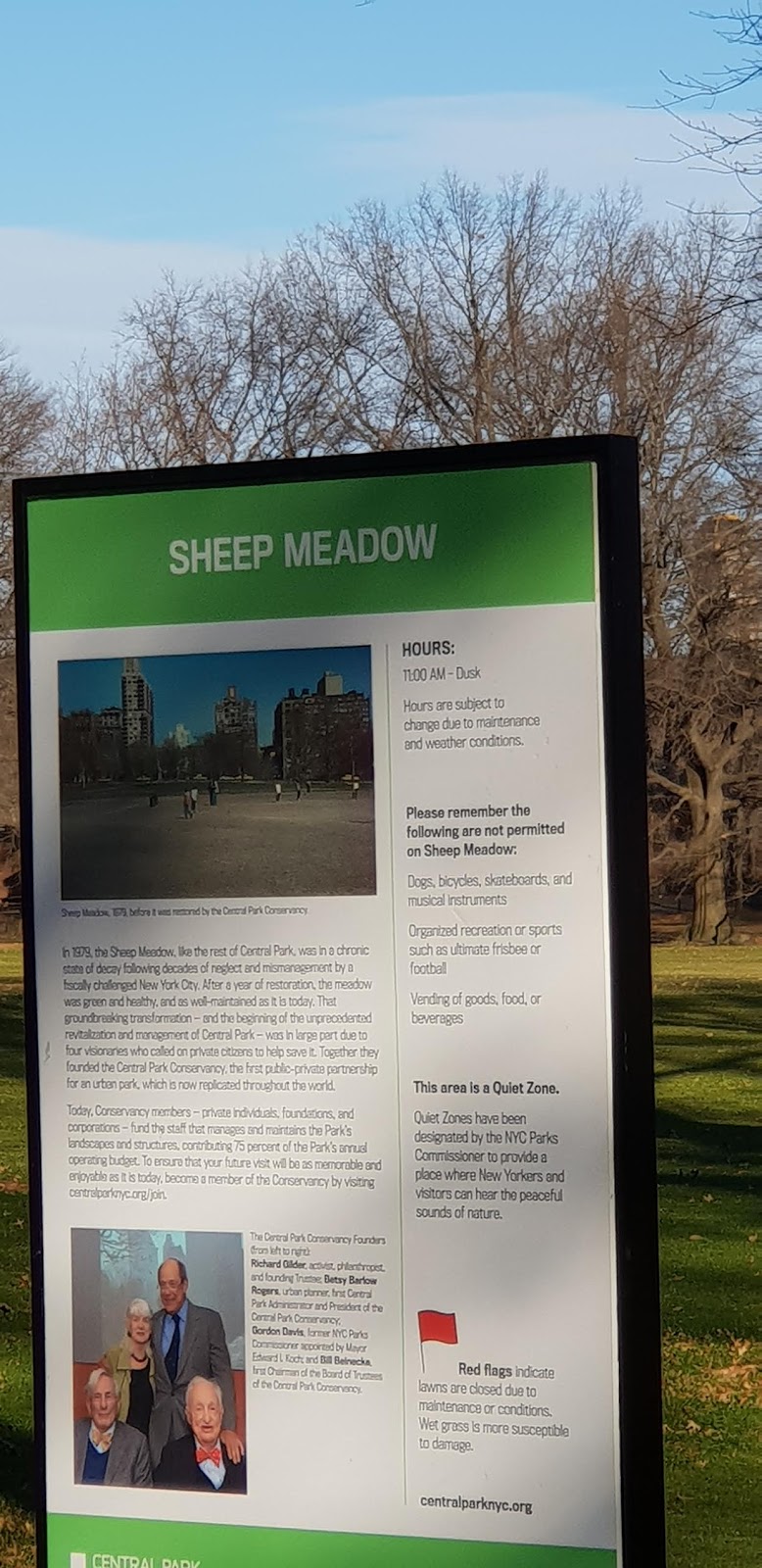
Once upon a time sheep did graze on the meadow, but these days it is designated a quiet area inspiring calm and refreshing thoughts, except for a period in the 1960s where there was more than one counter-culture protest, or love in, going on.

And, there’s the sign to say it was Sheep Meadow,

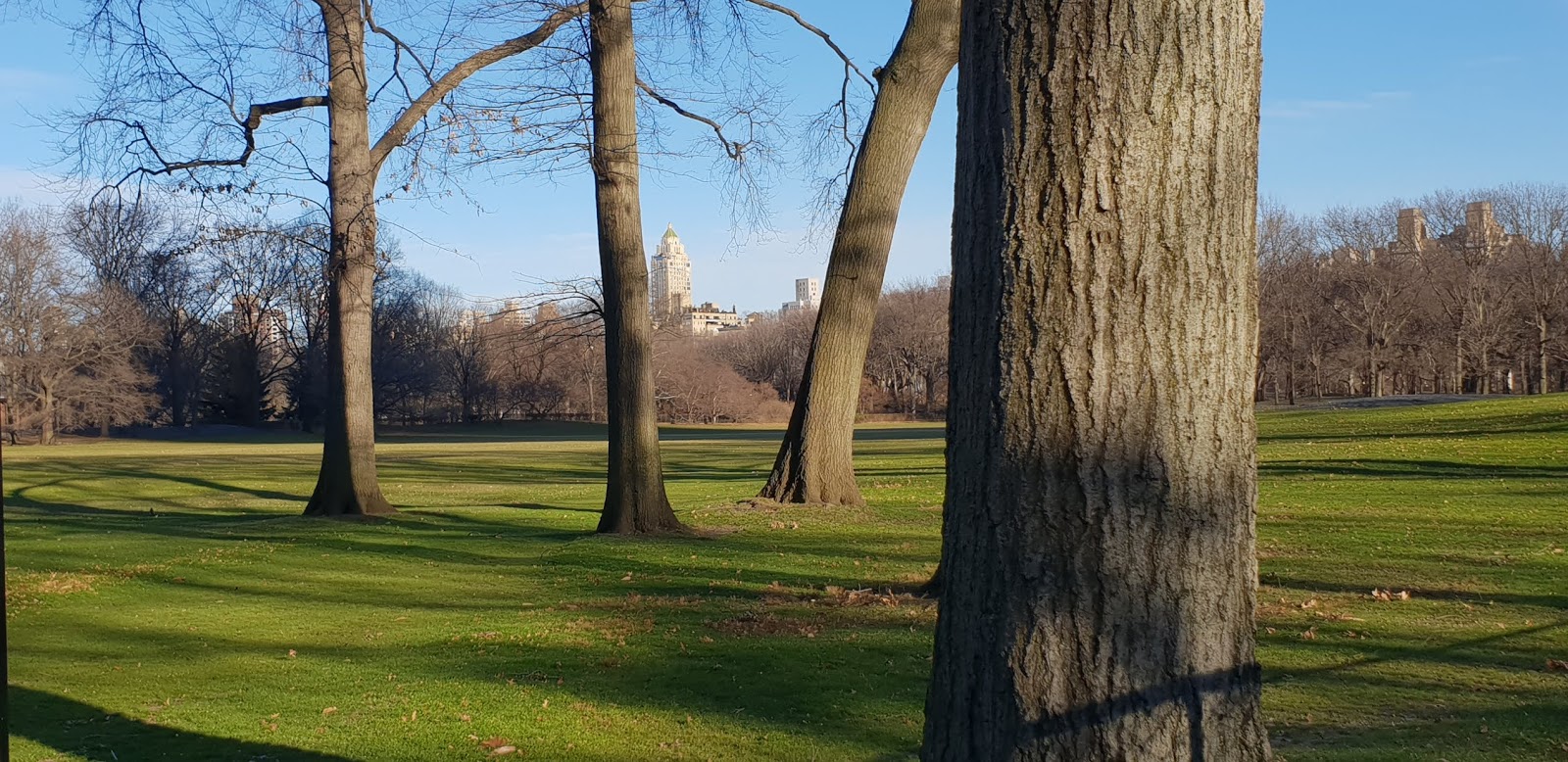
and that’s the meadow behind the sign,

Well, I don’t see any sheep, but of course, that’s not why the meadow is named or should there be any sheep on it.  That greenery that can be seen, restoring for the spring, was a very expensive addition to the park.

As a matter of fact, there is nothing was on it, because signs were up to say the meadow was closed for the winter, a new and interesting variation on the ‘Don’t Walk On The Grass’ signs.

I’m sure I could climb the fence, or, maybe not.  I’m a bit old to be climbing fences.

So, unable to walk on the grass, we tossed an imaginary coin, should we go towards West 110th Street, or back to West 59th Street.

West 59th Street won.

and, just in case we had any strange ideas about walking on the grass, the fence was there to deter us.  Perhaps if we had more determination…

One positive aspect of the park is that you could never get lost, and the tall buildings surrounding the park are nearly always visible through the trees, more so in winter because there is no foliage, maybe less so later in the year.

There is also a lot of very large rocky type hills, or outcrops where people seem to stand on, king of the mountain style, or sit to have a picnic lunch, quickly before it freezes.

Yes, it is cold outside and seems more so in the park.

I wondered briefly if it ever got foggy, then this place would be very spooky, particularly after the sun goes down.