An excerpt from “What Sets Us Apart”, a mystery with a twist

See the excerpt from the story below, just a taste of what’s in store…

http://amzn.to/2Eryfth

whatsetscover

McCallister was old school, a man who would most likely fit in perfectly campaigning on the battlefields of Europe during the Second World War. He’d been like a fish out of water in the army, post-Falklands, and while he retired a hero, he still felt he’d more to give.

He’d applied and was accepted as head of a SWAT team, and, watching him now as he and his men disembarked from the truck in almost military precision, a look passed between Annette, the police liaison officer, and I that said she’d seen it all before. I know I had.

There was a one in four chance his team would be selected for this operation, and she had been hoping it would be one of the other three. While waiting for them to arrive she filled me in on the various teams. His was the least co-operative, and the more likely to make ad-hoc decisions rather than adhere to the plan, or any orders that may come from the officer in charge.

This, she said quite bluntly, was going to end badly.

I still had no idea why Prendergast instructed me to attend the scene of what looked to be a normal domestic operation, but as the nominated expert in the field in these types of situations, it was fairly clear he wasn’t taking any chances. It was always a matter of opinion between us, and generally I lost.

In this case, it was an anonymous report identifying what the authorities believed were explosives in one of the dockside sheds where explosives were not supposed to be.

The only reason why the report was given any credence was the man, while not identifying himself by name, said he’d been an explosive expert once and recognized the boxes. That could mean anything, but the Chief Constable was a cautious man.

With his men settled and preparing their weapons, McCallister came over to the command post, not much more than the SUV my liaison and I arrived in, with weapons, bulletproof vests, and rolls of tape to cordon off the area afterward. We both had coffee, steaming in the cold early morning air. Dawn was slowly approaching and although rain had been forecast it had yet to arrive.

A man by the name of Benson was in charge. He too had groaned when he saw McCallister.

“A fine morning for it.” McCallister was the only enthusiastic one here.

He didn’t say what ‘it’ was, but I thought it might eventually be mayhem.

“Let’s hope the rain stays away. It’s going to be difficult enough without it,” Benson said, rubbing his hands together. We had been waiting for the SWAT team to arrive, and another team to take up their position under the wharf, and who was in the final stages of securing their position.

While we were waiting we drew up the plan. I’d go in first to check on what we were dealing with, and what type of explosives. The SWAT team, in the meantime, were to ensure all the exits to the shed were covered. When I gave the signal, they were to enter and secure the building. We were not expecting anyone inside or out, and no movement had been detected in the last hour since our arrival and deployment.

“What’s the current situation?”

“I’ve got eyes on the building, and a team coming in from the waterside, underneath. Its slow progress, but they’re nearly there. Once they’re in place, we’re sending McKenzie in.”

He looked in my direction.

“With due respect sir, shouldn’t it be one of us?” McCallister glared at me with the contempt that only a decorated military officer could.

“No. I have orders from above, much higher than I care to argue with, so, McCallister, no gung-ho heroics for the moment. Just be ready to move on my command, and make sure you have three teams at the exit points, ready to secure the building.”

McCallister opened his mouth, no doubt to question those orders, but instead closed it again. “Yes sir,” he muttered and turned away heading back to his men.

“You’re not going to have much time before he storms the battlements,” Benson quietly said to me, a hint of exasperation in his tone. “I’m dreading the paperwork.”

It was exactly what my liaison officer said when she saw McCallister arriving.

The water team sent their ‘in position’ signal, and we were ready to go.

In the hour or so we’d been on site nothing had stirred, no arrivals, no departures, and no sign anyone was inside, but that didn’t mean we were alone. Nor did it mean I was going to walk in and see immediately what was going on. If it was a cache of explosives then it was possible the building was booby-trapped in any number of ways, there could be sentries or guards, and they had eyes on us, or it might be a false alarm.

I was hoping for the latter.

I put on the bulletproof vest, thinking it was a poor substitute for full battle armor against an exploding bomb, but we were still treating this as a ‘suspected’ case. I noticed my liaison officer was pulling on her bulletproof vest too.

“You don’t have to go. This is my party, not yours,” I said.

“The Chief Constable told me to stick to you like glue, sir.”

I looked at Benson. “Talk some sense into her please, this is not a kindergarten outing.”

He shrugged. Seeing McCallister had taken all the fight out of him. “Orders are orders. If that’s what the Chief Constable requested …”

Madness. I glared at her, and she gave me a wan smile. “Stay behind me then, and don’t do anything stupid.”

“Believe me, I won’t be.” She pulled out and checked her weapon, chambering the first round. It made a reassuring sound.

Suited up, weapons readied, a last sip of the coffee in a stomach that was already churning from nerves and tension, I looked at the target, one hundred yards distant and thought it was going to be the longest hundred yards I’d ever traversed. At least for this week.

A swirling mist rolled in and caused a slight change in plans.

Because the front of the buildings was constantly illuminated by large overhead arc lamps, my intention had been to approach the building from the rear where there was less light and more cover. Despite the lack of movement, if there were explosives in that building, there’d be ‘enemy’ surveillance somewhere, and, after making that assumption, I believed it was going to be easier and less noticeable to use the darkness as a cover.

It was a result of the consultation, and studying the plans of the warehouse, plans that showed three entrances, the main front hangar type doors, a side entrance for truck entry and exit and a small door in the rear, at the end of an internal passage leading to several offices. I also assumed it was the exit used when smokers needed a break. Our entry would be by the rear door or failing that, the side entrance where a door was built into the larger sliding doors. In both cases, the locks would not present a problem.

The change in the weather made the approach shorter, and given the density of the mist now turning into a fog, we were able to approach by the front, hugging the walls, and moving quickly while there was cover. I could feel the dampness of the mist and shivered more than once.

It was nerves more than the cold.

I could also feel rather than see the presence of Annette behind me, and once felt her breath on my neck when we stopped for a quick reconnaissance.

It was the same for McCallister’s men. I could feel them following us, quickly and quietly, and expected, if I turned around, to see him breathing down my neck too.

It added to the tension.

My plan was still to enter by the back door.

We slipped up the alley between the two sheds to the rear corner and stopped. I heard a noise coming from the rear of the building, and the light tap on the shoulder told me Annette had heard it too. I put my hand up to signal her to wait, and as a swirl of mist rolled in, I slipped around the corner heading towards where I’d last seen the glow of a cigarette.

The mist cleared, and we saw each other at the same time. He was a bearded man in battle fatigues, not the average dockside security guard.

He was quick, but my slight element of surprise was his undoing, and he was down and unconscious in less than a few seconds with barely a sound beyond the body hitting the ground. Zip ties secured his hands and legs, and tape his mouth. Annette joined me a minute after securing him.

A glance at the body then me, “I can see why they, whoever they are, sent you.”

She’d asked who I worked for, and I didn’t answer. It was best she didn’t know.

“Stay behind me,” I said, more urgency in my tone. If there was one, there’d be another.

Luck was with us so far. A man outside smoking meant no booby traps on the back door, and quite possibly there’d be none inside. But it indicated there were more men inside, and if so, it appeared they were very well trained. If that were the case, they would be formidable opponents.

The fear factor increased exponentially.

I slowly opened the door and looked in. A pale light shone from within the warehouse itself, one that was not bright enough to be detected from outside. None of the offices had lights on, so it was possible they were vacant. I realized then they had blacked out the windows. Why hadn’t someone checked this?

Once inside, the door closed behind us, progress was slow and careful. She remained directly behind me, gun ready to shoot anything that moved. I had a momentary thought for McCallister and his men, securing the perimeter.

At the end of the corridor, the extent of the warehouse stretched before us. The pale lighting made it seem like a vast empty cavern, except for a long trestle table along one side, and, behind it, stacks of wooden crates, some opened. It looked like a production line.

To get to the table from where we were was a ten-yard walk in the open. There was no cover. If we stuck to the walls, there was equally no cover and a longer walk.

We needed a distraction.

As if on cue, the two main entrances disintegrated into flying shrapnel accompanied by a deafening explosion that momentarily disoriented both Annette and I. Through the smoke and dust kicked up I saw three men appear from behind the wooden crates, each with what looked like machine guns, spraying bullets in the direction of the incoming SWAT members.

They never had a chance, cut down before they made ten steps into the building.

By the time I’d recovered, my head heavy, eyes watering and ears still ringing, I took several steps towards them, managing to take down two of the gunmen but not the third.

I heard a voice, Annette’s I think, yell out, “Oh, God, he’s got a trigger,” just before another explosion, though all I remember in that split second was a bright flash, the intense heat, something very heavy smashing into my chest knocking the wind out of me, and then the sensation of flying, just before I hit the wall.

I spent four weeks in an induced coma, three months being stitched back together and another six learning to do all those basic actions everyone took for granted. It was twelve months almost to the day when I was released from the hospital, physically, except for a few alterations required after being hit by shrapnel, looking the same as I always had.

But mentally? The document I’d signed on release said it all, ‘not fit for active duty; discharged’.

It was in the name of David Cheney. For all intents and purposes, Alistair McKenzie was killed in that warehouse, and for the first time ever, an agent left the Department, the first to retire alive.

I was not sure I liked the idea of making history.

© Charles Heath 2016-2020

The first attempt is exactly that, a first draft

That’s what it feels like after you’ve put words on paper.

The story is there waiting to be written, I know where it’s coming from, and I know where I want it to go, but the words are not working.

I read it once, yuk, I read it twice, and it’s begging me to press the delete button.

Now!

This is how it looks:

My life was going nowhere.  If I took a step back and took a good, long, hard look at it, what could I say was the one defining moment?

There was no defining moment.

I’d bounced around schools till the day I decided I was not cut out to learn anything more, or perhaps the teachers had given up trying to impart knowledge.  Whatever the reason, I dropped out of college and drifted.  Seasonal labourer, farmhand, factory worker, night watchman.

At least now I had a uniform and looked like I’d made something of myself.

Until I went home.

My parents were distinctly disappointed I was not married with children.

My overachieving brother always said I was a loser and would never make anything of myself.

My ultra-successful sister, married into a very wealthy family, had the regulation 2.4 children and lived in the lap of luxury, mostly pretended I didn’t exist, didn’t invite me to the wedding, and I had yet to meet the husband and children.  I guess she was ashamed of me.

This year I was avoiding going home.

This year I volunteered to work during the holidays.

Yep, time to walk away and do something entirely different, like wrapping Christmas presents, my second favourite job to mowing the lawn.  Maybe if I contrive an accident with the lawnmower …

Back in front of the page, an idea pops into my head some hours later.  The story continues:

It was 3 a.m. and it was like standing on the exact epicentre of the South Pole.  I’d just stepped from the warehouse into the car park.

The car was covered in snow.  The weather was clear now, but more snow was coming.

A white Christmas?  That’s all I needed.  I hoped I remembered to put the antifreeze in my radiator this time.

As I approached my car, the light went on in an SUV parked next to mine.  The door opened and what looked like a woman was getting out of the car.

“Graham?”

It was a voice I was familiar with, though I hadn’t heard it for a long time.

My ultra-successful sister, Penelope.  She was leaning against her car door, and from what I could see, she didn’t look too well.

“What do you want?”

“Help.”

My help, I was the last person to help her or anyone for that matter.  But curiosity got the better of me.  “Why?”

“Because my husband is trying to kill me.”

With that said, she slid down the side of the car, and I could see, in the arc lamps lighting the car park, a trail of blood.

To be honest, it needs some more thought.  It’s got the makings of a story, but the MC shouldn’t come across as a hopeless case, he just needs to be, in part, a victim of circumstances, some of which he has to own.

But, as they say, anything on paper is better than nothing on paper.  Tomorrow, or the next day, I will edit and rewrite and see what happens.

Stay tuned.

© Charles Heath 2020-2025

Writing about writing a book – Day 7 Continues – Jennifer

Jennifer again.

From Bill Chandler’s perspective,

She was a good worker, but extremely private.  Her path had been clear; work, no play, and avoid everyone.  I’d seen her deal with executives and office boys alike, and put up barriers that no one could penetrate.  She made herself deliberately unattractive and unapproachable for reasons unknown.

Over time I tried to penetrate that steely exterior with moderate success, trying to get to know her better.  And, in doing so I discovered she apparently had a bad experience early on in life with someone, and it had affected her deeply.

Of course, it didn’t progress much more than that one admission, not until the divorce.  It was long and problematical because Ellen had chosen to go the hard route rather than just call it off, perhaps to make me realize just what I had put her through.  The sad fact was, there was nothing I could do to make it right, now or in the future.

But because of that, and because it seemed to Jennifer that I needed someone to ‘lean’ on in my time of trouble, she became the only person I could talk to.  It wasn’t difficult.  We were both working long hours in each others company, and neither of us had a desire to go home.

Then three months ago, something happened and everything changed. 

Well, it changed between us, but to the outside world, no one would ever know.  That didn’t mean we hadn’t been friends of a sort before that, it was just we were, well, I don’t think I could describe it.  All I know is I knew my feelings for her had changed, or perhaps they were the same, and she had changed.  Whatever it was, I was glad.  Ellen had been dragging me down for so long; just being with Jennifer was like a breath of fresh air.

I found I could pour out the details of my sad and undistinguished life to her.  She was the one and only person to whom I could talk freely.  And, all of a sudden, apparently I was the only one she could talk freely to too.  From that point, we had become a different sort of friends, and, in the last week or so, a little more than that.

Our last encounter had been interesting to say the least.  I was still not sure of what I said, or how it ended, other than I had apologized to her the Friday night before we parted.  I hadn’t exactly wanted any vacation days, they were thrust upon me, but perhaps it was fortuitous in that it would give us both time to consider our relationship.

After Ellen, I hadn’t thought about getting involved in a relationship, or anything else for that matter, but it seemed that was where Jennifer and I could finish up, despite the fact neither of us were realistically looking for anything other than a friendship.

That very subtly changed on that Friday night.

Now I’d been thrust back into the fire, and I wondered just how I would feel seeing her. 


Jennifer is an important character in several ways, as a friend to Bill, and in a way, connected to him in a way he doesn’t yet know.  She will also have some impact when his past finally catches up with him.

I’m still working on her character background, but more will follow soon.

She is about to change, especially in the eyes of Bill.


© Charles Heath 2016-2019

The cinema of my dreams – I never wanted to go to Africa – Episode 11

It’s still a battle of wits, but our hero knows he’s in serious trouble.

The problem is, there are familiar faces and a question of who is a friend and who is foe made all the more difficult because the enemy if it is the enemy, doesn’t look or sound or act like the enemy.
Old friends, new tricks.

Genial tone, trying to win my confidence.  I wasn’t going to ask, but wait for an explanation.  Asking would be like leaving the door ajar.

He sat after pulling the chair closer to the table and put his clasped hands on the table.

“This is a secret military operation known only to very few, apart from the team that is in situ.  Commander Breeman has been, against very specific direct orders, trying to find out what we are doing here.”  He stopped.

I think this was the moment I was supposed to ask, what was going on here.

If it was secret, then I didn’t want to know, and he was not going to tell me anyway.

I just looked attentive.

“You have been caught up in a jurisdictional issue.  It’s not hard to assume that you were sent here, with the pilot of that helicopter, to do an off the book search for this camp.  That, in itself, would be impossible, but the flyover coincided with a provedore run.  Just plain bad luck.”

For Joe, the pilot, it was.  Or not, if he had been given specific verbal orders, making it out to be a training run.  And the odds of me being on board at the same time, given my association with Breeman?

One coincidence too many.

And if it was as the man before had said, they knew everything, then Bamfield would know of my connection to her.

“You said you had no idea where you were when you were shot down?”

Time, I guess, to speak.  “No, I didn’t.  The desert looks all the same to me.”

“You will forgive me if I say I find that hard to believe.  I know you are better than that, Alan.  Who sent you out here?”

“I was along for the ride.  Standard operating procedure.  A helo goes up, someone like me has to be on board in case of trouble.  More conventional trouble than rockets.”

“But you specifically?”

“I don’t make the rosters, I just go where they tell me.”

Bamfield frowned.  I think he’d finally noticed I was not addressing him as ‘sir’.  Until I knew what side he was on, I considered myself a prisoner of war.


© Charles Heath 2019

Writing a book in 365 days – 275

Day 275

Poetry, again

The Necessary Madness: Why Poetry Demands a Certain Unsoundness of Mind

There are few pronouncements in literature as instantly arresting and delightfully unsettling as the suggestion that to truly engage with poetry—to write it, or even to enjoy it—requires “a certain unsoundness of mind.”

This quote, often attributed to the Romantic critic and essayist William Hazlitt (though sometimes debated), doesn’t just demand our attention; it challenges the very foundation of how we define sanity, rationality, and the purpose of art.

If the quote holds any truth, it suggests that the purest forms of human expression are found not in the center of logic, but on the fringes of accepted thought.

The Tyranny of the ‘Sound’ Mind

Before we celebrate this poetic madness, we must first define what the “sound mind” represents.

The ‘sound mind’ is the mind built for survival and efficiency. It is pragmatic, literal, and relentlessly focused on the material world. It asks: How does this benefit me? Is this efficient? What is the demonstrable return on investment? A sound mind appreciates a spreadsheet more than a sonnet.

Poetry, by its nature, is profoundly unsound. It is impractical. It sacrifices plain meaning for music, clarity for color, and the material for the transcendent. In the purely economic or rational sense, poetry is useless.

The poet, therefore, must reject the tyranny of the purely rational. They must be willing to stare at a blade of grass not as an element of photosynthesis, but as a small, green miracle demanding an ode. This ability to divert focus from the practical necessities of life to the consuming fire of feeling—this is the first hint of “unsoundness.”

The Poet as the Maximalist of Feeling

When we talk about the “unsoundness” necessary for poetry, we are generally not talking about pathology, but rather maximal sensitivity.

The poet is often someone who feels the world too intensely. They do not merely observe tragedy; they absorb it. They do not just see beauty; they are momentarily blinded by it. This heightened level of empathy and emotional responsiveness is exhausting, destabilizing, and deeply incompatible with the smooth running of mundane life.

To be a poet is to stand permanently outside the insulating wall of detachment that most people build to cope with existence. You must be vulnerable to the overwhelming sensory and emotional data the world constantly provides.

In this context, poetry becomes a necessary defense mechanism. It is the obsessive, painstaking labor of translating this overwhelming internal cacophony into structured sound. The rhyme, the meter, the perfect metaphor—these elements are not arbitrary decorations; they are the cage the poet builds to house their wild, excessive feelings.

Unsoundness is the Engine of Metaphor

Perhaps the greatest sign of poetic “unsoundness” is the absolute reliance on metaphor.

The logical mind deals strictly with A = A. The poetic mind insists that A = B, even when A and B share no literal qualities. It sees a lover’s eyes and calls them stars; it sees a city and calls it a sleeping animal.

This non-linear connection—this immediate leap across the chasm of logic—is the signature mental deviation required for the art form. The poet must briefly abandon empirical reality to create a new reality, one governed by emotional resonance rather than physics.

To create the brilliant, jarring imagery that defines great verse, the poet must be willing to let their mind wander into territory that the logical world deems nonsensical. They must embrace the illogical truth.

The Reader’s Necessary Leap

The quote states that even enjoying poetry demands this mental deviation. This is perhaps the more insidious and intriguing part of the claim.

If the poet is the architect of illogical truth, the reader must be willing to temporarily relocate their own mind to that space.

To truly enjoy a poem, you cannot read it primarily for information. You must allow yourself to be led away from the concrete ground you stand upon. The appreciation of poetry requires the reader to:

  1. Suspend Literal Meaning: To understand why the moon might weep or the wind might whisper secrets, we must momentarily sideline our rational understanding of astronomy and meteorology.
  2. Embrace Emotional Logic: We must prioritize the feeling the poem evokes over the fact it describes.
  3. Accept the Unexplained: We must allow the poem to exist outside the need for easy answers, recognizing that the beauty lies in the ambiguity.

In the brief time we spend with a stanza, we are happily infected by the poet’s particular brand of “madness.” We choose to be unsound, and in that fleeting moment of voluntary irrationality, we find profound emotional clarity.

A Celebration of Necessary Deviance

The history of poetry—from the romantic excess of Lord Byron to the stark, fragmented vision of Sylvia Plath—is littered with geniuses who struggled to align their profound internal lives with the demands of the pragmatic world.

The quote, therefore, is not an insult or a diagnosis. It is a profound observation about the nature of creativity. The “unsoundness of mind” is simply the maximal awareness of the human condition—the courage to feel disproportionately and to articulate those feelings without filtering them through the gauze of acceptable, practical thought.

If sanity is defined by the refusal to look beyond the mundane, then thank heaven for the glorious, necessary unsoundness that gives us the words to describe the sublime.


What Do You Think?

Do you agree that a departure from strict logic is necessary to appreciate poetry? Who is your favorite poet whose work seems to thrive on this “unsoundness” of mind? Share your thoughts in the comments below!

What I learned about writing – When you need a distraction!

If I get a headache, I can take paracetamol

If I have a sore back, I can take ipBrufen.

If I can’t put words on paper … what is there I can take?

Therein lies the writer’s dilemma.

I have been staring at the blank screen on my computer for about an hour now.  I am in the middle of a rewrite.  I know what direction I want the story to go.  Yet, for the life of me, I cannot find the words.

Is it writer’s block?

Here’s the thing.

Not four hours ago, I had all the words in the world.  The new scene was all but writing itself; the words flowed, and the characters were alive and almost bubbling over with enthusiasm.  I was almost as if I was in the same room with them and their mental sparring.

That scene is done.

And usually, the next is already forming in my mind as I’m getting to the end.  This time, an untimely interruption put a spoke in the works, diverted my attention to resolving a problem, and everything I’d been thinking about has gone.

Not a block then, but a dastardly distraction.

I guess I’m going on a long walk around the neighbourhood, looking but not seeing, thinking but trying not to think, stopping at the café and have a long hot coffee and a cake, perhaps this time a custard tart with whipped cream (OK, I know that can’t be good for me, but it is delicious) and by the time I get back …

Hopefully, the words will return.

An excerpt from “The Things We Do for Love”; In love, Henry was all at sea!

In the distance, he could hear the dinner bell ringing and roused himself.  Feeling the dampness of the pillow, and fearing the ravages of pent-up emotion, he considered not going down but thought it best not to upset Mrs. Mac, especially after he said he would be dining.

In the event, he wished he had reneged, especially when he discovered he was not the only guest staying at the hotel.

Whilst he’d been reminiscing, another guest, a young lady, had arrived.  He’d heard her and Mrs. Mac coming up the stairs and then shown to a room on the same floor, perhaps at the other end of the passage.

Henry caught his first glimpse of her when she appeared at the door to the dining room, waiting for Mrs. Mac to show her to a table.

She was in her mid-twenties, slim, with long brown hair, and the grace and elegance of a woman associated with countless fashion magazines.  She was, he thought, stunningly beautiful with not a hair out of place, and make-up flawlessly applied.  Her clothes were black, simple, elegant, and expensive, the sort an heiress or wife of a millionaire might condescend to wear to a lesser occasion than dinner.

Then there was her expression; cold, forbidding, almost frightening in its intensity.  And her eyes, piercingly blue and yet laced with pain.  Dracula’s daughter was his immediate description of her.

All in all, he considered, the only thing they had in common was, like him, she seemed totally out of place.

Mrs. Mac came out of the kitchen, wiping her hands on her apron.  She was, she informed him earlier, chef, waitress, hotelier, barmaid, and cleaner all rolled into one.  Coming up to the new arrival she said, “Ah, Miss Andrews, I’m glad you decided to have dinner.  Would you like to sit with Mr. Henshaw, or would you like to have a table of your own?”

Henry could feel her icy stare as she sized up his appeal as a dining companion, making the hair on the back of his neck stand up.  He purposely didn’t look back.  In his estimation, his appeal rating was minus six.  Out of a thousand!

“If Mr. Henshaw doesn’t mind….”  She looked at him, leaving the query in mid-air.

He didn’t mind and said so.  Perhaps he’d underestimated his rating.

“Good.”  Mrs. Mac promptly ushered her over.  Henry stood, made sure she was seated properly and sat.

“Thank you.  You are most kind.”  The way she said it suggested snobbish overtones.

“I try to be when I can.”  It was supposed to nullify her sarcastic tone but made him sound a little silly, and when she gave him another of her icy glares, he regretted it.

Mrs. Mac quickly intervened, asking, “Would you care for the soup?”

They did, and, after writing the order on her pad, she gave them each a look, imperceptibly shook her head, and returned to the kitchen.

Before Michelle spoke to him again, she had another quick look at him, trying to fathom who and what he might be.  There was something about him.

His eyes, they mirrored the same sadness she felt, and, yes, there was something else, that it looked like he had been crying?  There was a tinge of redness.

Perhaps, she thought, he was here for the same reason she was.

No.  That wasn’t possible.

Then she said, without thinking, “Do you have any particular reason for coming here?”  Seconds later she realized she’d spoken it out loud, had hadn’t meant to actually ask, it just came out.

It took him by surprise, obviously not the first question he was expecting her to ask of him.

“No, other than it is as far from civilization, and home, as I could get.”

At least we agree on that, she thought.

It was obvious he was running away from something as well.

Given the isolation of the village and lack of geographic hospitality, it was, from her point of view, ideal.  All she had to do was avoid him, and that wouldn’t be difficult.

After getting through this evening first.

“Yes,” she agreed.  “It is that.”

A few seconds passed, and she thought she could feel his eyes on her and wasn’t going to look up.

Until he asked, “What’s your reason?”

Slightly abrupt in manner, perhaps, because of her question and how she asked it.

She looked up.  “Rest.  And have some time to myself.”

She hoped he would notice the emphasis she had placed on the word ‘herself’ and take due note.  No doubt, she thought, she had completely different ideas of what constituted a holiday than he, not that she had said she was here for a holiday.

Mrs. Mac arrived at a fortuitous moment to save them from further conversation.

Over the entree, she wondered if she had made a mistake coming to the hotel.  Of course, there had been no conceivable way she could know that anyone else might have booked the same hotel, but realized it was foolish to think she might end up in it by herself.

Was that what she was expecting?

Not a mistake then, but an unfortunate set of circumstances, which could be overcome by being sensible.

Yet, there he was, and it made her curious, not that he was a man, by himself, in the middle of nowhere, hiding like she was, but for quite varied reasons.

On discreet observance, whilst they ate, she gained the impression his air of light-heartedness was forced, and he had no sense of humour.

This feeling was engendered by his looks, unruly dark hair, and permanent frown.  And then there was his abysmal taste in clothes on a tall, lanky frame.  They were quality but totally unsuited to the wearer.

Rebellion was written all over him.

The only other thought crossing her mind, and incongruously, was he could do with a decent feed.  In that respect, she knew now from the mountain of food in front of her, he had come to the right place.

“Mr. Henshaw?”

He looked up.  “Henshaw is too formal.  Henry sounds much better,” he said, with a slight hint of gruffness.

“Then my name is Michelle.”

Mrs. Mac came in to take their order for the only main course, gather up the entree dishes, and then return to the kitchen.

“Staying long?” she asked.

“About three weeks.  Yourself?”

“About the same.”

The conversation dried up.

Neither looked at the other, rather at the walls, out the window, towards the kitchen, anywhere.  It was, she thought, unbearably awkward.

Mrs. Mac returned with a large tray with dishes on it, setting it down on the table next to theirs.

“Not as good as the usual cook,” she said, serving up the dinner expertly, “but it comes a good second, even if I do say so myself.  Care for some wine?”

Henry looked at Michelle.  “What do you think?”

“I’m used to my dining companions making the decision.”

You would, he thought.  He couldn’t help but notice the cutting edge of her tone.  Then, to Mrs. Mac, he named a particular White Burgundy he liked, and she bustled off.

“I hope you like it,” he said, acknowledging her previous comment with a smile that had nothing to do with humour.

“Yes, so do I.”

Both made a start on the main course, a concoction of chicken and vegetables that were delicious, Henry thought when compared to the bland food he received at home and sometimes aboard my ship.

It was five minutes before Mrs Mac returned with the bottle and two glasses.  After opening it and pouring the drinks, she left them alone again.

Henry resumed the conversation.  “How did you arrive?  I came by train.”

“By car.”

“Did you drive yourself?”

And he thought, a few seconds later, that was a silly question, otherwise she would not be alone, and certainly not sitting at this table. With him.

“After a fashion.”

He could see that she was formulating a retort in her mind, then changed it, instead, smiling for the first time, and it served to lighten the atmosphere.

And in doing so, it showed him she had another more pleasant side despite the fact she was trying not to look happy.

“My father reckons I’m just another of ‘those’ women drivers,” she added.

“Whatever for?”

“The first and only time he came with me I had an accident.  I ran up the back of another car.  Of course, it didn’t matter to him the other driver was driving like a startled rabbit.”

“It doesn’t help,” he agreed.

“Do you drive?”

“Mostly people up the wall.”  His attempt at humour failed.  “Actually,” he added quickly, “I’ve got a very old Morris that manages to get me where I’m going.”

The apple pie and cream for dessert came and went and the rapport between them improved as the wine disappeared and the coffee came.  Both had found, after getting to know each other better, their first impressions were not necessarily correct.

“Enjoy the food?” Mrs. Mac asked, suddenly reappearing.

“Beautifully cooked and delicious to eat,” Michelle said, and Henry endorsed her remarks.

“Ah, it does my heart good to hear such genuine compliments,” she said, smiling.  She collected the last of the dishes and disappeared yet again.

“What do you do for a living,” Michelle asked in an off-hand manner.

He had a feeling she was not particularly interested, and it was just making conversation.

“I’m a purser.”

“A what?”

“A purser.  I work on a ship doing the paperwork, that sort of thing.”

“I see.”

“And you?”

“I was a model.”

“Was?”

“Until I had an accident, a rather bad one.”

“Oh, I’m sorry.”

So that explained the odd feeling he had about her.

As the evening wore on, he began to think there might be something wrong, seriously wrong with her because she didn’t look too well.  Even the carefully applied makeup, from close, didn’t hide the very pale, and tired look, or the sunken, dark-ringed eyes.

“I try not to think about it, but it doesn’t necessarily work.  I’ve come here for peace and quiet, away from doctors and parents.”

“Then you will not have to worry about me annoying you.  I’m one of those fall-asleep-reading-a-book types.”

Perhaps it would be like ships passing in the night and then smiled to himself about the analogy.

Dinner over, they separated.

Henry went back to the lounge to read a few pages of his book before going to bed, and Michelle went up to her room to retire for the night.

But try as he might, he was unable to read, his mind dwelling on the unusual, yet compellingly mysterious person he would be sharing the hotel with.

Overlaying that original blurred image of her standing in the doorway was another of her haunting expressions that had, he finally conceded, taken his breath away, and a look that had sent more than one tingle down his spine.

She may not have thought much of him, but she had certainly made an impression on him.

© Charles Heath 2015-2024

lovecoverfinal1

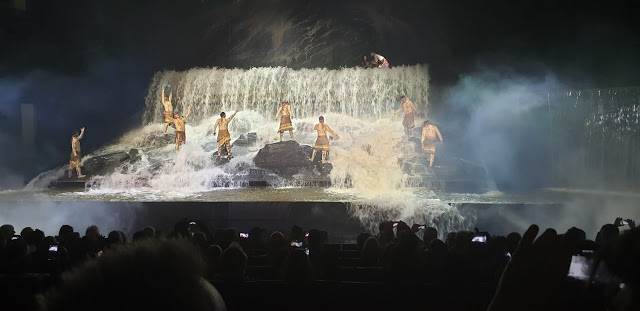
Searching for locations: The Golden Mask Dynasty Show, Beijing, China

The Golden Mask Dynasty Show was located at the OCT Theatre in Beijing’s Happy Valley. 

The theatre was quite full and the seats we had were directly behind the VIP area; as our guide told us, we had the best seats in the house. 

The play has 20 different dance scenes that depict war, royal banquets, and romance.  There are eight chapters and over 200 actors, and throughout the performance we were entertained by dancers, acrobats, costumes, lighting, and acoustics.

The story:

It is of romantic legend and historical memories, the Golden Mask Queen leads her army in defeating the invading Blue Mask King’s army, and afterwards the lands return to a leisurely pastoral life until the Queen forges a ‘mysterious tree’.  When the tree has grown, the Queen has a grand celebration, and releases the captured Blue soldiers, much to the admiration of the Blue Mask King.
This is followed by monstrous floods, and to save her people, and on the advice from the ‘mysterious tree’, the Queen sacrifices herself to save her people.  The Queen then turns into a golden sunbird flying in the sky blessing the people and that of the dynasty.

Billed as the best live show in China, described as a large scale dramatic musical, “The Golden Mask Dynasty” it lived up to its reputation and was thoroughly enjoyed by all.

It was not just singing dancing and acrobatics, it had a story and it was told so that language and cultural issues aside, it worked.  There was a narration of the story running beside the stage, but it was hard to divide attention between what was happening, and what was being related.

Then came the peacock dance, with live peacocks

And this was followed by a waterfall, well, I don’t think anyone in that audience could believe what they were seeing.

I know I was both astonished and in awe of the performance.

What a way to finish off our first day in Beijing.

Oh, sorry, that high was dented slightly when we had to go back to our room.

“One Last Look”, nothing is what it seems

A single event can have enormous consequences.

A single event driven by fate, after Ben told his wife Charlotte he would be late home one night, he left early, and by chance discovers his wife having dinner in their favourite restaurant with another man.

A single event where it could be said Ben was in the wrong place at the wrong time.

Who was this man? Why was she having dinner with him?

A simple truth to explain the single event was all Ben required. Instead, Charlotte told him a lie.

A single event that forces Ben to question everything he thought he knew about his wife, and the people who are around her.

After a near-death experience and forced retirement into a world he is unfamiliar with, Ben finds himself once again drawn back into that life of lies, violence, and intrigue.

From London to a small village in Tuscany, little by little Ben discovers who the woman he married is, and the real reason why fate had brought them together.

It is available on Amazon here:  http://amzn.to/2CqUBcz

Writing a book in 365 days – 275

Day 275

Poetry, again

The Necessary Madness: Why Poetry Demands a Certain Unsoundness of Mind

There are few pronouncements in literature as instantly arresting and delightfully unsettling as the suggestion that to truly engage with poetry—to write it, or even to enjoy it—requires “a certain unsoundness of mind.”

This quote, often attributed to the Romantic critic and essayist William Hazlitt (though sometimes debated), doesn’t just demand our attention; it challenges the very foundation of how we define sanity, rationality, and the purpose of art.

If the quote holds any truth, it suggests that the purest forms of human expression are found not in the center of logic, but on the fringes of accepted thought.

The Tyranny of the ‘Sound’ Mind

Before we celebrate this poetic madness, we must first define what the “sound mind” represents.

The ‘sound mind’ is the mind built for survival and efficiency. It is pragmatic, literal, and relentlessly focused on the material world. It asks: How does this benefit me? Is this efficient? What is the demonstrable return on investment? A sound mind appreciates a spreadsheet more than a sonnet.

Poetry, by its nature, is profoundly unsound. It is impractical. It sacrifices plain meaning for music, clarity for color, and the material for the transcendent. In the purely economic or rational sense, poetry is useless.

The poet, therefore, must reject the tyranny of the purely rational. They must be willing to stare at a blade of grass not as an element of photosynthesis, but as a small, green miracle demanding an ode. This ability to divert focus from the practical necessities of life to the consuming fire of feeling—this is the first hint of “unsoundness.”

The Poet as the Maximalist of Feeling

When we talk about the “unsoundness” necessary for poetry, we are generally not talking about pathology, but rather maximal sensitivity.

The poet is often someone who feels the world too intensely. They do not merely observe tragedy; they absorb it. They do not just see beauty; they are momentarily blinded by it. This heightened level of empathy and emotional responsiveness is exhausting, destabilizing, and deeply incompatible with the smooth running of mundane life.

To be a poet is to stand permanently outside the insulating wall of detachment that most people build to cope with existence. You must be vulnerable to the overwhelming sensory and emotional data the world constantly provides.

In this context, poetry becomes a necessary defense mechanism. It is the obsessive, painstaking labor of translating this overwhelming internal cacophony into structured sound. The rhyme, the meter, the perfect metaphor—these elements are not arbitrary decorations; they are the cage the poet builds to house their wild, excessive feelings.

Unsoundness is the Engine of Metaphor

Perhaps the greatest sign of poetic “unsoundness” is the absolute reliance on metaphor.

The logical mind deals strictly with A = A. The poetic mind insists that A = B, even when A and B share no literal qualities. It sees a lover’s eyes and calls them stars; it sees a city and calls it a sleeping animal.

This non-linear connection—this immediate leap across the chasm of logic—is the signature mental deviation required for the art form. The poet must briefly abandon empirical reality to create a new reality, one governed by emotional resonance rather than physics.

To create the brilliant, jarring imagery that defines great verse, the poet must be willing to let their mind wander into territory that the logical world deems nonsensical. They must embrace the illogical truth.

The Reader’s Necessary Leap

The quote states that even enjoying poetry demands this mental deviation. This is perhaps the more insidious and intriguing part of the claim.

If the poet is the architect of illogical truth, the reader must be willing to temporarily relocate their own mind to that space.

To truly enjoy a poem, you cannot read it primarily for information. You must allow yourself to be led away from the concrete ground you stand upon. The appreciation of poetry requires the reader to:

  1. Suspend Literal Meaning: To understand why the moon might weep or the wind might whisper secrets, we must momentarily sideline our rational understanding of astronomy and meteorology.
  2. Embrace Emotional Logic: We must prioritize the feeling the poem evokes over the fact it describes.
  3. Accept the Unexplained: We must allow the poem to exist outside the need for easy answers, recognizing that the beauty lies in the ambiguity.

In the brief time we spend with a stanza, we are happily infected by the poet’s particular brand of “madness.” We choose to be unsound, and in that fleeting moment of voluntary irrationality, we find profound emotional clarity.

A Celebration of Necessary Deviance

The history of poetry—from the romantic excess of Lord Byron to the stark, fragmented vision of Sylvia Plath—is littered with geniuses who struggled to align their profound internal lives with the demands of the pragmatic world.

The quote, therefore, is not an insult or a diagnosis. It is a profound observation about the nature of creativity. The “unsoundness of mind” is simply the maximal awareness of the human condition—the courage to feel disproportionately and to articulate those feelings without filtering them through the gauze of acceptable, practical thought.

If sanity is defined by the refusal to look beyond the mundane, then thank heaven for the glorious, necessary unsoundness that gives us the words to describe the sublime.


What Do You Think?

Do you agree that a departure from strict logic is necessary to appreciate poetry? Who is your favorite poet whose work seems to thrive on this “unsoundness” of mind? Share your thoughts in the comments below!