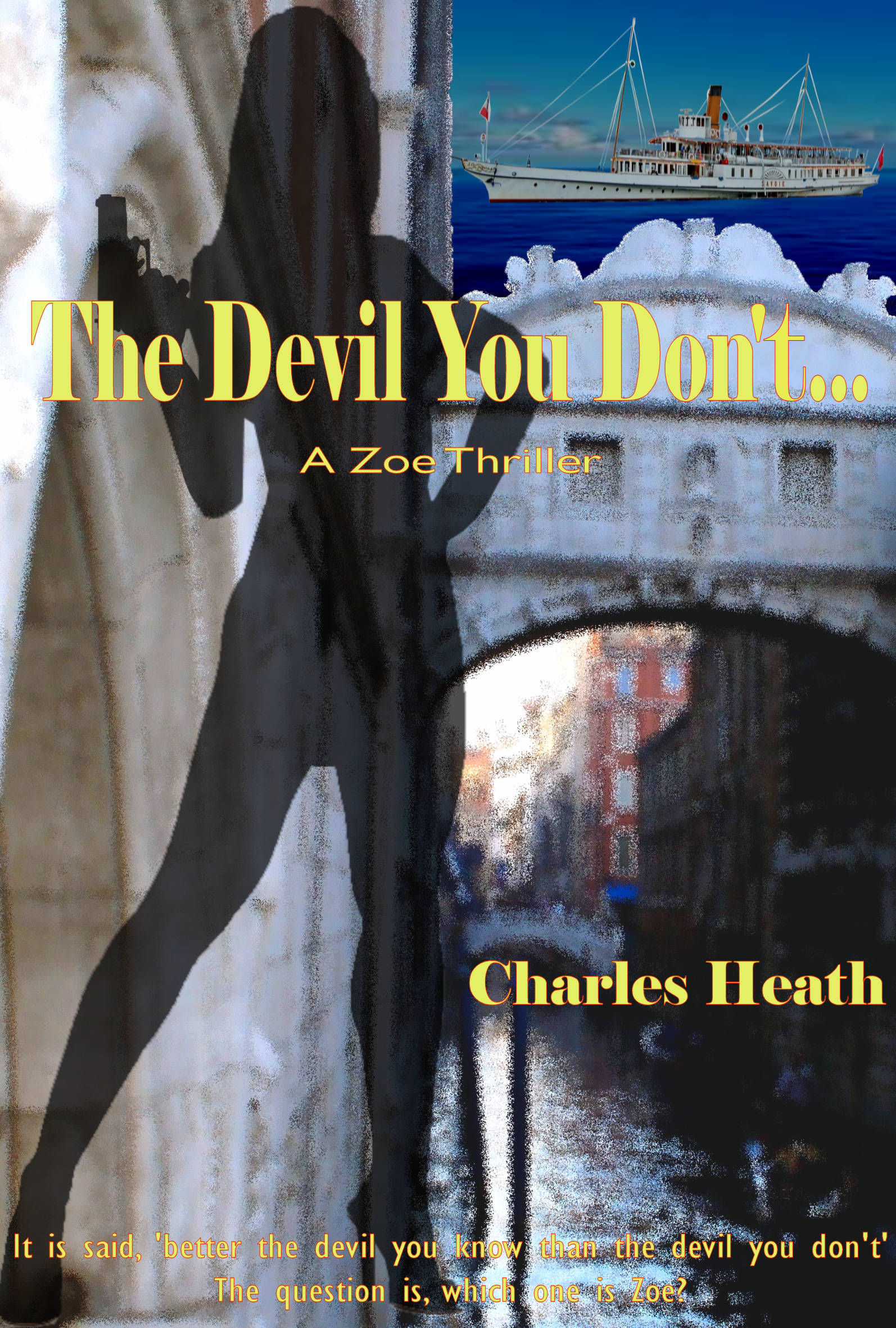
‘The Devil You Don’t’ – A beta reader’s view

It could be said that of all the women one could meet, whether contrived or by sheer luck, what are the odds it would turn out to be the woman who was being paid a very large sum to kill you.

John Pennington is a man who may be lucky in business, but not so lucky in love. He has just broken up with Phillipa Sternhaven, the woman he thought was the one, but relatives and circumstances, and perhaps because she was a ‘princess’, may also have contributed to the end result.

So, what do you do when you are heartbroken?

That is a story that slowly unfolds, from the first meeting with his nemesis on Lake Geneva, all the way to a hotel room in Sorrento, where he learns the shattering truth.

What should have been solace after disappointment, turns out to be something else entirely, and from that point, everything goes to hell in a handbasket.

He suddenly realizes his so-called friend Sebastian has not exactly told him the truth about a small job he asked him to do, the woman he is falling in love with is not quite who she says she is, and he is caught in the middle of a war between two men who consider people becoming collateral damage as part of their business.

The story paints the characters cleverly displaying all their flaws and weaknesses. The locations add to the story at times taking me back down memory lane, especially to Venice where, in those back streets I confess it’s not all that hard to get lost.

All in all a thoroughly entertaining story with, for once, a satisfying end.

Available on Amazon here: https://amzn.to/2Xyh1ow

Writing a book in 365 days – 279

Day 279

Riveting prose for the dull banality of life

The Unsung Epic: How Everyday Life Becomes Riveting Prose

“Drama is life with the dull bits cut out.”

It’s a line that resonates deeply with anyone who loves a good story. We crave the heightened stakes, the emotional rollercoasters, the twists and turns that define our favorite books, films, and series. But what if I told you that the “dull bits” aren’t always so dull? What if the real magic lies not in eliminating them, but in learning to see the drama hidden beneath their unassuming surface?

The challenge is enticing: Can we take everyday events and turn them into riveting prose? My answer, unequivocally, is yes. And in doing so, we don’t just write better stories; we learn to live a richer, more observant life.

Beyond Explosions: What Is Drama, Really?

First, let’s redefine “drama.” It’s not always grand gestures or world-ending stakes. At its core, drama is about conflict, tension, and emotion. It’s about a character wanting something and facing obstacles in getting it. It’s about choices, consequences, and the raw vulnerability of being human.

Consider that infamous “dull bits” pile: commuting, waiting in line, doing laundry, making coffee. On the surface, these are the unglamorous necessities of existence. But with a writer’s eye, they become potential stages for micro-dramas.

The Writer’s Superpower: Perspective and Pressure

The secret weapon for transforming the mundane is perspective. It’s about zooming in, acknowledging the internal monologue, and applying pressure.

  1. Zoom In: A spilled coffee isn’t just a stain; it’s the sudden, hot shock, the ruined shirt on the morning of a crucial presentation, the ripple effect of lateness. The drama isn’t the coffee itself, but what it means to the person experiencing it.
  2. Internal Monologue: We rarely share the full, rich narrative of our minds. What anxieties bubble up while waiting for a delayed train? What silent arguments play out as we fold a partner’s forgotten items? The internal world is a universe of untold stories, rife with hope, fear, regret, and determination.
  3. Apply Pressure: Take any everyday event and ask: What if something goes wrong? What if the stakes are slightly higher for this particular character?
    • The Commute: It’s not just a drive; it’s a desperate race against the clock to pick up a child from daycare before late fees kick in. The brake lights ahead aren’t just an inconvenience; they’re a physical manifestation of rising panic.
    • The Grocery Store: It’s not just a shopping trip; it’s the careful balancing act of an elderly person on a fixed income, trying to make healthy food last an entire week from a dwindling budget. Every price tag is a small, quiet battle.
    • The Awkward Conversation: It’s not just polite small talk; it’s a son trying to delicately broach a sensitive subject with his aging father, hoping to connect before it’s too late, fearing misinterpretation or dismissal.

Unearthing the Micro-Conflicts

Everyday life is brimming with small conflicts:

  • Person vs. Self: The internal debate over whether to speak up, to forgive, to take a risk, or to stick to the comfort of routine.
  • Person vs. Nature/Environment: The unexpected downpour when you forgot your umbrella, the power outage during a critical deadline, the unreliable public transport.
  • Person vs. Person (Subtle): The passive-aggressive note from a roommate, the slight that goes unaddressed, the unspoken tension across a dinner table, the small power plays in a queue.

These mini-struggles, when given the prose treatment, become relatable and powerful. They remind readers of their own quiet battles and hidden heroics.

The Art of Observation and Sensory Detail

To write riveting prose from the ordinary, you must become an exceptional observer.

  • What do you see? Not just objects, but the way light falls, the subtle expressions on faces, the wear and tear of time.
  • What do you hear? The hum of the refrigerator, the distant rumble of traffic, the specific cadence of a voice.
  • What do you feel? The cold ceramic of a mug, the ache in tired muscles, the prickle of irritation.
  • What do you smell and taste? The comforting aroma of baking bread, the metallic tang of fear, the bitterness of burnt toast.

These details ground your reader in the moment, making even the most mundane scene vivid and immersive.

So, Can We Do It?

Absolutely. By acknowledging the inherent drama in our struggles, choices, and interactions – no matter how small – we unlock a boundless reservoir of material. We aren’t cutting out the dull bits; we’re illuminating the hidden drama within them.

Next time you’re waiting in line, stuck in traffic, or simply watching the world go by, challenge yourself. What’s the story here? What’s at stake for the person beside you? What internal monologue is playing out in your own mind?

The world isn’t just a stage for grand narratives; it’s a collection of countless, intricate, and often riveting personal epics, waiting for us to notice, understand, and perhaps, to write them down.


What “dull bit” of your day do you think holds a hidden story? Share in the comments below!

In a word: Green

Of course, it is a colour, one used for traffic lights, grass, and a lot of different shades.

It’s made up of blue and yellow, adjusting the amounts of each to get the shade you want.

I once had a dark green suit.

I don’t have any green emeralds.

When you get a green light, it means to go ahead, or just go, in traffic, or for the starting of a project

And a green run on the ski fields denotes the easiest run – just about my level!

Green with envy, yes, though I’m not sure why they picked green for envy

In England especially, green is a patch of grassy land, usually in the middle of a village

A green worker is one that is new to the job, and usually gets all the rotten jobs

Then there is the biggest money-spinner of all time: going green, which means eco-friendly.

I have only one question, why is it to go ‘green’ is to charge far more than normal

Oh, and by the way, political parties that are eco-centric are usually called the greens

And, these are the same people who chain themselves to trees, deterring bulldozers

The blue sea is really green, believe it or not!

“The Things we do for Love”, the story behind the story

This story has been ongoing since I was seventeen, and just to let you know, I’m 71 this year.

Yes, it’s taken a long time to get it done.

Why, you might ask.

Well, I never gave it much interest because I started writing it after a small incident when I was 17, and working as a book packer for a book distributor in Melbourne

At the end of my first year, at Christmas, the employer had a Christmas party, and that year, it was at a venue in St Kilda.

I wasn’t going to go because at that age, I was an ordinary boy who was very introverted and basically scared of his own shadow and terrified by girls.

Back then, I would cross the street to avoid them

Also, other members of the staff in the shipping department were rough and ready types who were not backwards in telling me what happened, and being naive, perhaps they knew I’d be either shocked or intrigued.

I was both adamant I wasn’t coming and then got roped in on a dare.

Damn!

So, back then, in the early 70s, people looked the other way when it came to drinking, and of course, Dutch courage always takes away the concerns, especially when normally you wouldn’t do half the stuff you wouldn’t in a million years

I made it to the end, not as drunk and stupid as I thought I might be, and St Kilda being a salacious place if you knew where to look, my new friends decided to give me a surprise.

It didn’t take long to realise these men were ‘men about town’ as they kept saying, and we went on an odyssey.  Yes, those backstreet brothels where one could, I was told, have anything they could imagine.

Let me tell you, large quantities of alcohol and imagination were a very bad mix.

So, the odyssey in ‘The things we do’ was based on that, and then the encounter with Diana. Well, let’s just say I learned a great deal about girls that night.

Firstly, not all girls are nasty and spiteful, which seemed to be the case whenever I met one. There was a way to approach, greet, talk to, and behave.

It was also true that I could have had anything I wanted, but I decided what was in my imagination could stay there.  She was amused that all I wanted was to talk, but it was my money, and I could spend it how I liked.

And like any 17-year-old naive fool, I fell in love with her and had all these foolish notions.  Months later, I went back, but she had moved on, to where no one was saying or knew.

Needless to say, I was heartbroken and had to get over that first loss, which, like any 17-year-old, was like the end of the world.

But it was the best hour I’d ever spent in my life and would remain so until I met the woman I have been married to for the last 48 years.

As Henry, he was in part based on a rebel, the son of rich parents who despised them and their wealth, and he used to regale anyone who would listen about how they had messed up his life

If only I’d come from such a background!

And yes, I was only a run away from climbing up the stairs to get on board a ship, acting as a purser.

I worked for a shipping company and they gave their junior staff members an opportunity to spend a year at sea working as a purser on a cargo ship that sailed between Melbourne, Sydney and Hobart in Australia.

One of the other junior staff members’ turn came, and I would visit him on board when he would tell me stories about life on board, the officers, the crew, and other events. These stories, which sounded incredible to someone so impressionable, were a delight to hear.

Alas, by that time, I had tired of office work and moved on to be a tradesman at the place where my father worked.

It proved to be the right move, as that is where I met my wife.  Diana had been right; love would find me when I least expected it.

lovecoverfinal1

The fourth attempt, let’s look at the main character

So there are words on paper, and three times I’ve tried to fix it, or, perhaps just make it sound better because reading it in my head, there’s too little background and too many questions.

The flow of the story isn’t working for me, so I guess it’s time to sit down and work out what it is I’m trying to say.

The notion that our main character, Graham, is a loser seems to shine through, and that’s not what I’m trying to portray him as.  No, far from it, it’s been a lifetime of bad choices that have put him where he is, and he knows it.

So, in part, this is about owning your mistakes, and it’s my job to make him come across as a hero in waiting.  There’s good in him, perhaps too much, but there is also that attitude that led to all those bad choices, the one that can get him into trouble, and a sort of intransigence inherited from his father, that has more or less got him ostracised from the family. 

I want this character to be a chop off the old block, both of whom are the type not to back down, not to say sorry, and, to quote a rather apt allegory, would cut their nose off to spite their face.

Graham’s intransigence led to his refusal to follow his father into business, refusal to go to University despite having the necessary qualifications, and just to round out the defiance, his choice of women whom he knew would meet with family disapproval.

And these factors, over a period of time, saw him bounce from a low-paying job to jobs with no prospects, and a string of failed relationships, until this moment in time, where he was basically on his own, working the graveyard shift as a security guard.  The sort of job where qualifications weren’t looked for and workmates looked like and probably were ex-cons.

There are a few more details like the older brother, Jackson, politician and schemer, the same as his father before him (the seat was passed down through the family), like the younger sister who is a highly successful surgeon, married into immense wealth.  His brother had been less successful in the marital stakes but what he lacked in a wife was more than made up with a string of highly eligible and beautiful women.

And, no, he doesn’t resent the fact they’re rich, or that his parents were, too, just that they treated him with contempt.

It was almost five years since the last time he had seen any of them, that last time he attended the family Christmas in Martha’s Vineyard, the ‘Stockdale Residence’ an ostentatious sprawling fifty-room mansion that, in a drunken rage, he’s tried to burn down.

Once again, he had not received an invitation to the next, due in a few days, and it was not entirely unexpected.

Graham has his faults, but that even, five years ago, had pulled him off the road to self-destruction, helped along by a year stint in jail where he learned a great many lessons about life itself, and survival.

The four years since?

A lot of regrets, and a lot of repentance.  Life after jail was a lot worse than life trying to defy the family and the system.  There were two roads he could have gone down, and thankfully for him, it was not the wrong one.

So, he’s back on the path, a whole lot wiser, a whole lot tougher.

That might not have been exactly what I was thinking for him over the first three attempts.  I don’t think any character really begins to shine until halfway through, as you find him meeting various challenges in ways even you, as the writer, find quite unexpected.

Is that the end result of being a pantser over being a planner?

I don’t think, even as a planner, you can create a character that’s not going to change, or even surprise you, as the story evolves.

And somehow I don’t think I’m about to change from one to the other.

Well, not completely.

But there’s more, and no, it’s not steak knives!

© Charles Heath 2020-2024

Writing about writing a book – Day 10

I’m back to writing, sitting at the desk, pad in front of me, pen in hand.
The only thing lacking, an idea

It’s 9:03 am, too early to start on a six-pack.

I need to try and concentrate on the job at hand, but it isn’t working.

Blogging, websites, Twitter and Facebook, all of these social media problems are swirling around in my mind.

The more I read the more it bothers me that if I don’t have the right social media presence if I do not start to build an email list, all of my efforts in writing a book will come to naught.  And especially so, if I don’t hire a professional to do my cover.  Another problem to add to the ever-growing list.

Then I start trawling the internet for information on marketing and found a plethora of people offering any amount of advice for anything between a ‘small amount’ to a rather large amount that gives comprehensive coverage of most social media platforms for periods of a day, a week or a month.  I don’t have a book so it’s a bit early to be worrying about that.

I move onto the people who offer advice for a cost on how to build a following, how to build a web presence, how to get a thousand Twitter followers, how to get thousands of email followers before the launch.

The trouble is I’m writing a novel, not a nonfiction book, or have some marvelous 30-page ebook on how to do something, for free just to drive people to my site.  I’m a novelist, not a handyman so those ideas while good is not going to help me.  And there are enough people out there telling the rest of us how to be a writer, how to be a marketer and then some.  The problem is, most of them are one long advertisement, offering the ‘real’ answers’ for money.

I’m not sure how many people have my email address, but I’m getting over a hundred emails a day, all asking me to buy some sort of guaranteed service.

Yet another problem to wrestle with along with actually creating a product to sell in the first place.

Except I’m supposed to be writing for the love of it without the premeditated idea of writing for gain or getting rich quick.

What am I missing here?

So should l be writing short stories and offering them for free to drive people to my site?  These would have to be genre-specific so it needs time and effort and fit into a convenient size story that will highlight or showcase my talent.

Or should I create a website for the novel and set up pages for the characters and get some interaction going that way?  It will be difficult without giving the whole plot away so if I do it will have to be carefully managed.  And, in doing so, it will be taking me away from what I’m supposed to be doing, writing.

Of course, I could get someone else to set all this up for me, but I haven’t got fifty dollars, let along the $5,000 they are asking.   Yes, I can create a free site, yes, I can find a cheaper option if I looked hard enough, but, again, it takes me away from my primary objective.

I don’t think I will have a good night’s sleep again with all of these social media problems I’m going to have.

Oh well, back to the book.  It’s time to have a nightmare of a different sort!


When I opened my eyes I was in a room, not immediately recognizable, because it looked like my room, in my parent’s house where I grew up, when I was a young boy.

The curtains fluttered on the other side of the room, around the edges a muted light that could have been the moon or street lighting.

It was warm, the breeze pushing pas the curtain material and washing over me in gentle waves.  I was hot and could feel the sweat on my brow.

It reminded me of the long summer days, the warmth stretching into the night, and the cool breezes that made the endless heat bearable, where the only covering you needed was a sheet, and then sometimes not.

There was movement, also, on the other side of the room, a figure curled up in a chair, the form of which was framed as a silhouette against the indistinct light, now a little brighter.  My eyes were rapidly adjusting, and shapes were becoming clearer.

I turned my head slightly and saw a door with a window in it, slightly ajar.  My bedroom door had never had a window,

I tried to speak but couldn’t, my throat dry, and made swallowing difficult.  It felt like something was stuck in my throat.

I tried to think, but it made my head hurt, and, then, a thousand images flashed before my eyes, or what seemed like a thousand, of a time I’d never known about.

Not until now.

Of a past that I’d known was lurking somewhere in my mind.  Of a missing period of my life that had been, up till now, locked away, and beyond my grasp.

And for a good reason.

It was awful.

No.  It was horrendous.

No.  It was worse than that.  Words could not describe the images, the feelings, the despair, the hopelessness.

And then I screamed.  Bound, in pain, feeling a charge of electric current run through me, trying to beg them to stop, only to find my mouth stuffed with a filthy, horrible tasting rag, making me gag.

Then it stopped, and I slumped back, easing the muscles that had tensed in pain, opening my eyes to see a man, Chinese, holding a knife over me, saying, “You will tell me what I want to know” over and over, then slowly pushing the knife near my shoulder, the pain unbearable as I screamed and begged for him to stop.

And as suddenly it started, it stopped.

It had to be a dream.  It had to be.

Then nothing.


I’m not sure about the knife wound, what impact or damage it may have or cause so some investigation is needed.

And that’s not where it ends.  More of the nightmare tomorrow!


© Charles Heath 2018-2020
The cinema of my dreams – I never wanted to go to Africa – Episode 14

It’s still a battle of wits, but our hero knows he’s in serious trouble.

The problem is, there are familiar faces and a question of who is a friend and who is foe made all the more difficult because the enemy if it is the enemy, doesn’t look or sound or act like the enemy.


It was the smell, all hospitals seemed to smell the same.  Antiseptic.

And the first face I saw was Breeman’s.

How?

If  I could speak, which for some reason I knew I couldn’t, the first question would be, ‘Where am I?’

“Welcome back,” Breeman said.  “You gave us a few days of grave concern at the crash.  You’re in the base hospital, and lucky to be alive.”

OK, a few days missing, but lucky to survive?  I got out without a scratch, or did I?

I looked sideways and down.  Nothing but bandages, and, yes, plaster.  Broken bones?

“How you survived being thrown from the wreckage is anyone’s guess.  A search party found you last night, almost dead.  Broken legs, shattered shoulder, ribs, even a skull fracture.  The doctors are astonished.  So am I.”

She was holding my hand, a very unlike commanding officer thing to so, and it looked like a tear in her eye.  Perhaps our so-called casual fling was a little more than that.

“But you rest.  I’ll come back later when you’re better.”

Last I remember, except for some sore ribs, I’d been intact, and unharmed from the jump out of the helicopter.

Now, it appeared, I was the very epitome of a crash victim.  What the hell had happened to me from the time I was in the cell, getting that injection, and now?

Clearly, the people in the other camp didn’t want me to die.  But, surely they realized I would tell Breeman about my experiences at the camp.

Or not.  If anything, what I would have to tell them would be considered the ramblings of someone in very bad condition, mind wandering in the desert while fighting for his life, and then on return, ramblings fuelled by very high doses of painkillers.

And the fact none of it could be corroborated.  It was unlikely any flyover would locate the base if anyone was foolish enough to fly in the no-fly zone.

And, pushing the paranoia limits, I guessed that they would have someone in the base who was feeding them information, that’s how they knew so much about what was going on here.

I would have to lie low and choose my friends carefully.


© Charles Heath 2019

Writing a book in 365 days – 277/278

Days 277 and 278

Beta Readers

The Delicate Art of Beta Reading: Who to Trust With Your First Draft (And How to Ask)

Congratulations. You did the impossible. You typed “The End.”

That rush of relief, accomplishment, and sheer terror is the signature cocktail of the first-draft writer. You have a manuscript—a beautiful, messy, wonderful secret—and now you need to expose it to the light.

But who do you trust with your raw, vulnerable creation?

Sending your draft out for feedback is like choosing a mechanic for a car that’s barely held together with duct tape and hope. You don’t need a cheerleader; you need an expert who knows how to spot engine failure. Asking the wrong people can lead to useless praise, crippling negativity, or advice that sends you spiraling down the wrong revision path.

Here is your professional guide on curating the perfect feedback team and asking them the right questions.


Tier 1: The Inner Circle (The Mechanics)

These are the people who will look at the bones of your story. They are not focused on typos or beautiful prose—they are hunting for structural integrity and inherent flaws.

1. The Critique Partner (CP)

Who they are: A fellow working writer. Ideally, someone who writes in your genre or a similar one, and who understands the difference between a first draft and a finished product.

Why you need them: CPs see the craft. They can identify a weak inciting incident, inconsistent character motivation, pacing problems, and major plot holes. They understand the mechanics of story development and won’t confuse their personal preferences with necessary improvements.

The Golden Rule: Choose someone with whom you have an established reciprocal relationship. Critique is a two-way street; you should be dedicated to giving them thoughtful, critical feedback as well.

2. The Professional (The Editor)

Who they are: Someone who understands the publishing industry, perhaps a developmental editor you respect, or a writing coach.

Why you need them: While you might not hire a full developmental editor for your first draft, getting a manuscript evaluation from a professional can save you months of wasted revision time. They offer an objective, market-aware perspective that no friend or spouse can provide.


Tier 2: The Broader Circle (The Target Audience)

Once the structure is sound, you need to know if the book is enjoyable and if it hits the right notes for the people who will actually buy it. This is where you broaden your scope.

3. The Avid Reader

Who they are: Someone who reads 5-10 books per month, specifically in your genre. If you wrote a space opera, they must be a space opera fan. If you wrote gritty domestic suspense, they must devour psychological thrillers.

Why you need them: They represent your market. They are looking purely for the reading experience.

  • Do the tropes feel fresh?
  • Is the world immersive?
  • Did the ending satisfy me as a fan of this type of story?

This group provides essential data on market viability and reader expectation. They don’t care about your comma splices—they care about the emotional arc and the page-turning factor.

4. The “Non-Genre” Neutral Reader

Who they are: A highly literate individual who enjoys good stories but doesn’t necessarily specialize in your genre.

Why you need them: This reader tests the universality of your story. If your narrative relies too heavily on niche terminology or genre conventions, the neutral reader will get lost. If they love the characters, even if they never read Sci-Fi, you know you have something special. Just be careful: if they hate your book, make sure it’s not just because they inherently dislike the genre itself.


The Feedback Blacklist: Who to Avoid Asking

The biggest pitfall for first-time sharers is asking the wrong people—those whose feedback is either too gentle or entirely irrelevant.

PersonWhy You Should Avoid Them
Your Spouse/ParentsThey love you, not necessarily your draft. They will offer useless kindness that doesn’t help you improve.
People Who Hate Your GenreThey will critique the genre conventions (e.g., “Why did it have dragons?”) rather than your execution (e.g., “The dragons felt unnecessary to the plot.”).
The Overly Critical CoworkerIf their feedback is designed to make them feel superior or crush your spirit, it serves no purpose. Seek constructive criticism, not malicious dissection.
Someone Who Doesn’t ReadThey won’t understand pacing, structure, or reader expectation. Their notes will likely focus on surface-level issues easily fixed later.

The Secret Ingredient: How to Ask (The Feedback Toolkit)

Sending an email that says, “Tell me what you think,” is a recipe for vague, unhelpful responses. You need to give your readers a job description.

Before sending the manuscript, do three things:

1. Set the Stage (Manage Expectations)

Remind your reader that this is a first draft. It is messy. There are typos. The pacing might be terrible in Act II. This preemptive honesty frees them from trying to be polite about the obvious flaws and allows them to focus on the big picture.

2. Provide Targeted Questions

This is the most critical step. Instead of asking for a general opinion, give them 3–5 specific tasks related to your known weaknesses.

Examples of Targeted Questions:

  • “Did the protagonist’s actions in Chapter 12 feel consistent with their personality in Chapter 4?” (Testing character arc/consistency)
  • “Where exactly did you feel the tension drop? (Please mark the page number.)” (Testing pacing)
  • “Was the antagonist’s motivation clear and compelling, or did they feel like a cliché villain?” (Testing antagonist development)
  • “As a fan of [Genre], did the opening chapter hook you effectively?” (Testing the entry point/voice)

3. Offer Clear Instructions

Use a common format (Word Doc with Tracked Changes enabled, or Google Docs with Comments). Set a reasonable deadline (4–6 weeks for a novel-length work) and stick to it. If they miss the deadline, move on. Your writing schedule is paramount.

The Final Filter

Once the feedback starts rolling in, the work is not over. Your last, and most important, job is to be the Chief Executive Officer of Your Novel.

Not all feedback is created equal. If one reader hates a scene, but five others loved it, ignore the outlier. If three different people flag the same exact problem (e.g., “The middle section dragged”), you have identified a factual flaw that needs fixing.

Your first draft is an experiment. Feedback is the data. Learn to read the data dispassionately, apply what helps the story, and toss the rest with confidence. Now, take a deep breath, hit ‘send,’ and prepare for the rewrite.

Searching for locations: Terracotta Warriors and Horses Museum, X’ian, China

Terracotta Warriors and Horses Museum

A little history, and anecdotal advice first:

In 1974 a 26-year-old farmer, Yang Jide, was drilling a well and found fragments of the terracotta soldiers and bronze weapons.

What was discovered later was one of the biggest attended burial pits of China’s first feudal Emperor, Qin Shi Huang.  In the following years remains had been found in 3 pits, yielding at least 8,000 soldiers and horses, and over 100 chariots.  The soldiers were infantry, cavalry, and others.

Emperor Qin was born in 259 BC and died in 210 BC.  He began building a mausoleum for himself at the foot of Mount Li when he was 13.  Construction took 38 years, from 247 BC to 208 BC.  It was divided into 3 stages and involved 720,000 conscripts.

The pits of pottery figures are 1.5 km east of Emperor Qin’s mausoleum.  Pit 1 has about 6,000 terracotta armored warriors and horses and 40 wooden chariots.  Pit 2 is estimated to have over 900 terracotta warriors and 350 terracotta horses with about 90 wooden chariots.  Pit 3 had so far yielded only 66 pottery figures and one chariot drawn by four horses.

Official records say it was discovered later that it was likely Xiang Yu, a rebel, intentionally damaged the Mausoleum and the soldiers in the pits, by setting fire to the wooden roof rafters, and these fell on and broke the warriors into pieces.

However, we were told that after the terracotta warriors were completed, the Emperor ordered the builders to be killed so that they would not tell anyone about the warriors, and then of those that remained alive deliberately smashed all of the artifacts.

The thing is, all of the terracotta figures that have been found are in pieces, and they need computers to piece them back together again.

The visit:
The first impression is the size of the car park and the number of buses parked in the lot, and a hell of a lot more outside up the road an off on side streets.  Obviously, it costs money to park in the parking lot.

The other first impressions; the numbers waiting to get in were not as many as yesterday outside the forbidden city, in fact, a lot less.

Be warned there’s a long walk from the entrance gate where your bags are scanned and a body scan as well, before admittance.  This walk is through a landscaped area which it is expect might sometime in the future reveal more soldiers, or other artifacts.

At the end of the walk that takes about ten minutes, you can get a one-way ride to the second checkpoint, but we opted not to as no one else in our group did.

That walk is the warm-up exercise to an organized viewing of the exhibits after going through a second ticket checkpoint.  On the other side, we had to hand our tickets back to the tour guide which was disappointing not to end up with a memento of actually having been there.

So, on the other side in the courtyard, the guide told us the most important parts of the exhibition, that we should spend most of the time looking at pit 1, and then spent a little time in 2 which is only there in the first stages of excavation.  Then move onto the museum if only to see the replica chariots.

We do.

The chariots were small but interesting

The horses were better and intricately detailed

These are soldiers, perhaps complete examples of those types found in the end pit.

This is one of the archers.  You can tell by the way he wears his hair.

Pit 2

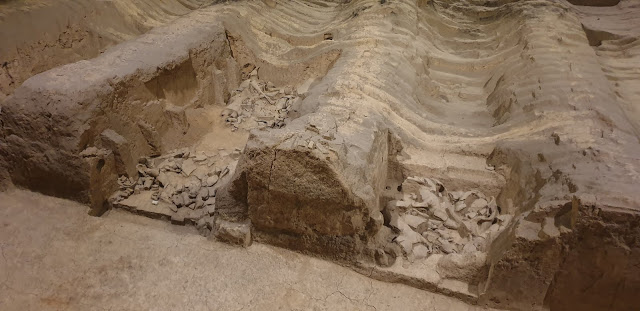
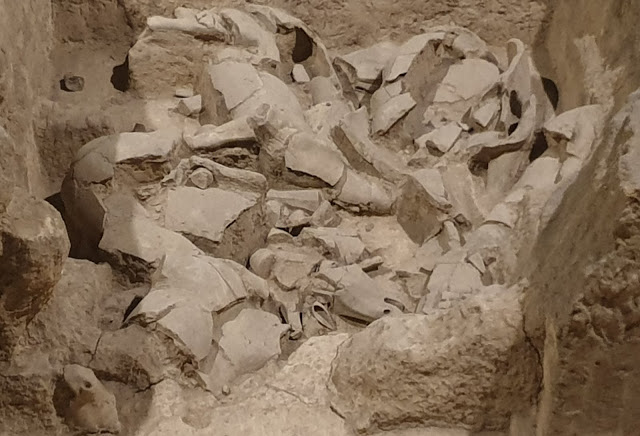
The excavation of this pit has only just begun, so it is possible to see where they have carefully removed the top cover, and you can see the broken parts of the warriors lying in a heap.

Some parts of the warriors are more discernible closer up

These parts are carefully extracted and taken to the ‘hospital’ where they are digitised and the computer will match each part with the warrior it belongs to.

Pit 1

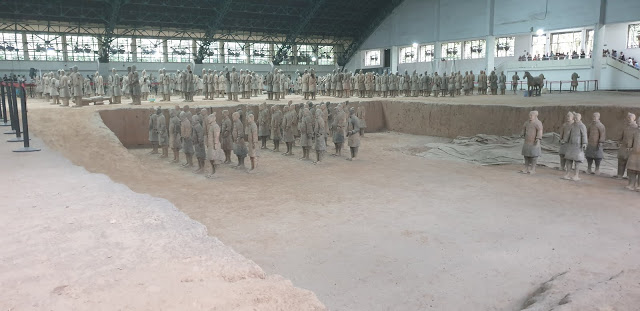
This has quite a number of standing soldiers that have been glued back together, but not necessarily complete and I notice a number if the statues were incomplete. And if they cannot find the missing pieces, then they are not added to or filled in.

The scale of the pit is enormous, and they have hardly scratched the surface in the restoration process.

What is there is a number of horses as well.

That’s at the front of the pit, a long line of statues, and what is clear is the location of the well where the first fragments were found by a farmer.

There are about eight lines of soldiers, and some lining the sides.

Midway down there is a large area currently under excavation

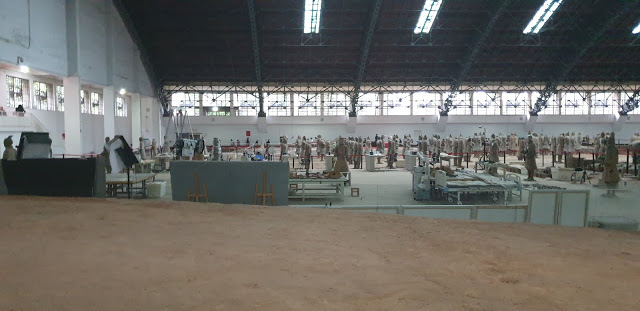
At the back is the hospital where the soldiers are reassembled.  There’s nearly a hundred in the various stages of rebuilding.  These days the soldiers are rebuilt using computer imaging.

The hospital area is where they are put back together

And these are some of the statues in various stages of reconstruction

Another two views of the size and scale of the reconstruction project

The coffee shop is also a sales centre, but there are too many people waiting for coffee and too few places to sit down.

What I learned about writing – Genealogy can provide interesting characters

I have seen this television program once or twice, where a television personality digs into their past, and sometimes they discover they had famous, or sometimes infamous, relatives.

I don’t think I would be so lucky, or unlucky as the case may be.

But, to be honest, I haven’t really been interested in digging into the past.

On the other hand, my older brother has a keen interest in genealogy in general, borne from a desire to find out more about our family tree.

And he has gone back to the 1600s, for the relatives who came out from England, and no, they have no transported convicts, or at least he’s not saying.

Genealogy is a rather fascinating subject, and I’ve discovered that it is taught in university as a degree.  My brother has one now. 

What I didn’t realise is that I’ve been playing with it for years because in writing what might be called sagas, you need to create your own set of mythical families, and then trace to forebears back in time.

I have one novel I’m writing that has required a family tree, and recently another for a story that required starting with a character who participated in the Eureka Stockade.  We had to create parents, a migration from England to Australia, and then construct a family tree through to today, so we could write a story from the perspective of a fourth-generation girl at school doing a school project.

If that sounds complicated, believe me, it is.  But from my granddaughter, who came up with the idea, she is very excited about it.

Much better than sitting in front of a computer playing games or a tv watching cartoons.

But once again I digress…

I have found a lot of genealogy stuff that my mother had been working on, and I’m taking it to my brother, and at the same time, l will get the latest instalment on our family.

So far, I’ve learned that I come from a combination of British relatives on both my mother’s and father’s side, the most recent being my father’s mother, who was born in England, and German from my mother’s side, her surname being Auhl.

No doubt, and with a great deal of irony, my relatives probably fought against each other in two world wars.

I’m sure more will be revealed on Wednesday.

But the more I learn, the more I feel inclined to create a fictionalised history with my family members as characters in the story.  At the moment, a biographical account of the family would be reasonably boring since, as yet, no one notorious had been discovered.