An excerpt from “What Sets Us Apart”, a mystery with a twist

See the excerpt from the story below, just a taste of what’s in store…

http://amzn.to/2Eryfth

whatsetscover

McCallister was old school, a man who would most likely fit in perfectly campaigning on the battlefields of Europe during the Second World War. He’d been like a fish out of water in the army, post-Falklands, and while he retired a hero, he still felt he’d more to give.

He’d applied and was accepted as head of a SWAT team, and, watching him now as he and his men disembarked from the truck in almost military precision, a look passed between Annette, the police liaison officer, and I that said she’d seen it all before. I know I had.

There was a one in four chance his team would be selected for this operation, and she had been hoping it would be one of the other three. While waiting for them to arrive she filled me in on the various teams. His was the least co-operative, and the more likely to make ad-hoc decisions rather than adhere to the plan, or any orders that may come from the officer in charge.

This, she said quite bluntly, was going to end badly.

I still had no idea why Prendergast instructed me to attend the scene of what looked to be a normal domestic operation, but as the nominated expert in the field in these types of situations, it was fairly clear he wasn’t taking any chances. It was always a matter of opinion between us, and generally I lost.

In this case, it was an anonymous report identifying what the authorities believed were explosives in one of the dockside sheds where explosives were not supposed to be.

The only reason why the report was given any credence was the man, while not identifying himself by name, said he’d been an explosive expert once and recognized the boxes. That could mean anything, but the Chief Constable was a cautious man.

With his men settled and preparing their weapons, McCallister came over to the command post, not much more than the SUV my liaison and I arrived in, with weapons, bulletproof vests, and rolls of tape to cordon off the area afterward. We both had coffee, steaming in the cold early morning air. Dawn was slowly approaching and although rain had been forecast it had yet to arrive.

A man by the name of Benson was in charge. He too had groaned when he saw McCallister.

“A fine morning for it.” McCallister was the only enthusiastic one here.

He didn’t say what ‘it’ was, but I thought it might eventually be mayhem.

“Let’s hope the rain stays away. It’s going to be difficult enough without it,” Benson said, rubbing his hands together. We had been waiting for the SWAT team to arrive, and another team to take up their position under the wharf, and who was in the final stages of securing their position.

While we were waiting we drew up the plan. I’d go in first to check on what we were dealing with, and what type of explosives. The SWAT team, in the meantime, were to ensure all the exits to the shed were covered. When I gave the signal, they were to enter and secure the building. We were not expecting anyone inside or out, and no movement had been detected in the last hour since our arrival and deployment.

“What’s the current situation?”

“I’ve got eyes on the building, and a team coming in from the waterside, underneath. Its slow progress, but they’re nearly there. Once they’re in place, we’re sending McKenzie in.”

He looked in my direction.

“With due respect sir, shouldn’t it be one of us?” McCallister glared at me with the contempt that only a decorated military officer could.

“No. I have orders from above, much higher than I care to argue with, so, McCallister, no gung-ho heroics for the moment. Just be ready to move on my command, and make sure you have three teams at the exit points, ready to secure the building.”

McCallister opened his mouth, no doubt to question those orders, but instead closed it again. “Yes sir,” he muttered and turned away heading back to his men.

“You’re not going to have much time before he storms the battlements,” Benson quietly said to me, a hint of exasperation in his tone. “I’m dreading the paperwork.”

It was exactly what my liaison officer said when she saw McCallister arriving.

The water team sent their ‘in position’ signal, and we were ready to go.

In the hour or so we’d been on site nothing had stirred, no arrivals, no departures, and no sign anyone was inside, but that didn’t mean we were alone. Nor did it mean I was going to walk in and see immediately what was going on. If it was a cache of explosives then it was possible the building was booby-trapped in any number of ways, there could be sentries or guards, and they had eyes on us, or it might be a false alarm.

I was hoping for the latter.

I put on the bulletproof vest, thinking it was a poor substitute for full battle armor against an exploding bomb, but we were still treating this as a ‘suspected’ case. I noticed my liaison officer was pulling on her bulletproof vest too.

“You don’t have to go. This is my party, not yours,” I said.

“The Chief Constable told me to stick to you like glue, sir.”

I looked at Benson. “Talk some sense into her please, this is not a kindergarten outing.”

He shrugged. Seeing McCallister had taken all the fight out of him. “Orders are orders. If that’s what the Chief Constable requested …”

Madness. I glared at her, and she gave me a wan smile. “Stay behind me then, and don’t do anything stupid.”

“Believe me, I won’t be.” She pulled out and checked her weapon, chambering the first round. It made a reassuring sound.

Suited up, weapons readied, a last sip of the coffee in a stomach that was already churning from nerves and tension, I looked at the target, one hundred yards distant and thought it was going to be the longest hundred yards I’d ever traversed. At least for this week.

A swirling mist rolled in and caused a slight change in plans.

Because the front of the buildings was constantly illuminated by large overhead arc lamps, my intention had been to approach the building from the rear where there was less light and more cover. Despite the lack of movement, if there were explosives in that building, there’d be ‘enemy’ surveillance somewhere, and, after making that assumption, I believed it was going to be easier and less noticeable to use the darkness as a cover.

It was a result of the consultation, and studying the plans of the warehouse, plans that showed three entrances, the main front hangar type doors, a side entrance for truck entry and exit and a small door in the rear, at the end of an internal passage leading to several offices. I also assumed it was the exit used when smokers needed a break. Our entry would be by the rear door or failing that, the side entrance where a door was built into the larger sliding doors. In both cases, the locks would not present a problem.

The change in the weather made the approach shorter, and given the density of the mist now turning into a fog, we were able to approach by the front, hugging the walls, and moving quickly while there was cover. I could feel the dampness of the mist and shivered more than once.

It was nerves more than the cold.

I could also feel rather than see the presence of Annette behind me, and once felt her breath on my neck when we stopped for a quick reconnaissance.

It was the same for McCallister’s men. I could feel them following us, quickly and quietly, and expected, if I turned around, to see him breathing down my neck too.

It added to the tension.

My plan was still to enter by the back door.

We slipped up the alley between the two sheds to the rear corner and stopped. I heard a noise coming from the rear of the building, and the light tap on the shoulder told me Annette had heard it too. I put my hand up to signal her to wait, and as a swirl of mist rolled in, I slipped around the corner heading towards where I’d last seen the glow of a cigarette.

The mist cleared, and we saw each other at the same time. He was a bearded man in battle fatigues, not the average dockside security guard.

He was quick, but my slight element of surprise was his undoing, and he was down and unconscious in less than a few seconds with barely a sound beyond the body hitting the ground. Zip ties secured his hands and legs, and tape his mouth. Annette joined me a minute after securing him.

A glance at the body then me, “I can see why they, whoever they are, sent you.”

She’d asked who I worked for, and I didn’t answer. It was best she didn’t know.

“Stay behind me,” I said, more urgency in my tone. If there was one, there’d be another.

Luck was with us so far. A man outside smoking meant no booby traps on the back door, and quite possibly there’d be none inside. But it indicated there were more men inside, and if so, it appeared they were very well trained. If that were the case, they would be formidable opponents.

The fear factor increased exponentially.

I slowly opened the door and looked in. A pale light shone from within the warehouse itself, one that was not bright enough to be detected from outside. None of the offices had lights on, so it was possible they were vacant. I realized then they had blacked out the windows. Why hadn’t someone checked this?

Once inside, the door closed behind us, progress was slow and careful. She remained directly behind me, gun ready to shoot anything that moved. I had a momentary thought for McCallister and his men, securing the perimeter.

At the end of the corridor, the extent of the warehouse stretched before us. The pale lighting made it seem like a vast empty cavern, except for a long trestle table along one side, and, behind it, stacks of wooden crates, some opened. It looked like a production line.

To get to the table from where we were was a ten-yard walk in the open. There was no cover. If we stuck to the walls, there was equally no cover and a longer walk.

We needed a distraction.

As if on cue, the two main entrances disintegrated into flying shrapnel accompanied by a deafening explosion that momentarily disoriented both Annette and I. Through the smoke and dust kicked up I saw three men appear from behind the wooden crates, each with what looked like machine guns, spraying bullets in the direction of the incoming SWAT members.

They never had a chance, cut down before they made ten steps into the building.

By the time I’d recovered, my head heavy, eyes watering and ears still ringing, I took several steps towards them, managing to take down two of the gunmen but not the third.

I heard a voice, Annette’s I think, yell out, “Oh, God, he’s got a trigger,” just before another explosion, though all I remember in that split second was a bright flash, the intense heat, something very heavy smashing into my chest knocking the wind out of me, and then the sensation of flying, just before I hit the wall.

I spent four weeks in an induced coma, three months being stitched back together and another six learning to do all those basic actions everyone took for granted. It was twelve months almost to the day when I was released from the hospital, physically, except for a few alterations required after being hit by shrapnel, looking the same as I always had.

But mentally? The document I’d signed on release said it all, ‘not fit for active duty; discharged’.

It was in the name of David Cheney. For all intents and purposes, Alistair McKenzie was killed in that warehouse, and for the first time ever, an agent left the Department, the first to retire alive.

I was not sure I liked the idea of making history.

© Charles Heath 2016-2020
In a word: haul

Well, I know a lot about long haul, because living in Australia it’s a long, long way to anywhere in the northern hemisphere, in what is known as a long haul airline.

For the rest, haul means to pull a load along with effort or force.

Or a haul can be the plunder of a thief, stolen goods.  It can be something different though, but generally lots of something taken away, such as fish.

You can haul yourself up the side of a hill, or up a cliff face

And for those who are nautically minded, and love sailing boats, you’ll know to haul offshore

If you’re an Olympian, you’ll know that seven medal haul was always going to be an uphill task.

This is not to be confused with hall, what you walk down in a building heading to a particular room.

Or it can be the name of a stately residence or building, for instance Toad Hall.

It can also be a university room where students are housed.

The fourth attempt, let’s look at the location

Equally important is the location.  Dark and brooding characters need dark and brooding locations.  It’s undeniable that there’s evil everywhere; we just have to look for it.

Of course, that’s not what I do, but …

I have been in a few tight corners, with some possibly dark and brooding characters, where my heart rate has increased exponentially, and I was saved by quick thinking and a desire not to hang around and see what happens (for the purposes of a writable experience – no, I’m not that stupid).

As the story stands, we move from a small staff room or restroom, and then we move out to the car park of … what?  It’s not exactly clear where it is, only that Graham is leaving work to go home.

Whether it’s clear or not, Graham is a security guard, part of a team that works on an industrial estate where there are a number of factories and office blocks. 

Some of those buildings are empty, for a variety of reasons, so a back story for this might be created so that I can convey a clearer picture of not only the bricks and mortar, but what it’s like there.

Ergo, the first descriptive line, stepping outside into the epicentre of the South Pole.  There is snow everywhere, which meant it was falling while he was inside at work, but now, the moment he leaves, it’s stopped.  Cold, then, and clear.

So it begins…

Now, as a secondary theme, it might not be obvious that the owners are lax in the hiring of security staff to watch over their assets, staff that are relatively dubious in character, which might, in turn, mean that the notion of using cut-price security might mean something else is going on.

Are the empty factories empty?  Or have they been repurposed, and the guards are not sure what they’re guarding?  Do they want to know?  A job is a job, and in this situation, either from a hint from the employer or the words of an old hand, and it doesn’t pay to poke a nose in where it’s not wanted.

So, as you can see, when starting the story, I didn’t give proper thought to the background story, the fact that I could weave another or several storylines intertwined with what will be the master plotline.

What is the master plotline?

I have an idea or two, but let’s not get too ahead of ourselves.

Let’s stitch together a scenario or two for the back story and see where it takes us.  Remember that this was more or less part of the storyline originally in my mind, but may not have been articulated in what I wrote at the time.

Basically, then, we’re dealing with a large industrial site on the outskirts of a city in decline.  Everyone can relate to the problematic times we’re in now, but this was written at the height of the last global financial meltdown about fifteen years ago, which caused a deep recession.

Within that framework, a lot of businesses and people went to the wall.  Graham and others lost a decent-paying job, as well as their house, having finally got on the property ladder, only to find they couldn’t pay for it.

At the time, he was not alone in that respect.  And lenders were not immune either, so there’s a possibility that one or two industrial park owners may not have been entirely legitimate in some of their business dealings, especially after taking heavy financial hits.

In that scenario, there’s always the possibility of insurance fraud as a means of cutting losses, hence the need for security that might be asked to look the other way.

Another possibility could be that empty buildings and enterprising men, or women, fit the category of ‘the devil finds work for idle hands’. 

Or someone who recognises an opportunity to make some money.  That particular scenario opens the door to a plethora of ideas.

© Charles Heath 2024

Writing about writing a book – Day 11

Once again, instead of writing, I have been obsessing over the planning and creation of a website for the book.

And, that being the case, now I have to give the book a name so I can name the site/blog after it.

The word Starburst has featured in the story so tentatively I’m going to name it “The Starburst Conspiracy”

The site will be on WordPress.  There will be progress blog posts, there will draft writing and possible chapters for beta reading and comment.  There will be separate pages for each of the characters.

I’m not sure how I’m going to build an email list so perhaps I’ll build a following first.

So, having mapped out a plan for the site, I’ve made the first post and written the ‘About’ page which basically gives a bit of history about the book.

Bear in mind the original book of about 400 pages scribbled over a long period of time, and not really a book in the sense of the word (more a collection of ideas set in some form of chronology) and set in the early eighties and will probably stay there but will be the basis for the new novel.

Another interesting aspect of this exercise is to see how far I have come writing-wise in the last 30 years and how easy it is to spot the issues with the original manuscript.

I’ve also created a master page for the cast of characters and only a page for the main character so far.  Others will follow.

There will be another page with an ongoing, updated synopsis.

Shortcuts to these pages, as the information flows will be in subsequent posts.


For now, it’s back to writing, after a long gap, and the ideas have been churning in my head.


© Charles Heath 2016-2020
The cinema of my dreams – I never wanted to go to Africa – Episode 15

Our hero knows he’s in serious trouble.

The problem is, there are familiar faces and a question of who is a friend and who is foe made all the more difficult because of the enemy, if it was the enemy, simply because it didn’t look or sound or act like the enemy.

But, it seems our hero has ‘escaped’ and had found his way back home.

Except not quite how he expected it would be.

Rest was impossible while so many thoughts about my recent experiences were swirling around in the back of my head.  Now, when thinking it through, it made sense that they make sure I was found alive, but in very bad shape.

Two reasons, one, to remind me that they could do whatever they liked to me, and the second, to appease Breeman, who, no doubt realizing a helicopter was missing, would send out search teams, a no-fly zone or not.

But it was a calculated risk assuming I would not tell Breeman, or someone else, about what had happened to me, whether they believed it or not.

That led to the next thought, why was I still alive.  It would be just as easy to kill me and be discovered after dying from injuries received in the crash.  Supposition, they still needed me, or, and this was a hail Mary at best, they needed access to the base, and Breeman.

Did that mean either of the two men I’d seen at the other camp would suddenly turn up?  My money was on Colonel Bamfield.  He was my first Commanding Officer, he had a keen interest in me from the get-go, and he was the one who facilitated my transfer to my current base before I knew he was working for ‘other interests’. 

I still didn’t want to think it was the enemy.

Another question popped into my head, what was his, or their, interest in Breeman because the line of questioning centered on her.

My best guess was that it was no accident I was on that helicopter, that she had directed the pilot to make a flyover, and wasn’t expected that we would be shot down and that she had assumed there would be no repercussions on either myself or the pilot.

It was also clear that if she had to explain how I came to be where they found me, and the fact no one had launched a similar attack of the rescue team, that what happened was simply a breach of orders, and a court-martial offense.

It would solve Bamfield and his new friend’s problem.  Whatever the outcome of the court-martial she would be sent home, relieved of her command.

It seemed the military, as always, had a mind of its own, and not always have the best interests of its personnel at heart.

I’d soon find out.

© Charles Heath 2019

Writing a book in 365 days – 279

Day 279

Riveting prose for the dull banality of life

The Unsung Epic: How Everyday Life Becomes Riveting Prose

“Drama is life with the dull bits cut out.”

It’s a line that resonates deeply with anyone who loves a good story. We crave the heightened stakes, the emotional rollercoasters, the twists and turns that define our favorite books, films, and series. But what if I told you that the “dull bits” aren’t always so dull? What if the real magic lies not in eliminating them, but in learning to see the drama hidden beneath their unassuming surface?

The challenge is enticing: Can we take everyday events and turn them into riveting prose? My answer, unequivocally, is yes. And in doing so, we don’t just write better stories; we learn to live a richer, more observant life.

Beyond Explosions: What Is Drama, Really?

First, let’s redefine “drama.” It’s not always grand gestures or world-ending stakes. At its core, drama is about conflict, tension, and emotion. It’s about a character wanting something and facing obstacles in getting it. It’s about choices, consequences, and the raw vulnerability of being human.

Consider that infamous “dull bits” pile: commuting, waiting in line, doing laundry, making coffee. On the surface, these are the unglamorous necessities of existence. But with a writer’s eye, they become potential stages for micro-dramas.

The Writer’s Superpower: Perspective and Pressure

The secret weapon for transforming the mundane is perspective. It’s about zooming in, acknowledging the internal monologue, and applying pressure.

  1. Zoom In: A spilled coffee isn’t just a stain; it’s the sudden, hot shock, the ruined shirt on the morning of a crucial presentation, the ripple effect of lateness. The drama isn’t the coffee itself, but what it means to the person experiencing it.
  2. Internal Monologue: We rarely share the full, rich narrative of our minds. What anxieties bubble up while waiting for a delayed train? What silent arguments play out as we fold a partner’s forgotten items? The internal world is a universe of untold stories, rife with hope, fear, regret, and determination.
  3. Apply Pressure: Take any everyday event and ask: What if something goes wrong? What if the stakes are slightly higher for this particular character?
    • The Commute: It’s not just a drive; it’s a desperate race against the clock to pick up a child from daycare before late fees kick in. The brake lights ahead aren’t just an inconvenience; they’re a physical manifestation of rising panic.
    • The Grocery Store: It’s not just a shopping trip; it’s the careful balancing act of an elderly person on a fixed income, trying to make healthy food last an entire week from a dwindling budget. Every price tag is a small, quiet battle.
    • The Awkward Conversation: It’s not just polite small talk; it’s a son trying to delicately broach a sensitive subject with his aging father, hoping to connect before it’s too late, fearing misinterpretation or dismissal.

Unearthing the Micro-Conflicts

Everyday life is brimming with small conflicts:

  • Person vs. Self: The internal debate over whether to speak up, to forgive, to take a risk, or to stick to the comfort of routine.
  • Person vs. Nature/Environment: The unexpected downpour when you forgot your umbrella, the power outage during a critical deadline, the unreliable public transport.
  • Person vs. Person (Subtle): The passive-aggressive note from a roommate, the slight that goes unaddressed, the unspoken tension across a dinner table, the small power plays in a queue.

These mini-struggles, when given the prose treatment, become relatable and powerful. They remind readers of their own quiet battles and hidden heroics.

The Art of Observation and Sensory Detail

To write riveting prose from the ordinary, you must become an exceptional observer.

  • What do you see? Not just objects, but the way light falls, the subtle expressions on faces, the wear and tear of time.
  • What do you hear? The hum of the refrigerator, the distant rumble of traffic, the specific cadence of a voice.
  • What do you feel? The cold ceramic of a mug, the ache in tired muscles, the prickle of irritation.
  • What do you smell and taste? The comforting aroma of baking bread, the metallic tang of fear, the bitterness of burnt toast.

These details ground your reader in the moment, making even the most mundane scene vivid and immersive.

So, Can We Do It?

Absolutely. By acknowledging the inherent drama in our struggles, choices, and interactions – no matter how small – we unlock a boundless reservoir of material. We aren’t cutting out the dull bits; we’re illuminating the hidden drama within them.

Next time you’re waiting in line, stuck in traffic, or simply watching the world go by, challenge yourself. What’s the story here? What’s at stake for the person beside you? What internal monologue is playing out in your own mind?

The world isn’t just a stage for grand narratives; it’s a collection of countless, intricate, and often riveting personal epics, waiting for us to notice, understand, and perhaps, to write them down.


What “dull bit” of your day do you think holds a hidden story? Share in the comments below!

Searching for locations: From X’ian to Zhengzhou dong by bullet train, China

Lunch and then off on another high-speed train

We walked another umpteen miles from the exhibition to a Chinese restaurant that is going to serve us Chinese food again with a beer and a rather potent pomegranate wine that had a real kick.  It was definitely value for money at 60 yuan per person.

But perhaps the biggest thrill, if it could be called that, was discovering downstairs, the man who discovered the original pieces of a terracotta soldier when digging a well.  He was signing books bought in the souvenir store, but not those purchased elsewhere.

Some of us even got photographed with him.  Fifteen minutes of fame moment?  Maybe.

After lunch, it was off to the station for another high-speed train ride, this time for about two and a half hours, from X’ian to Zhangzhou dong.

It’s the standard high-speed train ride and the usual seat switching because of weird allocation issues, so a little confusion reigns until the train departs at 5:59.

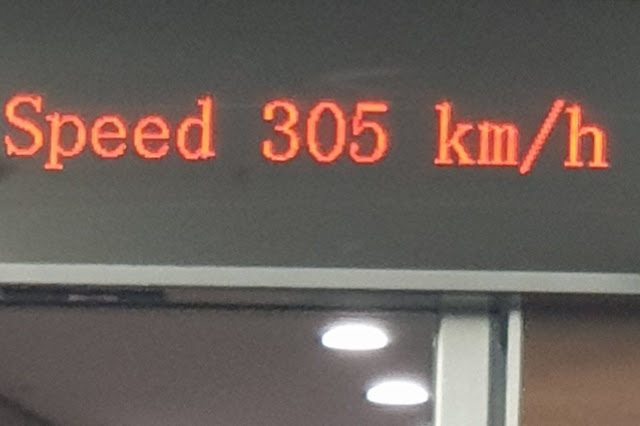
Once we were underway it didn’t take long before we hit the maximum speed

Twenty minutes before arrival, and knowing we only have three minutes to get off everyone is heading for the exit clogging up the passageway.  It wasn’t panic but with the three-minute limit, perhaps organized panic would be a better description.

As it turned out, with all the cases near the door, the moment to door opened one of our group got off, and the other just started putting cases on the platform, and in doing so we were all off in 42 seconds with time to spare.

And this was despite the fact there were about twenty passengers just about up against the door trying to get in.  I don’t think they expected to have cases flying off the train in their direction.

We find our way to the exit and our tour guide Dannie.  It was another long walk to the bus, somewhat shabbier from the previous day, with no leg room, no pocket, and no USB charging point like the day before.  Disappointing.

On the way from the station to the hotel, the tour guide usually gives us a short spiel on the next day’s activities, but instead, I think we got her life history and a song, delivered in high-pitched and rapid Chinglish that was hard to understand.

Not at this hour of the night to an almost exhausted busload of people who’d had enough from the train.  Oh, did I forget the singing, no, it was an interesting rendition of ‘You Are My Sunshine’.

The drive was interesting in that it was mostly in the dark.  There was no street lighting and in comparison to X’ian which was very bright and cheerful, this was dark and gloomy.

Then close to the hotel, our guide said that if we had any problems with the room, she would be in the lobby for half an hour.

That spoke volumes about the hotel they put us in.

What I learned about writing – A magical few hours lost in living history

Or as it might more commonly be known as, spending a few hours in a historical museum. which just happens to cover some of the material you need for a school project.

I brought up the subject of living history yesterday after we all packed off to have an hour ride on a steam train and accompanying equally aged carriages.

Since these trains have been missing for nearly fifty years, there is basically two generations of people who have never had the chance to travel in such a manner in their lifetime, unless, of course, they have found a tourist train like our example, the Mary Valley Rattler.

It’s the same as the early days of finding gold in Gympie, in Queensland, Australia.  It dates back to the 1860s, and one can only imagine what it was like because most of the history is in books.  Yes, they have sketches, and sometimes photographs, but these do not generally date back to the middle of the nineteenth century.

But, visiting a living example of what it was like in ‘the old days’ can give those generations a glimpse of what it was like.

Single room schools, because unlike today when schools now cater to over 1,000 children in varying years, one school held about 20 or 30 in all grades, with a single teacher.

In fact, today, I saw a collection of readers that I remember reading when I was in grade school, a long time ago.  Even the desks and the ink wells brought back interesting memories, one of which when I was ink monitor.

But housed in a number of old-style buildings was the information on the diggings, the mines and the impact of gold in general, and, at the very end, the children got to do a little panning for gold, and found a number of small fragments of real gold.

Once they’d been shown by a panning expert that looked as if he had been transported into this time from the past.

There are similar places elsewhere in this country that preserve the past to show future generations what it was like.

After this weekend, we have more than enough information to work on the project, based around gold mining, and it’s impact on the people, the area, and the government.

And best of all, it has generated an interest in the past, reading more, and perhaps if we’re lucky, an interest in writing something based on history, which sometimes is quite difficult when it has to compete with more interesting pastimes like computer games.

Inspiration, Maybe – Volume 2

50 photographs, 50 stories, of which there is one of the 50 below.

They all start with –

A picture paints … well, as many words as you like.  For instance:

And, the story:

Have you ever watched your hopes and dreams simply just fly away?

Everything I thought I wanted and needed had just left in an aeroplane, and although I said I was not going to, i came to the airport to see the plane leave.  Not the person on it, that would have been far too difficult and emotional, but perhaps it was symbolic, the end of one life and the start of another.

But no matter what I thought or felt, we had both come to the right decision.  She needed the opportunity to spread her wings.  It was probably not the best idea for her to apply for the job without telling me, but I understood her reasons.

She was in a rut.  Though her job was a very good one, it was not as demanding as she had expected, particularly after the last promotion, but with it came resentment from others on her level, that she, the youngest of the group would get the position.

It was something that had been weighing down of her for the last three months, and if noticed it, the late nights, the moodiness, sometimes a flash of temper.  I knew she had one, no one could have such red hair and not, but she had always kept it in check.

And, then there was us, together, and after seven years, it felt like we were going nowhere.  Perhaps that was down to my lack of ambition, and though she never said it, lack of sophistication.  It hadn’t been an issue, well, not until her last promotion, and the fact she had to entertain more, and frankly I felt like an embarrassment to her.

So, there it was, three days ago, the beginning of the weekend, and we had planned to go away for a few days and take stock.  We both acknowledged we needed to talk, but it never seemed the right time.

It was then she said she had quit her job and found a new one.  Starting the following Monday.

Ok, that took me by surprise, not so much that it something I sort of guessed might happen, but that she would just blurt it out.

I think that right then, at that moment, I could feel her frustration with everything around her.

What surprised her was my reaction.  None.

I simply asked where who, and when.

A world-class newspaper, in New York, and she had to be there in a week.

A week.

It was all the time I had left with her.

I remember I just shrugged and asked if the planned weekend away was off.

She stood on the other side of the kitchen counter, hands around a cup of coffee she had just poured, and that one thing I remembered was the lone tear that ran down her cheek.

Is that all you want to know?

I did, yes, but we had lost that intimacy we used to have when she would have told me what was happening, and we would have brainstormed solutions. I might be a cabinet maker but I still had a brain, was what I overheard her tell a friend once.

There’s not much to ask, I said.  You’ve been desperately unhappy and haven’t been able to hide it all that well, you have been under a lot of pressure trying to deal with a group of troglodytes, and you’ve been leaning on Bentley’s shoulder instead of mine, and I get it, he’s got more experience in that place,  and the politics that go with it, and is still an ally.

Her immediate superior and instrumental in her getting the position, but unlike some men in his position he had not taken advantage of a situation like some men would.  And even if she had made a move, which I doubted, that was not the sort of woman she was, he would have politely declined.

One of the very few happily married men in that organisation, so I heard.

So, she said, you’re not just a pretty face.

Par for the course for a cabinet maker whose university degree is in psychology.  It doesn’t take rocket science to see what was happening to you.  I just didn’t think it was my place to jump in unless you asked me, and when you didn’t, well, that told me everything I needed to know.

Yes, our relationship had a use by date, and it was in the next few days.

I was thinking, she said, that you might come with me,  you can make cabinets anywhere.

I could, but I think the real problem wasn’t just the job.  It was everything around her and going with her, that would just be a constant reminder of what had been holding her back. I didn’t want that for her and said so.

Then the only question left was, what do we do now?

Go shopping for suitcases.  Bags to pack, and places to go.

Getting on the roller coaster is easy.  On the beginning, it’s a slow easy ride, followed by the slow climb to the top.  It’s much like some relationships, they start out easy, they require a little work to get to the next level, follows by the adrenaline rush when it all comes together.

What most people forget is that what comes down must go back up, and life is pretty much a roller coaster with highs and lows.

Our roller coaster had just come or of the final turn and we were braking so that it stops at the station.

There was no question of going with her to New York.  Yes, I promised I’d come over and visit her, but that was a promise with crossed fingers behind my back.  After a few months in t the new job the last thing shed want was a reminder of what she left behind.  New friends new life.

We packed her bags, three out everything she didn’t want, a free trips to the op shop with stiff she knew others would like to have, and basically, by the time she was ready to go, there was nothing left of her in the apartment, or anywhere.

Her friends would be seeing her off at the airport, and that’s when I told her I was not coming, that moment the taxi arrived to take her away forever.  I remember standing there, watching the taxi go.  It was going to be, and was, as hard as it was to watch the plane leave.

So, there I was, finally staring at the blank sky, around me a dozen other plane spotters, a rather motley crew of plane enthusiasts.

Already that morning there’s been 6 different types of plane depart, and I could hear another winding up its engines for take-off.

People coming, people going.

Maybe I would go to New York in a couple of months, not to see her, but just see what the attraction was.  Or maybe I would drop in, just to see how she was.

As one of my friends told me when I gave him the news, the future is never written in stone, and it’s about time you broadened your horizons.

Perhaps it was.


© Charles Heath 2020-2021

Coming soon.  Find the above story and 49 others like it in:

Searching for locations: Terracotta Warriors and Horses Museum, X’ian, China

Terracotta Warriors and Horses Museum

A little history, and anecdotal advice first:

In 1974 a 26-year-old farmer, Yang Jide, was drilling a well and found fragments of the terracotta soldiers and bronze weapons.

What was discovered later was one of the biggest attended burial pits of China’s first feudal Emperor, Qin Shi Huang.  In the following years remains had been found in 3 pits, yielding at least 8,000 soldiers and horses, and over 100 chariots.  The soldiers were infantry, cavalry, and others.

Emperor Qin was born in 259 BC and died in 210 BC.  He began building a mausoleum for himself at the foot of Mount Li when he was 13.  Construction took 38 years, from 247 BC to 208 BC.  It was divided into 3 stages and involved 720,000 conscripts.

The pits of pottery figures are 1.5 km east of Emperor Qin’s mausoleum.  Pit 1 has about 6,000 terracotta armored warriors and horses and 40 wooden chariots.  Pit 2 is estimated to have over 900 terracotta warriors and 350 terracotta horses with about 90 wooden chariots.  Pit 3 had so far yielded only 66 pottery figures and one chariot drawn by four horses.

Official records say it was discovered later that it was likely Xiang Yu, a rebel, intentionally damaged the Mausoleum and the soldiers in the pits, by setting fire to the wooden roof rafters, and these fell on and broke the warriors into pieces.

However, we were told that after the terracotta warriors were completed, the Emperor ordered the builders to be killed so that they would not tell anyone about the warriors, and then of those that remained alive deliberately smashed all of the artifacts.

The thing is, all of the terracotta figures that have been found are in pieces, and they need computers to piece them back together again.

The visit:
The first impression is the size of the car park and the number of buses parked in the lot, and a hell of a lot more outside up the road an off on side streets.  Obviously, it costs money to park in the parking lot.

The other first impressions; the numbers waiting to get in were not as many as yesterday outside the forbidden city, in fact, a lot less.

Be warned there’s a long walk from the entrance gate where your bags are scanned and a body scan as well, before admittance.  This walk is through a landscaped area which it is expect might sometime in the future reveal more soldiers, or other artifacts.

At the end of the walk that takes about ten minutes, you can get a one-way ride to the second checkpoint, but we opted not to as no one else in our group did.

That walk is the warm-up exercise to an organized viewing of the exhibits after going through a second ticket checkpoint.  On the other side, we had to hand our tickets back to the tour guide which was disappointing not to end up with a memento of actually having been there.

So, on the other side in the courtyard, the guide told us the most important parts of the exhibition, that we should spend most of the time looking at pit 1, and then spent a little time in 2 which is only there in the first stages of excavation.  Then move onto the museum if only to see the replica chariots.

We do.

The chariots were small but interesting

The horses were better and intricately detailed

These are soldiers, perhaps complete examples of those types found in the end pit.

This is one of the archers.  You can tell by the way he wears his hair.

Pit 2

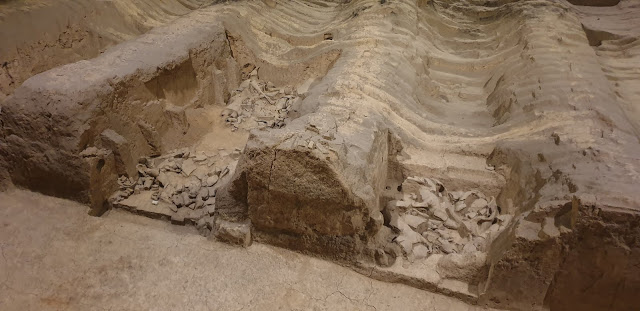
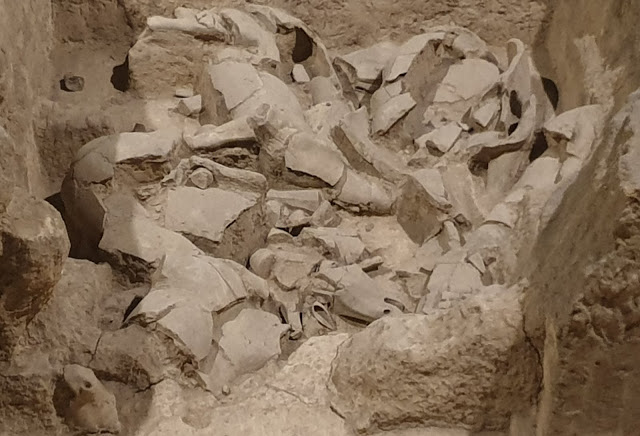
The excavation of this pit has only just begun, so it is possible to see where they have carefully removed the top cover, and you can see the broken parts of the warriors lying in a heap.

Some parts of the warriors are more discernible closer up

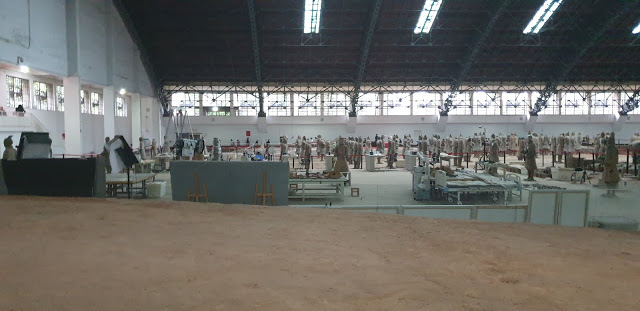
These parts are carefully extracted and taken to the ‘hospital’ where they are digitised and the computer will match each part with the warrior it belongs to.

Pit 1

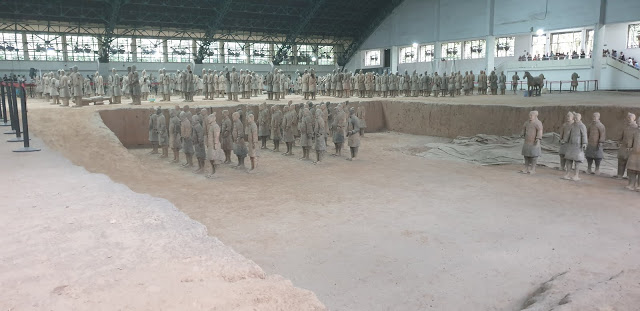
This has quite a number of standing soldiers that have been glued back together, but not necessarily complete and I notice a number if the statues were incomplete. And if they cannot find the missing pieces, then they are not added to or filled in.

The scale of the pit is enormous, and they have hardly scratched the surface in the restoration process.

What is there is a number of horses as well.

That’s at the front of the pit, a long line of statues, and what is clear is the location of the well where the first fragments were found by a farmer.

There are about eight lines of soldiers, and some lining the sides.

Midway down there is a large area currently under excavation

At the back is the hospital where the soldiers are reassembled.  There’s nearly a hundred in the various stages of rebuilding.  These days the soldiers are rebuilt using computer imaging.

The hospital area is where they are put back together

And these are some of the statues in various stages of reconstruction

Another two views of the size and scale of the reconstruction project

The coffee shop is also a sales centre, but there are too many people waiting for coffee and too few places to sit down.