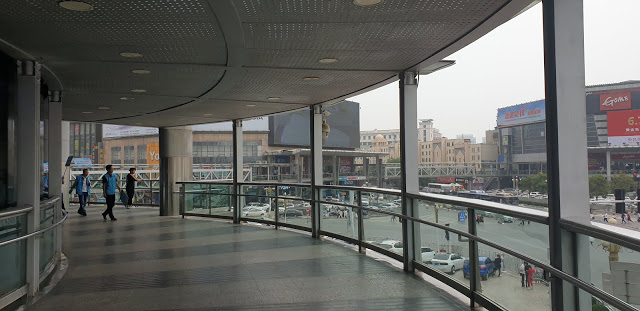
Searching for locations: The Erqi Memorial Tower, Zhengzhou, China

A convoluted explanation on the reasons for this memorial came down to it being about the deaths of those involved in the 1923 Erqi strike, though we’re not really sure what the strike was about.

So, after a little research, this is what I found:

The current Erqi Tower was built in 1971 and was, historically, the tallest building in the city. It is a memorial to the Erqi strike and in memory of Lin Xiangqian and other railway workers who went on strike for their rights, which happened on February 7, 1923.

It has 14 floors and is 63 meters high. One of the features of this building is the view from the top, accessed by a spiral staircase, or an elevator, when it’s working (it was not at the time of our visit).

There seems to be an affinity with the number 27 with this building, in that

  • It’s the 27th memorial to be built
  • to commemorate the 27th workers’ strike
  • located in the 27th plaza of Zhengzhou City.

We drive to the middle of the city where we once again find traveling in kamikaze traffic more entertaining than the tourist points

When we get to the drop-off spot, it’s a 10-minute walk to the center square where the tower is located on one side. Getting there we had to pass a choke point of blaring music and people hawking goods, each echoing off the opposite wall to the point where it was deafening. Too much of it would be torture.

But, back to the tower…

It has 14 levels, but no one seemed interested in climbing the 14 or 16 levels to get to the top. The elevator was broken, and after the great wall episode, most of us are heartily sick of stairs.

The center square was quite large but paved in places with white tiles that oddly reflected the heat rather than absorb it. In the sun it was very warm.

Around the outside of two-thirds of the square, and crossing the roads, was an elevated walkway, which if you go from the first shops and around to the other end, you finish up, on the ground level, at Starbucks.

This is the Chinese version and once you get past the language barrier, the mixology range of cold fruity drinks are to die for, especially after all that walking. Mine was a predominantly peach flavor, with some jelly and apricot at the bottom. I was expecting sliced peaches but I prefer and liked the apricot half.

A drink and fruit together was a surprise.

Then it was the walk back to the meeting point and then into the hotel to use the happy house before rejoining the kamikaze traffic.

We are taken then to the train station for the 2:29 to our next destination, Suzhou, the Venice of the East.

An excerpt from “If Only” – a work in progress

Investigation of crimes doesn’t always go according to plan, nor does the perpetrator get either found or punished.

That was particularly true in my case.  The murderer was incredibly careful in not leaving any evidence behind, to the extent that the police could not rule out whether it was a male or a female.

At one stage the police thought I had murdered my own wife though how I could be on a train at the time of the murder was beyond me.  I had witnesses and a cast-iron alibi.

The officer in charge was Detective First Grade Gabrielle Walters.  She came to me on the day after the murder seeking answers to the usual questions like, when was the last time you saw your wife, did you argue, the neighbors reckon there were heated discussions the day before.

Routine was the word she used.

Her fellow detective was a surly piece of work whose intention was to get answers or, more likely, a confession by any or all means possible.  I could sense the raging violence within him.  Fortunately, common sense prevailed.

Over the course of the next few weeks, once I’d been cleared of committing the crime, Gabrielle made a point of keeping me informed of the progress.

After three months the updates were more sporadic, and when, for lack of progress, it became a cold case, communication ceased.

But it was not the last I saw of Gabrielle.

The shock of finding Vanessa was more devastating than the fact she was now gone, and those images lived on in the same nightmare that came to visit me every night when I closed my eyes.

For months I was barely functioning, to the extent I had all but lost my job, and quite a few friends, particularly those who were more attached to Vanessa rather than me.

They didn’t understand how it could affect me so much, and since it had not happened to them, my tart replies of ‘you wouldn’t understand’ were met with equally short retorts.  Some questioned my sanity, even, for a time, so did I.

No one, it seemed, could understand what it was like, no one except Gabrielle.

She was by her own admission, damaged goods, having been the victim of a similar incident, a boyfriend who turned out to be an awfully bad boy.  Her story varied only in she had been made to witness his execution.  Her nightmare, in reliving that moment in time, was how she was still alive and, to this day, had no idea why she’d been spared.

It was a story she told me one night, some months after the investigation had been scaled down.  I was still looking for the bottom of a bottle and an emotional mess.  Perhaps it struck a resonance with her; she’d been there and managed to come out the other side.

What happened become our secret, a once-only night together that meant a great deal to me, and by mutual agreement, it was not spoken of again.  It was as if she knew exactly what was required to set me on the path to recovery.

And it had.

Since then, we saw each about once a month in a cafe.   I had been surprised to hear from her again shortly after that eventful night when she called to set it up, ostensibly for her to provide me with any updates on the case, but perhaps we had, after that unspoken night, formed a closer bond than either of us wanted to admit.

We generally talked for hours over wine, then dinner and coffee.  It took a while for me to realize that all she had was her work, personal relationships were nigh on impossible in a job that left little or no spare time for anything else.

She’d always said that if I had any questions or problems about the case, or if there was anything that might come to me that might be relevant, even after all this time, all I had to do was call her.

I wondered if this text message was in that category.  I was certain it would interest the police and I had no doubt they could trace the message’s origin, but there was that tiny degree of doubt, about whether or not I could trust her to tell me what the message meant.

I reached for the phone then put it back down again.  I’d think about it and decide tomorrow.

© Charles Heath 2018-2020

Writing a book in 365 days – 284/285

Days 284 and 285

Writing exercise – The world is upside down; climate change has made our home uninhabitable

We had all seen it coming, and to a certain extent, pretended it wasn’t happening.

Until we could ignore it no longer.

Perhaps we could have kept our collective heads in the sand, but Mother Nature wasn’t going to wait that long.

We woke up one morning to snow.

Three months early, just as Fall began.  Perhaps the fact that the trees had been losing their leaves far earlier than usual was a sign.

There were others, but it had happened before, a few years back, and it had sparked the usual warnings from scientists, debunking of climate change, politicians’ umming and erring, but in the end, nothing changed

We did the same this time.  Been there, done that, nothing to see here.  The government, such as it was, laughed it off.

As they did with most things that concerned the people, unless they were among the President’s private circle.

At first the snow turned the surroundings into a winter wonderland, usually here in mid-November, an interlude before the main event: Christmas.

It was barely into September, and it was a long way to the festive season.

It snowed every night for the next two weeks.  All night, virtually at blizzard level, and so badly that it was difficult and then impossible to keep the roads clear.  Except for the essential roads.

The houses were snowed in, then abandoned.

Whole areas were shut down and people evacuated.

I went up to the lookout once, and all I could see was white, except for a small area where the shopping centre was located

The whole was gone.  Our house would be next.

Beth was holding a light blue sheet of paper in her hand, a hand that was shaking.

I knew what it was.

“We got one.”  She held it up.

“Lou got his yesterday.”  Lou was across the street.  He’s lived there all his life, as did his parents before him.

We all knew this was the end.  Any more snow and our town would disappear.

It was the same in any direction you could go.

She had the TV on.  There was only one channel, reporting the weather and emergency information 24 hours a day.  She never turned it off.

“They’re not ignoring it now.  They keep playing the President saying it’s nothing and would go away in a few days.  Now he won’t talk to anyone.”

No surprise.  The last crisis, the pandemic, had been met with a similar response.

There were over a million deaths at that time; this had been exceeded in just two weeks.  If it didn’t go away, the total was going to be horrific.

“We’re not going to be leaving any time soon.  The police had shut the road for everything other than official vehicles.”  The trains stopped at midnight; the last one snowed in at our station.

“What’s going to happen to us?”

“Last I heard, we’re going to the missile complex.”

It was a ubiquitous small town, with a big secret.  We made up part of the air defence system in place to prevent invaders.  And the threat of being wiped off the face of the planet if anything went wrong.

Freda hated the idea of nesting with nuclear bombs.  So did I.

“Do we have a choice?”

“If you want to live.”

“So, in your opinion, it’s not going to stop.”

“No.”

I’d asked old man Bowen, ex-weatherman on channel 6 news, old meteorologist for Nasa, whose wife read tarot cards.

An expert.

“It’s part of a phenomenon that has happened in the past.  Two more years, if we’re lucky.”

“And you know this…oh.  the crazy old fool down the street.  Seriously, Monte?”

There were things wanted to believe, believable things, things that some people just didn’t want to hear.

Fundamentally, a good person, when she had first met the Bowens, she took an instant dislike to them.  He was abrupt and she was aloof, but that was just defence.

I smiled.  “As much as you hate them, so far, everything he’d said had come true.  As for the next, well, that was going to be the killer.”

“Or as the government says, we just have to wait it out a little longer.”

“While all the top officials, including our fearless leader, swan off to a country with a warmer climate.”

All the rich people were gone.

The president tried to sneak out by the back secret entrance that no one was supposed to know about.  Except for one old press hack.

She didn’t answer.  We agreed to disagree on certain matters, because not to would be letting politics destroy something good.

She glared at me.  “Don’t say it.  I’ve already had seventeen phone calls.  It’s easy to lay blame, not so easy to prove it.”

Yes.  He could do no wrong.  And it was going to kill her.

But I wasn’t going to be drawn in this time.  Just saying what I was thinking would get me arrested, and Beth would turn me in, husband or not.

“Then I guess God has a lot to answer for.”

That did it.  The president and then God, sometimes the two fused, according to the president, speaking candidly about his ‘friends’, telling the reporter, or rather the stooge paid to preen his ego, that who was he to dispute they believed he was the almighty himself.”

It had been impossible not to burst out laughing.

The truck came to pick us up, one small bag allowed.  Beth was going to come, but remembered that she had a small job to do and would come later.

She was warned that she had 24 hours.  After that, no one knew what was going to happen.

It was more like they did, but to tell us mere mortals might have set off a chain reaction of dissent.

The last I saw of her, she was waving.  I don’t think she expected me to leave.

We collected all the people on the street and headed to the silo.  There were two other trucks.  There was an officer in the truck who said there were rooms for 200 people.  It was once a mass point for soldiers in case of an attempted invasion.

I found it amusing that anyone would come to put two for the purpose of invading it.

So did the others.

There were five trucks.  The last of the townsfolk.  All outlying areas had been evacuated earlier.

About a dozen had chosen not to come or had something else to do, like Beth.

And after the sun went down and Beth or any of the others deigned not to come, it was the worst-case scenario.  The silo boss sent a team out to find them.

Then the snow started.

The search party came back in half an hour.  The cold was too intense.

That was what was going to happen.

After the snow, the earth was going to freeze.

It came and it didn’t go.

Everything froze unless protected.

Four months passed before the cold lifted to a point where we could go back outside.

By that time, we needed food, and I was charged with finding it, and took six volunteers.

We found food, and we found something else.

A place where those who believed that nothing was going to happen had frozen to death, dying as a result of their beliefs.

It was a terrible loss of life that could have been easily saved.

It was predicted that there would be a thaw, Mother Nature’s planet-wide reset.

It was hoped we had all learned a lesson.

©  Charles Heath  2025

An excerpt from “One Last Look”: Charlotte is no ordinary girl

This is currently available at Amazon herehttp://amzn.to/2CqUBcz

I’d read about out-of-body experiences, and like everyone else, thought it was nonsense.  Some people claimed to see themselves in the operating theatre, medical staff frantically trying to revive them, and being surrounded by white light.

I was definitely looking down, but it wasn’t me I was looking at.

It was two children, a boy and a girl, with their parents, in a park.

The boy was Alan.  He was about six or seven.  The girl was Louise, and she was five years old.  She had long red hair and looked the image of her mother.

I remember it now, it was Louise’s birthday and we went down to Bournemouth to visit our Grandmother, and it was the last time we were all together as a family.

We were flying homemade kites our father had made for us, and after we lay there looking up at the sky, making animals out of the clouds.  I saw an elephant, Louise saw a giraffe.

We were so happy then.

Before the tragedy.

When I looked again ten years had passed and we were living in hell.  Louise and I had become very adept at survival in a world we really didn’t understand, surrounded by people who wanted to crush our souls.

It was not a life a normal child had, our foster parents never quite the sort of people who were adequately equipped for two broken-hearted children.  They tried their best, but their best was not good enough.

Every day it was a battle, to avoid the Bannister’s and Archie in particular, every day he made advances towards Louise and every day she fended him off.

Until one day she couldn’t.

Now I was sitting in the hospital, holding Louise’s hand.  She was in a coma, and the doctors didn’t think she would wake from it.  The damage done to her was too severe.

The doctors were wrong.

She woke, briefly, to name her five assailants.  It was enough to have them arrested.  It was not enough to have them convicted.

Justice would have to be served by other means.

I was outside the Bannister’s home.

I’d made my way there without really thinking, after watching Louise die.  It was like being on autopilot, and I had no control over what I was doing.  I had murder in mind.  It was why I was holding an iron bar.

Skulking in the shadows.  It was not very different from the way the Bannister’s operated.

I waited till Archie came out.  I knew he eventually would.  The police had taken him to the station for questioning, and then let him go.  I didn’t understand why, nor did I care.

I followed him up the towpath, waiting till he stopped to light a cigarette, then came out of the shadows.

“Wotcha got there Alan?” he asked when he saw me.  He knew what it was, and what it was for.

It was the first time I’d seen the fear in his eyes.  He was alone.

“Justice.”

“For that slut of a sister of yours.  I had nuffing to do with it.”

“She said otherwise, Archie.”

“She never said nuffing, you just made it up.”  An attempt at bluster, but there was no confidence in his voice.

I held up the pipe.  It had blood on it.  Willy’s blood.  “She may or may not have Archie, but Willy didn’t make it up.  He sang like a bird.  That’s his blood, probably brains on the pipe too, Archie, and yours will be there soon enough.”

“He dunnit, not me.  Lyin’ bastard would say anything to save his own skin.”  Definitely scared now, he was looking to run away.

“No, Archie.  He didn’t.  I’m coming for you.  All of you Bannisters.  And everyone who touched my sister.”

It was the recurring nightmare I had for years afterwards.

I closed my eyes and tried to shut out the thoughts, the images of Louise, the phone call, the visit to the hospital and being there when she succumbed to her injuries.  Those were the very worst few hours of my life.

She had asked me to come to the railway station and walk home with her, and I was running late.  If I had left when I was supposed to, it would never have happened and for years afterwards, I blamed myself for her death.

If only I’d not been late…

When the police finally caught the rapists, I’d known all along who they’d be; antagonists from school, the ring leader, Archie Bannister, a spurned boyfriend, a boy whose parents, ubiquitously known to all as ‘the Bannister’s, dealt in violence and crime and who owned the neighbourhood.  The sins of the father had been very definitely passed onto the son.

At school, I used to be the whipping boy, Archie, a few grades ahead of me, made a point of belting me and a few of the other boys, to make sure the rest did as they were told.  He liked Louise, but she had no time for a bully like him, even when he promised he would ‘protect’ me.

I knew the gang members, the boys who tow-kowed to save getting beaten up, and after the police couldn’t get enough information to prosecute them because everyone was too afraid to speak out, I went after Willy.  There was always a weak link in a group, and he was it.

He worked in a factory, did long hours on a Wednesday and came home after dark alone.  It was a half mile walk, through a park.  The night I approached him, I smashed the lights and left it in darkness.  He nearly changed his mind and went the long way home.

He didn’t.

It took an hour and a half to get the names.  At first, when he saw me, he laughed.  He said I would be next, and that was four words more than he knew he should have said.

When I found him alone the next morning I showed him the iron bar and told him he was on the list.  I didn’t kill him then, he could wait his turn, and worry about what was going to happen to him.

When the police came to visit me shortly after that encounter, no doubt at the behest of the Bannister’s, the neighbourhood closed ranks and gave me an ironclad alibi.  The Bannister’s then came to visit me and threatened me.  I told them their days were numbered and showed them the door.

At the trial, he and his friends got off on a technicality.  The police had failed to do their job properly, but it was not the police, but a single policeman, corrupted by the Bannisters.

Archie could help but rub it in my face.  He was invincible.

Joe Collins took 12 bullets and six hours to bleed out.  He apologized, he pleaded, he cried, he begged.  I didn’t care.

Barry Mills, a strong lad with a mind to hurting people, Archie’s enforcer, almost got the better of me.  I had to hit him more times than I wanted to, and in the end, I had to be satisfied that he died a short but agonizing death.

I revisited Willy in the hospital.  He’d recovered enough to recognize me, and why I’d come.  Suffocation was too good for him.

David Williams, second in command of the gang, was as tough and nasty as the Bannisters.  His family were forging a partnership with the Bannister’s to make them even more powerful.  Outwardly David was a pleasant sort of chap, affable, polite, and well mannered.  A lot of people didn’t believe he could be like, or working with, the Bannisters.

He and I met in the pub.  We got along like old friends.  He said Willy had just named anyone he could think of, and that he was innocent of any charges.  We shook hands and parted as friends.

Three hours later he was sitting in a chair in the middle of a disused factory, blindfolded and scared.  I sat and watched him, listened to him, first threatening me, and then finally pleading with me.  He’d guessed who it was that had kidnapped him.

When it was dark, I took the blindfold off and shone a very bright light in his eyes.  I asked him if the violence he had visited upon my sister was worth it.  He told me he was just a spectator.

I’d read the coroner’s report.  They all had a turn.  He was a liar.

He took nineteen bullets to die.

Then came Archie.

The same factory only this time there were four seats.  Anna Bannister, brothel owner, Spike Bannister, head of the family, Emily Bannister, sister, and who had nothing to do with their criminal activities.  She just had the misfortune of sharing their name.

Archie’s father told me how he was going to destroy me, and everyone I knew.

A well-placed bullet between the eyes shut him up.

Archie’s mother cursed me.  I let her suffer for an hour before I put her out of her misery.

Archie remained stony-faced until I came to Emily.  The death of his parents meant he would become head of the family.  I guess their deaths meant as little to him as they did me.

He was a little more worried about his sister.

I told him it was confession time.

He told her it was little more than a forced confession and he had done nothing to deserve my retribution.

I shrugged and shot her, and we both watched her fall to the ground screaming in agony.  I told him if he wanted her to live, he had to genuinely confess to his crimes.  This time he did, it all poured out of him.

I went over to Emily.  He watched in horror as I untied her bindings and pulled her up off the floor, suffering only from a small wound in her arm.  Without saying a word she took the gun and walked over to stand behind him.

“Louise was my friend, Archie.  My friend.”

Then she shot him.  Six times.

To me, after saying what looked like a prayer, she said, “Killing them all will not bring her back, Alan, and I doubt she would approve of any of this.  May God have mercy on your soul.”

Now I was in jail.  I’d spent three hours detailing the deaths of the five boys, everything I’d done; a full confession.  Without my sister, my life was nothing.  I didn’t want to go back to the foster parents; I doubt they’d take back a murderer.

They were not allowed to.

For a month I lived in a small cell, in solitary, no visitors.  I believed I was in the queue to be executed, and I had mentally prepared myself for the end.

Then I was told I had a visitor, and I was expecting a priest.

Instead, it was a man called McTavish. Short, wiry, and with an accent that I could barely understand.

“You’ve been a bad boy, Alan.”

When I saw it was not the priest I told the jailers not to let him in, I didn’t want to speak to anyone.  They ignored me.  I’d expected he was a psychiatrist, come to see whether I should be shipped off to the asylum.

I was beginning to think I was going mad.

I ignored him.

“I am the difference between you living or dying Alan, it’s as simple as that.  You’d be a wise man to listen to what I have to offer.”

Death sounded good.  I told him to go away.

He didn’t.  Persistent bugger.

I was handcuffed to the table.  The prison officers thought I was dangerous.  Five, plus two, murders, I guess they had a right to think that.  McTavish sat opposite me, ignoring my request to leave.

“Why’d you do it?”

“You know why.”  Maybe if I spoke he’d go away.

“Your sister.  By all accounts, the scum that did for her deserved what they got.”

“It was murder just the same.  No difference between scum and proper people.”

“You like killing?”

“No-one does.”

“No, I dare say you’re right.  But you’re different, Alan.  As clean and merciless killing I’ve ever seen.  We can use a man like you.”

“We?”

“A group of individuals who clean up the scum.”

I looked up to see his expression, one of benevolence, totally out of character for a man like him.  It looked like I didn’t have a choice.

Trained, cleared, and ready to go.

I hadn’t realized there were so many people who were, for all intents and purposes, invisible.  People that came and went, in malls, in hotels, trains, buses, airports, everywhere, people no one gave a second glance.

People like me.

In a mall, I became a shopper.

In a hotel, I was just another guest heading to his room.

On a bus or a train, I was just another commuter.

At the airport, I became a pilot.  I didn’t need to know how to fly; everyone just accepted a pilot in a pilot suit was just what he looked like.

I had a passkey.

I had the correct documents to get me onto the plane.

That walk down the air bridge was the longest of my life.  Waiting for the call from the gate, waiting for one of the air bridge staff to challenge me, stepping onto the plane.

Two pilots and a steward.  A team.  On the plane early before the rest of the crew.  A group that was committing a crime, had committed a number of crimes and thought they’d got away with it.

Until the judge, the jury and their executioner arrived.

Me.

Quick, clean, merciless.  Done.

I was now an operational field agent.

I was older now, and I could see in the mirror I was starting to go grey at the sides.  It was far too early in my life for this, but I expect it had something to do with my employment.

I didn’t recognize the man who looked back at me.

It was certainly not Alan McKenzie, nor was there any part of that fifteen-year-old who had made the decision to exact revenge.

Given a choice; I would not have gone down this path.

Or so I kept telling myself each time a little more of my soul was sold to the devil.

I was Barry Gamble.

I was Lenny Buckman.

I was Jimmy Hosen.

I was anyone but the person I wanted to be.

That’s what I told Louise, standing in front of her grave, and trying to apologize for all the harm, all the people I’d killed for that one rash decision.  If she was still alive she would be horrified, and ashamed.

Head bowed, tears streamed down my face.

God had gone on holiday and wasn’t there to hand out any forgiveness.  Not that day.  Not any day.

New York, New Years Eve.

I was at the end of a long tour, dragged out of a holiday and back into the fray, chasing down another scumbag.  They were scumbags, and I’d become an automaton hunting them down and dispatching them to what McTavish called a better place.

This time I failed.

A few drinks to blot out the failure, a blonde woman who pushed my buttons, a room in a hotel, any hotel, it was like being on the merry-go-round, round and round and round…

Her name was Silvia or Sandra, or someone I’d met before, but couldn’t quite place her.  It could be an enemy agent for all I knew or all I cared right then.

I was done.

I’d had enough.

I gave her the gun.

I begged her to kill me.

She didn’t.

Instead, I simply cried, letting the pent up emotion loose after being suppressed for so long, and she stayed with me, holding me close, and saying I was safe, that she knew exactly how I felt.

How could she?  No one could know what I’d been through.

I remembered her name after she had gone.

Amanda.

I remembered she had an imperfection in her right eye.

Someone else had the same imperfection.

I couldn’t remember who that was.

Not then.

I had a dingy flat in Kensington, a place that I rarely stayed in if I could help it.  After five-star hotel rooms, it made me feel shabby.

The end of another mission, I was on my way home, the underground, a bus, and then a walk.

It was late.

People were spilling out of the pub after the last drinks.  Most in good spirits, others slightly more boisterous.

A loud-mouthed chap bumped into me, the sort who had one too many, and was ready to take on all comers.

He turned on me, “Watch where you’re going, you fool.”

Two of his friends dragged him away.  He shrugged them off, squared up.

I punched him hard, in the stomach, and he fell backwards onto the ground.  I looked at his two friends.  “Take him home before someone makes mincemeat out of him.”

They grabbed his arms, lifted him off the ground and took him away.

Out of the corner of my eye, I could see a woman, early thirties, quite attractive, but very, very drunk.  She staggered from the bar, bumped into me, and finished up sitting on the side of the road.

I looked around to see where her friends were.  The exodus from the pub was over and the few nearby were leaving to go home.

She was alone, drunk, and by the look of her, unable to move.

I sat beside her.  “Where are your friends?”

“Dunno.”

“You need help?”

She looked up, and sideways at me.  She didn’t look the sort who would get in this state.  Or maybe she was, I was a terrible judge of women.

“Who are you?” she asked.

“Nobody.”  I was exactly how I felt.

“Well Mr Nobody, I’m drunk, and I don’t care.  Just leave me here to rot.”

She put her head back between her knees, and it looked to me she was trying to stop the spinning sensation in her head.

Been there before, and it’s not a good feeling.

“Where are your friends?” I asked again.

“Got none.”

“Perhaps I should take you home.”

“I have no home.”

“You don’t look like a homeless person.  If I’m not mistaken, those shoes are worth more than my weekly salary.”  I’d seen them advertised, in the airline magazine, don’t ask me why the ad caught my attention.

She lifted her head and looked at me again.  “You a smart fucking arse are you?”

“I have my moments.”

“Have them somewhere else.”

She rested her head against my shoulder.  We were the only two left in the street, and suddenly in darkness when the proprietor turned off the outside lights.

“Take me home,” she said suddenly.

“Where is your place?”

“Don’t have one.  Take me to your place.”

“You won’t like it.”

“I’m drunk.  What’s not to like until tomorrow.”

I helped her to her feet.  “You have a name?”

“Charlotte.”

The wedding was in a small church.  We had been away for a weekend in the country, somewhere in the Cotswolds, and found this idyllic spot.  Graves going back to the dawn of time, a beautiful garden tended by the vicar and his wife, an astonishing vista over hills and down dales.

On a spring afternoon with the sun, the flowers, and the peacefulness of the country.

I had two people at the wedding, the best man, Bradley, and my boss, Watkins.

Charlotte had her sisters Melissa and Isobel, and Isobel’s husband Giovanni, and their daughter Felicity.

And one more person who was as mysterious as she was attractive, a rather interesting combination as she was well over retirement age.  She arrived late and left early.

Aunt Agatha.

She looked me up and down with what I’d call a withering look.  “There’s more to you than meets the eye,” she said enigmatically.

“Likewise I’m sure,” I said.  It earned me an elbow in the ribs from Charlotte.  It was clear she feared this woman.

“Why did you come,” Charlotte asked.

“You know why.”

Agatha looked at me.  “I like you.  Take care of my granddaughter.  You do not want me for an enemy.”

OK, now she officially scared me.

She thrust a cheque into my hand, smiled, and left.

“Who is she,” I asked after we watched her depart.

“Certainly not my fairy godmother.”

Charlotte never mentioned her again.

Zurich in summer, not exactly my favourite place.

Instead of going to visit her sister Isobel, we stayed at a hotel in Beethovenstrasse and Isobel and Felicity came to us.  Her husband was not with her this time.

Felicity was three or four and looked very much like her mother.  She also looked very much like Charlotte, and I’d remarked on it once before and it received a sharp rebuke.

We’d been twice before, and rather than talk to her sister, Charlotte spent her time with Felicity, and they were, together, like old friends.  For so few visits they had a remarkable rapport.

I had not broached the subject of children with Charlotte, not after one such discussion where she had said she had no desire to be a mother.  It had not been a subject before and wasn’t once since.

Perhaps like all Aunts, she liked the idea of playing with a child for a while and then give it back.

Felicity was curious as to who I was, but never ventured too close.  I believed a child could sense the evil in adults and had seen through my facade of friendliness.  We were never close.

But…

This time, when observing the two together, something quite out of left field popped into my head.  It was not possible, not by any stretch of the imagination, but I thought she looked like my mother.

And Charlotte had seen me looking in their direction.  “You seem distracted,” she said.

“I was just remembering my mother.  Odd moment, haven’t done so for a very long time.”

“Why now?”  I think she had a look of concern on her face.

“Her birthday, I guess,” I said, the first excuse I could think of.

Another look and I was wrong.  She looked like Isobel or Charlotte, or if I wanted to believe it possible, Melissa too.

I was crying, tears streaming down my face.

I was in pain, searing pain from my lower back stretching down into my legs, and I was barely able to breathe.

It was like coming up for air.

It was like Snow White bringing Prince Charming back to life.  I could feel what I thought was a gentle kiss and tears dropping on my cheeks, and when I opened my eyes, I saw Charlotte slowly lifting her head, a hand gently stroking the hair off my forehead.

And in a very soft voice, she said, “Hi.”

I could not speak, but I think I smiled.  It was the girl with the imperfection in her right eye.  Everything fell into place, and I knew, in that instant that we were irrevocably meant to be together.

“Welcome back.”

© Charles Heath 2016-2019

onelastlookcoverfinal2

In a word: bath

Everyone knows that Bath is a city in England where the rich and pampered used to ‘take the waters’, whatever that meant.  I’ve been to Bath, and it has many terrace houses built in a crescent shape.

I’ve been to the baths, too, which is another use of the word bath, a place where you clean yourself, or just soak away the troubles of the day, usually with a glass or three of champagne.

Apparently, the Bath baths have been there since Roman times and having been there and seen how old they look, I can attest to that fact.

We had a bath before we had a shower, and these days, a bathtub is usually a garden bed full of flowers rather than a body.

Being given a bath sometimes means you were comprehensively beaten in a game, like football.

Throwing the baby out with the bath water is a rather quaint expression that means nothing like it literally does but describes a wife or husband cleaning up a spouse’s space without due regard to what she or he might want to keep—that is, throwing everything out.

If you take a bath, yes, you might get wet, but in another sense, it might be when you take a large hit financially.  And, these days, it doesn’t take much for super funds to suddenly have negative growth.

A bathhouse could be a place where there might be a swimming pool, not just a bath, where people gather.  A notable one was seen in the movie ‘Gorky Park’.

“What Sets Us Apart”, a mystery with a twist

David is a man troubled by a past he is trying to forget.

Susan is rebelling against a life of privilege and an exasperated mother who holds a secret that will determine her daughter’s destiny.

They are two people brought together by chance. Or was it?

When Susan discovers her mother’s secret, she goes in search of the truth that has been hidden from her since the day she was born.

When David realizes her absence is more than the usual cooling off after another heated argument, he finds himself being slowly drawn back into his former world of deceit and lies.

Then, back with his former employers, David quickly discovers nothing is what it seems as he embarks on a dangerous mission to find Susan before he loses her forever.

Find the kindle version on Amazon here:  http://amzn.to/2Eryfth

whatsetscover

All I wanted was a cup of coffee

How can something so simple become so complicated and complex?

In New York, it seemed impossible to get exactly what you would like.  The coffee there is driven by what the machine interprets you want, aside from the language constraints due to the fact that English (or American) comes in a zillion different flavours.

So, what do I like (you notice I don’t say ‘want’)

A double shot Latte with two sugars and half a shot of vanilla.  That’s in a large cup.

As we all know coffee can come in a regular, large, or extra-large cup, but, hang on, these cup sizes sometimes have names, and you need to know what these names are.

My efforts of pointing to the cup size in New York often had horrendous consequences, when the cup piles were close together.  Sometimes it was a double shot in a regular, and a single shot in an extra-large cup.

One even had the name benti, or bento, or something like that.

Being old and decrepit, my memory for cup sizes isn’t all that great, so using a name in one shop that doesn’t have that size, well, you get it.

It seems not only coffee makers in New York have a problem producing consistent coffee.

Perhaps, then that’s half the charm of drinking it, the fact that no cup is ever the same.

And, when an outlet gets it right, finally, they go and change the coffee bean supplier, and all of a sudden, it’s bitter, or it’s lighter, as coffee shops try to reduce their costs and maximise profits.

Six dollars is a lot of money for a cup of coffee unless of course, you have to feed that addiction in which case, you’ll have a cup at whatever the cost.

I need coffee right now, so its off te the cupboard to see what’s available.

Maccona instant, which is not bad

A Nespresso long black – ok, don’t get me started with Nespresso because they have numbers from 1 to 12, possibly more, recognising strengths, and I usually have a double shot using a 10 and a 12.

And, yes, they fool around with the type of beans they use because there seem to be inconsistencies in potency from time to time.

Then there’s coffee bags, much the same as tea bags, which produces and interestingly flavoured brew which I’m still trying to figure out.  It tastes like coffee, but there’s something else there, like … paper?

I opt for an instant.

Yes, I needed a coffee after writing this.

Writing about writing a book – Day 13 extra

There’s nothing worse than an interrogation by children, particularly when they are brutally honest.  To make matters worse, I had two inquisitors, and it was clear they had spent some time before getting in the car to organize a coordinated plan of attack.

But, first, a little history.

Back in happier times, in other words before the eventual separation and divorce, we were known as nanna and poppy. I was, most of the time, referred to as grumpy poppy, and the two, girls adored their nanna.

She always had a way with children, and, it was also the case, with our own two sons.  They preferred her to me, for obvious reasons, I had to be bad cop all the time.

When we separated, and this was an eventuality that we both agreed on, and it was, I thought, quite amicable.  There was no underlying reason, like one or other of us cheating, but that we had, over time, simply drifted apart because we had separate ideas about life.

Since I was the nonpreferred grandparent, I decided to see less of the children and allow them more time to be with their nanna.  Sometimes we appeared together, like at birthdays and Christmas, but normally I kept my distance.

No one seemed to complain about my absences, least of all my own children, which spoke volumes, to me, about what they thought of me.

Now, out of the blue, I get this call to pick up my granddaughters from school. It was not as if their nanna was as so overloaded with things to so, so it seemed to me it was some sinister plot, but to what end, I could hardly imagine.

I’d find out soon enough.

The girls were waiting in the drop zone and got in the car.  It didn’t phase them that it was me, and I had thought they may have a problem since I was in a different car. But they seemed to know what to look for.

There was silence until we exited the school grounds, they went to a church primary school and perhaps they didn’t want to risk God’s judgment on me.

The older child fired the first salvo, “Nanna says you have a girlfriend.”

Ok, not the first question I was expecting.

Then the younger girl followed up with the second salvo, “is she going to become our new nanna?”

To them, these were serious questions.  But had they been inspired by their current nanna, and they were to get answers.  She’d know I wouldn’t lie to them.

I stopped at the traffic lights.

“If your nanna saw me with a friend having lunch the other day, then it’s quite possible it may have looked like that, but, no, I don’t have a girlfriend, and for what it’s worth, I’m not ready to embark on that journey again for a while.  As for the other question, there will never be a new or any other sort of nanna other than the one you have already.”

Speech timed to perfection.  The lights changed to green.

I let that sink in and then after a minute asked a question of my own.  “How come your nanna is not picking you up today?”

I notice the two give each other a look and wonder how young does a child have to be to understand what a lie is or be able to keep a secret.

“We were told that you would be collecting us today, that’s all.”

A question then for whoever is at home when I drop them off.

I notice a rather prolonged look from the younger girl, perhaps searching for a truth of her own in my expression, or that she was trying to read my thoughts.  Whatever she saw, she asked, “Do you still go to work?”

“In a manner of speaking.  I work for myself these days.”

“With computers?”

“Not anymore.  I thought I might try writing a novel.  Before, there never seemed to be enough time in a day to do anything, but now things are a little easier.”

Then the older girl chimed in, “Nanna says that it’s a bit late for you to become a writer.”

Yes, I can see it now, the rest of the family sitting around the dinner table saying that I’d finally lost my marbles doing what I always wanted to rather than what I had to.

And my ex had always said I would be wasting my time from the very first time I’d mentioned it to her.  So much for confiding your hopes and dreams in your so-called lifelong partner who is supposed to support you.  I know I had supported her through various career changes, no matter what the consequences.

“What do you think I should do?”

It would be interesting to get their perspective.

“If you don’t have a real job, how do you pay the bills?”

A practical question.  Just the sort my ex would have posed if she was here.

“You’d be surprised what you can do when you put your mind to it.  I manage.”

There was no doubt a dozen other questions to be asked, but the capacity for a child to remember was about three or four.  And then they had to remember my answers so they could relay them.

Hopefully, the interrogation was over.

The cinema of my dreams – I never wanted to go to Africa – Episode 20

Our hero knows he’s in serious trouble.

The problem is, there are familiar faces and a question of who is a friend and who is foe made all the more difficult because of the enemy, if it was the enemy, simply because it didn’t look or sound or act like the enemy.

Now, it appears, his problems stem from another operation he participated in.

Lallo gave me a minute or two to read what amounted to two lines, that my co-operation was expected, and to be given.  It wasn’t exactly addressed to me personally, but a blanket authorization to interview anyone involved in that operation.

I handed the letter back, but not before I noticed it had been unfolded and refolded several times as if it had been used before.  Had Lallo already interrogated Treen, the only other survivor?

Lallo’s first question: “Do you know who was responsible for organising that operation?”

It was rather an odd question, asking a Sergeant who was assigned at the last minute.

“Look, at the time I was assigned to non-combat duties, not as an on-call commando.  I was a late replacement for the member of the team who had to withdraw due to an accident. I was simply ordered to join the team at the airfield.  Given the results, I’m hoping whoever it was that organized and authorized that operation got the bollicking they deserved.”

I had been annoyed at the time, but I’d got over it.  In keeping with a lot of the operations I’d been involved with; very few had a successful outcome, but usually with fewer casualties.

He gave me a sidelong glance, close to an admonishment.  “Just stick to the facts when answering questions.  The other survivor was Lieutenant Treen, correct?”

Not a happy man was the Lieutenant.  Not happy that the operation was changed at the last minute or the fact the odds had been stacked against us, and not happy I’d been flown in as a replacement what he regarded as his personal group.

“Yes.”

“Are you aware he requested an investigation into that operation?”

It came as no surprise.  On the flight over, he had expressed more than one concern about the lack of intelligence and what the real situation was like on the ground.

“No.”

“Were you aware that a week ago Lieutenant Treen was found dead in his quarters, from an apparent suicide?”

Treen if anything was a soldier’s soldier, and the last man to contemplate suicide for any reason.  Surviving, just, that botched operation would not be a catalyst for such an event for such a man.

“No.”

“Odd then, don’t you think, you are nearly sent to your death the day after?”

If that was the case, and on the face of it, it seemed so, that wasn’t the only oddity about this whole affair.  I remembered the date of the General’s letter, the one telling me to be co-operative. It was the day before Treen’s suicide.

I didn’t think it was a coincidence?

It was quite clear someone didn’t want the General or whoever Lallo was working for, to question the last two survivors.

The question now was: what did we know, or what they thought we knew that was so important, that silencing us was necessary.

And would ‘they’ try again?

© Charles Heath 2019-2022

Writing a book in 365 days – My Story 43

More about my story

From Scribbles to a Cohesive Story: How to Tackle the Second Draft Like a Pro

“The time has come. All that scribbling, writing of chapters as they come to you, are roughly assembled, and the endless notes filed in order. You have the detailed synopsis; it’s time to write the second draft, the one that makes sense of quite often what is a disjointed and plothole‑laden manuscript. What’s the plan of action?”

If those words are echoing in your head, congratulations—you’ve crossed the most dreaded threshold for any writer: the moment when the raw material finally sits in front of you, begging for order, logic, and polish. The first draft is often a glorious, chaotic outpouring of imagination. The second draft, however, is where the real craft emerges. Below is a step‑by‑step plan to transform those scattered notes and chapter fragments into a tight, believable narrative that keeps readers turning pages.


1. Pause, Breathe, and Re‑Read (Without Editing)

Before you lift a pen—or tap a key—spend 30–60 minutes simply reading what you’ve already produced.

Why?What to Look For
Big‑picture feelDoes the story’s tone stay consistent?
Narrative momentumAre there sections that drag or rush?
Emotional arcsDo the characters’ journeys feel earned?

Resist the urge to fix anything now. This “cold read” gives you a fresh mental map of where the story stands, and it surfaces the most glaring gaps that you’ll need to address later.


2. Re‑Validate Your Synopsis

Your synopsis is the blueprint; the second draft is the construction crew.

  1. Compare Chapter by Chapter – Align each chapter with the corresponding synopsis point. Tick off what matches, note what deviates.
  2. Identify Missing Beats – Any plot point in the synopsis that has no chapter yet? Flag it.
  3. Spot Redundancies – Sometimes you’ll discover two scenes serving the same purpose; consolidate them.

If your synopsis feels dated after the first draft, revise it now. A solid, up‑to‑date outline is the safety net that prevents you from falling into new plot holes.


3. Map the Structural Skeleton

Visual aids are lifesavers. Choose a method that resonates with you—index cards, a spreadsheet, a mind‑map tool (e.g., Scrivener, Milanote, or even a whiteboard). Populate it with:

  • Scene headings (location, time, POV)
  • Purpose (what does this scene accomplish? Conflict, revelation, transition?)
  • Key beats (the inciting incident, midpoint twist, climax, resolution)

Seeing the entire story laid out reveals:

  • Pacing problems – clusters of low‑stakes scenes or long gaps between major events.
  • Plot holes – missing cause‑and‑effect links.
  • Character arcs – where growth stalls or accelerates too abruptly.

4. Diagnose the “Disjointed” Spots

Now that you have a macro view, zoom in on the trouble areas:

CategoryTypical SymptomsQuick Fixes
Plot GapsUnexplained changes in motivation, events that happen “out of nowhere.”Add a short catalyst scene, insert a character’s internal monologue, or create a flashback for context.
PlotholesContradictory facts (e.g., a character knows something they shouldn’t).Insert a logical bridge—perhaps a conversation, a document, or a memory reveal.
Character InconsistencySudden shifts in personality or skill set.Plant subtle foreshadowing earlier; give a brief “training” moment or a back‑story hint.
Pacing LullsToo many exposition‑heavy paragraphs.Break up with a moment of conflict, a dialogue beat, or a sensory detail that propels the scene forward.

Take each flagged spot and write a mini‑action plan: what needs to be added, moved, or cut, and why. Keep the plan short—one sentence per issue—so you can reference it quickly while you rewrite.


5. Set a Realistic Writing Schedule

Second drafts can feel endless, but a structured timetable keeps momentum alive.

Time BlockGoalExample
Daily 90‑minute sprintFinish a specific scene or page count.“Rewrite Chapter 4, focusing on tightening dialogue.”
Weekly review (30 min)Compare progress to the structural skeleton, adjust if needed.“Check if the midpoint twist lands with enough payoff.”
Bi‑weekly “big‑picture” dayRe‑read the draft up to the current point, ensuring continuity.“Read chapters 1‑6, note any new inconsistencies.”

Treat these blocks as appointments you cannot miss. Use a timer (Pomodoro technique works wonders) to stay disciplined.


6. Rewrite with Intent—One Layer at a Time

Trying to fix everything in one go leads to burnout. Adopt a layered approach:

  1. Structural Pass – Move, add, or delete entire scenes to align with your outline.
  2. Narrative Flow Pass – Smooth transitions, tighten pacing, ensure cause‑and‑effect chains are crystal clear.
  3. Character Consistency Pass – Verify motivations, voice, and growth arcs.
  4. Language Pass – Polish prose, eliminate passive voice, tighten dialogue, enrich descriptions.
  5. Proofreading Pass – Grammar, spelling, formatting.

Each pass focuses on a single type of improvement, making the workload manageable and the end result more cohesive.


7. Leverage Feedback—But Do It Strategically

Before you dive into the final polish, get targeted beta feedback. Instead of handing out the whole manuscript, send:

  • The synopsis + structural skeleton – to confirm the plot makes sense.
  • A few pivotal chapters – especially the opening, the midpoint, and the climax.
  • A character sheet – to verify arcs feel authentic.

Ask specific questions: “Does the protagonist’s decision in Chapter 8 feel justified?” or “Is the reveal at the end of Chapter 12 too abrupt?” Focused feedback saves you from generic, overwhelming commentary.


8. The Final Sweep: Consistency & Polish

When the structural and narrative issues are resolved, it’s time for the polish:

  • Read aloud – catches clunky dialogue and rhythm problems.
  • Run a “character name” search – ensures you haven’t inadvertently swapped names.
  • Check timeline continuity – use a simple spreadsheet to list dates, ages, and events.
  • Run style tools (Grammarly, ProWritingAid) – but trust your own ear first.

Once you’ve run through this checklist, you can consider the second draft complete.


9. Celebrate and Reset

Finishing a second draft is a milestone worth celebrating. Take a short break (a weekend, a hike, a binge‑watch session) before you embark on the third draft or start polishing for submission. A rested mind sees errors you missed while immersed in the manuscript.


TL;DR – The Action Plan in a Nutshell

  1. Read the whole draft (no editing).
  2. Cross‑check every chapter with the synopsis.
  3. Create a visual scene map.
  4. Identify and plan fixes for disjointed spots.
  5. Set a realistic writing schedule.
  6. Rewrite in layers (structure → flow → character → language → proof).
  7. Gather targeted beta feedback.
  8. Do a final consistency & polish sweep.
  9. Celebrate, then move on.

Final Thought

The second draft isn’t just a “clean‑up” phase; it’s where a writer’s critical eye meets the raw spark of imagination. By approaching it methodically—treating each problem as a solvable puzzle—you’ll turn a fragmented manuscript into a compelling, seamless story that readers can’t put down. So roll up your sleeves, follow the plan, and let the magic of revision reveal the masterpiece hidden within your notes. Happy drafting!