John Pennington’s life is in the doldrums. Looking for new opportunities, and prevaricating about getting married, the only joy on the horizon was an upcoming visit to his grandmother in Sorrento, Italy.
Suddenly he is left at the check-in counter with a message on his phone telling him the marriage is off, and the relationship is over.
If only he hadn’t promised a friend he would do a favour for him in Rome.
At the first stop, Geneva, he has a chance encounter with Zoe, an intriguing woman who captures his imagination from the moment she boards the Savoire, and his life ventures into uncharted territory in more ways than one.
That ‘favour’ for his friend suddenly becomes a life-changing event, and when Zoe, the woman who he knows is too good to be true, reappears, danger and death follow.
Shot at, lied to, seduced, and drawn into a world where nothing is what it seems, John is dragged into an adrenaline-charged undertaking, where he may have been wiser to stay with the ‘devil you know’ rather than opt for the ‘devil you don’t’.
There’s more than one way … er, perhaps it’s better to say, there are many ways to use the word bar, which is not bad for a three-letter word.
Bar, the one you associate with drinks, in hotels, restaurants and we’ll, just bars.
Probably the best type of bar you might find me in is a Sports Bar, where you can snack on buffalo wings a tall glass of beer and watch with ice hockey in winter or baseball in summer.
It’s one I use from time to time when asked, what will we do, and the reply is often let’s go to a bar. The best bars are underground, dark and dingy, full of eclectic people, with a band playing almost passable music or better still jazz
Bar, as in the legal variety
There are so many legal references to using bar, that the one that I am most familiar with is being admitted to the bar which means that you can now practice law.
Raising the bar, if that’s possible, where the bar is that imaginary level which offers sinks very low. When someone says they’re going to try and raise the bar, you may be assured there will be a long battle ahead, simply because people generally find it hard to change.
Bar, as in we are not going to let you in here. Yes, this is the irksome one where you find yourself, often for reasons unknown, barred from somewhere or something. This may also be referred to by saying everyone may enter bar you.
Bar, as in an iron bar, the sort that is sometimes used as a blunt force object by villains to remind the victim they owe any one of a loan shark, bookie or the mafia. God help you if it is all three.
There are also iron bars of a different sort, those that are set in concrete outside a window most likely in a prison where the objective is to prevent escape.
It gives rise to an old expression, that person should be behind bars.
Then there is just a bar, such as a bar of gold, which I’m sure we’d all like to have stashed away, but not necessarily in the mattress, or the more common variety, a chocolate bar, which I have one now. What’s your favorite?
And just to add to the list of meanings you can always refer to sashes or stripes as bars.
Confused? Well, there’s still music, and the bane of yachtsmen, sand bars but I think we’ll leave it there.
It was the first time in almost a week that I made the short walk to the cafe alone. It was early, and the chill of the morning was still in the air. In summer, it was the best time of the day. When Susan came with me, it was usually much later, when the day was much warmer and less tolerable.
On the morning of the third day of her visit, Susan said she was missing the hustle and bustle of London, and by the end of the fourth she said, in not so many words, she was over being away from ‘civilisation’. This was a side of her I had not seen before, and it surprised me.
She hadn’t complained, but it was making her irritable. The Susan that morning was vastly different to the Susan on the first day. So much, I thought, for her wanting to ‘reconnect’, the word she had used as the reason for coming to Greve unannounced.
It was also the first morning I had time to reflect on her visit and what my feelings were towards her. It was the reason I’d come to Greve: to soak up the peace and quiet and think about what I was going to do with the rest of my life.
I sat in my usual corner. Maria, one of two waitresses, came out, stopped, and there was no mistaking the relief in her manner. There was an air of tension between Susan and Maria I didn’t understand, and it seemed to emanate from Susan rather than the other way around. I could understand her attitude if it was towards Alisha, but not Maria. All she did was serve coffee and cake.
When Maria recovered from the momentary surprise, she said, smiling, “You are by yourself?” She gave a quick glance in the direction of my villa, just to be sure.
“I am this morning. I’m afraid the heat, for one who is not used to it, can be quite debilitating. I’m also afraid it has had a bad effect on her manners, for which I apologise. I cannot explain why she has been so rude to you.”
“You do not have to apologise for her, David, but it is of no consequence to me. I have had a lot worse. I think she is simply jealous.”
It had crossed my mind, but there was no reason for her to be. “Why?”
“She is a woman, I am a woman, she thinks because you and I are friends, there is something between us.”
It made sense, even if it was not true. “Perhaps if I explained…”
Maria shook her head. “If there is a hole in the boat, you should not keep bailing but try to plug the hole. My grandfather had many expressions, David. If I may give you one piece of advice, as much as it is none of my business, you need to make your feelings known, and if they are not as they once were, and I think they are not, you need to tell her. Before she goes home.”
Interesting advice. Not only a purveyor of excellent coffee, but Maria was also a psychiatrist who had astutely worked out my dilemma. What was that expression, ‘not just a pretty face’?
“Is she leaving soon?” I asked, thinking Maria knew more about Susan’s movements than I did.
“You would disappoint me if you had not suspected as much. Susan was having coffee and talking to someone in her office on a cell phone. It was an intense conversation. I should not eavesdrop, but she said being here was like being stuck in hell. It is a pity she does not share your love for our little piece of paradise, is it not?”
“It is indeed. And you’re right. She said she didn’t have a phone, but I know she has one. She just doesn’t value the idea of getting away from the office. Perhaps her role doesn’t afford her that luxury.”
And perhaps Alisha was right about Maria, that I should be more careful. She had liked Maria the moment she saw her. We had sat at this very table, the first day I arrived. I would have travelled alone, but Prendergast, my old boss, liked to know where ex-employees of the Department were, and what they were doing.
She sighed. “I am glad I am just a waitress. Your usual coffee and cake?”
“Yes, please.”
Several months had passed since we had rescued Susan from her despotic father; she had recovered faster than we had thought, and settled into her role as the new Lady Featherington, though she preferred not to use that title, but go by the name of Lady Susan Cheney.
I didn’t get to be a Lord, or have any title, not that I was expecting one. What I had expected was that Susan, once she found her footing as head of what seemed to be a commercial empire, would not have time for details like husbands, particularly when our agreement made before the wedding gave either of us the right to end it.
There was a moment when I visited her recovering in the hospital, where I was going to give her the out, but I didn’t, and she had not invoked it. We were still married, just not living together.
This visit was one where she wanted to ‘reconnect’ as she called it, and invite me to come home with her. She saw no reason why we could not resume our relationship, conveniently forgetting she indirectly had me arrested for her murder, charges both her mother and Lucy vigorously pursued, and had the clone not returned to save me, I might still be in jail.
It was not something I would forgive or forget any time soon.
There were other reasons why I was reluctant to stay with her, like forgetting small details, an irregularity in her character I found odd. She looked the same, she sounded the same, she basically acted the same, but my mind was telling me something was not right. It was not the Susan I first met, even allowing for the ordeal she had been subjected to.
But, despite those misgivings, there was no question in my mind that I still loved her, and her clandestine arrival had brought back all those feelings. But as the days passed, I began to get the impression my feelings were one-sided and she was just going through the motions.
Which brought me to the last argument, earlier, where I said if I went with her, it would be business meetings, social obligations, and quite simply her ‘celebrity’ status that would keep us apart. I reminded her that I had said from the outset I didn’t like the idea of being in the spotlight, and when I reiterated it, she simply brushed it off as just part of the job, adding rather strangely that I always looked good in a suit. The flippancy of that comment was the last straw, and I left before I said something I would regret.
I knew I was not a priority. Maybe somewhere inside me, I had wanted to be a priority, and I was disappointed when I was not.
And finally, there was Alisha. Susan, at the height of the argument, had intimated she believed I had an affair with her, but that elephant was always in the room whenever Alisha was around. It was no surprise when I learned Susan had asked Prendergast to reassign her to other duties.
At least I knew what my feelings for Alisha were, and there were times when I had to remember she was persona non grata. Perhaps that was why Susan had her banished, but, again, a small detail; jealousy was not one of Susan’s traits when I first knew her.
Perhaps it was time to set Susan free.
When I swung around to look in the direction of the lane where my villa was, I saw Susan. She was formally dressed, not in her ‘tourist’ clothes, which she had bought from one of the local clothing stores. We had fun that day, shopping for clothes, a chore I’d always hated. It had been followed by a leisurely lunch, lots of wine and soul searching.
It was the reason why I sat in this corner; old habits die hard. I could see trouble coming from all directions, not that Susan was trouble or at least I hoped not, but it allowed me the time to watch her walking towards the cafe in what appeared to be short, angry steps; perhaps the culmination of the heat wave and our last argument.
She glared at me as she sat, dropping her bag beside her on the ground, where I could see the cell phone sitting on top. She followed my glance down, and then she looked unrepentant back at me.
Maria came back at the exact moment she was going to speak. I noticed Maria hesitate for a second when she saw Susan, then put her smile in place to deliver my coffee.
Neither spoke nor looked at each other. I said, “Susan will have what I’m having, thanks.”
Maria nodded and left.
“Now,” I said, leaning back in my seat, “I’m sure there’s a perfectly good explanation as to why you didn’t tell me about the phone, but that first time you disappeared, I’d guessed you needed to keep in touch with your business interests. I thought it somewhat unwisethat you should come out when the board of one of your companies was trying to remove you, because of what was it, an unexplained absence? All you had to do was tell me there were problems and you needed to remain at home to resolve them.”
My comment elicited a sideways look, with a touch of surprise.
“It was unfortunate timing on their behalf, and I didn’t want you to think everything else was more important than us. There were issues before I came, and I thought the people at home would be able to manage without me for at least a week, but I was wrong.”
“Why come at all. A phone call would have sufficed.”
“I had to see you, talk to you. At least we have had a chance to do that. I’m sorry about yesterday. I once told you I would not become my mother, but I’m afraid I sounded just like her. I misjudged just how much this role would affect me, and truly, I’m sorry.”
An apology was the last thing I expected.
“You have a lot of work to do catching up after being away, and of course, in replacing your mother and gaining the requisite respect as the new Lady Featherington. I think it would be for the best if I were not another distraction. We have plenty of time to reacquaint ourselves when you get past all these teething issues.”
“You’re not coming with me?” She sounded disappointed.
“I think it would be for the best if I didn’t.”
“Why?”
“It should come as no surprise to you that I’ve been keeping an eye on your progress. You are so much better doing your job without me. I told your mother once that when the time came I would not like the responsibilities of being your husband. Now that I have seen what it could possibly entail, I like it even less. You might also want to reconsider our arrangement, after all, we only had a marriage of convenience, and now that those obligations have been fulfilled, we both have the option of terminating it. I won’t make things difficult for you if that’s what you want.”
It was yet another anomaly, I thought; she should look distressed, and I would raise the matter of that arrangement. Perhaps she had forgotten the finer points. I, on the other hand, had always known we would not last forever. The perplexed expression, to me, was a sign she might have forgotten.
Then, her expression changed. “Is that what you want?”
“I wasn’t madly in love with you when we made that arrangement, so it was easy to agree to your terms, but inexplicably, since then, my feelings for you changed, and I would be sad if we parted ways. But the truth is, I can’t see how this is going to work.”
“In saying that, do you think I don’t care for you?”
That was exactly what I was thinking, but I wasn’t going to voice that opinion out loud. “You spent a lot of time finding new ways to make my life miserable, Susan. You and that wretched friend of yours, Lucy. While your attitude improved after we were married, that was because you were going to use me when you went to see your father, and then almost let me go to prison for your murder.”
“I had nothing to do with that, other than to leave, and I didn’t agree with Lucy that you should be made responsible for my disappearance. I cannot be held responsible for the actions of my mother. She hated you; Lucy didn’t understand you, and Millie told me I was stupid for not loving you in return, and she was right. Why do you think I gave you such a hard time? You made it impossible not to fall in love with you, and it nearly changed my mind about everything I’d been planning so meticulously. But perhaps there was a more subliminal reason why I did because after I left, I wanted to believe, if anything went wrong, you would come and find me.”
“How could you possibly know that I’d even consider doing something like that, given what you knew about me?”
“Prendergast made a passing comment when my mother asked him about you; he told us you were very good at finding people and even better at fixing problems.”
“And yet here we are, one argument away from ending it.”
I could see Maria hovering, waiting for the right moment to deliver her coffee, then go back and find Gianna, the café owner, instead. Gianna was more abrupt and, for that reason, was rarely seen serving the customers. Today, she was particularly cantankerous, banging the cake dish on the table and frowning at Susan before returning to her kitchen. Gianna didn’t like Susan either.
Behind me, I heard a car stop, and when she looked up, I knew it was for her. She had arrived with nothing, and she was leaving with nothing.
She stood. “Last chance.”
“Forever?”
She hesitated and then shook away the look of annoyance on her face. “Of course not. I wanted you to come back with me so we could continue working on our relationship. I agree there are problems, but it’s nothing we can’t resolve if we try.”
I had been trying. “It’s too soon for both of us, Susan. I need to be able to trust you, and given the circumstances, and all that water under the bridge, I’m not sure if I can yet.”
She frowned at me. “As you wish.” She took an envelope out of her bag and put it on the table. “When you are ready, it’s an open ticket home. Please make it sooner rather than later. Despite what you think of me, I have missed you, and I have no intention of ending it between us.”
That said, she glared at me for a minute, shook her head, then walked to the car. I watched her get in and the car drive slowly away.
Everyone seems to be talking to themselves and I think it has something to do with smoking, perhaps a side effect.
You know how it is, you are walking by and someone near you starts talking. You think they are talking to you, but they are not.
And then they take a puff of a cigarette.
It’s not an uncommon assumption.
But the thing is, if you take a closer look you notice they have a Bluetooth device in their ear and they are really talking to someone out there in cyberspace.
Or for the uninitiated, they’re talking on their mobile phone.
Not many years ago men in white suits would be collecting these people and taking them to an asylum typically called Bellevue. The stuff of 1950’s horror films. You really didn’t want to be caught talking to yourself.
It, of course, has a number of symptoms, this condition we’ll call cybersickness. Like, for instance, wandering aimlessly and either bumping into people or in front of cars on the street.
Is it the voices in their head telling them what to do?
Can we say we have just created a viable excuse for these people, or should they be locked up? Maybe we’re too late because I think a lot of them are already living in their own world.
Colonel Davenport, the evil mastermind as I like to think of him, but in reality, he was a tortured soul on a number of fronts.
I’d like to say what happened to him was not his fault, but to a certain extent, people can go one way or the other, choose between right and wrong, choose the easy path or the hard path, and most of all, never take advantage of a situation for personal gain.
Most people.
But try having a reputation to live up to, and the expectations of everyone put on your shoulders, and you knew you would never be able to carry the load?
That was Archibald Davenport, first son of General Horace Davenport, the great, great, great, so many times grandson of the fearless and famous Walter Davenport, who was with General Grant, serving with honor and valor in the Civil War.
No such weight was ever passed on to his younger brother, Leslie, so, free to live his own life, and in doing so, far surpassing his older brother in respect and accomplishment.
Archibald Davenport managed to miss the Second World War, much to the disappointment of his father, kept to the fringes of the Korean War, but unluckily was in the wrong place at the wrong time when serving officers were sought to go over as advisors to the Vietnamese in the years before the conflict escalated.
Or, speaking plainly, his commander wanted to move the problem on by obtaining a promotion to Major and recommending him for service in Vietnam. It was either that or dishonorable discharge and a few years in the stockade.
Knowing how it would affect his father, he took the commission.
But for an operator like Davenport, a man who could seek out and at the same time have trouble finding him, saw the conflict as a means to an end, and has latched onto an operative that he assumed was working covertly with the CIA, realized the potential for a man of his talents.
It didn’t take long before he was unofficially attached to the CIA, his army commander willingly signing the orders to ‘get rid of what will become a major (pardon the pun) problem’. So began the empire, arms, drugs, information, whatever was needed by whoever had the wherewithal, he was the man to see.
How did Bill find himself under Davenport’s command?
The problem is, there are familiar faces and a question of who is a friend and who is foe made all the more difficult because of the enemy, if it was the enemy, simply because it didn’t look or sound or act like the enemy.
Now, it appears, his problems stem from another operation he participated in.
…
Lallo delivered that statement with deceptive calm, and I didn’t miss the inference. That is if he was trying to say that anyone associated with that operation was likely to end up dead sooner rather than later.
Food for thought indeed, and suddenly it explained the reason for this interrogation. And though I didn’t want to believe it, or even think it possible, Breeman might be in some way connected with that operation. Or someone involved in it.
Suddenly I found my mid connecting dots, real or imaginary, that led back to Breeman requesting my transfer, knowing who I was, and then becoming closer in a way that was not expected, or could be explained, which had consequences if it came to light.
That was what Bamfield was alluding to in the desert camp.
But even Lallo had to admit it would be stretch at best to tie what was a random event being selected for what was basically an off-book training flight to being shot down, and link to a failed operation, and a suspicious suicide by Treen.
Especially when it was Bamfield’s own men who shot the helicopter out of the sky because we had so-called encroached the no-fly zone. Yet, by extension, if those people knew the proximity of the helicopter to the ground, and how thorough my survival training had been, that posed a whole new raft of questions, which, right then, I didn’t want to think about.
No, it was utterly ridiculous. My thoughts were simply the manna which drove conspiracy theories. Lallo was jumping to conclusions, and even I was guilty of the same offence.
Time to put it out of my mind, and answer the question, even if it sounded rhetorical. “It was the Colonel who tried to kill me, not the person who sent me on that operation. Are you trying to tell me Bamfield is involved in more than one conspiracy?”
Lallo simply shook his head, made a note in his notebook, and turned the page.
“Let’s go back to the day you were assigned to the ill-fated exercise. How many of your number at that particular base, are available for helicopter duty?”
“Four.”
“Who assigns the missions?”
“Operations.”
“Not the commanding officer?”
“No.”
“And in this particular case, when you were sent on the fatal mission?”
“I had to countersign the order. I didn’t see her name on the form.”
“But she would know, or be able to make suggestions.”
There was a group who made those decisions, not any one person, and it was possible anyone of that group could make a suggestion. But, as for Breeman, I doubt she was interested in that level of micromanagement.
Yet there was a suggestion I’d been moved off the active roster, and that it was possibly on her orders. Perhaps it would be best not to say anything about that. It also begged the question of why. Had she known something might happen to me? Or did she have an idea what might happen for another reason?
“Anything is possible, but I’m not privy to the machinations of command. I just do as I’m ordered.”
He smiled thinly. “I’m sure you’d say that even if it wasn’t true.”
Lallo was becoming an annoying little gnat, so I decided to treat him like one. “Is there an actual point to these questions, other than to dredge up past history, make erroneous accusations, and base all your conclusions on conjecture?”
“I simply deal with the facts before me.” It was almost a childish response.
A face hovered outside the ward door, and he noticed it.
“Excuse me.” He put down the notebook and headed out the door. Monroe remained, looking menacing.
Was someone else listening, and didn’t like the turn of events?
Writing exercise – The world is upside down; climate change has made our home uninhabitable
…
We had all seen it coming, and to a certain extent, pretended it wasn’t happening.
Until we could ignore it no longer.
Perhaps we could have kept our collective heads in the sand, but Mother Nature wasn’t going to wait that long.
We woke up one morning to snow.
Three months early, just as Fall began. Perhaps the fact that the trees had been losing their leaves far earlier than usual was a sign.
There were others, but it had happened before, a few years back, and it had sparked the usual warnings from scientists, debunking of climate change, politicians’ umming and erring, but in the end, nothing changed
We did the same this time. Been there, done that, nothing to see here. The government, such as it was, laughed it off.
As they did with most things that concerned the people, unless they were among the President’s private circle.
At first the snow turned the surroundings into a winter wonderland, usually here in mid-November, an interlude before the main event: Christmas.
It was barely into September, and it was a long way to the festive season.
It snowed every night for the next two weeks. All night, virtually at blizzard level, and so badly that it was difficult and then impossible to keep the roads clear. Except for the essential roads.
The houses were snowed in, then abandoned.
Whole areas were shut down and people evacuated.
I went up to the lookout once, and all I could see was white, except for a small area where the shopping centre was located
The whole was gone. Our house would be next.
Beth was holding a light blue sheet of paper in her hand, a hand that was shaking.
I knew what it was.
“We got one.” She held it up.
“Lou got his yesterday.” Lou was across the street. He’s lived there all his life, as did his parents before him.
We all knew this was the end. Any more snow and our town would disappear.
It was the same in any direction you could go.
She had the TV on. There was only one channel, reporting the weather and emergency information 24 hours a day. She never turned it off.
“They’re not ignoring it now. They keep playing the President saying it’s nothing and would go away in a few days. Now he won’t talk to anyone.”
No surprise. The last crisis, the pandemic, had been met with a similar response.
There were over a million deaths at that time; this had been exceeded in just two weeks. If it didn’t go away, the total was going to be horrific.
“We’re not going to be leaving any time soon. The police had shut the road for everything other than official vehicles.” The trains stopped at midnight; the last one snowed in at our station.
“What’s going to happen to us?”
“Last I heard, we’re going to the missile complex.”
It was a ubiquitous small town, with a big secret. We made up part of the air defence system in place to prevent invaders. And the threat of being wiped off the face of the planet if anything went wrong.
Freda hated the idea of nesting with nuclear bombs. So did I.
“Do we have a choice?”
“If you want to live.”
“So, in your opinion, it’s not going to stop.”
“No.”
I’d asked old man Bowen, ex-weatherman on channel 6 news, old meteorologist for Nasa, whose wife read tarot cards.
An expert.
“It’s part of a phenomenon that has happened in the past. Two more years, if we’re lucky.”
“And you know this…oh. the crazy old fool down the street. Seriously, Monte?”
There were things wanted to believe, believable things, things that some people just didn’t want to hear.
Fundamentally, a good person, when she had first met the Bowens, she took an instant dislike to them. He was abrupt and she was aloof, but that was just defence.
I smiled. “As much as you hate them, so far, everything he’d said had come true. As for the next, well, that was going to be the killer.”
“Or as the government says, we just have to wait it out a little longer.”
“While all the top officials, including our fearless leader, swan off to a country with a warmer climate.”
All the rich people were gone.
The president tried to sneak out by the back secret entrance that no one was supposed to know about. Except for one old press hack.
She didn’t answer. We agreed to disagree on certain matters, because not to would be letting politics destroy something good.
She glared at me. “Don’t say it. I’ve already had seventeen phone calls. It’s easy to lay blame, not so easy to prove it.”
Yes. He could do no wrong. And it was going to kill her.
But I wasn’t going to be drawn in this time. Just saying what I was thinking would get me arrested, and Beth would turn me in, husband or not.
“Then I guess God has a lot to answer for.”
That did it. The president and then God, sometimes the two fused, according to the president, speaking candidly about his ‘friends’, telling the reporter, or rather the stooge paid to preen his ego, that who was he to dispute they believed he was the almighty himself.”
It had been impossible not to burst out laughing.
The truck came to pick us up, one small bag allowed. Beth was going to come, but remembered that she had a small job to do and would come later.
She was warned that she had 24 hours. After that, no one knew what was going to happen.
It was more like they did, but to tell us mere mortals might have set off a chain reaction of dissent.
The last I saw of her, she was waving. I don’t think she expected me to leave.
We collected all the people on the street and headed to the silo. There were two other trucks. There was an officer in the truck who said there were rooms for 200 people. It was once a mass point for soldiers in case of an attempted invasion.
I found it amusing that anyone would come to put two for the purpose of invading it.
So did the others.
There were five trucks. The last of the townsfolk. All outlying areas had been evacuated earlier.
About a dozen had chosen not to come or had something else to do, like Beth.
And after the sun went down and Beth or any of the others deigned not to come, it was the worst-case scenario. The silo boss sent a team out to find them.
Then the snow started.
The search party came back in half an hour. The cold was too intense.
That was what was going to happen.
After the snow, the earth was going to freeze.
It came and it didn’t go.
Everything froze unless protected.
Four months passed before the cold lifted to a point where we could go back outside.
By that time, we needed food, and I was charged with finding it, and took six volunteers.
We found food, and we found something else.
A place where those who believed that nothing was going to happen had frozen to death, dying as a result of their beliefs.
It was a terrible loss of life that could have been easily saved.
It was predicted that there would be a thaw, Mother Nature’s planet-wide reset.
For the first time on this trip, we encounter problems with Chinese officialdom at the railway station, though we were warned that this might occur.
We had a major problem with the security staff when they pulled everyone over with aerosols and confiscated them. We lost styling mousse, others lost hair spray, and the men, their shaving cream. But, to her credit, the tour guide did warn us they were stricter here, but her suggestion to be angry they were taking our stuff was probably not the right thing to do.
As with previous train bookings, the Chinese method of placing people in seats didn’t quite manage to keep couples traveling together, together on the train. It was an odd peculiarity which few of the passengers understood, nor did they conform, swapping seat allocations.
This train ride did not seem the same as the last two and I don’t think we had the same type of high-speed train type that we had for the last two. The carriages were different, there was only one toilet per carriage, and I don’t think we were going as fast.
But aside from that, we had 753 kilometers to travel with six stops before ours, two of which were very large cities, and then our stop, about four and a half hours later. With two minutes this time, to get the baggage off the team managed it in 40 seconds, a new record.
After slight disorientation getting off the train, we locate our guide, easily found by looking for the Trip-A-Deal flag. From there it’s a matter of getting into our respective groups and finding the bus.
As usual, the trip to the hotel was a long one, but we were traveling through a much brighter, and well lit, city.
As for our guide, we have him from now until the end of the tour. There are no more train rides, we will be taking the bus from city to city until we reach Shanghai. Good thing then that the bus is brand new, with that new car smell. Only issue, no USB charging point.
The Snowy Sea hotel.
It is finally a joy to get a room that is nothing short of great. It has a bathroom and thus privacy.
Everyone had to go find a supermarket to purchase replacements for the confiscated items. Luckily there was a huge supermarket just up from the hotel that had everything but the kitchen sink.
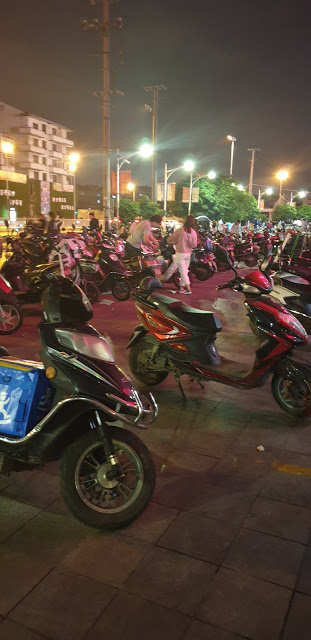
But, unlike where we live, the carpark is more of a scooter park!
It is also a small microcosm of Chinese life for the new more capitalistic oriented Chinese.
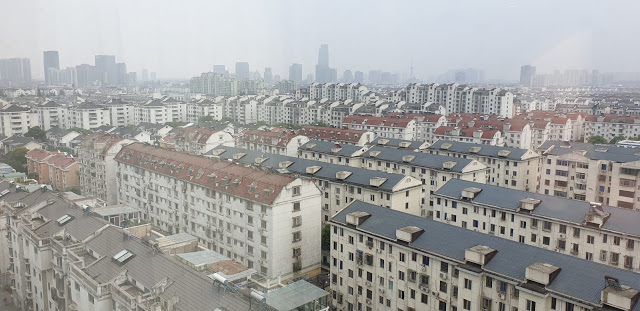
The next morning we get some idea of the scope of high-density living, though here, the buildings are not 30 stories tall, but still just as impressive.
These look like the medium density houses, but to the right of these are much larger buildings
The remarkable thing about this is those buildings stretch as far as the eye can see.
Televison is a great recorder of the past, and most channels, and especially cable tv have great libraries of films that go back more than a hundred years.
And, whilst it’s possible that modern day films and television series can try to recapture the past, the English as an exception being very good at it, often it is impossible to capture it correctly.
But, if you have a film shot in the moment, then you have a visual record of what life, and what was once part of our world before you in all it’s dated glory. The pity of it is that, then, we never appreciated it.
After all, in those particular times, who had the time to figuratively stop and smell the roses. Back then as life was going on, we were all tied up with just trying to get through each day.
Years later, often on reflection, we try to remember the old days, and, maybe, remember some of what it was like, but the chances are that change came far too rapidly, and often too radical, that it erases what we thought we knew existed before.
My grandmothers house is a case in point. In it’s place is a multi lane super highway, and there’s nothing left to remind us, or anyone of it, just some old sepia photographs.
I was reminded of how volatile history really is when watching an old documentary, in black and white, and how the city I grew up in used to look.
Then, even though it seemed large to me then, it was a smaller city, with suburbs that stretched about ten or so miles in every direction, and the outer suburbs were where people moved to get a larger block, and countrified atmosphere.
Now, those outer suburbs are no longer spacious properties, the acreage subdivided and the old owners now much richer for a decision made with profit not being the motivator, and the current suburban sprawl is now out to forty or fifty miles.
The reason for the distance is no longer the thought of open spaces and cleaner air, the reason for moving now is that land further out is cheaper, and can make buying that first house more affordable.
This is where I tip my hat to the writers of historical fiction. I myself am writing a story based in the 1970s, and its difficult to find what is and isn’t time specific.
If only I had a dollar for every time I went to write the character pulling out his or her mobile phone.
What I’ve found is the necessity to research, and this has amounted to finding old films, documentaries of the day, and a more fascinating source of information, the newspapers of the day.
The latter especially has provoked a lot of memories and a lot of stuff I thought I’d forgotten, some of it by choice, but others that were poignant.
Yes, and don’t get me started on the distractions.
Would you give up everything to be with the one you love?
…
Is love the metaphorical equivalent to ‘walking the plank’; a dive into uncharted waters?
For Henry, the only romance he was interested in was a life at sea, and when away from it, he strived to find sanctuary from his family and perhaps life itself. It takes him to a small village by the sea, a place he never expected to find another just like him, Michelle, whom he soon discovers is as mysterious as she is beautiful.
Henry had long since given up the notion of finding romance, and Michelle couldn’t get involved for reasons she could never explain, but in the end, both acknowledge that something happened the moment they first met.
Plans were made, plans were revised, and hopes were shattered.
A chance encounter causes Michelle’s past to catch up with her, and whatever hope she had of having a normal life with Henry, or anyone else, is gone. To keep him alive she has to destroy her blossoming relationship, an act that breaks her heart and shatters his.
But can love conquer all?
It takes a few words of encouragement from an unlikely source to send Henry and his friend Radly on an odyssey into the darkest corners of the red-light district in a race against time to find and rescue the woman he finally realizes is the love of his life.
The cover, at the moment, looks like this:
Is love the metaphorical equivalent to ‘walking the plank’; a dive into uncharted waters?
For Henry, the only romance he was interested in was a life at sea, and when away from it, he strived to find sanctuary from his family and perhaps life itself. It takes him to a small village by the sea, s place he never expected to find another just like him, Michelle, whom he soon discovers is as mysterious as she is beautiful.
Henry had long since given up the notion of finding romance, and Michelle couldn’t get involved for reasons she could never explain, but in the end, both acknowledge that something happened the moment they first met.
Plans were made, plans were revised, and hopes were shattered.
A chance encounter causes Michelle’s past to catch up with her, and whatever hope she had of having a normal life with Henry, or anyone else, is gone. To keep him alive she has to destroy her blossoming relationship, an act that breaks her heart and shatters his.
But can love conquer all?
It takes a few words of encouragement from an unlikely source to send Henry and his friend Radly on an odyssey into the darkest corners of the red-light district in a race against time to find and rescue the woman he finally realizes is the love of his life.




 Thrills, Spills, and just a dash of Romance