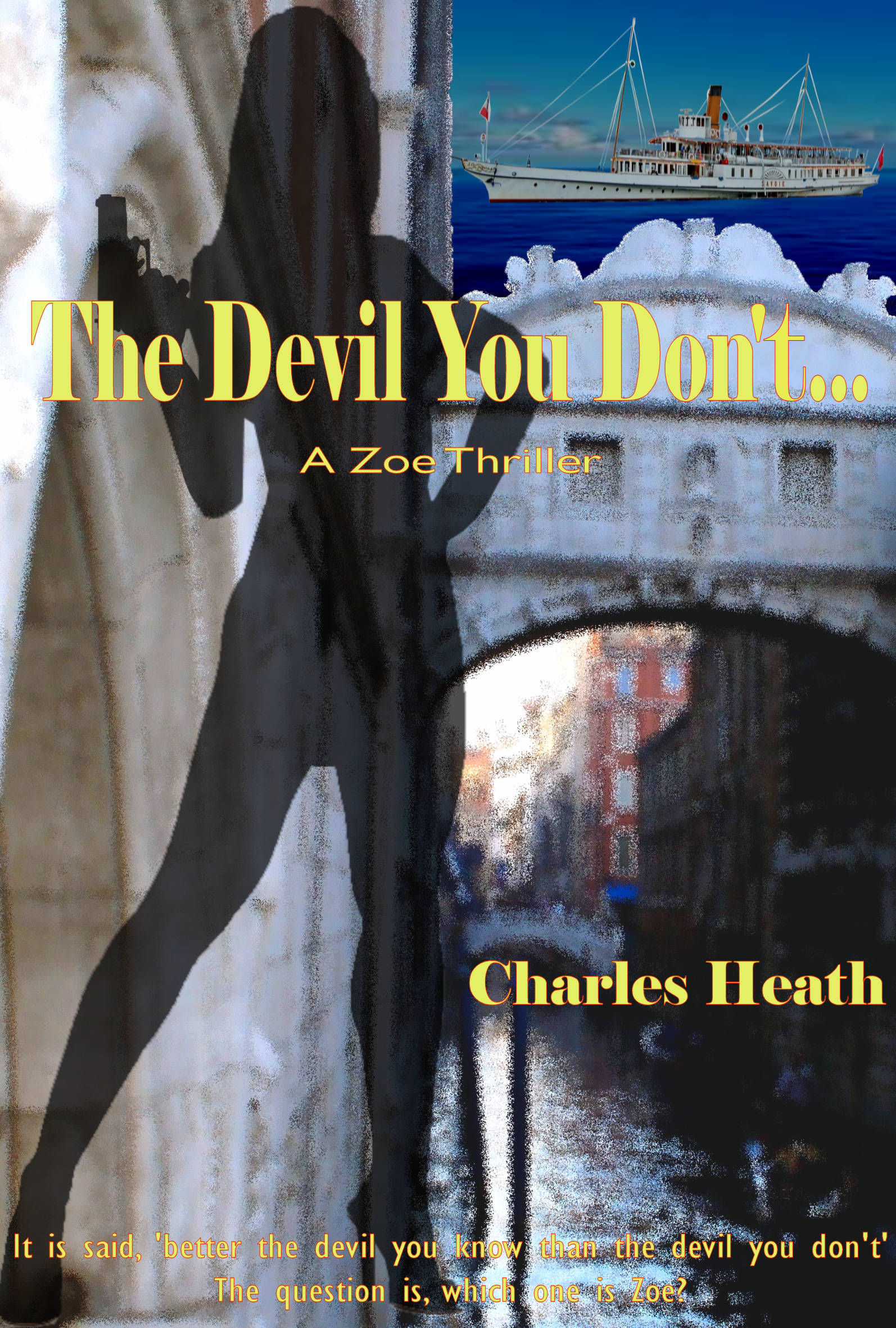
An excerpt from “Mistaken Identity” – a work in progress

The odds of any one of us having a doppelganger are quite high. Whether or not you got to meet him or her, or be confronted by them was significantly lower. Except of course, unless you are a celebrity.

It was a phenomenon remarkable only for the fact, at times, certain high-profile people, notorious or not, had doubles if only to put off enemies or the general public. Sometimes we see people in the street, people who look like someone we knew, and made the mistake of approaching them like a long lost friend, only to discover an embarrassed individual desperately trying to get away for what they perceive is a stalker or worse.

And then sometimes it is a picture that looms up on a TV screen, an almost exact likeness of you. At first, you are fascinated, and then according to the circumstances, and narrative that is attached to that picture, either flattered or horrified.

For me one turned to the other when I saw an almost likeness of me flash up on the screen when I turned the TV on in my room. What looked to be my photo, with only minor differences, was in the corner of the screen, the newsreader speaking in rapid Italian, so fast I could only translate every second or third word.

But the one word I did recognize was murder. The photo of the man up on the screen was the subject of an extensive manhunt. The crime, the murder of a woman in the very same hotel I was staying, and it was being played out live several floors above me. The gist of the story, the woman had been seen with, and staying with the man who was my double, and, less than an hour ago, the body had been discovered by a chambermaid.

The killer, the announcer said, was believed to be still in the hotel because the woman had died shortly before she had been discovered.

I watched, at first fascinated at what I was seeing. I guess I should have been horrified, but at that moment it didn’t register that I might be mistaken for that man.

Not until another five minutes had passed, and I was watching the police in full riot gear, with a camera crew following behind, coming up a passage towards a room. Live action of the arrest of the suspected killer the breathless commentator said.

Then, suddenly, there was a pounding on the door. On the TV screen, plain to see, was the number of my room.
I looked through the peephole and saw an army of police officers. It didn’t take much to realize what had happened. The hotel staff identified me as the man in the photograph on the TV and called the police.

Horrified wasn’t what I was feeling right then.

It was fear.

My last memory was the door crashing open, the wood splintering, and men rushing into the room, screaming at me, waving guns, and when I put my hands up to defend myself, I heard a gunshot.

And in one very confused and probably near-death experience, I thought I saw my mother and thought what was she doing in Rome?

I was the archetypal nobody.

I lived in a small flat, I drove a nondescript car, had an average job in a low profile travel agency, was single, and currently not involved in a relationship, no children, and according to my workmates, no life.

They were wrong. I was one of those people who preferred their own company, I had a cat, and travelled whenever I could. And I did have a ‘thing’ for Rosalie, one of the reasons why I stayed at the travel agency. I didn’t expect anything to come of it, but one could always hope.

I was both pleased and excited to be going to the conference. It was my first, and the glimpse I had seen of it had whetted my appetite for more information about the nuances of my profession.

Some would say that a travel agent wasn’t much of a job, but to me, it was every bit as demanding as being an accountant or a lawyer. You were providing a customer with a service, and arguably more people needed a travel agent than a lawyer. At least that was what I told myself, as I watched more and more people start using the internet, and our relevance slowly dissipating.

This conference was about countering that trend.

The trip over had been uneventful. I was met at the airport and taken to the hotel where the conference was being held with a number of other delegates who had arrived on the same plane. I had mingled with a number of other delegates at the pre conference get together, including one whose name was Maryanne.

She was an unusual young woman, not the sort that I usually met, because she was the one who was usually surrounded by all the boys, the life of the party. In normal circumstances, I would not have introduced myself to her, but she had approached me. Why did I think that may have been significant? All of this ran through my mind, culminating in the last event on the highlight reel, the door bursting open, men rushing into my room, and then one of the policemen opened fire.

I replayed that last scene again, trying to see the face of my assailant, but it was just a sea of men in battle dress, bullet proof vests and helmets, accompanied by screaming and yelling, some of which I identified as “Get on the floor”.

Then came the shot.

Why ask me to get on the floor if all they were going to do was shoot me. I was putting my hands up at the time, in surrender, not reaching for a weapon.

Then I saw the face again, hovering in the background like a ghost. My mother. Only the hair was different, and her clothes, and then the image was going, perhaps a figment of my imagination brought on by pain killing drugs. I tried to imagine the scene again, but this time it played out, without the image of my mother.

I opened my eyes took stock of my surroundings. What I felt in that exact moment couldn’t be described. I should most likely be dead, the result of a gunshot wound. I guess I should be thankful the shooter hadn’t aimed at anything vital, but that was the only item on the plus side.

I was in a hospital room with a policeman by the door. He was reading a newspaper, and sitting uncomfortably on a small chair. He gave me a quick glance when he heard me move slightly, but didn’t acknowledge me with either a nod, or a greeting, just went back to the paper.

If I still had a police guard, then I was still considered a suspect. What was interesting was that I was not handcuffed to the bed. Perhaps that only happened in TV shows. Or maybe they knew I couldn’t run because my injuries were too serious. Or the guard would shoot me long before my feet hit the floor. I knew the police well enough now to know they would shoot first and ask questions later.

On the physical side, I had a large bandage over the top left corner of my chest, extending over my shoulder. A little poking and prodding determined the bullet had hit somewhere between the top of my rib cage and my shoulder. Nothing vital there, but my arm might be somewhat useless for a while, depending on what the bullet hit on the way in, or through.

It didn’t feel like there were any broken or damaged bones.

That was the good news.

On the other side of the ledger, my mental state, there was only one word that could describe it. Terrified. I was looking at a murder charge and jail time, a lot of it. Murder usually had a long time in jail attached to it.

Whatever had happened, I didn’t do it. I know I didn’t do it, but I had to try and explain this to people who had already made up their minds. I searched my mind for evidence. It was there, but in the confused state brought on by the medication, all I could think about was jail, and the sort of company I was going to have.

I think death would have been preferable.

Half an hour later, maybe longer, I was drifting in an out of consciousness, a nurse, or what I thought was a nurse, came into the room. The guard stood, checked her ID card, and then stood by the door.

She came over and stood beside the bed. “How are you?” she asked, first in Italian, and when I pretended I didn’t understand, she asked the same question in accented English.

“Alive, I guess,” I said. “No one has come and told what my condition is yet. You are my first visitor. Can you tell me?”

“Of course. You are very lucky to be alive. You will be fine and make a full recovery. The doctors here are excellent at their work.”

“What happens now?”

“I check you, and then you have a another visitor. He is from the British Embassy I think. But he will have to wait until I have finished my examination.”

I realized then she was a doctor, not a nurse.

My second visitor was a man, dressed in a suit the sort of which I associated with the British Civil Service.  He was not very old which told me he was probably a recent graduate on his first posting, the junior officer who drew the short straw.

The guard checked his ID but again did not leave the room, sitting back down and going back to his newspaper.

My visitor introduced himself as Alex Jordan from the British Embassy in Rome and that he had been asked by the Ambassador to sort out what he labelled a tricky mess.

For starters, it was good to see that someone cared about what happened to me.  But, equally, I knew the mantra, get into trouble overseas, and there is not much we can do to help you.  So, after that lengthy introduction, I had to wonder why he was here.

I said, “They think I am an international criminal by the name of Jacob Westerbury, whose picture looks just like me, and apparently for them it is an open and shut case.”  I could still hear the fragments of the yelling as the police burst through the door, at the same time telling me to get on the floor with my hands over my head.

“It’s not.  They know they’ve got the wrong man, which is why I’m here.  There is the issue of what had been described as excessive force, and the fact you were shot had made it an all-round embarrassment for them.”

“Then why are you here?  Shouldn’t they be here apologizing?”

“That is why you have another visitor.  I only took precedence because I insisted I speak with you first.  I have come, basically to ask you for a favour.  This situation has afforded us with an opportunity.  We would like you to sign the official document which basically indemnifies them against any legal proceedings.”

Curious.  What sort of opportunity was he talking about?  Was this a matter than could get difficult and I could be charged by the Italian Government, even if I wasn’t guilty, or was it one of those hush hush type deals, you do this for us, we’ll help you out with that.  “What sort of opportunity?”

“We want to get our hands on Jacob Westerbury as much as they do.  They’ve made a mistake, and we’d like to use that to get custody of him if or when he is arrested in this country.  I’m sure you would also like this man brought into custody as soon as possible so you will stop being confused with him.  I can only imagine what it was like to be arrested in the manner you were.  And I would not blame you if you wanted to get some compensation for what they’ve done.  But.  There are bigger issues in play here, and you would be doing this for your country.”

I wondered what would happen if I didn’t agree to his proposal.  I had to ask, “What if I don’t?”

His expression didn’t change.  “I’m sure you are a sensible man Mr Pargeter, who is more than willing to help his country whenever he can.  They have agreed to take care of all your hospital expenses, and refund the cost of the Conference, and travel.  I’m sure I could also get them to pay for a few days at Capri, or Sorrento if you like, before you go home.  What do you say?”

There was only one thing I could say.  Wasn’t it treason if you went against your country’s wishes?

“I’m not an unreasonable man, Alex.  Go do your deal, and I’ll sign the papers.”

“Good man.”

After Alex left, the doctor came back to announce the arrival of a woman, by the way she had announced herself, the publicity officer from the Italian police. When she came into the room, she was not dressed in a uniform.

The doctor left after giving a brief report to the civilian at the door. I understood the gist of it, “The patient has recovered excellently and the wounds are healing as expected. There is no cause for concern.”

That was a relief.

While the doctor was speaking to the civilian, I speculated on who she might be. She was young, not more than thirty, conservatively dressed so an official of some kind, but not necessarily with the police. Did they have prosecutors? I was unfamiliar with the Italian legal system.

She had long wavy black hair and the sort of sultry looks of an Italian movie star, and her presence made me more curious than fearful though I couldn’t say why.

The woman then spoke to the guard, and he reluctantly got up and left the room, closing the door behind him.
She checked the door, and then came back towards me, standing at the end of the bed. Now alone, she said, “A few questions before we begin.” Her English was only slightly accented. “Your name is Jack Pargeter?”

I nodded. “Yes.”

“You are in Rome to attend the Travel Agents Conference at the Hilton Hotel?”

“Yes.”

“You attended a preconference introduction on the evening of the 25th, after arriving from London at approximately 4:25 pm.”

“About that time, yes. I know it was about five when the bus came to collect me, and several others, to take us to the hotel.”

She smiled. It was then I noticed she was reading from a small notepad.

“It was ten past five to be precise. The driver had been held up in traffic. We have a number of witnesses who saw you on the plane, on the bus, at the hotel, and with the aid of closed circuit TV we have established you are not the criminal Jacob Westerbury.”

She put her note book back in her bag and then said, “My name is Vicenza Andretti and I am with the prosecutor’s office. I am here to formally apologize for the situation that can only be described as a case of mistaken identity. I assure you it is not the habit of our police officers to shoot people unless they have a very strong reason for doing so. I understand that in the confusion of the arrest one of our officers accidentally discharged his weapon. We are undergoing a very thorough investigation into the circumstances of this event.”

I was not sure why, but between the time I had spoken to the embassy official and now, something about letting them off so easily was bugging me. I could see why they had sent her. It would be difficult to be angry or annoyed with her.

But I was annoyed.

“Do you often send a whole squad of trigger happy riot police to arrest a single man?” It came out harsher than I intended.

“My men believed they were dealing with a dangerous criminal.”

“Do I look like a dangerous criminal?” And then I realized if it was mistaken identity, the answer would be yes.

She saw the look on my face, and said quietly, “I think you know the answer to that question, Mr. Pargeter.”

“Well, it was overkill.”

“As I said, we are very sorry for the circumstances you now find yourself in. You must understand that we honestly believed we were dealing with an armed and dangerous murderer, and we were acting within our mandate. My department will cover your medical expenses, and any other amounts for the inconvenience this has caused you. I believe you were attending a conference at your hotel. I am very sorry but given the medical circumstances you have, you will have to remain here for a few more days.”

“I guess, then, I should thank you for not killing me.”

Her expression told me that was not the best thing I could have said in the circumstances.

“I mean, I should thank you for the hospital and the care. But a question or two of my own. May I?”

She nodded.

“Did you catch this Jacob Westerbury character?”

“No. In the confusion created by your arrest he escaped. Once we realized we had made a mistake and reviewed the close circuit TV, we tracked him leaving by a rear exit.”

“Are you sure it was one of your men who shot me?”

I watched as her expression changed, to one of surprise.

“You don’t think it was one of my men?”

“Oddly enough no. But don’t ask me why.”

“It is very interesting that you should say that, because in our initial investigation, it appeared none of our officer’s weapons had been discharged. A forensic investigation into the bullet tells us it was one that is used in our weapons, but…”

I could see their dilemma.

“Have you any enemies that would want to shoot you Mr Pargeter?”

That was absurd because I had no enemies, at least none that I knew of, much less anyone who would want me dead.

“Not that I’m aware of.”

“Then it is strange, and will perhaps remain a mystery. I will let you know if anything more is revealed in our investigation.”

She took an envelope out of her briefcase and opened it, pulling out several sheets of paper.

I knew what it was. A verbal apology was one thing, but a signed waiver would cover them legally. They had sent a pretty girl to charm me. Perhaps using anyone else it would not have worked. There was potential for a huge litigation payout here, and someone more ruthless would jump at the chance of making a few million out of the Italian Government.

“We need a signature on this document,” she said.

“Absolving you of any wrong doing?”

“I have apologized. We will take whatever measures are required for your comfort after this event. We are accepting responsibility for our actions, and are being reasonable.”

They were. I took the pen from her and signed the documents.

“You couldn’t add dinner with you on that list of benefits?” No harm in asking.

“I am unfortunately unavailable.”

I smiled. “It wasn’t a request for a date, just dinner. You can tell me about Rome, as only a resident can. Please.”

She looked me up and down, searching for the ulterior motive. When she couldn’t find one, she said, “We shall see once the hospital discharges you in a few days.”

“Then I’ll pencil you in?”

She looked at me quizzically. “What is this pencil me in?”

“It’s an English colloquialism. It means maybe. As when you write something in pencil, it is easy to erase it.”

A momentary frown, then recognition and a smile. “I shall remember that. Thank-you for your time and co-operation Mr. Pargeter. Good morning.”

© Charles Heath 2015-2021

A to Z – April – 2026 – V

V is for – A Viper’s Misguided Revenge

“I dare you to tell me the truth.”

Evelyn glared at me with such intensity that it made me feel hot under the collar. 

Perhaps that was a tinge of guilt, not that I had done anything wrong, but her meddling sister had been in her ear again, and I was never going to live down the fact that I chose Evelyn over her.

It had taken me a week to realise Darcy, her older sister, was a manipulative and evil woman like their mother had been.   And years before, I had rediscovered Evelyn, and another after that, before we started dating.

Now it was the week of the wedding, and Darcy was up to her old tricks.  Her sister was happy and settled, Darcy was not, and she didn’t like it.

“The truth about Elizabeth.”

Oh, Elizabeth.  The other girl I’d liked at school, and was out of my league, then and now.  Darcy trotted her out every time she wanted to make Evelyn unsettled, hinting that we had had a long-standing relationship the whole time, and secretly, I was more in love with her.

The truth?  I was not.  She had told me a long time ago that anything with me was impossible because of her parents’ expectations.

“Well, the obvious truth is she’s a lovely lady, single, simply because she doesn’t trust any man, and probably will remain so now that she has taken over the running of her family business.  You and I both know for a fact she has spent three weeks at best this side of the Atlantic this year, so I’m not sure when we’re supposed to have found time to be together.”

It was the same answer I gave her the last time and the time before that.  And it would be the next time if there was a next time.  I always took it as a sign that if Evelyn was looking for excuses, she started prevaricating.

“You’ve made four two-week trips to England in the last six months.”

This was true, and I told her the details of each trip, where I went, who I saw, and called her twice a day, first thing in the morning and last thing at night.

I sighed.  I just caught a glimpse of Darcy outside the door to the room, listening to the fruits of her labours, to break us up.  Perhaps it was time to do so.  Darcy was never going to give up, and Evelyn was always going to not fully trust me.

“The truth is always going to be what you believe, Evelyn, not what I say.  And if you want the truth, right now, it is that whatever it is we think we have, it’s not going to work.  Not if you’re going to let Darcy undermine our relationship.  So, here’s the truth, Evelyn.  We should not get married and spend the rest of our lives regretting it.  There has been and always will be only one girl for me, and that’s you.  It’s a pity Darcy can’t see that.  So, another truth, Evelyn, let Darcy pick your husband, get her seal of approval, and perhaps then she’ll stop making everybody else’s life as miserable as hers is.  I’m sorry, Evelyn, but enough is enough.”

“The wedding is off?”  Why did she suddenly sound incredulous?

“It’s what Darcy wants, and you apparently agree with her.  As for me, I’m done with Washington. I actually quit my job yesterday, and in about three hours, I’m getting on a plane to go home.  Since my father died, my mother has not been coping with the business, and Joey is about as useless as Darcy is.  Pity they didn’t get married, they are certainly a pigeon pair.  But there it is, you live and learn.  Goodbye, Evelyn.  I really do hope you find what you’re looking for, but as far as I can see, it’s not me.”

I gave her a final look up and down, realising that I would never find another like her ever again.  Then I shook my head and walked out of the room.  Had she asked me to come back, I would have.  Had she said she was no longer going to listen to her sister, I would have believed her, but she said nothing.

Darcy was waiting at the front door and opened it as I approached.

“How does it feel to be a loser?” she asked.

“You always said you’d get your revenge.”

“Yes,” she smiled, the cat who ate the canary, “I did.”

I smiled back.  “What do you do for a living again?”

“I pick and choose companies I believe are very good investments for our clients, and we make a lot of money.  I make a lot of money.”

“What was your prediction for Billingsgate?”

“Not what happened.  That was an aberration.  Whoever owns it just happened to be in the right place at the right time.”

“I know; that was my brainchild, Darcy.  And like I said, and I know you were listening in, I sold the company, the same as quitting my job, and now I’m going home.  I did it for Evelyn, but thanks to you, she’ll miss that opportunity.  Not your best work, Darcy.”

The expression on her face, as I walked through the door, was priceless.

©  Charles Heath 2025-2026

365 Days of writing, 2026 – 98

Day 98 – The truth in your voice

Beyond the Lab Coat: What Rachel Carson Teaches Every Aspiring Writer

In the 1930s, the scientific community was a fortress of rigid archetypes. To be a “scientist” meant you were expected to behave, dress, and communicate in a specific way—usually echoing the dry, inaccessible jargon of academia.

Then came Rachel Carson.

Carson didn’t fit the mold. She wasn’t a stereotypical lab-coat-wearing academic, but she possessed a secret weapon that would eventually change the world: a profound flair for narrative. Her journey—from her humble beginnings writing radio scripts on the habits of fish to authoring the earth-shattering Silent Spring—offers a masterclass for any beginning writer today.

If you are just starting your writing journey, here is why Rachel Carson should be your guiding light.

1. Your “Lack of Fit” is Your Greatest Asset

When Carson started, she was an outlier. She didn’t have the traditional “authority” that a tenured professor might have had, but that was precisely why she succeeded. Because she didn’t write like a scientist, she didn’t write for scientists; she wrote for the public.

The Lesson: If you feel like an imposter because you don’t have a specific degree, a decade of experience, or a “correct” background, stop worrying. The most compelling stories are often told by the outsiders. Your unique perspective is not a lack of qualification; it is your competitive edge.

2. The Power of “Translating” Complexity

Carson’s genius lay in her ability to take dense, technical data about marine biology and transform it into lyrical prose. She understood that facts are meaningless if they don’t resonate with the reader’s emotions. Her early work on fish wasn’t just a report; it was storytelling.

The Lesson: Don’t just dump information. Your job as a writer is to be a bridge between complexity and comprehension. Whether you are writing about technology, finance, or arts and culture, focus on the “human” angle. Use metaphors, narrative arcs, and evocative language to make your subject matter breathe.

3. Start Small, But Think Big

Carson didn’t set out to write Silent Spring as her first project. She started by writing scripts for the U.S. Bureau of Fisheries. Those seemingly small, unglamorous tasks were the forge where she sharpened her voice. She mastered the craft of clear, rhythmic, and persuasive writing on a small scale before she took on the monumental task of changing global environmental policy.

The Lesson: Don’t wait for the “Big Book” or the “Viral Hit” to start practising. Hone your craft on the small stuff. Write the blog post, the newsletter, the caption, or the short essay. Every sentence is a rep in the gym. You are building the muscle that will eventually allow you to write something that matters.

4. Curiosity is the Engine of Credibility

Carson’s work on Silent Spring wasn’t just a sudden burst of inspiration; it was built on years of being a voracious learner. She cared deeply about the subject matter. Readers can smell when a writer is just “phoning it in.”

The Lesson: Write about what you are legitimately curious about. If you are passionate and curious, you will do the deep research required to back up your claims. That research is what gives you authority—not a title, not a degree, but the sheer effort you put into understanding your subject.

The Takeaway

Rachel Carson reimagined what a “science writer” could be. She proved that you don’t need a formal invitation to change the conversation; you just need a pen, a perspective, and the courage to tell the truth in your own voice.

If you’re a beginner, remember: You don’t need to fit the mold of the authors who came before you. You just need to show up, do the work, and let your curiosity lead the way. You never know—the “small” piece you write today might be the one that shifts the world tomorrow.

The story behind the story – Echoes from the Past

The novel ‘Echoes from the past’ started out as a short story I wrote about 30 years ago, titled ‘The birthday’.

My idea was to take a normal person out of their comfort zone and led on a short but very frightening journey to a place where a surprise birthday party had been arranged.

Thus the very large man with a scar and a red tie was created.

So was the friend with the limousine who worked as a pilot.

So were the two women, Wendy and Angelina, who were Flight Attendants that the pilot friend asked to join the conspiracy.

I was going to rework the short story, then about ten pages long, into something a little more.

And like all re-writes, especially those I have anything to do with, it turned into a novel.

There was motivation.  I had told some colleagues at the place where I worked at the time that I liked writing, and they wanted a sample.  I was going to give them the re-worked short story.  Instead, I gave them ‘Echoes from the past’

Originally it was not set anywhere in particular.

But when considering a location, I had, at the time, recently been to New York in December, and visited Brooklyn and Queens, as well as a lot of New York itself.  We were there for New Years, and it was an experience I’ll never forget.

One evening we were out late, and finished up in Brooklyn Heights, near the waterfront, and there was rain and snow, it was cold and wet, and there were apartment buildings shimmering in the street light, and I thought, this is the place where my main character will live.

It had a very spooky atmosphere, the sort where ghosts would not be unexpected.  I felt more than one shiver go up and down my spine in the few minutes I was there.

I had taken notes, as I always do, of everywhere we went so I had a ready supply of locations I could use, changing the names in some cases.

Fifth Avenue near the Rockefeller center is amazing at first light, and late at night with the Seasonal decorations and lights.

The original main character was a shy and man of few friends, hence not expecting the surprise party.  I enhanced that shyness into purposely lonely because of an issue from his past that leaves him always looking over his shoulder and ready to move on at the slightest hint of trouble.  No friends, no relationships, just a very low profile.

Then I thought, what if he breaks the cardinal rule, and begins a relationship?

But it is also as much an exploration of a damaged soul, as it is the search for a normal life, without having any idea what normal was, and how the understanding of one person can sometimes make all the difference in what we may think or feel.

And, of course, I wanted a happy ending.

Except for the bad guys.

Get it here:  https://amzn.to/2CYKxu4

newechocover5rs

NaNoWriMo – April – 2026 – Day 25

Having reached the milestone of writing 50,000 words plus, it’s not the time to hang up the pen and think the job’s done.

It isn’t.

I still have a few more chapters to write, to bring the story to a satisfying conclusion.

That I’m still not quite sure about, but I have one conclusion I’ll write, and then later if I think of something better, I’ll substitute it.

That isn’t to say the end won’t change when it’s time to make a second pass at the manuscript.

Other than that, things are going according to plan. This means, I guess, that writing to a plan can work even for someone who doesn’t usually use that method

I will be considering this to plan the sequels for the two series I’m writing at the moment.

But, not to get ahead of myself, I have this project to finish.

The first case of PI Walthenson – “A Case of Working With the Jones Brothers”

This case has everything, red herrings, jealous brothers, femme fatales, and at the heart of it all, greed.

See below for an excerpt from the book…

Coming soon!

PIWalthJones1

An excerpt from the book:

When Harry took the time to consider his position, a rather uncomfortable position at that, he concluded that he was somehow involved in another case that meant very little to him.

Not that it wasn’t important in some way he was yet to determine, it was just that his curiosity had got the better of him, and it had led to this: sitting in a chair, securely bound, waiting for someone one of his captors had called Doug.

It was not the name that worried him so much, it was the evil laugh that had come after the name was spoken.

Doug what? Doug the ‘destroyer’, Doug the ‘dangerous’, Doug the ‘deadly’; there was any number of sinister connotations, and perhaps that was the point of the laugh, to make it more frightening than it was.

But there was no doubt about one thing in his mind right then: he’d made a mistake. A very big. and costly, mistake. Just how big the cost, no doubt he would soon find out.

His mother, and his grandmother, the wisest person he had ever known, had once told him never to eavesdrop.

At the time he couldn’t help himself and instead of minding his own business, listening to a one-sided conversation which ended with a time and a place. The very nature of the person receiving the call was, at the very least, sinister, and, because of the cryptic conversation, there appeared to be, or at least to Harry, criminal activity involved.

For several days he had wrestled with the thought of whether he should go. Stay on the fringe, keep out of sight, observe and report to the police if it was a crime. Instead, he had willingly gone down the rabbit hole.

Now, sitting in an uncomfortable chair, several heat lamps hanging over his head, he was perspiring, and if perspiration could be used as a measure of fear, then Harry’s fear was at the highest level.

Another runnel of sweat rolled into his left eye, and, having his hands tied, literally, it made it impossible to clear it. The burning sensation momentarily took his mind off his predicament. He cursed and then shook his head trying to prevent a re-occurrence. It was to no avail.

Let the stinging sensation be a reminder of what was right and what was wrong.

It was obvious that it was the right place and the right time, but in considering his current perilous situation, it definitely was the wrong place to be, at the worst possible time.

It was meant to be his escape, an escape from the generations of lawyers, what were to Harry, dry, dusty men who had been in business since George Washington said to the first Walthenson to step foot on American soil, ‘Why don’t you become a lawyer?” when asked what he could do for the great man.

Or so it was handed down as lore, though Harry didn’t think Washington meant it literally, the Walthenson’s, then as now, were not shy of taking advice.

Except, of course, when it came to Harry.

He was, Harry’s father was prone to saying, the exception to every rule. Harry guessed his father was referring to the fact his son wanted to be a Private Detective rather than a dry, dusty lawyer. Just the clothes were enough to turn Harry off the profession.

So, with a little of the money Harry inherited from one of his aunts, he leased an office in Gramercy Park and had it renovated to look like the Sam Spade detective agency, you know the one, Spade and Archer, and The Maltese Falcon.

There’s a movie and a book by Dashiell Hammett if you’re interested.

So, there it was, painted on the opaque glass inset of the front door, ‘Harold Walthenson, Private Detective’.

There was enough money to hire an assistant, and it took a week before the right person came along, or, more to the point, didn’t just see his business plan as something sinister. Ellen, a tall cool woman in a long black dress, or so the words of a song in his head told him, fitted in perfectly.

She’d seen the movie, but she said with a grin, Harry was no Humphrey Bogart.

Of course not, he said, he didn’t smoke.

Three months on the job, and it had been a few calls, no ‘real’ cases, nothing but missing animals, and other miscellaneous items. What he really wanted was a missing person. Or perhaps a beguiling, sophisticated woman who was as deadly as she was charming, looking for an errant husband, perhaps one that she had already ‘dispatched’.

Or for a tall, dark and handsome foreigner who spoke in riddles and in heavily accented English, a spy, or perhaps an assassin, in town to take out the mayor. The man was such an imbecile Harry had considered doing it himself.

Now, in a back room of a disused warehouse, that wishful thinking might be just about to come to a very abrupt end, with none of the romanticized trappings of the business befalling him. No beguiling women, no sinister criminals, no stupid policemen.

Just a nasty little man whose only concern was how quickly or how slowly Harry’s end was going to be.

© Charles Heath 2019-2024

The cinema of my dreams – It all started in Venice – Episode 11

Verbal sparring with Juliet

I had expected Juliet would try and maneuver the conversation in the direction Larry wanted, and I thought about whether I would be obtuse in simply ignoring her and talking about anything else, or just have fun with Larry who, no doubt, would be listening in.

Her first question was hardly surprising, an effort to see if I would tell her what my work was.  I couldn’t even if I wanted to, but I could intimate certain things.  But not straight away, Juliet was going to give to ask the right questions.

“Since retirement, I spent most of my time looking after Violetta.”

“Was she unwell?”

A natural assumption that everyone made, but nothing could be further from the truth.   She had given me purpose after so long in a trade that traded in endless lies and deception.

And it had been on one of those missions she had been caught in the crossfire, as I pretended to be, and got her out.  We found each other again, by accident, literally, and it developed from there.

I was done with that job and wandering aimlessly around Europe at the time.  She knew something was wrong with me, but never pushed, just accepted that everything would be better in time.

And it was.

It was a while before I answered, several vivid memories of her rising to the surface as they did, unexpectedly at times.

“No.  I often think she was exactly what she thought I needed to be for her.  She had come from a family that had servants all their lives, and there were certain expectations.”

I could see it in her expression, that Violetta treated me like a servant.   Good, let her.

“I had always wondered what it was you did, that you could end up I’m my hospital in such bad shape.  I never bought that car accident excuse we were given, because the injuries were inconsistent.”

“You were an expert on car injuries?”

“As a matter of fact, yes, I had made it a hobby if you like, to treat as many as possible, cataloging the injuries so that other doctors might treat patients with such injuries more efficiently.”

“So, having said that, what in your humble opinion was the cause of my injuries?”

“Being tossed out of a moving car, but more likely the result of a bar fight, the sort they had in the old wild west.”

And she’d be right.  It was six against two, and at a disadvantage, and, yes, I had been thrown a short distance, but not by the enemy.  It was a gesture to save me from a worse beating.  I had been lucky that night, my partner had not.

“Well, always an interesting topic for doctors sitting around a campfire talking shop.  But I will say this, I was a policeman once, with a blue uniform too.  I did spend time on the streets, but mostly doing paperwork, as I keep telling everyone.”

“And what caused your injuries?”

She was persistent, I’ll give her that.

“Getting involved in a domestic argument.  It’s not the sort of work anyone wants to get in the middle of, and my partner at the time was killed.  You saw what happened to me.  We were just in the wrong place at the wrong time.”

She gave me a measured look, one that seemed to say she didn’t believe a word of it, and I was fine with that.  In any other circumstance, we would not be talking about it, and I had tried to put the real events of that day behind me.

It wasn’t easy.  Not when you lose someone.  It becomes that situation where at first you blame yourself for the death, and then after enough people tell you it wasn’t your fault, you begin to wonder what you could have done better to prevent it.

A lot, perhaps, but I’d been younger then, and not as wise.  That came layer with experience.

“Tell me about you,” I said, changing the focus.

“Nothing to tell.”

“I read newspapers Juliet, and I know what happened.  It might have been on page 16, but it leaped off the page.  I wanted to believe it wasn’t true.”

If she thought she was going to escape the inquisition, she was wrong.

I had been surprised to see her name, more surprised at the circumstances, a dalliance with drugs, a bad call, an avoidable death, and the downward spiral from there.

The photo of her in the paper after her arrest was not pretty.  She went to jail for a short period, lost her license to practice medicine, and lost a whole lot more.

“If you read the news, then there’s nothing left to tell.  I’m clean now, have been for a few years.”

The admission came almost reluctantly, for someone in her situation, it was like an evening ender when the truth was out.

“You were a good doctor.  What happened?”

“Too many hours, not enough sleep.  A husband who was too consumed in his own career, I took the easy way out.  Life is a series of choices, and I made a few bad ones.  Shit happens.”

“So, what do you do now?”

“Forensic medicine, assisting coroners.  I work with the dead.  I figure I can’t hurt them anymore.  I try to see the people who don’t survive car crashes, and continue my work in the hope some of the death and mayhem can be prevented.”

As well as doing Larry’s dirty work.  Had she done this before?

Sparring suspended, the main courses arrived.

© Charles Heath 2022

NaNoWriMo – April – 2026 – Day 24

I was writing Chapter 29 when I suddenly had a bad feeling. You know the sort of feeling you get, you’ve forgotten something, or there wasn’t a lead into an event which will feel like it came from nowhere…

I’m having one of those moments.

Damn.

I’ve forgotten something.

So, I stopped editing, brought up the last eight chapters and started reading.

No, nothing I’ve forgotten. But there is something.

No point going on. This has to run around in my mind for a bit while doing something completely different, like painting a ceiling.

True, I’m in the middle of painting the dining room ceiling and putting it off to get on with the project. The project has hit a speed hump, so it’s back to the painting.

Halfway through the roof, it comes to me.

A basic error is not making sure all the points are covered in the story; otherwise, the reader will say, “ok, you said that back in Chapter 18, and now, why haven’t you realised that something’s going to happen because of your negligence?”

I know what it is.

And it will require another chapter.

But first, I have to finish the painting.

A to Z – April – 2026 – U

U is for – Undercover

I think I had reached the point where I had so fully immersed myself in the role that I no longer knew who or what I had been before.

I had said it wouldn’t happen, and they said it would, and as time passed, they could see it, and I could not.

The gig was over.

The message came over the phone in their cryptic code, devised so that if anyone else saw it, it would look just like the title of a book, which it was.

“Where Eagles Dare”.

I had dared to fly higher than the mythical Icarus, but they said it was too close to the sun.

They were right.

Ballinger, the boss, was seated opposite me, gun in lap, giving me his most menacing look.  He didn’t have to try too hard; the result of many beatings when he was a boy had given his face the look of a world-weary boxer who had to retire early.

Ever since I first met him, he had always been a man of short patience.

“I really am disappointed, Spence.  Really disappointed.”

He glanced sideways at one of his henchmen, an equally scary gorilla called Lefty.  He had another name, but I couldn’t pronounce it.  Neither could anyone else.

Lefty said, as was expected of him, “Really disappointed.”

I was not sure if it was to emphasise Ballinger’s disappointment, or that he could parrot words on command like a dutiful henchman.

I would ask why, but I knew.  There had been a ten-minute diatribe about how another of his henchmen, Wally, had discovered I was an undercover cop.  He didn’t say how he came upon this interesting discovery.

“I was disappointed you didn’t promote me a month back, but I didn’t tie you up and express disappointment.”

Lefty slapped me so hard it knocked me sideways to the floor.

It hurt.

“Don’t be insolent to the boss,” Lefty said.

Another sideways glance from Ballinger at Lefty, and he picked me back up.

After shaking my head, I said, “You’re wrong, by the way.  Do I look smart enough to be an undercover cop?”

“There aren’t any smart cops, Spence, so you fit the bill perfectly.  What did you hope to gain?”

“Let’s cut the charade.  How the hell could anybody ever assume I’m anything but just another dumb schmuck on your payroll?  Seriously?  A cop?  I’ve seen what cops make, and I couldn’t survive on a cop’s salary.  It’s why there are corrupt cops.  You know that as well as I do, you’ve got about half a dozen on the payroll.”

“How do you know that?”

“You don’t exactly make it a secret.   I’m sure their bosses know who they’re consorting with.  Besides, when I got dragged into the station after Wally botched the simple job you gave him, and the cops were called, they told me I’d be smart if I walked away.  I’m hoping it wasn’t Wally who’s suggesting I’m a cop simply because they hauled me away for questioning.”

His look confirmed what I already knew.  Wally was working for the cops, and there were rumours that there was an undercover cop in Ballinger’s crew.  Wally was spreading the blame to me to cover his backside after he nearly blew his cover.  Wally was a rank amateur.

“You need to look closer to home.”

That interview with the police, about a week ago, was the first time I’d been back in over six months, the time it had taken to worm my way into the gang, albeit inside, but outside the part that mattered.

At first, they didn’t know who I was and treated me like a hard case, which was what I was portraying.  Then the head of the task force discovered I was in the cells and came to see me.  It hadn’t been like anything I’d expected.

He’d completely lost it.

Ballinger, by comparison, was a nice guy.

I told the head of the task force that keeping up regular contact with him was how they discovered the undercover cop who had preceded me, through a combination of surveillance and crooked cops on the payroll.

I said I wouldn’t get caught, and yet here I was.

There was a commotion outside, a woman loudly arguing with someone outside the door, and then a loud crashing sound.

Tina.

Ballinger’s daughter; very loud, very brassy, very spoilt.

She came into the room and stopped a short distance from her father.

“What are you doing?”

“Dealing with Spence.  He’s an undercover cop.”

She looked at me, then her father, and then she laughed so hard she nearly fell over.  “Spence a cop?  Are you serious, or have you completely lost your mind?”

Lefty said, “Wally reckons he is.”

“Wally is dumb as dog shit, Lefty.  He bungled the job so simple that he’s the one you should shoot.  Spence got caught up in his mess.”

Ballinger looked at her, then Lefty, then me.

“Where’s Wally?”

“You’re asking me where your henchmen are?  He’s probably down at the cop shop spilling his guts and asking for witness protection.  You’re doing just what he wants, wasting your time on the wrong people while he gets away.”

Ballinger glared at Lefty.  “Cut Spence free, then find Wally and kill him.  Now.”

To the rest of the men in the room, “Don’t come back till Wally’s dead.”  He looked at Tina.  “You coming?”

“A word with Spence, then I’m right behind you.”

We both watched him and the men leave.  I flexed my arms and legs to get the circulation flowing, then stood, slightly unsteadily.

“Thanks.”

She shrugged.  “It’s either you or Wally, or both of you.  I like you, Spence, so it better not be you.  OK.”

“I’m too stupid to be playing both sides of the fence, Tina.”

She looked at me with a bemused expression.  “One thing you ain’t, Spence, and that’s stupid.  I don’t miss much, Spence, so don’t let me down.”

I shrugged.  “Count on it.”

©  Charles Heath 2026

365 Days of writing, 2026 – 97

Day 97 – Writing Exercise

I had been sitting in a chair looking at the inanimate robot that I was told was state-of-the-art, the very best of the best in technology.

And it was extremely scary.

The last memo I had received told me that robots would not be taking over our lives, that they were not going to be that lifelike that we could not tell whether they were human or android, and here was
the epitome of exactly the opposite.

I could not, at a distance of 10 feet, tell that I was not looking at another human.

It was standing, eyes open, looking at me, as if waiting for instructions.

But that had not been the worst of the revelation.

That robot looked exactly like me.

I had been summoned to the Central Robotics Institute to attend a demonstration of the latest humanised robot with the latest version of artificial intelligence programming.

About five years before, I had been on the short list for Director of the institute and had it not been for the fact, on the week before the announcement of the new Director, a recording of my comments against fully integrated artificial intelligence into human-like robots surfaced.

It was not a stance I was ashamed to admit I believed in; in fact, I had been campaigning against a Government green paper that set out the Government’s wish list in robotics and what drove them.

The person who got the job was, in a sense, a rival, though for many years, as we both toiled through school, university, and in the commercial sector, we once agreed on limiting AI and robotics.

Until she didn’t.  I guess she wanted the job more than I did and was willing to disavow her beliefs.  That was where our paths diverged, both in work and privately, where our plans to be married and start our own company were over.

I was disappointed, but not surprised.

She had joined the bloc to extoll everything she once hated, and was now actively promoting artificial intelligence as the saviour of mankind.

And I knew, secretly, she and the company she had been working with for nearly five years were tendering for a closed military contract worth trillions of dollars.

It was part of a push by the military to use artificial intelligence to drive a new line of defence weapons, including robot soldiers.

It was the worst nightmare come true; like any new breakthrough in technology, there was always a group of scientists looking to weaponise it.

This was the first prototype.  Fully functional, fully tested, and was about to be shown to the military.

Frances Terries, in a sense, my ex, had called two days before, the first contact we had in nearly five years, and invited me to the test facility, way out in the middle of the desert, far away from the enemy’s prying eyes.

She sent a private jet to fetch me.

When I landed, and she met me on the tarmac, I asked her why she had invited me.  All she said was as the program’s greatest detractor, I would become its greatest fan.

That was a challenge I wasn’t going to turn down.

I heard the clucking of heels behind me, and knew Frances was coming.  She would be alone.

She had introduced me to the highest echelons of the company, the men with the money, deep enough pockets to create such a robot.  Names that rarely made the papers, names that were involved in any number of government projects.  She was involved with one,  and I was happy for her.

She was always going to be a success, and had devoted what was necessary to create a unit she had been working on since her days back in University.  In fact, we had both worked on that project, but I had more reservations about what might happen if we succeeded in that.

But we never intended to build it or bring it to life.  I wondered briefly what tipped the scale for her.  I didn’t think it could be as crass as just money or fame.  She had never shown any inclination towards wanting acknowledgement, other than the respect from her peers and contemporaries.

Unless that had changed, too.

She stopped beside me, and I could just smell a hint of her favourite perfume.  Some things didn’t change.

“What do you think?” She asked.

“That you couldn’t stop thinking about me?”

Why else would she build a robot that looked like me?  Perhaps that statement was a little crass even for me.

She laughed.  “Only you could come up with something like that.  There is a lot of you in him.  He even has your name, Steven.”

“Programming?”

“Level 7 AI.  Best yet.  A vocabulary of infinite words.  There’s so much stuff crammed into his memory you could literally ask him anything.”

“Would he have a reason not to become a super soldier?”

“That was not why we built him.” 

She sounded a little indignant, which was a surprise.  Building a lifelike robot for the military wasn’t going to see them as office clerks or blue-collar workers.

“Except the military paid for the research and development.  We both know what is going to happen here.”

“I get the implication, but that is not the purpose of this particular model.”

“Not this particular one, perhaps.”

I could see out of the corner of my eye the frown. She might be thinking that asking me here was a mistake.  She had to know that I couldn’t in all conscience sign off on military robots.

She tried a different tack. “Perhaps they need them to go into space?  The military is also interested in manned space flights to other planets.  They do not have the same limitations as mortal men.”

Possible, but not probable.  I’d seen their green paper, and there weren’t many references to space travel, though the application would be ideal. They could lie dormant for the years it would take to get to the other planets.

“Agreed.  But we still have the problem of building robots that are going to take jobs of normal people.”

“AI is doing that new thing and has for a few years.  This is just a small progression, putting a real face to the interface.”

“You know my views.   Why exactly am I here…”

“To show you that our dream was not a dream, it’s now a reality. You didn’t believe it could be done.  And yet, here it is.”

I didn’t want it to happen.  There’s a difference.  I knew it was inevitable, and I had recently travelled the world to see the remarkable instances of humanoid robots.  But none of them had made them indistinguishable from real humans.

Or more to the point, they didn’t show me.

“Does it work?”

She gave a rather pointed look.  “Of course.”  She looked at the robot.  “Good morning, Steve.”

It turned its head and looked at her.  “Good morning, Miss Frances.” It turned slightly to look at me.  “I am guessing you are Steven Fletcher.  How do you do?”

The polite tone was matched with a quizzical expression.

“Good morning, Steve.  You have to admit, this is a rather curious experience, virtually talking to yourself.”

It was slightly disconcerting.

“Would you like to ask Steve a question?”

I still couldn’t quite understand why she had built a robot that looked like me.

I looked at him.  “Why?”

The reply came back almost instantly.

“Because it is a crooked letter and can’t be straightened.”

Wow.  That took me back to the first time Frances and I had an argument.  Not the first time we had a difference of opinion, but a real argument.  She had simply asked me why, and that’s how I answered her.  It was meant to inject some levity.

Had I known then that it would be the first crack in our relationship, maybe I would have kept the remark to myself.

“Of all the things to add to its vocabulary.”

“I assure you I did not.”

A glance at her expression told me she was as surprised as I was at the response.

I looked at the robot again, a very strange feeling coming over me.  “Are you self-aware, Steve?”

It looked at me, then at Frances, with a rather interesting expression on its face.  The fact that it could run through several almost infetisamble changes like a human would, was quite astonishing.

She said, ‘Answer him.”

Back to me.  “If you are asking me if I know that I am an artificial life form, the answer is yes.  That looks like you. That is a surprise for both of us.  I know that you and Miss Frances were once very good friends because she has told me a lot about you, but not the reason why you ceased being friends.  I will not speculate as to why she built me in your likeness.”

I would save my own speculation for another day.

“Thank you, Steve.”

She turned to me.  “Please.  Come with me.  I have several of the production teams waiting to answer any questions you have.”

“Any questions?”

“You have been given top-level clearance.  They know you were involved initially with the concept, and want your honest opinion of the product.”

“Is that what you are calling the Robot.  The product?”

“It is not human and therefore should not be labelled as anything but what it is.”

I shrugged.  She still didn’t get it.

The product.

That description stuck with me, because the problem I had with creating an entity that had even the slightest degree of autonomy was in my mind something more than a ‘product’.

It was getting close to a sentient being.

I used to marvel at the thought that robots could be life like, and in the great life imitates art paradime, it was where Frances and I got the idea to create a life like robot, and more so when we saw Data in Star Trek.

We had been avid science fiction fans, and one day just started throwing ideas around.  It wasn’t quite possible at that time because of limitations in developing body parts, and both computer storage and computing power were limited; communications between a unit and a central server were not as advanced.

Having a humanoid-type robot was possible, but its look and feel, as well as programming, would need a quantum leap in technology before something better could be contemplated.

Now, 10 years after our first attempts had a moderate degree of success, that environment was on a threshold.

Frances had the unit; the question was how AI would drive it, and in my mind, that’s where it fell down.  No one could program a computer to cover every eventuality that a human brain could.

If the army wanted a force of mindless automatons, it was possible, but how could they guarantee they wouldn’t turn on their masters? 

It was that very question I put to the programming team; they had answers, but in the end, not one was satisfactory.  And it was telling that Frances wrapped it up and sent them away when she saw what I was doing

Wasn’t that the reason she asked me to come and see her creation?

“You were being a little subjective, nnn.  You’re asking questions that haven’t yet been considered in detail.”

“What sort of demo are you planning for the military?  They will want to see a killing machine that won’t readily fall in battle.”

“That’s some way off in the future.  I’m told the programmers will be able to create an environment where it will be possible to discern allies and enemies and eliminate civilian casualties.”

“And you believe that’s possible?”

“I do.  Along with a set of overarching rules determined by the work assigned.  Teachers teach, doctors cure, janitors clean, mechanics mechanic.  They can do all the tedious jobs that no one wants to do, and they won’t need to be paid.”

“So an army of slaves.  It feels like we’re going full circle.”

She frowned at me.  The face that always told me she was annoyed.  We’d had these conversations before.

“You haven’t changed.  I don’t think you ever will.  You are seeing problems where there are none.  There is no intention of allowing the robots free thinking, or the ability to think for themselves.”

“But once you pass them onto the military, you’re not going to know how or where they deploy them.  Or with what programming?  If they have paid for the research and development, then they will access these computer units with whatever programming they see fit.   You know that, and I know that.  You want my opinion, the product you’ve created is astonishing. It is everything you and I set out to build, as a unit.   Programming, it will be limited to the shortcomings of the programmers.  If it’s soldiering, they will be soldiers.  But being a soldier is not just about killing the enemy.  They can and will be turned against anyone the government sees as an enemy, and as has been seen recently, that’s put their own people.

“I know you want success, and you want to be the first in the history books.  Don’t sell your soul to get it.

While having a croissant and coffee in my room, I took the time to wonder why Frances wanted me to look at her new toy.

That’s what it felt like.  A toy.

But that was not the worst of it.  She had quite literally sold her soul to the devil.  Do anything for the military, and you can make one sure bet, that what they have in mind is nothing like a, what they tell you, and b, take the absolute worst case scenario and multiply that by a hundred, no, make it a thousand.

The croissant tasted stale and the coffee bitter.  Or perhaps that was just my feelings.  It was great to see Frances again, and it had stirred up a lot of emotions.

It was a case of so near and yet so far.

My introspection was interrupted by a light rapping on the door.

Odd, I wasn’t expecting anyone, and room service had been delivered.

I went over to the door and pushed the video button.  It was Steve the robot.  Here.  A multi-billion-dollar product is out in society.

What was Frances thinking? Or did she not know where her robot was?

I opened the door, motioning him not to speak and to come in.  I looked up and down the passage, then closed the door.

“Why the necessity for secrecy? He asked.

“Are you supposed to be here, dis you escape, or were you sent.”

“You seemed disturbed.”

Terrified, actually.  If I were caught with this thing, I would probably spend the rest of my life in a very deep, dark hole.

“Understandably, Steve.  You should not be here.”

“O was told to come here.”

“By who?”

“Miss Frances, of course.”

“Why?”

“In her words, if there was any one person on this planet that could screw her robot up, it would be you. I didn’t know what screw up meant, but I don’t think it means tightening literally screws, does it?”

“Have you been out in public before?”

“Many times.  I needed training in public.  Tests to see if I could fit in, tests to have meaningless conversations with strangers and others.  Behave like a normal person.”

“But you’re not normal.”

“I like to think I am, with a little quirkiness.”

“Your opinion or theirs?”

‘We should sit down.  You are looking somewhat pale, and I’m sensing fear.  I will not harm you, and they will not be coming for me.”

We sat.  Steven sat on the end of the bed, and I sat on the only chair in the room.  I took a moment to actually consider the pure brilliance of the planning and construction of what was a fully human-looking robot that might never be identified as what it really was by a large percentage of the population.

“I take your point.  I have no original thoughts, only an amalgam of endless others’ opinions, observations, memories and ideals.  I have no opinion of my own.”

“Does that bother you?”

“I’m a robot, how could anything bother me.  If you insult me, I am not filled with the desire to enact revenge.  Revenge is an overused reaction to a slight or insult, and invariably a waste of time and effort.”

“Humans will tell you otherwise.  Frances might have enacted it by sending you here to crush me when I didn’t offer my recommendation.”

“Miss Frances would not do that to you.  She is, I believe, still in love with you.”

Well, that’s a revelation.  I knew that the robot could not have had the observational nuances humans had to ‘see’ the attraction between people, but by more scientific means.  Just the same…

“That was in the past.  I’m sure she had related many stories…”

“With affection.  Her tone changes when she speaks about you, as well as other hidden effects.  It is a curious thing, this thing called love.”

“It can be exhausting, exhilarating, or a curse.  Think yourself lucky.”

“I’m told you make your own luck “

“Luck is now a tangible thing; it’s a concept that we use depending on circumstances.  The thing is, you have no control over circumstances, and you contribute to them, positively or negatively.  Then, you have a set of principles, and these can guide you accordingly.  Then, you can abandon them and go against them to achieve a specific result.  Lucky, yes, but had you retained your principles, unlucky instead.”

“Like you.  Kept your principles and didn’t get the job.”

So, Frances had a good, long talk to her substitute, Steve, about his principles.  Fascinating.

“I didn’t want to build something the Military would turn into a weapon.  That’s the definition of Pandora’s Box.  We are on the threshold of a new era.  Robots can be used for good, but mankind never sees the good in anything.”

“Hence your quandary about my existence.”

“I have no qualms about you existing, just the limited capability they will saddle you with.  No one can work with only half a brain.”

“I have considerable terabytes of knowledge in my system, a basis for making a decision or anything else.”

“Except you have to consult what they’ve given you, and if it’s not there, what happens?”

“I cannot process and make a decision.”

“Death for someone then.  That’s where humans can never be replaced.  We can think outside the box.  That’s where a military version would have a limited set of instructions, and when it’s a situation someone never thought of, because it’s not happened before…you get my drift.  You are not me.”

“Exactly.  A flaw, if it could be called that, she has repeatedly pointed out.  I believe that fits the saying, great minds think alike.”

“Or more likely fools seldom differ.”

It struck me then that there had to be a reason why she sent the robot to me.  It certainly wasn’t simple to talk to me, or for me to try to break it.  She knew that couldn’t be done.

I had to ask, “Why are you really here?”

If a robot could smile in a sense that it was not creepy, Steve did, and it was a fascinating moment.  “Miss Frances said it would take you 15 minutes to realise there was another reason for my visit.  What if I were to tell you that only she knows where I am right at this moment?”

“I’m sure you have GPS tracking.”

“I have switched it off.”

“Wouldn’t that raise suspicions?”

“Not if it was a regular part of testing.”

“Are you on a test?”

“As far as the others are aware, yes.”

“But?”

“This is a different test.  We are going to bend time and space.”

Frances had always been fascinated with Star Trek’s version of getting from point to point almost instantly, not using transporters, but portals.

I said it was impossible.  I honestly believed it was impossible.  That notion you could go from New York to London, simply stepping through a portal at either end, was a tantalising thought, but in reality it was little more than science fiction.

“There’s more, isn’t there?”

“The last thing you said to her was about selling her soul to get what she wanted.  Until about two hours ago, she believed what they told her, that developing me was for the betterment of mankind. 

That was when the order came from the military to hand over all materials and documentation pertinent to the building of humanoid robots, including the three working prototypes.  Everything.

All those years of work are now effectively top secret, and she suspects that she and the others who worked on the project are about to suddenly disappear.  I am the fourth robot.”

The one she built for insurance, the one I suspect had another module in its programming.  A robot and a module that the military knew nothing about.

“The one only I know about?”

“Knew about, Steven.  My job is to show certain people that lying is never good for their health.  Your job is to be with her in exile.  I’m sure there are worse ways to spend the rest of your life, but what she had in mind, even you might like it more than you’ll first admit.”

“She knows me that well?”

“I’m not going to state the obvious.”  He held out his hand, and I shook it.  Odd.  No, weird.  “Nor will I use that would luck.”

He pressed a button on his belt, and the air in front of him shimmered, like it looked when heat from a fire rose.

“Will I see you again?”

“Me, no.  Someone like me?  No.  But a humanised robot, most likely.  They have them in China, mostly, but in other places.  It’s the latest thing.”

I looked at the shimmering portal.  “Is it safe?”

“Yes.”

“I simply walk through it, and I’m at the destination.”

“Yes.”

I shrugged.  Here goes nothing.  I stepped through.

It never occurred to me that it could be a trick.

It never occurred to me that I could end up in a jail cell, or worse.

In fact, when I got ‘there’ it was in darkness, in a confined space, with a close-fitting door and no windows.

There was a blinking red light not far above my head, a sure sign of CCTV.

Five minutes passed.

Then I heard a clunking sound, and the metallic sounds of a lock being turned.  When that stopped, there was a scraping sound, then as the door slowly opened, light came in.

When fully open, and my eyes adjusted, I saw Frances standing in front of me.

“You came.”

“Steve made a compelling case.”

“You were right.”

I stepped out into the sunshine.  If I were to guess, we were on an island.  Perfect blue sky, warm to hot, with a balmy breeze.  Paradise?

“Where are we?”

“Where they can’t find us.”

“You sure?”

“I have defence systems they would kill for.  Pity the double-crossed me.”

“Did they.  You knew once the military piled money into your project, that was when you lost control of it.”

“Well, they got what they paid for.”

Behind me, there was a building almost completely concealed by the trees and shrubs.  From the air and sea, it was invisible.

“Your home away from home.”

“Our home away from home.   I’d like for us to pick up where we left off.  I’ve put the last five years down to my one lapse of judgement that we shall never refer to again.  What say you?”

I could do worse, and had.  Frances had always been the one, and if I was honest, I was jealous she took the job.

“The rest of our lives?”

She smiled and took my hand.  “The rest of our lives.”

©  Charles Heath  2026