What I learned about writing – Every day is the same, there is no Friday…

Someone, many years ago, told me that once you turned 65 the weeks just flew, you know, like when a day was a long time, days will seem like hours, weeks like days, and years, well, it’s like watching the time clock on a time machine.

That last week went really fast, and now suddenly I’m 70.  What happened to the last five years!

But…

I finally knuckled down and got some work done on the multitude of writing projects I’ve got going on.

I’ve recently been working on a story I’ve been calling ‘The helicopter story that’s been keeping me awake’, that got to the fifteenth episode, the end of what I now call part one, and as of the sixteenth episode is now under the ubiquitous title of ‘What happens after an action-packed start’.

Now written through to episode thirty, it starts on the third part and the climax of the story, and I may call it ‘What happens when you’re sent on a fool’s errand’.

The story will have three parts and will become a novella.  The title, “Under the Cover of Darkness”, and Part 1 is called “Crash Landing”.  More news on the other parts soon.

It has also become part of my “Cinema of my dreams” series, under the subtitle of ‘I never wanted to go to Africa.”

Another that I have been calling ‘I Always Wanted to go on a Treasure Hunt” was a whimsical idea that cropped up because I was stuck on an aeroplane, where the initial idea was formed, then home where it was a hot afternoon, and it reminded me of a desert island, just where you’d expect to find treasure.

Of course, the treasure isn’t on an island, it’s somewhere on the Florida coast, and there’s an intrepid adventurer who had the ‘real’ map, sought after by a variety of bad people.

It’s now rounded out into ninety-one episodes, and nothing like what I originally envisaged.

It too is one of the ‘Cinema of my dreams’ series, subtitled, naturally, ‘I always wanted to go on a treasure hunt’.

Last week I even began drawing up the treasure map, after all, you can’t have a treasure hunt without a map, can you?

Then there’s my war story, without a title.  That might not happen until it is finished.  It has forty-seven episodes so far, but we’re heading towards the end quite quickly.

It’s in WW2, and the Germans are about to discover all is not going their way.

Another of the ‘Cinema of my dreams’ series, it is subtitled ‘I always wanted to write a war story’.

There is a fourth story, under the title “Was it just another surveillance job’ that has surprisingly found a new life, and I’m having fun trying to work out the lies from the truth, except in the spy business, no one ever really knows which is which, do they?

It has just ended with 67 episodes and is finally at a conclusion.

There’s a fifth, a story that started out being fuelled by screenshots of planets in Skymap, that blossomed into my take on space travel and meeting alien races out on the edge of the galaxy.  Fifty-one episodes on, it’s a miracle they haven’t been blasted out of the sky.

Stay tuned for another progress report.

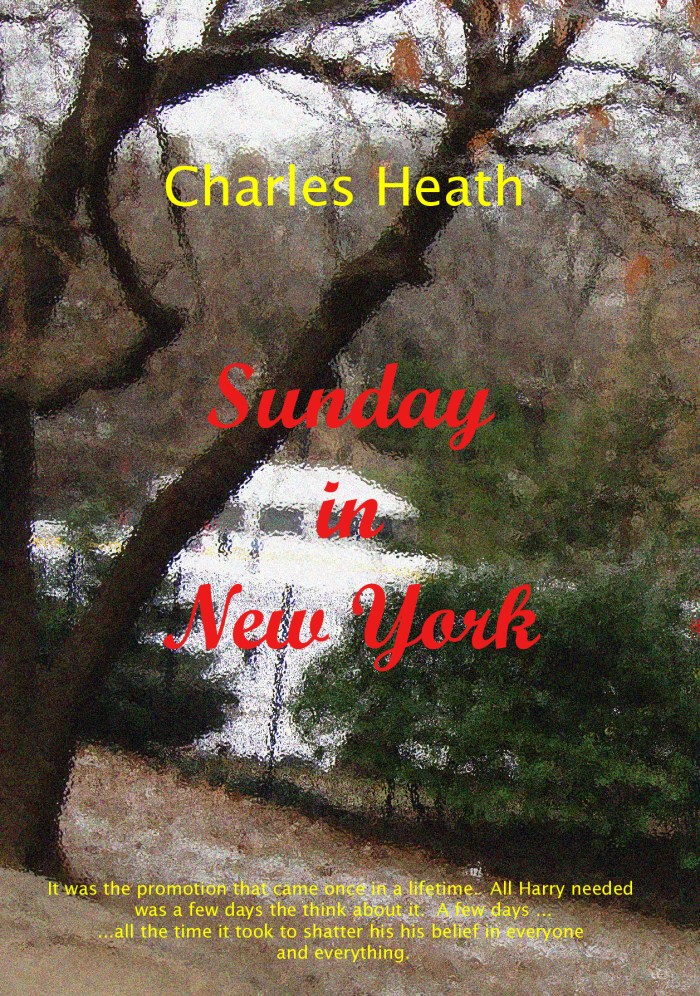
“Sunday in New York”, a romantic adventure that’s not a walk in the park!

“Sunday in New York” is ultimately a story about trust, and what happens when a marriage is stretched to its limits.

When Harry Steele attends a lunch with his manager, Barclay, to discuss a promotion that any junior executive would accept in a heartbeat, it is the fact his wife, Alison, who previously professed her reservations about Barclay, also agreed to attend, that casts a small element of doubt in his mind.

From that moment, his life, in the company, in deciding what to do, his marriage, his very life, spirals out of control.

There is no one big factor that can prove Harry’s worst fears, that his marriage is over, just a number of small, interconnecting events, when piled on top of each other, points to a cataclysmic end to everything he had believed in.

Trust is lost firstly in his best friend and mentor, Andy, who only hints of impending disaster, Sasha, a woman whom he saved, and who appears to have motives of her own, and then in his wife, Alison, as he discovered piece by piece damning evidence she is about to leave him for another man.

Can we trust what we see with our eyes or trust what we hear?

Haven’t we all jumped to conclusions at least once in our lives?

Can Alison, a woman whose self-belief and confidence is about to be put to the ultimate test, find a way of proving their relationship is as strong as it has ever been?

As they say in the classics, read on!

Purchase:

http://tinyurl.com/Amazon-SundayInNewYork

“Echoes From The Past”, the past doesn’t necessarily stay there


What happens when your past finally catches up with you?

Christmas is just around the corner, a time to be with family. For Will Mason, an orphan since he was fourteen, it is a time for reflection on what his life could have been, and what it could be.

Until a chance encounter brings back to life the reasons for his twenty years of self-imposed exile from a life only normal people could have. From that moment Will’s life slowly starts to unravel and it’s obvious to him it’s time to move on.

This time, however, there is more at stake.

Will has broken his number one rule, don’t get involved.

With his nemesis, Eddie Jamieson, suddenly within reach, and a blossoming relationship with an office colleague, Maria, about to change everything, Will has to make a choice. Quietly leave, or finally, make a stand.

But as Will soon discovers, when other people are involved there is going to be terrible consequences no matter what choice he makes.

https://amzn.to/2CYKxu4

newechocover5rs

Writing a book in 365 days – 312/313

Days 312 and 313

Writing exercise – NaNoWriMo month, so start a novel – “The Fourth Son”

It was a clear night, and the stars were out, as well as they could be seen in the city from the roof of my apartment block.

I had wanted to go to Arizona or Montana, where stargazing would be so much better, but Cecily wanted to go on an Ocean Cruise with her parents and just didn’t come back.

That much I learned when I came home from work several weeks later, and every shred of evidence of her was gone.

It was, I guess, time to end what had become a stagnant relationship, but even so, it didn’t help to see the photos of her new boyfriend, a prince from one of those minor European Principalities, on Facebook and in the magazines.

She could have at the very least sent me a text.  I thought I was owed that much, and perhaps if she had known who I was, it might have been different.

Or not.

I shrugged, took another sip of cold beer, and stared up at the sky.  It was the early hours of the morning, and I had a telescope, a rather good one at that, and often came up to see if I could locate the planets whenever they were in range.

When they were not, a shooting star or a celestial body sufficed, and, failing that, sometimes it was just sitting on the roof, knocking back a six-pack was equally as preferable.

It was the way this night was going.

I heard rustling over by the exit and looked over.  The light wasn’t that distinct, but it wasn’t hard to pick out the shape of another roof visitor, though not the usual suspect.

“Ruth told me this is where you hide from the rest of humanity.”

Female, different voice.  Was this our infamous new apartment dweller?  Old Mary McGinty had passed on, her apartment remaining empty for months, unusually because of a shortage, until one Agatha Morell arrived very early one morning and moved in.

Ruth had been trying to find out who she was, with no success.  No one could because no one had seen her.  Except, it seems, by Agatha’s admission, Ruth.

“Ruth has a vivid imagination.”

“Ruth wishes you would use yours and read the signals.”  She came over, and we shook hands, or more likely touched hands.

I felt a tingling sensation.  The night air was charged with static electricity.  “Ruth and I are just friends.”

“So she tells me.  Home astronomer?”  She had seen the telescope.

“Would be an astronaut.”  I was feeling like being flippant, a trait Ruth sometimes frowned upon.

“Were you too old, too young, underqualified or overqualified?”

“I wish.  Let’s just say I’m thirsty.  Do you drink beer?”

“Of course.”  She took one out of the six-pack, removed the lid like an expert, and drank.

I picked up mine and did the same.

She flopped into the seat by the telescope.  I looked at the telescope, the sky, the new arrival, and sat beside her.

In that glance as I sat, I saw a woman in her mid-thirties, shortish hair coloured red or auburn, an expression that showed she smiled a lot, very fit, and, even in casual clothes, looked very, very attractive.  And unattached, maybe.  There were no rings.

A fitting rival for Ruth, whom I had once declared drop-dead gorgeous.  And the only person in the building who knew who I really was, other than Mary McGinty.

Yes, I got the signals Ruth was sending, and yes, I would have acted on them, but she would be eaten alive by the people who professed to care about me and who had other ideas about whom I should have a relationship with.  And if my identity was discovered, there would be the relentless and intrusive media who would make her life utter hell.

For a few brief moments after Cecily had gone, I thought my invisible handlers had gotten to her.  Or perhaps she met my mother; that would be enough to send anyone packing.

“So, hiding or not, what brings you to the roof?  She had another go at asking the same question.  She was either a politician or a journalist.

“The sky, the beer, a chance to meet inquisitive women.  Your excuse?”

“The sky, the beer, a chance to meet mysterious men.”  She smiled, and an instant shudder went through me.  My instinct was telling me this girl was trouble.

“I assure you I am far from mysterious.”

“Then that dream I had as a child, to be swept off my feet by a prince, is not about to come true?”

My heart rate just went into overdrive, trying to keep my best poker face in place and quell the rising panic.

“Unfortunately, no.”  It took a fraction of a second too long to get that panic inflection in my voice under control.

It elicited a quick and concerned glance from her

A deep breath and then, “I suspect, given the number of actual princes I don’t know of, I would imagine they do not go around sweeping damsels off their feet, except, of course, in Hallmark movies and Mills and Boon paperbacks.”

Her expression changed to one of surprise, perhaps something else.

“And you know this gem of information how?”

“My older sister, who often dreams about being swept off her feet by a prince, though admittedly it would be on the dance floor to a waltz.  She’s actually pretty good.”

A first attempt to deflect and switch subjects.

“Do you dance?”

“Waltz, yes, what that wriggling and uncoordinated swaying like drunken sailors represents, no.  My mother made all of us go to dancing lessons.  Do you?”

I would stick to the truth and improvise until I discovered what she was after.  I could, if I were worried, push the panic button, but that would cause no end of trouble for a great many people.

Perhaps on her part, it was just a poor choice of words.

“Finishing school in Lucerne, Switzerland.  My grandmother thought I needed the rough edges honed off before I returned to civilisation.  Ballroom dancing seemed to be a part of the finishing process.”

Finishing school.  Granddaughter, presumably of Mary McGinty, was more than just a possibility.  But, if it was a cover story, it was a good one.  I tried to remember if Mary had ever mentioned such a granddaughter, and on the fringe of my memory, I remembered her mentioning that her daughter had three children.

“I assume you are Mary’s granddaughter, Agatha, if I’m not mistaken.  You had this thing about red hair, even though it wasn’t, and spent some time working through the colours of the rainbow.  It seemed to vex her.”

Now, it was an interesting shade of auburn blended with black.

“I didn’t realise you were so well acquainted.”  She looked me up and down with more interest.

“She liked talking about you. I got the feeling she would like to have seen you more often.”

“She and mother had this thing, and we suffered as a result of the collateral damage.  Mother died about a month before Gran, leaving us precious little time to be reacquainted.  Then there was the inheritance, tedious and convoluted, with claims and counterclaims, as if we wanted anything to do with it.  We just wanted somewhere to live.”

“A nice place indeed.”

“The luck of the draw.  We could have ended up in a tenement on the Lower East Side.  I’m grateful, and I don’t intend to be or cause trouble.”

“Your sisters are with you?”

“Yes, Bethany and little Diana, though not exactly little any more.  It was the devil’s own job keeping them out of the foster system, but we’re together, and it’s going to stay that way.”

A woman of determination.

“Do you have a job?”

“Yes.  Managing my aunt’s business interests.  I had no idea she had so many fingers in so many pies, as she used to say.  It keeps me amused, along with being a surrogate mother.  This is my first night off, well, it’s not exactly a night off, just repurposing the early hours.”

She finished the bottle of beer, put the empty back in the six-pack, and stood.  “If you find any available princes, tell them I’m looking for one.  A dance partner or whatever. In a couple of weeks, the planets are lining up, so there’s no hurry.”  She smiled.  “Thanks for letting me ramble on.  It feels good to have someone I can talk to at last.”

Then, as quickly as she appeared, she disappeared.

Being as interested as I was in the solar system, and the fact that she had said the planets were going to line up, I checked, and she was right.

It was odd that she knew such random stuff, and since I didn’t believe in coincidences, whether she had interrogated Ruth about me.

Ruth was finally back from the other side of the country, and I went to meet her at the airport.  I did this sometimes to surprise her.

She was suitably surprised when she saw me leaning against a pillar, hands in pockets, surveying each passenger as they came out of the door into the terminal.  Ruth was almost last; a sign she had travelled coach.

She was frowning as she entered the terminal, but that changed to a smile when she saw me.  Like lovers who hadn’t seen each other for a long time, we kissed and hugged.

“I was hoping you’d come.”  The hug lasted longer than usual.  I suspect her business had not gone well.

“Either that or it was another starless night on the roof.”

“I’m glad I rate above astronomy.”

“You always rate above astronomy.  I take it you shunned the airline food?”

She made a face, the one that said, Don’t ask silly questions.

“Good. I have made a reservation at Luigi’s.”

She looked at me thoughtfully, then said, “Agatha.”

“What makes you think that?”

“I’ll tell you over wine and pasta.”

Luigi’s was a small, intimate restaurant, a favourite place for both Ruth and I.

It was the sort of place where one could propose to the love of their life, and it had happened three times when we had been dining there.

She had dropped hints more than once that it was just the sort of place she would like to be proposed to, and if I had been more romantically attached, it would be exactly the place I would use.

And in that moment, looking at her in the subdued lighting and the flickering candlelight, she had never looked so enchanting.  It made me wonder why I was so reticent.  As Agatha had said, the planets were lined up, and what other reason did I need?

I guess it was the fallout from making such a decision when so much was expected of me, one that would cause my parents’ consternation, though eventually there would be reluctant acceptance, but in that period between proposal and acceptance, they would have destroyed the romance and the very essence of a girl who simply wanted to be loved.

The truth is, love would not be enough.  Not being in the constant limelight, and the intrusion into every facet of her life.  I’d seen it happen to my next eldest brother, choosing a girl for love, and it had broken both of them.  It was why I was hiding, accepting anonymity for as long as possible.

And I knew it was not going to last much longer.  A recent Sunday magazine feature on my family and the country, celebrating 800 years of royal rule, had an early photo of me in a family portrait, but the resemblance between then and now was discernible, if someone was looking.

Ruth had seen it and had remarked on how adorable I was as a child.  I had no such recollection.  It was more like the youngest boy that I was the figurative punching bag for my elder brothers.

Enough staring into each other’s eyes and wishing everything could be different.

“Have you met Agatha?  Yes, of course you have.  She is what some would call a force of nature.”

“She invaded my astronomy space.”

“The roof belongs to everyone.”

I shook my head.  “I guess I had a good run.  I’ll have to find somewhere else to hide.”

“What did you think of her?”

“Trouble.  I think she knows who I am.”

She gave me one of those looks, the one that said I spent too much time worrying about what might happen rather than concentrating on what I should be doing.

“I didn’t tell her, and I doubt Mary ever would.  She knew the importance of keeping your identity a secret.”

“She may have seen the paper.  They might have had the decency to tell me what was about to happen, or perhaps it was part of the plan to get me to come home.  Did she ask about me?”

“You’re not exactly a presence that could be ignored, and she is of an age and availability that she would ask about you.  I simply told her you were the shy, retiring type who preferred to keep to yourself.  When she asked if we were, you know, I said I liked to think so.  She was interested.”

“Then I didn’t help my cause.”

She took both my hands in hers.  “You are going to have to decide what it is you want.  You can’t keep drifting.”

“Well, that might be decided for me.  My father is thinking of retiring, and the consequent reshuffle of responsibilities would mean I would have to return.”

“Forever?”

“No, but I would have to become a Prince, and that would mean the end of anonymity.  It would also mean, if I were to keep seeing you, the end of your life that you have now, and I don’t want that to happen to you.”

“Is that why…”

“I saw what it did to my brother, Richard, and the girl he chose for love, and it destroyed them.  I don’t want that to happen to you.”

A strange expression took over her face, her eyes glistened, and a smile appeared.  I knew right in that moment she was everything I wanted, and that what I felt was like the earth moving.

“I can’t ask you to sacrifice your future or life for what could only be described as pure hell.  Aside from what would happen at home.”

“What do you want?”

“It’s not a matter of what I want.  It’s a matter of what is expected.”

“And yet you are here despite all that?”

An interesting point.  Against all their advice and reluctance, they had succumbed to my wishes.

“The fourth son has its advantages.”

Luigi hovered, refilled the glasses with champagne.  I hadn’t ordered it, but he must have sensed something.

“You are the perfect couple, you know.  Drink, talk, I will prepare the perfect meal.”

He gave a little bow, as he did to his favourite customers and then left us.

“We shall visit my parents, and if you survive that, then I will do what I should have done months ago.  If that is you’ll have me?”

“You had me the first time I met you.  Yes, yes and yes.”

It was a sublime moment.

Until….

I looked up and saw a rather tenacious-looking woman staring down at me.

“You’re that prince something or other that was in the paper.”

That was followed by camera flashes, and the moment I had dreaded had arrived.

©  Charles Heath  2025

An excerpt from “What Sets Us Apart”, a mystery with a twist

See the excerpt from the story below, just a taste of what’s in store…

http://amzn.to/2Eryfth

whatsetscover

McCallister was old school, a man who would most likely fit in perfectly campaigning on the battlefields of Europe during the Second World War. He’d been like a fish out of water in the army, post-Falklands, and while he retired a hero, he still felt he’d more to give.

He’d applied and was accepted as head of a SWAT team, and, watching him now as he and his men disembarked from the truck in almost military precision, a look passed between Annette, the police liaison officer, and I that said she’d seen it all before. I know I had.

There was a one in four chance his team would be selected for this operation, and she had been hoping it would be one of the other three. While waiting for them to arrive she filled me in on the various teams. His was the least co-operative, and the more likely to make ad-hoc decisions rather than adhere to the plan, or any orders that may come from the officer in charge.

This, she said quite bluntly, was going to end badly.

I still had no idea why Prendergast instructed me to attend the scene of what looked to be a normal domestic operation, but as the nominated expert in the field in these types of situations, it was fairly clear he wasn’t taking any chances. It was always a matter of opinion between us, and generally I lost.

In this case, it was an anonymous report identifying what the authorities believed were explosives in one of the dockside sheds where explosives were not supposed to be.

The only reason why the report was given any credence was the man, while not identifying himself by name, said he’d been an explosive expert once and recognized the boxes. That could mean anything, but the Chief Constable was a cautious man.

With his men settled and preparing their weapons, McCallister came over to the command post, not much more than the SUV my liaison and I arrived in, with weapons, bulletproof vests, and rolls of tape to cordon off the area afterward. We both had coffee, steaming in the cold early morning air. Dawn was slowly approaching and although rain had been forecast it had yet to arrive.

A man by the name of Benson was in charge. He too had groaned when he saw McCallister.

“A fine morning for it.” McCallister was the only enthusiastic one here.

He didn’t say what ‘it’ was, but I thought it might eventually be mayhem.

“Let’s hope the rain stays away. It’s going to be difficult enough without it,” Benson said, rubbing his hands together. We had been waiting for the SWAT team to arrive, and another team to take up their position under the wharf, and who was in the final stages of securing their position.

While we were waiting we drew up the plan. I’d go in first to check on what we were dealing with, and what type of explosives. The SWAT team, in the meantime, were to ensure all the exits to the shed were covered. When I gave the signal, they were to enter and secure the building. We were not expecting anyone inside or out, and no movement had been detected in the last hour since our arrival and deployment.

“What’s the current situation?”

“I’ve got eyes on the building, and a team coming in from the waterside, underneath. Its slow progress, but they’re nearly there. Once they’re in place, we’re sending McKenzie in.”

He looked in my direction.

“With due respect sir, shouldn’t it be one of us?” McCallister glared at me with the contempt that only a decorated military officer could.

“No. I have orders from above, much higher than I care to argue with, so, McCallister, no gung-ho heroics for the moment. Just be ready to move on my command, and make sure you have three teams at the exit points, ready to secure the building.”

McCallister opened his mouth, no doubt to question those orders, but instead closed it again. “Yes sir,” he muttered and turned away heading back to his men.

“You’re not going to have much time before he storms the battlements,” Benson quietly said to me, a hint of exasperation in his tone. “I’m dreading the paperwork.”

It was exactly what my liaison officer said when she saw McCallister arriving.

The water team sent their ‘in position’ signal, and we were ready to go.

In the hour or so we’d been on site nothing had stirred, no arrivals, no departures, and no sign anyone was inside, but that didn’t mean we were alone. Nor did it mean I was going to walk in and see immediately what was going on. If it was a cache of explosives then it was possible the building was booby-trapped in any number of ways, there could be sentries or guards, and they had eyes on us, or it might be a false alarm.

I was hoping for the latter.

I put on the bulletproof vest, thinking it was a poor substitute for full battle armor against an exploding bomb, but we were still treating this as a ‘suspected’ case. I noticed my liaison officer was pulling on her bulletproof vest too.

“You don’t have to go. This is my party, not yours,” I said.

“The Chief Constable told me to stick to you like glue, sir.”

I looked at Benson. “Talk some sense into her please, this is not a kindergarten outing.”

He shrugged. Seeing McCallister had taken all the fight out of him. “Orders are orders. If that’s what the Chief Constable requested …”

Madness. I glared at her, and she gave me a wan smile. “Stay behind me then, and don’t do anything stupid.”

“Believe me, I won’t be.” She pulled out and checked her weapon, chambering the first round. It made a reassuring sound.

Suited up, weapons readied, a last sip of the coffee in a stomach that was already churning from nerves and tension, I looked at the target, one hundred yards distant and thought it was going to be the longest hundred yards I’d ever traversed. At least for this week.

A swirling mist rolled in and caused a slight change in plans.

Because the front of the buildings was constantly illuminated by large overhead arc lamps, my intention had been to approach the building from the rear where there was less light and more cover. Despite the lack of movement, if there were explosives in that building, there’d be ‘enemy’ surveillance somewhere, and, after making that assumption, I believed it was going to be easier and less noticeable to use the darkness as a cover.

It was a result of the consultation, and studying the plans of the warehouse, plans that showed three entrances, the main front hangar type doors, a side entrance for truck entry and exit and a small door in the rear, at the end of an internal passage leading to several offices. I also assumed it was the exit used when smokers needed a break. Our entry would be by the rear door or failing that, the side entrance where a door was built into the larger sliding doors. In both cases, the locks would not present a problem.

The change in the weather made the approach shorter, and given the density of the mist now turning into a fog, we were able to approach by the front, hugging the walls, and moving quickly while there was cover. I could feel the dampness of the mist and shivered more than once.

It was nerves more than the cold.

I could also feel rather than see the presence of Annette behind me, and once felt her breath on my neck when we stopped for a quick reconnaissance.

It was the same for McCallister’s men. I could feel them following us, quickly and quietly, and expected, if I turned around, to see him breathing down my neck too.

It added to the tension.

My plan was still to enter by the back door.

We slipped up the alley between the two sheds to the rear corner and stopped. I heard a noise coming from the rear of the building, and the light tap on the shoulder told me Annette had heard it too. I put my hand up to signal her to wait, and as a swirl of mist rolled in, I slipped around the corner heading towards where I’d last seen the glow of a cigarette.

The mist cleared, and we saw each other at the same time. He was a bearded man in battle fatigues, not the average dockside security guard.

He was quick, but my slight element of surprise was his undoing, and he was down and unconscious in less than a few seconds with barely a sound beyond the body hitting the ground. Zip ties secured his hands and legs, and tape his mouth. Annette joined me a minute after securing him.

A glance at the body then me, “I can see why they, whoever they are, sent you.”

She’d asked who I worked for, and I didn’t answer. It was best she didn’t know.

“Stay behind me,” I said, more urgency in my tone. If there was one, there’d be another.

Luck was with us so far. A man outside smoking meant no booby traps on the back door, and quite possibly there’d be none inside. But it indicated there were more men inside, and if so, it appeared they were very well trained. If that were the case, they would be formidable opponents.

The fear factor increased exponentially.

I slowly opened the door and looked in. A pale light shone from within the warehouse itself, one that was not bright enough to be detected from outside. None of the offices had lights on, so it was possible they were vacant. I realized then they had blacked out the windows. Why hadn’t someone checked this?

Once inside, the door closed behind us, progress was slow and careful. She remained directly behind me, gun ready to shoot anything that moved. I had a momentary thought for McCallister and his men, securing the perimeter.

At the end of the corridor, the extent of the warehouse stretched before us. The pale lighting made it seem like a vast empty cavern, except for a long trestle table along one side, and, behind it, stacks of wooden crates, some opened. It looked like a production line.

To get to the table from where we were was a ten-yard walk in the open. There was no cover. If we stuck to the walls, there was equally no cover and a longer walk.

We needed a distraction.

As if on cue, the two main entrances disintegrated into flying shrapnel accompanied by a deafening explosion that momentarily disoriented both Annette and I. Through the smoke and dust kicked up I saw three men appear from behind the wooden crates, each with what looked like machine guns, spraying bullets in the direction of the incoming SWAT members.

They never had a chance, cut down before they made ten steps into the building.

By the time I’d recovered, my head heavy, eyes watering and ears still ringing, I took several steps towards them, managing to take down two of the gunmen but not the third.

I heard a voice, Annette’s I think, yell out, “Oh, God, he’s got a trigger,” just before another explosion, though all I remember in that split second was a bright flash, the intense heat, something very heavy smashing into my chest knocking the wind out of me, and then the sensation of flying, just before I hit the wall.

I spent four weeks in an induced coma, three months being stitched back together and another six learning to do all those basic actions everyone took for granted. It was twelve months almost to the day when I was released from the hospital, physically, except for a few alterations required after being hit by shrapnel, looking the same as I always had.

But mentally? The document I’d signed on release said it all, ‘not fit for active duty; discharged’.

It was in the name of David Cheney. For all intents and purposes, Alistair McKenzie was killed in that warehouse, and for the first time ever, an agent left the Department, the first to retire alive.

I was not sure I liked the idea of making history.

© Charles Heath 2016-2020

In a word: Quick

Go get your stuff and be quick about it.

I’ve tried on many occasion to be quick, but it’s like my shoes have lead soles, or it’s like walking through water.

Perhaps I should just stop finding excuses and admit it’s old age and I am slowing down!

I’m guessing that in using the expressing the quick and the dead, I’ve got one foot in the grave.

But when you use the word quick it generally means moving fast or doing something at a rapid rate.

It could also refer to someone who picks up knowledge rapidly, that is to say, that boy is quick, maybe quick as a flash.

I’ve been cut to the quick. An interesting expression which basically means you’ve been hurt very badly.

It also makes reference to the more sensitive side to us, hence the above expression.

It has a more literal meaning, referring to the quick, under your fingernails, and you know how much that hurts when you cut the nail too short, or remove the nail from the quick.

And like most of us, I’ve been caught more than once in metaphorical quicksand.

It doesn’t pay to go near or test out what real quicksand is, but if you have to, make sure you tie yourself to an anchored rope first.

Harry Walthenson, Private Detective – the second case – A case of finding the “Flying Dutchman”

What starts as a search for a missing husband soon develops into an unbelievable story of treachery, lies, and incredible riches.

It was meant to remain buried long enough for the dust to settle on what was once an unpalatable truth, when enough time had passed, and those who had been willing to wait could reap the rewards.

The problem was, no one knew where that treasure was hidden or the location of the logbook that held the secret.

At stake, billions of dollars’ worth of stolen Nazi loot brought to the United States in an anonymous tramp steamer and hidden in a specially constructed vault under a specifically owned plot of land on the once docklands of New York.

It may have remained hidden and unknown to only a few, if it had not been for a mere obscure detail being overheard …

… by our intrepid, newly minted private detective, Harry Walthenson …

… and it would have remained buried.

Now, through a series of unrelated events, or are they, that well-kept secret is out there, and Harry will not stop until the whole truth is uncovered.

Even if it almost costs him his life.  Again.

PI Walthenson’s second case – A case of finding the ‘Flying Dutchman’.

Known only to a few, there is a legend that a ship named the ‘Flying Dutchman’ left Nazi Germany in the last weeks of the war and set sail for America, escorted by U-boats, under a different name. Aboard was a trove of treasure and gold worth a ‘king’s ransom’.

It was said that it had been sent to a group of American Nazis to create the Fourth Reich at an appropriate time. Over the years since many expeditions off the coast had searched, but found no trace of the vessel or the treasure.

In other words, it was just a legend created to boost tourism.

Fast forward to 2024. Our intrepid private detective, Harry Walthenson, overhears a conversation at Grand Central Station. It was the oddness of the message that caught his attention. An investigation turned up nothing out of the ordinary, and he thinks no more about it.

Then Harry is kidnapped, interrogated, and asked questions over and over about a date and a place, why he went there, and when he could not give satisfactory answers, he was beaten half to death and left for dead on a rubbish heap. He was lucky that it was a living space for homeless men; otherwise, he would have died.

In the aftermath, he once again gives it no more thought.

After resolving his first case successfully, there’s no rest. Harry’s angry mother comes to his office and demands that he find out where his father has gone. She believes he has run off with a mistress, not for the first time.

Perhaps it was not the wisest decision she has made, because Harry promises to investigate, and adds that she might not like what he finds.

He soon discovered he does not like what he finds, that his father’s friends, a cabal formed at University, have two who are his mother’s current lovers, and another, a criminal blackmailing his father.

Felicity, now his partner, working on a different case, and trying to get answers, uncovers a crime family involved in guarding a disused warehouse on the docks, where she believes Harry had been taken for interrogation, and subsequently dumped nearby to die.

Why are they up to? What is so important that the empty warehouse needs guarding? Who is employing them?

Harry, following up on the death of the blackmailer, traces his death back to an enforcer employed by his grandfather. His mother’s grandfather was a pre-war industrialist who made his fortune in war munitions and shipbuilding.

He was also a member of the American Nazi party.

When Harry also discovers a logbook belonging to a so-called wartime Liberty ship the “Paul Revere” in brackets ‘Freiheitskämpfer’, hidden by his father, and written in a code that is not readily identifiable.

It is no longer a matter of a father who has run off with his mistress; it is a very frightened man in fear of his life, running from a group who will stop at nothing to get the logbook back. And when Harry discovers a family connection to the group, it becomes a race against time to decode the log and find his father before his grandfather does.

Coming soon: Harry Walthenson’s new adventure – A case of finding the ‘Flying Dutchman’

NANOWRIMO – November 2025 – Day 25

The Third Son of a Duke

In all the investigation of Melbourne of 1915, the more I realised that if we never go looking, we will never find out what history is, what was good, what was bad, what were the prevailing attitudes of the time.

IT gives credence to a few odd sayings I’ve heard over time, ones that are viewed with a great deal of distaste these days, but fifty, seventy, eighty years ago, they were part of what we grew up with.

The thing is, women had it very tough.  That saying you hear a lot, even these days, is ‘it’s a man’s world’, and to a certain degree it is.  Back when I was looking, women could only work until they were married, when it was expected they would stay home, and, dare I say it, attend to the man’s needs.

I have a schoolbook of my mother’s, which she used in 1942, and the back pages are filled with notes on how she was supposed to attend to her husband’s needs.

I showed it to my granddaughters, and they were totally gobsmacked.

This is the thing about the past, and it can be a problem for writers who, if they do not know about the past, can make some fatal flaws in their writing, assuming today’s standards applied back then.

Also, back then, society was very judgmental about a woman’s virtue, and there was very little she could do without society frowning on her or turning her into a pariah.  This was much the same until the sixties, when a lot of that went out the window.

Back in 1915, wow, straight laces and very well behaved. 

However, I suspect, what went on behind closed doors was a different story.

1995 words, for a total of 41245 words.

Writing about writing a book – Day 29

It is hard sometimes to keep the lid on what might be called justification of your position in a company where there are many naysayers and little support from those who are supposed to be working together towards a single conclusion.

Not work against you, or have their own agenda, not only to further their career on the back of your mistakes but take the credit for all your hard work.

Every company has them.

I’ve worked in a few where this has happened, but the deciding factor of whether they’re successful or not is when they have to stand on their own two feet when the source of their reputed good work suddenly is unavailable, and the shit hits the proverbial fan.

What is it called?  Art imitates life.

Benton is the proverbial leader who takes credit, but when it comes to the crunch, can’t pull the rabbit out of the hat.

I guess in writing this little piece, I was subconsciously getting back at someone from a real, but now distant, past.

Perhaps there might be a little more about one of the places I worked cropping up from time to time.

It’s not so much writing about what you know, but writing about what happened, and what you might have wanted to happen.  Invariably it never did, because these credit takers are a cunning lot, and sometimes lay the foundations for getting out from under when there is a disaster.

Unfortunately, I’ve been there too.

It’s called cutting your nose off to spite your face.

Be that as it may, I let this little vent run and see where it goes.

It was my responsibility since I’d recommended it and then won the support of management over his objections, and following that it had become a point of continual contention, a petty war neither of us was going to win.

I tried to keep the joy out of my voice.  He’d also vetoed my recommendation for a full-time network engineer as my alternative, making my job become single-point sensitive.  There was no one to replace me if anything went wrong.

“Sounds like you’re having fun.”  I had to work hard to keep the amusement out of my tone.

“Fun nothing.”  His tone was reaching that exasperation point.  “There is no one else.”

“Why did you approve my holiday if I can’t have one?” I’d stretch his patience just a little more.

“You promised me the network was stable.”

“It is, and has been for the last six months.  I’ve said so in my last six-monthly reports.  You have been reading them, haven’t you?”

Silence.  It said all I needed to know.

I had a choice sentence to deliver, but an ignominious thought popped into my head.  He could probably use this against me, and would if I gave him the opportunity.  Perhaps I should shelve my differences with him for this morning.

Aside from that, there was a shooting, and we didn’t get one of those every day.  Not that it would probably amount to very much.  During the previous week, the office grapevine had been working overtime on the rumour Richardson was having a relationship with one of the ladies in the Accounts department.  It was just the sort of scandal the data entry staff thrived on.

A shooting and a network failure.  I didn’t know which was worse.  Perhaps if it was Benton they’d shot, there might be some justice…

I decided not to argue with him.  “Give me an hour.”

“Half.  Aitchison wants to see you.”

Werner Aitchison was head of Internal Security and a man who took his job seriously.  Enough, that is, to annoy my staff, and me.  He was ex-military intelligence, so ‘they’ said, but he appeared to me like a man out of his depth in this new age of communications.  Computers had proliferated in our company over the last few years, and the technology to go with them spiralling out of control.

We dealt in billions via financial transactions processed on computers, computers which, we were told often enough, were insecure, and easily taken control of outside their environment.  Aitchison was paranoid, and rightly so, but he had a strange way of going about his business.  He and I had butted heads on many occasions, and we may have had our disagreements, but we were good friends and colleagues outside work.

Just in case Benton was accusing me, I said, as sincerely as I could, “I didn’t do it.”

“Of that, I have no doubt.  He has requested a meeting with you at 10 am.  You will be there.”

“I said I would come in to look at the problem.  I didn’t say I was staying.”

“Let me know when you get in.”  That was it.  No ifs.  No buts.  Just a simple, ‘Let me know…’

I seriously considered ignoring him, but somewhere within me, there was that odd sense of loyalty.  Not to Benton, not to the Company, but to someone else, the man who had given me the job in the first place, who had given me every opportunity.

I was doing it for him and would tell him.

When I found out who it was!

© Charles Heath 2016-2025