Inspiration, maybe – Volume 1

50 photographs, 50 stories, of which there is one of the 50 below.

They all start with –

A picture paints … well, as many words as you like.  For instance:
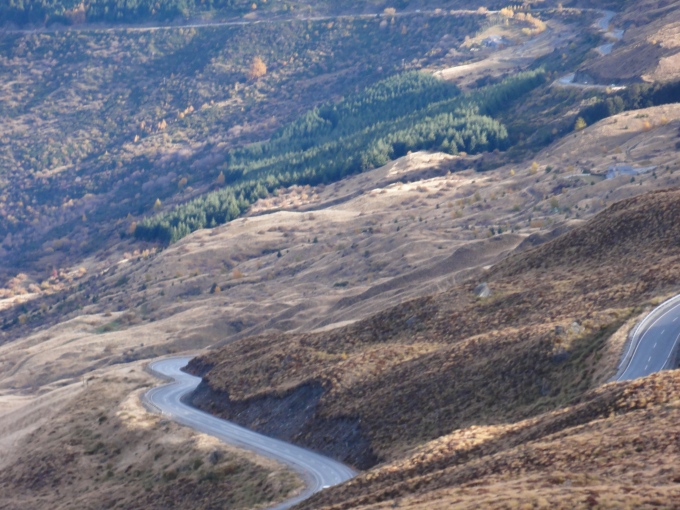
lookingdownfromcoronetpeak

And the story:

It was once said that a desperate man has everything to lose.

The man I was chasing was desperate, but I, on the other hand, was more desperate to catch him.

He’d left a trail of dead people from one end of the island to the other.

The team had put in a lot of effort to locate him, and now his capture was imminent.  We were following the car he was in, from a discrete distance, and, at the appropriate time, we would catch up, pull him over, and make the arrest.

There was nowhere for him to go.

The road led to a dead-end, and the only way off the mountain was back down the road were now on.  Which was why I was somewhat surprised when we discovered where he was.

Where was he going?

“Damn,” I heard Alan mutter.  He was driving, being careful not to get too close, but not far enough away to lose sight of him.

“What?”

“I think he’s made us.”

“How?”

“Dumb bad luck, I’m guessing.  Or he expected we’d follow him up the mountain.  He’s just sped up.”

“How far away?”

“A half-mile.  We should see him higher up when we turn the next corner.”

It took an eternity to get there, and when we did, Alan was right, only he was further on than we thought.”

“Step on it.  Let’s catch him up before he gets to the top.”

Easy to say, not so easy to do.  The road was treacherous, and in places just gravel, and there were no guard rails to stop a three thousand footfall down the mountainside.

Good thing then I had the foresight to have three agents on the hill for just such a scenario.

Ten minutes later, we were in sight of the car, still moving quickly, but we were going slightly faster.  We’d catch up just short of the summit car park.

Or so we thought.

Coming quickly around another corner we almost slammed into the car we’d been chasing.

“What the hell…” Aland muttered.

I was out of the car, and over to see if he was in it, but I knew that it was only a slender possibility.  The car was empty, and no indication where he went.

Certainly not up the road.  It was relatively straightforward for the next mile, at which we would have reached the summit.  Up the mountainside from here, or down.

I looked up.  Nothing.

Alan yelled out, “He’s not going down, not that I can see, but if he did, there’s hardly a foothold and that’s a long fall.”

Then where did he go?

Then a man looking very much like our quarry came out from behind a rock embedded just a short distance up the hill.

“Sorry,” he said quite calmly.  “Had to go if you know what I mean.”

I’d lost him.

It was as simple as that.

I had been led a merry chase up the hill, and all the time he was getting away in a different direction.

I’d fallen for the oldest trick in the book, letting my desperation blind me to the disguise that anyone else would see through in an instant.

It was a lonely sight, looking down that road, knowing that I had to go all that way down again, only this time, without having to throw caution to the wind.

“Maybe next time,” Alan said.

“We’ll get him.  It’s just a matter of time.”

© Charles Heath 2019-2021

Find this and other stories in “Inspiration, maybe”  available soon.

InspirationMaybe1v1

Writing about writing a book – Day 24

Time to put the team back together, well, sort of.

We’ve been given the introduction to who Barry McDougall is, or the man otherwise known as ‘Brainless’, and after three days of trying to get it straight, this is the first rough draft of his start in the story.

…

Barry, whose daring selfless deeds earned him the nickname Brainless because that was the only way to describe the motivation behind them, was one of the regular soldiers, and, for a long time, had been my only true friend.  His was a reputation both friends and foes alike considered awesome.  He’d been in Vietnam, and later just turned up at Davenport’s camp, reporting for duty.

Davenport was more surprised than I was at his arrival, but obviously, after checking his credentials, was impressed because he let him stay.  And it would be true to say, if he had not, I would not be here now.

So Barry was just the sort of person I needed to help me.

That was the good news.

The bad news was Barry, at the best of times, either on one of his ‘benders’ using drugs or alcohol, whatever was easier to get at the time, lost to everyone, or locked up in a mental institution, having admitted himself.  He had no interest in participating in life, hadn’t worked in years, and often said, in moments when he was at his lowest, that he did not care if he lived or died.  It had not always been that way, but his demons had all but taken him over, and despite the help, I tried to give him, nothing could shake him out of this lethargy.  He said once he envied me that I could not remember the dark days, and, now those memories had returned, I knew what he meant.

For a long time, I could not understand why he didn’t try harder to help himself, and I guess he humored me by accepting the jobs I’d found him, and the help I offered.  I owed him a great deal, but that was probably the one honorable thing about him, he never expected, nor wanted, anything in return.

He tried to make a go of being a police officer and lasted several years before he resigned over an incident that didn’t reach the papers.  There was, he said, no place for heroics in modern society.  I hadn’t got to the bottom of it, but I heard he shot some thieves at a time when the police were trying to promote a pacifist image.

He tried a few other occupations with an equal lack of success, so now he survived on whatever money I gave him.  He lived on the street, and when he was not there, I knew he could be found in a bar, in one of the more seedier parts of the city, a ubiquitous underground bar called Jackson’s, named after a man who had a salubrious reputation that hovered between load shark and saint, and who was reputed to be buried under the storeroom floor.  The present owner, or what I assumed to be the owner, was a large, gruff, ex-prizefighter, who had the proverbial heart of gold, most of the time, and who took my money and looked after Barry without making it look like he was.

I’d called the bartender in advance, and he said he was in his usual spot, and that it was at the start of the next cycle, having just discharged himself from the hospital after a bout of pneumonia.  It was, he said, getting worse, and taking longer to recover.

It was probably only a matter of time before it took him, so perhaps this time I would have to try harder to convince him to give up his nomadic lifestyle.

When I walked in, the aroma of spilled beer, stale sweat, and vomit, mingled with the industrial-strength carbolic cleaner almost took my breath away.  In the corner, two construction workers were sitting, quietly smoking and drinking large glasses of beer.  In the other, Barry was being held up by the table, an untouched double scotch sitting in front of him.  Sitting at the bar was a woman of indeterminate age, badly made up, and thin to the point of emaciation.  I was not sure what she was drinking, or what it was she was smoking, but I could smell it from the front doorway.

The bartender, Ogilvy, no first name given, was pretending to polish glasses, standing at the end of the bar, looking at the television, playing some daytime soap.  He didn’t look over when I came in, but I knew he didn’t miss anything.  I saw him flick a glance at Barry, and then shake his head.  I think he cared as much about Barry as I did, but could recognize the sadness within him.  As much as Ogilvy said, which wasn’t much, he too had seen service in Vietnam, and it had affected him too.

I ordered an orange juice, caught the glances from the construction workers, and a steely look from the woman then went over to Barry’s table and sat down.  Despite the loud scraping noise when I moved the chair, or the creaking as I sat in it, Barry didn’t move.

Whilst the bar had that seedy aroma, Barry was showing the signs of having spent the time on the street.  It was one of the disadvantages of having no permanent residence and though there was a shower at the bar which Ogilvy let Barry use from time to time, he obviously hadn’t for a few days.

A groan emanated from the table, and Barry moved his head slightly.

I shifted the drink in front of him, and then a hand went out and moved it back.  He lifted his head to look at me, and then lowered it again.

“I thought it was you.”

© Charles Heath 2016-2021

It’s all about the Cover

And, of course, the description.

Probably one of the hardest things for a first-time author is not so much the writing but what is needed after the book is written.

You need a good description.  Short, sharp, incisive!

There’s a ream of advice out there, and I have read it all.

And, still, I got it wrong.

Then there is the cover.

I wanted simplistic, a short description to give the reader a taste of what’s in store, and let the story speak for itself.

No.

Apparently, a good cover will attract the reader to the book.

When I tendered my books on various sites to advertise them, sites such as Goodreads, and ThirdScribe, all was well with what I had done.

Then I submitted my books to a third site and they rejected the covers as too simplistic and the descriptions mundane, and wouldn’t post them.

Wow.

There’s a huge blow to the ego.  And just the sort of advice that would make a writer think twice about even bothering to continue.

But…

Perhaps the person who wrote that critique was being cruel to be kind.

At any rate, I am changing the covers, and rewording the descriptions.

Will it be a case of ‘what a difference a cover makes’?

The cinema of my dreams – I always wanted to see the planets – Episode 9

What’s the worst that could happen?

…

Captains invariably hated the word ‘problem’. I did too, because it conjured up so many different scenarios, each more scarier than the last, and maginified exponentially because we were in space.

We took a closer look, and it was the sort of damage if it was back on Earth, one would associate with weapons fire, lasers to be exact.

Yes, in the 24th century we had ray guns, handheld, and ship bound.

The only problem was, only the cruise class vessels, like the one I was now on, were allowed to have them, and using them, well, the paperwork alone could keep a complement of 20 working day and night for a month.

Test them, yes, less paperwork, use them, no. There had never been a reason to.

But someone had, and on a freighter, which only meant one possibility, that whatever the freighter had been carrying, had been worth violating a thousand regulations and rules.

And bring their ship and selves out into the light.

It was, of course, Space Command’s worst nightmare realised, that the ideal of space exploration as a united effort by everyone, had a member who had decided against unity.

Unless, of course, the improbably had happened, there was life outside our solar system, and we were dealing with a new planet, or people.

Except I would not expect them to use something as conventional as a laser.

Myrtle had put us very close to the damaged area and taken a number of photographs, and the engineer had analysed the damaged area.

Then, cleared to enter the freighter, she took us up to the cargo doors and waited as we watched them open.

It was the same time the engineer’s hand held computer started beeping.

And a warning light on the console in front of Myrtle started flashing, accompanied by a warning klaxon.

Another vessel had just entered our proximity zone.

…

© Charles Heath 2021

“The Document” – a thirty-day revision – Day 27

This book has been written for some time and the manuscript was sitting in a box with half a dozen others gathering dust and not quite as complete, so this month it is going to get the makeover, a first draft for the editor.

And so it begins…

…

All’s well if it ends well

…

Three days to go, so much to do.

Although I’ve reached nearly 62,000 words, much longer than the original 50,000 word target I have not finished the novel, and the plot changes are causing a little consternation.

I know now how it is going to end, but it’s getting there, in three days that’s the problem.

So, back and forth I go, laying the groundwork in the earlier chapters and I now have only one more piece to fix, the words on the document that set the series of events in motion.

Novel writing is exhausting.

The editor’s draft is not going to be the horrible mess covered in post-it notes like the first draft, but after all is said and done it will be a novel that was revised and a lot more coherent in 30 days, a remarkable achievement.

Searching for locations: West Lake, Hangzhou, China

West Lake is a freshwater lake in Hangzhou, China. It is divided into five sections by three causeways. There are numerous temples, pagodas, gardens, and artificial islands within the lake.

Measuring 3.2 kilometers (2 miles) in length, 2.8 kilometers (1.7 miles) in width, and 2.3 meters (7.5 feet) in average depth, the lake spreads itself in an area totaling 6.5 square kilometers (2.5 square miles).

The earliest recorded name for West Lake was the “Wu Forest River”, but over time it changed to two distinct names.  One is “Qiantang Lake”, due to the fact that Hangzhou was called “Qiantang” in ancient times.  The other, “West Lake”, due to the lake being west of the city

It’s about to get busy, with a number of activities planned, and the warmth of the day is starting to make an impact.

The tour starts in the car park about a kilometer away, but the moment we left the car park we were getting a taste of the park walking along a tree-lined avenue.

When we cross the road, once again dicing with death with the silent assassins on motor scooters.

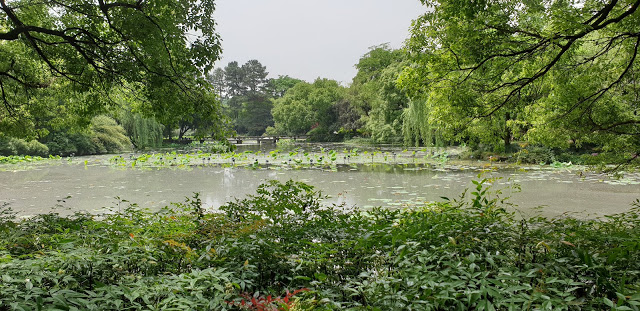
We are in the park proper, and it is magnificent, with flowers, mostly at the start hydrangeas and then any number of other trees and shrubs, some carved into other flower shapes like a lotus.

Then there was the lake and the backdrop of bridges and walkways.

.

And if you can tune out the background white noise the place would be great for serenity and relaxation.

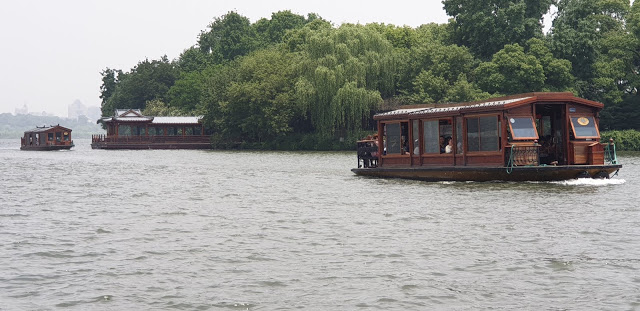
That, in fact, was how the boat ride panned out, about half an hour or more gliding across the lake in an almost silent boat, by an open window, with the air and the majestic scenery.

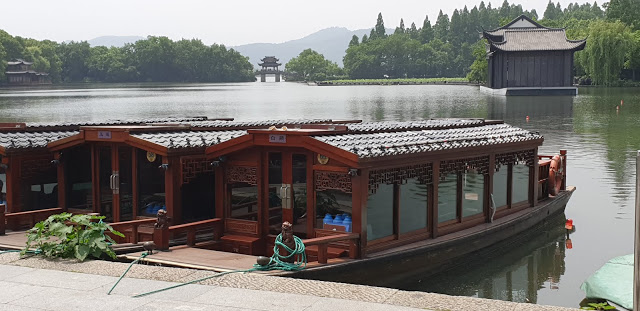
No, not that boat, which would be great to have lunch on while cruising, but the boat below:

Not quite in the same class, but all the same, very easy to tune out and soak it in.

It was peaceful, amazingly quiet, on a summery day

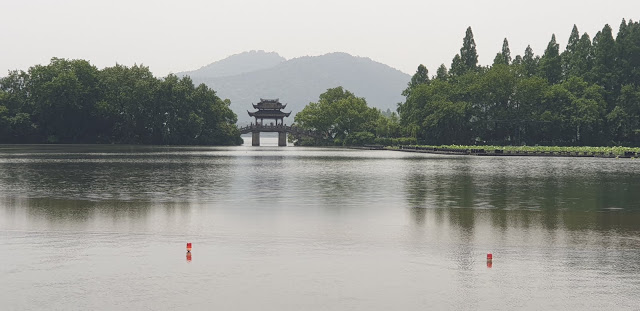
A pagoda in the hazy distance, an island we were about to circumnavigate.

Of all the legends, the most touching one is the love story between Bai Suzhen and Xu Xi’an. Bai Suzhen was a white snake spirit and Xu Xi’an was a mortal man.

They fell in love when they first met on a boat on the West Lake, and got married very soon after.

However, the evil monk Fa Hai attempted to separate the couple by imprisoning Xu Xi’an. Bai Suzhen fought against Fa Hai and tried her best to rescue her husband, but she failed and was imprisoned under the Leifeng Pagoda by the lake.

Years later the couple was rescued by Xiao Qing, the sister of Baisuzhen, and from then on, Bai Suzhen and Xu Xi’an lived together happily.

The retelling of the story varied between tour guides, and on the cruise boat, we had two.  Our guide kept to the legend, the other tour guide had a different ending.

Suffice to say it had relevance to the two pagodas on the far side of the lake.

There was a cafe or restaurant on the island, but that was not our lunch destination.

Nor were the buildings further along from where we disembarked.

All in all the whole cruise took about 45 minutes and was an interesting break from the hectic nature of the tour.

Oh yes, and the boat captain had postcards for sale.  We didn’t buy any.

Lunch

At the disembarkation point there was a mall that sold souvenirs and had a few ‘fast food’ shops, and a KFC, not exactly what we came to China for, but it seemed like the only place in town a food cautious Australian could eat at.

And when tried to get in the door, that’s where at least 3 busloads were, if they were not in the local Starbucks.  Apparently, these were the places of first choice wherever we went.

The chicken supply by the time we got to the head of the line amounted to pieces at 22.5 RMB a piece and nuggets.  Everything else had run out, and for me, there were only 5 pieces left.  Good thing there were chips.

And Starbucks with coffee and cheesecake.

At least the setting for what could have been a picnic lunch was idyllic.

The End is never The End

Can you actually say you know the exact moment a story is done, finished, and that’s it?

For me, the end never quite seems to be the end, that point where you finally draw a line in the sand and say, that’s it, I’m done, step away from the typewriter.

But are we ever satisfied the story is done, can we not make one more change, it’s just a little tweak, it won’t take long.

Please!

My editor tolerated three ‘minor’ changes.

Firstly, a change of name for a character

Secondly, consistency of word use, such as times and contractions

Thirdly, I wasn’t happy with the overall story, and it needed some more action. More writing, more editing, more prevaricating.

It took three weeks to sort out all of those issues, and last night I send the final draft to the Editor.

It’s like watching your child go to school on their first day. Not knowing what will happen but expecting everything will be fine.

This morning I sat in front of the computer, a blank sheet of paper on the screen. I know it’s not a matter of starting the next story from scratch; I have so many started and finished, sitting in the wings to be ‘tinkered with’.

It’s my way of savoring the moment.

Just before I dive back into the murky waters.

The cinema of my dreams – Was it just another surveillance job – Episode 44

I’m back home and this story has been sitting on the back burner for a few months, waiting for some more to be written.

The trouble is, there are also other stories to write, and I’m not very good at prioritizing.

But, here we are, a few minutes opened up and it didn’t take long to get back into the groove.

Chasing leads, maybe


I leaned back in the chair and shuddered.  It was not so much the cold as the stark realization before me, well, before all of us really.

The USB was gone.

But it was going to be impossible to convince any or all of Severin, Maury, and Nobbin.  Or for that matter Monica.  None of them were going to believe the explosion in the café was a deliberate act.  

But it did raise a question.

“How did whoever placed the bomb in the café know you and your contact were going to be there, and, for that matter, that either of you might have the USB?”

O’Connell seemed lost in thought.  After prodding him, I asked the question again.  His hesitation seemed to suggest that what he’d told me might be a lie, or a half-truth because the more I thought about it, the more implausible it sounded.  The other side of that was, what did he have to gain by lying?  Of no doubt, there was more to this story.

“There are more people involved in this than what you know.  Dobbin had me looking into a biological laboratory, one that was reportedly doing research on cures for various coronaviruses, like SARS.  The thing is, they had a store of nasties they were using as candidates for finding cures.

“The laboratory had been getting funding from the military so that to me meant they’d been working on weaponizing one of those nasty viruses, but there had been containment breach leading to a review, and they lost their funding.

“That, in turn, leads to the head of the company seeking funding from elsewhere, and that it was going to be an overseas government institution, one which they claimed commercial confidence so the donor could not be released.  Of course, our intelligence services went into a spin, thinking the worst, that it was either Russia or the Chinese, or some other rogue regime, and if they got their hands on those candidates, well, you can imagine the paranoia.

“There was also the problem of hacking, where various countries and/or individuals are looking for information to use for their own benefit, or to sell to the highest bidder.  That as far as I can tell is what happened here; it was not a case of external hacking, this was internal by one of the staff, downloading sensitive information onto the USB and smuggling it out.

“As soon as the breach was discovered, it triggered an internal review, which had a member of the military on the panel, and it concluded it was one of three ex-employees.  Dobbin gave me the three names, and I tracked them down.  One of the three had stolen the data, but far from stealing it to sell to the highest bidder, he had stolen it to pass on to a newspaper reporter, the person I was going to see.

“He could see the information was not the sort to be disseminated to the general public and wanted it returned.  I was going to get it.

“So, in answer to your question, it was possible that someone else had done the same as I had after I had visited each of the three, and decided to deal with the problem decisively.  But it would have required planning and an organization with infinite resources to pull it off.  Top of my list is the owners of the laboratory, simply because, they were not interested in getting the copy back, and the fact they didn’t want to have any witnesses, which meant the reporter and had to be silenced.”

“And the person who stole the information?”

“Burned to death in a house fire.  The fire department concluded it was a gas leak.”

“Helped by a person or persons unknown.”

“Given the distribution list of that final report, unless Dobbin has been moonlighting as an assassin, there’s only one other name on the list.”

No need to say it out loud.  That left one question, and probably a hundred others that wouldn’t get answers.

“What’s it to do with Severin and Maury?”

“That’s not their names.  Severin is really David Westcott, and Maury is Bernie Salvin.  Both used to be in the security detail at the company about three years ago when several biological entities were being researched, both of whom were assigned by the military to keep an eye on their investment.

“When the accident occurred, they were reassigned, but I suspect, at the time, they knew exactly what had happened, and what is involved.  It’s not a leap to come to the conclusion they had a shift in allegiance and may have helped the person who stole the information because there was no way the person who stole it had the knowledge to get it out.

“It was not something he would tell me.  That, he said, if he told me, would sign his death warrant.”

Which it did.  Was the original thief killed before or after the explosion?

“Do we Assume Severin is the man in charge?”

“No.  They’re basically blunt instruments, giving orders, and doing what they’re told.  We all are, to a certain extent.  This operation had someone else, someone far more clever, and connected.”

“But they did create a whole unit and train them in an existing facility without anyone knowing.”

“Is that you they told you?  And you believed them?  Nothing goes on in that place with an official sanction.  No.  Your operation was created on the books, but on the quiet so if anything went wrong, they could disavow any knowledge of it.  It went south and what happened?”

“They disavowed any knowledge of it.”

“And kept you on, only reassigned?”

“Those of us who survived, yes.”

“Then I suggest you watch your back and keep all of them at arm’s length.  You’ll only be useful until the USB is found, so you have to keep them believing it’s missing.”

“We’re not going to be able to do that forever.”

“No.  Which makes it imperative we find out who Severin and Maury’s bosses are and chop of the head.”

All while pretending he was dead.  Easier said than done.


© Charles Heath 2020-2021

“One Last Look”, nothing is what it seems

A single event can have enormous consequences.

A single event driven by fate, after Ben told his wife Charlotte he would be late home one night, he left early, and by chance discovers his wife having dinner in their favourite restaurant with another man.

A single event where it could be said Ben was in the wrong place at the wrong time.

Who was this man? Why was she having dinner with him?

A simple truth to explain the single event was all Ben required. Instead, Charlotte told him a lie.

A single event that forces Ben to question everything he thought he knew about his wife, and the people who are around her.

After a near-death experience and forced retirement into a world he is unfamiliar with, Ben finds himself once again drawn back into that life of lies, violence, and intrigue.

From London to a small village in Tuscany, little by little Ben discovers who the woman he married is, and the real reason why fate had brought them together.

It is available on Amazon here:  http://amzn.to/2CqUBcz

Searching for locations: The canals of Suzhou, China

This morning is a boat ride that will take us along a small portion of the main canal, and we head through a number of back streets, to a landing where there are a number of boats all vying with each other to get us passengers on boats.

But…

These boats don’t have a wharf to tie up to and then put out a stable gangplank.  No.  They just more into a concrete step and you take your life in your hands getting on.  One wrong step and you’re in the canal.  And not a very clean one at that.

That’s if another boat doesn’t come along and bumps you, knocking you off balance.  We managed not to lose anyone in boarding the vessel.

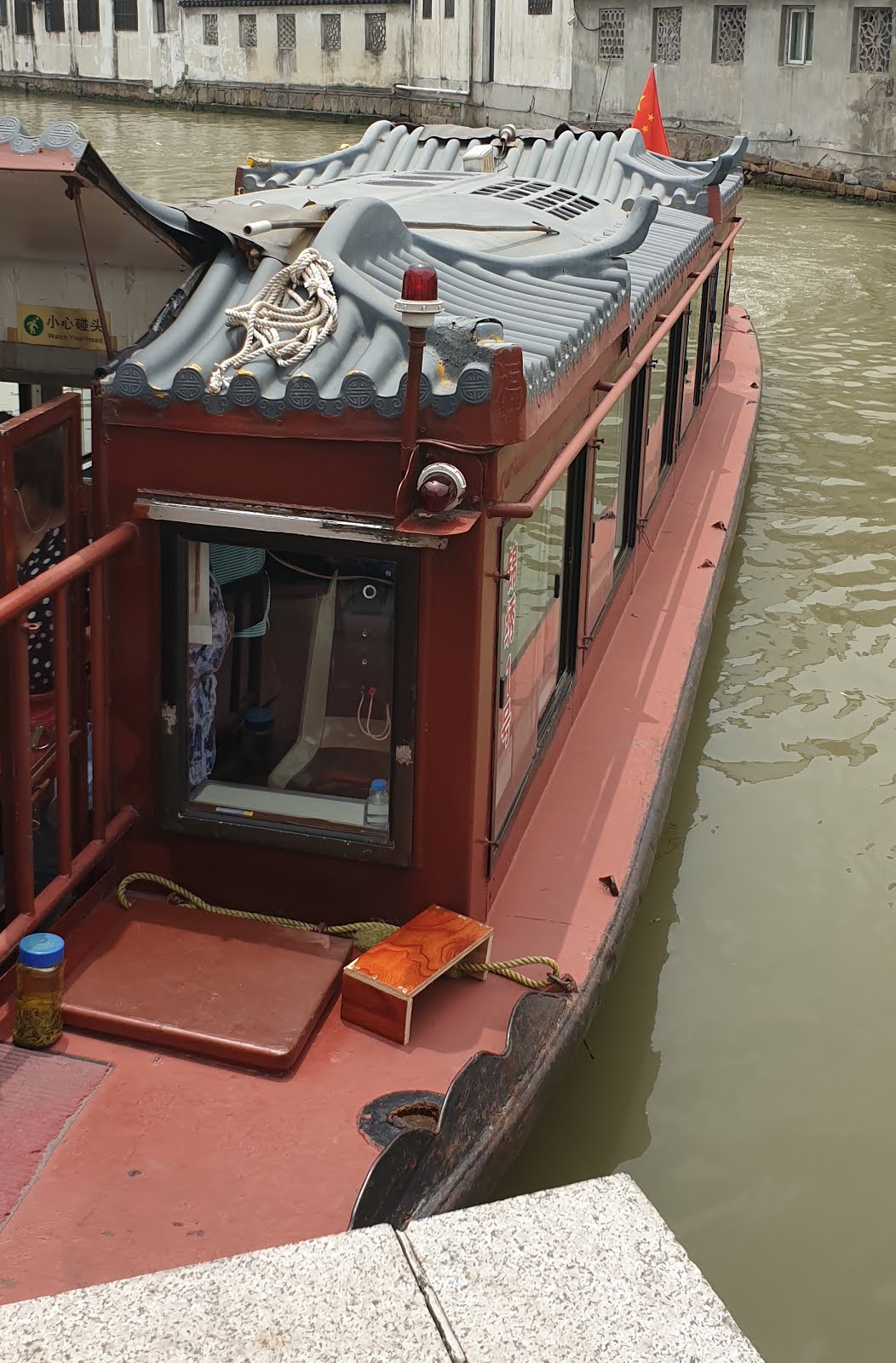
This is where we get on the boat

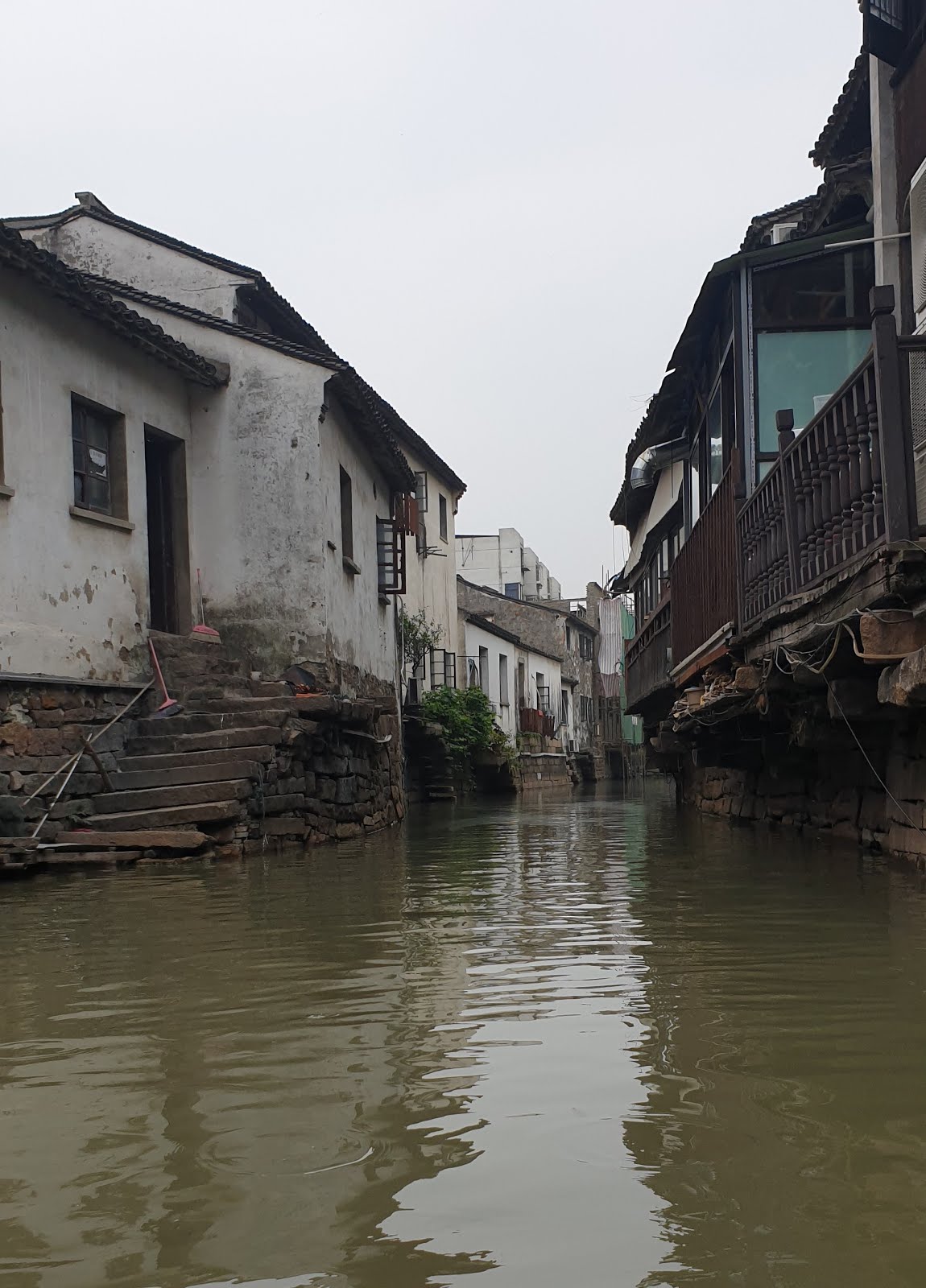
We go along what appears to be downstream towards another larger canal, past tree-lined streets until the canal narrows and we’re looking at the backs of houses, which look very dilapidated.

And the canals?  Well, it’s not quite like it is in Venice

Though some parts of the canal look better than others

What doesn’t bear thinking about is the electrical wiring which is a nightmarish spider web of cables going off in all directions.  How anyone could troubleshoot problems is beyond me.

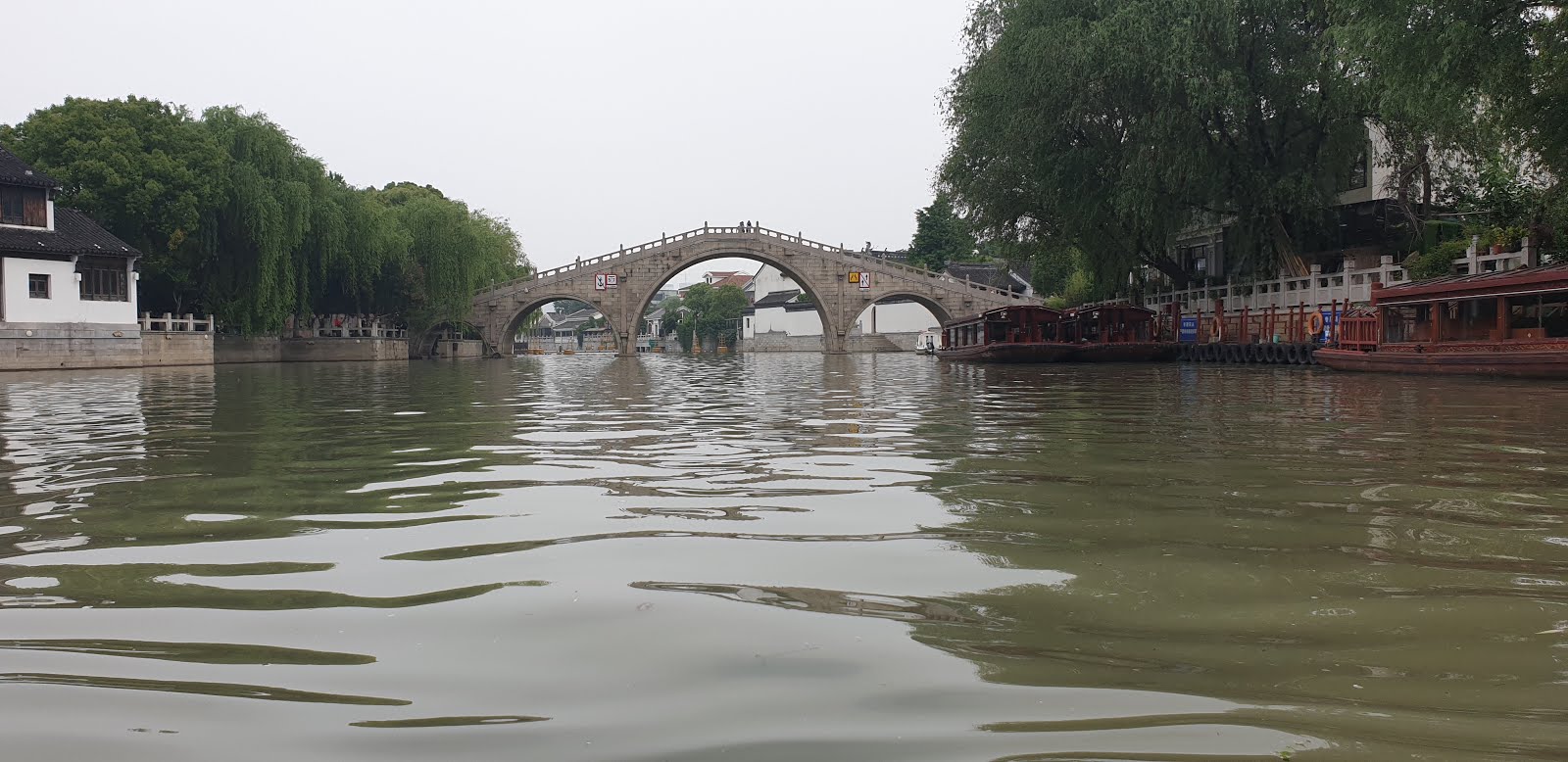
We pass under a number of bridges, and then, about 30 minutes after leaving, we reach a larger canal and do a 180-degree turn, and head back to a drop off point the will enable us to walk through a typical everyday Chinese market for food and the other items.

This drop off point is much the same as the starting point, a concrete step which is as hazardous as the first.  At least we don’t have to compete with other boats for the landing spot.

We take a leisurely stroll down a small section of Pingjiang Road with small shops on either side, selling all manner of goods

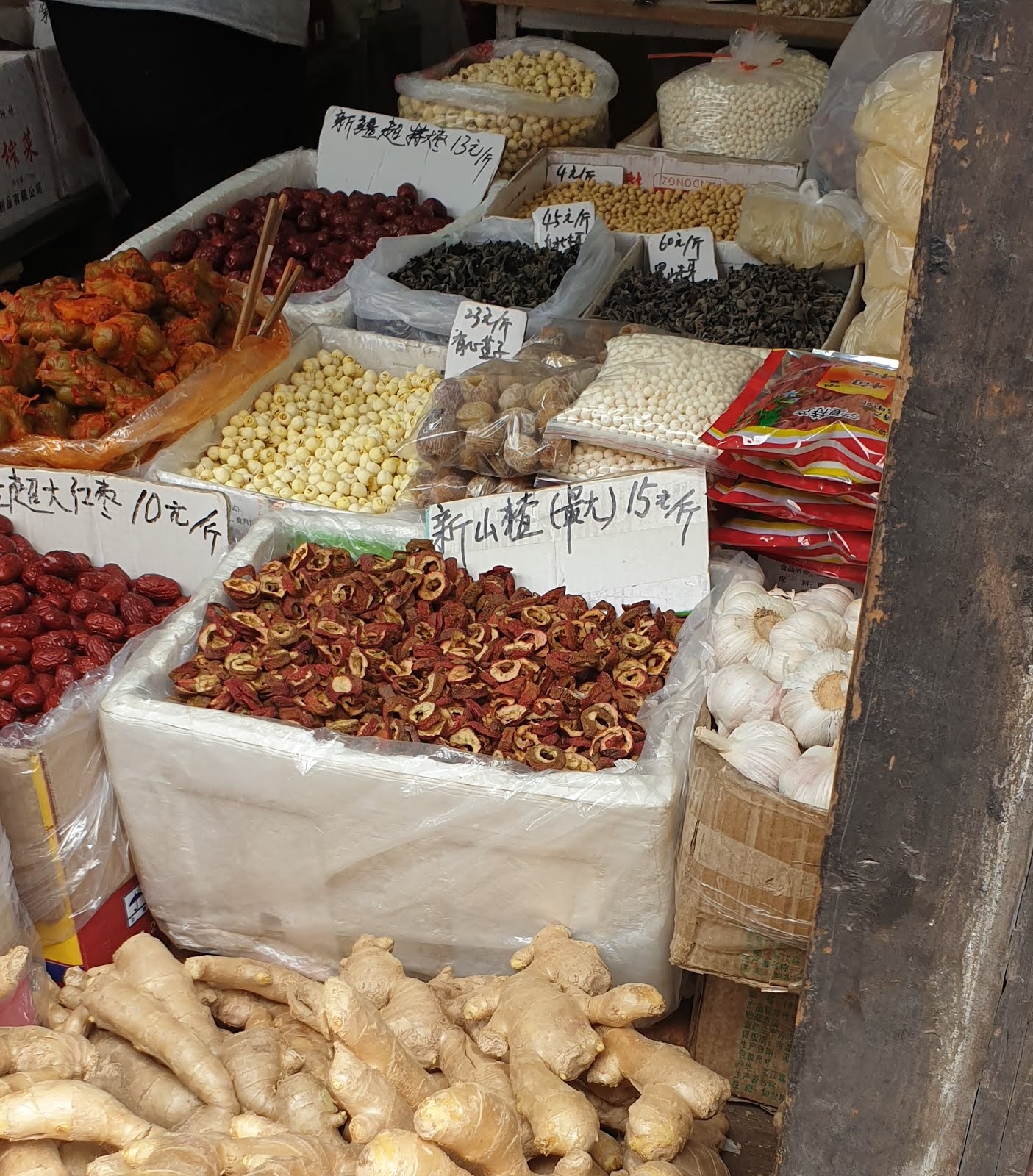
but my interest is in the food and the prices, which at times seem quite expensive for so-called local people, so maybe because the tourists go down this street every day, the prices have been inflated accordingly.

I find it rather disappointing.

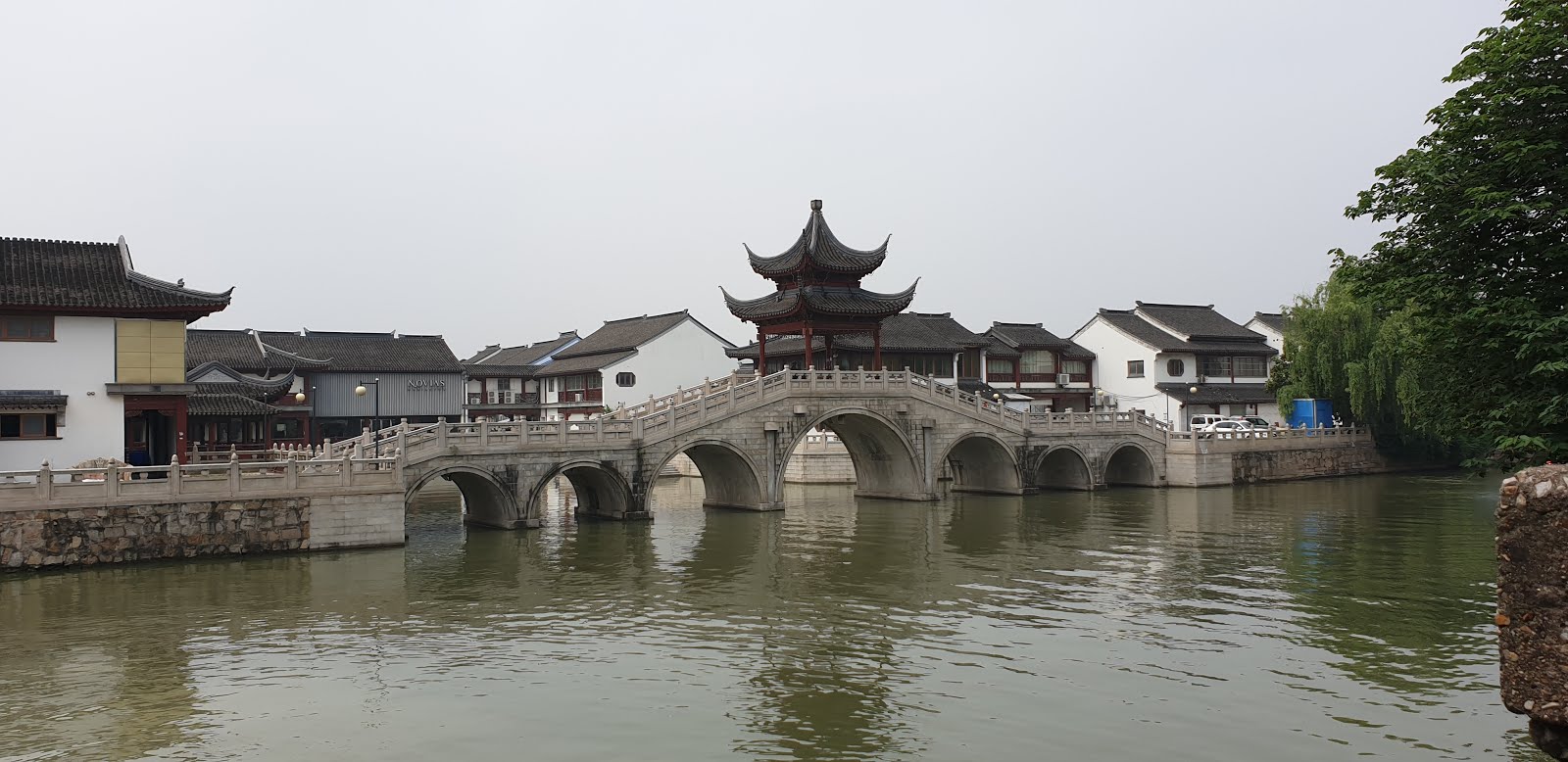
We walk to the bridge, go under to the other side crossing the canal and find the coffee shop which is also the meeting place.

So…

When is a coffee shop not a coffee shop, when it takes an eternity to make a cup of coffee, we waited 25 minutes?

We also ordered beef black pepper rice and it took 20 minutes before it arrived, but it was well worth the wait.  Strands of perfectly cooked beef with onion, carrot, and capsicum, with a very peppery and spicy sauce, with a side of boiled rice.

A pizza was ordered too but it did not arrive at all before we left.