“The Things We Do For Love”

Would you give up everything to be with the one you love?

…

Is love the metaphorical equivalent to ‘walking the plank’; a dive into uncharted waters?

For Henry, the only romance he was interested in was a life at sea, and when away from it, he strived to find sanctuary from his family and perhaps life itself.  It takes him to a small village by the sea, a place he never expected to find another just like him, Michelle, whom he soon discovers is as mysterious as she is beautiful.

Henry had long since given up the notion of finding romance, and Michelle couldn’t get involved for reasons she could never explain, but in the end, both acknowledge that something happened the moment they first met.  

Plans were made, plans were revised, and hopes were shattered.

A chance encounter causes Michelle’s past to catch up with her, and whatever hope she had of having a normal life with Henry, or anyone else, is gone.  To keep him alive she has to destroy her blossoming relationship, an act that breaks her heart and shatters his.

But can love conquer all?

It takes a few words of encouragement from an unlikely source to send Henry and his friend Radly on an odyssey into the darkest corners of the red-light district in a race against time to find and rescue the woman he finally realizes is the love of his life.

The cover, at the moment, looks like this:

lovecoverfinal1

Is love the metaphorical equivalent to ‘walking the plank’; a dive into uncharted waters?

For Henry the only romance he was interested in was a life at sea, and when away from it, he strived to find sanctuary from his family and perhaps life itself.  It takes him to a small village by the sea, s place he never expected to find another just like him, Michelle, whom he soon discovers is as mysterious as she is beautiful.

Henry had long since given up the notion of finding romance, and Michelle couldn’t get involved for reasons she could never explain, but in the end both acknowledge that something happened the moment they first met.  

Plans were made, plans were revised, and hopes were shattered.

A chance encounter causes Michelle’s past to catch up with her, and whatever hope she had of having a normal life with Henry, or anyone else, is gone.  To keep him alive she has to destroy her blossoming relationship, an act that breaks her heart and shatters his.

But can love conquer all?

It takes a few words of encouragement from an unlikely source to send Henry and his friend Radly on an odyssey into the darkest corners of the red light district in a race against time to find and rescue the woman he finally realizes is the love of his life.

The cover, at the moment, looks like this:

lovecoverfinal1

In a word: Not

You will not go outside, you will not go to the movies.

The word not, when used by your parents when you are a child is the key in the lock keeping you from having fun.

It is the very definition of everything negative, and much harsher than just a plain no.

That you will ‘not…’ has been the gateway for many an exploit or adventure, because anything you have done contrary to the ‘not’ is all that much sweeter.

Until you get into trouble, but, then, isn’t that how you learn life’s lessons?

But if you are a programmer like me, not takes on a whole new meaning in a language like,

‘If not like …. then’

meaning in layman’s terms if something isn’t like a specific value then do something else.

Hang on, isn’t that a bit like reality?

This is not to be confused with the word Knot which is,

A blemish in a piece of wood

The speed of a ship, winds, and sometimes a plane

But basically,

Something you tie to keep your shoes on, or around your finger to remind you to tie your shoes before getting on the 36-knot high-speed ferry made of knotty wood.

It is also something you find in tangled hair and is very painful trying to remove it.

It is also an unpleasant tightness in body muscles and you need a masseuse to get rid of them.

An excerpt from “If Only” – a work in progress

Investigation of crimes doesn’t always go according to plan, nor does the perpetrator get either found or punished.

That was particularly true in my case.  The murderer was incredibly careful in not leaving any evidence behind, to the extent that the police could not rule out whether it was a male or a female.

At one stage the police thought I had murdered my own wife though how I could be on a train at the time of the murder was beyond me.  I had witnesses and a cast-iron alibi.

The officer in charge was Detective First Grade Gabrielle Walters.  She came to me on the day after the murder seeking answers to the usual questions like, when was the last time you saw your wife, did you argue, the neighbors reckon there were heated discussions the day before.

Routine was the word she used.

Her fellow detective was a surly piece of work whose intention was to get answers or, more likely, a confession by any or all means possible.  I could sense the raging violence within him.  Fortunately, common sense prevailed.

Over the course of the next few weeks, once I’d been cleared of committing the crime, Gabrielle made a point of keeping me informed of the progress.

After three months the updates were more sporadic, and when, for lack of progress, it became a cold case, communication ceased.

But it was not the last I saw of Gabrielle.

The shock of finding Vanessa was more devastating than the fact she was now gone, and those images lived on in the same nightmare that came to visit me every night when I closed my eyes.

For months I was barely functioning, to the extent I had all but lost my job, and quite a few friends, particularly those who were more attached to Vanessa rather than me.

They didn’t understand how it could affect me so much, and since it had not happened to them, my tart replies of ‘you wouldn’t understand’ were met with equally short retorts.  Some questioned my sanity, even, for a time, so did I.

No one, it seemed, could understand what it was like, no one except Gabrielle.

She was by her own admission, damaged goods, having been the victim of a similar incident, a boyfriend who turned out to be an awfully bad boy.  Her story varied only in she had been made to witness his execution.  Her nightmare, in reliving that moment in time, was how she was still alive and, to this day, had no idea why she’d been spared.

It was a story she told me one night, some months after the investigation had been scaled down.  I was still looking for the bottom of a bottle and an emotional mess.  Perhaps it struck a resonance with her; she’d been there and managed to come out the other side.

What happened become our secret, a once-only night together that meant a great deal to me, and by mutual agreement, it was not spoken of again.  It was as if she knew exactly what was required to set me on the path to recovery.

And it had.

Since then, we saw each about once a month in a cafe.   I had been surprised to hear from her again shortly after that eventful night when she called to set it up, ostensibly for her to provide me with any updates on the case, but perhaps we had, after that unspoken night, formed a closer bond than either of us wanted to admit.

We generally talked for hours over wine, then dinner and coffee.  It took a while for me to realize that all she had was her work, personal relationships were nigh on impossible in a job that left little or no spare time for anything else.

She’d always said that if I had any questions or problems about the case, or if there was anything that might come to me that might be relevant, even after all this time, all I had to do was call her.

I wondered if this text message was in that category.  I was certain it would interest the police and I had no doubt they could trace the message’s origin, but there was that tiny degree of doubt, about whether or not I could trust her to tell me what the message meant.

I reached for the phone then put it back down again.  I’d think about it and decide tomorrow.

© Charles Heath 2018-2020

A photograph from the inspirational bin – 43

…

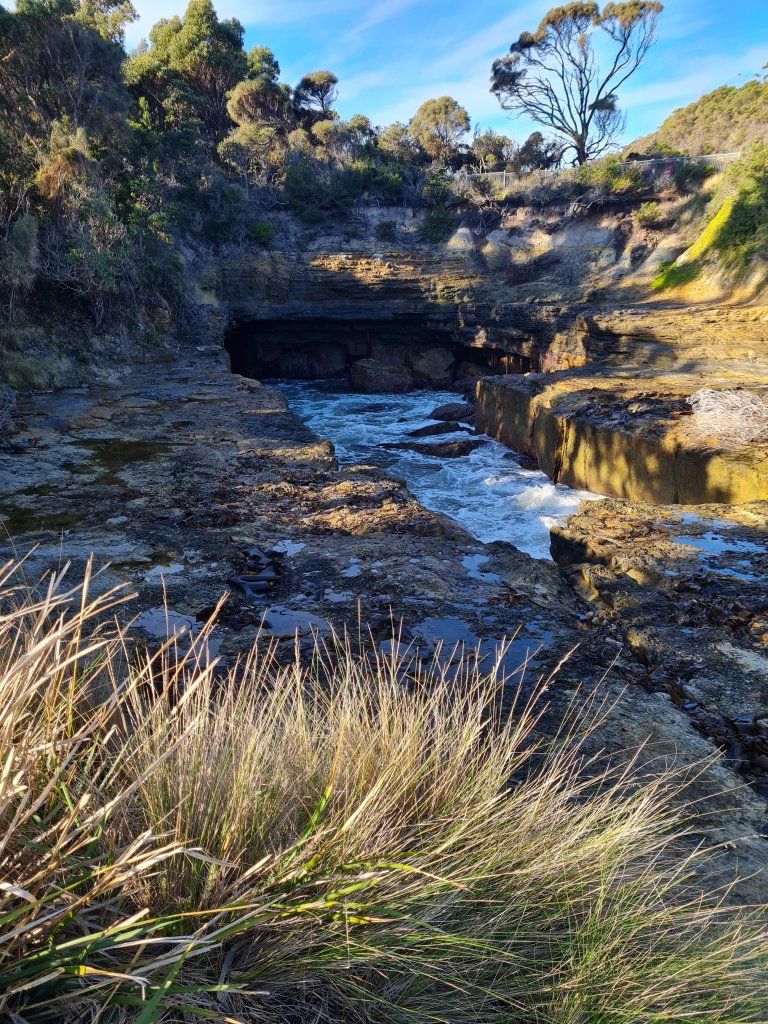
This is a blow hole, where the sea meets a rocking shoreline, and when there’s a big enough swell, crashes through to the other side.

On a quiet day, there’s nothing to see.

On a stormy day, when the waves are crashing into the base of the cliffs, water comes crashing through, and leaves the swirling, foamy water that can be seen above.

An interesting oddity, but nothing to fuel the imagination.

But…

What if, aside from the blowhole, there are caves, or there’s an underwater opening, and a channel leading up to it?

What if those caves were supposedly used by pirates to store treasure.

What if there is an underwater channel, and it is being used by small submarines to get to a base that has been hewn our of the rock?

What if no one knew until one night, a photographer, looking for caves to photograph and explore is investigating when people suddenly appear from nowhere?

Memories of the conversations with my cat – 62

As some may be aware, but many not, Chester, my faithful writing assistant, mice catcher, and general pain in the neck, passed away some years ago.

Recently I was running a series based on his adventures, under the title of Past Conversations with my cat.

For those who have not had the chance to read about all of his exploits I will run the series again from Episode 1

These are the memories of our time together…

20160921_071506

This is Chester.  You wouldn’t think he would have an interest in horse racing.

But…

He does.  Today, in Australia, is the day the Melbourne Cup is run.  It seems to be the biggest thing on the racing calendar, not only in Melbourne but the rest of the country.

Chester, as usual, doesn’t seem to think it’s all that great.

He wants to know why the cat races are not televised.

What cat races?

It seems he had been watching Fox Sports, and there’s dog races, greyhounds he says.

I’ve heard of them, even went once or twice when we lived in Melbourne, where there was a dog race track.

Well, he says, if they can race dogs, they can race cats.

I appear a little sceptical.  What are they going to chase?

Mice.

Isn’t that a little cruel, I mean, you’ll get the animal rights people up in arms.

Over mice, he snorts.  No one likes mice.  But if it’s a problem, why not rats?  Everyone hates rats.

So, I say, you’re up for it then.  We could make a killing.

A shake of the head, and nose in the air.  “Of course not, I’m a pedigree cat.  That’s for the alley cats.  I’ll be watching from the Royal box thankyou.”

The cinema of my dreams – Was it just another surveillance job – Episode 11

I’m back home and this story has been sitting on a back burner for a few months, waiting for some more to be written.

The trouble is, there are also other stories to write, and I’m not very good at prioritising.

But, here we are, a few minutes opened up and it didn’t take long to get back into the groove.

Just the person to see next


I couldn’t imagine what those details were.  But if it was a setup, it was a very elaborate one, by people who knew our systems and procedures.  Naturally, the first thought that sprang to mind, someone who was working here, or used to.

Then I had another thought, what if none of us was meant to survive the operation, and hat we had been selected specifically because we were new to field operations.  At the briefing, we had been told this was simple surveillance, observe and report, nothing more.

Usually we had one experienced member and three new team members, the experienced member was there to continue on the job training and evaluation.  What worried me was that an experienced member could be taken out apparently as easy as the others.

And my money was not on the guy I’d cornered.  Of course, I could be wrong, and no doubt circumstantial evidence would go a long way towards proving that, but in my estimation, a cornered man like he was, with a thirst and talent for killing, would not have hesitated to kill me before I’d got three words out.

I believed him.  He was scared and, now that I thought about it, confused.  That was anything but the m.o. of a conscienceless killer.

The wrinkle that hadn’t been accounted for was the explosion.  No one could have predicted that, or its effect on the operation.  It might well have saved him, except that I didn’t play by the rules and reconnected with him.  Maybe he had felt safe after taking out the others, and assuming I’d been taken down by the explosion.

Except, if I didn’t think he did the killing, who did, and why?  Severin?  Just who the hell is this Severin?  There’s been no indication he wasn’t one of us.

I was pondering that question when the woman returned and sat down again.  This time her stare wasn’t quite as glacial.

“Describe this Severin.”

She opened her notebook, and had her pencil ready.  Odd that she should be taking notes in pencil.

I described him.  Five feet eight inches tall, 250 pounds, thinning black hair, making him anywhere between 35 and 50, though I thought he was mid-forties.  He wore a tweed suit, rather an odd choice for the climate, and had the aroma of cigarette smoke hanging about him.

Every free moment I saw him, he had a cigarette, so I thought he was quite possibly a chain smoker, and from that, perhaps a man with bad nerves, or who worried a lot.  Now I knew he was not one of us, that could be interpreted as thinking he might get caught.

But he was confident, and outgoing, which meant he was quite sure he wouldn’t get caught, and that meant, quite possibly there was someone within our department that was working for or with him and had covered his comings and goings.  Either that or he had a universal passcode key to come and go as he pleased.

When I finished the description I could see a flicker of recognition.  IT was possible she knew who he might be, and if so, I was betting she knew him by another name.  I asked if that was the case.

“You know who this man is, don’t you?”

The stern reproving look returned.  “What makes you think that?”

“I read faces.  Yours is not a poker face.”

“Well, that disappoints me because I like to play poker.  Perhaps the people I play with have a different view.”

“I’m usually a good judge of character.”

“It’s let you down this time.”  She stood.  “Before you go, one of the supervisors here would like a word with you.  His name is Nobbin.  He works out of another office and is coming here directly.  After that, you’re free to go.”

She didn’t wait to say goodbye, and I was glad I managed to keep a straight face long enough.

Nobbin.  Just the man I wanted to see.


© Charles Heath 2019

First Dig Two Graves – the editor’s second draft – Day 6

This book has finally come back from the Editor, so this month it is going to get a second revision, a second draft for the editor, and beta readers.

…

It’s a recap of how John and Zoe survived the first year of their relationship. Zoe could take only so much downtime, so it was back to work – for different people, she just had to find them.

And, so far, those who are seeking her are still out there.

Fast forward three months: John is trying to figure out what he wants to do next because the easy life is getting to him too.

There’s the possibility of getting a job with Sebastian, after all, he didn’t do that badly the first time around.

There’s languishing with his grandmother, but two visits in a year were one too many.

And yes, he has a seminal moment!

Start a private investigation agency, with himself as the first client – he is beginning to believe Zoe will not be coming back so he is going to find her and find out once and for all if they are over.

How hard could it be?

…

Searching for locations: The Erqi Memorial Tower, Zhengzhou, China

A convoluted explanation on the reasons for this memorial came down to it being about the deaths of those involved in the 1923 Erqi strike, though we’re not really sure what the strike was about.

So, after a little research, this is what I found:

The current Erqi Tower was built in 1971 and was, historically, the tallest building in the city. It is a memorial to the Erqi strike and in memory of Lin Xiangqian and other railway workers who went on strike for their rights, which happened on February 7, 1923.

It has 14 floors and is 63 meters high. One of the features of this building is the view from the top, accessed by a spiral staircase, or an elevator, when it’s working (it was not at the time of our visit).

There seems to be an affinity with the number 27 with this building, in that

  • It’s the 27th memorial to be built
  • to commemorate the 27th workers’ strike
  • located in the 27th plaza of Zhengzhou City.

We drive to the middle of the city where we once again find traveling in kamikaze traffic more entertaining than the tourist points

When we get to the drop-off spot, it’s a 10-minute walk to the center square where the tower is located on one side. Getting there we had to pass a choke point of blaring music and people hawking goods, each echoing off the opposite wall to the point where it was deafening. Too much of it would be torture.

But, back to the tower…

It has 14 levels, but no one seemed interested in climbing the 14 or 16 levels to get to the top. The elevator was broken, and after the great wall episode, most of us are heartily sick of stairs.

The center square was quite large but paved in places with white tiles that oddly reflected the heat rather than absorb it. In the sun it was very warm.

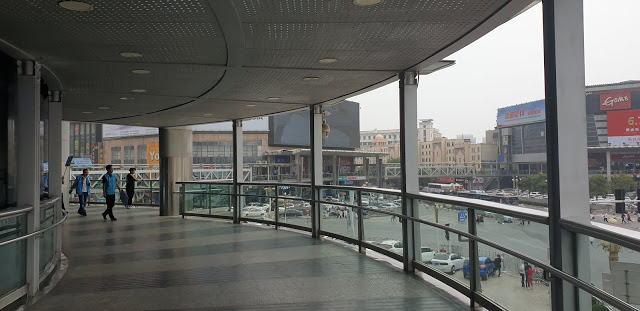
Around the outside of two-thirds of the square, and crossing the roads, was an elevated walkway, which if you go from the first shops and around to the other end, you finish up, on the ground level, at Starbucks.

This is the Chinese version and once you get past the language barrier, the mixology range of cold fruity drinks are to die for, especially after all that walking. Mine was a predominantly peach flavor, with some jelly and apricot at the bottom. I was expecting sliced peaches but I prefer and liked the apricot half.

A drink and fruit together was a surprise.

Then it was the walk back to the meeting point and then into the hotel to use the happy house before rejoining the kamikaze traffic.

We are taken then to the train station for the 2:29 to our next destination, Suzhou, the Venice of the East.

Whatever happened to free websites?

There’s nothing more certain than a favourite website you go to and use often, sooner or later starts charging a subscription ‘fee’.  I guess nothing in this life is free, they have to raise advertising to make it so, but…

The alternatives that charge do not give you the facilities you need unless you pay an exorbitant monthly or yearly charge.  And, if you accept the minimum charge, you get nothing other than a visual display of your books, and that’s about it.

And what author starting out can afford the $200 a month for the premium site to get all the bells and whistles, which coincidentally is the stuff the author needs just to sell.

Anyway…

I remember when the NANOWRIMO site had been updated, and the changes looked good.  At that moment the site was free, but you do get a lot of emails and requests to purchase products, which I think is a reasonable way to raise money for keeping the site free.

But, how long is this going to last before a ‘fee’ is introduced, and then a ‘fee’ to enter your book?

It’s the airline principle, it was a flat charge for the ticket, now you pay for this tax, that tax, fuel tax, baggage tax, tax on the tax, and then if that’s not enough, a charge for the food and water.  Soon it will be a charge for toilets, and then the air you breathe.

It’s inevitable, and once these charges start they don’t stop and only get higher with each passing year.

A lot of the sites I use are free.  Some have since started to charge and have put up a firewall to stop you from getting any free information.

I’m not a rich author, so sadly I have to discontinue using these sites.

Perhaps the problem is that the owner of the site has come up with a good idea, thousands of people sign up, and suddenly a small website becomes a big one, and hosting costs suddenly go through the roof.

Like airlines, it’s the user that pays.

Often I see or get an email from, various people with what looks to be a useful site.  Some start out by giving you a month free to have a look and use the facilities.  In some cases they are quite good, in others, well, there are a dozen others like it that are still free.

But, after a month, you have to pay.  What gets me with some of them, they are asking somewhere between 50 and 200 US dollars a month, you heard that right, a month, which you can basically double that for me after the exchange rate and a dozen bank fees.

Sometimes there are different levels, but basically, if you look at the fine print, the lowest level set, which gives you very little, is set low deliberately.  Say it’s 10 dollars a month.  It’s no different to the free version except they probably don’t have annoying ads and advertise, what for many, is non-existent 24/7 help (via an email, no guarantee they look at it more than once a week, if at all).  Money for jam for the site owner, as the saying goes.

Why can’t there be a more reasonable option?

But I get it.  Everyone wants to get rich quick, it’s an objective that’s built into all of us, but it seems I missed the inoculation given the day after you’re born.

I also get it that these people worked hard on coming up with the websites and facilities, and they deserve a reward for that hard work, but to me it would make more sense if they sold the service for 10 dollars or even 20 dollars a month if the systems were available and they worked.  And flowing from that wouldn’t 20,000 sales at 20 dollars, be better than 2000 at a 100 dollars?

The same seems to go for the so-called decent website hosts, like WordPress, Wix and GoDaddy.  The free option is good but just for show and tell, but I’m sure they deliberately nobble it so it’s slow and kludgy just the sort of attributes that turn potential visitors off.

I thought if I paid a monthly charge for Wix, and reading the inclusions for what my site could do over the free one was very persuasive, so I signed up.  The site was no better than it was before and half the options that were on the list weren’t available, and still aren’t.  But I suspect if I paid them 100 plus dollars a month or more for their premium package I’d get it.

But, to pay for it I would have to be selling a million books a month, and I doubt, no matter how good my web site is, it wouldn’t attract that kind of business.

Not one of the basic packages, read affordable for me, has the ability to allow downloads after sales.  You can’t even have a sales page where you can actually sell books to people like you were a bookshop.  That’s in all of the premium packages, so they say, and that costs far too much.

GoDaddy was by far the worst, telling me if I signed up for the 60-dollar-a-month package I could have sales and downloads.  I tried to add it to the web page, which I might add was as difficult to create as all hell, and when it didn’t work, rang up to ask why I couldn’t have downloading after sales and was met with silence.

No, that’s not available at the moment, I was told, and not likely in the future.  What am I paying all this money for?  I don’t have a GoDaddy site any more.  I had a Wix site that I paid for, and I don’t have that any more.  They don’t offer anything useful, and they too, make it virtually impossible to create a useful site, so it sits out there in the ether with disappointment written all over it.

Perhaps others have had better luck, or things have changed in the last few years but I won’t be going back.

Maybe one day someone might understand the needs of the majority who can afford to pay exorbitant monthly charges but just not as much as we are expected to, for very little in return.

What’s that saying, hope springs eternal.

PS Sorry about the rant!

An excerpt from “The Things We Do For Love”; In love, Henry was all at sea!

In the distance he could hear the dinner bell ringing and roused himself.  Feeling the dampness of the pillow, and fearing the ravages of pent up emotion, he considered not going down but thought it best not to upset Mrs. Mac, especially after he said he would be dining.

In the event, he wished he had reneged, especially when he discovered he was not the only guest staying at the hotel.

Whilst he’d been reminiscing, another guest, a young lady, had arrived.  He’d heard her and Mrs. Mac coming up the stairs, and then shown to a room on the same floor, perhaps at the other end of the passage.

Henry caught his first glimpse of her when she appeared at the door to the dining room, waiting for Mrs. Mac to show her to a table.

She was about mid-twenties, slim, long brown hair, and the grace and elegance of a woman associated with countless fashion magazines.  She was, he thought, stunningly beautiful with not a hair out of place, and make-up flawlessly applied.  Her clothes were black, simple, elegant, and expensive, the sort an heiress or wife of a millionaire might condescend to wear to a lesser occasion than dinner.

Then there was her expression; cold, forbidding, almost frightening in its intensity.  And her eyes, piercingly blue and yet laced with pain.  Dracula’s daughter was his immediate description of her.

All in all, he considered, the only thing they had in common was, like him, she seemed totally out of place.

Mrs. Mac came out of the kitchen, wiping her hands on her apron.  She was, she informed him earlier, chef, waitress, hotelier, barmaid, and cleaner all rolled into one.  Coming up to the new arrival she said, “Ah, Miss Andrews, I’m glad you decided to have dinner.  Would you like to sit with Mr. Henshaw, or would you like to have a table of your own?”

Henry could feel her icy stare as she sized up his appeal as a dining companion, making the hair on the back on his neck stand up.  He purposely didn’t look back.  In his estimation, his appeal rating was minus six.  Out of a thousand!

“If Mr. Henshaw doesn’t mind….”  She looked at him, leaving the query in mid-air.

He didn’t mind and said so.  Perhaps he’d underestimated his rating.

“Good.”  Mrs. Mac promptly ushered her over.  Henry stood, made sure she was seated properly and sat.

“Thank you.  You are most kind.”  The way she said it suggested snobbish overtones.

“I try to be when I can.”  It was supposed to nullify her sarcastic tone but made him sound a little silly, and when she gave him another of her icy glares, he regretted it.

Mrs. Mac quickly intervened, asking, “Would you care for the soup?”

They did, and, after writing the order on her pad, she gave them each a look, imperceptibly shook her head, and returned to the kitchen.

Before Michelle spoke to him again, she had another quick look at him, trying to fathom who and what he might be.  There was something about him.

His eyes, they mirrored the same sadness she felt, and, yes, there was something else, that it looked like he had been crying?  There was a tinge of redness.

Perhaps, she thought, he was here for the same reason she was.

No.  That wasn’t possible.

Then she said, without thinking, “Do you have any particular reason for coming here?”  Seconds later she realized she’s spoken it out loud, had hadn’t meant to actually ask, it just came out.

It took him by surprise, obviously not the first question he was expecting her to ask of him.

“No, other than it is as far from civilization, and home, as I could get.”

At least we agree on that, she thought.

It was obvious he was running away from something as well.

Given the isolation of the village and lack of geographic hospitality, it was, from her point of view, ideal.  All she had to do was avoid him, and that wouldn’t be difficult.

After getting through this evening first.

“Yes,” she agreed.  “It is that.”

A few seconds passed, and she thought she could feel his eyes on her and wasn’t going to look up.

Until he asked, “What’s your reason?”

Slight abrupt in manner, perhaps as a result of her question, and the manner in which she asked it.

She looked up.  “Rest.  And have some time to myself.”

She hoped he would notice the emphasis she had placed on the word ‘herself’ and take due note.  No doubt, she thought,  she had completely different ideas of what constituted a holiday than he, not that she had actually said she was here for a holiday.

Mrs. Mac arrived at a fortuitous moment to save them from further conversation.

Over the entree, she wondered if she had made a mistake coming to the hotel.  Of course, there had been no possible way she could know than anyone else might have booked the same hotel, but realized it was foolish to think she might end up in it by herself.

Was that what she was expecting?

Not a mistake then, but an unfortunate set of circumstances, which could be overcome by being sensible.

Yet, there he was, and it made her curious, not that he was a man, by himself, in the middle of nowhere, hiding like she was, but for very different reasons.

On discreet observance whilst they ate, she gained the impression his air of light-heartedness was forced and he had no sense of humor.

This feeling was engendered by his looks, unruly dark hair, and permanent frown.  And then there was his abysmal taste in clothes on a tall, lanky frame.  They were quality but totally unsuited to the wearer.

Rebellion was written all over him.

The only other thought crossing her mind, and rather incongruously, was he could do with a decent feed.  In that respect, she knew now from the mountain of food in front of her, he had come to the right place.

“Mr. Henshaw?”

He looked up.  “Henshaw is too formal.  Henry sounds much better,” he said, with a slight hint of gruffness.

“Then my name is Michelle.”

Mrs. Mac came in to take their order for the only main course, gather up the entree dishes, then return to the kitchen.

“Staying long?” she asked.

“About three weeks.  Yourself?”

“About the same.”

The conversation dried up.

Neither looked at the other, rather at the walls, out the window, towards the kitchen, anywhere.  It was, she thought, almost unbearably awkward.

Mrs. Mac returned with a large tray with dishes on it, setting it down on the table next to theirs.

“Not as good as the usual cook,” she said, serving up the dinner expertly, “but it comes a good second, even if I do say so myself.  Care for some wine?”

Henry looked at Michelle.  “What do you think?”

“I’m used to my dining companions making the decision.”

You would, he thought.  He couldn’t help but notice the cutting edge of her tone.  Then, to Mrs. Mac, he named a particular White Burgundy he liked and she bustled off.

“I hope you like it,” he said, acknowledging her previous comment with a smile that had nothing to do with humor.

“Yes, so do I.”

Both made a start on the main course, a concoction of chicken and vegetables that were delicious, Henry thought, when compared to the bland food he received at home and sometimes aboard my ship.

It was five minutes before Mrs. Mac returned with the bottle and two glasses.  After opening it and pouring the drinks, she left them alone again.

Henry resumed the conversation.  “How did you arrive?  I came by train.”

“By car.”

“Did you drive yourself?”

And he thought, a few seconds later, that was a silly question, otherwise she would not be alone, and certainly not sitting at this table. With him.

“After a fashion.”

He could see that she was formulating a retort in her mind, then changed it, instead, smiling for the first time, and it served to lighten the atmosphere.

And in doing so, it showed him she had another more pleasant side despite the fact she was trying not to look happy.

“My father reckons I’m just another of ‘those’ women drivers,” she added.

“Whatever for?”

“The first and only time he came with me I had an accident.  I ran up the back of another car.  Of course, it didn’t matter to him the other driver was driving like a startled rabbit.”

“It doesn’t help,” he agreed.

“Do you drive?”

“Mostly people up the wall.”  His attempt at humor failed.  “Actually,” he added quickly, “I’ve got a very old Morris that manages to get me where I’m going.”

The apple pie and cream for dessert came and went and the rapport between them improved as the wine disappeared and the coffee came.  Both had found, after getting to know each other better, their first impressions were not necessarily correct.

“Enjoy the food?” Mrs. Mac asked, suddenly reappearing.

“Beautifully cooked and delicious to eat,” Michelle said, and Henry endorsed her remarks.

“Ah, it does my heart good to hear such genuine compliments,” she said, smiling.  She collected the last of the dishes and disappeared yet again.

“What do you do for a living,” Michelle asked in an off-hand manner.

He had a feeling she was not particularly interested and it was just making conversation.

“I’m a purser.”

“A what?”

“A purser.  I work on a ship doing the paperwork, that sort of thing.”

“I see.”

“And you?”

“I was a model.”

“Was?”

“Until I had an accident, a rather bad one.”

“Oh, I’m sorry.”

So that explained the odd feeling he had about her.

As the evening had worn on, he began to think there might be something wrong, seriously wrong with her because she didn’t look too well.  Even the carefully applied makeup, from close up, didn’t hide the very pale, and tired look, or the sunken, dark ringed eyes.

“I try not to think about it, but it doesn’t necessarily work.  I’ve come here for peace and quiet, away from doctors and parents.”

“Then you will not have to worry about me annoying you.  I’m one of those fall-asleep-reading-a-book types.”

Perhaps it would be like ships passing in the night and then smiled to himself about the analogy.

Dinner now over, they separated.

Henry went back to the lounge to read a few pages of his book before going to bed, and Michelle went up to her room to retire for the night.

But try as he might, he was unable to read, his mind dwelling on the unusual, yet the compellingly mysterious person he would be sharing the hotel with.

Overlaying that original blurred image of her standing in the doorway was another of her haunting expressions that had, he finally conceded, taken his breath away, and a look that had sent more than one tingle down his spine.

She may not have thought much of him, but she had certainly made an impression on him.

© Charles Heath 2015-2020

lovecoverfinal1