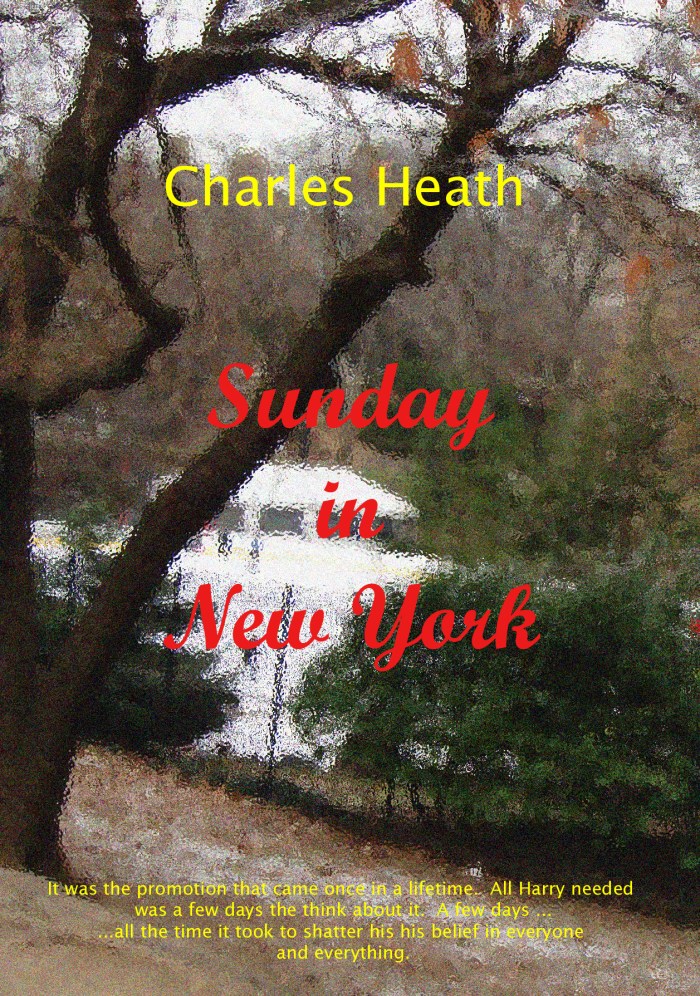
“Sunday in New York”, a romantic adventure that’s not a walk in the park!

“Sunday in New York” is ultimately a story about trust, and what happens when a marriage is stretched to its limits.

When Harry Steele attends a lunch with his manager, Barclay, to discuss a promotion that any junior executive would accept in a heartbeat, it is the fact his wife, Alison, who previously professed her reservations about Barclay, also agreed to attend, that casts a small element of doubt in his mind.

From that moment, his life, in the company, in deciding what to do, his marriage, his very life, spirals out of control.

There is no one big factor that can prove Harry’s worst fears, that his marriage is over, just a number of small, interconnecting events, when piled on top of each other, points to a cataclysmic end to everything he had believed in.

Trust is lost firstly in his best friend and mentor, Andy, who only hints of impending disaster, Sasha, a woman whom he saved, and who appears to have motives of her own, and then in his wife, Alison, as he discovered piece by piece damning evidence she is about to leave him for another man.

Can we trust what we see with our eyes or trust what we hear?

Haven’t we all jumped to conclusions at least once in our lives?

Can Alison, a woman whose self-belief and confidence is about to be put to the ultimate test, find a way of proving their relationship is as strong as it has ever been?

As they say in the classics, read on!

Purchase:

http://tinyurl.com/Amazon-SundayInNewYork

In a word: will

Now that I’ve hit the age of 65, I now have to give some consideration to creating a will.

You know, that document that specifies which child gets what, or if you think any or all of them don’t deserve what’s left of the hard-earned millions, which cat or dog will inherit a fortune.

A will is both a reason for siblings or beneficiaries to kill to get a reward or the fact you have to make one so that the state doesn’t inherit your fortune.

This is only one use of the word.

Another might be that it’s possible to have something like the will to carry on.

Carry on what?

Life, a marriage, a business relationship.

Does it require will power, or is it a matter of where there’s a will there’s a way?

I will come over. I will turn up tomorrow.

In this sense, it is promoting futility.

Of course, seeing is believing.

And as a bit of self-serving advertising, I’m going to promote a new story, actually titled, The Will.

Inheritance can resolve monetary problems, and not only that, set one of the siblings up financially for life. All they have to do is wrest the family home from the dying fingers of a mother who had seen it all.

Into the mix comes the grandson, a man who sometimes is a son but mostly a grandson, someone who doesn’t fit in, who doesn’t want to follow family tradition, and who prefers to go to his grandmothers rather than going home to his family.

He is constantly appalled at his mother’s lack of respect for her mother and suddenly finds himself in the middle of a battle between his grandmother and her daughter, his mother, over the family estate.

Who will win?

That’s a question that will be answered when you read the book.

“Echoes From The Past”, the past doesn’t necessarily stay there


What happens when your past finally catches up with you?

…

Christmas is just around the corner, a time to be with family. For Will Mason, an orphan since he was fourteen, it is a time for reflection on what his life could have been, and what it could be.

Until a chance encounter brings back to life the reasons for his twenty years of self-imposed exile from a life only normal people could have. From that moment Will’s life slowly starts to unravel and it’s obvious to him it’s time to move on.

This time, however, there is more at stake.

Will has broken his number one rule, don’t get involved.

With his nemesis, Eddie Jamieson, suddenly within reach, and a blossoming relationship with an office colleague, Maria, about to change everything, Will has to make a choice. Quietly leave, or finally, make a stand.

But as Will soon discovers, when other people are involved there is going to be terrible consequences no matter what choice he makes.

https://amzn.to/2CYKxu4

newechocover5rs

A to Z Blog Challenge – April 2024 – E is for Eccentric

…

It often came as a surprise to anyone who knew me that I reached adulthood with anything that resembled sanity.

My parents died early in my life, when j was about seven, probably a good age, if it could be said that there was anything good about it, having been shoved in a boarding school, and having parents who travelled the world as diplomats.  They had been interested in everything bar their son, so consequently I didn’t miss them as much as I should.

But…

What to do with a seven-year-old that no one really wanted.  I remember sitting in the headmaster’s office waiting to be taken to the funeral.  I didn’t know what to expect, all the headmaster had said was that my grandparents were coming.

That gave me a choice.  My father’s parents, the severe, strict, bible-thumping minister and his wife, a more sinister-looking pair than anything I’d seen before and was positively petrified when we visited them twice a year.

Then there were my mother’s parents who lived in a castle, not the fairy tale sort, but one with over a hundred rooms and a dungeon, and places where children should never venture.  Of course, telling a child no was the same as saying go for it, and that was a source of contention.

Needless to say, I knew who I wanted it to be.

Equally, I knew who I wanted to live with, but we always never got what we wanted, or so I had been told repeatedly by everyone.

So, until I was old enough to leave school and fend for myself, I had to split my time between the two, not that there was much left after school.  And, yes, neither took me out of boarding school, deciding that a break in my routine would be a disaster.

Nobody thought to ask me my opinion.

When I left school, finally, it was with the necessary qualifications, but not necessarily life skills.  Those were supposedly learned in the family environment.  Of the two, if I strictly applied what I learned in those few brief weeks at home each year was, on one hand, eccentric based on based on the notion I would become a minister, or eccentricity based on the notion I would become lord of the manor.

At no time was it suggested I would become a diplomat, even though I had applied when my parents’ old boss who came to the funeral offered me a pass to join the ranks after graduation.  You know, like father like son.

It gave me an escape, to get away from the stifling life I’d had for the past twelve years, standing at the station waiting for the train to take me away from basically everything I knew, and everyone, it seemed like the end of the world.

Perhaps then, had I not accepted an invitation to go on a holiday with Horace Arbuthnot Esq., my life might have turned out a lot differently.

Or not.  After all, destiny is what it was because it was not written in stone.

Twenty years on, when looking back, it seemed almost an eternity.

That summer, the year I turned eighteen, was memorable for many reasons.  I started out being introduced to Horace’s family and acquaintances as the eccentric Mr Alexander Wilberstone, the only son of highly regarded diplomatic problem solvers who disappeared mysteriously in the uncharted jungle of Africa.

The way he spun the tale was so much different from the reality of what happened, being gunned down on the back streets of Nairobi in a random drive-by shooting. I was, at that time, almost as mysterious as my parents, and the sort of character that added street cred to a lonely boy with no friends.

I didn’t tell him I was in the same boat, but since I was heading for the minister’s manse anything other than that was a godsend.  Besides, I like Horace and the tales he spun to make his ordinary life far more interesting.  And the fact he used my looks and charm to get girls to come and talk to us.

That was the second memorable thing about that year, Anna Louise Romano, an American girl with her family visiting Italian relations in Florence. 

She had a friend who I eventually discovered had been planning to meet Horace in Italy and it only dawned on me later why he seemed to move about constantly seeking tourist attractions and after each visit, noticing his mounting despair.

That of course led to the third thing about turning eighteen, it unlocked my inheritance which was, when an old dusty lawyer in an old dusty office right out of a Dickens novel, told me one dusty afternoon in London.  It was, to an eighteen-year-old, an unimaginably large sum to do whatever I liked.

Within reason, of course.  The minister and the lord of the manor had taught me one thing; to be miserly.

Perhaps Horace had known about it. He certainly knew everything about everyone, ensuring he was not bullied or his friends, the advantage of which I recognised early on.  He was always perpetually short on funds and was always going to pay me back, the mysteriously unavailable funds just about to drop when…  well put any excuse you like in there.

I didn’t mind paying his way.  Twelve years of friendship needed repaying.  And I regarded it my job to ensure he got to meet the love of his life. As for myself, just enough time to fall hopelessly in love, to spend the most incredible four weeks of my life, and then watch her slip through my fingers like the sands of an hourglass.

Horace was lucky, though, in time, he convinced me that very little came to anyone being lucky.  He married his girl, moved to Tuscany, started a vineyard and winery, and told me I had a home any time I wanted one.

I travelled the world, noted all the shortcomings of travel agencies, and everything else in between and created an app that solved firstly my problems and then everyone else’s and sold it for a staggeringly large sum, more staggering than the original inheritance, and on the very day of my thirty-eighth birthday moved into a quaint loft in Brooklyn, New York, to contemplate my next venture.

And as it happened, Horace and Beverly were in the city, and I was taking them to dinner, a sort of birthday party to celebrate everything.  All that was missing was the girl I could share my life with.

I’d tried over the years, but there was never that one, not the Anna Louise Remano that I fell in love with and would never forget, as much as I tried to.  But don’t get me wrong.  I was happy.  I had experienced in those few short weeks what many couples never could in a lifetime.

The restaurant was not far from the apartment, and I’d invited Horace to stay with me, far less expensive than a hotel, and easier for me to show them the city starting the next day.  They had brought their children two remarkable but seemingly unrelated people who had ideas of their own that didn’t include being seen with us old people.  I hired a nanny, much to their dismay.  Until they met her.

We walked, the evening warm but not hot.  It was an ideal time of the year.  Horace was different. He’d lost weight and was looking fit and healthy, more than he had when he was a child.  Life in the countryside, hard work, and finding the perfect partner had cast a spell on him.  I was happy for him. His life had always been harder than mine.

But there was something.  It was like he had a secret, and it was going to burst out of him.  He was making small talk, and he only ever did that when he had a secret and was trying hard not to spill it

Until that moment…

When we reached the restaurant, he opened the door for me.  Usually, it was the other way around.  I gestured for Beverly to go first, but she hung back.

Had he invited one of our old friends, one I hadn’t seen for a long time.  He’d been skirting around the old memories, the time we had been in Florence, taken the train to Piza and driven to Venice.

The mention of Venice had brought back a flood of memories, all of which involved what I had believed to be the love of my life.

Anna Louise Romano.

And the moment I stepped through that door, I knew she was there.  It didn’t matter that the restaurant was crowded, I had that tingling sensation go up and down my spine.

And it was as if the crowd parted and there standing before me was the girl herself, all grown up and as beautiful as the first day I saw her.

Then he was beside me.  “Surprise!”

“How? Where?”

“You were just two ships passing in the night, Alex.  She’s recovering from a nasty divorce, so treat her with kid gloves.  Who knows what might happen?”

…

Memories of the conversations with my cat – 88

As some may be aware, but many not, Chester, my faithful writing assistant, mice catcher, and general pain in the neck, passed away some years ago.

Recently I was running a series based on his adventures, under the title of Past Conversations with my cat.

For those who have not had the chance to read about all of his exploits I will run the series again from Episode 1

These are the memories of our time together…

20160909_062838-2

This is Chester.  He had reminded me that it is Dr. Seuss’s birthday

Or perhaps that of the Cat in the Hat.

Chester told me once he auditioned for the role of Cat in the Hat, but he couldn’t get the hat to sit right.

A stitch-up, really, he added.  There was this fat cat, and he told everyone the role was his.

Period.

So, I had to ask, did he get the role?

No.  You’ve seen the Cat in the Hat, haven’t you?  Nothing like him.

So, other than trying to intimidate the competition, what was so scary about him?

Oh, I wasn’t scared or anything like that.  I just didn’t want to make a scene in front of the ladies.

I take a minute, trying to equate the cat in front of me, and that of the Cat in the Hat.

No resemblance at all.

And as for the scaredy-cat part, I decide not to remind him of his all-conquering fear of the grandchildren.

I’ll just wait until the next time they visit…

In less than two hours.

The cinema of my dreams – Was it just another surveillance job – Episode 37

I’m back home and this story has been sitting on a back burner for a few months, waiting for some more to be written.

The trouble is, there are also other stories to write, and I’m not very good at prioritizing.

But, here we are, a few minutes opened up and it didn’t take long to get back into the groove.

Chasing leads, maybe

…

I had a change of mind before I went on an odyssey to Peaslake. I needed help, and I was going to try and convince Jennifer to help me. If she had been injured, that might be more difficult.

I caught a train and a bus to Putney and then walked the remaining fifty yards to her front door. It was a flat over the top of a shop, and, when I read the name of the shop, I thought I knew why she was there. The shop, and quite likely the building belonged to her family, not that it was her surname, but I could be hopeful.

I went up the side stairs and reached the landing. There were two doors, one with 1A on it, and one with 1B on it. Hers was 1A.

I knocked on the door.

A minute later nothing had happened.

I knocked again, this time a little harder.

There was no answer, again, but there was a movement in the flat next door, then the door opened and a scruffy young man, perhaps a university student put his head out.

“She’s not here.”

“Not here, and in no longer living here, or not here as in she is out somewhere and will be back.”

He looked at me blankly, like I’d spoken too fast, or used too many words for him to understand. Possibly he’d just woken up.

He shook his head. “Just out probably getting coffee or something. The shops on the other side of the road, three or four doors up. Can’t miss it, it smells like coffee.”

He gave me a look up and down, gauging whether or not I could be of interest to her, then went back inside his room and closed the door.

It might be a lie, but I was going to take him at his word.

I went back down the stairs and out onto the sidewalk and looked up and down both sides of the street. There was a café, on the other side, not far away.

I waited for a break in the traffic, then crossed the road.

She was inside, reading a paper, oblivious to those around her, and, in particular, those coming from outside. She should be casually keeping an eye out for trouble.

I managed to get inside and take the seat next to her before she raised her head to see who it was.

No surprise.

“You,” she said. “You made it out alive too?”

“You should be more careful.”

“I was told I was no longer employed, that the people who hired me were ex-agents with some sort of agenda.”

I glanced at the open page of the newspaper. The jobs vacant page.

“Then it might come as a bit of a surprise to realize you’re still on their books, just assigned to a different department. Same as me.”

“They told me I was redundant.”

“Who told you?”

“A woman. Monica Sherive she said her name was.”

“I spoke to her earlier this morning. I didn’t ask, but I will the next time I’m in the office. What do you remember about the assignment?”

“We were supposed to maintain surveillance on a man, no name, just a photograph. I heard you had him in sight and was about to pass him off to Adam. I didn’t hear Adam acknowledge. I heard an explosion and all hell broke loose. No point carrying on, so I left.”

And that was what saved her life. Incorrect procedure. Unless she reported in.

“Did you report to the overseer.”

“Over the radio. He told me to go. What happened to Adam and Jack?”

“Dead. Murdered by the target, I think. The target’s dead too. A chap by the name of O’Connell, though the more I find out about him, the more interesting it gets.”

I could see the cogs ticking over behind her eyes as she put one and one together. “So…”

“You should be dead too. What saved your life was just up and leaving.”

“How did you escape?”

“I didn’t. I found the target again after the explosion and followed him to an alley. When I got there he told me I was making a mistake, and then he was shot. Severin and Maury turned up, and that was it.”

“Did they kill him?”

“No. It was a sniper, and I’m still wondering why I didn’t get shot too.”

“The woman told me Severin and Maury didn’t work for the organization. How could that be? They seemed real to me. I think whatever they and we were doing became a mess that needed to be cleaned up by getting rid of everyone associated with it. I liked that job. Now I have to go back to a daily drudge job.”

“Don’t think so. Like I said, I saw your name listed as active in the same department as me, the head of which is a guy called Nobbin. I’ve met him, I’m supposed to be investigating O’Connell, who, by the way, was one of his people, who had allegedly some documents on him when he died. You feel like helping out?”

“I would, but are you sure I’m supposed to be working for these people, God, I don’t know who they are or what I was doing anymore.”

“We can go to the office and ask questions. Get this Monica and get her to tell you. But in the meantime, I had a job I need to do, and it would be better with two. Can you help?”

“If you come with me to the office?”

“Sure.”

She folded the paper and slid off the seat. “Then, let’s go.”

…

© Charles Heath 2020

“Mistaken Identity” – The Final Editor’s Draft- Day 2

This book has finally reached the Final Editor’s draft, so this month it is going to get the last revision, and a reread for the beta readers.

…

Writing proceeds apace and the next chapter seems to have gone on a bit longer than I wanted, but that was because I was having fun. The editor’s suggestions brought a whole new light to the story, with the two main characters being together, not exactly by choice, but as the result of circumstances.

I have also been making notes at the same time, of situations that will arise from their being together, and establishing the reasons behind a lot of what happens later.

I have also re-established the timeline with actions that stretch further into the story and wrote a few little sections at the same time because the story was almost writing itself, and in moments like those, I find it best to get it down on paper, no matter how roughly it turns out.

I am also doing a quick edit of this section of writing because it will be most likely two or three chapters, not just one.

More tomorrow.

Searching for locations: The Kingston Flyer, Kingston, New Zealand

The Kingston Flyer was a vintage train that ran about 14km to Fairlight from Kingston, at the southern end of Lake Wakatipu, and back.

This tourist service was suspended in December 2012 because of locomotive issues.

However, before that, we managed to go on one of the tours, and it was a memorable trip.  Trying to drink a cup of tea from the restaurant car was very difficult, given how much the carriages moved around on the tracks.

The original Kingston Flyer ran between Kingston, Gore, Invercargill, and sometimes Dunedin, from the 1890s through to 1957.

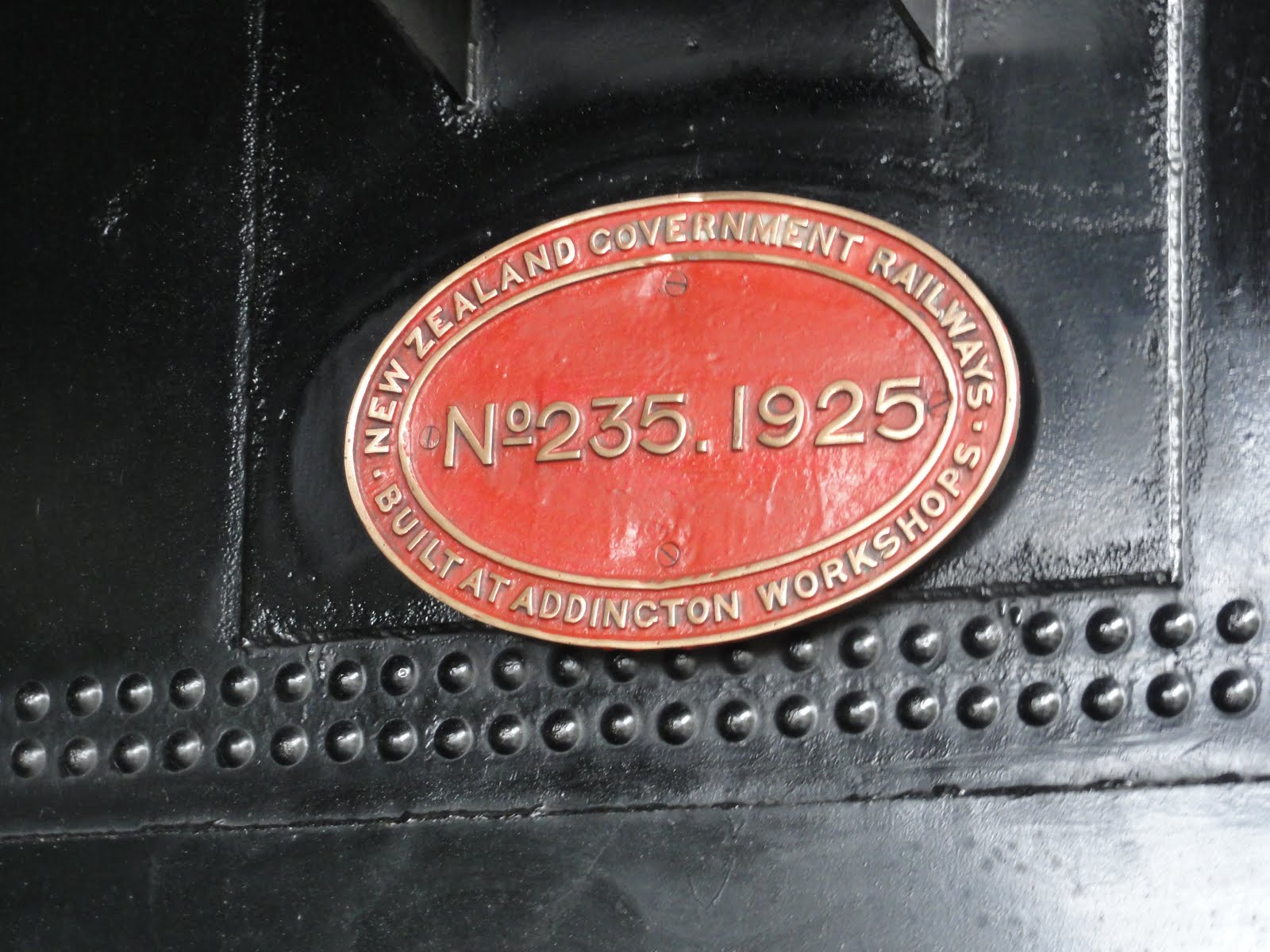
There are two steam locomotives used for the Kingston Flyer service, the AB778 starting service in 1925, and the AB795 which started service in 1927.

The AB class locomotive was a 4-6-2 Pacific steam locomotive with a Vanderbilt tender, of which 141 were built between 1915 and 1927 some of which by New Zealand Railways Addington Workshops.

No 235 is the builder’s number for the AB778

There were seven wooden bodied passenger carriages, three passenger coaches, one passenger/refreshments carriage and two car/vans.  The is also a Birdcage gallery coach.  Each of the rolling stock was built between 1900 and 1923.  They were built at either of Addington, Petone, or Hillside.

I suspect the 2 on the side means second class

The passenger coach we traveled in was very comfortable.

This is one of the guard’s vans, and for transporting cargo.

The Kingston Railway Station

and cafe.

A poster sign advertising the Kingston Flyer

The running times for the tourist services, when it was running.

NANOWRIMO – April 2024 – “The One That Got Away” – Day 7

The reporter

…

Winifred, daughter of Adria, is the contradiction.

She always had no intention of playing on her title, and she always regarded people addressing her as Lady Winifred with suspicion.

She also never wanted to use her name to open doors or get an advantage.  She went to university, and soon realised her calling was the written word and a talent for getting to the truth of the matter.

She honed her journalistic skills in the university newspaper and had the distinction of solving a rather convoluted death that was first believed to be a suicide as a murder, one the murderer would have got away with if she hadn’t tenaciously pursued it.

Those detective skills stood her in good stead, getting her a job at a major newspaper, except the editor didn’t believe she was up to the task, her society and aristocratic background getting in the way.

She has a point to prove, and this latest move by her mother’s organisation as good as any for what might be a good story.

And, in the back of her mind, something she had overheard when researching another story stuck, that involved the General, and it wasn’t good.

Of course, her mother knows Winnie is like a dog with a bone and warns her, ‘There’s nothing to see here’.

Winnie isn’t so sure…

…

Words today, 1,529, for a total of 12,545

An excerpt from “The Things We Do For Love”; In love, Henry was all at sea!

In the distance he could hear the dinner bell ringing and roused himself.  Feeling the dampness of the pillow, and fearing the ravages of pent up emotion, he considered not going down but thought it best not to upset Mrs. Mac, especially after he said he would be dining.

In the event, he wished he had reneged, especially when he discovered he was not the only guest staying at the hotel.

Whilst he’d been reminiscing, another guest, a young lady, had arrived.  He’d heard her and Mrs. Mac coming up the stairs, and then shown to a room on the same floor, perhaps at the other end of the passage.

Henry caught his first glimpse of her when she appeared at the door to the dining room, waiting for Mrs. Mac to show her to a table.

She was about mid-twenties, slim, long brown hair, and the grace and elegance of a woman associated with countless fashion magazines.  She was, he thought, stunningly beautiful with not a hair out of place, and make-up flawlessly applied.  Her clothes were black, simple, elegant, and expensive, the sort an heiress or wife of a millionaire might condescend to wear to a lesser occasion than dinner.

Then there was her expression; cold, forbidding, almost frightening in its intensity.  And her eyes, piercingly blue and yet laced with pain.  Dracula’s daughter was his immediate description of her.

All in all, he considered, the only thing they had in common was, like him, she seemed totally out of place.

Mrs. Mac came out of the kitchen, wiping her hands on her apron.  She was, she informed him earlier, chef, waitress, hotelier, barmaid, and cleaner all rolled into one.  Coming up to the new arrival she said, “Ah, Miss Andrews, I’m glad you decided to have dinner.  Would you like to sit with Mr. Henshaw, or would you like to have a table of your own?”

Henry could feel her icy stare as she sized up his appeal as a dining companion, making the hair on the back on his neck stand up.  He purposely didn’t look back.  In his estimation, his appeal rating was minus six.  Out of a thousand!

“If Mr. Henshaw doesn’t mind….”  She looked at him, leaving the query in mid-air.

He didn’t mind and said so.  Perhaps he’d underestimated his rating.

“Good.”  Mrs. Mac promptly ushered her over.  Henry stood, made sure she was seated properly and sat.

“Thank you.  You are most kind.”  The way she said it suggested snobbish overtones.

“I try to be when I can.”  It was supposed to nullify her sarcastic tone but made him sound a little silly, and when she gave him another of her icy glares, he regretted it.

Mrs. Mac quickly intervened, asking, “Would you care for the soup?”

They did, and, after writing the order on her pad, she gave them each a look, imperceptibly shook her head, and returned to the kitchen.

Before Michelle spoke to him again, she had another quick look at him, trying to fathom who and what he might be.  There was something about him.

His eyes, they mirrored the same sadness she felt, and, yes, there was something else, that it looked like he had been crying?  There was a tinge of redness.

Perhaps, she thought, he was here for the same reason she was.

No.  That wasn’t possible.

Then she said, without thinking, “Do you have any particular reason for coming here?”  Seconds later she realized she’s spoken it out loud, had hadn’t meant to actually ask, it just came out.

It took him by surprise, obviously not the first question he was expecting her to ask of him.

“No, other than it is as far from civilization, and home, as I could get.”

At least we agree on that, she thought.

It was obvious he was running away from something as well.

Given the isolation of the village and lack of geographic hospitality, it was, from her point of view, ideal.  All she had to do was avoid him, and that wouldn’t be difficult.

After getting through this evening first.

“Yes,” she agreed.  “It is that.”

A few seconds passed, and she thought she could feel his eyes on her and wasn’t going to look up.

Until he asked, “What’s your reason?”

Slight abrupt in manner, perhaps as a result of her question, and the manner in which she asked it.

She looked up.  “Rest.  And have some time to myself.”

She hoped he would notice the emphasis she had placed on the word ‘herself’ and take due note.  No doubt, she thought,  she had completely different ideas of what constituted a holiday than he, not that she had actually said she was here for a holiday.

Mrs. Mac arrived at a fortuitous moment to save them from further conversation.

Over the entree, she wondered if she had made a mistake coming to the hotel.  Of course, there had been no possible way she could know than anyone else might have booked the same hotel, but realized it was foolish to think she might end up in it by herself.

Was that what she was expecting?

Not a mistake then, but an unfortunate set of circumstances, which could be overcome by being sensible.

Yet, there he was, and it made her curious, not that he was a man, by himself, in the middle of nowhere, hiding like she was, but for very different reasons.

On discreet observance whilst they ate, she gained the impression his air of light-heartedness was forced and he had no sense of humor.

This feeling was engendered by his looks, unruly dark hair, and permanent frown.  And then there was his abysmal taste in clothes on a tall, lanky frame.  They were quality but totally unsuited to the wearer.

Rebellion was written all over him.

The only other thought crossing her mind, and rather incongruously, was he could do with a decent feed.  In that respect, she knew now from the mountain of food in front of her, he had come to the right place.

“Mr. Henshaw?”

He looked up.  “Henshaw is too formal.  Henry sounds much better,” he said, with a slight hint of gruffness.

“Then my name is Michelle.”

Mrs. Mac came in to take their order for the only main course, gather up the entree dishes, then return to the kitchen.

“Staying long?” she asked.

“About three weeks.  Yourself?”

“About the same.”

The conversation dried up.

Neither looked at the other, rather at the walls, out the window, towards the kitchen, anywhere.  It was, she thought, almost unbearably awkward.

Mrs. Mac returned with a large tray with dishes on it, setting it down on the table next to theirs.

“Not as good as the usual cook,” she said, serving up the dinner expertly, “but it comes a good second, even if I do say so myself.  Care for some wine?”

Henry looked at Michelle.  “What do you think?”

“I’m used to my dining companions making the decision.”

You would, he thought.  He couldn’t help but notice the cutting edge of her tone.  Then, to Mrs. Mac, he named a particular White Burgundy he liked and she bustled off.

“I hope you like it,” he said, acknowledging her previous comment with a smile that had nothing to do with humor.

“Yes, so do I.”

Both made a start on the main course, a concoction of chicken and vegetables that were delicious, Henry thought, when compared to the bland food he received at home and sometimes aboard my ship.

It was five minutes before Mrs. Mac returned with the bottle and two glasses.  After opening it and pouring the drinks, she left them alone again.

Henry resumed the conversation.  “How did you arrive?  I came by train.”

“By car.”

“Did you drive yourself?”

And he thought, a few seconds later, that was a silly question, otherwise she would not be alone, and certainly not sitting at this table. With him.

“After a fashion.”

He could see that she was formulating a retort in her mind, then changed it, instead, smiling for the first time, and it served to lighten the atmosphere.

And in doing so, it showed him she had another more pleasant side despite the fact she was trying not to look happy.

“My father reckons I’m just another of ‘those’ women drivers,” she added.

“Whatever for?”

“The first and only time he came with me I had an accident.  I ran up the back of another car.  Of course, it didn’t matter to him the other driver was driving like a startled rabbit.”

“It doesn’t help,” he agreed.

“Do you drive?”

“Mostly people up the wall.”  His attempt at humor failed.  “Actually,” he added quickly, “I’ve got a very old Morris that manages to get me where I’m going.”

The apple pie and cream for dessert came and went and the rapport between them improved as the wine disappeared and the coffee came.  Both had found, after getting to know each other better, their first impressions were not necessarily correct.

“Enjoy the food?” Mrs. Mac asked, suddenly reappearing.

“Beautifully cooked and delicious to eat,” Michelle said, and Henry endorsed her remarks.

“Ah, it does my heart good to hear such genuine compliments,” she said, smiling.  She collected the last of the dishes and disappeared yet again.

“What do you do for a living,” Michelle asked in an off-hand manner.

He had a feeling she was not particularly interested and it was just making conversation.

“I’m a purser.”

“A what?”

“A purser.  I work on a ship doing the paperwork, that sort of thing.”

“I see.”

“And you?”

“I was a model.”

“Was?”

“Until I had an accident, a rather bad one.”

“Oh, I’m sorry.”

So that explained the odd feeling he had about her.

As the evening had worn on, he began to think there might be something wrong, seriously wrong with her because she didn’t look too well.  Even the carefully applied makeup, from close up, didn’t hide the very pale, and tired look, or the sunken, dark ringed eyes.

“I try not to think about it, but it doesn’t necessarily work.  I’ve come here for peace and quiet, away from doctors and parents.”

“Then you will not have to worry about me annoying you.  I’m one of those fall-asleep-reading-a-book types.”

Perhaps it would be like ships passing in the night and then smiled to himself about the analogy.

Dinner now over, they separated.

Henry went back to the lounge to read a few pages of his book before going to bed, and Michelle went up to her room to retire for the night.

But try as he might, he was unable to read, his mind dwelling on the unusual, yet the compellingly mysterious person he would be sharing the hotel with.

Overlaying that original blurred image of her standing in the doorway was another of her haunting expressions that had, he finally conceded, taken his breath away, and a look that had sent more than one tingle down his spine.

She may not have thought much of him, but she had certainly made an impression on him.

© Charles Heath 2015-2020

lovecoverfinal1