Searching for locations: Terracotta Warriors and Horses Museum, X’ian, China

Terracotta Warriors and Horses Museum

A little history, and anecdotal advice first:

In 1974 a 26-year-old farmer, Yang Jide, was drilling a well and found fragments of the terracotta soldiers and bronze weapons.

What was discovered later was one of the biggest attended burial pits of China’s first feudal Emperor, Qin Shi Huang.  In the following years remains had been found in 3 pits, yielding at least 8,000 soldiers and horses, and over 100 chariots.  The soldiers were infantry, cavalry, and others.

Emperor Qin was born in 259 BC and died in 210 BC.  He began building a mausoleum for himself at the foot of Mount Li when he was 13.  Construction took 38 years, from 247 BC to 208 BC.  It was divided into 3 stages and involved 720,000 conscripts.

The pits of pottery figures are 1.5 km east of Emperor Qin’s mausoleum.  Pit 1 has about 6,000 terracotta armored warriors and horses and 40 wooden chariots.  Pit 2 is estimated to have over 900 terracotta warriors and 350 terracotta horses with about 90 wooden chariots.  Pit 3 had so far yielded only 66 pottery figures and one chariot drawn by four horses.

Official records say it was discovered later that it was likely Xiang Yu, a rebel, intentionally damaged the Mausoleum and the soldiers in the pits, by setting fire to the wooden roof rafters, and these fell on and broke the warriors into pieces.

However, we were told that after the terracotta warriors were completed, the Emperor ordered the builders to be killed so that they would not tell anyone about the warriors, and then of those that remained alive deliberately smashed all of the artifacts.

The thing is, all of the terracotta figures that have been found are in pieces, and they need computers to piece them back together again.

The visit:
The first impression is the size of the car park and the number of buses parked in the lot, and a hell of a lot more outside up the road an off on side streets.  Obviously, it costs money to park in the parking lot.

The other first impressions; the numbers waiting to get in were not as many as yesterday outside the forbidden city, in fact, a lot less.

Be warned there’s a long walk from the entrance gate where your bags are scanned and a body scan as well, before admittance.  This walk is through a landscaped area which it is expect might sometime in the future reveal more soldiers, or other artifacts.

At the end of the walk that takes about ten minutes, you can get a one-way ride to the second checkpoint, but we opted not to as no one else in our group did.

That walk is the warm-up exercise to an organized viewing of the exhibits after going through a second ticket checkpoint.  On the other side, we had to hand our tickets back to the tour guide which was disappointing not to end up with a memento of actually having been there.

So, on the other side in the courtyard, the guide told us the most important parts of the exhibition, that we should spend most of the time looking at pit 1, and then spent a little time in 2 which is only there in the first stages of excavation.  Then move onto the museum if only to see the replica chariots.

We do.

The chariots were small but interesting

The horses were better and intricately detailed

These are soldiers, perhaps complete examples of those types found in the end pit.

This is one of the archers.  You can tell by the way he wears his hair.

Pit 2

The excavation of this pit has only just begun, so it is possible to see where they have carefully removed the top cover, and you can see the broken parts of the warriors lying in a heap.
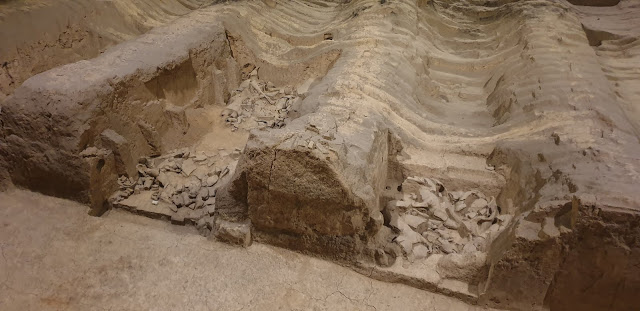
Some parts of the warriors are more discernible closer up
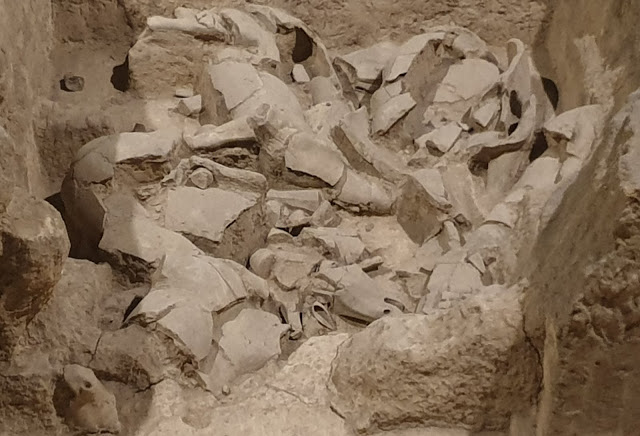
These parts are carefully extracted and taken to the ‘hospital’ where they are digitised and the computer will match each part with the warrior it belongs to.

Pit 1

This has quite a number of standing soldiers that have been glued back together, but not necessarily complete and I notice a number if the statues were incomplete. And if they cannot find the missing pieces, then they are not added to or filled in.

The scale of the pit is enormous, and they have hardly scratched the surface in the restoration process.

What is there is a number of horses as well.

That’s at the front of the pit, a long line of statues, and what is clear is the location of the well where the first fragments were found by a farmer.

There are about eight lines of soldiers, and some lining the sides.

Midway down there is a large area currently under excavation

At the back is the hospital where the soldiers are reassembled.  There’s nearly a hundred in the various stages of rebuilding.  These days the soldiers are rebuilt using computer imaging.
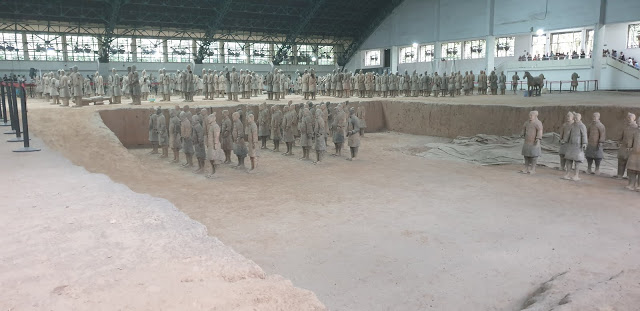
The hospital area is where they are put back together
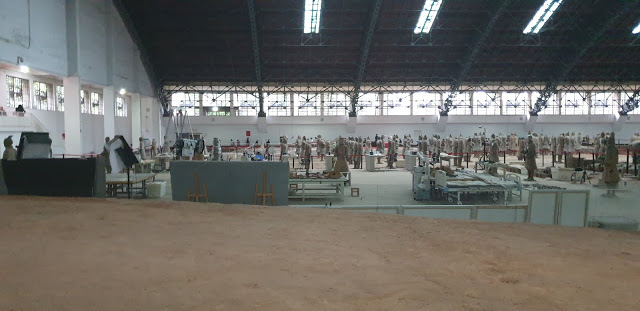
And these are some of the statues in various stages of reconstruction

Another two views of the size and scale of the reconstruction project

The coffee shop is also a sales centre, but there are too many people waiting for coffee and too few places to sit down.

Searching for locations: Terracotta Warriors and Horses Museum, X’ian, China

Terracotta Warriors and Horses Museum

A little history, and anecdotal advice first:

In 1974 a 26-year-old farmer, Yang Jide, was drilling a well and found fragments of the terracotta soldiers and bronze weapons.

What was discovered later was one of the biggest attended burial pits of China’s first feudal Emperor, Qin Shi Huang.  In the following years remains had been found in 3 pits, yielding at least 8,000 soldiers and horses, and over 100 chariots.  The soldiers were infantry, cavalry, and others.

Emperor Qin was born in 259 BC and died in 210 BC.  He began building a mausoleum for himself at the foot of Mount Li when he was 13.  Construction took 38 years, from 247 BC to 208 BC.  It was divided into 3 stages and involved 720,000 conscripts.

The pits of pottery figures are 1.5 km east of Emperor Qin’s mausoleum.  Pit 1 has about 6,000 terracotta armored warriors and horses and 40 wooden chariots.  Pit 2 is estimated to have over 900 terracotta warriors and 350 terracotta horses with about 90 wooden chariots.  Pit 3 had so far yielded only 66 pottery figures and one chariot drawn by four horses.

Official records say it was discovered later that it was likely Xiang Yu, a rebel, intentionally damaged the Mausoleum and the soldiers in the pits, by setting fire to the wooden roof rafters, and these fell on and broke the warriors into pieces.

However, we were told that after the terracotta warriors were completed, the Emperor ordered the builders to be killed so that they would not tell anyone about the warriors, and then of those that remained alive deliberately smashed all of the artifacts.

The thing is, all of the terracotta figures that have been found are in pieces, and they need computers to piece them back together again.

The visit:
The first impression is the size of the car park and the number of buses parked in the lot, and a hell of a lot more outside up the road an off on side streets.  Obviously, it costs money to park in the parking lot.

The other first impressions; the numbers waiting to get in were not as many as yesterday outside the forbidden city, in fact, a lot less.

Be warned there’s a long walk from the entrance gate where your bags are scanned and a body scan as well, before admittance.  This walk is through a landscaped area which it is expect might sometime in the future reveal more soldiers, or other artifacts.

At the end of the walk that takes about ten minutes, you can get a one-way ride to the second checkpoint, but we opted not to as no one else in our group did.

That walk is the warm-up exercise to an organized viewing of the exhibits after going through a second ticket checkpoint.  On the other side, we had to hand our tickets back to the tour guide which was disappointing not to end up with a memento of actually having been there.

So, on the other side in the courtyard, the guide told us the most important parts of the exhibition, that we should spend most of the time looking at pit 1, and then spent a little time in 2 which is only there in the first stages of excavation.  Then move onto the museum if only to see the replica chariots.

We do.

The chariots were small but interesting

The horses were better and intricately detailed

These are soldiers, perhaps complete examples of those types found in the end pit.

This is one of the archers.  You can tell by the way he wears his hair.

Pit 2

The excavation of this pit has only just begun, so it is possible to see where they have carefully removed the top cover, and you can see the broken parts of the warriors lying in a heap.

Some parts of the warriors are more discernible closer up

These parts are carefully extracted and taken to the ‘hospital’ where they are digitised and the computer will match each part with the warrior it belongs to.

Pit 1

This has quite a number of standing soldiers that have been glued back together, but not necessarily complete and I notice a number if the statues were incomplete. And if they cannot find the missing pieces, then they are not added to or filled in.

The scale of the pit is enormous, and they have hardly scratched the surface in the restoration process.

What is there is a number of horses as well.

That’s at the front of the pit, a long line of statues, and what is clear is the location of the well where the first fragments were found by a farmer.

There are about eight lines of soldiers, and some lining the sides.

Midway down there is a large area currently under excavation

At the back is the hospital where the soldiers are reassembled.  There’s nearly a hundred in the various stages of rebuilding.  These days the soldiers are rebuilt using computer imaging.

The hospital area is where they are put back together

And these are some of the statues in various stages of reconstruction

Another two views of the size and scale of the reconstruction project

The coffee shop is also a sales centre, but there are too many people waiting for coffee and too few places to sit down.

Searching for locations: Toowoomba Flower Festival, Toowoomba, Queensland, Australia

The Toowoomba Carnival of Flowers is held in September, and generally runs for ten days at the end of the month.

We visited the Laurel Bank Park, where there are beds of many colorful flowers,

open spaces,

statues,

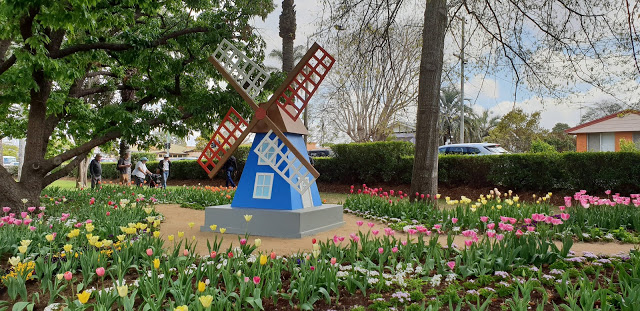
an area set aside for not only tulips but a model windmill

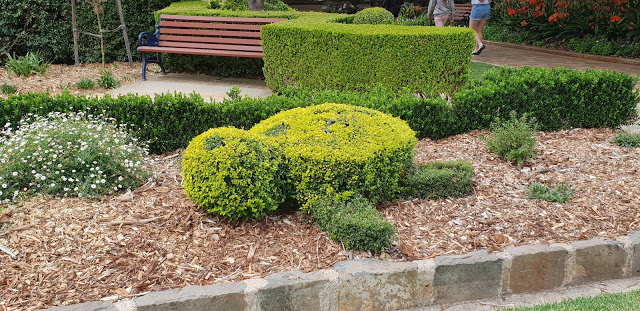
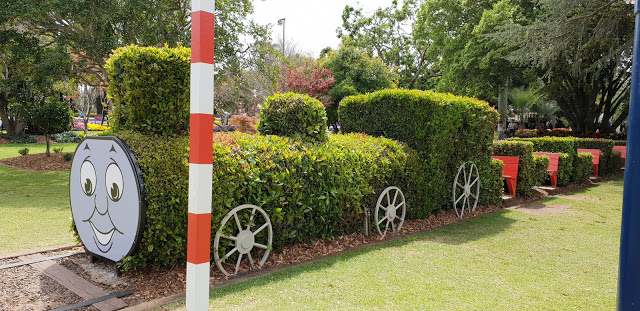
and quite a number of hedge sculptures

There was also the opportunity to go on a morning or afternoon garden tour which visited a number of private gardens of residences in Toowoomba.

Searching for locations: Toowoomba Flower Festival, Toowoomba, Queensland, Australia

The Toowoomba Carnival of Flowers is held in September, and generally runs for ten days at the end of the month.

We visited the Laurel Bank Park, where there are beds of many colorful flowers,

open spaces,

statues,

an area set aside for not only tulips but a model windmill

and quite a number of hedge sculptures

There was also the opportunity to go on a morning or afternoon garden tour which visited a number of private gardens of residences in Toowoomba.

Wishful thinking will not get us there any faster!

My phone, being smart and all, has been creating a notification that tells me I have some memories stored on it for this day a year ago, or two years, or many years.

The pictures it is showing are of our trip to China a few years ago.

Not much chance of going back, and, back then, neither of us could imagine that everything that has happened in the last six months could happen.

But, it did.

And one of the effects of those events is no more overseas travel

No more travel of any sort at the moment with the travel restrictions in place.  We can’t even fly to another state.  Come to that, we might not have an airline to fly on.

Travel, of course, is the main escape, where we can get away from our daily lives, and go somewhere quite different from where we live and experience a different world.  The people, the food, the sights.

What is probably more significant is that we might not be able to go away again, if there is no cure for the virus.  No one will want to risk catching it in another country, simply because of the medical expenses, the chances are that travel insurance will not cover you for the Coronavirus.

And no cover, no travel, even if you are able to.

So, it means that any travel we will be doing, when we can, will be in our own country.  We can do this without a vaccine because we have so few active cases, and the measures we have is stopping it in its tracks.

So too for New Zealand, and we may be able to travel there.

One day.

Until then, my smartphone is going to keep sending me gentle reminders of what it was like in another lifetime.

Memories of the conversations with my cat – 3

As some may be aware, but many not, Chester, my faithful writing assistant, mice catcher, and general pain in the neck, passed away some months ago.

Recently I was running a series based on his adventures, under the title of Past Conversations with my cat.

For those who have not had the chance to read about all of his exploits I will run the series again from Episode 1

These are the memories of our time together…

20160902_123201

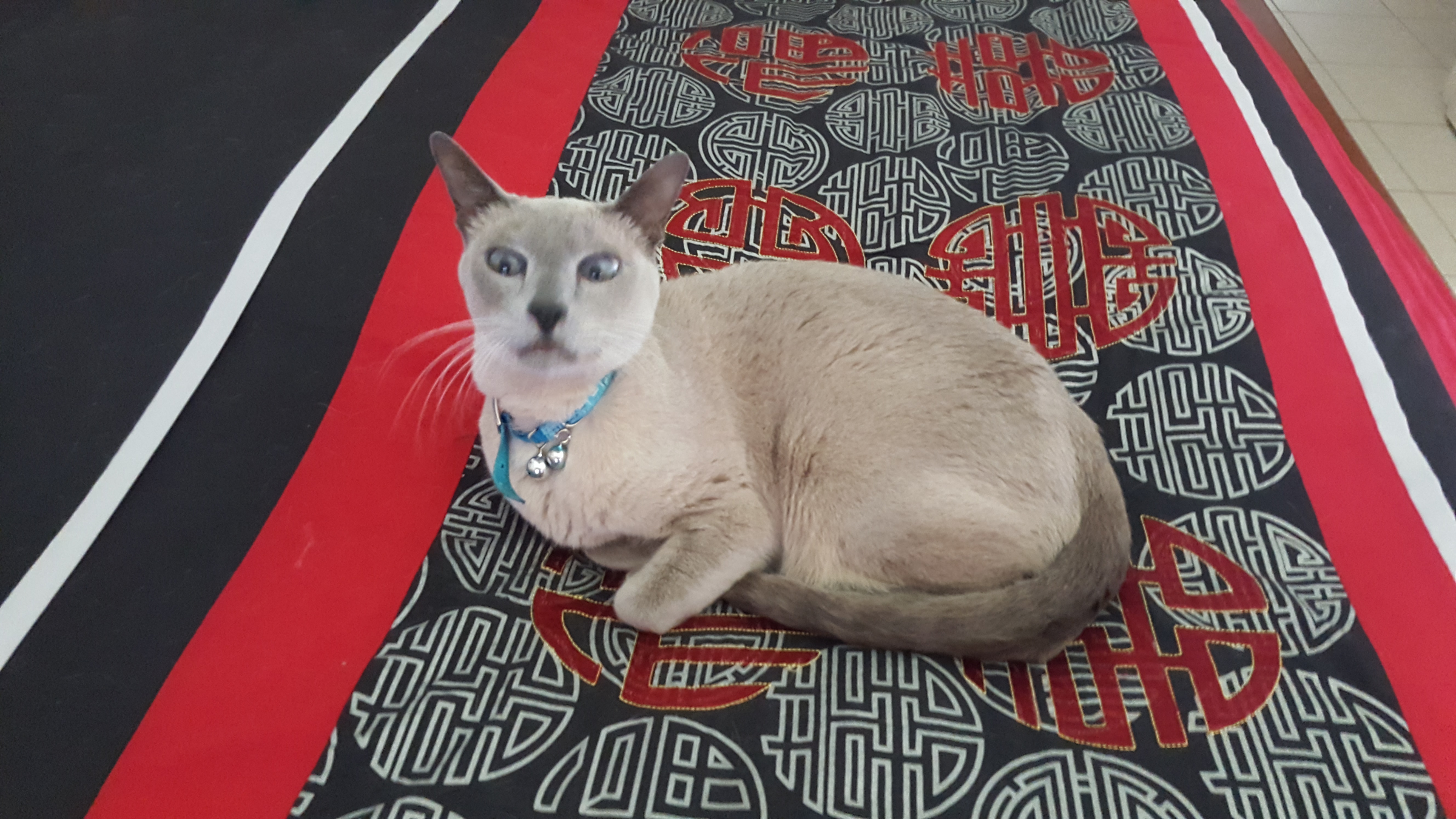
This is Chester.  Back on the bed.

Another argument lost, another smug ‘I’ve got the better of you, again’ look.

Time to move on, pick a battle I think I can win.

Food.  There’s the old wives tale, that cats love fish, and it’s true to a certain extent.

Chester doesn’t believe fish live in cans or plastic packets, despite how it’s dressed up.  Fresh fish, he’s into it, but there always seems to be a measured reluctance to eat something out of a can.

I think he regards us humans with disdain when our food comes out of a can or packet.

He refuses to eat the leftovers!

Then there’s chicken, or its more expensive neighbor, turkey.

He loves turkey.

I’m sure he’d eat quail and spatchcock too, but no, he’s a cat, and cats have to get used to eating chicken.  We’ve had this discussion, one too many times.

And just for good measure, I told him if he thinks he’s coming to Italy with us, he’d better get used to the idea of eating pasta.

Of course, always with the last word, he said, quite nonchalantly, ‘then you’d better call me Garfield’.

Grrrrrrr.

Wishful thinking will not get us there any faster!

My phone, being smart and all, has been creating a notification that tells me I have some memories stored on it for this day a year ago, or two years, or many years.

The pictures it is showing are of our trip to China a few years ago.

Not much chance of going back, and, back then, neither of us could imagine that everything that has happened in the last six months could happen.

But, it did.

And one of the effects of those events is no more overseas travel

No more travel of any sort at the moment with the travel restrictions in place.  We can’t even fly to another state.  Come to that, we might not have an airline to fly on.

Travel, of course, is the main escape, where we can get away from our daily lives, and go somewhere quite different from where we live and experience a different world.  The people, the food, the sights.

What is probably more significant is that we might not be able to go away again, if there is no cure for the virus.  No one will want to risk catching it in another country, simply because of the medical expenses, the chances are that travel insurance will not cover you for the Coronavirus.

And no cover, no travel, even if you are able to.

So, it means that any travel we will be doing, when we can, will be in our own country.  We can do this without a vaccine because we have so few active cases, and the measures we have is stopping it in its tracks.

So too for New Zealand, and we may be able to travel there.

One day.

Until then, my smartphone is going to keep sending me gentle reminders of what it was like in another lifetime.

Memories of the conversations with my cat – 3

As some may be aware, but many not, Chester, my faithful writing assistant, mice catcher, and general pain in the neck, passed away some months ago.

Recently I was running a series based on his adventures, under the title of Past Conversations with my cat.

For those who have not had the chance to read about all of his exploits I will run the series again from Episode 1

These are the memories of our time together…

20160902_123201

This is Chester.  Back on the bed.

Another argument lost, another smug ‘I’ve got the better of you, again’ look.

Time to move on, pick a battle I think I can win.

Food.  There’s the old wives tale, that cats love fish, and it’s true to a certain extent.

Chester doesn’t believe fish live in cans or plastic packets, despite how it’s dressed up.  Fresh fish, he’s into it, but there always seems to be a measured reluctance to eat something out of a can.

I think he regards us humans with disdain when our food comes out of a can or packet.

He refuses to eat the leftovers!

Then there’s chicken, or its more expensive neighbor, turkey.

He loves turkey.

I’m sure he’d eat quail and spatchcock too, but no, he’s a cat, and cats have to get used to eating chicken.  We’ve had this discussion, one too many times.

And just for good measure, I told him if he thinks he’s coming to Italy with us, he’d better get used to the idea of eating pasta.

Of course, always with the last word, he said, quite nonchalantly, ‘then you’d better call me Garfield’.

Grrrrrrr.

I never thought it would be so difficult…

To get a decent cup of coffee.

Yes, something as simple as that.

We all have our favourite places, ours is a coffee franchise called Zaraffas. It has a giraffe as its logo, and an African motif to remind us of something, perhaps that they make good coffee, or the coffee comes from Africa.

Problem is, it’s been going downhill. It’s happened before, and I suspect it’s all in the name of making more money, and not being interested in the customer’s desire for a good cup of coffee.

It started out as being the best compared to a lot of other places, like Coffee Club, like Starbucks, and others. I never liked Starbucks, and my hate affair began in New York, and spread back home. Their coffee is far to weak for a double shot. Perhaps only in China does Starbucks shine, or the fact it was the only coffee franchise we could believe was safe.

But, back to Zaraffas, recently the coffee has been getting weaker, which for a double shot, is odd. You might put it down to the fact staff turnover was high, and some were still learning to be baristas, but then, the people we used to rely on made the coffee, and it was still weak.

A double shot went to a triple shot. Slight improvement, but it gradually got worse. There’s only two excuses, they changed coffee beans to a cheaper brand, or they’re not putting as much coffee in the strainer. That, I learned, when looking up the making of coffee, can be critical. It needs to be tamped down tightly to get a good brew.

So, we went elsewhere, a place called Merlo. It’s cheaper, but the results are completely different. A double shot is a true double shot, it tastes better, much better. Different beans.

There’s another place just around the corner, that had organic coffee. More expensive, but you can really taste the difference.

I’m sad, but we don’t go to our usual place unless it’s on the way home. Life’s too short to be compromising, especially where coffee is concerned.

And, just as a matter of interest, while in New York for a week, I went to the same coffee shop every morning, and never got the same cup of coffee for each of the days. A double shot, latte with two sugars had so many different connotations, by the third day, it became a game, until I realised they didn’t make coffee the same as we have in Australia. There they just push a button.

Perhaps that’s part of the coffee drinkers adventure there, you never know what you’re going to get. In the end, I settled for the brewed coffee and vanilla milk in the hotel’s breakfast bar.

I never thought it would be so difficult…

To get a decent cup of coffee.

Yes, something as simple as that.

We all have our favourite places, ours is a coffee franchise called Zaraffas. It has a giraffe as its logo, and an African motif to remind us of something, perhaps that they make good coffee, or the coffee comes from Africa.

Problem is, it’s been going downhill. It’s happened before, and I suspect it’s all in the name of making more money, and not being interested in the customer’s desire for a good cup of coffee.

It started out as being the best compared to a lot of other places, like Coffee Club, like Starbucks, and others. I never liked Starbucks, and my hate affair began in New York, and spread back home. Their coffee is far to weak for a double shot. Perhaps only in China does Starbucks shine, or the fact it was the only coffee franchise we could believe was safe.

But, back to Zaraffas, recently the coffee has been getting weaker, which for a double shot, is odd. You might put it down to the fact staff turnover was high, and some were still learning to be baristas, but then, the people we used to rely on made the coffee, and it was still weak.

A double shot went to a triple shot. Slight improvement, but it gradually got worse. There’s only two excuses, they changed coffee beans to a cheaper brand, or they’re not putting as much coffee in the strainer. That, I learned, when looking up the making of coffee, can be critical. It needs to be tamped down tightly to get a good brew.

So, we went elsewhere, a place called Merlo. It’s cheaper, but the results are completely different. A double shot is a true double shot, it tastes better, much better. Different beans.

There’s another place just around the corner, that had organic coffee. More expensive, but you can really taste the difference.

I’m sad, but we don’t go to our usual place unless it’s on the way home. Life’s too short to be compromising, especially where coffee is concerned.

And, just as a matter of interest, while in New York for a week, I went to the same coffee shop every morning, and never got the same cup of coffee for each of the days. A double shot, latte with two sugars had so many different connotations, by the third day, it became a game, until I realised they didn’t make coffee the same as we have in Australia. There they just push a button.

Perhaps that’s part of the coffee drinkers adventure there, you never know what you’re going to get. In the end, I settled for the brewed coffee and vanilla milk in the hotel’s breakfast bar.