One the first things you notice when driving around Beijing, other than the roads are congested with traffic, is the number of trees and flowers that have been planted, in the median strip as well as along the edges of the road.
What you also notice is the large number of multi-story apartment blocks, which are needed to house the millions of Beijing residents. What we have, so far, rarely seen, is single-story houses. These continuous areas of trees and rose bushes are, every now and then, broken up by very colorful garden beds:
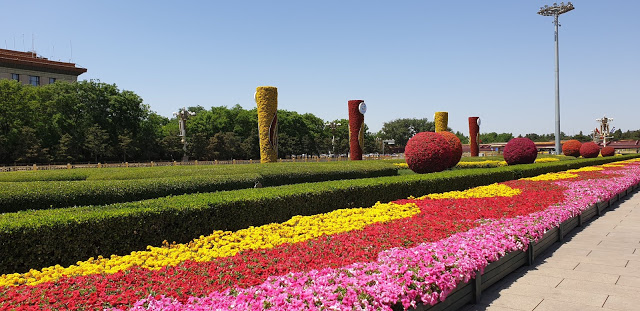
Nearer to the square we are able to get up close to the flowers. These, we are told, are a variation on the rose, one that flowers for nine months of the year.
They come in a variety of colors.
And they are literally everywhere you go, on the side of the roadway, often blotting out the concrete jungle behind them.
One the first things you notice when driving around Beijing, other than the roads are congested with traffic, is the number of trees and flowers that have been planted, in the median strip as well as along the edges of the road.
What you also notice is the large number of multi-story apartment blocks, which are needed to house the millions of Beijing residents. What we have, so far, rarely seen, is single-story houses. These continuous areas of trees and rose bushes are, every now and then, broken up by very colorful garden beds:
Nearer to the square we are able to get up close to the flowers. These, we are told, are a variation on the rose, one that flowers for nine months of the year.
They come in a variety of colors.
And they are literally everywhere you go, on the side of the roadway, often blotting out the concrete jungle behind them.
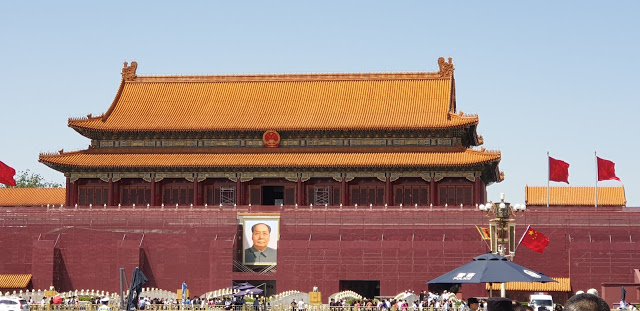
Tiananmen Square Some interesting facts before we get out of the bus… Tiananmen Square or Tian’anmen Square is in the centre of Beijing name after the Gate of Heavenly Peace, a gate that one separated the square from the Forbidden City.
The Square contains,
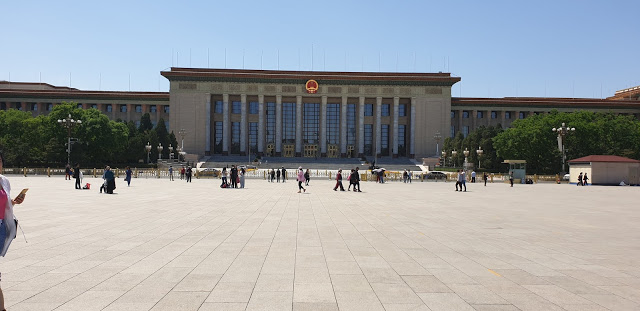
the Monument to the People’s Heroes the Great Hall of the People the National Museum of China the Mausoleum of Mao Zedong.
The square is about 109 acres and was designed and built in 1651, and since then been enlarged four times since, the most recent upgrade in the 1950s.
The Monument to the People’s Heroes
This is a ten-story obelisk built to commemorate the matters of the revolutions. It was built between August 1952 and May 1958. On the pedestal are reliefs depicting the eight major revolutionary episodes.
The Great Hall of the People
This was opened in September 1959, and covers 171809 square meters. The Great Hall is the largest auditorium in China and can seat up to 10,000 people. The State Banquet Hall can seat up to 5,000 diners.
The National Museum of China
This is one of the largest museums in the world and the second most visited museum in the world after the Louvre in Paris. It was completed in 1959, and sits on 65 hectares, and rises four floors. It has a permanent collection of over 1,000,000 items.
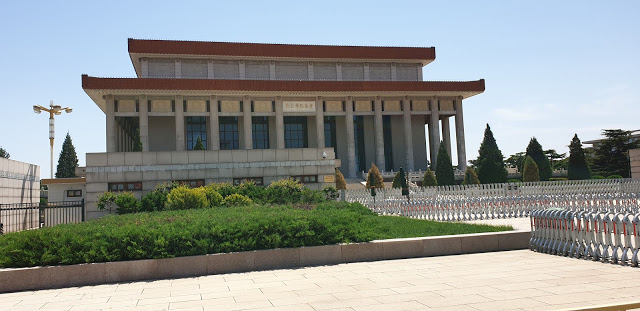
The Mauseloum of Mao Zedong
This was built shortly after his death, and completed on May 24th, 1977. The embalmed body of the Chairman is preserved and on display in the center hall.
My own observations This is huge; one of the largest public squares in the world, and if you’re going to walk it, like we did, make sure you’ve been exercising before you go. It covers 44 hectares, borders on the Forbidden City, and has a memorial to Chairman Mao in the center of it. But you cannot go near it, it’s fenced off, and it is guarded.
That’s both the statue and the square as there are random guards marching in random directions all the while watching us to see that we don’t misbehave.No one wants to find out what would happen if you jumped the fence around the statue, but I’m guessing you’ll have a few years to contemplate the stupidity of your actions with some very unhappy government officials.
Around the edges of the square are huge buildings, on one side is the museum
and on the other is the Chinese equivalent of parliament.
Around the sides are also large gardens
At one end, where the Forbidden City borders on the square, there’s a huge flag pole flying the Chinese flag, and this too like the monument is fenced off, and guarded by members of all of their armed services. No tanks rolled out during our visit much to our disappointment. There is no entrance to the Forbidden City from the square
At the other end is the Mausoleum of Mao Zedong, which was closed the day we were there, as was the museum.
There are four sculptural groups installed outside the mausoleum.
Other than that, it’s just another square, albeit probably one of the largest in the world. It can, we were told, hold about a million people.
Tiananmen Square Some interesting facts before we get out of the bus… Tiananmen Square or Tian’anmen Square is in the centre of Beijing name after the Gate of Heavenly Peace, a gate that one separated the square from the Forbidden City.
The Square contains,
the Monument to the People’s Heroes the Great Hall of the People the National Museum of China the Mausoleum of Mao Zedong.
The square is about 109 acres and was designed and built in 1651, and since then been enlarged four times since, the most recent upgrade in the 1950s.
The Monument to the People’s Heroes
This is a ten-story obelisk built to commemorate the matters of the revolutions. It was built between August 1952 and May 1958. On the pedestal are reliefs depicting the eight major revolutionary episodes.
The Great Hall of the People
This was opened in September 1959, and covers 171809 square meters. The Great Hall is the largest auditorium in China and can seat up to 10,000 people. The State Banquet Hall can seat up to 5,000 diners.
The National Museum of China
This is one of the largest museums in the world and the second most visited museum in the world after the Louvre in Paris. It was completed in 1959, and sits on 65 hectares, and rises four floors. It has a permanent collection of over 1,000,000 items.
The Mauseloum of Mao Zedong
This was built shortly after his death, and completed on May 24th, 1977. The embalmed body of the Chairman is preserved and on display in the center hall.
My own observations This is huge; one of the largest public squares in the world, and if you’re going to walk it, like we did, make sure you’ve been exercising before you go. It covers 44 hectares, borders on the Forbidden City, and has a memorial to Chairman Mao in the center of it. But you cannot go near it, it’s fenced off, and it is guarded.
That’s both the statue and the square as there are random guards marching in random directions all the while watching us to see that we don’t misbehave.No one wants to find out what would happen if you jumped the fence around the statue, but I’m guessing you’ll have a few years to contemplate the stupidity of your actions with some very unhappy government officials.
Around the edges of the square are huge buildings, on one side is the museum
and on the other is the Chinese equivalent of parliament.
Around the sides are also large gardens
At one end, where the Forbidden City borders on the square, there’s a huge flag pole flying the Chinese flag, and this too like the monument is fenced off, and guarded by members of all of their armed services. No tanks rolled out during our visit much to our disappointment. There is no entrance to the Forbidden City from the square
At the other end is the Mausoleum of Mao Zedong, which was closed the day we were there, as was the museum.
There are four sculptural groups installed outside the mausoleum.
Other than that, it’s just another square, albeit probably one of the largest in the world. It can, we were told, hold about a million people.
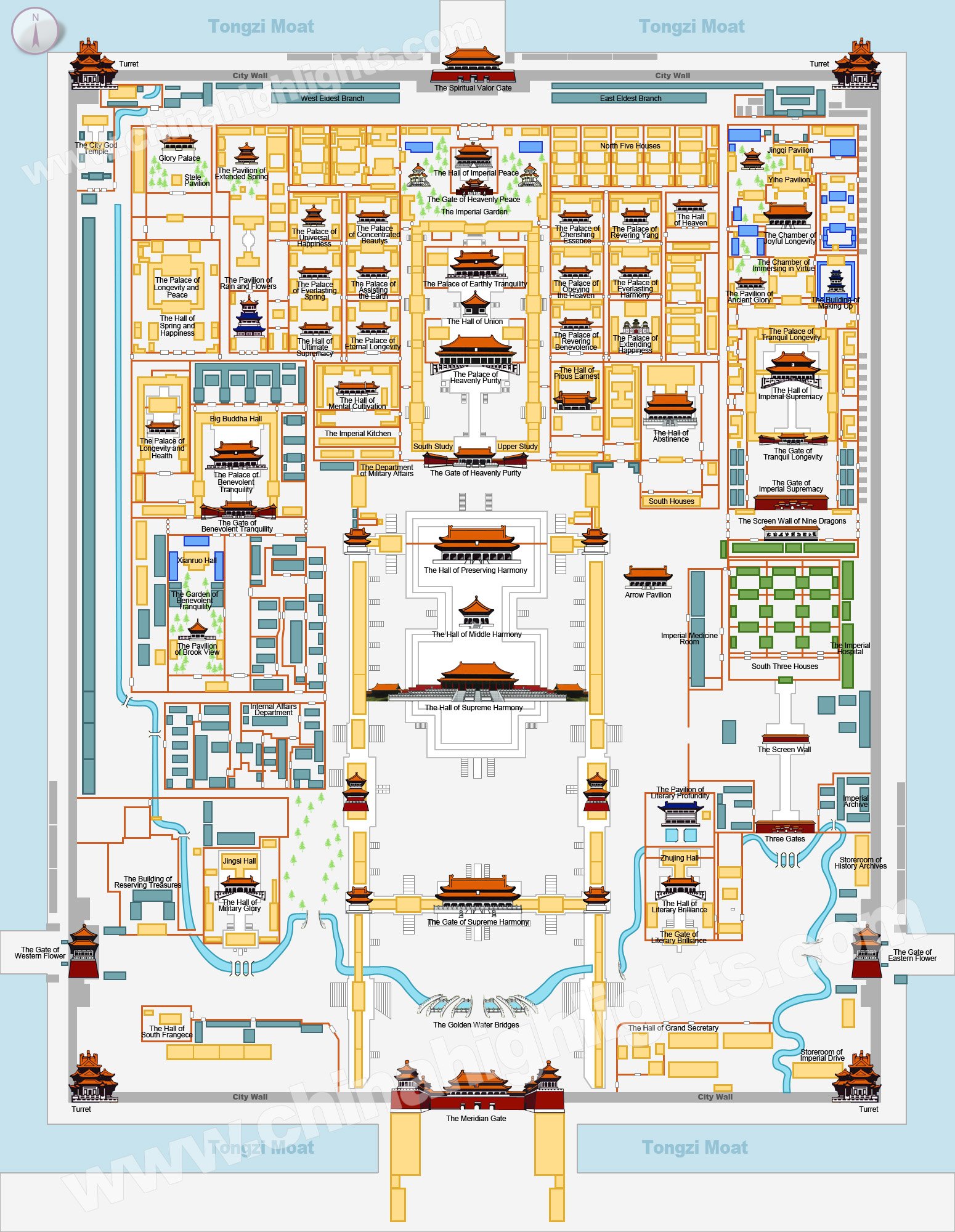
Now we’re walking to the Forbidden City, and it seems like we’re walking for miles and we’re practically exhausted before we get started on the main tour. I’m not sure if we received a map of the city, but one is certainly needed so that you can navigate the many features, buildings, and walkways.
There are tour groups everywhere in the large courtyard outside the gate, most likely getting a lecture on the last of the Chinese emperors about that time Sun Yat-Sen proclaimed the new China around 1912. We were no exception, and it was an interesting way to spend the time waiting to get in. It was a tale of intrigue, interwoven with a 3-year-old emperor, and a scheming concubine who becomes the Emperor’s favorite, enough to bear him a son and successor.
Bribery and corruption at its best.
But its history runs something like this:
The Forbidden City is was once the imperial and state residence of the Emperor of China, as well as the center of government, from the Ming Dynasty to the Qing Dynasty, or 1420 to 1924.
It was built from 1406 to 1420 when the Yongle Emperor moved the capital from Nanking to Beijing and consists of about 980 buildings, and 8,886 bays of rooms (not the 9,999 as prescribed in myth) and covers 180 acres. Over the 14 years, a million workers used whole logs of wood from the jungles of southwestern China, marble from quarries near Beijing, specially made golden bricks from Suzhou
Since 1925 it has been a museum and is the largest number of preserved wooden structures in the world.
The city is surrounded by a wall 7.9 meters high, and a moat that is 6 meters deep and 52 meters wide. A tower sits at each of the four corners. Each side has a gate, the north is called the Gate of Divine Might, the south is called the Meridian gate. East and west are called East Glorious Gate and West Glorious Gate respectively.
But, back in the courtyard, we are ready to go in and follow the tour guide who has switched from her amplified microphone to a whisper device we all wear in our ears. She talks and we listen.
We all make it through and regroup on the other side. This is where the fun begins because we are about to meet a large percentage of the 80,000, they let for the day.
It seems to me they have all arrived at the same time, although by the time we get to the entrance gate, it is very well organized, bags are scanned, people are scanned, and you’re in.
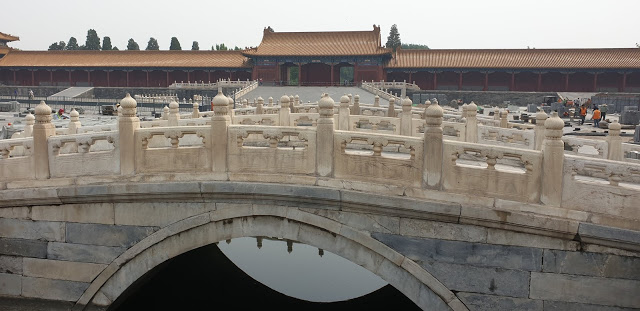
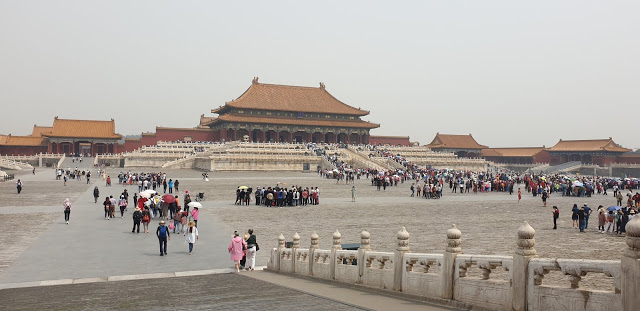
After crossing one of the seven Golden Water bridges, you begin to get some idea of the size and scope of the City, and in the distance, the first of the buildings, The Gate of Supreme Harmony. On a hot day, that could be a long and thirsty walk.
From there it is one pagoda after another with buildings that surround the edge of the whole Forbidden City, as does the moat.
By the time we get to the second courtyard, it was time to have ice cream as a refresher. Others head up to another exhibit, and it’s just too many stairs for us.
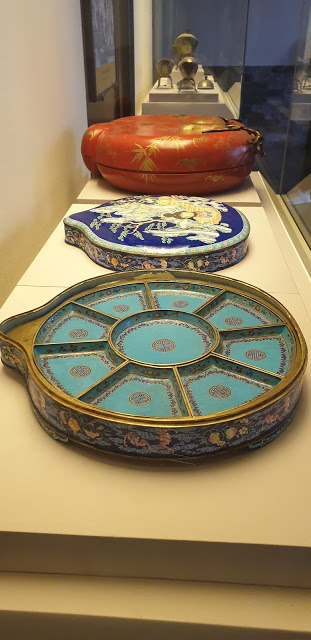
After this, it’s a walkthrough another courtyard, heading up and down some more stairs, we go and see the museum, with priceless relics from past emperors.
There are areas like the outer courtyard, the inner courtyard, yet another courtyard, and the gardens where the concubines walked and spent their leisure time. It is not far from the emperor’s wives living quarters, though there’s precious little left of the furniture, other than a settee and two rather priceless so-called Ming dynasty vases.
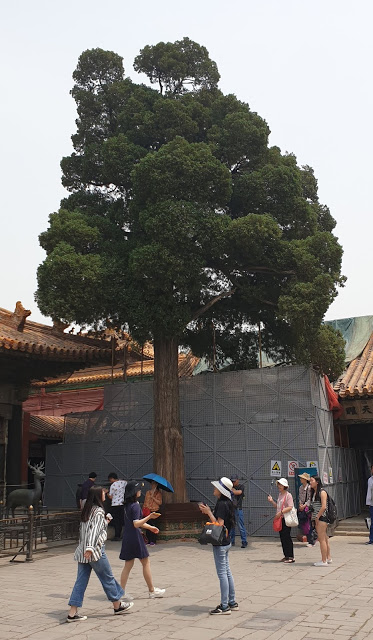
We get into the bad habit of calling all of the vases Ming dynasties. Above is one of the inner courtyards there were living quarters, and that tree is over 300 years old.
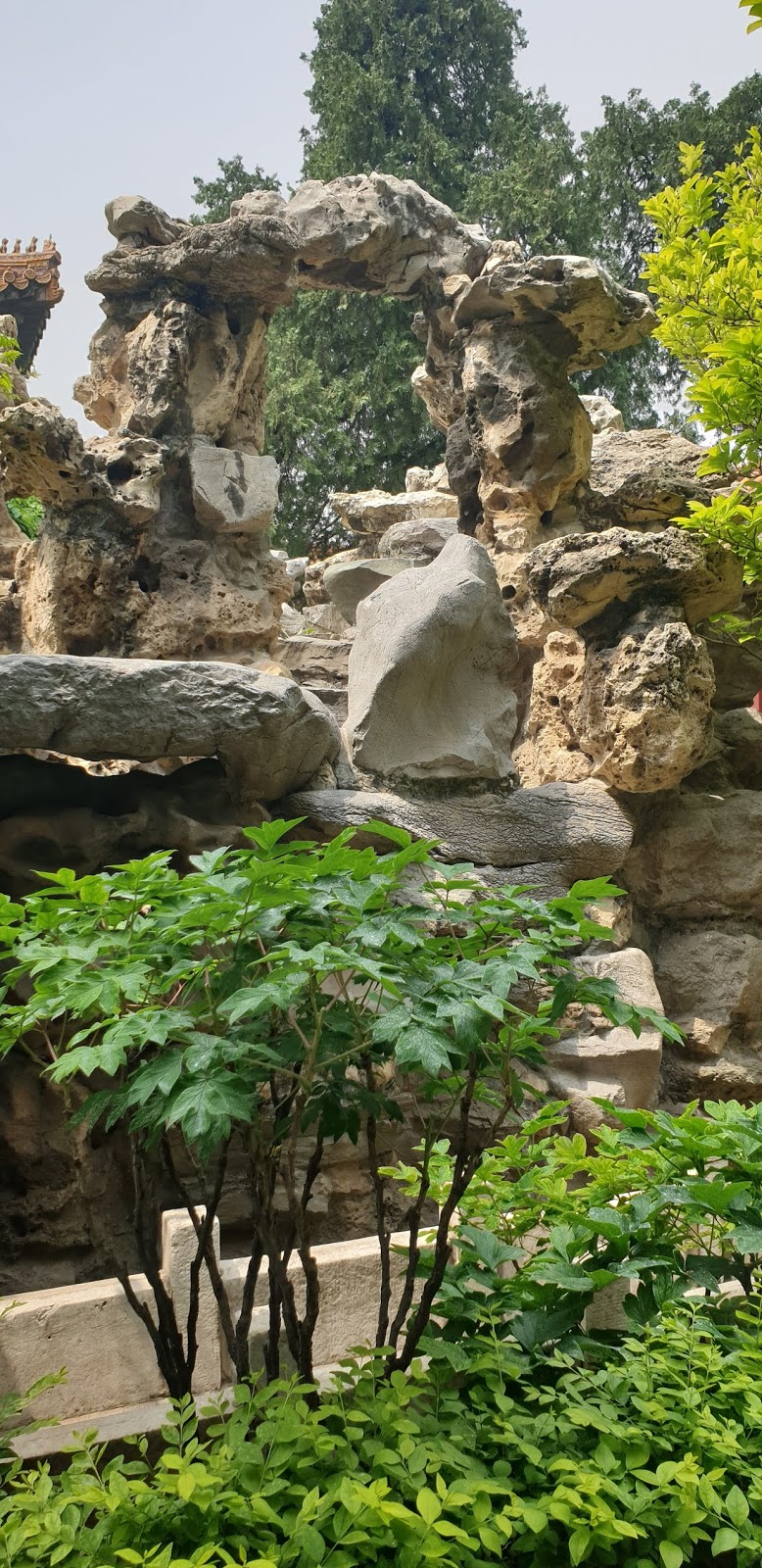
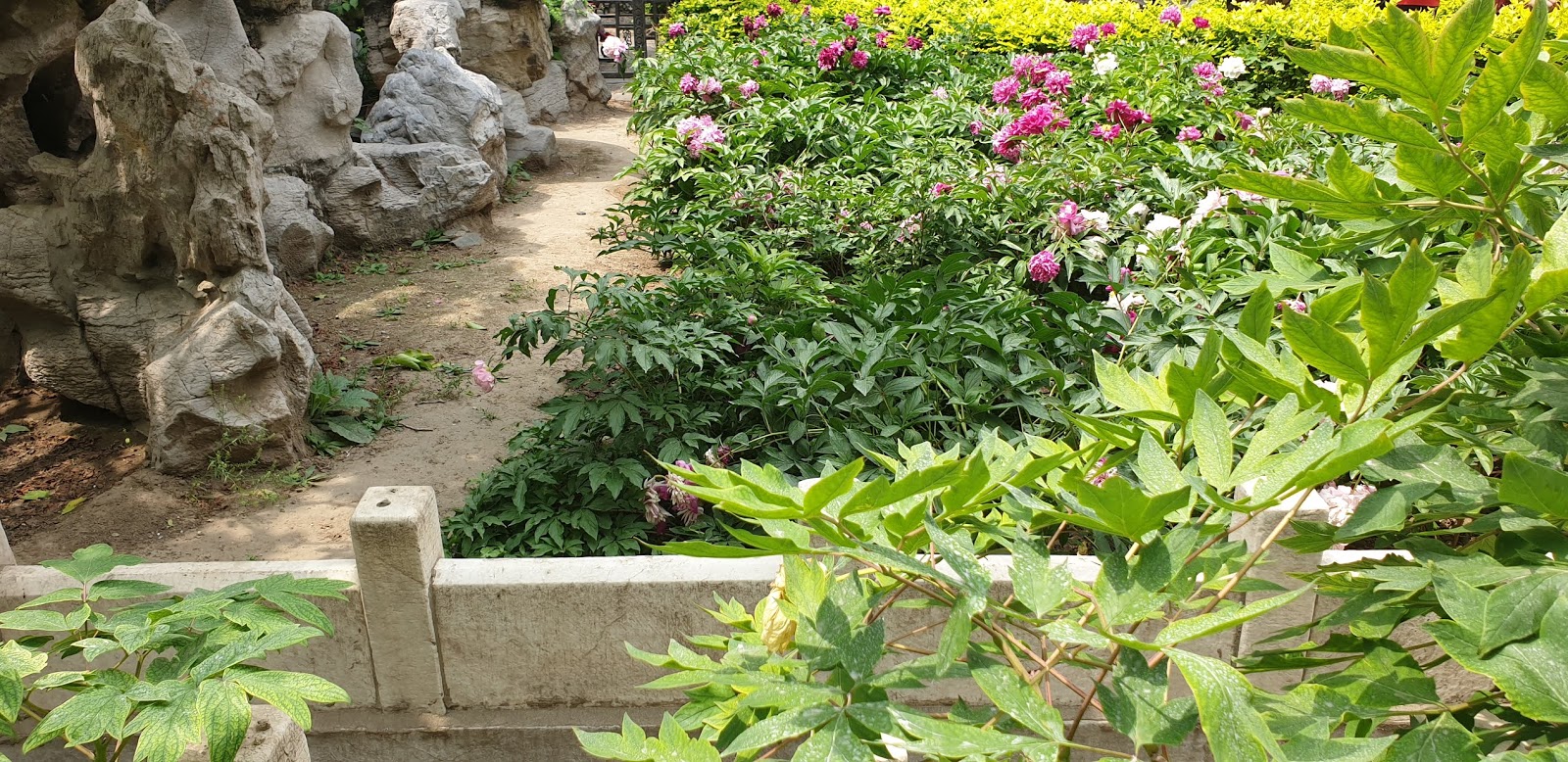
Out through some more alleyways and through an entrance that led to the area where the concubines lived, very spacious, bright, and filled with trees, plants, and walkways through rocky outcrops.
The whole area was made up of living quarters and waterways, rocks and paths, all very neatly set out, and it looked to be a very good place to live.
This is an example of the living quarters, overlooking the gardens
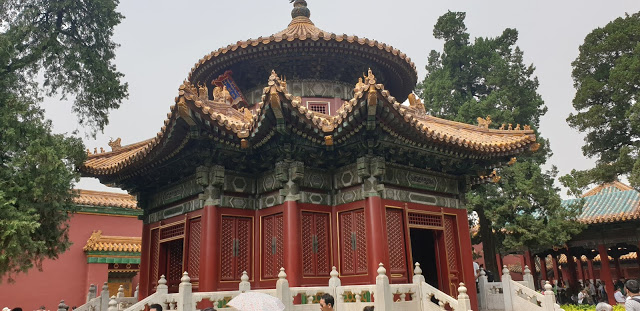
And there were several pagodas
From there its a quick exit out the northern entrance, and another longish walk to our bus, which arrives at the meeting point shortly after we do.
That done, the Beijing tour guide has completed her section of our China experience, and we’re ready to move onto the next.
Now we’re walking to the Forbidden City, and it seems like we’re walking for miles and we’re practically exhausted before we get started on the main tour. I’m not sure if we received a map of the city, but one is certainly needed so that you can navigate the many features, buildings, and walkways.
There are tour groups everywhere in the large courtyard outside the gate, most likely getting a lecture on the last of the Chinese emperors about that time Sun Yat-Sen proclaimed the new China around 1912. We were no exception, and it was an interesting way to spend the time waiting to get in. It was a tale of intrigue, interwoven with a 3-year-old emperor, and a scheming concubine who becomes the Emperor’s favorite, enough to bear him a son and successor.
Bribery and corruption at its best.
But its history runs something like this:
The Forbidden City is was once the imperial and state residence of the Emperor of China, as well as the center of government, from the Ming Dynasty to the Qing Dynasty, or 1420 to 1924.
It was built from 1406 to 1420 when the Yongle Emperor moved the capital from Nanking to Beijing and consists of about 980 buildings, and 8,886 bays of rooms (not the 9,999 as prescribed in myth) and covers 180 acres. Over the 14 years, a million workers used whole logs of wood from the jungles of southwestern China, marble from quarries near Beijing, specially made golden bricks from Suzhou
Since 1925 it has been a museum and is the largest number of preserved wooden structures in the world.
The city is surrounded by a wall 7.9 meters high, and a moat that is 6 meters deep and 52 meters wide. A tower sits at each of the four corners. Each side has a gate, the north is called the Gate of Divine Might, the south is called the Meridian gate. East and west are called East Glorious Gate and West Glorious Gate respectively.
But, back in the courtyard, we are ready to go in and follow the tour guide who has switched from her amplified microphone to a whisper device we all wear in our ears. She talks and we listen.
We all make it through and regroup on the other side. This is where the fun begins because we are about to meet a large percentage of the 80,000, they let for the day.
It seems to me they have all arrived at the same time, although by the time we get to the entrance gate, it is very well organized, bags are scanned, people are scanned, and you’re in.
After crossing one of the seven Golden Water bridges, you begin to get some idea of the size and scope of the City, and in the distance, the first of the buildings, The Gate of Supreme Harmony. On a hot day, that could be a long and thirsty walk.
From there it is one pagoda after another with buildings that surround the edge of the whole Forbidden City, as does the moat.
By the time we get to the second courtyard, it was time to have ice cream as a refresher. Others head up to another exhibit, and it’s just too many stairs for us.
After this, it’s a walkthrough another courtyard, heading up and down some more stairs, we go and see the museum, with priceless relics from past emperors.
There are areas like the outer courtyard, the inner courtyard, yet another courtyard, and the gardens where the concubines walked and spent their leisure time. It is not far from the emperor’s wives living quarters, though there’s precious little left of the furniture, other than a settee and two rather priceless so-called Ming dynasty vases.
We get into the bad habit of calling all of the vases Ming dynasties. Above is one of the inner courtyards there were living quarters, and that tree is over 300 years old.
Out through some more alleyways and through an entrance that led to the area where the concubines lived, very spacious, bright, and filled with trees, plants, and walkways through rocky outcrops.
The whole area was made up of living quarters and waterways, rocks and paths, all very neatly set out, and it looked to be a very good place to live.
This is an example of the living quarters, overlooking the gardens
And there were several pagodas
From there its a quick exit out the northern entrance, and another longish walk to our bus, which arrives at the meeting point shortly after we do.
That done, the Beijing tour guide has completed her section of our China experience, and we’re ready to move onto the next.
We walked another umpteen miles from the exhibition to a Chinese restaurant that is going to serve us Chinese food again with a beer and a rather potent pomegranate wine that has a real kick. It was definitely value for money at 60 yuan per person.
But perhaps the biggest thrill, if it could be called that, was discovering downstairs, the man who discovered the original pieces of a terracotta soldier when digging a well. He was signing books bought in the souvenir store, but not those that had been bought elsewhere.
Some of is even got photographed with him. Fifteen minutes of fame moment? Maybe.
After lunch, it was off to the station for another high-speed train ride, this time for about two and a half hours, from X’ian to Zhangzhou dong.
It’s the standard high-speed train ride and the usual seat switching because of weird allocation issues, so a little confusion reigns until the train departs at 5:59.
Once we were underway it didn’t take long before we hit the maximum speed
Twenty minutes before arrival, and knowing we only have three minutes to get off everyone is heading for the exit clogging up the passageway. It wasn’t panic but with the three-minute limit, perhaps organized panic would be a better description.
As it turned out, with all the cases near the door, the moment to door opened one of our group got off, and the other just started putting cases on the platform, and in doing so we were all off in 42 seconds with time to spare.
And this was despite the fact there were about twenty passengers just about up against the door trying to get in. I don’t think they expected to have cases flying off the train in their direction.
We find our way to the exit and our tour guide Dannie. It was another long walk to the bus, somewhat shabbier from the previous day, no leg room, no pocket, no USB charging point like the day before. Disappointing.
On the way from the station to the hotel, the tour guide usually gives us a short spiel on the next day’s activities, but instead, I think we got her life history and a song, delivered in high pitched and rapid Chinglish that was hard to understand.
Not at this hour of the night to an almost exhausted busload of people who’d had enough from the train. Oh, did I forgot the singing, no, it was an interesting rendition of ‘you are my sunshine’.
The drive was interesting in that it mostly in the dark. There was no street lighting and in comparison to X’ian which was very bright and cheerful, this was dark and gloomy.
Then close to the hotel our guide said that if we had any problems with the room, she would be in the lobby for half an hour.
That spoke volumes about the hotel they put us in.
We walked another umpteen miles from the exhibition to a Chinese restaurant that is going to serve us Chinese food again with a beer and a rather potent pomegranate wine that has a real kick. It was definitely value for money at 60 yuan per person.
But perhaps the biggest thrill, if it could be called that, was discovering downstairs, the man who discovered the original pieces of a terracotta soldier when digging a well. He was signing books bought in the souvenir store, but not those that had been bought elsewhere.
Some of is even got photographed with him. Fifteen minutes of fame moment? Maybe.
After lunch, it was off to the station for another high-speed train ride, this time for about two and a half hours, from X’ian to Zhangzhou dong.
It’s the standard high-speed train ride and the usual seat switching because of weird allocation issues, so a little confusion reigns until the train departs at 5:59.
Once we were underway it didn’t take long before we hit the maximum speed
Twenty minutes before arrival, and knowing we only have three minutes to get off everyone is heading for the exit clogging up the passageway. It wasn’t panic but with the three-minute limit, perhaps organized panic would be a better description.
As it turned out, with all the cases near the door, the moment to door opened one of our group got off, and the other just started putting cases on the platform, and in doing so we were all off in 42 seconds with time to spare.
And this was despite the fact there were about twenty passengers just about up against the door trying to get in. I don’t think they expected to have cases flying off the train in their direction.
We find our way to the exit and our tour guide Dannie. It was another long walk to the bus, somewhat shabbier from the previous day, no leg room, no pocket, no USB charging point like the day before. Disappointing.
On the way from the station to the hotel, the tour guide usually gives us a short spiel on the next day’s activities, but instead, I think we got her life history and a song, delivered in high pitched and rapid Chinglish that was hard to understand.
Not at this hour of the night to an almost exhausted busload of people who’d had enough from the train. Oh, did I forgot the singing, no, it was an interesting rendition of ‘you are my sunshine’.
The drive was interesting in that it mostly in the dark. There was no street lighting and in comparison to X’ian which was very bright and cheerful, this was dark and gloomy.
Then close to the hotel our guide said that if we had any problems with the room, she would be in the lobby for half an hour.
That spoke volumes about the hotel they put us in.
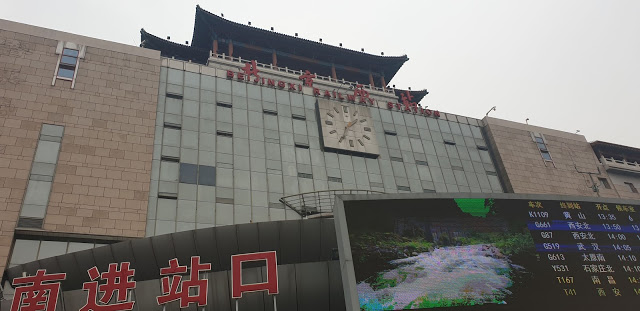
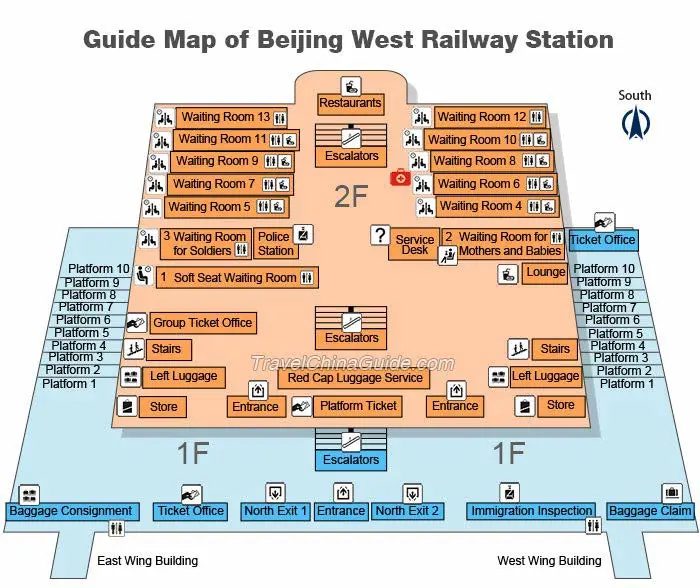
Beijing west railway station is about eight kilometers from the Forbidden City, located at East Lianhuachi Road, Fengtai District. Most trains traveling between south central, southwest, northwest, and south China are boarded here.
This place is huge and there are so many people here, perhaps the other half of Beijing’s population that wasn’t in the forbidden city.
Getting into the station looked like it was going to be fraught with danger but the tour guide got us into the right queue and then arranged for a separate scanner for the group to help keep us all together
Then we decided to take the VIP service and got to waiting room no 13, the VIP service waiting room which was full to overflowing. Everyone today was a VIP. We got the red hat guy to lead us to a special area away from the crowd.
Actually, it was on the other side of the gate, away from the hoards sitting or standing patiently in the waiting room. It gave us a chance to get something to eat before the long train ride.
The departure is at 4 pm, the train number was G655, and we were told the trains leave on time. As it is a high-speed train, stops are far and few between, but we’re lucky, this time, in that we don’t have to count stations to know where to get off.
We’re going to the end of the line.
However, it was interesting to note the stops which, in each case, were brief, and you had to be ready to get off in a hurry.
These stops were Shijiazhuang, Zhengzhou East, Luoyang Longmen, Huashan North, and Weinan North. At night, you could see the lights of these cities from a distance and were like oases in the middle of a desert. During the day, the most prominent features were high rise apartment blocks and power stations.
A train ride with a difference
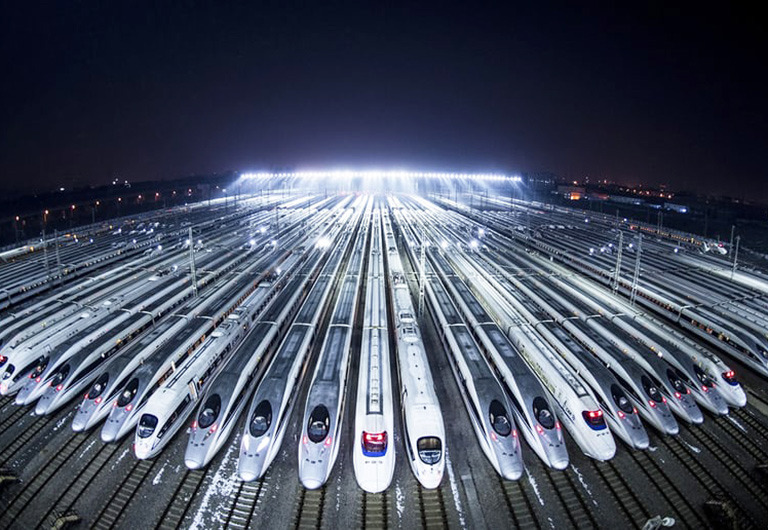
China’s high-speed trains, also known as bullet or fast trains, can reach a top speed of 350 km/h (217 mph).
Over 2,800 pairs of bullet trains numbered by G, D or C run daily connecting over 550 cities in China and covering 33 of the country’s 34 provinces. Beijing-Shanghai high-speed train link the two megacities 1,318 km (819 mi) away in just 4.5 hours.
By 2019, China keeps the world’s largest high-speed rail (HSR) network with a length totaling over 35,000 km (21,750 mi).
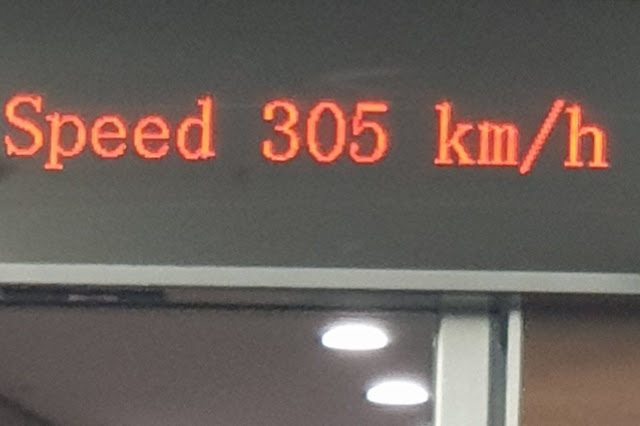
To make the five and a half hours go quicker we keep an eye on the speed which hovers between 290 and 305 kph, and sitting there with our camera waiting for the speed to hit 305 which is a rare occurrence, and then, for 306 and then for 307, which happened when we all took a stroll up to the restaurant car to find there had nothing to eat.
I got a strange flavored drink for 20 yuan.
There was a lady manning a trolley that had some food, and fresh, maybe, fruit on it, and she had a sense of humor if not much English.
We didn’t but anything but the barrel of caramel popcorn looked good.
The good thing was, after hovering around 298, and 299 kph, it finally hit 300.
We get to the end of the line, and there is an announcement in Chinese that we don’t understand and attempts to find out if it is the last station fall on deaf ears, probably more to do with the language barrier than anything else.
Then, suddenly the train conductor, the lady with the red hat, comes and tells us it is, and we have fifteen minutes, so we’re now hurrying to get off.
As the group was are scattered up and down the platform, we all come together and we go down the escalator, and, at the bottom, we see the trip-a-deal flags.
X’ian,and the Xi’an North Railway Station
Xi’an North Railway Station is one of the most important transportation hubs of the Chinese high-speed rail network. It is about 8.7 miles (14 km) from Bell Tower (city center) and is located at the intersection of the Weiyang Road and Wenjing Road in Weiyang District.
This time we have a male guide, Sam, who meets us at the end of the platform after we have disembarked. We have a few hiccups before we head to the bus. Some of our travelers are not on his list, but with the other group. Apparently a trip-a-deal mix-up or miscommunication perhaps.
Then it’s another long walk with bags to the bus. Good thing its a nicely air-conditioned newish bus, and there’s water, and beer for 10 yuan. How could you pass up a tsing tao for that price?
Xi’an is a very brightly lit up city at night with wide roads. It is very welcoming, and a surprise for a city of 10 million out in the middle of China.
As with all hotels, it’s about a 50-minute drive from the railway station and we are all tired by the time we get there.
Tomorrow’s program will be up at 6, on the bus 8.40 and off to the soldiers, 2.00 late lunch, then train station to catch the 4.00 train, that will arrive 2 hours later at the next stop. A not so late night this time.
The Grand Noble Hotel
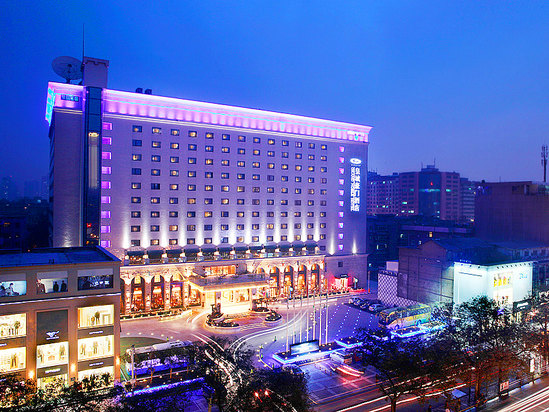
Grand Noble Hotel Xi’an is located in the most prosperous business district within the ancient city wall in the center of Xi’an.
The Grand Noble Hotel, like the Friendship Hotel, had a very flash foyer with tons of polished marble. It sent out warning signals, but when we got to our room, we found it to be absolutely stunning. More room, a large bathroom, air conditioning the works.
Only one small problem, as in Beijing the lighting is inadequate. Other than that it’s what I would call a five-star hotel. This one is definitely better than the Friendship Hotel.
In the center of the city, very close to the bell tower, one of the few ancient buildings left in Xi’an. It is also in the middle of a larger roundabout and had a guard with a machine gun.
Sadly there was no time for city center sightseeing.
I’d been on the starship for almost three hours when…
…
The captain was coming up from the earth station by transport, not wanting to trust the transporters, and I’d just finished the orientation of the ship by the second officer, and had arrived on the bridge to see various crew members hunched over their consoles.
The captain had told me, before stepping onto the transport, that we would be leaving the dock shortly after he arrived.
Nothing I’d seen so far had led me to believe it would be going anywhere, anytime soon.
Nevertheless, the crew briefing had run smoothly, the second officer assigned to correlate the complaints/problems list, and everyone else had taken their assigned positions.
I was waiting for the captain, standing beside the ‘chair’, ready to hand over. In any other situation, we would be off to an illustrious start.
Until the dulcet tones of the Chief Engineer rang through the bridge, uttering those fateful words, “the warp coil has had a catastrophic failure”.
This was at odds with another statement he had made earlier when I was in Engineering, and given I was told the Chief Engineer was prone to hyperbole; his statement ‘they just don’t make warp coils like they used to’ hadn’t exactly filled me with confidence, but I had been expecting we would be ready to depart.
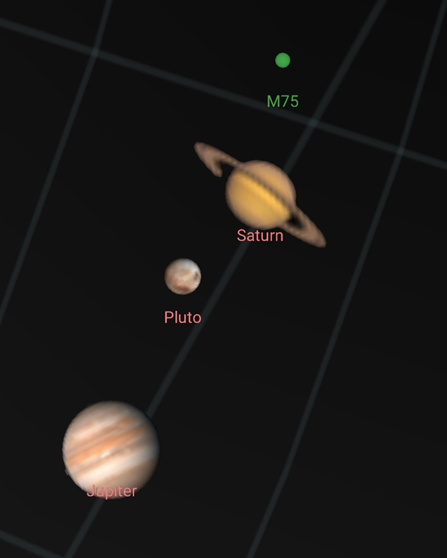
I had been looking at the screen, an overlay of the window that looked out over space, or at this moment, the space dock, where there was a representation of the planets that were ‘out there’.
I had been curious about M75, but the helmsman, a rather taciturn chap who seemed to resent the fact he was assigned to this ship, just shrugged and said, “it’s something, somewhere, but not of much interest,” then went back to his console.
If this was Star Trek, we’d be ejecting the warp coil by now, but in the space dock, that didn’t seem to me to be a viable option.
“How long before we can get this bucket of bolts moving,” I ask the Chief.
“I’m going as fast as I can.”
Yes, words ripped right out of the script of a Star Trek episode, I thought. A sad case of life imitating art.
A strange whistling sound emanated from the speakers, then the whoosh of the elevator just before the doors opened. OK, new ship, squeaky doors, another item to be put on the ‘look at’ list after the shakedown cruise.
The Captain had arrived.
“Why are dock workers still on the ship, Number One.”
For a moment there, I thought I was talking to John Luc Picard.
“Faulty warp coil. You know how it goes, save a billion by outsourcing to the cheapest supplier.”
The captain didn’t appreciate my sardonic humour, or my apparent disdain in outsourcing what we had once built ourselves.
He gave me a frown, a slight shake of his head, then said, “I’ll be in my quarters. Let me know when we’re about to leave.”
He didn’t wait for acknowledgement and disappeared through another squeaky door. More repairs.
The Chief’s voice then came over the speaker. “I can give you impulse speed, warp speed will take a little longer.”
“Doesn’t that refer to miracles over the impossible,” I ask.
“Perhaps. But in the meantime, I need a specific spanner and the replicators are down. So, now we have to fix them first, before moving on. Might take a while.”
I look around the crew, seeing their expectant faces drop with disappointment.
Outer space was going to have to wait a little longer.