Oreti Village, Pukawa Bay, North Island, New Zeland
On the southern tip of Lake Taupo
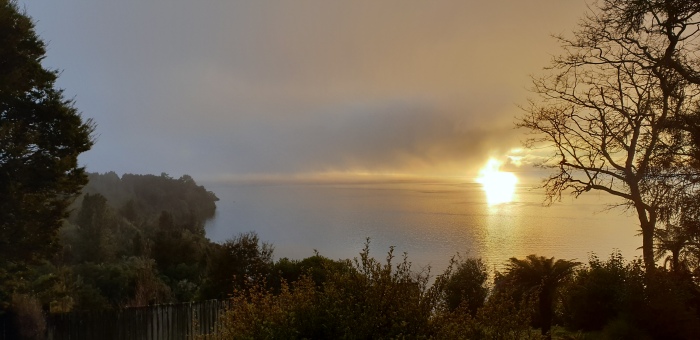
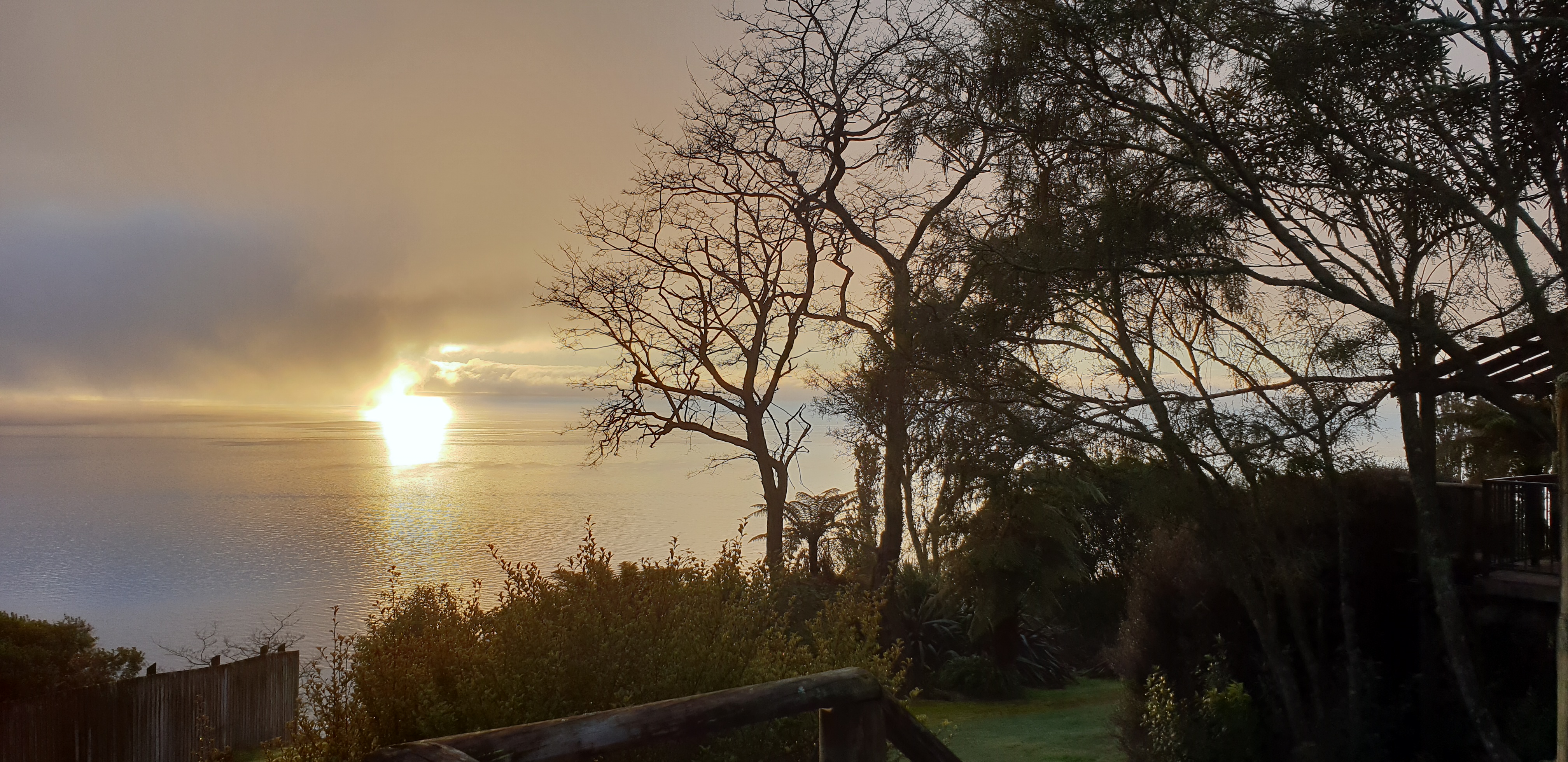
Our first morning there, a Saturday. Winter. Cold. And a beautiful sunrise.
This was taken from the balcony, overlooking the lake.
The sun is just creeping up over the horizon
It gradually gets lighter, and then the sun breaks free of the low cloud
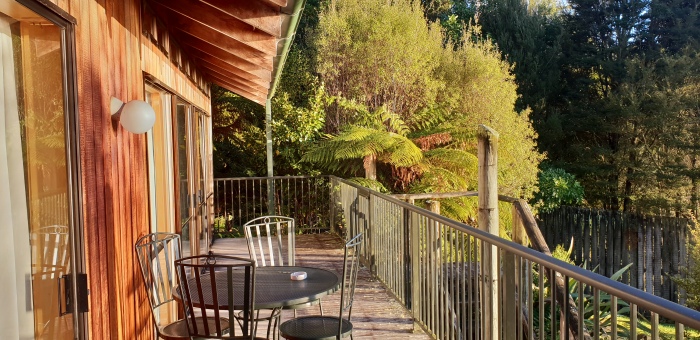
It lights up the balcony
And the trees just beyond, a cascade of colorful ferns.
It looks like it’s going to be a fine day, our first for this trip, and we will be heading to the mountains to see snow, for the first time for two of our granddaughters.
How many of us have skeletons in the closet that we know nothing about? The skeletons we know about generally stay there, but those we do not, well, they have a habit of coming out of left field when we least expect it.
In this case, when you see your photo on a TV screen with the accompanying text that says you are wanted by every law enforcement agency in Europe, you’re in a state of shock, only to be compounded by those same police, armed and menacing, kicking the door down.
I’d been thinking about this premise for a while after I discovered my mother had a boyfriend before she married my father, a boyfriend who was, by all accounts, the man who was the love of her life.
Then, in terms of coming up with an idea for a story, what if she had a child by him that we didn’t know about, which might mean I had a half brother or sister I knew nothing about. It’s not an uncommon occurrence from what I’ve been researching.
There are many ways of putting a spin on this story.
Then, in the back of my mind, I remembered a story an acquaintance at work was once telling us over morning tea, that a friend of a friend had a mother who had a twin sister and that each of the sisters had a son by the same father, without each knowing of the father’s actions, both growing up without the other having any knowledge of their half brother, only to meet by accident on the other side of the world.
It was an encounter that in the scheme of things might never have happened, and each would have remained oblivious of the other.
For one sister, the relationship was over before she discovered she was pregnant, and therefore had not told the man he was a father. It was no surprise the relationship foundered when she discovered he was also having a relationship with her sister, a discovery that caused her to cut all ties with both of them and never speak to either from that day.
It’s a story with more twists and turns than a country lane!
It was a relic from the past, put back together by a dedicated group of volunteers who had not wanted the last vestiges of the past to disappear.
Train enthusiasts, the called themselves.
They’d put together a steam locomotive, five carriages, a restaurant car, and the conductor’s car. The original train might have been twice to three times as long, but these days, the tourist market rarely filled the train.
I was one of a group who made it their mission to visit and rate every vintage train, not only in this country, but all over the world. It was a sad state of affairs when I first began, with locomotives and carriages dropping out of the system due to lack of funds, but more disheartening, the lack of government assistance in keeping it’s heritage alive.
It seemed money was short, and there were better things to spend it on, like two brand new 737-800 jets just to ferry the prime minister and government officials around. Just think of what that quarter of a billion dollars could have bought in heritage.
But it is what it is.
What I had before me was one of the most recent restorations to check out, and on first glance, it was remarkable just how lifelike and true to age it was.
Of course, I was of an age that could remember the old railway carriages, what were called red rattlers because of the ill fitting windows that went up and down, allow fresh air, or in days gone by, smoke from the locomotive hauling the train. I had not travelled during the last glorious years of steam, but the carriages had lived on briefly before the advent of the sterile aluminum tin cans with uncomfortably hard seats.
These carriages were built for comfort, and my first experience had been a five hour trip from Melbourne to Wangaratta, in Victoria, on my way to Mt Buffalo Chalet, a guesthouse owned by the Railways.
That too had been a remarkable old chalet style guest house with a room and all the dining included. I always left after the week having put on weight. Breakfast, morning tea, lunch, afternoon tea, and dinner, every day, and high tea on Sunday.
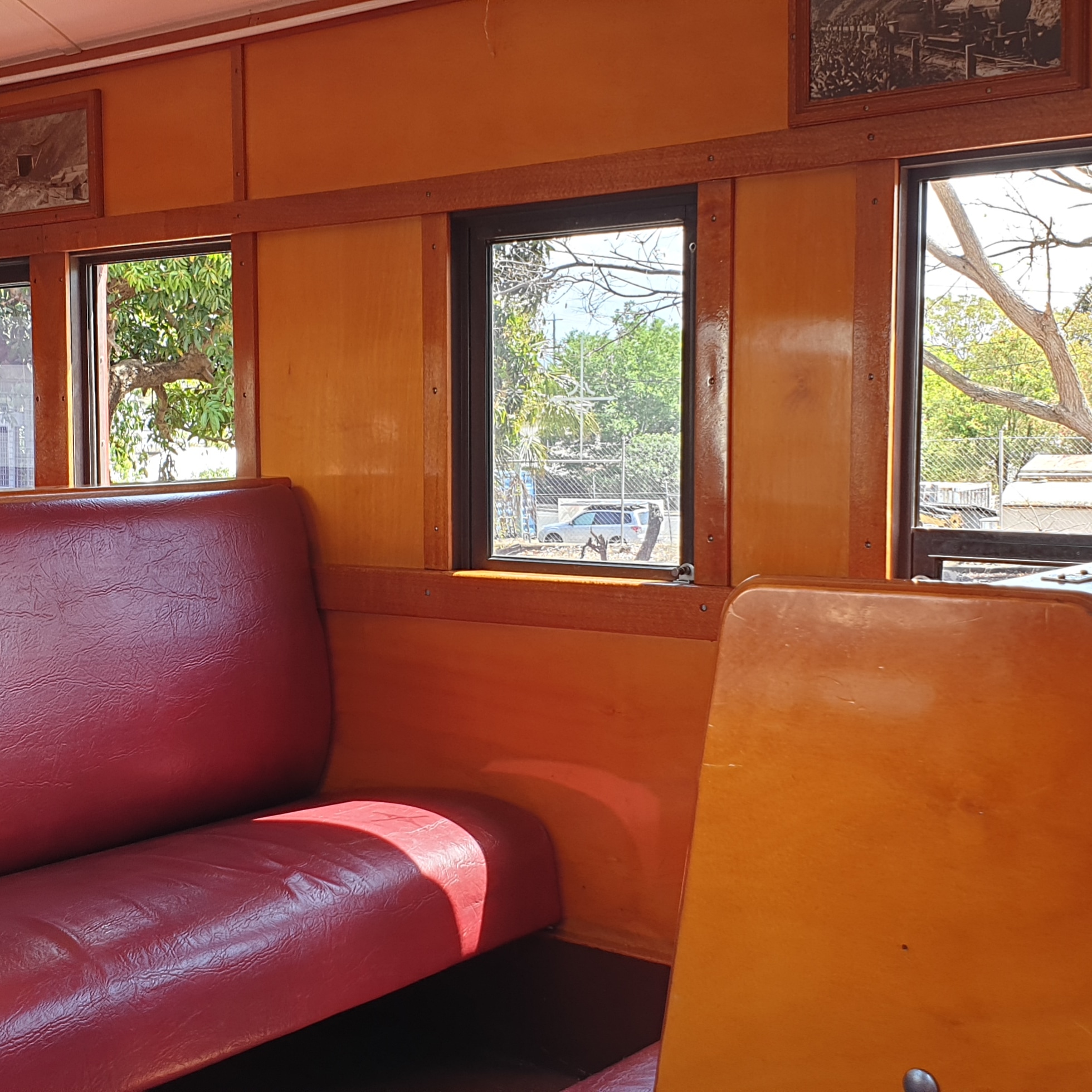
But this carriage, the polished wood that had shellac rather than varnish, highlighting the timber’s grain, the leather seats with generous padding, the curved ceilings with hanging lights, windows the could be opened and closed, allowing fresh air to circulate.
There was also a carriage with the passageway, and five or six separate compartments, each sitting six passengers. I remembered these well, having quite often ridden in one to work for some years when the country trains still ran.
It was always remarkable how a sight or a scent could trigger such memories.
For this carriage on this train, it used to ply the Gympie to Brooloo branch line from about 1915 onwards.
That was the history. It only went as far as Amamoor these days, it was still long enough to capture the sensation of riding the rails back in what is always referred to as the good old days, even if they were not.
Oreti Village, Pukawa Bay, North Island, New Zeland
On the southern tip of Lake Taupo
Our first morning there, a Saturday. Winter. Cold. And a beautiful sunrise.
This was taken from the balcony, overlooking the lake.
The sun is just creeping up over the horizon
It gradually gets lighter, and then the sun breaks free of the low cloud
It lights up the balcony
And the trees just beyond, a cascade of colorful ferns.
It looks like it’s going to be a fine day, our first for this trip, and we will be heading to the mountains to see snow, for the first time for two of our granddaughters.
A relatively unassuming lane leads to what could be described as a grand hotel, called Waitomo Caves Hotel.
The original hotel was built in 1908, and it was later extended in 1928. Part of it is ‘Victorian’, based on an eastern Europe mountain chalet, and part of it is ‘Art Deco’, the concrete wing, and a feature, if it could be called that, is none of the four corners are the same.
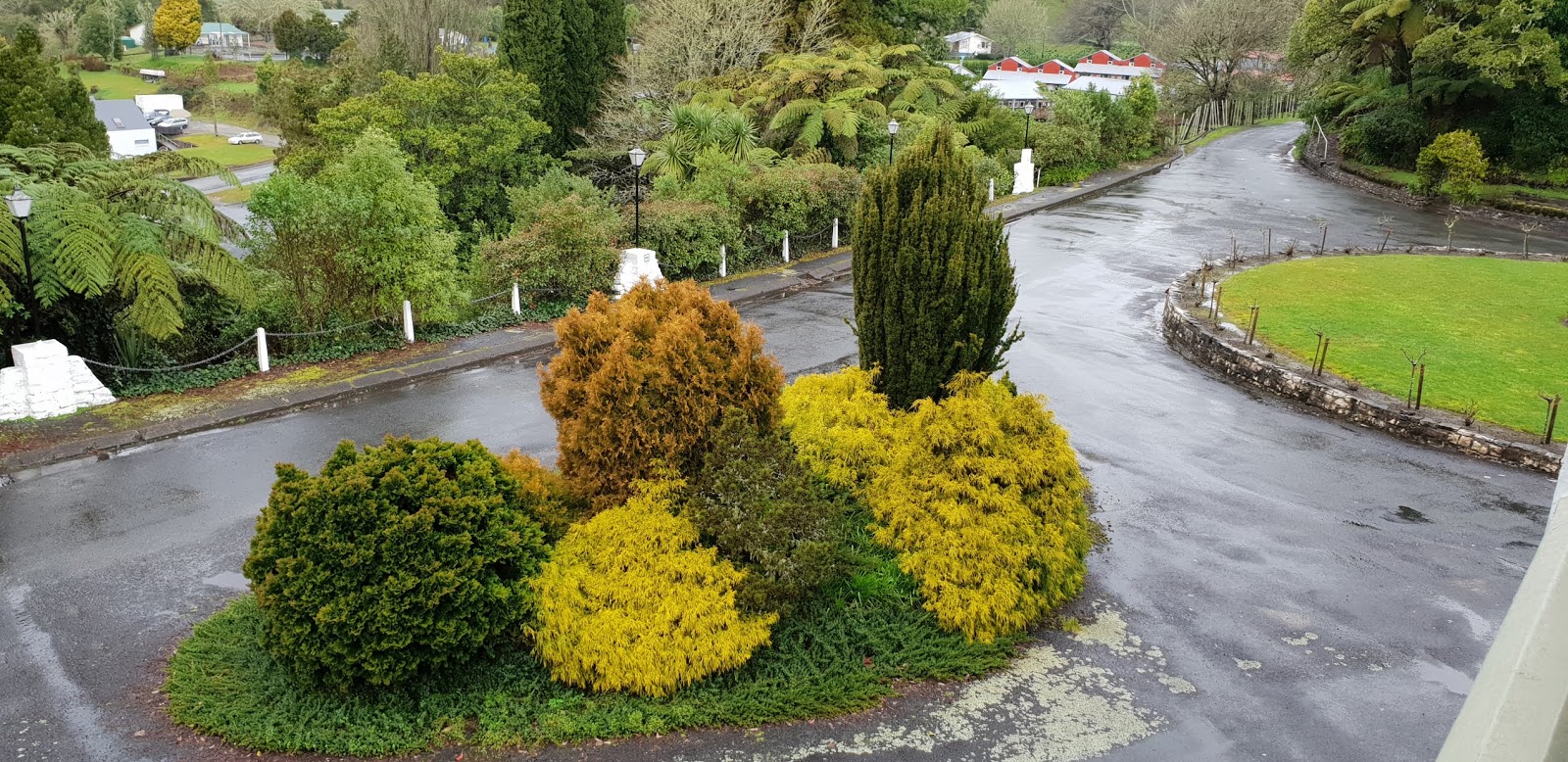
Views from the balcony show part of the surrounding gardens
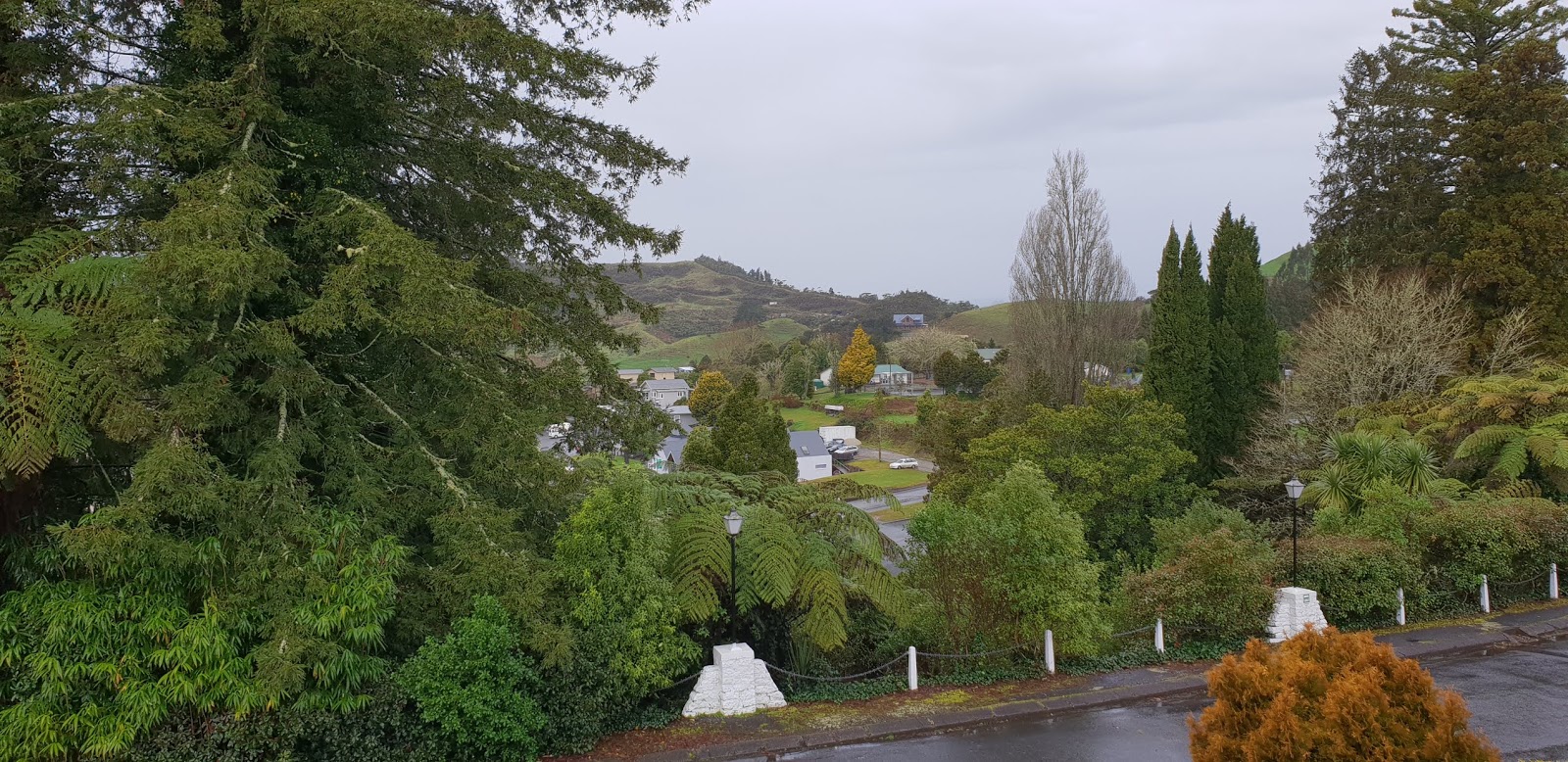
and the town of Waitomo in the distance.
In gloomy weather, it does look rather spooky, and I suspect there may be a ghost or two lurking somewhere in the buildings.
But…
This a a very interesting, and the words of one of my younger grand daughters, a very creepy place. It would make an excellent base for paranormal activity, and there could very well be ghosts walking the corridors of this hotel.
It has the long darkish passageways that lead in all directions and to almost hidden rooms, a creepy nighttime aspect, and the creaky woodwork.
I know when we were exploring, it was easy to lose your bearings, if not get lost, trying to find certain places, and once found, hard to find your way back.
All in all, it was one of the best stays in a very old place going through the throes of modernisation.
And looking at it from the outside at night, I’ll leave you with that thought…
I remeber once being told that if you shoot for the moon, you’ll land in the clouds, if you shoot for the tree tops, you’ll finish up back where you started from.
It was a silly analogy, but I always remembered it when I looked up at the sky and saw clouds.
That was back in those hazy carefree days just after you were finished with school and you had your whole life in front of you. Your parents were there as the safety net, and were still proud of your scholastic achievements, and were not in too much of a hurry to hustle you out of the house.
But what happened when there’s a recession that came upon everyone without any warning.
Stocks plummeted, people lost their life’s savings, those with mortgages and loans suddenly finding that along with unemployment came no income, no ability to pay the bills, and therefore lost everything.
Although I never said it, I was thinking what good was an education when the whole world had gone to hell in a handbasket.
Two things I remember from back then, which in the context of disaster, wasn’t all that long ago. Firstly, my father making us children go camping from before we could walk, and with it, to survive with nothing but the clothes on our backs, and our wits.
It had happened to him, as a member of am expedition in Africa in his younger days, thinking that he might become the next great explorer, or archeologist, and finishing up getting lost, even though he asserted the other members had deliberately left him behind.
And secondly, that it was essential that we forge working relationships with any and all those who were like minded, such as those who wanted to be saved, not those who expected everyone else to so the work. It was obvious he had met a lot of those type of people too.
It served us well.
When nations began turning on each other, when essential resources like electricity and fuel stopped being distributed and rationed, when food suddenly became scarce, that’s when the real trouble started. My father said, at the outset, what would happen, and was glad our mother was not there to see it.
Then, when neighbours attacked neighbours once food became scarce, it was time to leave. The pity of it was, he died defending us, even after offering up some of the food we had stored away, but that had not appeased a hungry or angry mob.
His last words, “Go to where we said we would go, and remember everything I’ve taught you” were etched in my brain, and my brother and I did as he asked.
But, even knowing where we had to go, and how to get there, a plan of action made many years before, and trialled in recent years with success, nothing in the past could have prepared us for the journey.
Yes, it’s that simple word that we use to call someone affectionately.
Or sometimes, with a little accent on the word; yes, dear and no, dear.
In other words, it’s a person regarded with deep affection.
It can also mean expensive, by saying, that’s a bit dear, isn’t it, when we’re really saying it’s way overpriced.
I can’t remember how many times I’ve said something is ‘too dear’ to the children.
Grannies tend to use the expression, ‘be a dear and…’, to get you do do something for them.
Friends, sometimes tongue in cheek, will say, ‘oh dear, I’ve upset you’, when that was exactly what they meant to do. Friends you say? Yes, friends indeed.
And then we always start a letter (always? Who writes letters any more?) with
Dear John (oops, not one of THOSE letters)
Dear Sir/Madam
Of course, instead of swearing, you could simply say ‘Oh dear, you’ve let us down again!’.
And when you lose your job, which is happening a lot at the moment, it is said it would cost you dear, though sometimes it would be more appropriate to use the adverb, dearly.
It is not to be confused with the word deer which is an animal, the males of which have antlers.
There are a number of different types of deer, such as reindeer and elk. In Canada, they are called caribou.
In Robin Hood’s day, killing deer brought you very harsh punishment.
And one of my favourite meats is venison, meat from a deer, which are farmed in New Zealand along with sheep.
A relatively unassuming lane leads to what could be described as a grand hotel, called Waitomo Caves Hotel.
The original hotel was built in 1908, and it was later extended in 1928. Part of it is ‘Victorian’, based on an eastern Europe mountain chalet, and part of it is ‘Art Deco’, the concrete wing, and a feature, if it could be called that, is none of the four corners are the same.
Views from the balcony show part of the surrounding gardens
and the town of Waitomo in the distance.
In gloomy weather, it does look rather spooky, and I suspect there may be a ghost or two lurking somewhere in the buildings.
But…
This a a very interesting, and the words of one of my younger grand daughters, a very creepy place. It would make an excellent base for paranormal activity, and there could very well be ghosts walking the corridors of this hotel.
It has the long darkish passageways that lead in all directions and to almost hidden rooms, a creepy nighttime aspect, and the creaky woodwork.
I know when we were exploring, it was easy to lose your bearings, if not get lost, trying to find certain places, and once found, hard to find your way back.
All in all, it was one of the best stays in a very old place going through the throes of modernisation.
And looking at it from the outside at night, I’ll leave you with that thought…
How many of us have skeletons in the closet that we know nothing about? The skeletons we know about generally stay there, but those we do not, well, they have a habit of coming out of left field when we least expect it.
In this case, when you see your photo on a TV screen with the accompanying text that says you are wanted by every law enforcement agency in Europe, you’re in a state of shock, only to be compounded by those same police, armed and menacing, kicking the door down.
I’d been thinking about this premise for a while after I discovered my mother had a boyfriend before she married my father, a boyfriend who was, by all accounts, the man who was the love of her life.
Then, in terms of coming up with an idea for a story, what if she had a child by him that we didn’t know about, which might mean I had a half brother or sister I knew nothing about. It’s not an uncommon occurrence from what I’ve been researching.
There are many ways of putting a spin on this story.
Then, in the back of my mind, I remembered a story an acquaintance at work was once telling us over morning tea, that a friend of a friend had a mother who had a twin sister and that each of the sisters had a son by the same father, without each knowing of the father’s actions, both growing up without the other having any knowledge of their half brother, only to meet by accident on the other side of the world.
It was an encounter that in the scheme of things might never have happened, and each would have remained oblivious of the other.
For one sister, the relationship was over before she discovered she was pregnant, and therefore had not told the man he was a father. It was no surprise the relationship foundered when she discovered he was also having a relationship with her sister, a discovery that caused her to cut all ties with both of them and never speak to either from that day.
It’s a story with more twists and turns than a country lane!
It was a relic from the past, put back together by a dedicated group of volunteers who had not wanted the last vestiges of the past to disappear.
Train enthusiasts, the called themselves.
They’d put together a steam locomotive, five carriages, a restaurant car, and the conductor’s car. The original train might have been twice to three times as long, but these days, the tourist market rarely filled the train.
I was one of a group who made it their mission to visit and rate every vintage train, not only in this country, but all over the world. It was a sad state of affairs when I first began, with locomotives and carriages dropping out of the system due to lack of funds, but more disheartening, the lack of government assistance in keeping it’s heritage alive.
It seemed money was short, and there were better things to spend it on, like two brand new 737-800 jets just to ferry the prime minister and government officials around. Just think of what that quarter of a billion dollars could have bought in heritage.
But it is what it is.
What I had before me was one of the most recent restorations to check out, and on first glance, it was remarkable just how lifelike and true to age it was.
Of course, I was of an age that could remember the old railway carriages, what were called red rattlers because of the ill fitting windows that went up and down, allow fresh air, or in days gone by, smoke from the locomotive hauling the train. I had not travelled during the last glorious years of steam, but the carriages had lived on briefly before the advent of the sterile aluminum tin cans with uncomfortably hard seats.
These carriages were built for comfort, and my first experience had been a five hour trip from Melbourne to Wangaratta, in Victoria, on my way to Mt Buffalo Chalet, a guesthouse owned by the Railways.
That too had been a remarkable old chalet style guest house with a room and all the dining included. I always left after the week having put on weight. Breakfast, morning tea, lunch, afternoon tea, and dinner, every day, and high tea on Sunday.
But this carriage, the polished wood that had shellac rather than varnish, highlighting the timber’s grain, the leather seats with generous padding, the curved ceilings with hanging lights, windows the could be opened and closed, allowing fresh air to circulate.
There was also a carriage with the passageway, and five or six separate compartments, each sitting six passengers. I remembered these well, having quite often ridden in one to work for some years when the country trains still ran.
It was always remarkable how a sight or a scent could trigger such memories.
For this carriage on this train, it used to ply the Gympie to Brooloo branch line from about 1915 onwards.
That was the history. It only went as far as Amamoor these days, it was still long enough to capture the sensation of riding the rails back in what is always referred to as the good old days, even if they were not.