“Echoes From The Past”, the past doesn’t necessarily stay there


What happens when your past finally catches up with you?

…

Christmas is just around the corner, a time to be with family. For Will Mason, an orphan since he was fourteen, it is a time for reflection on what his life could have been, and what it could be.

Until a chance encounter brings back to life the reasons for his twenty years of self-imposed exile from a life only normal people could have. From that moment Will’s life slowly starts to unravel and it’s obvious to him it’s time to move on.

This time, however, there is more at stake.

Will has broken his number one rule, don’t get involved.

With his nemesis, Eddie Jamieson, suddenly within reach, and a blossoming relationship with an office colleague, Maria, about to change everything, Will has to make a choice. Quietly leave, or finally, make a stand.

But as Will soon discovers, when other people are involved there is going to be terrible consequences no matter what choice he makes.

https://amzn.to/2CYKxu4

newechocover5rs

The cinema of my dreams – I always wanted to go on a treasure hunt – Episode 40

Here’s the thing…

Every time I close my eyes, I see something different.

I’d like to think the cinema of my dreams is playing a double feature but it’s a bit like a comedy cartoon night on Fox.

But these dreams are nothing to laugh about.

Once again there’s a new installment of an old feature, and we’re back on the treasure hunt.


The passage heading towards the marina was littered with fallen rocks, timber beams, and roofing material. Much of the damage was in this wing, where the marina had started falling apart.

It was a problem with the foundations. A long and costly investigation had found that the marinas foundations had been inadequately built on a shifting base, made worse by the seasonal water flow.

It was interesting to learn that the event that caused the start of the problems had not occurred in a hundred years, but had been noted in an early newspaper report, and only that it was a phenomenon, 

No one at the time had any interest in building there, and it was understood when the navy built its marina, there was no mention of anything untoward happening that would preclude the construction.

And, over the life of the project, nothing had happened. It was why, when the mall was being touted, no one really knew anything about flooding because it hadn’t happened in living memory.  That only came later, after the damage was done.

We reached the end of the passageway and found the stairs leading up to the walkway around the marina was closed off. Someone had pulled a board away and we could peer through the crack.

There was daylight beyond, and we could see the large cracks in the staircase, and along the walls either side.  There were two sets of stairs up both at the end of a mall passageway, and, in between, there were steps down into the carpark.  To one side of that was an elevator lobby, but the elevators would not be working.

But, just out of curiosity, I pressed the button.  The light came on, but nothing happened, and, a second later, it went out again.

I looked up, but Boggs had not moved from the top of the stairs.

These steps were not blocked by a barricade, but there would be some difficulty stepping over masonry that had fallen from the roof, which now had a gaping crack and a few pieces of concrete missing.  I could see the steel reinforcing and it was rusting.

A few years, all of it would eventually come down.

“You sure this is safe,” I asked.

“Been here a few times.  I reckon it hasn’t changed much in years.”

He was looking at the map again, and I peered over his shoulder.  The stairs were there but looking down we could only see as far as the landing.  There were cracked and broken tiles everywhere, and the handrail had been bent severely out of shape by a boulder now wedged in the rail.

Boggs put the map in his back pocket and said, “Follow me.”  He started walking slowly down the stairs, flashing his cell phone light ahead so we could see if there were any hazards.

At the landing, we looked further down the stairs, and these were cleaner.  Also, the wall which kept the marina out had a crack in it, and it was damp which meant water was seeping in.  The smell was of mold, and I wondered if that could be good for our health.

I followed him down to the first level of the carpark.  In the distance, looking back towards the front entrance of the mall, way in the distance was the slatted entrance gates, light seeping in through the cracks. 

Between us and those gates were several cars, crushed by a huge concrete beam that had fallen on them.  I remembered, then, that there had been a husband and wife in one of the cars at the time and they’d been killed.  Their children had been luckier, the youngest had to go to the restroom, and that minute delay had saved them.

Still, it would not be good seeing your parents killed in front of your eyes.

“This place is giving me the creeps,” I said and shuddered. 

They said there were ghosts, and I now believed them.

“What are we looking for?: I asked.

“Evidence of the underground river.”

“That would be long gone by now, since they built this lot over it, and some of it falling into it.”

“We shall see.” 

He then went down the next flight of steps to the bottom carpark, and I followed.  There was less debris on this level, but it was much darker down here, and with only Boggs’ cell phone light, we couldn’t see much else.

“That’s strange,” Boggs said, having taken a dozen or so steps to the right.

“What is?”  I wondered what his definition of the word strange was.

“There’s supposed to be an open section here where the wall fell away, pushed by the water flow last time it flooded.  The report said that a section here wasn’t anchored properly with formwork, hence the ease in which it was moved.”

I looked at the wall.  It seemed to be still intact to me.

Boggs pulled out a pocketknife and tapped it against the surface.

The false concrete chipped and fell away, and a closer inspection showed stippled plaster over plywood, very damp plywood.  Boggs extracted a knife and worked on the wall, clearing a foot square, the damp plaster easily peeling away.

A false wall, one that no one would think twice about if they were not looking for it.

Boggs then scraped sideways until the blade hit metal, then he scraped around it until a gate-type bolt was exposed.  It didn’t have a lock.  It was rusted shut, so Boggs found a rock and hit it a few times, shaking it loose.  He opened it, then tugged on it.

Was he expecting a door to open?

“Give us some help here.”

We both pulled on it, and it gave way, showering us in plaster pieces.  At least we weren’t smothered in dust.

As it opened, light flooded in, almost blinding me.

I let Boggs open it the rest of the way while my eyes adjusted.

Then I tentatively looked out.

From where we were standing, we could see the two levels of the marina walkway, broken away at this end above the doorway, and a big hole in the side wall of what was the marina pool.  We could see, and smell the seawater, and beyond, the ocean.

Looking down, there was a sheer drop of about 30 feet, and under us, there was an opening.  At that 30 feet was flowing water, and through the water, I thought I could see clothes.

“Is that a body down there?”

It looked like one.

“No.  Don’t think so.  Someone probably threw a clothed dummy down there for fun, once when this was open.  I’d say it was closed up to make the place safer. Anyway, we’ll soon find out.  We’re going down to have a look.”

© Charles Heath 2020

Searching for locations: Shaolin Kung Fu, near Zhengzhou City, Henan Province, China

After leaving the hotel in Zhengzhou, which was once one of the eight ancient capitals of China, we are going to Dengfeng city, the home of China’s most famous martial art – Shaolin Kung Fu.

The Shaolin Temple nearby is the origin of Chinese Zen Buddhism, and the Songyang Academy, called “the Centre of Heaven and Earth” is located 87 Km from Zhengzhou, or, as we were advised, a 2-hour drive.  It will be scenic because we are heading towards the mountains.

As one of the four ancient Song Dynasty Academies, Songyang Academy is one of many schools in the province.  It is both on a large scale, is quite spectacular, and is a comprehensive Wushu training base where students are trained to spread the Shaolin Wushu Kung fu style at home and abroad.

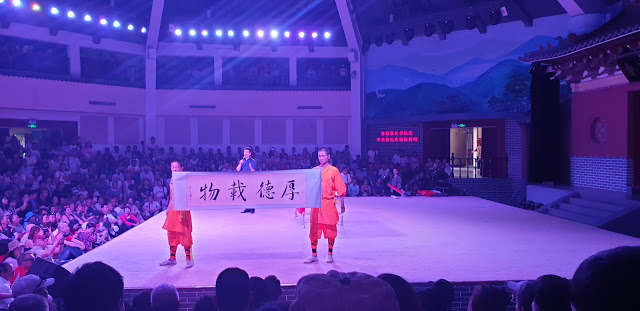
There is a 500-seat demonstration hall where you are able to observe 30 minutes of various martial arts in shows starting on the hour.

Outside there is a specific area that generally has about 600 trainees learning kung fu elements during the day but can hold 5,000 people when outdoor performances are required.

The kung fu school

The thing you notice most about the kung fu school is its size and then the number of buses which tells you that it is a popular tourist stop.

And with that size comes long distances between the car park and the venues we need to go to, the first of which is about half a km, and that’s just to get to the ticket plaza.

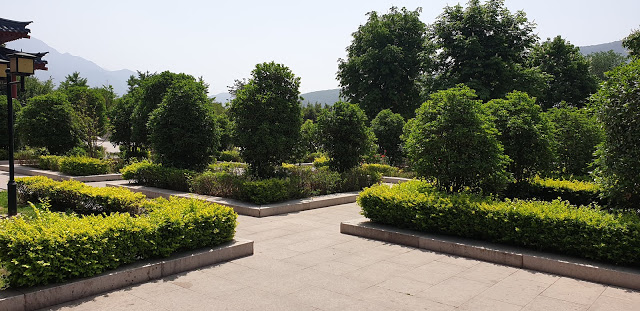
But, it is pleasantly set out and is quite a large number of shops for both souvenirs and food

We pass by some of the students going through their paces

From there it’s another long, long walk to the show arena, where we’re supposed to see various kung fu elements on display.  We watched this for a few minutes, then headed off towards the hall for a more intense demonstration of kung fu, and because there is limited seating we have to start lining up at the head of the queue to get a seat.

But…

Everyone else has the same idea and we join the throng which then becomes a ride, and true to the Chinese they start finding ways to push in, even using the imaginary friend somewhere ahead in the queue.

The doors open and then it’s open slather, with the hoards pushing from behind and sliding up the side to get in first.  We go with the tide, and manage to get in and find a seat though we were separated from three of our group.

It was an interesting show even though not one word of English was spoken, which from our point of view was a disappointment because we had no idea what was going on.

However…

It wasn’t hard to follow

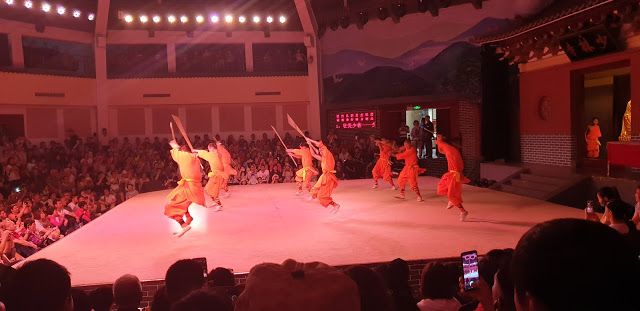
What the performers were doing was relatively self-explanatory, and quite fascinating, especially the guy who broke a sword over his head, and the guy who stopped two spears penetrating the neck, both examples of very disciplined men.

Boys gave a demonstration of kung fu moves, and intensity and age increased as this progressed to the end.

Next, we were taken in hand by an instructor in Tai chi or an equivalent, I was not quite sure what it was called, and went through the twelve or maybe more moves that constituted a morning or afternoon exercise session or it could be just for relaxation.  I lasted the first session but it was a little difficult to do with my sore limbs and a bad back.

Not that I could remember any of it now other than hands overhead, hands in front, bent knees, and a few gentle kung fu hand moves.

Perhaps when I get home I might seek out someone to show me the moves.

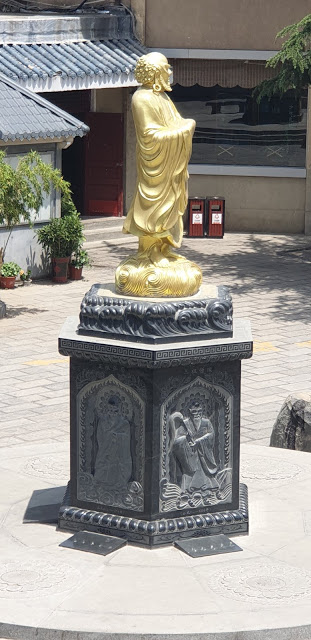
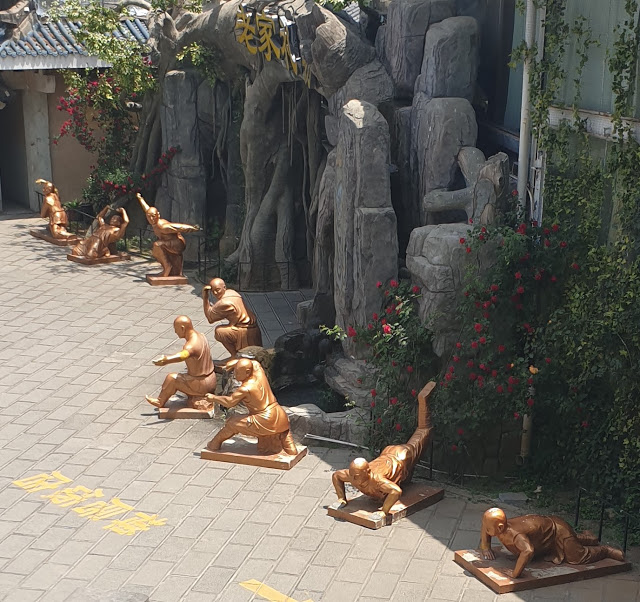
Whilst the others were following their training instructor, I wandered about, finding a large statue

 
And some smaller statues

Lunch in the Zen Restaurant

After all that exercise it was time to have lunch purportedly the same food as the king fu masters.
It’s in the Zen restaurant, aptly named, and the food when it came, came thick and fast, but some of it wasn’t very nice, meat with bones, tofu, a tasteless soup, but some good dishes like the vegetables and noodles with meat, without bones.

The only problem was nothing to drink except a pot of hot water.  No tea, no cold water, and if you wanted a cold drink you had to pay for it.  After paying 550 yuan why should we have to pay more for a drink when we have not had to so far.

But no cold water?  That was just not on, and when we brought this to the attention of the tour guide she just simply ignored us.  We just didn’t get anything.

That basically tainted the whole experience.

After lunch, there was the Shaolin Temple and the Pogoda Forest to visit.

The cinema of my dreams – I always wanted to go on a treasure hunt – Episode 38

Here’s the thing…

Every time I close my eyes, I see something different.

I’d like to think the cinema of my dreams is playing a double feature but it’s a bit like a comedy cartoon night on Fox.

But these dreams are nothing to laugh about.

Once again there’s a new installment of an old feature, and we’re back on the treasure hunt.

Before we embarked on the great driving expedition, for which I was beginning to think might be harder than it seemed to Boggs’ one-track mind, we decided to go and check out the mall, and if, indeed, there was an underground river, or, at the very least, if his flooding theory was correct. 

We were going to need very old clothes, and when I left the next morning, my mother noticed it.

“I’m going to do some gardening with Boggs.  He came up with this notion we could help out tat the old folk’s home.”

“That’s a nice thought.”

And it was a lie I knew would eventually come back to bite me.  My mother hadn’t exactly told me to stop seeing Boggs, because she was beginning to think his mental capacity had been diminished after the beating.

It was a logical and perfectly acceptable reason for his odd behavior.

I went directly to Boggs’ house, and he was waiting for me.  From there it was about twenty minutes, to a spot where he knew the surrounding fence had a hole big enough for us to crawl through.

It was odd seeing the place again, sitting out a few miles from the town, looking forlorn.  At the front entrance, off the road specially built between it and the town, there were miles of cyclone fencing, with signs alternately telling people to keep out on threat of prosecution for trespass, and more recently, hazard signs proclaiming the whole area was unsafe.

From where we’d stopped, we could see the carpark, enough for hundreds of cars, a bus terminus, a taxi rank, and the front façade of the shopping center, mostly looking like the front of a castle, with towers and ramparts.

There had been auxiliary plans for a medieval theme park at one stage, that would have blended in with the mall buildings, but that had to be abandoned, even though the land allocated to it was stable.  Or so a surveyor said.

We continued on until we reached the side leading to the marina.  From this vantage point looking one way, there was the ocean, and the other, the damage to the side of the mall buildings, the cracks, and, in places, where the roof had collapsed.

This would be the first time I’d set foot in the place since it had been a mall.

It had been popular, and there was always plenty of people shopping, eating and drinking, going to the cinemas, or just having a day out.  There had also been a museum dedicated to the naval days.

Now there was nothing.

It was ironic that as many of the castles in the British Isles that had been reduced to rubble, that was exactly what was going to happen here if someone didn’t take a bulldozer to the lot and level it out.

And that might happen sooner rather than later.  This was reputed to be the site of many a disappearance of a local person.  Three girls, two men, and a boy were supposedly hidden somewhere inside the mall, but the bodies had never been found.

I was thinking of those missing people when I said, with a degree of trepidation, “Do you really want to do this?  I mean, if you’re sure there’s an underground waterway here, I’ll happily take your word for it.”

Boggs just shook his head.  “You’re the last person I’d expect to chicken out.”

“It not that.”

“Isn’t it?  I can go by myself if you’re worried about getting hurt.”

“No.  You and me together.  I have to learn to fight those fears.”

Another look, then, “OK.  “Just a little further.”

Another minute or so, we reached a large rusting cylinder which had an almost illegible sign on it say the tank held inflammable liquid.  I tapped on the metal and it sounded empty.  I guess as part of the shut down they would have had to drain the tank.  I followed the tangle of pipes that ran slightly downhill for about 20 yards and then saw the opening in the fence Boggs had referred to.

We left our bikes behind the tank, among some bushes.

We then walked down to the fence line where the pipes passed through, and Boggs pulled back the chain wire.  A closer look showed it had been cut halfway up, making it easy to slip by, easier if there were two people along for the visit.

“Did you cut the fence,” I asked him.

He didn’t answer.  I guess he wanted me to think he had.

“Have you been here before?”

“Through here, yes.  A few times.”  He held the wire away and I climbed through.  I did the same for him on the other side, and he joined me.  The two halves melded back together so from a distance no one could tell the fence had been tampered with.

From the fence, we had to cross the access road to the marina, and across a carpark, now overgrown with weeds, and bushes, with the odd tree springing up through the cracks in the concrete.

The wall, when we reached it, was where several large cracks joined, and part of the wall had fallen away leaving a hole large enough to crawl through.  I put my head through the crack and could barely see anything.  There was light coming from the seaward side, but on the other, it was inky darkness.

There was also a very disturbing aroma, like freshly laid concrete crossed with the smell of a garage repair shop.  Years of spilled oil and grease.

“Is it safe?”  I asked.

Boggs shrugged.  “It could all fall down at any moment.  You read the signs on the fence.  Basically, this is, on one hand, cheating death.  On the other, we could be on the verge of an interesting discovery.”  Then, without another word, he went through the gap and inside. 

A few seconds later, I could see the light from his cell phone.

I shrugged.  If anything happened, like the building falling on me, I probably wouldn’t feel it.  And he was right, we could be on the verge of an interesting discovery.

I followed him inside and slid down the broken concrete and bricks to a dirty but solid-feeling floor, where Boggs was waiting, the light from his phone pointed in the direction of a storefront.

And looking at a dummy still dressed in clothes left behind.

I couldn’t help but think I’d seen that style of clothes somewhere before.

© Charles Heath 2020

The cinema of my dreams – It ended in Sorrento – Episode 64

What is Juliet’s game?

…

Juliet was waiting for me by the car where we left it.

By that time, I was almost ready to strangle her with my bare hands.

“Where did you go?”

“Away from trouble.  I waited until I was sure you were not going to be killed, then I left.”  She held out the gun by the barrel.  “I figured you would have been able to take that guy with the gun, and there was no point being captured with it.”

She was right, but that didn’t make me any less angry.

I took it and unlocked the car.

“Where are the women?”

“He doesn’t know.  Worse still, he had no idea that another woman was taken at the same time.”

“You believe him?”

“Given the circumstances of seeing the woman that was going to solve all your problems dead on the floor had a way of making you believable.  No one is that good an actor.”

She looked at me with a strange expression.  “You have one working with you.”

“Her mother wasn’t killed in front of her.  Not the same.”

“Square one then?”

“It might be.  If he didn’t know where they were or wanted to, it’s like as not they are not on any of his properties.  If he didn’t care what happened to the countess, that doesn’t mean the same for those who are holding her, or Mrs Rodby.  They’ll know, eventually a reward will be offered., and we’re giving them one.”

I called Cecilia.  “How’s the search going.  I assume the fact you haven’t called me means you’ve found nothing?”

“Zip.  This Dicostini has a lot of dud property.  Maybe someone should tell him to build a resort rather than try to grow grapes.  There’d be a lot more money in it.”

“I think he has more problems than that to worry about right now.”

“How did you go?”

“Kept the place under surveillance waiting to see if the fake countess was hiding at his place.  She was.  She came out, and they had an argument. And he killed her.”

“What?  Shot her?”

“He hit her in a moment of temper, she fell awkwardly hitting her head on the table, dead before she hit the floor.”

“That makes things a little difficult.  I assume you didn’t get the location of the two women?”

“You assume correctly.”

“Then they could be anywhere?”

“Maybe, maybe not.  I’m going to give you a name and address.  Get onto Anthony and find out where he lives, then park yourself outside until you hear from me.  I have a hunch but be prepared to waste some time if it doesn’t pan out.  Take Alfie with you.  Leave Francesca, there’s nothing she can do now.”

“What are you planning?”

“Offering a huge reward for Mrs Rodby.  I think we can safely say the countess is either dead or will be when Dicostini calls the kidnappers.”

“Wouldn’t they just kill her too.  Faces?

“They might, but if they’re good, that won’t be a problem.  Getting a bigger payday is.  Everybody has a price.”

“Even you?”

“When I figure out how to disappear, maybe.  Go.  Times wasting.”

I thought about starting the car, then didn’t.

It was not enough that so many different scenarios were running through my head when the call finally came.  I was sure now the main game was over, they side players would be looking for a slice of the action.

There were only two candidates.  One seemed improbably, which made it the more likely, the other the logical choice, but unlikely.  It all depended on how fast Anthony could get the wanted poster out there.

In the meantime, I had another more perplexing problem.

“What are you doing here?” I asked Juliet.

She looked at me strangely.  “You asked me.”

“I mean what are you doing here in Italy?”

She kept looking at me as if I was mad.

“I was setting up for a conference.”

She looked earnest, but there was something in her manner.

“Are you really that pathologist.  I mean for a down and out doctor how could such a disgraced person get a foot back in the door?”

Her look of bemusement turned to annoyance.  “Tell me what you really think?  It took a lot of banging on doors and grovelling.”

I shook my head.  That wasn’t the whole story.

“Why so I keep running into you?”

“Fate.  Serendipity.  The universe telling us we didn’t end things properly the last time.”

Words.  Words that had a certain ring to them.  I shook my head. 

“Fate is a load of bollocks, Juliet.”

“You can call me Julie if you like.  It sounds better.”

“This is not done with, not by a long chalk.”

© Charles Heath 2023

The story behind the story – Echoes from the Past

The novel ‘Echoes from the past’ started out as a short story I wrote about 30 years ago, titled ‘The birthday’.

My idea was to take a normal person out of their comfort zone and led on a short but very frightening journey to a place where a surprise birthday party had been arranged.

Thus the very large man with a scar and a red tie was created.

So was the friend with the limousine who worked as a pilot.

So were the two women, Wendy and Angelina, who were Flight Attendants that the pilot friend asked to join the conspiracy.

I was going to rework the short story, then about ten pages long, into something a little more.

And like all re-writes, especially those I have anything to do with, it turned into a novel.

There was motivation.  I had told some colleagues at the place where I worked at the time that I liked writing, and they wanted a sample.  I was going to give them the re-worked short story.  Instead, I gave them ‘Echoes from the past’

Originally it was not set anywhere in particular.

But when considering a location, I had, at the time, recently been to New York in December, and visited Brooklyn and Queens, as well as a lot of New York itself.  We were there for New Years, and it was an experience I’ll never forget.

One evening we were out late, and finished up in Brooklyn Heights, near the waterfront, and there was rain and snow, it was cold and wet, and there were apartment buildings shimmering in the street light, and I thought, this is the place where my main character will live.

It had a very spooky atmosphere, the sort where ghosts would not be unexpected.  I felt more than one shiver go up and down my spine in the few minutes I was there.

I had taken notes, as I always do, of everywhere we went so I had a ready supply of locations I could use, changing the names in some cases.

Fifth Avenue near the Rockefeller center is amazing at first light, and late at night with the Seasonal decorations and lights.

The original main character was a shy and man of few friends, hence not expecting the surprise party.  I enhanced that shyness into purposely lonely because of an issue from his past that leaves him always looking over his shoulder and ready to move on at the slightest hint of trouble.  No friends, no relationships, just a very low profile.

Then I thought, what if he breaks the cardinal rule, and begins a relationship?

But it is also as much an exploration of a damaged soul, as it is the search for a normal life, without having any idea what normal was, and how the understanding of one person can sometimes make all the difference in what we may think or feel.

And, of course, I wanted a happy ending.

Except for the bad guys.


Get it here:  https://amzn.to/2CYKxu4

newechocover5rs


The first case of PI Walthenson – “A Case of Working With the Jones Brothers”

This case has everything, red herrings, jealous brothers, femme fatales, and at the heart of it all, greed.

See below for an excerpt from the book…

Coming soon!

PIWalthJones1

An excerpt from the book:

When Harry took the time to consider his position, a rather uncomfortable position at that, he concluded that he was somehow involved in another case that meant very little to him.

Not that it wasn’t important in some way he was yet to determine, it was just that his curiosity had got the better of him, and it had led to this: sitting in a chair, securely bound, waiting for someone one of his captors had called Doug.

It was not the name that worried him so much, it was the evil laugh that had come after the name was spoken.

Doug what? Doug the ‘destroyer’, Doug the ‘dangerous’, Doug the ‘deadly’; there was any number of sinister connotations, and perhaps that was the point of the laugh, to make it more frightening than it was.

But there was no doubt about one thing in his mind right then: he’d made a mistake. A very big. and costly, mistake. Just how big the cost, no doubt he would soon find out.

His mother, and his grandmother, the wisest person he had ever known, had once told him never to eavesdrop.

At the time he couldn’t help himself and instead of minding his own business, listening to a one-sided conversation which ended with a time and a place. The very nature of the person receiving the call was, at the very least, sinister, and, because of the cryptic conversation, there appeared to be, or at least to Harry, criminal activity involved.

For several days he had wrestled with the thought of whether he should go. Stay on the fringe, keep out of sight, observe and report to the police if it was a crime. Instead, he had willingly gone down the rabbit hole.

Now, sitting in an uncomfortable chair, several heat lamps hanging over his head, he was perspiring, and if perspiration could be used as a measure of fear, then Harry’s fear was at the highest level.

Another runnel of sweat rolled into his left eye, and, having his hands tied, literally, it made it impossible to clear it. The burning sensation momentarily took his mind off his predicament. He cursed and then shook his head trying to prevent a re-occurrence. It was to no avail.

Let the stinging sensation be a reminder of what was right and what was wrong.

It was obvious that it was the right place and the right time, but in considering his current perilous situation, it definitely was the wrong place to be, at the worst possible time.

It was meant to be his escape, an escape from the generations of lawyers, what were to Harry, dry, dusty men who had been in business since George Washington said to the first Walthenson to step foot on American soil, ‘Why don’t you become a lawyer?” when asked what he could do for the great man.

Or so it was handed down as lore, though Harry didn’t think Washington meant it literally, the Walthenson’s, then as now, were not shy of taking advice.

Except, of course, when it came to Harry.

He was, Harry’s father was prone to saying, the exception to every rule. Harry guessed his father was referring to the fact his son wanted to be a Private Detective rather than a dry, dusty lawyer. Just the clothes were enough to turn Harry off the profession.

So, with a little of the money Harry inherited from one of his aunts, he leased an office in Gramercy Park and had it renovated to look like the Sam Spade detective agency, you know the one, Spade and Archer, and The Maltese Falcon.

There’s a movie and a book by Dashiell Hammett if you’re interested.

So, there it was, painted on the opaque glass inset of the front door, ‘Harold Walthenson, Private Detective’.

There was enough money to hire an assistant, and it took a week before the right person came along, or, more to the point, didn’t just see his business plan as something sinister. Ellen, a tall cool woman in a long black dress, or so the words of a song in his head told him, fitted in perfectly.

She’d seen the movie, but she said with a grin, Harry was no Humphrey Bogart.

Of course not, he said, he didn’t smoke.

Three months on the job, and it had been a few calls, no ‘real’ cases, nothing but missing animals, and other miscellaneous items. What he really wanted was a missing person. Or perhaps a beguiling, sophisticated woman who was as deadly as she was charming, looking for an errant husband, perhaps one that she had already ‘dispatched’.

Or for a tall, dark and handsome foreigner who spoke in riddles and in heavily accented English, a spy, or perhaps an assassin, in town to take out the mayor. The man was such an imbecile Harry had considered doing it himself.

Now, in a back room of a disused warehouse, that wishful thinking might be just about to come to a very abrupt end, with none of the romanticized trappings of the business befalling him. No beguiling women, no sinister criminals, no stupid policemen.

Just a nasty little man whose only concern was how quickly or how slowly Harry’s end was going to be.

© Charles Heath 2019

An excerpt from “Echoes from the Past”

Available on Amazon Kindle here:  https://amzn.to/2CYKxu4

…

With my attention elsewhere, I walked into a man who was hurrying in the opposite direction.  He was a big man with a scar running down the left side of his face from eye socket to mouth, and who was also wearing a black shirt with a red tie.

That was all I remembered as my heart almost stopped.

He apologized as he stepped to one side, the same way I stepped, as I also muttered an apology.

I kept my eyes down.  He was not the sort of man I wanted to recognize later in a lineup.  I stepped to the other side and so did he.  It was one of those situations.  Finally getting out of sync, he kept going in his direction, and I towards the bus, which was now pulling away from the curb.

Getting my breath back, I just stood riveted to the spot watching it join the traffic.  I looked back over my shoulder, but the man I’d run into had gone.  I shrugged and looked at my watch.  It would be a few minutes before the next bus arrived.

Wait, or walk?  I could also go by subway, but it was a long walk to the station.  What the hell, I needed the exercise.

At the first intersection, the ‘Walk’ sign had just flashed to ‘Don’t Walk’.  I thought I’d save a few minutes by not waiting for the next green light.  As I stepped onto the road, I heard the screeching of tires.

A yellow car stopped inches from me.

It was a high powered sports car, perhaps a Lamborghini.  I knew what they looked like because Marcus Bartleby owned one, as did every other junior executive in the city with a rich father.

Everyone stopped to look at me, then the car.  It was that sort of car.  I could see the driver through the windscreen shaking his fist, and I could see he was yelling too, but I couldn’t hear him.  I stepped back onto the sidewalk, and he drove on.  The moment had passed and everyone went back to their business.

My heart rate hadn’t come down from the last encounter.   Now it was approaching cardiac arrest, so I took a few minutes and several sets of lights to regain composure.

At the next intersection, I waited for the green light, and then a few seconds more, just to be sure.  I was no longer in a hurry.

At the next, I heard what sounded like a gunshot.  A few people looked around, worried expressions on their faces, but when it happened again, I saw it was an old car backfiring.  I also saw another yellow car, much the same as the one before, stopped on the side of the road.  I thought nothing of it, other than it was the second yellow car I’d seen.

At the next intersection, I realized I was subconsciously heading towards Harry’s new bar.   It was somewhere on 6th Avenue, so I continued walking in what I thought was the right direction.

I don’t know why I looked behind me at the next intersection, but I did.  There was another yellow car on the side of the road, not far from me.  It, too, looked the same as the original Lamborghini, and I was starting to think it was not a coincidence.

Moments after crossing the road, I heard the roar of a sports car engine and saw the yellow car accelerate past me.  As it passed by, I saw there were two people in it, and the blurry image of the passenger; a large man with a red tie.

Now my imagination was playing tricks.

It could not be the same man.  He was going in a different direction.

In the few minutes I’d been standing on the pavement, it had started to snow; early for this time of year, and marking the start of what could be a long cold winter.  I shuddered, and it was not necessarily because of the temperature.

I looked up and saw a neon light advertising a bar, coincidentally the one Harry had ‘found’ and, looking once in the direction of the departing yellow car, I decided to go in.  I would have a few drinks and then leave by the back door if it had one.

Just in case.

© Charles Heath 2015-2020

newechocover5rs

The Cinema of My Dreams – It ended in Sorrento – Episode 62

When you least expect it

…

After an hour passed, and no one had come looking for our intruder, darkness had fallen, the mother had taken the three children off in the car, and the people in the house had all left, leaving Dicostini to sit at the table reading a newspaper.

He didn’t seem to be too interested in running or working on his farm.  Maybe if he took more of an interest, it might be turning over a profit.

Behind me, I could hear our would-be assailant stirring and finding himself very tightly bound and gagged.  I turned around.  “If you know what’s good for you, I’d go back to sleep.  Either way, make any noise I will shoot you.”  I held up the silenced gun and waved it for emphasis.

“You do realise he has seen us, don’t you?”

“Do you want me to shoot him?”

“Well, you know what he’s going to do when he gets free.”

I did, but I wasn’t going to tell her.  I’d sent a text message to Alfie and he would be collected the moment we left the clearing.

Another hour passed when I noticed a shadow behind Dicostini who, now, had slumped forward, perhaps asleep.  The shadow materialised into a human form, and then a woman.  When the pale light from a wall lamp shone on her face, I recognised it instantly.

The fake countess.

She shook him by the shoulder, and when he roused, he stood and looked like he was yelling at her.

Juliet came over and lay down next to me.  “What’s happening?”

“The fake countess just came out of the woodwork.  That’s our cue?”

“For what?”

“Storming the battlements.  Taking no prisoners.  Or perhaps just ask a few questions and reasonably expect answers.”

I stood and dismantled the rifle and put the parts back in the case. 

“Grab the bag, we’re on the clock.”

“What about him?”  She nodded in the man’s direction.  His eyes told the story, he didn’t like being tied up like that.

“Hopefully he’s learned a valuable lesson, don’t go blundering around in the undergrowth.”

We stowed the gun and bag in the car and headed back towards the farmhouse by a different route.  It was dark enough that we didn’t have to try too hard to stay in the shadows.

Lucking Juliet had thought to wear black.

“When we stopped behind the wall of one of the outhouses, I could hear her in my ear, “So, do I get a gun?”

“No.”

“What do I do when the shit hits the fan?”

“The same as me.  Duck.”

She punched me, which was not unexpected.

We made it to the back of the house, and to a window that looked in over an open-plan living area.  We had heard voices as we approached the house, now they were clearer we could see them.

“…part of staying out of sight didn’t you get?”  Dicostini was angry.

“In that little hole, you put me in?”

“You’re safe there, for the time being.”

“They know, you know.  It’s just a question of whether they’ve told Von Burkhardt.”

“Do you want me to go over there and ask?”

“You should have killed them all when you had the chance, not just the son and the father.  Like everything else you’ve done, this is going to end up an utter failure.”

He was going to say something but didn’t.  Instead, filled with pent-up rage, he hit her.  I thought it had been with an open hand, but it was a fist, and so hard she spun sideways, hit her head on the solid wooden table with a sickening thud and then just flopped like a rag doll on the ground.

So engrossed in watching those events unfold, I forgot about Juliet and suddenly felt what might be the barrel of a gun in my back.

Juliet!

© Charles Heath 2023

An excerpt from “What Sets Us Apart”, a mystery with a twist

See the excerpt from the story below, just a taste of what’s in store…

http://amzn.to/2Eryfth

whatsetscover

McCallister was old school, a man who would most likely fit in perfectly campaigning on the battlefields of Europe during the Second World War. He’d been like a fish out of water in the army, post-Falklands, and while he retired a hero, he still felt he’d more to give.

He’d applied and was accepted as head of a SWAT team, and, watching him now as he and his men disembarked from the truck in almost military precision, a look passed between Annette, the police liaison officer, and I that said she’d seen it all before. I know I had.

There was a one in four chance his team would be selected for this operation, and she had been hoping it would be one of the other three. While waiting for them to arrive she filled me in on the various teams. His was the least co-operative, and the more likely to make ad-hoc decisions rather than adhere to the plan, or any orders that may come from the officer in charge.

This, she said quite bluntly, was going to end badly.

I still had no idea why Prendergast instructed me to attend the scene of what looked to be a normal domestic operation, but as the nominated expert in the field in these types of situations, it was fairly clear he wasn’t taking any chances. It was always a matter of opinion between us, and generally I lost.

In this case, it was an anonymous report identifying what the authorities believed were explosives in one of the dockside sheds where explosives were not supposed to be.

The only reason why the report was given any credence was the man, while not identifying himself by name, said he’d been an explosive expert once and recognized the boxes. That could mean anything, but the Chief Constable was a cautious man.

With his men settled and preparing their weapons, McCallister came over to the command post, not much more than the SUV my liaison and I arrived in, with weapons, bulletproof vests, and rolls of tape to cordon off the area afterward. We both had coffee, steaming in the cold early morning air. Dawn was slowly approaching and although rain had been forecast it had yet to arrive.

A man by the name of Benson was in charge. He too had groaned when he saw McCallister.

“A fine morning for it.” McCallister was the only enthusiastic one here.

He didn’t say what ‘it’ was, but I thought it might eventually be mayhem.

“Let’s hope the rain stays away. It’s going to be difficult enough without it,” Benson said, rubbing his hands together. We had been waiting for the SWAT team to arrive, and another team to take up their position under the wharf, and who was in the final stages of securing their position.

While we were waiting we drew up the plan. I’d go in first to check on what we were dealing with, and what type of explosives. The SWAT team, in the meantime, were to ensure all the exits to the shed were covered. When I gave the signal, they were to enter and secure the building. We were not expecting anyone inside or out, and no movement had been detected in the last hour since our arrival and deployment.

“What’s the current situation?”

“I’ve got eyes on the building, and a team coming in from the waterside, underneath. Its slow progress, but they’re nearly there. Once they’re in place, we’re sending McKenzie in.”

He looked in my direction.

“With due respect sir, shouldn’t it be one of us?” McCallister glared at me with the contempt that only a decorated military officer could.

“No. I have orders from above, much higher than I care to argue with, so, McCallister, no gung-ho heroics for the moment. Just be ready to move on my command, and make sure you have three teams at the exit points, ready to secure the building.”

McCallister opened his mouth, no doubt to question those orders, but instead closed it again. “Yes sir,” he muttered and turned away heading back to his men.

“You’re not going to have much time before he storms the battlements,” Benson quietly said to me, a hint of exasperation in his tone. “I’m dreading the paperwork.”

It was exactly what my liaison officer said when she saw McCallister arriving.

The water team sent their ‘in position’ signal, and we were ready to go.

In the hour or so we’d been on site nothing had stirred, no arrivals, no departures, and no sign anyone was inside, but that didn’t mean we were alone. Nor did it mean I was going to walk in and see immediately what was going on. If it was a cache of explosives then it was possible the building was booby-trapped in any number of ways, there could be sentries or guards, and they had eyes on us, or it might be a false alarm.

I was hoping for the latter.

I put on the bulletproof vest, thinking it was a poor substitute for full battle armor against an exploding bomb, but we were still treating this as a ‘suspected’ case. I noticed my liaison officer was pulling on her bulletproof vest too.

“You don’t have to go. This is my party, not yours,” I said.

“The Chief Constable told me to stick to you like glue, sir.”

I looked at Benson. “Talk some sense into her please, this is not a kindergarten outing.”

He shrugged. Seeing McCallister had taken all the fight out of him. “Orders are orders. If that’s what the Chief Constable requested …”

Madness. I glared at her, and she gave me a wan smile. “Stay behind me then, and don’t do anything stupid.”

“Believe me, I won’t be.” She pulled out and checked her weapon, chambering the first round. It made a reassuring sound.

Suited up, weapons readied, a last sip of the coffee in a stomach that was already churning from nerves and tension, I looked at the target, one hundred yards distant and thought it was going to be the longest hundred yards I’d ever traversed. At least for this week.

A swirling mist rolled in and caused a slight change in plans.

Because the front of the buildings was constantly illuminated by large overhead arc lamps, my intention had been to approach the building from the rear where there was less light and more cover. Despite the lack of movement, if there were explosives in that building, there’d be ‘enemy’ surveillance somewhere, and, after making that assumption, I believed it was going to be easier and less noticeable to use the darkness as a cover.

It was a result of the consultation, and studying the plans of the warehouse, plans that showed three entrances, the main front hangar type doors, a side entrance for truck entry and exit and a small door in the rear, at the end of an internal passage leading to several offices. I also assumed it was the exit used when smokers needed a break. Our entry would be by the rear door or failing that, the side entrance where a door was built into the larger sliding doors. In both cases, the locks would not present a problem.

The change in the weather made the approach shorter, and given the density of the mist now turning into a fog, we were able to approach by the front, hugging the walls, and moving quickly while there was cover. I could feel the dampness of the mist and shivered more than once.

It was nerves more than the cold.

I could also feel rather than see the presence of Annette behind me, and once felt her breath on my neck when we stopped for a quick reconnaissance.

It was the same for McCallister’s men. I could feel them following us, quickly and quietly, and expected, if I turned around, to see him breathing down my neck too.

It added to the tension.

My plan was still to enter by the back door.

We slipped up the alley between the two sheds to the rear corner and stopped. I heard a noise coming from the rear of the building, and the light tap on the shoulder told me Annette had heard it too. I put my hand up to signal her to wait, and as a swirl of mist rolled in, I slipped around the corner heading towards where I’d last seen the glow of a cigarette.

The mist cleared, and we saw each other at the same time. He was a bearded man in battle fatigues, not the average dockside security guard.

He was quick, but my slight element of surprise was his undoing, and he was down and unconscious in less than a few seconds with barely a sound beyond the body hitting the ground. Zip ties secured his hands and legs, and tape his mouth. Annette joined me a minute after securing him.

A glance at the body then me, “I can see why they, whoever they are, sent you.”

She’d asked who I worked for, and I didn’t answer. It was best she didn’t know.

“Stay behind me,” I said, more urgency in my tone. If there was one, there’d be another.

Luck was with us so far. A man outside smoking meant no booby traps on the back door, and quite possibly there’d be none inside. But it indicated there were more men inside, and if so, it appeared they were very well trained. If that were the case, they would be formidable opponents.

The fear factor increased exponentially.

I slowly opened the door and looked in. A pale light shone from within the warehouse itself, one that was not bright enough to be detected from outside. None of the offices had lights on, so it was possible they were vacant. I realized then they had blacked out the windows. Why hadn’t someone checked this?

Once inside, the door closed behind us, progress was slow and careful. She remained directly behind me, gun ready to shoot anything that moved. I had a momentary thought for McCallister and his men, securing the perimeter.

At the end of the corridor, the extent of the warehouse stretched before us. The pale lighting made it seem like a vast empty cavern, except for a long trestle table along one side, and, behind it, stacks of wooden crates, some opened. It looked like a production line.

To get to the table from where we were was a ten-yard walk in the open. There was no cover. If we stuck to the walls, there was equally no cover and a longer walk.

We needed a distraction.

As if on cue, the two main entrances disintegrated into flying shrapnel accompanied by a deafening explosion that momentarily disoriented both Annette and I. Through the smoke and dust kicked up I saw three men appear from behind the wooden crates, each with what looked like machine guns, spraying bullets in the direction of the incoming SWAT members.

They never had a chance, cut down before they made ten steps into the building.

By the time I’d recovered, my head heavy, eyes watering and ears still ringing, I took several steps towards them, managing to take down two of the gunmen but not the third.

I heard a voice, Annette’s I think, yell out, “Oh, God, he’s got a trigger,” just before another explosion, though all I remember in that split second was a bright flash, the intense heat, something very heavy smashing into my chest knocking the wind out of me, and then the sensation of flying, just before I hit the wall.

I spent four weeks in an induced coma, three months being stitched back together and another six learning to do all those basic actions everyone took for granted. It was twelve months almost to the day when I was released from the hospital, physically, except for a few alterations required after being hit by shrapnel, looking the same as I always had.

But mentally? The document I’d signed on release said it all, ‘not fit for active duty; discharged’.

It was in the name of David Cheney. For all intents and purposes, Alistair McKenzie was killed in that warehouse, and for the first time ever, an agent left the Department, the first to retire alive.

I was not sure I liked the idea of making history.

© Charles Heath 2016-2020