Searching for locations: Shaolin Kung Fu, near Zhengzhou City, Henan Province, China

After leaving the hotel in Zhengzhou, which was once one of the eight ancient capitals of China, we are going to Dengfeng city, the home of China’s most famous martial art – Shaolin Kung Fu.

The Shaolin Temple nearby is the origin of Chinese Zen Buddhism, and the Songyang Academy, called “the Centre of Heaven and Earth” is located 87 Km from Zhengzhou, or, as we were advised, a 2-hour drive.  It will be scenic because we are heading towards the mountains.

As one of the four ancient Song Dynasty Academies, Songyang Academy is one of many schools in the province.  It is both on a large scale, is quite spectacular, and is a comprehensive Wushu training base where students are trained to spread the Shaolin Wushu Kung fu style at home and abroad.

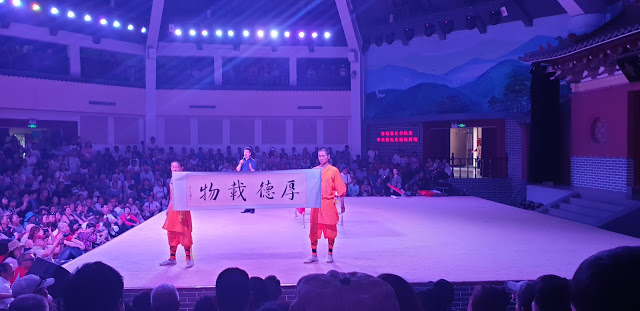
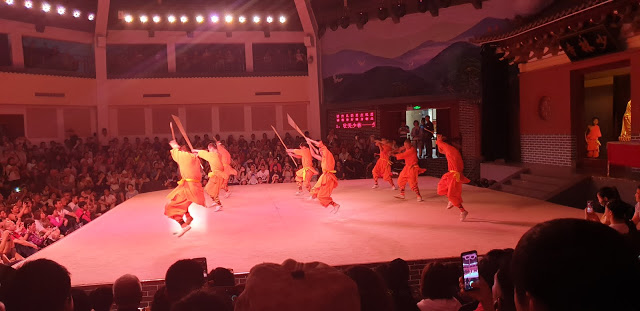
There is a 500-seat demonstration hall where you are able to observe 30 minutes of various martial arts in shows starting on the hour.

Outside there is a specific area that generally has about 600 trainees learning kung fu elements during the day but can hold 5,000 people when outdoor performances are required.

The kung fu school

The thing you notice most about the kung fu school is its size and then the number of buses which tells you that it is a popular tourist stop.

And with that size comes long distances between the car park and the venues we need to go to, the first of which is about half a km, and that’s just to get to the ticket plaza.

But, it is pleasantly set out and is quite a large number of shops for both souvenirs and food

We pass by some of the students going through their paces

From there it’s another long, long walk to the show arena, where we’re supposed to see various kung fu elements on display.  We watched this for a few minutes, then headed off towards the hall for a more intense demonstration of kung fu, and because there is limited seating we have to start lining up at the head of the queue to get a seat.

But…

Everyone else has the same idea and we join the throng which then becomes a ride, and true to the Chinese they start finding ways to push in, even using the imaginary friend somewhere ahead in the queue.

The doors open and then it’s open slather, with the hoards pushing from behind and sliding up the side to get in first.  We go with the tide, and manage to get in and find a seat though we were separated from three of our group.

It was an interesting show even though not one word of English was spoken, which from our point of view was a disappointment because we had no idea what was going on.

However…

It wasn’t hard to follow

What the performers were doing was relatively self-explanatory, and quite fascinating, especially the guy who broke a sword over his head, and the guy who stopped two spears penetrating the neck, both examples of very disciplined men.

Boys gave a demonstration of kung fu moves, and intensity and age increased as this progressed to the end.

Next, we were taken in hand by an instructor in Tai chi or an equivalent, I was not quite sure what it was called, and went through the twelve or maybe more moves that constituted a morning or afternoon exercise session or it could be just for relaxation.  I lasted the first session but it was a little difficult to do with my sore limbs and a bad back.

Not that I could remember any of it now other than hands overhead, hands in front, bent knees, and a few gentle kung fu hand moves.

Perhaps when I get home I might seek out someone to show me the moves.

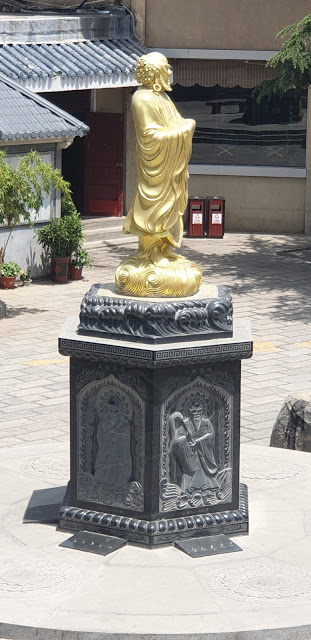
Whilst the others were following their training instructor, I wandered about, finding a large statue


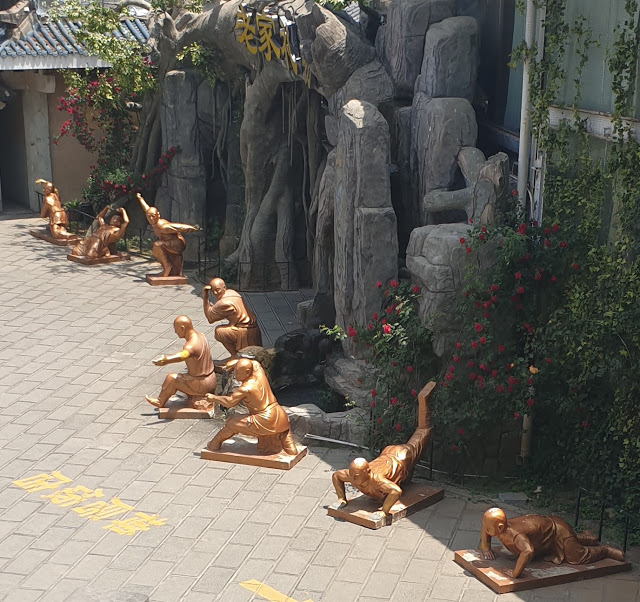
And some smaller statues

Lunch in the Zen Restaurant

After all that exercise it was time to have lunch purportedly the same food as the king fu masters.
It’s in the Zen restaurant, aptly named, and the food when it came, came thick and fast, but some of it wasn’t very nice, meat with bones, tofu, a tasteless soup, but some good dishes like the vegetables and noodles with meat, without bones.

The only problem was nothing to drink except a pot of hot water.  No tea, no cold water, and if you wanted a cold drink you had to pay for it.  After paying 550 yuan why should we have to pay more for a drink when we have not had to so far.

But no cold water?  That was just not on, and when we brought this to the attention of the tour guide she just simply ignored us.  We just didn’t get anything.

That basically tainted the whole experience.

After lunch, there was the Shaolin Temple and the Pogoda Forest to visit.

“Sunday in New York”, a romantic adventure that’s not a walk in the park!

“Sunday in New York” is ultimately a story about trust, and what happens when a marriage is stretched to its limits.

When Harry Steele attends a lunch with his manager, Barclay, to discuss a promotion that any junior executive would accept in a heartbeat, it is the fact his wife, Alison, who previously professed her reservations about Barclay, also agreed to attend, that casts a small element of doubt in his mind.

From that moment, his life, in the company, in deciding what to do, his marriage, his very life, spirals out of control.

There is no one big factor that can prove Harry’s worst fears, that his marriage is over, just a number of small, interconnecting events, when piled on top of each other, points to a cataclysmic end to everything he had believed in.

Trust is lost firstly in his best friend and mentor, Andy, who only hints of impending disaster, Sasha, a woman whom he saved, and who appears to have motives of her own, and then in his wife, Alison, as he discovered piece by piece damning evidence she is about to leave him for another man.

Can we trust what we see with our eyes or trust what we hear?

Haven’t we all jumped to conclusions at least once in our lives?

Can Alison, a woman whose self-belief and confidence is about to be put to the ultimate test, find a way of proving their relationship is as strong as it has ever been?

As they say in the classics, read on!

Purchase:

http://tinyurl.com/Amazon-SundayInNewYork

“Echoes From The Past”, the past doesn’t necessarily stay there


What happens when your past finally catches up with you?

Christmas is just around the corner, a time to be with family. For Will Mason, an orphan since he was fourteen, it is a time for reflection on what his life could have been, and what it could be.

Until a chance encounter brings back to life the reasons for his twenty years of self-imposed exile from a life only normal people could have. From that moment Will’s life slowly starts to unravel and it’s obvious to him it’s time to move on.

This time, however, there is more at stake.

Will has broken his number one rule, don’t get involved.

With his nemesis, Eddie Jamieson, suddenly within reach, and a blossoming relationship with an office colleague, Maria, about to change everything, Will has to make a choice. Quietly leave, or finally, make a stand.

But as Will soon discovers, when other people are involved there is going to be terrible consequences no matter what choice he makes.

https://amzn.to/2CYKxu4

newechocover5rs

An excerpt from “What Sets Us Apart”, a mystery with a twist

See the excerpt from the story below, just a taste of what’s in store…

http://amzn.to/2Eryfth

whatsetscover

McCallister was old school, a man who would most likely fit in perfectly campaigning on the battlefields of Europe during the Second World War. He’d been like a fish out of water in the army, post-Falklands, and while he retired a hero, he still felt he’d more to give.

He’d applied and was accepted as head of a SWAT team, and, watching him now as he and his men disembarked from the truck in almost military precision, a look passed between Annette, the police liaison officer, and I that said she’d seen it all before. I know I had.

There was a one in four chance his team would be selected for this operation, and she had been hoping it would be one of the other three. While waiting for them to arrive she filled me in on the various teams. His was the least co-operative, and the more likely to make ad-hoc decisions rather than adhere to the plan, or any orders that may come from the officer in charge.

This, she said quite bluntly, was going to end badly.

I still had no idea why Prendergast instructed me to attend the scene of what looked to be a normal domestic operation, but as the nominated expert in the field in these types of situations, it was fairly clear he wasn’t taking any chances. It was always a matter of opinion between us, and generally I lost.

In this case, it was an anonymous report identifying what the authorities believed were explosives in one of the dockside sheds where explosives were not supposed to be.

The only reason why the report was given any credence was the man, while not identifying himself by name, said he’d been an explosive expert once and recognized the boxes. That could mean anything, but the Chief Constable was a cautious man.

With his men settled and preparing their weapons, McCallister came over to the command post, not much more than the SUV my liaison and I arrived in, with weapons, bulletproof vests, and rolls of tape to cordon off the area afterward. We both had coffee, steaming in the cold early morning air. Dawn was slowly approaching and although rain had been forecast it had yet to arrive.

A man by the name of Benson was in charge. He too had groaned when he saw McCallister.

“A fine morning for it.” McCallister was the only enthusiastic one here.

He didn’t say what ‘it’ was, but I thought it might eventually be mayhem.

“Let’s hope the rain stays away. It’s going to be difficult enough without it,” Benson said, rubbing his hands together. We had been waiting for the SWAT team to arrive, and another team to take up their position under the wharf, and who was in the final stages of securing their position.

While we were waiting we drew up the plan. I’d go in first to check on what we were dealing with, and what type of explosives. The SWAT team, in the meantime, were to ensure all the exits to the shed were covered. When I gave the signal, they were to enter and secure the building. We were not expecting anyone inside or out, and no movement had been detected in the last hour since our arrival and deployment.

“What’s the current situation?”

“I’ve got eyes on the building, and a team coming in from the waterside, underneath. Its slow progress, but they’re nearly there. Once they’re in place, we’re sending McKenzie in.”

He looked in my direction.

“With due respect sir, shouldn’t it be one of us?” McCallister glared at me with the contempt that only a decorated military officer could.

“No. I have orders from above, much higher than I care to argue with, so, McCallister, no gung-ho heroics for the moment. Just be ready to move on my command, and make sure you have three teams at the exit points, ready to secure the building.”

McCallister opened his mouth, no doubt to question those orders, but instead closed it again. “Yes sir,” he muttered and turned away heading back to his men.

“You’re not going to have much time before he storms the battlements,” Benson quietly said to me, a hint of exasperation in his tone. “I’m dreading the paperwork.”

It was exactly what my liaison officer said when she saw McCallister arriving.

The water team sent their ‘in position’ signal, and we were ready to go.

In the hour or so we’d been on site nothing had stirred, no arrivals, no departures, and no sign anyone was inside, but that didn’t mean we were alone. Nor did it mean I was going to walk in and see immediately what was going on. If it was a cache of explosives then it was possible the building was booby-trapped in any number of ways, there could be sentries or guards, and they had eyes on us, or it might be a false alarm.

I was hoping for the latter.

I put on the bulletproof vest, thinking it was a poor substitute for full battle armor against an exploding bomb, but we were still treating this as a ‘suspected’ case. I noticed my liaison officer was pulling on her bulletproof vest too.

“You don’t have to go. This is my party, not yours,” I said.

“The Chief Constable told me to stick to you like glue, sir.”

I looked at Benson. “Talk some sense into her please, this is not a kindergarten outing.”

He shrugged. Seeing McCallister had taken all the fight out of him. “Orders are orders. If that’s what the Chief Constable requested …”

Madness. I glared at her, and she gave me a wan smile. “Stay behind me then, and don’t do anything stupid.”

“Believe me, I won’t be.” She pulled out and checked her weapon, chambering the first round. It made a reassuring sound.

Suited up, weapons readied, a last sip of the coffee in a stomach that was already churning from nerves and tension, I looked at the target, one hundred yards distant and thought it was going to be the longest hundred yards I’d ever traversed. At least for this week.

A swirling mist rolled in and caused a slight change in plans.

Because the front of the buildings was constantly illuminated by large overhead arc lamps, my intention had been to approach the building from the rear where there was less light and more cover. Despite the lack of movement, if there were explosives in that building, there’d be ‘enemy’ surveillance somewhere, and, after making that assumption, I believed it was going to be easier and less noticeable to use the darkness as a cover.

It was a result of the consultation, and studying the plans of the warehouse, plans that showed three entrances, the main front hangar type doors, a side entrance for truck entry and exit and a small door in the rear, at the end of an internal passage leading to several offices. I also assumed it was the exit used when smokers needed a break. Our entry would be by the rear door or failing that, the side entrance where a door was built into the larger sliding doors. In both cases, the locks would not present a problem.

The change in the weather made the approach shorter, and given the density of the mist now turning into a fog, we were able to approach by the front, hugging the walls, and moving quickly while there was cover. I could feel the dampness of the mist and shivered more than once.

It was nerves more than the cold.

I could also feel rather than see the presence of Annette behind me, and once felt her breath on my neck when we stopped for a quick reconnaissance.

It was the same for McCallister’s men. I could feel them following us, quickly and quietly, and expected, if I turned around, to see him breathing down my neck too.

It added to the tension.

My plan was still to enter by the back door.

We slipped up the alley between the two sheds to the rear corner and stopped. I heard a noise coming from the rear of the building, and the light tap on the shoulder told me Annette had heard it too. I put my hand up to signal her to wait, and as a swirl of mist rolled in, I slipped around the corner heading towards where I’d last seen the glow of a cigarette.

The mist cleared, and we saw each other at the same time. He was a bearded man in battle fatigues, not the average dockside security guard.

He was quick, but my slight element of surprise was his undoing, and he was down and unconscious in less than a few seconds with barely a sound beyond the body hitting the ground. Zip ties secured his hands and legs, and tape his mouth. Annette joined me a minute after securing him.

A glance at the body then me, “I can see why they, whoever they are, sent you.”

She’d asked who I worked for, and I didn’t answer. It was best she didn’t know.

“Stay behind me,” I said, more urgency in my tone. If there was one, there’d be another.

Luck was with us so far. A man outside smoking meant no booby traps on the back door, and quite possibly there’d be none inside. But it indicated there were more men inside, and if so, it appeared they were very well trained. If that were the case, they would be formidable opponents.

The fear factor increased exponentially.

I slowly opened the door and looked in. A pale light shone from within the warehouse itself, one that was not bright enough to be detected from outside. None of the offices had lights on, so it was possible they were vacant. I realized then they had blacked out the windows. Why hadn’t someone checked this?

Once inside, the door closed behind us, progress was slow and careful. She remained directly behind me, gun ready to shoot anything that moved. I had a momentary thought for McCallister and his men, securing the perimeter.

At the end of the corridor, the extent of the warehouse stretched before us. The pale lighting made it seem like a vast empty cavern, except for a long trestle table along one side, and, behind it, stacks of wooden crates, some opened. It looked like a production line.

To get to the table from where we were was a ten-yard walk in the open. There was no cover. If we stuck to the walls, there was equally no cover and a longer walk.

We needed a distraction.

As if on cue, the two main entrances disintegrated into flying shrapnel accompanied by a deafening explosion that momentarily disoriented both Annette and I. Through the smoke and dust kicked up I saw three men appear from behind the wooden crates, each with what looked like machine guns, spraying bullets in the direction of the incoming SWAT members.

They never had a chance, cut down before they made ten steps into the building.

By the time I’d recovered, my head heavy, eyes watering and ears still ringing, I took several steps towards them, managing to take down two of the gunmen but not the third.

I heard a voice, Annette’s I think, yell out, “Oh, God, he’s got a trigger,” just before another explosion, though all I remember in that split second was a bright flash, the intense heat, something very heavy smashing into my chest knocking the wind out of me, and then the sensation of flying, just before I hit the wall.

I spent four weeks in an induced coma, three months being stitched back together and another six learning to do all those basic actions everyone took for granted. It was twelve months almost to the day when I was released from the hospital, physically, except for a few alterations required after being hit by shrapnel, looking the same as I always had.

But mentally? The document I’d signed on release said it all, ‘not fit for active duty; discharged’.

It was in the name of David Cheney. For all intents and purposes, Alistair McKenzie was killed in that warehouse, and for the first time ever, an agent left the Department, the first to retire alive.

I was not sure I liked the idea of making history.

© Charles Heath 2016-2020

The fourth attempt, let’s look at the location

Equally important is the location.  Dark and brooding characters need dark and brooding locations.  It’s undeniable that there’s evil everywhere; we just have to look for it.

Of course, that’s not what I do, but …

I have been in a few tight corners, with some possibly dark and brooding characters, where my heart rate has increased exponentially, and I was saved by quick thinking and a desire not to hang around and see what happens (for the purposes of a writable experience – no, I’m not that stupid).

As the story stands, we move from a small staff room or restroom, and then we move out to the car park of … what?  It’s not exactly clear where it is, only that Graham is leaving work to go home.

Whether it’s clear or not, Graham is a security guard, part of a team that works on an industrial estate where there are a number of factories and office blocks. 

Some of those buildings are empty, for a variety of reasons, so a back story for this might be created so that I can convey a clearer picture of not only the bricks and mortar, but what it’s like there.

Ergo, the first descriptive line, stepping outside into the epicentre of the South Pole.  There is snow everywhere, which meant it was falling while he was inside at work, but now, the moment he leaves, it’s stopped.  Cold, then, and clear.

So it begins…

Now, as a secondary theme, it might not be obvious that the owners are lax in the hiring of security staff to watch over their assets, staff that are relatively dubious in character, which might, in turn, mean that the notion of using cut-price security might mean something else is going on.

Are the empty factories empty?  Or have they been repurposed, and the guards are not sure what they’re guarding?  Do they want to know?  A job is a job, and in this situation, either from a hint from the employer or the words of an old hand, and it doesn’t pay to poke a nose in where it’s not wanted.

So, as you can see, when starting the story, I didn’t give proper thought to the background story, the fact that I could weave another or several storylines intertwined with what will be the master plotline.

What is the master plotline?

I have an idea or two, but let’s not get too ahead of ourselves.

Let’s stitch together a scenario or two for the back story and see where it takes us.  Remember that this was more or less part of the storyline originally in my mind, but may not have been articulated in what I wrote at the time.

Basically, then, we’re dealing with a large industrial site on the outskirts of a city in decline.  Everyone can relate to the problematic times we’re in now, but this was written at the height of the last global financial meltdown about fifteen years ago, which caused a deep recession.

Within that framework, a lot of businesses and people went to the wall.  Graham and others lost a decent-paying job, as well as their house, having finally got on the property ladder, only to find they couldn’t pay for it.

At the time, he was not alone in that respect.  And lenders were not immune either, so there’s a possibility that one or two industrial park owners may not have been entirely legitimate in some of their business dealings, especially after taking heavy financial hits.

In that scenario, there’s always the possibility of insurance fraud as a means of cutting losses, hence the need for security that might be asked to look the other way.

Another possibility could be that empty buildings and enterprising men, or women, fit the category of ‘the devil finds work for idle hands’. 

Or someone who recognises an opportunity to make some money.  That particular scenario opens the door to a plethora of ideas.

© Charles Heath 2024

Writing about writing a book – Day 11

Once again, instead of writing, I have been obsessing over the planning and creation of a website for the book.

And, that being the case, now I have to give the book a name so I can name the site/blog after it.

The word Starburst has featured in the story so tentatively I’m going to name it “The Starburst Conspiracy”

The site will be on WordPress.  There will be progress blog posts, there will draft writing and possible chapters for beta reading and comment.  There will be separate pages for each of the characters.

I’m not sure how I’m going to build an email list so perhaps I’ll build a following first.

So, having mapped out a plan for the site, I’ve made the first post and written the ‘About’ page which basically gives a bit of history about the book.

Bear in mind the original book of about 400 pages scribbled over a long period of time, and not really a book in the sense of the word (more a collection of ideas set in some form of chronology) and set in the early eighties and will probably stay there but will be the basis for the new novel.

Another interesting aspect of this exercise is to see how far I have come writing-wise in the last 30 years and how easy it is to spot the issues with the original manuscript.

I’ve also created a master page for the cast of characters and only a page for the main character so far.  Others will follow.

There will be another page with an ongoing, updated synopsis.

Shortcuts to these pages, as the information flows will be in subsequent posts.


For now, it’s back to writing, after a long gap, and the ideas have been churning in my head.


© Charles Heath 2016-2020

The cinema of my dreams – I never wanted to go to Africa – Episode 15

Our hero knows he’s in serious trouble.

The problem is, there are familiar faces and a question of who is a friend and who is foe made all the more difficult because of the enemy, if it was the enemy, simply because it didn’t look or sound or act like the enemy.

But, it seems our hero has ‘escaped’ and had found his way back home.

Except not quite how he expected it would be.

Rest was impossible while so many thoughts about my recent experiences were swirling around in the back of my head.  Now, when thinking it through, it made sense that they make sure I was found alive, but in very bad shape.

Two reasons, one, to remind me that they could do whatever they liked to me, and the second, to appease Breeman, who, no doubt realizing a helicopter was missing, would send out search teams, a no-fly zone or not.

But it was a calculated risk assuming I would not tell Breeman, or someone else, about what had happened to me, whether they believed it or not.

That led to the next thought, why was I still alive.  It would be just as easy to kill me and be discovered after dying from injuries received in the crash.  Supposition, they still needed me, or, and this was a hail Mary at best, they needed access to the base, and Breeman.

Did that mean either of the two men I’d seen at the other camp would suddenly turn up?  My money was on Colonel Bamfield.  He was my first Commanding Officer, he had a keen interest in me from the get-go, and he was the one who facilitated my transfer to my current base before I knew he was working for ‘other interests’. 

I still didn’t want to think it was the enemy.

Another question popped into my head, what was his, or their, interest in Breeman because the line of questioning centered on her.

My best guess was that it was no accident I was on that helicopter, that she had directed the pilot to make a flyover, and wasn’t expected that we would be shot down and that she had assumed there would be no repercussions on either myself or the pilot.

It was also clear that if she had to explain how I came to be where they found me, and the fact no one had launched a similar attack of the rescue team, that what happened was simply a breach of orders, and a court-martial offense.

It would solve Bamfield and his new friend’s problem.  Whatever the outcome of the court-martial she would be sent home, relieved of her command.

It seemed the military, as always, had a mind of its own, and not always have the best interests of its personnel at heart.

I’d soon find out.

© Charles Heath 2019

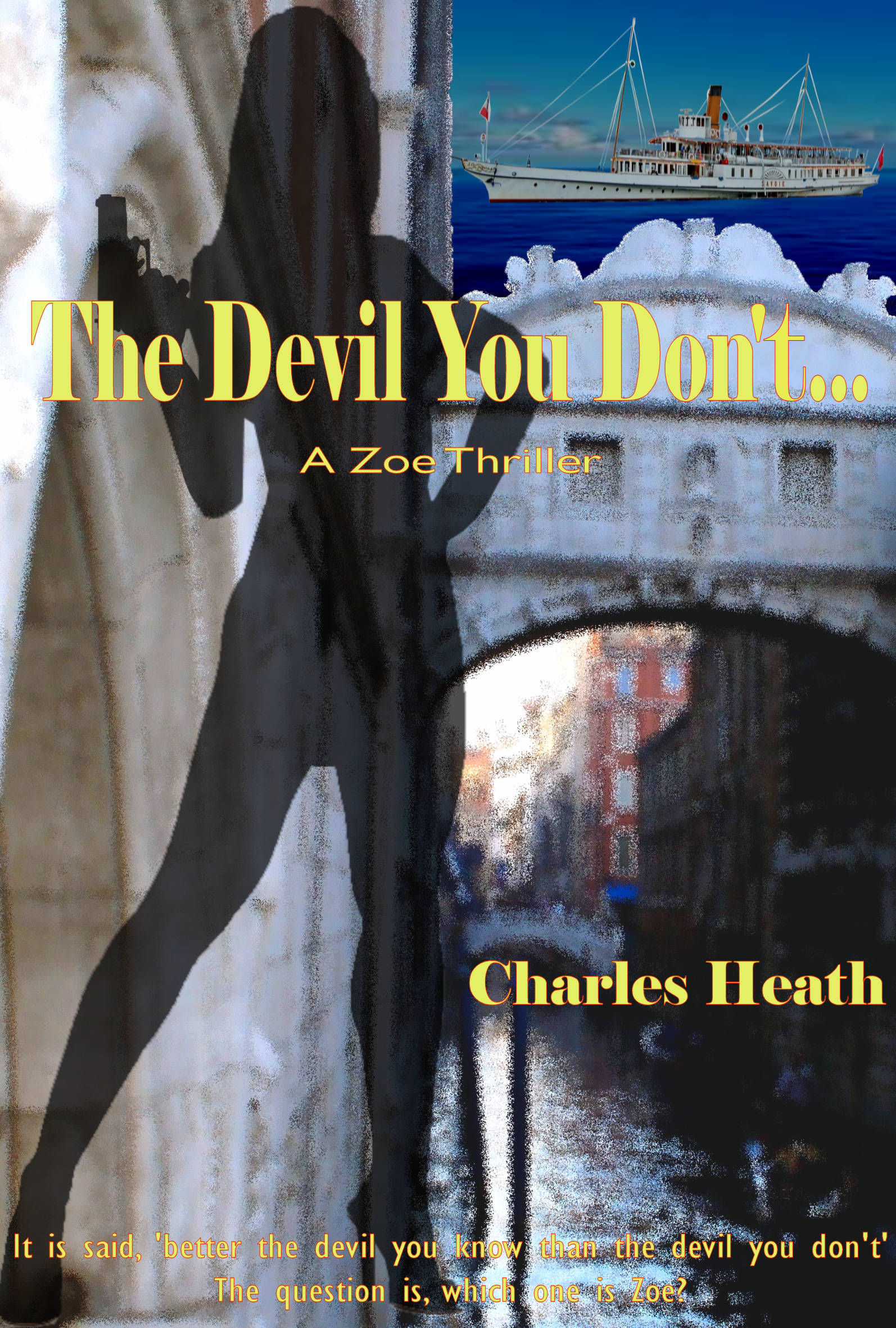
‘The Devil You Don’t’ – A beta reader’s view

It could be said that of all the women one could meet, whether contrived or by sheer luck, what are the odds it would turn out to be the woman who was being paid a very large sum to kill you.

John Pennington is a man who may be lucky in business, but not so lucky in love. He has just broken up with Phillipa Sternhaven, the woman he thought was the one, but relatives and circumstances, and perhaps because she was a ‘princess’, may also have contributed to the end result.

So, what do you do when you are heartbroken?

That is a story that slowly unfolds, from the first meeting with his nemesis on Lake Geneva, all the way to a hotel room in Sorrento, where he learns the shattering truth.

What should have been solace after disappointment, turns out to be something else entirely, and from that point, everything goes to hell in a handbasket.

He suddenly realizes his so-called friend Sebastian has not exactly told him the truth about a small job he asked him to do, the woman he is falling in love with is not quite who she says she is, and he is caught in the middle of a war between two men who consider people becoming collateral damage as part of their business.

The story paints the characters cleverly displaying all their flaws and weaknesses. The locations add to the story at times taking me back down memory lane, especially to Venice where, in those back streets I confess it’s not all that hard to get lost.

All in all a thoroughly entertaining story with, for once, a satisfying end.

Available on Amazon here: https://amzn.to/2Xyh1ow

“The Things we do for Love”, the story behind the story

This story has been ongoing since I was seventeen, and just to let you know, I’m 71 this year.

Yes, it’s taken a long time to get it done.

Why, you might ask.

Well, I never gave it much interest because I started writing it after a small incident when I was 17, and working as a book packer for a book distributor in Melbourne

At the end of my first year, at Christmas, the employer had a Christmas party, and that year, it was at a venue in St Kilda.

I wasn’t going to go because at that age, I was an ordinary boy who was very introverted and basically scared of his own shadow and terrified by girls.

Back then, I would cross the street to avoid them

Also, other members of the staff in the shipping department were rough and ready types who were not backwards in telling me what happened, and being naive, perhaps they knew I’d be either shocked or intrigued.

I was both adamant I wasn’t coming and then got roped in on a dare.

Damn!

So, back then, in the early 70s, people looked the other way when it came to drinking, and of course, Dutch courage always takes away the concerns, especially when normally you wouldn’t do half the stuff you wouldn’t in a million years

I made it to the end, not as drunk and stupid as I thought I might be, and St Kilda being a salacious place if you knew where to look, my new friends decided to give me a surprise.

It didn’t take long to realise these men were ‘men about town’ as they kept saying, and we went on an odyssey.  Yes, those backstreet brothels where one could, I was told, have anything they could imagine.

Let me tell you, large quantities of alcohol and imagination were a very bad mix.

So, the odyssey in ‘The things we do’ was based on that, and then the encounter with Diana. Well, let’s just say I learned a great deal about girls that night.

Firstly, not all girls are nasty and spiteful, which seemed to be the case whenever I met one. There was a way to approach, greet, talk to, and behave.

It was also true that I could have had anything I wanted, but I decided what was in my imagination could stay there.  She was amused that all I wanted was to talk, but it was my money, and I could spend it how I liked.

And like any 17-year-old naive fool, I fell in love with her and had all these foolish notions.  Months later, I went back, but she had moved on, to where no one was saying or knew.

Needless to say, I was heartbroken and had to get over that first loss, which, like any 17-year-old, was like the end of the world.

But it was the best hour I’d ever spent in my life and would remain so until I met the woman I have been married to for the last 48 years.

As Henry, he was in part based on a rebel, the son of rich parents who despised them and their wealth, and he used to regale anyone who would listen about how they had messed up his life

If only I’d come from such a background!

And yes, I was only a run away from climbing up the stairs to get on board a ship, acting as a purser.

I worked for a shipping company and they gave their junior staff members an opportunity to spend a year at sea working as a purser on a cargo ship that sailed between Melbourne, Sydney and Hobart in Australia.

One of the other junior staff members’ turn came, and I would visit him on board when he would tell me stories about life on board, the officers, the crew, and other events. These stories, which sounded incredible to someone so impressionable, were a delight to hear.

Alas, by that time, I had tired of office work and moved on to be a tradesman at the place where my father worked.

It proved to be the right move, as that is where I met my wife.  Diana had been right; love would find me when I least expected it.

lovecoverfinal1

The fourth attempt, let’s look at the main character

So there are words on paper, and three times I’ve tried to fix it, or, perhaps just make it sound better because reading it in my head, there’s too little background and too many questions.

The flow of the story isn’t working for me, so I guess it’s time to sit down and work out what it is I’m trying to say.

The notion that our main character, Graham, is a loser seems to shine through, and that’s not what I’m trying to portray him as.  No, far from it, it’s been a lifetime of bad choices that have put him where he is, and he knows it.

So, in part, this is about owning your mistakes, and it’s my job to make him come across as a hero in waiting.  There’s good in him, perhaps too much, but there is also that attitude that led to all those bad choices, the one that can get him into trouble, and a sort of intransigence inherited from his father, that has more or less got him ostracised from the family. 

I want this character to be a chop off the old block, both of whom are the type not to back down, not to say sorry, and, to quote a rather apt allegory, would cut their nose off to spite their face.

Graham’s intransigence led to his refusal to follow his father into business, refusal to go to University despite having the necessary qualifications, and just to round out the defiance, his choice of women whom he knew would meet with family disapproval.

And these factors, over a period of time, saw him bounce from a low-paying job to jobs with no prospects, and a string of failed relationships, until this moment in time, where he was basically on his own, working the graveyard shift as a security guard.  The sort of job where qualifications weren’t looked for and workmates looked like and probably were ex-cons.

There are a few more details like the older brother, Jackson, politician and schemer, the same as his father before him (the seat was passed down through the family), like the younger sister who is a highly successful surgeon, married into immense wealth.  His brother had been less successful in the marital stakes but what he lacked in a wife was more than made up with a string of highly eligible and beautiful women.

And, no, he doesn’t resent the fact they’re rich, or that his parents were, too, just that they treated him with contempt.

It was almost five years since the last time he had seen any of them, that last time he attended the family Christmas in Martha’s Vineyard, the ‘Stockdale Residence’ an ostentatious sprawling fifty-room mansion that, in a drunken rage, he’s tried to burn down.

Once again, he had not received an invitation to the next, due in a few days, and it was not entirely unexpected.

Graham has his faults, but that even, five years ago, had pulled him off the road to self-destruction, helped along by a year stint in jail where he learned a great many lessons about life itself, and survival.

The four years since?

A lot of regrets, and a lot of repentance.  Life after jail was a lot worse than life trying to defy the family and the system.  There were two roads he could have gone down, and thankfully for him, it was not the wrong one.

So, he’s back on the path, a whole lot wiser, a whole lot tougher.

That might not have been exactly what I was thinking for him over the first three attempts.  I don’t think any character really begins to shine until halfway through, as you find him meeting various challenges in ways even you, as the writer, find quite unexpected.

Is that the end result of being a pantser over being a planner?

I don’t think, even as a planner, you can create a character that’s not going to change, or even surprise you, as the story evolves.

And somehow I don’t think I’m about to change from one to the other.

Well, not completely.

But there’s more, and no, it’s not steak knives!

© Charles Heath 2020-2024