‘What Sets Us Apart’ – A beta readers view

There’s something to be said for a story that starts like a James Bond movie, throwing you straight in the deep end, a perfect way of getting to know the main character, David, or is that Alistair?

A retired spy, well not so much a spy as a retired errand boy, David’s rather wry description of his talents, and a woman that most men would give their left arm for, not exactly the ideal couple, but there is a spark in a meeting that may or may not have been a setup.

But as the story progressed, the question I kept asking myself was why he’d bother.

And, page after unrelenting page, you find out.

Susan is exactly the sort of woman to pique his interest.  Then, inexplicably, she disappears.  That might have been the end to it, but Prendergast, that shadowy enigma, David’s ex-boss who loves playing games with real people, gives him an ultimatum, find her or come back to work.

Nothing like an offer that’s a double-edged sword!

A dragon for a mother, a sister he didn’t know about, Susan’s BFF who is not what she seems or a friend indeed, and Susan’s father who, up till David meets her, couldn’t be less interested, his nemesis proves to be the impossible dream, and he’s always just that one step behind.

When the rollercoaster finally came to a halt, and I could start breathing again, it was an ending that was completely unexpected.

I’ve been told there’s a sequel in the works.

Bring it on!

The book can be purchased here:  http://amzn.to/2Eryfth

The cinema of my dreams – I always wanted to write a war story – Episode 43

For a story that was conceived during those long boring hours flying in a steel cocoon, striving to keep away the thoughts that the plane and everyone in it could just simply disappear as planes have in the past, it has come a long way.

Whilst I have always had a fascination with what happened during the second world war, not the battles or fighting, but in the more obscure events that took place, I decided to pen my own little sidebar to what was a long and bitter war.

And, so, it continues…

——

Mayer fought the urge to panic, and then consider giving himself up.  He remembered what the Standartenfuhrer said, and knew that it was not an option.

He slid back into the forest, then far enough back, stood, and ran, the thick snow not only hampering his speed but also covering the sound of his flight. 

He stopped and listened for the sound of the following soldiers, but all he could hear was the sound of a locomotive and his breathing.  His heart was pounding, not used to such exercise or fear.

The soldiers must have stopped where the running person had fallen, and then on the verge of the tree line when the Standartenfuhrer had been shot.

He kneeled down and struggled to catch his breath.  He had the bad the Standartenfuhrer had thrust upon him as they got out of the car, and hoped it had a map, but it was too dark to look now.

From earlier, he remembered the other side of the railway tracks had trees too, and the road that led to the border, the village, if there was one, and the railway station.  There would also be a small shunting area, freight sheds, or something else to hide in, maybe even a signal tower.

Somewhere warm, and with some light, so he could plan his next move.  He was not sure what the Standartenfuhrer Had planned, but it certainly could not be by car the whole way, and they would not make the rendezvous by walking.

The plan had to include going by train.

Brenner pass was along the main track from Austria to the south of Italy, and from an earlier look at a map, the train would go through F, Verona, Bologna, to Florence where he would find the next guide.

Details of that guide hopefully were in the bag, a bag that he would have to hide or lose if he was captured because it would give away the escape route and resistance members who helped those fleeing Germany.

If he had the time or could think straight.  The cold was making that very difficult.  And there was the shock of losing the Standartenfuhrer.

It took five minutes to regain a certain amount of calm and be able to think. 

First, he had to get back to the tree line and see where he was, in proximity to the village, and the railway tracks.

That took about ten minutes carefully picking his way through the trees.  There was no path, it was dark, and he kept hitting low branches and getting covered in snow. There was enough down the back of his neck to make him very uncomfortable.

When he reached the tree line he looked back from where he had been, about a kilometer, and he could see the torches of the soldiers milling around where he and the Standartenfuhrer had been.  The train was still there, the locomotive’s light blazing in front, lighting a short distance of the track in front of it, almost blindingly bright. 

He was not sure why it was waiting on the track.

Looking the other way, there were two sets of tracks, a wide clear area, then another track with several flat cars and a guards van sitting in darkness, all of which were covered in snow.  They were not being used, so the van might provide some shelter.

He just had to get over there, about 100 meters distant.  The problem was there were lights, not very bright, at regular distances, but short enough that a man might present a shadowy outline if anyone was looking.

If he stayed low and run fast, it might just work.

A train whistle in the distance, coming from Italy caused him to shrink back into the cover of the trees.  Another train was coming.  It was oddly busy at a very late hour.

The locomotive also had a bright light that lit up the edge of the tree line, so he had to go further back to get away from it, and wait until the train passed.  It had a lot of flat cars with tanks and troop carriers on it, going back to Germany.  There were no soldiers so perhaps the equipment was needed elsewhere, maybe that final push to England he kept hearing about.

Once that train passed, the one that had been waiting finally restarted its journey south and slowly rumbled past him.  It was almost like a passenger train with no priority had had to wait until essential war trains passed.

When that train had gone, the surrounding area descended into a quiet, also silent field.  The snow had begun to fall heavier, which would be advantageous, and after several long looks in both directions, he ran, crossing the tracks, the empty space, and then to the guard van where he hid between it and the freight car until he caught his breath.

And see if anyone had seen him, expecting whistles and shouting coming from up the track.

Another look showed that only two torches remained back where there had been frenetic activity.  He hoped they considered they had caught the people they were looking for.

He went down the side of the guard’s van to the door, climbed the ladder, and tried the door.  It was unlocked.  There was no reason why it would be locked.

He went in and shut the door, and immediately it was warmer, and certainly dryer.  IT was impossibly dark inside, so he felt around in the bag and found a torch.  Someone had been clever enough to add a torch, some first aid equipment.  The papers included a map.

He checked the cabin for windows and found the shutters were closed, so he didn’t have to stifle the torches light.  A further check showed a bed at the end of the cabin, with a blanket, musty but dry.

There was a stove, a kettle with water, and a tin of tea leaves.  He wasn’t going to start a fire, so no tea.  There was no food, so the hunger would have to remain for a while longer.  The water tasted alright, but he could melt some snow if he needed more.

A place to stay, at least until daybreak when it would be wise to get into the forest on the roadside, and head towards the village, or perhaps wait for a train and see if he could hide on it for the trip south.

First, he needed some rest.

——-

© Charles Heath 2020-2022

A photograph from the inspirational bin – 7

There is always something strange about certain photographs that is not evident when you take them.

For instance, the photograph above.

While this might look like vegetation by the side of a river or stream, it’s the blackness behind what look like steps up from the water level that adds a level of intrigue or mystery.

For instance:

We had spent two weeks slowly going upriver looking for a needle in a haystack. It was an apt description, because there had been quite a large number of likely spots, all of which, after investigation, came to nothing.

I mean, the description Professor Bates had given was as hazy as day is long in these parts.

His recollection: that it was a cave-like space behind lush undergrowth, with stone steps.

It was all the more confusing. Because when we found him, he was drifting on a rough-hewn and constructed raft, half dead from dehydration. We were told he’d been on the raft for nearly a week.

That meant the cave could be anywhere between where we found him at the 10 mile mark and 200 miles further on, based on river flow.

We were currently at the 150-mile mark, and the river was losing depth and width; soon, there would not be enough water to continue in the boat.

It was dusk and too dark to continue. We’d been enthusiastic in those first days, continuing on in the dark, on shifts, using the arc lamps.

Then, after a week, having lights on made us target practise, and after several brushes with death, and the loss of all the bulbs being shot out, we got the message.

There was the odd marauder during the day, but we had the width of the river for safety.  Now that had gone too, and we had lookouts posted, but seeing into the dense jungle was difficult.

But we got through another night with no activity, and come morning, what looked like the entrance to a cave was not fifteen feet from us.

All we had to do was row over and check.

© Charles Heath 2020-2021

The cinema of my dreams – Was it just another surveillance job – Episode 26

I’m back home and this story has been sitting on a back burner for a few months, waiting for some more to be written.

The trouble is, there are also other stories to write, and I’m not very good at prioritizing.

But, here we are, a few minutes opened up and it didn’t take long to get back into the groove.

Maury drops in for a search


I moved to the doorway and switched off the light, sending the room back into inky darkness.  Not good for the eyes, going bright light to instant dark.  We stood together behind the door as it opened inwards, Jan ready with her gun.

The door opened slowly, at the same time letting light in from the corridor, making it easier to see.

Opened fully, the visitor tentatively stepped into the room, and once the shape moved past the door, I slammed it shut and Jan lunged with the gun.  

I was not sure what result she was expecting but the person fought back, and as they turned to wrench the gun out of her hand, I let loose a punch, aiming for the head, and as hard as I could.  I head a cracking sound followed by a thump as the body hit the ground.

When I turned the light back on, there were two surprises.  The first, that I’d managed to knock someone out, and the second, Maury was back for a second look.

Why?

It didn’t matter.  He wasn’t going to be unconscious for very long.  Jan had some twine in her room, I wasn’t going to ask why, and she tied his hands and legs together, trussed almost like a turkey.

We left him on the floor when he’d fallen.  Unconscious, he was too heavy to move, or lift.

“Is this man Severin, Maury or Nobbin?” she asked.  She’d saved the questions until after he’d been neutralized, and we’d taken his gun off him.  Also, a knife.  She’d also look through his pockets to see if he carried any identification.  He didn’t, and I wouldn’t expect to find anything.  At the moment I was the same, and since I threw the phone’s sim card, I was now completely anonymous.

“Maury,” I said.

“The attack dog?”

“Not able to attack us at the moment, but yes.  I wonder why he came back?”

“We should ask him,” she said, “when he wakes up.”

We were sitting in the chairs, turned around to face Maury lying on the ground.  He had wriggled, and realizing he was tied up, tried harder to escape the bonds, and then relaxed when he realized he couldn’t.

His eyes turned to us, and it felt like a death stare.  

“This is a mistake,” he said.  “untie these ropes and I might make an exception for you.

“Why are you here?” I asked him.

“That’s none of your business.”

“But it is mine.  This is my flat, and you’re trespassing,” Jan said.

He switched his death gaze to her.

“I’m not here to cause trouble.”

“Then why are you here?”

“To ask you if your next-door neighbor left anything here with you to collect at a later date.”

No doubt with a menacing attitude, which would end in violence because Maury was not the sort to take no for an answer.

“Most people would knock on the door, and politely wait until it was answered.”

Most people.

“I was told there would be no one at home.”

“And it couldn’t wait until I returned?  I’m sorry, but you have broken into my flat and I’m going to call the police.”

He looked at me.

“That’s not a good idea.  Tell her, Jackson.”

“I don’t work for you, or Severin, anymore.  In fact, when I went back into the office, I got dragged aside and interrogated.  No one seems to know who you and Severin are.”

“That’s because our operation was on a need to know basis.  How do you think our business works?  Not by telling everyone what you’re doing.  Now untie me, and I’ll be on my way.”

“No,” Jan said.  “Not until you tell us exactly who you are and who you work for, and why you deemed it necessary to murder O’Connell.”

Maury looked at me again, and there was no mistaking the anger.

“You do understand what the Official Secrets Act means, don’t you Jackson?”

“More or less.  But it depends on who it is you speak to whether that’s relevant or not.”

Back to Jan.  

“Who are you, then?”

“As you keep pulling out of your hat, it’s on a need to know basis, and, of course, we just tell everyone what we’re doing either.  But one thing I’m sure of, we do not go around killing agents.  As far as I can tell, O’Connell was working for an agency, possibly yours but I don’t think so, and in the course of his investigation, he came across some valuable information.  Information, I’m told, you want.  What is it and why?”

“Are you serious?”

He shifted his glare back to me.

“Seriously Jackson, who is this person?”

“Someone, I fear, who is going to cause you a great deal of grief if you don’t answer her questions.”

“Don’t be ridiculous.  I don’t have to tall you or anyone else the nature of my business.”

I saw her shake her head.  “I take it, that’s a no.”  She shrugged and pulled out her phone and dialed a number.  “Always the hard way with you people.”

“Sir,” she said when the call was answered.  “I’ve got a character named Maury tied up in my flat.  Breaking and entering for starters.  Yes, I’ll be here.”

She put the phone back in her bag.  “They’ll be here in ten minutes.”

All we had to do was hope that Maury didn’t have a backup.

© Charles Heath 2020

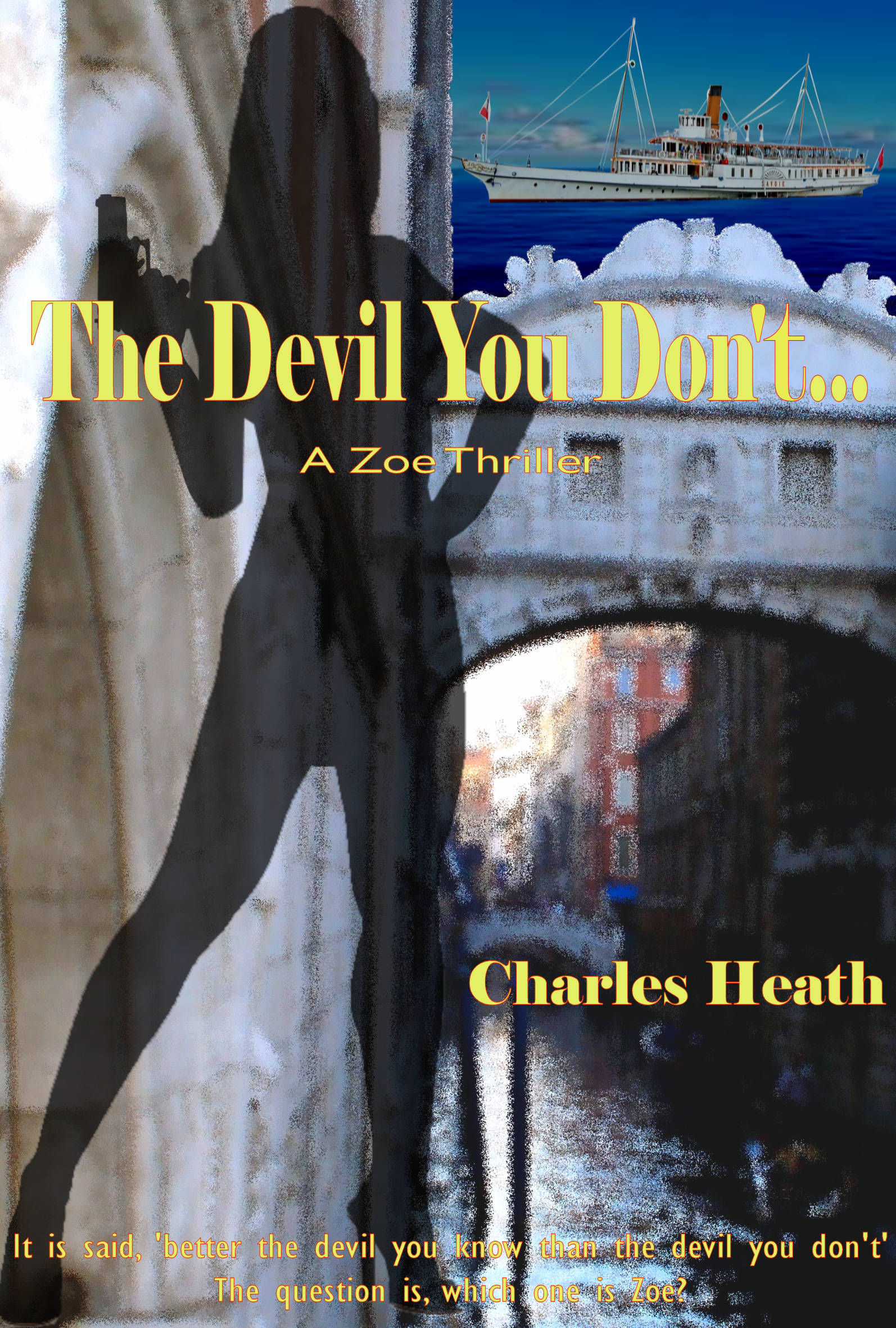
‘The Devil You Don’t’ – A beta reader’s view

It could be said that of all the women one could meet, whether contrived or by sheer luck, what are the odds it would turn out to be the woman who was being paid a very large sum to kill you.

John Pennington is a man who may be lucky in business, but not so lucky in love. He has just broken up with Phillipa Sternhaven, the woman he thought was the one, but relatives and circumstances, and perhaps because she was a ‘princess’, may also have contributed to the end result.

So, what do you do when you are heartbroken?

That is a story that slowly unfolds, from the first meeting with his nemesis on Lake Geneva, all the way to a hotel room in Sorrento, where he learns the shattering truth.

What should have been solace after disappointment, turns out to be something else entirely, and from that point, everything goes to hell in a handbasket.

He suddenly realizes his so-called friend Sebastian has not exactly told him the truth about a small job he asked him to do, the woman he is falling in love with is not quite who she says she is, and he is caught in the middle of a war between two men who consider people becoming collateral damage as part of their business.

The story paints the characters cleverly displaying all their flaws and weaknesses. The locations add to the story at times taking me back down memory lane, especially to Venice where, in those back streets I confess it’s not all that hard to get lost.

All in all a thoroughly entertaining story with, for once, a satisfying end.

Available on Amazon here: https://amzn.to/2Xyh1ow

“The Things we do for Love”, the story behind the story

This story has been ongoing since I was seventeen, and just to let you know, I’m 72 this year.

Yes, it’s taken a long time to get it done.

Why, you might ask.

Well, I never gave it much interest because I started writing it after a small incident when I was 17, and working as a book packer for a book distributor in Melbourne

At the end of my first year, at Christmas, the employer had a Christmas party, and that year, it was at a venue in St Kilda.

I wasn’t going to go because at that age, I was an ordinary boy who was very introverted and basically scared of his own shadow and terrified by girls.

Back then, I would cross the street to avoid them

Also, other members of the staff in the shipping department were rough and ready types who were not backwards in telling me what happened, and being naive, perhaps they knew I’d be either shocked or intrigued.

I was both adamant I wasn’t coming and then got roped in on a dare.

Damn!

So, back then, in the early 70s, people looked the other way when it came to drinking, and of course, Dutch courage always takes away the concerns, especially when normally you wouldn’t do half the stuff you wouldn’t in a million years

I made it to the end, not as drunk and stupid as I thought I might be, and St Kilda being a salacious place if you knew where to look, my new friends decided to give me a surprise.

It didn’t take long to realise these men were ‘men about town’ as they kept saying, and we went on an odyssey.  Yes, those backstreet brothels where one could, I was told, have anything they could imagine.

Let me tell you, large quantities of alcohol and imagination were a very bad mix.

So, the odyssey in ‘The things we do’ was based on that, and then the encounter with Diana. Well, let’s just say I learned a great deal about girls that night.

Firstly, not all girls are nasty and spiteful, which seemed to be the case whenever I met one. There was a way to approach, greet, talk to, and behave.

It was also true that I could have had anything I wanted, but I decided what was in my imagination could stay there.  She was amused that all I wanted was to talk, but it was my money, and I could spend it how I liked.

And like any 17-year-old naive fool, I fell in love with her and had all these foolish notions.  Months later, I went back, but she had moved on, to where no one was saying or knew.

Needless to say, I was heartbroken and had to get over that first loss, which, like any 17-year-old, was like the end of the world.

But it was the best hour I’d ever spent in my life and would remain so until I met the woman I have been married to for the last 48 years.

As Henry, he was in part based on a rebel, the son of rich parents who despised them and their wealth, and he used to regale anyone who would listen about how they had messed up his life

If only I’d come from such a background!

And yes, I was only a run away from climbing up the stairs to get on board a ship, acting as a purser.

I worked for a shipping company and they gave their junior staff members an opportunity to spend a year at sea working as a purser on a cargo ship that sailed between Melbourne, Sydney and Hobart in Australia.

One of the other junior staff members’ turn came, and I would visit him on board when he would tell me stories about life on board, the officers, the crew, and other events. These stories, which sounded incredible to someone so impressionable, were a delight to hear.

Alas, by that time, I had tired of office work and moved on to be a tradesman at the place where my father worked.

It proved to be the right move, as that is where I met my wife.  Diana had been right; love would find me when I least expected it.

lovecoverfinal1

The cinema of my dreams – I always wanted to write a war story – Episode 42

For a story that was conceived during those long boring hours flying in a steel cocoon, striving to keep away the thoughts that the plane and everyone in it could just simply disappear as planes have in the past, it has come a long way.

Whilst I have always had a fascination with what happened during the second world war, not the battles or fighting, but in the more obscure events that took place, I decided to pen my own little sidebar to what was a long and bitter war.

And, so, it continues…

——

The Standartenfuhrer checked his gun and settled his nerves for an onslaught.  If they were going to die, then he was going to kill as many of them as he could.

He threw his hand pistol to Mayer.  “Shoot anything that comes in the door.”

Mayer fumbled the weapon, dropping it on the floor, then finding it hard, with cold hands, to pick it up.  Perhaps his life wasn’t sufficiently in danger to be more proactive.

The Standartenfuhrer shook his head.  Boffins were all the same.  The slightest threat and they went weak at the knees. And Mayer was no exception.

Mayer managed to get the gun into his hand.

“Don’t forget to turn off the safety.”

Mayer looked at the gun, and found the switch.

At the same time, another burst of gunfire ricocheted off the walls of the hut.  It was followed by a harsh order to stop firing, and save the ammunition for the enemy.  There was also a mutter about alerting the enemy, but that ship had sailed.

The soldiers seemed content to shoot randomly at the cabin, rather than check to see if anyone was inside, and soon the sounds of men, guns, and dogs were gone.  The dogs had not picked up their scent, and the Standartenfuhrer had managed to cover their tracks sufficiently to keep them at bay.

Relief, but not enough to rest.  The Standartenfuhrer knew they had to keep moving.

In the background, both could hear a stream locomotive at slow speed passing.  In the circuitous route they’d taken to escape, they must have circled back towards the railway line which must be on the other side of the forest.

That proximity of the railway line would work in their favor because the next phase of the journey was going to be on a train.

Just not one full of soldiers, if possible.

After a half-hour, just to ensure the soldiers didn’t return, the Standartenfuhrer dragged himself up off the ground.

“We’d better move.  They’re likely to come back, or had a second sweep when they don’t find us.”

“Surely we can have a rest.”

“If you want to get caught.  I don’t have to tell you what they’ll do to you if they capture you.”

“Probably send me back to that hell hole.”

“Hitler is not that forgiving.  The odds are you’ll be handed over to the SS and I’m sure you’ve seen what those people are capable of.”

He had, especially with the forced labor from the Jewish camps and POW camps.  At times it beggared belief.

Mayer dragged himself up off the floor.

The Standartenfuhrer checked his weapon, then looked out through the crack in the door.  It was dark and snowing, not too heavy, but enough to hide their movement.  It was a shame their coats were dark, they would stand out against the white background, but it couldn’t be helped.  That was a problem for daylight, still some hours away.

“Keep your weapon handy.  You may need it.”

Mayer was worried his hands would be too cold and stiff, and instead of having it in his hand, slipped it into his pocket.  He didn’t think too many people would be about at this hour.

“Once outside, head straight for the trees, as fast as you can.”

The Standartenfuhrer was in the doorway one second, gone the next, and Mayer followed.  He could just see the dark figure in front of him, then almost ran into him when he stopped just past the first line of trees.

He could see lights intermittently through the trees, a train or houses along the railway line perhaps.

It was much darker in the forest, and they had to go slower, picking their way through the trees, running into low branches, and getting a face full of wet snow, often trickling down the back of their necks.

It was cold, wet, and very uncomfortable.

The Standartenfuhrer stopped.  The trees had thinned and the lights became more pronounced.  They could now definitely hear a locomotive close by, and a train well lit up stopped.  The windows were fogged from condensation on the inside, but it was clear enough to see heads.

It was a passenger train, waiting.

A piercing whistle shattered the relative quiet, and another train coming in the other direction at speed flashed passed very loudly, the wheels of the carriages clanking on the track joints.  An empty freight train with many flat cars, going back to Germany.

Then suddenly shouting, a whistle, and gunfire.

A man was running towards them,, and several soldiers were in pursuit, randomly shooting in his direction, and into the forest.  A shot hit the running person and they fell.

Mayer heard a thud and a groan, then realized that the Standartenfuhrer had been hit.  By the time he turned the Standartenfuhrer over, he was dead.

Mayer ducked out of sight just before torchlight shone on the spot he was crouching.

There was another shout, and the soldiers started heading towards him.

——-

© Charles Heath 2020-2022

The cinema of my dreams – Was it just another surveillance job – Episode 25

I’m back home and this story has been sitting on a back burner for a few months, waiting for some more to be written.

The trouble is, there are also other stories to write, and I’m not very good at prioritizing.

But, here we are, a few minutes opened up and it didn’t take long to get back into the groove.

Chasing leads, maybe


Jan hailed a taxi and had it drop us off a block from her building.  It was agreed that we would not just arrive out the front and trust to luck that everything would be fine.

I had a feeling that Nobbin would have come to the same conclusion I had, that it was possible the USB might be in the neighbor’s flat.  I’m sure Josephine hadn’t thought of that possibility.  Severin had, but I suspect he might not know of the cat.

Nor would Nobbin.

We did a circuit of the building before going in.  There were no suspicious cars, nr anyone lurking in the shadows.  If we had surveillance, it was really good, or there was none.  I preferred to think the latter option was right.  After all, neither Nobbin nor Severin knew exactly where I was.

Jan unlicked the front door and we went into the brightly lit foyer.

During the day there was a concierge sitting at the desk.  At night, it was empty.  The building manager couldn’t afford 24-hour security, beyond the bright lights, and camera in each quadrant recording the comings and goings of residents.  I’m not sure how Josephine got in, but I would have like to have the time to go through the old footage to check on O’Connell in the past, and Josephine, if she came through the front door, recently.

I glanced at the monitor, at present on screen saver mode, then followed Jan to the elevator lobby.

She pressed the button to go up, and the doors to the left-hand elevator opened.  We stepped in, she pressed the floor button, the doors closed, and we slowly went up.

It hesitated at the floor, jerked up about an inch or two, then a click signified it was level and the doors opened.

I could see her door from the elevator.  As we got closer, I could see it was open, ajar by about half an inch.  There was no tell-tale strip of light behind the opening so it could mean someone was in her flat searching by torchlight, or there was no one there.

After a minute waiting to see if there was a moving light somewhere in the flat, it remained dark.

Standing behind me, I could see she had pulled a gun out of her handbag and had it in one hand ready to use.  She could have used it any time since we first met, but she hadn’t.  

I pushed the door open slowly, and thankfully it didn’t make a creaking sound.  Wide enough to walk in, I took a few tentative steps into the first room.  There was little light, and my eyes took a while to adjust to the darkness.  

I could feel her going past me, further into the room, and with the gun raised and in two hands to steady the shot.  She took more steps, slowly towards the passage leading to her bedroom, I assumed, as it was a reverse copy of that next door, O’Connell’s.

There was no one in this part of the flat, and she had disappeared up the corridor and into her room.  Nothing there either.

“Clear,” she called out.

I stepped back to close and lock the door.  At the same time, she switched on the main room light and for a second it was almost blinding.

When my sight cleared, I could see the signs of a search, furniture tipped over, books dragged from the shelves, other items tossed on the floor, one of which was a vase, now broken into a number of pieces.

“Looks like they were in a hurry,” she said.

“Or frustrated.”  I could see clear marks of an item that had been thrown against the wall and dented the plasterwork.  The broken shards of the ornament were on the ground beneath the indentation.

I heard her sigh when she saw the broken pieces.

“Not the best way to treat a genuine Wedgewood antique.”

She disappeared into the bedroom again, and I could hear her calling the cat, Tibbles.  Interesting name for a cat.

I didn’t hear it answer back.  It was probably traumatized after the breaking and the smashing of crockery.

I had a quick look in places I thought the cat might hide, but it was not in any of them.  And, oddly enough, no traces of cat hair.  Usually, cats left fur wherever they lay down.  At least one cat I knew did that.  

She came back empty-handed. 

“I think it’s done a runner,” she said.  “He’s not in the usual place he hides, nor under the bed, or under the covers, as he sometimes does, usually when I’m trying to sleep.”

“Well, it was a good idea.  We might have to search outside.  The cat was allowed to go outside?”

“He’d escape, yes, but no.  O’Connell thought if he got out, he’d get run over.  It’s a reasonably busy road outside.”

“Better out there than in here, though.  Open windows?”

She did a quick check, but none were open.

“Did O’Connell ever come in here?”

“Once or twice, but he only dropped in if he was going away to ask if I would look after the cat, or when he came back.  Never further than the front door.”

“Knowing who is was, now, do you think he might have come in and hidden the USB in here?”

“He might, but there isn’t anywhere I could think he could put it.”

“But that doesn’t mean he didn’t.”

Both of us heard the scratching sound at the front door, not the sort made by a cat trying to get in, but by someone using a tool to unlock the door.

Someone was trying to break in.

© Charles Heath 2019-2020

Skeletons in the closet, and doppelgangers

A story called “Mistaken Identity”

How many of us have skeletons in the closet that we know nothing about? The skeletons we know about generally stay there, but those we do not, well, they have a habit of coming out of left field when we least expect it.

In this case, when you see your photo on a TV screen with the accompanying text that says you are wanted by every law enforcement agency in Europe, you’re in a state of shock, only to be compounded by those same police, armed and menacing, kicking the door down.

I’d been thinking about this premise for a while after I discovered my mother had a boyfriend before she married my father, a boyfriend who was, by all accounts, the man who was the love of her life.

Then, in terms of coming up with an idea for a story, what if she had a child by him that we didn’t know about, which might mean I had a half brother or sister I knew nothing about. It’s not an uncommon occurrence from what I’ve been researching.

There are many ways of putting a spin on this story.

Then, in the back of my mind, I remembered a story an acquaintance at work was once telling us over morning tea, that a friend of a friend had a mother who had a twin sister and that each of the sisters had a son by the same father, without each knowing of the father’s actions, both growing up without the other having any knowledge of their half brother, only to meet by accident on the other side of the world.

It was an encounter that in the scheme of things might never have happened, and each would have remained oblivious of the other.

For one sister, the relationship was over before she discovered she was pregnant, and therefore had not told the man he was a father. It was no surprise the relationship foundered when she discovered he was also having a relationship with her sister, a discovery that caused her to cut all ties with both of them and never speak to either from that day.

It’s a story with more twists and turns than a country lane!

And a great idea for a story.

That story is called ‘Mistaken Identity’.

“The Devil You Don’t”, she was the girl you would not take home to your mother!

Now only $0.99 at https://amzn.to/2Xyh1ow

John Pennington’s life is in the doldrums. Looking for new opportunities, and prevaricating about getting married, the only joy on the horizon was an upcoming visit to his grandmother in Sorrento, Italy.

Suddenly he is left at the check-in counter with a message on his phone telling him the marriage is off, and the relationship is over.

If only he hadn’t promised a friend he would do a favour for him in Rome.

At the first stop, Geneva, he has a chance encounter with Zoe, an intriguing woman who captures his imagination from the moment she boards the Savoire, and his life ventures into uncharted territory in more ways than one.

That ‘favour’ for his friend suddenly becomes a life-changing event, and when Zoe, the woman who he knows is too good to be true, reappears, danger and death follow.

Shot at, lied to, seduced, and drawn into a world where nothing is what it seems, John is dragged into an adrenaline-charged undertaking, where he may have been wiser to stay with the ‘devil you know’ rather than opt for the ‘devil you don’t’.

newdevilcvr6