I’m still working on Bill’s backstory, and how he got mixed up in the war, and as a general background to his situation, and life before Davenport.
This is still in his own words:
…
But whether we were stupid or naive, or completely mad, we were all eager to get into battle, filled with the sort of hate only Army propaganda films could fill you with. They were our enemy, and they deserved to concede or die.
A fresh face in a hardened platoon, I was eager to get on with it. They looked knowingly, having seen it all before. No idea of the reality, and no time to tell us. Have a few beers to celebrate, and then, the next morning, go out on patrol. No problem.
There was camaraderie, but it was subdued. We walked single file, the seasoned campaigners in front and at the rear, treading carefully, demanding quiet, and a general cautiousness. In the middle of nowhere, where only the sound of rain, or the animals and birds for company, we were naive enough to think this was going to be a doddle.
Then it happened, six hours out, and just before we reached a small clearing. I thought to myself it was odd there should be such a clear space with jungle all around it. There must be a reason.
There was.
We had walked into an ambush, and everyone hit the ground. I was bringing up the rear with another soldier, a veteran not much older than myself whose name was Scotty, a little farther back from the main group. Bullets sprayed the undergrowth, pinging off trees and leaves. I buried my face in the dirt, praying I would not die on my first patrol.
We became separated from the others, lying in a hollow, with no idea how far away help was. He was muttering to himself. “God, I hate this. You can never see the bastards. They’re out there, but you can never bloody well see them.” Then he crawled up the embankment, gun first.
He let off a few rounds, causing a return of machine-gun fire, spattering the dirt at the top. Next thing I knew he was sliding down the hill with half his face shot away. Dead. I threw up there and then. What an initiation.
Then one of the enemy soldiers came over the hill to check on his ‘kill’. I saw him at the same time he saw me and aimed my gun and shot. It was instinct more than anything else, and I hadn’t stopped to think of the consequences. He fell down, finishing up next to me, staring at me from black, lifeless eyes.
Dead.
I’ll never forget those lifeless eyes. I just got up and ran, making it back to the rest of the group without getting hit. No one could explain how I made it safely through the hail of gunfire, from our side and theirs.
Back in the camp later, the veterans remarked on how unlucky Scotty was and how lucky I was to shoot one of the enemies, and not be killed myself. They all thought it was worth a celebration.
Before we went out the next day to do it all again.
I spent the night vomiting, unable to sleep, haunted look on his face, one I finally realized that reflected complete astonishment.
The problem is, there are familiar faces and a question of who is a friend and who is foe made all the more difficult because of the enemy, if it was the enemy, simply because it didn’t look or sound or act like the enemy.
Now, it appears, his problems stem from another operation he participated in, and because of it, he has now been roped into what might be called a suicide mission.
…
The folder had half a dozen single-page sheets with a photo attached to each with a standard-issue army paper clip. There was no top secret in pale red ink diagonally scribed across any of the pages which somehow diminished the exercise.
I guessed this was the hand-picked team selected for me to take on our suicide mission. It didn’t have the officer overseeing the mission, or the go-between Jacobi. Not exactly a useful man to have along in a firefight, because he would be too busy working out who would pay the most if or when he survived.
It still astonished me that we hired people like Jacobi, fully knowing that they would sell out their own mother if the price was right. I was going to reserve one bullet in my gun to execute him the moment he even looked the wrong way.
Trust him, I did not.
Nor any 0f the six members of that hand-picked team.
Sergeant Barnes. Tall, wide, deadly, that last attribute courtesy of a line in his resume that said he killed three soldiers of the army we were supposed to be training and supporting. No meaningful reason was given as to why he did, only that he’d just finished serving a five-year sentence, cut short by a month so he could join this force. Hand to hand combat, and a handy man to have if you’ve got a handheld rocket launcher handy.
Private Williamson. Had been a Corporal, but considered that too much of a burden, having men look up to him, and having to give orders. He decided to go AWOL instead. Used to be a butcher before signing on to see the world, and as described very handy with a knife. Refused to use a gun, and refused orders too, which was the reason why he was in the stockade, with his friend, the next man on the list.
Private Shurl. If we needed a man who excelled at sword fighting, he was our man. A very accomplished swordsman, but I doubt we were going to need a man of his talents because enemy swordsmen seemed only to exist in the old movies. I guess Lallo was expecting the three musketeers or something. Other than that, he was a useful radioman and would be handling the communications once we were on the ground in enemy territory.
Corporal Stark. His claim to fame was reading maps. He was also an expert on the ground in the country whose borders we were about to violate. He lived in the country for several years with his wife, who came from there, and who’d been killed by the dictator in a case of mistaken identity. Stark would have to be carefully managed.
Staff Sergeant Mobley. A man who had been up and down in ranks for a long time, suggesting a bad attitude, his latest bout leaving him fresh from a stint in the stockade. He had no valid reason to be in on this disaster and yet had volunteered. That took courage, to apply for a suicide mission with little hope of return. I suspect he had an agenda that no one else knew about.
And, lastly
Lieutenant Lesley Davies. A woman marine, no longer a lieutenant but just another soldier who obviously didn’t understand the concept of taking one step back when everyone else steps in another direction. It didn’t say what it was she did wrong, but my guess there were a few men out there frightened of meeting her on a dark night. Some women are dainty, some women are large, and then there’s Davies, a powerhouse that could be dangerous if out of control.
Out of all of that team, she was the one who interested me the most.
There was a knock on the door, interrupting my thoughts. I called out, “Enter”, surprised the person outside hadn’t just shoved their way into the room.
The door opened, Monroe walked in and closed the door behind her.
“Let me guess,” I said. “You’re running point.”
“And save your sorry ass from those recruits. Not a brain between the lot of them, and we need people who can think, given the nature of the forthcoming exercise. The brains trust has decided the rescue team reports to us. I didn’t ask for it by the way. This is one of Lallo’s sick jokes.”
Maybe he had a problem with her too and was hoping she wasn’t coming back.
“You and me both,” I said.
She threw another folder on the table. “Operational orders, wheels up at 0600 tomorrow. Make sure you get a hearty meal before we leave, it might be your last for a while.”
I shrugged.
“Suit yourself.” She went back to the door, gave me a curious look, and left.
I opened the file and looked at the one piece of paper in it. It was marked Top Secret in red diagonally across the page, probably specially done by Lallo to make me feel important. It had departure time, the weather, the flight time, how long the stopover would be before going on to the target.
Tightly planned, no room for missing connections, though this was the army, not an airline taking us, no room for errors. New intel said that we had five days before the prisoners were to be executed.
Just when you think that the story is done, and you’re on the third re-read, just to make sure…
Damn!
I don’t like the way that chapter reads, and what’s worse, it’s about the tenth time I’ve looked at it.
It doesn’t matter the last three times you read it, it was just fine, or, the editor has read it and the chapter passed without any major comment.
I think the main problem I have is letting go. For some odd reason, certain parts of a story sometimes seem to me as though they are not complete, or can be missing a vital clue or connection for the continuity of the story.
That, of course, happens when you rewrite a section that is earlier on in the story, and then have to make ongoing changes.
Yes, I hear the stern warnings, that I should have made a comprehensive outline at the beginning, but the trouble is, I can change the ending, as I’m writing it and then have to go back and add the hooks earlier on. Not the best method, but isn’t that what an editor is for, to pick up the missed connections, and out of the blue events that happen for no reason?
I find that often after leaving a finished story for a month before the next reading, the whole picture must formulate itself in my head, so when I re-read, there was always a problem, one I didn’t want to think about until the re-read.
Even then it might survive a second pass.
I know the scene is in trouble when I get to it and alarm bells are going off. I find anything else to do but look at it.
So, here I am, making major changes.
But, at least now I am satisfied with where it’s going.
This story has been ongoing since I was seventeen, and just to let you know, I’m 72 this year.
Yes, it’s taken a long time to get it done.
Why, you might ask.
Well, I never gave it much interest because I started writing it after a small incident when I was 17, and working as a book packer for a book distributor in Melbourne
At the end of my first year, at Christmas, the employer had a Christmas party, and that year, it was at a venue in St Kilda.
I wasn’t going to go because at that age, I was an ordinary boy who was very introverted and basically scared of his own shadow and terrified by girls.
Back then, I would cross the street to avoid them
Also, other members of the staff in the shipping department were rough and ready types who were not backwards in telling me what happened, and being naive, perhaps they knew I’d be either shocked or intrigued.
I was both adamant I wasn’t coming and then got roped in on a dare.
Damn!
So, back then, in the early 70s, people looked the other way when it came to drinking, and of course, Dutch courage always takes away the concerns, especially when normally you wouldn’t do half the stuff you wouldn’t in a million years
I made it to the end, not as drunk and stupid as I thought I might be, and St Kilda being a salacious place if you knew where to look, my new friends decided to give me a surprise.
It didn’t take long to realise these men were ‘men about town’ as they kept saying, and we went on an odyssey. Yes, those backstreet brothels where one could, I was told, have anything they could imagine.
Let me tell you, large quantities of alcohol and imagination were a very bad mix.
So, the odyssey in ‘The things we do’ was based on that, and then the encounter with Diana. Well, let’s just say I learned a great deal about girls that night.
Firstly, not all girls are nasty and spiteful, which seemed to be the case whenever I met one. There was a way to approach, greet, talk to, and behave.
It was also true that I could have had anything I wanted, but I decided what was in my imagination could stay there. She was amused that all I wanted was to talk, but it was my money, and I could spend it how I liked.
And like any 17-year-old naive fool, I fell in love with her and had all these foolish notions. Months later, I went back, but she had moved on, to where no one was saying or knew.
Needless to say, I was heartbroken and had to get over that first loss, which, like any 17-year-old, was like the end of the world.
But it was the best hour I’d ever spent in my life and would remain so until I met the woman I have been married to for the last 48 years.
As Henry, he was in part based on a rebel, the son of rich parents who despised them and their wealth, and he used to regale anyone who would listen about how they had messed up his life
If only I’d come from such a background!
And yes, I was only a run away from climbing up the stairs to get on board a ship, acting as a purser.
I worked for a shipping company and they gave their junior staff members an opportunity to spend a year at sea working as a purser on a cargo ship that sailed between Melbourne, Sydney and Hobart in Australia.
One of the other junior staff members’ turn came, and I would visit him on board when he would tell me stories about life on board, the officers, the crew, and other events. These stories, which sounded incredible to someone so impressionable, were a delight to hear.
Alas, by that time, I had tired of office work and moved on to be a tradesman at the place where my father worked.
It proved to be the right move, as that is where I met my wife. Diana had been right; love would find me when I least expected it.
How many of us have skeletons in the closet that we know nothing about? The skeletons we know about generally stay there, but those we do not, well, they have a habit of coming out of left field when we least expect it.
In this case, when you see your photo on a TV screen with the accompanying text that says you are wanted by every law enforcement agency in Europe, you’re in a state of shock, only to be compounded by those same police, armed and menacing, kicking the door down.
I’d been thinking about this premise for a while after I discovered my mother had a boyfriend before she married my father, a boyfriend who was, by all accounts, the man who was the love of her life.
Then, in terms of coming up with an idea for a story, what if she had a child by him that we didn’t know about, which might mean I had a half brother or sister I knew nothing about. It’s not an uncommon occurrence from what I’ve been researching.
There are many ways of putting a spin on this story.
Then, in the back of my mind, I remembered a story an acquaintance at work was once telling us over morning tea, that a friend of a friend had a mother who had a twin sister and that each of the sisters had a son by the same father, without each knowing of the father’s actions, both growing up without the other having any knowledge of their half brother, only to meet by accident on the other side of the world.
It was an encounter that in the scheme of things might never have happened, and each would have remained oblivious of the other.
For one sister, the relationship was over before she discovered she was pregnant, and therefore had not told the man he was a father. It was no surprise the relationship foundered when she discovered he was also having a relationship with her sister, a discovery that caused her to cut all ties with both of them and never speak to either from that day.
It’s a story with more twists and turns than a country lane!
I’m back to writing Bill’s backstory, and how he got mixed up in the war, and a few other details which will play out later on.
This will be some of it, in his own words:
…
I think I volunteered for active duty in Vietnam.
It was either that, or I had been volunteered by my prospective father-in-law. I was serving under his command in an Army Camp for some time, and unbeknownst to me, I had been dating his daughter.
The daughter of a General. It was like that adage, ‘marrying the boss’s daughter’. Only this boss was the bastard of all bastards. When he found out, my life became hell. As a Corporal, he told me I was far beneath his expectations of the right man for his daughter. He thought she would be better off with a Colonel.
Then I got my orders. I was to join the latest batch of nashos on their way to the latest theatre of war. But before that, Ellen, a woman with a mind of her own, and sometimes daring enough to defy her father, said we should get married, and I being the young fool I did, in a registry office, the day before I left for the war.
I promised to be faithful, as all newly married men did, and that I would come back to her. We had all heard the stories coming out of Southeast Asia, where the war was not going so well, for us, or the Americans, and that this was a final effort.
When we landed, we were greeted by the men leaving. They were glad to be going home. And I chose not to believe some of the stories. Nothing could be as bad as they painted it.
Could it?
I’d been trained for war. I could handle a weapon, several actually, and or I could if I had to kill the enemy. After all, it was my job. I was defending Queen and country.
I was a regular soldier, not a nasho. Not one of the mostly terrified boys who’d hardly reached anything approaching manhood, some all gung-ho, others frightened out of their minds. As a regular soldier, this was where I was supposed to be.
But being sent to a war to fight, and having to fight, I soon discovered were two very different things. On the training ground, even training with live ammunition, being shot at, mortared, and chased through the jungles of North Queensland, it was not the same, on the ground in Saigon.
It was relentlessly hot, steamy, raining, and fine. Or dry and dusty. But in any of the conditions, it was uncomfortable being hot all the time. During the day, and during the night.
Then we were sent out to join various units. Mine was north, where, I wasn’t quite sure, where the motley remains of the group were bolstered by us, new people. Morale was not good, as we arrived in the torrential rain in an air transport that had seen better days, and notable for two events, the fact we were shot at several times and taking out the first casualty before we arrived, and the near-crash landing when we did.
I soon learned the value of the statement, ‘any landing you walk away from is a good one’.
…
Yes, seems like a good start to a bad end. More on this tomorrow while I’m in the mood.
The problem is, there are familiar faces and the question of who is a friend and who is a foe is made all the more difficult because of the enemy, if it was the enemy, simply because it didn’t look or sound or act like the enemy.
Now, it appears, his problems stem from another operation he participated in.
…
At the end of the discussion, which began to get quite heated, I was escorted from the room and taken to another interrogation room.
Fresh from his intimidatory success with Jacobi, Lallo was, no doubt, going to try and press on his advantage with me though I was not quite sure what it was he thought I could help him with, other than to dissuade him from his current plan.
I had to wait an hour in that small, stuffy room considering the possibilities. Surely he wasn’t expecting me to join his band of merry men.
When he finally came, he arrived with a folder and two bottles of cold water, one of which he gave to me before he sat down.
I took a sip of water out of the bottle, after checking the seal hadn’t been broken. I still didn’t trust him, and with good reason considering the trick he’d played on me.
“Now, I’m sure you saw and heard everything that happened with Jacobi.”
I nodded.
“He’s the reason your mission failed. He met the other team on the ground and was supposed to lead them to the building where the targets were hiding. Instead, he told the Government forces, Bahti, the plan for their rescue and their location. It was a double-cross brought on by greed.”
“It always is. But he’s more than likely right about the fate of the two prisoners.”
“Half dead, yes, pressed into working on a prison farm, but neither has been cracked yet. After the last attempt at rescuing them, we cultivated new agents on the ground. Their advice has led to us being able to formulate a new attempt to rescue them.”
Had they asked my opinion long before the first attempt, I would have told them to have more than one source, particularly if they were paying handsomely for information. It was always an opportunity for double-crossing.
There still was, but I don’t think that eventuality was factored into Lallo’s thinking.
“Who’s the fool you have in mind to lead this disaster.”
“You.”
Good thing I’d braced myself for the bad news, and it came as no surprise. In that hour of considering possibilities, they all seemed to come back to one person. I was the only one left who’d been there, if only for a few hours.
It had also given me time to work on an excuse not to go.
“I don’t think so…”
Lallo put his hand up to stop me. My protestations might have worked on a reasonable man, but Lallo wasn’t reasonable.
“Well, you, too, have a choice. Stay and be court marshalled for your failure to follow orders in the last attempt or redeem yourself and volunteer to lead the next.”
“I did nothing wrong the last time.”
“Not according to the investigation I’ve just completed, the one that I intend to submit to the JAG if you are unwilling to follow orders.”
And there it was. All the time I’d been in Lallo’s hands he had been compiling a feasible case against me, just so that I could be induced to do his bidding. I was stupid not to connect the dots long before this and shut my mouth. Everything I had denied, was the same evidence he could use against me.
n typical military style, someone had to shoulder the blame for the previous mess.
And to be given a choice, one that made me as expendable as Jacobi, was, as far as Lallo was concerned, a masterstroke.
If I went and was killed in action, he would have a scapegoat he needed. If I didn’t go, I would be court marshalled and thrown in a cell for the rest of my life. And if I went, and succeeded, he would become the golden boy in the intelligence services, and the same fate as any other scenario would befall me. It was a lose-lose.
“You’re not throwing out any bones?”
“Don’t have to. But you get to pick the team you want to go with you.” He tossed a file across the table to me, and I opened it. Several pages, with photos attached.
A who’s who of the military types that spent more time in the stockade than on the battlefield. Men who would do anything to stay out, men who had nothing to lose. Men who were expendable.
“You’re kidding?” I looked up at him, but his expression told me he wasn’t.
“Are you sure any of these will obey orders?”
“You have my assurance they will. We’re sending an observer, just to make sure everyone stays on mission. You have three days to pick a team of four men, establish command, and prepare to leave.”
Something else I thought about in that hour, other than it was probably the last time I would have for reflection, was that it would have been better to die in the helicopter crash.
I waited until he left the room before I reopen the file.
So, the first treat for the day is the high-speed magnetic train, something we only learned about after arriving in China and was not on any of the pre-tour documentation.
The train line connects Shanghai Pudong International Airport and Longyang Road Station (in the outskirts of central Pudong). It is the oldest commercial maglev still in operation, and the first commercial high-speed maglev with cruising speed of 431 km/h (268 mph). At full speed, the journey takes 7 minutes and 20 seconds to complete the distance of about 30 km.
Construction of the line began on March 1, 2001 and public services commenced on 1 January 2004. It was built by a joint venture of Siemens and ThyssenKrupp from Kassel, Germany.
But, like visiting anything from a hotel, first we have to drive to the station and because we are leaving at 8, its peak hour traffic, and it takes 1 hour 10 minutes to get there.
The train also has a practical use and that is to take passengers from Shanghai to Pudong international airport as well as for those train enthusiasts, which is what we are.
On the train, it has the same sleek look as the bullet trains, but it is completely different, and you are able to see from the front of the train to the back.
Reputed to travel at 431 kph we take a seat and it is not long before the doors shut, and a loud humming noise is soon replaced by what sounds like an engine, then we start moving. It sounds just like a normal train, and is a lot noisier than a normal bullet train.
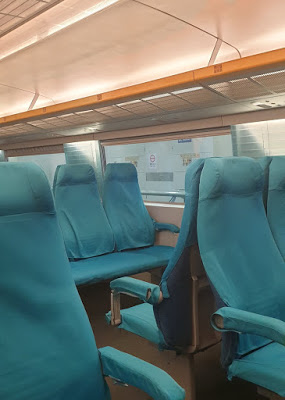
Seating on the train was nothing special, as one might expect
It didn’t take long before it hits the advertised speed of 431 kph. This is not sustained for very long, because the distance is on 40 odd kilometers, and the whole trip takes about 7 minutes.
We go to the airport, and then we come back. Is it worth the price, yes. If you are a train enthusiast.
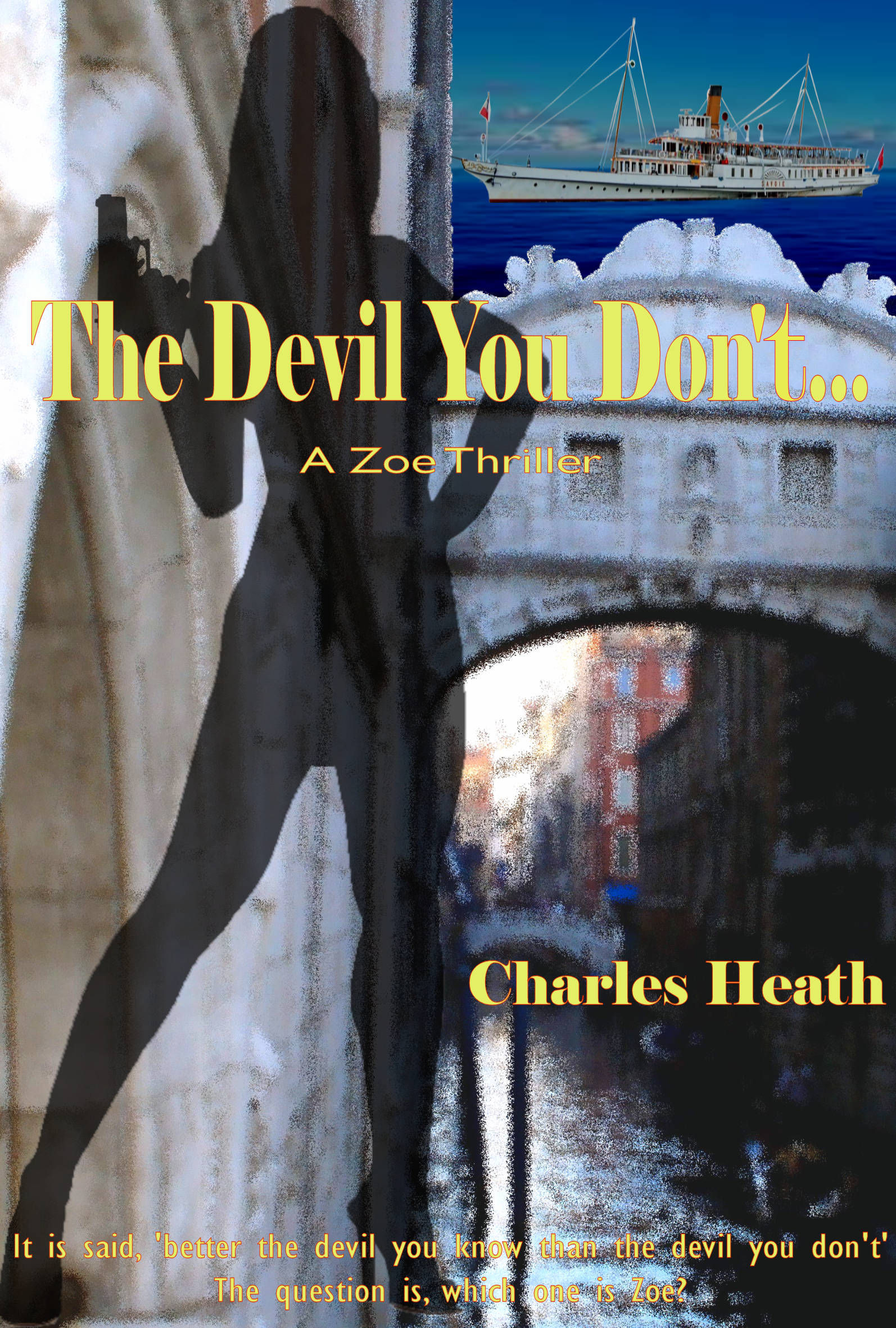
John Pennington’s life is in the doldrums. Looking for new opportunities, and prevaricating about getting married, the only joy on the horizon was an upcoming visit to his grandmother in Sorrento, Italy.
Suddenly he is left at the check-in counter with a message on his phone telling him the marriage is off, and the relationship is over.
If only he hadn’t promised a friend he would do a favour for him in Rome.
At the first stop, Geneva, he has a chance encounter with Zoe, an intriguing woman who captures his imagination from the moment she boards the Savoire, and his life ventures into uncharted territory in more ways than one.
That ‘favour’ for his friend suddenly becomes a life-changing event, and when Zoe, the woman who he knows is too good to be true, reappears, danger and death follow.
Shot at, lied to, seduced, and drawn into a world where nothing is what it seems, John is dragged into an adrenaline-charged undertaking, where he may have been wiser to stay with the ‘devil you know’ rather than opt for the ‘devil you don’t’.
It was the first time in almost a week that I made the short walk to the cafe alone. It was early, and the chill of the morning was still in the air. In summer, it was the best time of the day. When Susan came with me, it was usually much later, when the day was much warmer and less tolerable.
On the morning of the third day of her visit, Susan said she was missing the hustle and bustle of London, and by the end of the fourth she said, in not so many words, she was over being away from ‘civilisation’. This was a side of her I had not seen before, and it surprised me.
She hadn’t complained, but it was making her irritable. The Susan that morning was vastly different to the Susan on the first day. So much, I thought, for her wanting to ‘reconnect’, the word she had used as the reason for coming to Greve unannounced.
It was also the first morning I had time to reflect on her visit and what my feelings were towards her. It was the reason I’d come to Greve: to soak up the peace and quiet and think about what I was going to do with the rest of my life.
I sat in my usual corner. Maria, one of two waitresses, came out, stopped, and there was no mistaking the relief in her manner. There was an air of tension between Susan and Maria I didn’t understand, and it seemed to emanate from Susan rather than the other way around. I could understand her attitude if it was towards Alisha, but not Maria. All she did was serve coffee and cake.
When Maria recovered from the momentary surprise, she said, smiling, “You are by yourself?” She gave a quick glance in the direction of my villa, just to be sure.
“I am this morning. I’m afraid the heat, for one who is not used to it, can be quite debilitating. I’m also afraid it has had a bad effect on her manners, for which I apologise. I cannot explain why she has been so rude to you.”
“You do not have to apologise for her, David, but it is of no consequence to me. I have had a lot worse. I think she is simply jealous.”
It had crossed my mind, but there was no reason for her to be. “Why?”
“She is a woman, I am a woman, she thinks because you and I are friends, there is something between us.”
It made sense, even if it was not true. “Perhaps if I explained…”
Maria shook her head. “If there is a hole in the boat, you should not keep bailing but try to plug the hole. My grandfather had many expressions, David. If I may give you one piece of advice, as much as it is none of my business, you need to make your feelings known, and if they are not as they once were, and I think they are not, you need to tell her. Before she goes home.”
Interesting advice. Not only a purveyor of excellent coffee, but Maria was also a psychiatrist who had astutely worked out my dilemma. What was that expression, ‘not just a pretty face’?
“Is she leaving soon?” I asked, thinking Maria knew more about Susan’s movements than I did.
“You would disappoint me if you had not suspected as much. Susan was having coffee and talking to someone in her office on a cell phone. It was an intense conversation. I should not eavesdrop, but she said being here was like being stuck in hell. It is a pity she does not share your love for our little piece of paradise, is it not?”
“It is indeed. And you’re right. She said she didn’t have a phone, but I know she has one. She just doesn’t value the idea of getting away from the office. Perhaps her role doesn’t afford her that luxury.”
And perhaps Alisha was right about Maria, that I should be more careful. She had liked Maria the moment she saw her. We had sat at this very table, the first day I arrived. I would have travelled alone, but Prendergast, my old boss, liked to know where ex-employees of the Department were, and what they were doing.
She sighed. “I am glad I am just a waitress. Your usual coffee and cake?”
“Yes, please.”
Several months had passed since we had rescued Susan from her despotic father; she had recovered faster than we had thought, and settled into her role as the new Lady Featherington, though she preferred not to use that title, but go by the name of Lady Susan Cheney.
I didn’t get to be a Lord, or have any title, not that I was expecting one. What I had expected was that Susan, once she found her footing as head of what seemed to be a commercial empire, would not have time for details like husbands, particularly when our agreement made before the wedding gave either of us the right to end it.
There was a moment when I visited her recovering in the hospital, where I was going to give her the out, but I didn’t, and she had not invoked it. We were still married, just not living together.
This visit was one where she wanted to ‘reconnect’ as she called it, and invite me to come home with her. She saw no reason why we could not resume our relationship, conveniently forgetting she indirectly had me arrested for her murder, charges both her mother and Lucy vigorously pursued, and had the clone not returned to save me, I might still be in jail.
It was not something I would forgive or forget any time soon.
There were other reasons why I was reluctant to stay with her, like forgetting small details, an irregularity in her character I found odd. She looked the same, she sounded the same, she basically acted the same, but my mind was telling me something was not right. It was not the Susan I first met, even allowing for the ordeal she had been subjected to.
But, despite those misgivings, there was no question in my mind that I still loved her, and her clandestine arrival had brought back all those feelings. But as the days passed, I began to get the impression my feelings were one-sided and she was just going through the motions.
Which brought me to the last argument, earlier, where I said if I went with her, it would be business meetings, social obligations, and quite simply her ‘celebrity’ status that would keep us apart. I reminded her that I had said from the outset I didn’t like the idea of being in the spotlight, and when I reiterated it, she simply brushed it off as just part of the job, adding rather strangely that I always looked good in a suit. The flippancy of that comment was the last straw, and I left before I said something I would regret.
I knew I was not a priority. Maybe somewhere inside me, I had wanted to be a priority, and I was disappointed when I was not.
And finally, there was Alisha. Susan, at the height of the argument, had intimated she believed I had an affair with her, but that elephant was always in the room whenever Alisha was around. It was no surprise when I learned Susan had asked Prendergast to reassign her to other duties.
At least I knew what my feelings for Alisha were, and there were times when I had to remember she was persona non grata. Perhaps that was why Susan had her banished, but, again, a small detail; jealousy was not one of Susan’s traits when I first knew her.
Perhaps it was time to set Susan free.
When I swung around to look in the direction of the lane where my villa was, I saw Susan. She was formally dressed, not in her ‘tourist’ clothes, which she had bought from one of the local clothing stores. We had fun that day, shopping for clothes, a chore I’d always hated. It had been followed by a leisurely lunch, lots of wine and soul searching.
It was the reason why I sat in this corner; old habits die hard. I could see trouble coming from all directions, not that Susan was trouble or at least I hoped not, but it allowed me the time to watch her walking towards the cafe in what appeared to be short, angry steps; perhaps the culmination of the heat wave and our last argument.
She glared at me as she sat, dropping her bag beside her on the ground, where I could see the cell phone sitting on top. She followed my glance down, and then she looked unrepentant back at me.
Maria came back at the exact moment she was going to speak. I noticed Maria hesitate for a second when she saw Susan, then put her smile in place to deliver my coffee.
Neither spoke nor looked at each other. I said, “Susan will have what I’m having, thanks.”
Maria nodded and left.
“Now,” I said, leaning back in my seat, “I’m sure there’s a perfectly good explanation as to why you didn’t tell me about the phone, but that first time you disappeared, I’d guessed you needed to keep in touch with your business interests. I thought it somewhat unwisethat you should come out when the board of one of your companies was trying to remove you, because of what was it, an unexplained absence? All you had to do was tell me there were problems and you needed to remain at home to resolve them.”
My comment elicited a sideways look, with a touch of surprise.
“It was unfortunate timing on their behalf, and I didn’t want you to think everything else was more important than us. There were issues before I came, and I thought the people at home would be able to manage without me for at least a week, but I was wrong.”
“Why come at all. A phone call would have sufficed.”
“I had to see you, talk to you. At least we have had a chance to do that. I’m sorry about yesterday. I once told you I would not become my mother, but I’m afraid I sounded just like her. I misjudged just how much this role would affect me, and truly, I’m sorry.”
An apology was the last thing I expected.
“You have a lot of work to do catching up after being away, and of course, in replacing your mother and gaining the requisite respect as the new Lady Featherington. I think it would be for the best if I were not another distraction. We have plenty of time to reacquaint ourselves when you get past all these teething issues.”
“You’re not coming with me?” She sounded disappointed.
“I think it would be for the best if I didn’t.”
“Why?”
“It should come as no surprise to you that I’ve been keeping an eye on your progress. You are so much better doing your job without me. I told your mother once that when the time came I would not like the responsibilities of being your husband. Now that I have seen what it could possibly entail, I like it even less. You might also want to reconsider our arrangement, after all, we only had a marriage of convenience, and now that those obligations have been fulfilled, we both have the option of terminating it. I won’t make things difficult for you if that’s what you want.”
It was yet another anomaly, I thought; she should look distressed, and I would raise the matter of that arrangement. Perhaps she had forgotten the finer points. I, on the other hand, had always known we would not last forever. The perplexed expression, to me, was a sign she might have forgotten.
Then, her expression changed. “Is that what you want?”
“I wasn’t madly in love with you when we made that arrangement, so it was easy to agree to your terms, but inexplicably, since then, my feelings for you changed, and I would be sad if we parted ways. But the truth is, I can’t see how this is going to work.”
“In saying that, do you think I don’t care for you?”
That was exactly what I was thinking, but I wasn’t going to voice that opinion out loud. “You spent a lot of time finding new ways to make my life miserable, Susan. You and that wretched friend of yours, Lucy. While your attitude improved after we were married, that was because you were going to use me when you went to see your father, and then almost let me go to prison for your murder.”
“I had nothing to do with that, other than to leave, and I didn’t agree with Lucy that you should be made responsible for my disappearance. I cannot be held responsible for the actions of my mother. She hated you; Lucy didn’t understand you, and Millie told me I was stupid for not loving you in return, and she was right. Why do you think I gave you such a hard time? You made it impossible not to fall in love with you, and it nearly changed my mind about everything I’d been planning so meticulously. But perhaps there was a more subliminal reason why I did because after I left, I wanted to believe, if anything went wrong, you would come and find me.”
“How could you possibly know that I’d even consider doing something like that, given what you knew about me?”
“Prendergast made a passing comment when my mother asked him about you; he told us you were very good at finding people and even better at fixing problems.”
“And yet here we are, one argument away from ending it.”
I could see Maria hovering, waiting for the right moment to deliver her coffee, then go back and find Gianna, the café owner, instead. Gianna was more abrupt and, for that reason, was rarely seen serving the customers. Today, she was particularly cantankerous, banging the cake dish on the table and frowning at Susan before returning to her kitchen. Gianna didn’t like Susan either.
Behind me, I heard a car stop, and when she looked up, I knew it was for her. She had arrived with nothing, and she was leaving with nothing.
She stood. “Last chance.”
“Forever?”
She hesitated and then shook away the look of annoyance on her face. “Of course not. I wanted you to come back with me so we could continue working on our relationship. I agree there are problems, but it’s nothing we can’t resolve if we try.”
I had been trying. “It’s too soon for both of us, Susan. I need to be able to trust you, and given the circumstances, and all that water under the bridge, I’m not sure if I can yet.”
She frowned at me. “As you wish.” She took an envelope out of her bag and put it on the table. “When you are ready, it’s an open ticket home. Please make it sooner rather than later. Despite what you think of me, I have missed you, and I have no intention of ending it between us.”
That said, she glared at me for a minute, shook her head, then walked to the car. I watched her get in and the car drive slowly away.





 Thrills, Spills, and just a dash of Romance