An excerpt from “Mistaken Identity” – a work in progress

The odds of any one of us having a doppelganger are quite high. Whether or not you got to meet them or be confronted by them was significantly lower. Except, of course, unless you are a celebrity.

It was a phenomenon remarkable only for the fact that, at times, certain high-profile people, notorious or not, had doubles if only to put off enemies or the general public. Sometimes we see people in the street who look like someone we knew and make the mistake of approaching them like a long-lost friend, only to discover an embarrassed individual desperately trying to get away from what they perceive as a stalker, or worse.

And then sometimes it is a picture that looms up on a TV screen, an almost exact likeness of you. At first, you are fascinated, and then, according to the circumstances and narrative that is attached to that picture, either flattered or horrified.

For me, one turned to the other when I saw an almost likeness of me flash up on the screen when I turned the TV on in my room. What looked to be my photo, with only minor differences, was in the corner of the screen, the newsreader speaking in rapid Italian, so fast I could only translate every second or third word.

But the one word I did recognise was murder. The photo of the man on the screen was the subject of an extensive manhunt. The crime, the murder of a woman in the very same hotel I was staying, and it was being played out live several floors above me. The gist of the story, the woman had been seen with and staying with the man who was my double, and, less than an hour ago, the body had been discovered by a chambermaid.

The killer, the announcer said, was believed to be still in the hotel because the woman had died shortly before she had been discovered.

I watched, at first fascinated by what I was seeing. I guess I should have been horrified, but at that moment it didn’t register that I might be mistaken for that man.

Not until another five minutes had passed, and I was watching the police in full riot gear, with a camera crew following behind, coming up a passage towards a room. Live action of the arrest of the suspected killer, the breathless commentator said.

Then, suddenly, there was a pounding on the door. On the TV screen, plain to see, was the number of my room. I looked through the peephole and saw an army of police officers. It didn’t take much to realise what had happened. The hotel staff identified me as the man in the photograph on the TV and called the police.

Horrified wasn’t what I was feeling right then.

It was fear.

My last memory was the door crashing open, the wood splintering, and men rushing into the room, screaming at me, waving guns, and when I put my hands up to defend myself, I heard a gunshot.

And in one very confused and probably near-death experience, I thought I saw my mother and thought what was she doing in Rome?

I was the archetypal nobody.

I lived in a small flat, I drove a nondescript car, had an average job in a low-profile travel agency, was single, and currently not involved in a relationship, had no children, and, according to my workmates, no life.

They were wrong. I was one of those people who preferred their own company; I had a cat, and travelled whenever I could. And I did have a ‘thing’ for Rosalie, one of the reasons why I stayed at the travel agency. I didn’t expect anything to come of it, but one could always hope.

I was both pleased and excited to be going to the conference. It was my first, and the glimpse I had seen of it had whetted my appetite for more information about the nuances of my profession.

Some would say that a travel agent wasn’t much of a job, but to me, it was every bit as demanding as being an accountant or a lawyer. You were providing a customer with a service, and arguably, more people needed a travel agent than a lawyer. At least that was what I told myself as I watched more and more people start using the internet, and our relevance slowly dissipating.

This conference was about countering that trend.

The trip over had been uneventful. I was met at the airport and taken to the hotel where the conference was being held with several other delegates who had arrived on the same plane. I had mingled with several other delegates at the pre-conference get-together, including one whose name was Maryanne.

She was an unusual young woman, not the sort that I usually met, because she was the one who was usually surrounded by all the boys, the life of the party. In normal circumstances, I would not have introduced myself to her, but she had approached me. Why did I think that may have been significant? All of this ran through my mind, culminating in the last event on the highlight reel, the door bursting open, men rushing into my room, and then one of the policemen opened fire.

I replayed that last scene again, trying to see the face of my assailant, but it was just a sea of men in battle dress, bulletproof vests and helmets, accompanied by screaming and yelling, some of which I identified as “Get on the floor”.

Then came the shot.

Why ask me to get on the floor if all they were going to do was shoot me? I was putting my hands up at the time, in surrender, not reaching for a weapon.

Then I saw the face again, hovering in the background like a ghost. My mother. Only the hair was different, and her clothes, and then the image was going, perhaps a figment of my imagination brought on by pain-killing drugs. I tried to imagine the scene again, but this time it played out without the image of my mother.

I opened my eyes and took stock of my surroundings. What I felt in that exact moment couldn’t be described. I should most likely be dead, the result of a gunshot wound. I guess I should be thankful the shooter hadn’t aimed at anything vital, but that was the only item on the plus side.

I was in a hospital room with a policeman by the door. He was reading a newspaper and sitting uncomfortably on a small chair. He gave me a quick glance when he heard me move slightly, but didn’t acknowledge me with either a nod or a greeting, just went back to the paper.

If I still had a police guard, then I would still be considered a suspect. What was interesting was that I was not handcuffed to the bed. Perhaps that only happened in TV shows. Or maybe they knew I couldn’t run because my injuries were too serious. Or the guard would shoot me long before my feet hit the floor. I knew the police well enough now to know they would shoot first and ask questions later.

On the physical side, I had a large bandage over the top left corner of my chest, extending over my shoulder. A little poking and prodding determined the bullet had hit somewhere between the top of my rib cage and my shoulder. Nothing vital there, but my arm might be somewhat useless for a while, depending on what the bullet hit on the way in or through.

It didn’t feel like there were any broken or damaged bones.

That was the good news.

On the other side of the ledger, my mental state, there was only one word that could describe it. Terrified. I was looking at a murder charge and jail time, a lot of it. Murder usually had a long time in jail attached to it.

Whatever had happened, I didn’t do it. I know I didn’t do it, but I had to try to explain this to people who had already made up their minds. I searched my mind for evidence. It was there, but in the confused state brought on by the medication, all I could think about was jail, and the sort of company I was going to have.

I think death would have been preferable.

Half an hour later, maybe longer, I was drifting in and out of consciousness. A nurse, or what I thought was a nurse, came into the room. The guard stood, checked her ID card, and then stood by the door.

She came over and stood beside the bed. “How are you?” she asked, first in Italian, and when I pretended I didn’t understand, she asked the same question in accented English.

“Alive, I guess,” I said. “No one has come and told me what my condition is yet. You are my first visitor. Can you tell me?”

“Of course. You are very lucky to be alive. You will be fine and make a full recovery. The doctors here are excellent at their work.”

“What happens now?”

“I check you, and then you have another visitor. He is from the British Embassy, I think. But he will have to wait until I have finished my examination.”

I realised then she was a doctor, not a nurse.

My second visitor was a man, dressed in a suit, the sort of which I associated with the British Civil Service.  He was not very old, which told me he was probably a recent graduate on his first posting, the junior officer who drew the short straw.

The guard checked his ID but again did not leave the room, sitting back down and going back to his newspaper.

My visitor introduced himself as Alex Jordan from the British Embassy in Rome, and he had been asked by the Ambassador to sort out what he labelled a tricky mess.

For starters, it was good to see that someone cared about what happened to me.  But, equally, I knew the mantra, get into trouble overseas, and there is not much we can do to help you.  So, after that lengthy introduction, I had to wonder why he was here.

I said, “They think I am an international criminal by the name of Jacob Westerbury, whose picture looks just like me, and apparently, for them, it is an open and shut case.”  I could still hear the fragments of the yelling as the police burst through the door, at the same time telling me to get on the floor with my hands over my head.

“It’s not.  They know they’ve got the wrong man, which is why I’m here.  There is the issue of what had been described as excessive force, and the fact that you were shot had made it an all-around embarrassment for them.”

“Then why are you here?  Shouldn’t they be here apologising?”

“That is why you have another visitor.  I only took precedence because I insisted on speaking with you first.  I have come, basically, to ask you for a favour.  This situation has afforded us an opportunity.  We would like you to sign the official document, which basically indemnifies them against any legal proceedings.”

Curious.  What sort of opportunity was he talking about?  Was this a matter that could get difficult and I could be charged by the Italian Government, even if I wasn’t guilty, or was it one of those hush-hush type deals, you do this for us, we’ll help you out with that?  “What sort of opportunity?”

“We want to get our hands on Jacob Westerbury as much as they do.  They’ve made a mistake, and we’d like to use that to get custody of him if or when he is arrested in this country.  I’m sure you would also like this man brought into custody as soon as possible, so you will stop being confused with him.  I can only imagine what it was like to be arrested in the manner you were.  And I would not blame you if you wanted to get some compensation for what they’ve done.  But.  There are bigger issues in play here, and you would be doing this for your country.”

I wondered what would happen if I didn’t agree to his proposal.  I had to ask, “What if I don’t?”

His expression didn’t change.  “I’m sure you are a sensible man, Mr Pargeter, who is more than willing to help his country whenever he can.  They have agreed to take care of all your hospital expenses, refund the cost of the Conference, and travel.  I’m sure I could also get them to pay for a few days at Capri or Sorrento, if you like, before you go home.  What do you say?”

There was only one thing I could say.  Wasn’t it treason if you went against your country’s wishes?

“I’m not an unreasonable man, Alex.  Go do your deal, and I’ll sign the papers.”

“Good man.”

After Alex left, the doctor came back to announce the arrival of a woman, who had announced herself as the publicity officer from the Italian police. When she came into the room, she was not dressed in a uniform.

The doctor left after giving a brief report to the civilian at the door. I understood the gist of it: “The patient has recovered excellently, and the wounds are healing as expected. There is no cause for concern.”

That was a relief.

While the doctor was speaking to the civilian, I speculated on who she might be. She was young, not more than thirty, conservatively dressed, so an official of some kind, but not necessarily with the police. Did they have prosecutors? I was unfamiliar with the Italian legal system.

She had long, wavy black hair and the sort of sultry looks of an Italian movie star, and her presence made me more curious than fearful, though I couldn’t say why.

The woman then spoke to the guard, and he reluctantly got up and left the room, closing the door behind him. She checked the door and then came back towards me, standing at the end of the bed. Now alone, she said, “A few questions before we begin.” Her English was only slightly accented. “Your name is Jack Pargeter?”

I nodded. “Yes.”

“You are in Rome to attend the Travel Agents Conference at the Hilton Hotel?”

“Yes.”

“You attended a preconference introduction on the evening of the 25th, after arriving from London at approximately 4:25 pm.”

“About that time, yes. I know it was about five when the bus came to collect me, and several others, to take us to the hotel.”

She smiled. It was then that I noticed she was reading from a small notepad.

“It was ten past five to be precise. The driver had been held up in traffic. We have several witnesses who saw you on the plane, on the bus, at the hotel, and with the aid of closed-circuit TV, we have established you are not the criminal Jacob Westerbury.”

She put her notebook back in her bag and then said, “My name is Vicenza Andretti, and I am with the prosecutor’s office. I am here to formally apologise for the situation that can only be described as a case of mistaken identity. I assure you, it is not the habit of our police officers to shoot people unless they have a very strong reason for doing so. I understand that in the confusion of the arrest, one of our officers accidentally discharged his weapon. We are undergoing a very thorough investigation into the circumstances of this event.”

I was not sure why, but between the time I had spoken to the embassy official and now, something about letting them off so easily was bugging me. I could see why they had sent her. It would be difficult to be angry or annoyed with her.

But I was annoyed.

“Do you often send a whole squad of trigger-happy riot police to arrest a single man?” It came out harsher than I intended.

“My men believed they were dealing with a dangerous criminal.”

“Do I look like a dangerous criminal?” And then I realised if it was mistaken identity, the answer would be yes.

She saw the look on my face and said quietly, “I think you know the answer to that question, Mr Pargeter.”

“Well, it was overkill.”

“As I said, we are very sorry for the circumstances you now find yourself in. You must understand that we honestly believed we were dealing with an armed and dangerous murderer, and we were acting within our mandate. My department will cover your medical expenses and any other amounts for the inconvenience this has caused you. I believe you were attending a conference at your hotel. I am very sorry, but given the medical circumstances you have, you will have to remain here for a few more days.”

“I guess, then, I should thank you for not killing me.”

Her expression told me that was not the best thing I could have said in the circumstances.

“I mean, I should thank you for the hospital and the care. But a question or two of my own. May I?”

She nodded.

“Did you catch this Jacob Westerbury character?”

“No. In the confusion created by your arrest, he escaped. Once we realised we had made a mistake and reviewed the closed-circuit TV, we tracked him leaving by a rear exit.”

“Are you sure it was one of your men who shot me?”

I watched as her expression changed to one of surprise.

“You don’t think it was one of my men?”

“Oddly enough, no. But don’t ask me why.”

“It is very interesting that you should say that, because in our initial investigation, it appeared none of our officers’ weapons had been discharged. A forensic investigation into the bullet tells us it was one that is used in our weapons, but…”

I could see their dilemma.

“Have you any enemies that would want to shoot you, Mr Pargeter?”

That was absurd because I had no enemies, at least none that I knew of, much less anyone who would want me dead.

“Not that I’m aware of.”

“Then it is strange, and will perhaps remain a mystery. I will let you know if anything more is revealed in our investigation.”

She took an envelope out of her briefcase and opened it, pulling out several sheets of paper.

I knew what it was. A verbal apology was one thing, but a signed waiver would cover them legally. They had sent a pretty girl to charm me. Perhaps using anyone else would not have worked. There was potential for a huge litigation payout here, and someone more ruthless would jump at the chance of making a few million out of the Italian Government.

“We need a signature on this document,” she said.

“Absolving you of any wrongdoing?”

“I have apologised. We will take whatever measures are required for your comfort after this event. We are accepting responsibility for our actions and are being reasonable.”

They were. I took the pen from her and signed the documents.

“You couldn’t add dinner with you on that list of benefits?” No harm in asking.

“I am unfortunately unavailable.”

I smiled. “It wasn’t a request for a date, just dinner. You can tell me about Rome, as only a resident can. Please.”

She looked me up and down, searching for the ulterior motive. When she couldn’t find one, she said, “We shall see once the hospital discharges you in a few days.”

“Then I’ll pencil you in?”

She looked at me quizzically. “What is this pencil me in?”

“It’s an English colloquialism. It means maybe. As when you write something in pencil, it is easy to erase it.”

A momentary frown, then recognition and a smile. “I shall remember that. Thank you for your time and cooperation, Mr Pargeter. Good morning.”

© Charles Heath 2015-2021

The cinema of my dreams – I never wanted to go to Africa – Episode 14

It’s still a battle of wits, but our hero knows he’s in serious trouble.

The problem is, there are familiar faces and a question of who is a friend and who is foe made all the more difficult because the enemy if it is the enemy, doesn’t look or sound or act like the enemy.


It was the smell, all hospitals seemed to smell the same.  Antiseptic.

And the first face I saw was Breeman’s.

How?

If  I could speak, which for some reason I knew I couldn’t, the first question would be, ‘Where am I?’

“Welcome back,” Breeman said.  “You gave us a few days of grave concern at the crash.  You’re in the base hospital, and lucky to be alive.”

OK, a few days missing, but lucky to survive?  I got out without a scratch, or did I?

I looked sideways and down.  Nothing but bandages, and, yes, plaster.  Broken bones?

“How you survived being thrown from the wreckage is anyone’s guess.  A search party found you last night, almost dead.  Broken legs, shattered shoulder, ribs, even a skull fracture.  The doctors are astonished.  So am I.”

She was holding my hand, a very unlike commanding officer thing to so, and it looked like a tear in her eye.  Perhaps our so-called casual fling was a little more than that.

“But you rest.  I’ll come back later when you’re better.”

Last I remember, except for some sore ribs, I’d been intact, and unharmed from the jump out of the helicopter.

Now, it appeared, I was the very epitome of a crash victim.  What the hell had happened to me from the time I was in the cell, getting that injection, and now?

Clearly, the people in the other camp didn’t want me to die.  But, surely they realized I would tell Breeman about my experiences at the camp.

Or not.  If anything, what I would have to tell them would be considered the ramblings of someone in very bad condition, mind wandering in the desert while fighting for his life, and then on return, ramblings fuelled by very high doses of painkillers.

And the fact none of it could be corroborated.  It was unlikely any flyover would locate the base if anyone was foolish enough to fly in the no-fly zone.

And, pushing the paranoia limits, I guessed that they would have someone in the base who was feeding them information, that’s how they knew so much about what was going on here.

I would have to lie low and choose my friends carefully.


© Charles Heath 2019

The story behind the story – Echoes from the Past

The novel ‘Echoes from the Past’ started out as a short story I wrote about 30 years ago, titled ‘The Birthday’.

My idea was to take a normal person out of their comfort zone and led on a short but very frightening journey to a place where a surprise birthday party had been arranged.

Thus, the very large man with a scar and a red tie was created.

So was the friend with the limousine who worked as a pilot.

So were the two women, Wendy and Angelina, who were Flight Attendants that the pilot friend asked to join the conspiracy.

I was going to rework the short story, then about ten pages long, into something a little more.

And like all rewrites, especially those I have anything to do with, it turned into a novel.

There was motivation.  I had told some colleagues at the place where I worked at the time that I liked writing, and they wanted a sample.  I was going to give them the re-worked short story.  Instead, I gave them ‘Echoes from the past’

Originally, it was not set anywhere in particular.

But when considering a location, I had, at the time, recently been to New York in December, and visited Brooklyn and Queens, as well as a lot of New York itself.  We were there for New Year’s, and it was an experience I’ll never forget.

One evening, we were out late and finished up in Brooklyn Heights, near the waterfront, and there was rain and snow; it was cold and wet, and apartment buildings were shimmering in the street light, and I thought, “This is the place where my main character will live.”

It had a very spooky atmosphere, the sort where ghosts would not be unexpected.  I felt more than one shiver go up and down my spine in the few minutes I was there.

I had taken notes, as I always do, of everywhere we went, so I had a ready supply of locations I could use, changing the names in some cases.

Fifth Avenue near the Rockefeller Centre is amazing at first light, and late at night with the Seasonal decorations and lights.

The original main character was a shy man with few friends, hence not expecting the surprise party.  I enhanced that shyness into purposely lonely because of an issue from his past that leaves him always looking over his shoulder and ready to move on at the slightest hint of trouble.  No friends, no relationships, just a very low profile.

Then I thought, what if he breaks the cardinal rule and begins a relationship?

But it is also as much an exploration of a damaged soul as it is the search for a normal life, without having any idea what normal was, and how the understanding of one person can sometimes make all the difference in what we may think or feel.

And, of course, I wanted a happy ending.

Except for the bad guys.

Get it here:  https://amzn.to/2CYKxu4

newechocover5rs

The cinema of my dreams – It continued in London – Episode 36

Juliet has a secret identity

It bothered me that Juliet was not quite as fazed about being shot at as she should be.  Ordinarily, being shot at would bring on a bout of hysterics at the very least, but she was unmoved.

Was that because, after being coerced into criminal activity by the likes of Larry, and possibly others, she had been expecting something to happen, just not when.  Or did she know that it was quite possibly her mother that was gunning for her?

To me, I would take a less active approach and try to come to some arrangement with the possible heir to a very large estate.  There was no possible way her mother could get it, other than to marry and then kill, Alessandro, after taking care of the countess.  Or gain favour with her daughter and split the proceeds, after killing the other parties.

It seemed a lot of work, to me, and with no guarantees she could remain anonymous.  After all, we knew about her, how many others did?  I was still thinking about how quickly she had recovered from the attack.  I know my heart was still beating quite fast.

“After what happened back at the conference centre, do you think it’s possible we might be gunned down in the street?”

I had been thinking that exact same thought, not moments before, and it would be so easy, without the possibility of being caught.  I had been looking around to make sure there was no one, or anything, suspicious.

We had almost reached the underground station to take us to Russell Square, near where her apartment was.  I was hoping there would be a nearby restaurant where we could get dinner.

“Do you want to be a victim of a possible drive-by shooting?”

“No, but it is possible.  It’s the sort of thing that happens to other people, isn’t it, like real criminals.”

“That only happens to people who double cross or snitch on their bosses or fellow gang members.  Unless you are part of a gang, or thinking of ratting someone out, I’d say that was a result of reading too many crime novels.  I doubt you could classify yourself as a real criminal.”

“Perhaps not anymore, but you know that I was caught up in something I had no control over, at least not the last time.  I can promise you I don’t do stuff like that anymore.  I have a legitimate job, and a lot of respect from my fellow coroners.”

“Then why are you sounding concerned?  What is more concerning is why this isn’t bothering you?”

“Perhaps it’s because as much as I don’t want it to be, it seems that stuff like this happens to me.”

OK, what did she mean by that?  “Has it happened before?”

“Three times in the last month, if I let my imagination run wild.  Two weeks ago, a car came up on the footpath and I thought it was because the driver was trying to avoid a dog.  Very nearly ran me over.  Last week, another car didn’t stop at a pedestrian crossing, an old man, I thought it might be a medical incident.  Today just put those incidents into another perspective.  I’m sure you’ll tell me why eventually.”

I chose not to speak any more about the subject and got her to tell me about the presentation at the conference if only to take her mind off working on a barrage of difficult questions.

That consumed the train trip and the walk to an Italian Restaurant a block from her apartment.  It was reasonably empty before the later dinner rush which suited me; we could sit where I could keep an eye on everything.  I didn’t expect trouble in the restaurant, but maybe later when we left.

If they, whoever they were, knew where she lived.  I still hadn’t seen anyone following us, but it was London, and there were a lot of people about.  And I was still a little rusty.

After we ordered I could see she had been patient enough.  “So, tell me, why are you here?”

I shrugged.  There was no simple way around asking.  “What can you tell me about your mother?”

“My birth mother or my adoptive mother?”

If she was trying to surprise me, it didn’t work.  That she decided to be truthful did.  Given that I had seen the photo of her with Vittoria when she was about thirteen at Sorrento, how did that fit into the two-mother thing?  I guess it was just another question among many.

“Birth mother to begin with.”

“Not as much as I would like.”

“As in you’ve never known, no one told you, or you didn’t want to know?”

“As in I was never told her name, just that she lived in a large house in Italy, and that my father had been someone very important.  It was a condition that I should not be told because she didn’t want me to know.”

“A condition imposed on your adoptive mother?”

“Yes.  She was an Englishwoman who had been a servant in that large house in Italy, a friend of my mother.  My adoptive mother had found me in her room one morning, with a letter, telling her that I would be better off in her care.”

“Did you see your real mother again?”

“Yes.  Once.  When I was a teenager, we were holidaying in Italy.  We went to the large castle or chateau near Sorrento, and I met her and no one else, though my adoptive mother didn’t tell me it was her until after we left.  I have a photograph, the only thing I have of her.”

“Have you ever wanted to find out who she is?”

“Of course, I’ve been to Italy many times, even staked out the house, but I never saw her again.  You said it was possible I could inherit a lot of money.  It is from those people in that house?”

“Do you know who they are?”

“A family called Burkehardt I think.  Are you telling me I’m one of them?”

© Charles Heath 2023

The first case of PI Walthenson – “A Case of Working With the Jones Brothers”

This case has everything, red herrings, jealous brothers, femme fatales, and at the heart of it all, greed.

See below for an excerpt from the book…

Coming soon!

PIWalthJones1

An excerpt from the book:

When Harry took the time to consider his position, a rather uncomfortable position at that, he concluded that he was somehow involved in another case that meant very little to him.

Not that it wasn’t important in some way he was yet to determine, it was just that his curiosity had got the better of him, and it had led to this: sitting in a chair, securely bound, waiting for someone one of his captors had called Doug.

It was not the name that worried him so much, it was the evil laugh that had come after the name was spoken.

Doug what? Doug the ‘destroyer’, Doug the ‘dangerous’, Doug the ‘deadly’; there was any number of sinister connotations, and perhaps that was the point of the laugh, to make it more frightening than it was.

But there was no doubt about one thing in his mind right then: he’d made a mistake. A very big. and costly, mistake. Just how big the cost, no doubt he would soon find out.

His mother, and his grandmother, the wisest person he had ever known, had once told him never to eavesdrop.

At the time he couldn’t help himself and instead of minding his own business, listening to a one-sided conversation which ended with a time and a place. The very nature of the person receiving the call was, at the very least, sinister, and, because of the cryptic conversation, there appeared to be, or at least to Harry, criminal activity involved.

For several days he had wrestled with the thought of whether he should go. Stay on the fringe, keep out of sight, observe and report to the police if it was a crime. Instead, he had willingly gone down the rabbit hole.

Now, sitting in an uncomfortable chair, several heat lamps hanging over his head, he was perspiring, and if perspiration could be used as a measure of fear, then Harry’s fear was at the highest level.

Another runnel of sweat rolled into his left eye, and, having his hands tied, literally, it made it impossible to clear it. The burning sensation momentarily took his mind off his predicament. He cursed and then shook his head trying to prevent a re-occurrence. It was to no avail.

Let the stinging sensation be a reminder of what was right and what was wrong.

It was obvious that it was the right place and the right time, but in considering his current perilous situation, it definitely was the wrong place to be, at the worst possible time.

It was meant to be his escape, an escape from the generations of lawyers, what were to Harry, dry, dusty men who had been in business since George Washington said to the first Walthenson to step foot on American soil, ‘Why don’t you become a lawyer?” when asked what he could do for the great man.

Or so it was handed down as lore, though Harry didn’t think Washington meant it literally, the Walthenson’s, then as now, were not shy of taking advice.

Except, of course, when it came to Harry.

He was, Harry’s father was prone to saying, the exception to every rule. Harry guessed his father was referring to the fact his son wanted to be a Private Detective rather than a dry, dusty lawyer. Just the clothes were enough to turn Harry off the profession.

So, with a little of the money Harry inherited from one of his aunts, he leased an office in Gramercy Park and had it renovated to look like the Sam Spade detective agency, you know the one, Spade and Archer, and The Maltese Falcon.

There’s a movie and a book by Dashiell Hammett if you’re interested.

So, there it was, painted on the opaque glass inset of the front door, ‘Harold Walthenson, Private Detective’.

There was enough money to hire an assistant, and it took a week before the right person came along, or, more to the point, didn’t just see his business plan as something sinister. Ellen, a tall cool woman in a long black dress, or so the words of a song in his head told him, fitted in perfectly.

She’d seen the movie, but she said with a grin, Harry was no Humphrey Bogart.

Of course not, he said, he didn’t smoke.

Three months on the job, and it had been a few calls, no ‘real’ cases, nothing but missing animals, and other miscellaneous items. What he really wanted was a missing person. Or perhaps a beguiling, sophisticated woman who was as deadly as she was charming, looking for an errant husband, perhaps one that she had already ‘dispatched’.

Or for a tall, dark and handsome foreigner who spoke in riddles and in heavily accented English, a spy, or perhaps an assassin, in town to take out the mayor. The man was such an imbecile Harry had considered doing it himself.

Now, in a back room of a disused warehouse, that wishful thinking might be just about to come to a very abrupt end, with none of the romanticized trappings of the business befalling him. No beguiling women, no sinister criminals, no stupid policemen.

Just a nasty little man whose only concern was how quickly or how slowly Harry’s end was going to be.

© Charles Heath 2019-2024

Searching for locations: Shaolin Kung Fu, near Zhengzhou City, Henan Province, China

After leaving the hotel in Zhengzhou, which was once one of the eight ancient capitals of China, we are going to Dengfeng city, the home of China’s most famous martial art – Shaolin Kung Fu.

The Shaolin Temple nearby is the origin of Chinese Zen Buddhism, and the Songyang Academy, called “the Centre of Heaven and Earth” is located 87 Km from Zhengzhou, or, as we were advised, a 2-hour drive.  It will be scenic because we are heading towards the mountains.

As one of the four ancient Song Dynasty Academies, Songyang Academy is one of many schools in the province.  It is both on a large scale, is quite spectacular, and is a comprehensive Wushu training base where students are trained to spread the Shaolin Wushu Kung fu style at home and abroad.

There is a 500-seat demonstration hall where you are able to observe 30 minutes of various martial arts in shows starting on the hour.

Outside there is a specific area that generally has about 600 trainees learning kung fu elements during the day but can hold 5,000 people when outdoor performances are required.

The kung fu school

The thing you notice most about the kung fu school is its size and then the number of buses which tells you that it is a popular tourist stop.

And with that size comes long distances between the car park and the venues we need to go to, the first of which is about half a km, and that’s just to get to the ticket plaza.

But, it is pleasantly set out and is quite a large number of shops for both souvenirs and food

We pass by some of the students going through their paces

From there it’s another long, long walk to the show arena, where we’re supposed to see various kung fu elements on display.  We watched this for a few minutes, then headed off towards the hall for a more intense demonstration of kung fu, and because there is limited seating we have to start lining up at the head of the queue to get a seat.

But…

Everyone else has the same idea and we join the throng which then becomes a ride, and true to the Chinese they start finding ways to push in, even using the imaginary friend somewhere ahead in the queue.

The doors open and then it’s open slather, with the hoards pushing from behind and sliding up the side to get in first.  We go with the tide, and manage to get in and find a seat though we were separated from three of our group.

It was an interesting show even though not one word of English was spoken, which from our point of view was a disappointment because we had no idea what was going on.

However…

It wasn’t hard to follow

What the performers were doing was relatively self-explanatory, and quite fascinating, especially the guy who broke a sword over his head, and the guy who stopped two spears penetrating the neck, both examples of very disciplined men.

Boys gave a demonstration of kung fu moves, and intensity and age increased as this progressed to the end.

Next, we were taken in hand by an instructor in Tai chi or an equivalent, I was not quite sure what it was called, and went through the twelve or maybe more moves that constituted a morning or afternoon exercise session or it could be just for relaxation.  I lasted the first session but it was a little difficult to do with my sore limbs and a bad back.

Not that I could remember any of it now other than hands overhead, hands in front, bent knees, and a few gentle kung fu hand moves.

Perhaps when I get home I might seek out someone to show me the moves.

Whilst the others were following their training instructor, I wandered about, finding a large statue


And some smaller statues

Lunch in the Zen Restaurant

After all that exercise it was time to have lunch purportedly the same food as the king fu masters.
It’s in the Zen restaurant, aptly named, and the food when it came, came thick and fast, but some of it wasn’t very nice, meat with bones, tofu, a tasteless soup, but some good dishes like the vegetables and noodles with meat, without bones.

The only problem was nothing to drink except a pot of hot water.  No tea, no cold water, and if you wanted a cold drink you had to pay for it.  After paying 550 yuan why should we have to pay more for a drink when we have not had to so far.

But no cold water?  That was just not on, and when we brought this to the attention of the tour guide she just simply ignored us.  We just didn’t get anything.

That basically tainted the whole experience.

After lunch, there was the Shaolin Temple and the Pogoda Forest to visit.

An excerpt from “Echoes from the Past”

Available on Amazon Kindle here:  https://amzn.to/2CYKxu4

With my attention elsewhere, I walked into a man who was hurrying in the opposite direction.  He was a big man with a scar running down the left side of his face from eye socket to mouth, and who was also wearing a black shirt with a red tie.

That was all I remembered as my heart almost stopped.

He apologized as he stepped to one side, the same way I stepped, as I also muttered an apology.

I kept my eyes down.  He was not the sort of man I wanted to recognize later in a lineup.  I stepped to the other side and so did he.  It was one of those situations.  Finally getting out of sync, he kept going in his direction, and I towards the bus, which was now pulling away from the curb.

Getting my breath back, I just stood riveted to the spot watching it join the traffic.  I looked back over my shoulder, but the man I’d run into had gone.  I shrugged and looked at my watch.  It would be a few minutes before the next bus arrived.

Wait, or walk?  I could also go by subway, but it was a long walk to the station.  What the hell, I needed the exercise.

At the first intersection, the ‘Walk’ sign had just flashed to ‘Don’t Walk’.  I thought I’d save a few minutes by not waiting for the next green light.  As I stepped onto the road, I heard the screeching of tires.

A yellow car stopped inches from me.

It was a high powered sports car, perhaps a Lamborghini.  I knew what they looked like because Marcus Bartleby owned one, as did every other junior executive in the city with a rich father.

Everyone stopped to look at me, then the car.  It was that sort of car.  I could see the driver through the windscreen shaking his fist, and I could see he was yelling too, but I couldn’t hear him.  I stepped back onto the sidewalk, and he drove on.  The moment had passed and everyone went back to their business.

My heart rate hadn’t come down from the last encounter.   Now it was approaching cardiac arrest, so I took a few minutes and several sets of lights to regain composure.

At the next intersection, I waited for the green light, and then a few seconds more, just to be sure.  I was no longer in a hurry.

At the next, I heard what sounded like a gunshot.  A few people looked around, worried expressions on their faces, but when it happened again, I saw it was an old car backfiring.  I also saw another yellow car, much the same as the one before, stopped on the side of the road.  I thought nothing of it, other than it was the second yellow car I’d seen.

At the next intersection, I realized I was subconsciously heading towards Harry’s new bar.   It was somewhere on 6th Avenue, so I continued walking in what I thought was the right direction.

I don’t know why I looked behind me at the next intersection, but I did.  There was another yellow car on the side of the road, not far from me.  It, too, looked the same as the original Lamborghini, and I was starting to think it was not a coincidence.

Moments after crossing the road, I heard the roar of a sports car engine and saw the yellow car accelerate past me.  As it passed by, I saw there were two people in it, and the blurry image of the passenger; a large man with a red tie.

Now my imagination was playing tricks.

It could not be the same man.  He was going in a different direction.

In the few minutes I’d been standing on the pavement, it had started to snow; early for this time of year, and marking the start of what could be a long cold winter.  I shuddered, and it was not necessarily because of the temperature.

I looked up and saw a neon light advertising a bar, coincidentally the one Harry had ‘found’ and, looking once in the direction of the departing yellow car, I decided to go in.  I would have a few drinks and then leave by the back door if it had one.

Just in case.

© Charles Heath 2015-2020

newechocover5rs

The cinema of my dreams – I never wanted to go to Africa – Episode 13

It’s still a battle of wits, but our hero knows he’s in serious trouble.

The problem is, there are familiar faces and a question of who is a friend and who is foe made all the more difficult because the enemy if it is the enemy, doesn’t look or sound or act like the enemy.

If at first, you don’t succeed, try a few threats, or leverage.

Or just get rid of the problem


Back in my cell, delivered more forcibly than when they escorted me to the interrogation room, I had time to consider his words.

A tactic, I told myself.  Classic divide and conquer.

It was obvious that he wanted me to corroborate his suspicion that Breeman had sent the helicopter out to find his operation.  Did it sound like something she would do or any other commanding officer whose jurisdiction this operation fell under?

Why hadn’t they told her?  If t was military and being run by our side, why would they keep it secret from their own people, especially when something like what just happened, could happen?

It didn’t make sense.

Unless, of course, it was the CIA.  They seemed to be a law unto themselves, except in this case they needed something to incriminate her with in order to have her removed, and replaced with a more sympathetic commanding officer.

It was all too much for a gunnery sergeant like me to understand.

At least I didn’t know anything so I couldn’t tell them anything.  A little solace perhaps, but the trouble was, they’d never believe me.

I sighed.  Perhaps some sleep before they returned for the next round.

They came in the middle of the night.  Or day, I had no idea what it was outside because there were no windows in my cave cell.

They had no intention of being polite, I was dragged up by the scruff of the next and tossed in the direction of the door.  When I stumbled, still half asleep and unable to see properly, one of the guards kicked me and said he would do it again if I didn’t get up.

He did anyway because I took too long.

My ribs were hurting when I breathed, as I staggered in front of them, one behind me giving me a shove every two or three steps, perhaps hoping I’d stumble again so he could kick me.

At the interrogation room, a different one this time, he shoved me in and shut the door.  I didn’t hear a key in the lock, so perhaps they were hoping I’d try to escape.

There was only one chair in the room, and I sat in it.  I couldn’t sit up straight because it hurt, so I had to slump over.

A half hour later a man and a woman, both with white coats like a doctor would wear, came in.  Nothing was said.  The man took up a position behind me, then held me so I couldn’t move.

The woman then joined him, produced as a syringe, and jabbed it in my neck.

The man let me go, and a few seconds later I fell off the chair onto the floor hitting my head in the process, and a few more after that, it was lights out.

At least there was no more pain.


© Charles Heath 2019

Inspiration, maybe – Volume 1

50 photographs, 50 stories, of which there is one of the 50 below.

They all start with –

A picture paints … well, as many words as you like.  For instance:

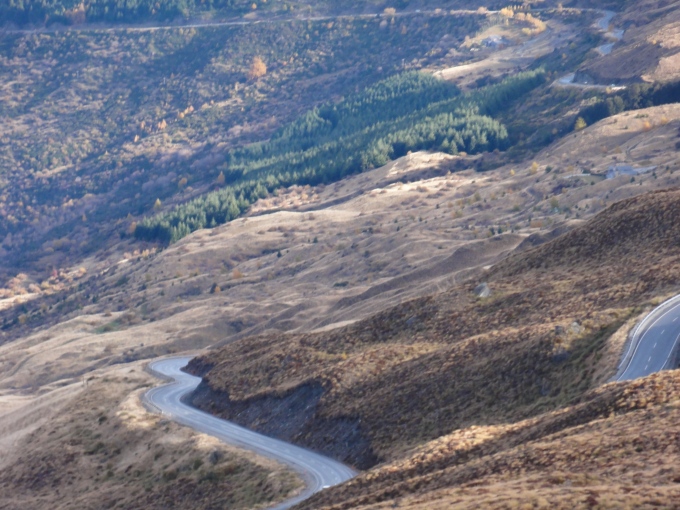
lookingdownfromcoronetpeak

And the story:

It was once said that a desperate man has everything to lose.

The man I was chasing was desperate, but I, on the other hand, was more desperate to catch him.

He’d left a trail of dead people from one end of the island to the other.

The team had put in a lot of effort to locate him, and now his capture was imminent.  We were following the car he was in, from a discreet distance, and, at the appropriate time, we would catch up, pull him over, and make the arrest.

There was nowhere for him to go.

The road led to a dead-end, and the only way off the mountain was back down the road we were now on.  Which was why I was somewhat surprised when we discovered where he was.

Where was he going?

“Damn,” I heard Alan mutter.  He was driving, being careful not to get too close, but not far enough away to lose sight of him.

“What?”

“I think he’s made us.”

“How?”

“Dumb bad luck, I’m guessing.  Or he expected we’d follow him up the mountain.  He’s just sped up.”

“How far away?”

“A half-mile.  We should see him higher up when we turn the next corner.”

It took an eternity to get there, and when we did, Alan was right, only he was further on than we thought.”

“Step on it.  Let’s catch him up before he gets to the top.”

Easy to say, not so easy to do.  The road was treacherous, and in places, just gravel, and there were no guard rails to stop a three-thousand-foot fall down the mountainside.

Good thing then, I had the foresight to have three agents on the hill for just such a scenario.

Ten minutes later, we were in sight of the car, still moving quickly, but we were going slightly faster.  We’d catch up just short of the summit car park.

Or so we thought.

Coming quickly around another corner, we almost slammed into the car we’d been chasing.

“What the hell…” Aland muttered.

I was out of the car and over to see if he was in it, but I knew that it was only a slender possibility.  The car was empty, and no indication of where he had gone.

Certainly not up the road.  It was relatively straightforward for the next mile, at which we would have reached the summit.  Up the mountainside from here, or down.

I looked up.  Nothing.

Alan yelled out, “He’s not going down, not that I can see, but if he did, there’s hardly a foothold and that’s a long fall.”

Then where did he go?

Then a man looking very much like our quarry came out from behind a rock embedded just a short distance up the hill.

“Sorry,” he said quite calmly.  “Had to go if you know what I mean.”

I’d lost him.

It was as simple as that.

I had been led a merry chase up the hill, and all the time he was getting away in a different direction.

I’d fallen for the oldest trick in the book, letting my desperation blind me to the disguise that anyone else would see through in an instant.

It was a lonely sight, looking down that road, knowing that I had to go all that way down again, only this time, without having to throw caution to the wind.

“Maybe next time,” Alan said.

“We’ll get him.  It’s just a matter of time.”

© Charles Heath 2019-2026

Find this and other stories in “Inspiration, maybe”, available soon.

InspirationMaybe1v1

The cinema of my dreams – It continued in London – Episode 35

Attack!

It seemed to me that trouble gravitated towards Juliet, especially when I was around.  Perhaps between the two of us we had that sort of chemistry going.  The sort that attracted bullets.

She had got up to collect her computer from a desk on one side of the dais, and I had just turned after taking her hand to assist her off the dais when I caught sight of a movement out of the corner of my eye, and with barely enough time to consider what it was, I pushed her to one side and dived towards the floor, feeling the plucking effect of a bullet ripping at my sleeve.

“What the…”, was as much as she got to say before she too realised, we were being shot at from the top of the aisle, bullets thumping into the floorboards barely inches from us as we scrabbled to get behind the seats of the first aisle.

Nineteen shots from a silenced gun, then silence.

Was the shooter reloading.

“Is everything alright in here?”  A deep male voice yelled out from above.

Was it the shooter of our saviour?

Juliet put her head above the seats and recognised the man and slowly dragged herself up from the floor.

“Mr Roberts.”

“Is everything alright?”

“No.  We were just shot at by someone up there on the other side of the hall.  Be careful.”

I slowly got up, shook out my clothes and saw the tear from the bullet.  Any closer would have hit my arm and another injury.

“Are you alright?” I asked her.

She glared at me.  “Who did you bring with you?”

“No one.  I made sure no one was following me.  Of that much, you can be assured.  Whoever it was, they were here for you.”

“And you being here, you know who it is?”

The man from the top of the hall, invisible, yelled out, “There’s no one up here now.”

“You’d better call the police.  We have a wrecked floor with bullet holes in it.  It might give some indication of who was shooting at us.”

He came out from behind a wall near the top row of seats.  “What do you mean, shooting at you?  Bullet holes?”

He came down the steps and Juliet took him over to where we were standing when the shots started.  “Why would anyone be shooting at you?”  He looked at the damage to the floor and groaned.

“This is all I need.  The place is booked solid.”

She looked at me.  “Evan?”

“It seems you might be entitled to a share of an estate worth quite a lot of money, and there are people who might not want you to inherit what they think is theirs, not yours.”

She had an expression that conveyed a degree of astonishment, not forced, which told me that it was a surprise.

I don’t know anyone who would have that sort of money.”

“Not immediately, but perhaps we should wait for the police, then have a talk about it.  I was hoping we could have a few glasses of wine first, but that’s not going to be possible.”

The police came and looked at the crime scene, and then one of the constables called a detective who also looked at the crime scene, who then called in the forensic team. 

The hall manager was told the hall would be out of action for a few days, the last news he needed to hear.

The detective asked Juliet a half dozen quests, the usual like, do you know anyone who would want to shoot at you, do you have any criminal connections, a interesting question she answered with a qualified yes, the man was now dead, and did you see anyone suspicious now or earlier in the day, where she was staying, a friend’s apartment in Bloomsbury, how long was she in the city, what she was doing here, and how long was she staying.

It answered nearly all of the questions I’d intended to ask her.

The detective looked at me, asked me why I was there, and was it possible I was the target.  Of course, I had to ask him why he thought I was, so he asked me my profession, and I told him that I was a journalist specializing in Archaeology, which I was.  She too learned where I lived, answers that seemed to amuse her.

Especially the one where he asked what the nature of our relationship was.  I let her answer with exes catching up. 

When he was done, an hour and a half later, along with the forensic team, we were allowed to go.  Her lecture the next day was now not going to happen, calls going to the organisers, and the hall owners.

“Well,” she said, once everyone had left, “you now owe me dinner, and some of your time tomorrow since I now have a free day.”

“You don’t seem overly worried that people are trying to kill you.”

“Why should I.  You’re here to protect me, are you not?”

I don’t think that was in the terms of my remit.

© Charles Heath 2023