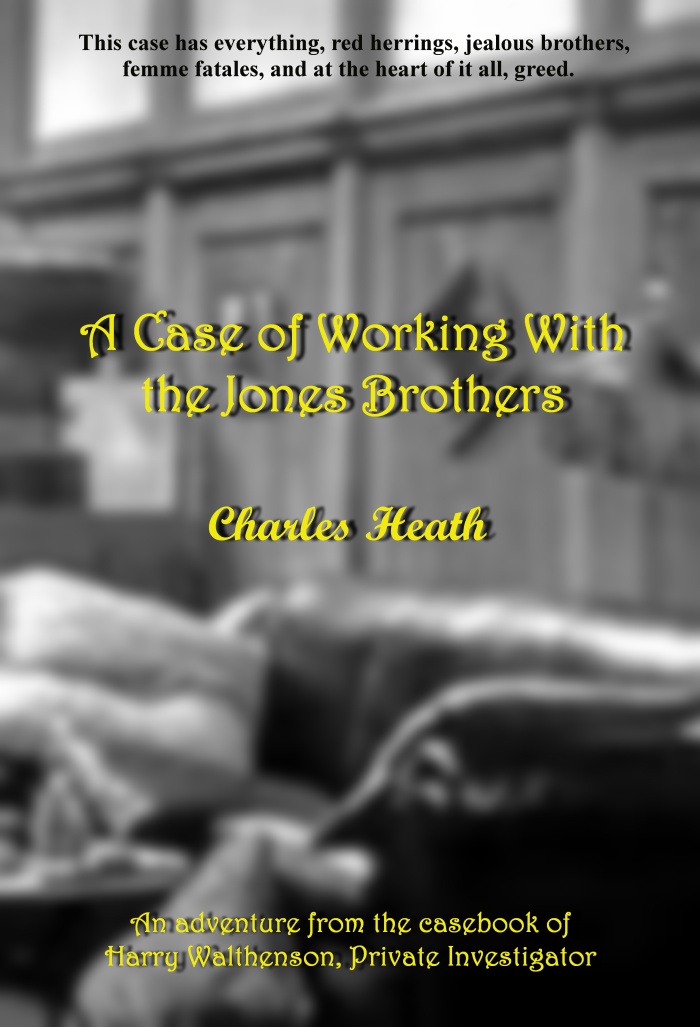
The story behind the story: A Case of Working With the Jones Brothers

To write a private detective serial has always been one of the items at the top of my to-do list, though trying to write novels and a serial, as well as a blog, and maintain a social media presence, well, you get the idea.

But I made it happen, from a bunch of episodes I wrote a long, long time ago, used these to start it, and then continue on, then as now, never having much of an idea where it was going to end up, or how long it would take to tell the story.

That, I think is the joy of ad hoc writing, even you, as the author, have as much idea of where it’s going as the reader does.

It’s basically been in the mill since 1990, and although I finished it last year, it looks like the beginning to end will have taken exactly 30 years.  Had you asked me 30 years ago if I’d ever get it finished, the answer would be maybe?

My private detective, Harry Walthenson

I’d like to say he’s from that great literary mold of Sam Spade, or Mickey Spillane, or Phillip Marlow, but he’s not.

But, I’ve watched Humphrey Bogart play Sam Spade with much interest, and modelled Harry and his office on it.  Similarly, I’ve watched Robert Micham play Phillip Marlow with great panache, if not detachment, and added a bit of him to the mix.

Other characters come into play, and all of them, no matter what period they’re from, always seem larger than life.  I’m not above stealing a little of Mary Astor, Peter Lorre or Sidney Greenstreet, to breathe life into beguiling women and dangerous men alike.

Then there’s the title, like

The Case of the Unintentional Mummy – this has so many meanings in so many contexts, though I imagine that back in Hollywood in the ’30s and ’40s, this would be excellent fodder for Abbott and Costello

The Case of the Three-Legged Dog – Yes, I suspect there may be a few real-life dogs with three legs, but this plot would involve something more sinister.  And if made out of plaster, yes, they’re always something else inside.

But for mine, to begin with, it was “The Case of the …”, because I had no idea what the case was going to be about, well, I did, but not specifically.

Then I liked the idea of calling it “The Case of the Brother’s Revenge” because I began to have a notion there was a brother no one knew about, but that’s stuff for other stories, not mine, so then went the way of the others.

Now it’s called ‘A Case of Working With the Jones Brothers’, finished the first three drafts, and at the editor for the last.

I have high hopes of publishing it in early 2021.  It even has a cover.

PIWalthJones1

An excerpt from “The Devil You Don’t”

Available on Amazon Kindle here:  https://amzn.to/2Xyh1ow

By the time I returned to the Savoie, the rain had finally stopped, and there was a streak of blue sky to offer some hope the day would improve.

The ship was not crowded, the possibility of bad weather perhaps holding back potential passengers.  Of those I saw, a number of them would be aboard for the lunch by Phillippe Chevrier.  I thought about it, but the Concierge had told me about several restaurants in Yvoire and had given me a hand-drawn map of the village.  I think he came from the area because he spoke with the pride and knowledge of a resident.

I was looking down from the upper deck observing the last of the boarding passengers when I saw a woman, notable for her red coat and matching shoes, making a last-minute dash to get on board just before the gangway was removed.  In fact, her ungainly manner of boarding had also captured a few of the other passenger’s attention.  Now they would have something else to talk about, other than the possibility of further rain.

I saw her smile at the deckhand, but he did not smile back.  He was not impressed with her bravado, perhaps because of possible injury.  He looked at her ticket then nodded dismissively, and went back to his duties in getting the ship underway.  I was going to check the departure time, but I, like the other passengers, had my attention diverted to the woman in red.

From what I could see there was something about her.  It struck me when the light caught her as she turned to look down the deck, giving me a perfect profile.  I was going to say she looked foreign, but here, as in almost anywhere in Europe, that described just about everyone.  Perhaps I was just comparing her to Phillipa, so definitively British, whereas this woman was very definitely not.

She was perhaps in her 30’s, slim or perhaps the word I’d use was lissom, and had the look and manner of a model.  I say that because Phillipa had dragged me to most of the showings, whether in Milan, Rome, New York, London, or Paris.  The clothes were familiar, and in the back of my mind, I had a feeling I’d seen her before.

Or perhaps, to me, all models looked the same.

She looked up in my direction, and before I could divert my eyes, she locked on.  I could feel her gaze boring into me, and then it was gone as if she had been looking straight through me.  I remained out on deck as the ship got underway, watching her disappear inside the cabin.  My curiosity was piqued, so I decided to keep an eye out for her.

I could feel the coolness of the air as the ship picked up speed, not that it was going to be very fast.  With stops, the trip would take nearly two hours to get to my destination.  It would turn back almost immediately, but I was going to stay until the evening when it returned at about half eight.  It would give me enough time to sample the local fare, and take a tour of the medieval village.

Few other passengers ventured out on the deck, most staying inside or going to lunch.  After a short time, I came back down to the main deck and headed forward.  I wanted to clear my head by concentrating on the movement of the vessel through the water, breathing in the crisp, clean air, and let the peacefulness of the surroundings envelope me.

It didn’t work.

I knew it wouldn’t be long before I started thinking about why things hadn’t worked, and what part I played in it.  And the usual question that came to mind when something didn’t work out.  What was wrong with me?

I usually blamed it on my upbringing.

I had one of those so-called privileged lives, a nanny till I was old enough to go to boarding school, then sent to the best schools in the land.  There I learned everything I needed to be the son of a Duke, or, as my father called it in one of his lighter moments, nobility in waiting.

Had this been five or six hundred years ago, I would need to have sword and jousting skills, or if it had been a few hundred years later a keen military mind.  If nothing else I could ride a horse, and go on hunts, or did until they became not the thing to do.

I learned six languages, and everything I needed to become a diplomat in the far-flung British Empire, except the Empire had become the Commonwealth, and then, when no-one was looking, Britain’s influence in the world finally disappeared.  I was a man without a cause, without a vocation, and no place to go.

Computers were the new vogue and I had an aptitude for programming.  I guess that went hand in hand with mathematics, which although I hated the subject, I excelled in.  Both I and another noble outcast used to toss ideas around in school, but when it came to the end of our education, he chose to enter the public service, and I took a few of those ideas we had mulled over and turned them into a company.

About a year ago, I was made an offer I couldn’t refuse.  There were so many zeroes on the end of it I just said yes, put the money into a very grateful bank, and was still trying to come to terms with it.

Sadly, I still had no idea what I was going to do with the rest of my life.  My parents had asked me to come back home and help manage the estate, and I did for a few weeks.  It was as long as it took for my parents to drive me insane.

Back in the city, I spent a few months looking for a mundane job, but there were very few that suited the qualifications I had, and the rest, I think I intimidated the interviewer simply because of who I was.  In that time I’d also featured on the cover of the Economist, and through my well-meaning accountant, started involving myself with various charities, earning the title ‘philanthropist’.

And despite all of this exposure, even making one of those ubiquitous ‘eligible bachelor’ lists, I still could not find ‘the one’, the woman I wanted to spend the rest of my life with.  Phillipa seemed to fit the bill, but in time she proved to be a troubled soul with ‘Daddy’ issues.  I knew that in building a relationship compromise was necessary, but with her, in the end, everything was a compromise and what had happened was always going to be the end result.

It was perhaps a by-product of the whole nobility thing.  There was a certain expectation I had to fulfill, to my peers, contemporaries, parents and family, and those who either liked or hated what it represented.  The problem was, I didn’t feel like I belonged.  Not like my friend from schooldays, and now obscure acquaintance, Sebastian.  He had been elevated to his Dukedom early when his father died when he was in his twenties.  He had managed to fade from the limelight and was rarely mentioned either in the papers or the gossip columns.  He was one of the lucky ones.

I had managed to keep a similarly low profile until I met Phillipa.  From that moment, my obscurity disappeared.  It was, I could see now, part of a plan put in place by Phillipa’s father, a man who hogged the limelight with his daughter, to raise the profile of the family name and through it their businesses.  He was nothing if not the consummate self-advertisement.

Perhaps I was supposed to be the last piece of the puzzle, the attachment to the establishment, that link with a class of people he would not normally get in the front door.  There was nothing refined about him or his family, and more than once I’d noticed my contemporaries cringe at the mention of his name, or any reference of my association with him.

Yet could I truthfully say I really wanted to go back to the obscurity I had before Phillipa?  For all her faults, there were times when she had been fun to be with, particularly when I first met her when she had a certain air of unpredictability.  That had slowly disappeared as she became part of her father’s plan for the future.  She just failed to see how much he was using her.

Or perhaps, over time, I had become cynical.

I thought about calling her.  It was one of those moments of weakness when I felt alone, more alone than usual.

I diverted my attention back to my surroundings and the shoreline.  Out of the corner of my eye, I could see the woman in the red coat, making a move.  The red coat was like a beacon, a sort of fire engine red.  It was not the sort of coat most of the women I knew would wear, but on her, it looked terrific.  In fact, her sublime beauty was the one other attribute that was distinctly noticeable, along with the fact her hair was short, rather than long, and jet black.

I had to wrench my attention away from her.

A few minutes later several other passengers came out of the cabin for a walk around the deck, perhaps to get some exercise, perhaps checking up on me, or perhaps I was being paranoid.  I waited till they passed on their way forward, and I turned and headed aft.

I watched the wake sluicing out from under the stern for a few minutes, before retracing my steps to the front of the ship and there I stood against the railing, watching the bow carve its way through the water.  It was almost mesmerizing.  There, I emptied my mind of thoughts about Phillipa, and thoughts about the woman in the red coat.

Until a female voice behind me said, “Having a bad day?”

I started, caught by surprise, and slowly turned.  The woman in the red coat had somehow got very close me without my realizing it.  How did she do that?  I was so surprised I couldn’t answer immediately.

“I do hope you are not contemplating jumping.  I hear the water is very cold.”

Closer up, I could see what I’d missed when I saw her on the main deck.  There was a slight hint of Chinese, or Oriental, in her particularly around the eyes, and of her hair which was jet black.  An ancestor twice or more removed had left their mark, not in a dominant way, but more subtle, and easily missed except from a very short distance away, like now.

Other than that, she was quite possibly Eastern European, perhaps Russian, though that covered a lot of territory.  The incongruity of it was that she spoke with an American accent, and fluent enough for me to believe English was her first language.

Usually, I could ‘read’ people, but she was a clean slate.  Her expression was one of amusement, but with cold eyes.  My first thought, then, was to be careful.

“No.  Not yet.”  I coughed to clear my throat because I could hardly speak.  And blushed, because that was what I did when confronted by a woman, beautiful or otherwise.

The amusement gave way to a hint of a smile that brightened her demeanor as a little warmth reached her eyes.  “So that’s a maybe.  Should I change into my lifesaving gear, just in case?”

It conjured up a rather interesting image in my mind until I reluctantly dismissed it.

“Perhaps I should move away from the edge,” I said, moving sideways until I was back on the main deck, a few feet further away.  Her eyes had followed me, and when I stopped she turned to face me again.  She did not move closer.

I realized then she had removed her beret and it was in her left side coat pocket.  “Thanks for your concern …?”

“Zoe.”

“Thanks for your concern, Zoe.  By the way, my name is John.”

She smiled again, perhaps in an attempt to put me at ease.  “I saw you earlier, you looked so sad, I thought …”

“I might throw myself overboard?”

“An idiotic notion I admit, but it is better to be safe than sorry.”

Then she tilted her head to one side then the other, looking intently at me.  “You seem to be familiar.  Do I know you?”

I tried to think of where I may have seen her before, but all I could remember was what I’d thought earlier when I first saw her; she was a model and had been at one of the showings.  If she was, it would be more likely she would remember Phillipa, not me.  Phillipa always had to sit in the front row.

“Probably not.”  I also didn’t mention the fact she may have seen my picture in the society pages of several tabloid newspapers because she didn’t look the sort of woman who needed a daily dose of the comings and goings, and, more often than not, scandal associated with so-called celebrities.

She gave me a look, one that told me she had just realized who I was.  “Yes, I remember now.  You made the front cover of the Economist.  You sold your company for a small fortune.”

Of course.  She was not the first who had recognized me from that cover.  It had raised my profile considerably, but not the Sternhaven’s.  That article had not mentioned Phillipa or her family.  I suspect Grandmother had something to do with that, and it was, now I thought about it, another nail in the coffin that was my relationship with Phillipa.

“I wouldn’t say it was a fortune, small or otherwise, just fortunate.”  Each time, I found myself playing down the wealth aspect of the business deal.

“Perhaps then, as the journalist wrote, you were lucky.  It is not, I think, a good time for internet-based companies.”

The latter statement was an interesting fact, one she read in the Financial Times which had made that exact comment recently.

“But I am boring you.”  She smiled again.  “I should be minding my own business and leaving you to your thoughts.  I am sorry.”

She turned to leave and took a few steps towards the main cabin.

“You’re not boring me,” I said, thinking I was letting my paranoia get the better of me.  It had been Sebastian on learning of my good fortune, who had warned me against ‘a certain element here and abroad’ whose sole aim would be to separate me from my money.  He was not very subtle when he described their methods.

But I knew he was right.  I should have let her walk away.

She stopped and turned around.  “You seem nothing like the man I read about in the Economist.”

A sudden and awful thought popped into my head.  Those words were part of a very familiar opening gambit.  “Are you a reporter?”

I was not sure if she looked surprised, or amused.  “Do I look like one?”

I silently cursed myself for speaking before thinking, and then immediately ignored my own admonishment.  “People rarely look like what they are.”

I saw the subtle shake of the head and expected her to take her leave.  Instead she astonished me.

“I fear we have got off on the wrong foot.  To be honest, I’m not usually this forward, but you seemed like you needed cheering up when probably the opposite is true.  Aside from the fact this excursion was probably a bad idea.  And,” she added with a little shrug, “perhaps I talk too much.”

I was not sure what I thought of her after that extraordinary admission. It was not something I would do, but it was an interesting way to approach someone and have them ignoring their natural instinct.  I would let Sebastian whisper in my ear for a little longer and see where this was going.

“Oddly enough, I was thinking the same thing.  I was supposed to be traveling with my prospective bride.  I think you can imagine how that turned out.”

“She’s not here?”

“No.”

“She’s in the cabin?”  Her eyes strayed in that direction for a moment then came back to me.  She seemed surprised I might be traveling with someone.

“No.  She is back in England, and the wedding is off.  So is the relationship.  She dumped me by text.”

OK, why was I sharing this humiliating piece of information with her?  I still couldn’t be sure she was not a reporter.

She motioned to an empty seat, back from the edge.  No walking the plank today.  She moved towards it and sat down.  She showed no signs of being cold, nor interested in the breeze upsetting her hair.  Phillipa would be having a tantrum about now, being kept outside, and freaking out over what the breeze might be doing to her appearance.

I wondered, if only for a few seconds if she used this approach with anyone else.  I guess I was a little different, a seemingly rich businessman alone on a ferry on Lake Geneva, contemplating the way his life had gone so completely off track.

She watched as I sat at the other end of the bench, leaving about a yard between us.  After I leaned back and made myself as comfortable as I could, she said, “I have also experienced something similar, though not by text message.  It is difficult, the first few days.”

“I saw it coming.”

“I did not.”  She frowned, a sort of lifeless expression taking over, perhaps brought on by the memory of what had happened to her.  “But it is done, and I moved on.  Was she the love of your life?”

OK, that was unexpected.

When I didn’t answer, she said, “I am sorry.  Sometimes I ask personal questions without realizing what I’m doing.  It is none of my business.”  She shivered.  “Perhaps we should go back inside.”

She stood, and held out her hand.  Should I take it and be drawn into her web?  I thought of Sebastian.  What would he do in this situation?

I took her hand in mine and let her pull me gently to my feet.  “Wise choice,” she said, looking up at the sky.

It just started to rain.

© Charles Heath 2015-2023

newdevilcvr6

Writing about writing a book – Research

Day 23 – Air America

Cargo of Shadows: Unpacking the CIA’s Air America and the Vietnam War’s Dark Underbelly

The Vietnam War, a conflict already steeped in tragedy and controversy, has spawned countless legends and dark whispers. Among the most enduring is the story of Air America – a seemingly innocent civilian airline operating in Southeast Asia, but widely believed to be a clandestine arm of the CIA, flying not just supplies, but also engaging in drug trafficking, weapon running, and other “shady operations.”

So, how likely is it that the CIA had a thing called Air America running in the Vietnam War, shifting drugs and weapons, and running shady operations? Let’s unpack the layers of secrecy and come to a conclusion that’s more nuanced than a simple yes or no.


What Was Air America, Officially?

From 1950 to 1976, Air America was a U.S. proprietary airline, owned and operated by the CIA. Its official mission was to provide air support for covert operations in Southeast Asia, particularly Laos, which was caught in a brutal “Secret War” between the Royal Lao Government and the communist Pathet Lao, supported by North Vietnam.

Given that Laos was officially neutral, direct U.S. military involvement was prohibited. Enter Air America. Operating out of bases like Udorn in Thailand and Long Tieng in Laos, its pilots, often ex-military, flew everything from fixed-wing transports like C-47s and C-123s to helicopters like the Bell 204/205 (Huey).

Their supposed tasks were benign: resupplying remote outposts, ferrying personnel, evacuating refugees, and delivering humanitarian aid. But beneath this veneer of legitimacy lay a far more complex and morally ambiguous reality.

The “Secret War” and Plausible Deniability

The need for Air America stemmed directly from the CIA’s efforts to fight communism in Indochina without direct military intervention. The agency armed and advised indigenous forces, most notably the Hmong ethnic minority led by General Vang Pao, who became key allies against the Pathet Lao.

These were guerrilla fighters operating in incredibly difficult, mountainous terrain. Regular supply lines were impossible. Air America became their lifeline, delivering weapons, ammunition, food, and other necessities to sustain the fight. This aspect – running weapons and essential supplies to proxy forces – is not just likely; it is a documented and undeniable fact of Air America’s mission. That was its primary, stated (within covert circles) purpose.

The Allegations: Drugs and Shady Operations

Now, to the darker allegations:

  1. Drug Trafficking (Opium & Heroin): This is where the story gets truly controversial. The highlands of Laos were part of the “Golden Triangle,” a prime opium-producing region. Many of the Hmong, the CIA’s primary allies, were traditional opium growers. As their communities were disrupted by war, and as they fought on the CIA’s behalf, their need for income became desperate.
    • The Allegation: Air America aircraft, it is widely claimed, were used to transport raw opium and even refined heroin from remote poppy fields to larger airfields for distribution. Some accounts suggest the CIA actively facilitated this trade, either directly profiting or, more plausibly, “turning a blind eye” or even assisting the drug trade of their allies to fund their war effort and secure their loyalty.
    • The Evidence: While no smoking-gun document has ever explicitly shown the CIA itself directly running a drug syndicate for profit, numerous credible historical accounts, particularly Alfred W. McCoy’s seminal book “The Politics of Heroin: CIA Complicity in Global Drug Trafficking,” present substantial circumstantial evidence and eyewitness testimonies. McCoy argues that the CIA’s actions created an environment where drug trafficking flourished, and that Air America aircraft were indeed used to move drugs, sometimes out of necessity for their allies, sometimes as a means of payment, and sometimes simply because they were the only available transport. The U.S. State Department even acknowledged that Lao government generals, who were U.S. allies, were involved in the drug trade.
    • Likelihood: It is highly probable that Air America aircraft, wittingly or unwittingly by some of its personnel, transported opium and heroin for its allies. It is also highly probable that the CIA, at a minimum, tolerated or ignored the drug trade of its Hmong and Lao allies, understanding it was a vital source of income for them to continue fighting. Whether the CIA itself directly profited from this trade is less clear and less substantiated, but its indirect complicity in facilitating it, or at least enabling it by controlling the only air transport network, is very difficult to dispute.
  2. Shady Operations: This is a broad category, but given the nature of a covert airline operating in a secret war, it’s almost a given.
    • Personnel Insertion/Extraction: Dropping off or picking up intelligence operatives, special forces (often disguised as civilians), and allied commanders in hostile territory.
    • Intelligence Gathering: Reconnaissance flights, monitoring enemy movements.
    • Black Operations: While less commonly documented in detail, the infrastructure of Air America certainly provided the means for clandestine actions, sabotage, or psychological warfare if needed.
    • Likelihood: Undoubtedly true. These “shady operations” are exactly what a covert intelligence agency’s proprietary airline is designed for. The entire existence of Air America was a “shady operation” in itself, designed to obscure U.S. involvement.

Conclusion: How Likely?

Let’s break it down:

  • Running Air America as a CIA front airline: 100% likely. This is an officially acknowledged historical fact.
  • Shifting weapons and essential supplies to proxy forces: 100% likely. This was the core mission and was extensively documented.
  • Running other “shady operations” (covert personnel transport, intelligence gathering, etc.): Extremely likely, bordering on certainty. This is standard operating procedure for a covert airline.
  • Shifting drugs (opium/heroin) for profit or as a critical part of their allies’ financing: Highly probable. While direct CIA profit is debated, the evidence strongly suggests Air America’s network was used to facilitate drug transport for its allies, and the CIA was, at minimum, complicit through tolerance or indirect assistance, seeing it as a necessary evil to maintain the war effort.

The story of Air America is a stark reminder of the moral compromises and complex realities of covert warfare. In the shadows of neutrality, an airline became an indispensable tool for a secret war, its legacy forever entwined with both heroism and the dark underbelly of the Golden Triangle’s illicit trade. It’s a testament to how far nations will go, and what lines they will blur, in the pursuit of geopolitical objectives.

The cinema of my dreams – I never wanted to go to Africa – Episode 36

Our hero knows he’s in serious trouble.

The problem is, there are familiar faces and a question of who is a friend and who is foe made all the more difficult because of the enemy, if it was the enemy, simply because it didn’t look or sound or act like the enemy.

Now, it appears, his problems stem from another operation he participated in, and because of it, he has now been roped into what might be called a suicide mission.


The next stretch of road was from Aba to Nagero, the gateway to the Garamba National Park.  This was a road where we would have to be more careful because it was possible, now we were off the main road, even though it was designated a highway, or perhaps that was a little too optimistic since it had a number N26, which ran into the R240 at a place nominally named Faradje, but did have a place to stay called the Residence Robert Ball.

I guess I missed that.

Beyond Faradje the road was a little more intense, but something else that worried me, there was more scope for us to be ambushed.  To be honest, I had expected trouble for the last 100 kilometers, but trucks and people were plentiful enough to keep any surprises away.  Now, that element of safety had gone and for quite some distance now we’d been moving slowly, and everyone was on alert.

My fears were not misplaced.

We’d hit a rather rough patch and had to slow down, and coming into a creek crossing the road narrowed, and the trees came down to the side of the road, providing any would-be attacker plenty of cover.  I had been considering how I would arrange an ambush when, suddenly the car in front stopped suddenly, and we, caught unawares, slid almost into the back of them.

My other radio crackled, Monroe was reporting in.  “Houston, we’ve got a problem.”

A flooded creek that was impassable, or a rockfall.  There had been one of each so far, but both had been relatively easy to negotiate.

Then she added, “A gentleman in army gear with a gun.  He’s brought a few friends to the party.”

“Real army, or…”

“The or, I think.  Some of his ‘men’ are, well, not men.”

A local militia.  Ahead I could see several more of the ‘soldiers’ filtering down to cover each of the vehicles until a real soldier stopped near ours, gun aimed and ready to fire.

“Send in our guide and get him to sort the matter out.”

No one was asking us to leave the vehicles yet, so this might but just a ‘request’ for a passing fee.  Jacobi had said this might happen once we left the mainstream roads.  I had hoped, the Garamba National Park is internationally known, all roads in and out would be ‘protected’.  Perhaps that was only for convoys protected by Government troops, a service we had to forego due to the nature of our business.

Five minutes passed, then the next update.

“Jacobi is going now.  We’ve finally got past any possible misunderstandings.  Good thing he knows the language.”

Mindful of where the soldier covering us was standing and his line of sight into the car, I said into the other radio, “Mobley?”

“Sir?”

“Where are you?”

“About a k behind you.”

“Stop.  Park, and approach on foot.  We have a small problem, about 10 militiamen have stopped us at a choke point.”

“Done.  I will be there shortly.  Take them out?”

“Get a position and standby.”

Forward of us little was happening.  I could now see Jacobi and the group commander standing to one side of the lead vehicle, talking.  Jacobi was gesturing, and the soldier was looking defensive.

Seconds dragged by like they were minutes.

Davies came back to life.  “Why have we stopped?”

“Checkpoint.”

“There isn’t meant to be a checkpoint here, is there?”

“No.”

Before we started out Davies had hidden a sidearm under her seat, in a place where I had hoped would not be checked by the border officials.  They had made a cursory scan in the front of the car but hadn’t seen it.  Now she had reached down and had it in her hand, at the same time making sure she had eye contact with the militiaman on her side of our car.

Our personal detail had doubled in the last minute or so.  I had just watched Jacobi return to the lead vehicle, get in, but leave the door open.

The radio crackled again.  “They want five thousand US dollars, and we can proceed.”

“We got five thousand.”

“Jacobi says two should do it.”

“Give it a go.”

I watched and waited as it took a few more minutes before Jacobi, with a bulky envelope, got out of the car and walked towards the soldier.

Showing we had money and were willing to hand it over might lead to further demands, particularly if the soldier though he was being disrespected.  It all depended on Jacobi’s negotiating skills.

Mobley reported in.  He had a position where he could see the men at the head of the convoy.

I spoke into the radio to the others, “Has everyone got a clear shot on their covering guards, just in case this goes sideways.”

“They’re not exactly soldiers,” I heard Barnes say.

“But they’ll shoot to kill you all the same.  Unfortunately, we’re on a mission-critical timeline here, and whilst I don’t like it, it’s going to be one of those at all costs decisions.”

A series of ‘ready’ came over the radio.

Several more minutes passed, and more animated conversation between Jacobi and the commander, then Jacobi returned to the car, minus the envelope.

Was it successful?

Monroe.  “Seems he wants ten thousand now.  Orders?”

“Negotiations are over.”

Several shots rang our, taking down the three men at the front of the convoy in quick succession, the signal for the others to take out their guards almost simultaneously.  It was a miracle none of the guards got a shot off, but, then, they were standing a little too close for their own good.


Five minutes later we were back on the road, the militiamen having their arms removed, and removed from sight, just in case anyone came looking for them.  It might be a forward group from the kidnappers, looking for some extra cash, or, if the negotiations had dragged on, looking to take the ransom and then demand another when we turned up empty-handed.

Whatever had happened, it was over.

Ten minutes later Mobley had re-joined the convoy behind me.


© Charles Heath 2019-2020

An excerpt from “What Sets Us Apart”, a mystery with a twist

See the excerpt from the story below, just a taste of what’s in store…

http://amzn.to/2Eryfth

whatsetscover

McCallister was old school, a man who would most likely fit in perfectly campaigning on the battlefields of Europe during the Second World War. He’d been like a fish out of water in the army, post-Falklands, and while he retired a hero, he still felt he’d more to give.

He’d applied and was accepted as head of a SWAT team, and, watching him now as he and his men disembarked from the truck in almost military precision, a look passed between Annette, the police liaison officer, and I that said she’d seen it all before. I know I had.

There was a one in four chance his team would be selected for this operation, and she had been hoping it would be one of the other three. While waiting for them to arrive she filled me in on the various teams. His was the least co-operative, and the more likely to make ad-hoc decisions rather than adhere to the plan, or any orders that may come from the officer in charge.

This, she said quite bluntly, was going to end badly.

I still had no idea why Prendergast instructed me to attend the scene of what looked to be a normal domestic operation, but as the nominated expert in the field in these types of situations, it was fairly clear he wasn’t taking any chances. It was always a matter of opinion between us, and generally I lost.

In this case, it was an anonymous report identifying what the authorities believed were explosives in one of the dockside sheds where explosives were not supposed to be.

The only reason why the report was given any credence was the man, while not identifying himself by name, said he’d been an explosive expert once and recognized the boxes. That could mean anything, but the Chief Constable was a cautious man.

With his men settled and preparing their weapons, McCallister came over to the command post, not much more than the SUV my liaison and I arrived in, with weapons, bulletproof vests, and rolls of tape to cordon off the area afterward. We both had coffee, steaming in the cold early morning air. Dawn was slowly approaching and although rain had been forecast it had yet to arrive.

A man by the name of Benson was in charge. He too had groaned when he saw McCallister.

“A fine morning for it.” McCallister was the only enthusiastic one here.

He didn’t say what ‘it’ was, but I thought it might eventually be mayhem.

“Let’s hope the rain stays away. It’s going to be difficult enough without it,” Benson said, rubbing his hands together. We had been waiting for the SWAT team to arrive, and another team to take up their position under the wharf, and who was in the final stages of securing their position.

While we were waiting we drew up the plan. I’d go in first to check on what we were dealing with, and what type of explosives. The SWAT team, in the meantime, were to ensure all the exits to the shed were covered. When I gave the signal, they were to enter and secure the building. We were not expecting anyone inside or out, and no movement had been detected in the last hour since our arrival and deployment.

“What’s the current situation?”

“I’ve got eyes on the building, and a team coming in from the waterside, underneath. Its slow progress, but they’re nearly there. Once they’re in place, we’re sending McKenzie in.”

He looked in my direction.

“With due respect sir, shouldn’t it be one of us?” McCallister glared at me with the contempt that only a decorated military officer could.

“No. I have orders from above, much higher than I care to argue with, so, McCallister, no gung-ho heroics for the moment. Just be ready to move on my command, and make sure you have three teams at the exit points, ready to secure the building.”

McCallister opened his mouth, no doubt to question those orders, but instead closed it again. “Yes sir,” he muttered and turned away heading back to his men.

“You’re not going to have much time before he storms the battlements,” Benson quietly said to me, a hint of exasperation in his tone. “I’m dreading the paperwork.”

It was exactly what my liaison officer said when she saw McCallister arriving.

The water team sent their ‘in position’ signal, and we were ready to go.

In the hour or so we’d been on site nothing had stirred, no arrivals, no departures, and no sign anyone was inside, but that didn’t mean we were alone. Nor did it mean I was going to walk in and see immediately what was going on. If it was a cache of explosives then it was possible the building was booby-trapped in any number of ways, there could be sentries or guards, and they had eyes on us, or it might be a false alarm.

I was hoping for the latter.

I put on the bulletproof vest, thinking it was a poor substitute for full battle armor against an exploding bomb, but we were still treating this as a ‘suspected’ case. I noticed my liaison officer was pulling on her bulletproof vest too.

“You don’t have to go. This is my party, not yours,” I said.

“The Chief Constable told me to stick to you like glue, sir.”

I looked at Benson. “Talk some sense into her please, this is not a kindergarten outing.”

He shrugged. Seeing McCallister had taken all the fight out of him. “Orders are orders. If that’s what the Chief Constable requested …”

Madness. I glared at her, and she gave me a wan smile. “Stay behind me then, and don’t do anything stupid.”

“Believe me, I won’t be.” She pulled out and checked her weapon, chambering the first round. It made a reassuring sound.

Suited up, weapons readied, a last sip of the coffee in a stomach that was already churning from nerves and tension, I looked at the target, one hundred yards distant and thought it was going to be the longest hundred yards I’d ever traversed. At least for this week.

A swirling mist rolled in and caused a slight change in plans.

Because the front of the buildings was constantly illuminated by large overhead arc lamps, my intention had been to approach the building from the rear where there was less light and more cover. Despite the lack of movement, if there were explosives in that building, there’d be ‘enemy’ surveillance somewhere, and, after making that assumption, I believed it was going to be easier and less noticeable to use the darkness as a cover.

It was a result of the consultation, and studying the plans of the warehouse, plans that showed three entrances, the main front hangar type doors, a side entrance for truck entry and exit and a small door in the rear, at the end of an internal passage leading to several offices. I also assumed it was the exit used when smokers needed a break. Our entry would be by the rear door or failing that, the side entrance where a door was built into the larger sliding doors. In both cases, the locks would not present a problem.

The change in the weather made the approach shorter, and given the density of the mist now turning into a fog, we were able to approach by the front, hugging the walls, and moving quickly while there was cover. I could feel the dampness of the mist and shivered more than once.

It was nerves more than the cold.

I could also feel rather than see the presence of Annette behind me, and once felt her breath on my neck when we stopped for a quick reconnaissance.

It was the same for McCallister’s men. I could feel them following us, quickly and quietly, and expected, if I turned around, to see him breathing down my neck too.

It added to the tension.

My plan was still to enter by the back door.

We slipped up the alley between the two sheds to the rear corner and stopped. I heard a noise coming from the rear of the building, and the light tap on the shoulder told me Annette had heard it too. I put my hand up to signal her to wait, and as a swirl of mist rolled in, I slipped around the corner heading towards where I’d last seen the glow of a cigarette.

The mist cleared, and we saw each other at the same time. He was a bearded man in battle fatigues, not the average dockside security guard.

He was quick, but my slight element of surprise was his undoing, and he was down and unconscious in less than a few seconds with barely a sound beyond the body hitting the ground. Zip ties secured his hands and legs, and tape his mouth. Annette joined me a minute after securing him.

A glance at the body then me, “I can see why they, whoever they are, sent you.”

She’d asked who I worked for, and I didn’t answer. It was best she didn’t know.

“Stay behind me,” I said, more urgency in my tone. If there was one, there’d be another.

Luck was with us so far. A man outside smoking meant no booby traps on the back door, and quite possibly there’d be none inside. But it indicated there were more men inside, and if so, it appeared they were very well trained. If that were the case, they would be formidable opponents.

The fear factor increased exponentially.

I slowly opened the door and looked in. A pale light shone from within the warehouse itself, one that was not bright enough to be detected from outside. None of the offices had lights on, so it was possible they were vacant. I realized then they had blacked out the windows. Why hadn’t someone checked this?

Once inside, the door closed behind us, progress was slow and careful. She remained directly behind me, gun ready to shoot anything that moved. I had a momentary thought for McCallister and his men, securing the perimeter.

At the end of the corridor, the extent of the warehouse stretched before us. The pale lighting made it seem like a vast empty cavern, except for a long trestle table along one side, and, behind it, stacks of wooden crates, some opened. It looked like a production line.

To get to the table from where we were was a ten-yard walk in the open. There was no cover. If we stuck to the walls, there was equally no cover and a longer walk.

We needed a distraction.

As if on cue, the two main entrances disintegrated into flying shrapnel accompanied by a deafening explosion that momentarily disoriented both Annette and I. Through the smoke and dust kicked up I saw three men appear from behind the wooden crates, each with what looked like machine guns, spraying bullets in the direction of the incoming SWAT members.

They never had a chance, cut down before they made ten steps into the building.

By the time I’d recovered, my head heavy, eyes watering and ears still ringing, I took several steps towards them, managing to take down two of the gunmen but not the third.

I heard a voice, Annette’s I think, yell out, “Oh, God, he’s got a trigger,” just before another explosion, though all I remember in that split second was a bright flash, the intense heat, something very heavy smashing into my chest knocking the wind out of me, and then the sensation of flying, just before I hit the wall.

I spent four weeks in an induced coma, three months being stitched back together and another six learning to do all those basic actions everyone took for granted. It was twelve months almost to the day when I was released from the hospital, physically, except for a few alterations required after being hit by shrapnel, looking the same as I always had.

But mentally? The document I’d signed on release said it all, ‘not fit for active duty; discharged’.

It was in the name of David Cheney. For all intents and purposes, Alistair McKenzie was killed in that warehouse, and for the first time ever, an agent left the Department, the first to retire alive.

I was not sure I liked the idea of making history.

© Charles Heath 2016-2020

An excerpt from “The Things We Do for Love”; In love, Henry was all at sea!

In the distance, he could hear the dinner bell ringing and roused himself.  Feeling the dampness of the pillow, and fearing the ravages of pent-up emotion, he considered not going down but thought it best not to upset Mrs. Mac, especially after he said he would be dining.

In the event, he wished he had reneged, especially when he discovered he was not the only guest staying at the hotel.

Whilst he’d been reminiscing, another guest, a young lady, had arrived.  He’d heard her and Mrs. Mac coming up the stairs and then shown to a room on the same floor, perhaps at the other end of the passage.

Henry caught his first glimpse of her when she appeared at the door to the dining room, waiting for Mrs. Mac to show her to a table.

She was in her mid-twenties, slim, with long brown hair, and the grace and elegance of a woman associated with countless fashion magazines.  She was, he thought, stunningly beautiful with not a hair out of place, and make-up flawlessly applied.  Her clothes were black, simple, elegant, and expensive, the sort an heiress or wife of a millionaire might condescend to wear to a lesser occasion than dinner.

Then there was her expression; cold, forbidding, almost frightening in its intensity.  And her eyes, piercingly blue and yet laced with pain.  Dracula’s daughter was his immediate description of her.

All in all, he considered, the only thing they had in common was, like him, she seemed totally out of place.

Mrs. Mac came out of the kitchen, wiping her hands on her apron.  She was, she informed him earlier, chef, waitress, hotelier, barmaid, and cleaner all rolled into one.  Coming up to the new arrival she said, “Ah, Miss Andrews, I’m glad you decided to have dinner.  Would you like to sit with Mr. Henshaw, or would you like to have a table of your own?”

Henry could feel her icy stare as she sized up his appeal as a dining companion, making the hair on the back of his neck stand up.  He purposely didn’t look back.  In his estimation, his appeal rating was minus six.  Out of a thousand!

“If Mr. Henshaw doesn’t mind….”  She looked at him, leaving the query in mid-air.

He didn’t mind and said so.  Perhaps he’d underestimated his rating.

“Good.”  Mrs. Mac promptly ushered her over.  Henry stood, made sure she was seated properly and sat.

“Thank you.  You are most kind.”  The way she said it suggested snobbish overtones.

“I try to be when I can.”  It was supposed to nullify her sarcastic tone but made him sound a little silly, and when she gave him another of her icy glares, he regretted it.

Mrs. Mac quickly intervened, asking, “Would you care for the soup?”

They did, and, after writing the order on her pad, she gave them each a look, imperceptibly shook her head, and returned to the kitchen.

Before Michelle spoke to him again, she had another quick look at him, trying to fathom who and what he might be.  There was something about him.

His eyes, they mirrored the same sadness she felt, and, yes, there was something else, that it looked like he had been crying?  There was a tinge of redness.

Perhaps, she thought, he was here for the same reason she was.

No.  That wasn’t possible.

Then she said, without thinking, “Do you have any particular reason for coming here?”  Seconds later she realized she’d spoken it out loud, had hadn’t meant to actually ask, it just came out.

It took him by surprise, obviously not the first question he was expecting her to ask of him.

“No, other than it is as far from civilization, and home, as I could get.”

At least we agree on that, she thought.

It was obvious he was running away from something as well.

Given the isolation of the village and lack of geographic hospitality, it was, from her point of view, ideal.  All she had to do was avoid him, and that wouldn’t be difficult.

After getting through this evening first.

“Yes,” she agreed.  “It is that.”

A few seconds passed, and she thought she could feel his eyes on her and wasn’t going to look up.

Until he asked, “What’s your reason?”

Slightly abrupt in manner, perhaps, because of her question and how she asked it.

She looked up.  “Rest.  And have some time to myself.”

She hoped he would notice the emphasis she had placed on the word ‘herself’ and take due note.  No doubt, she thought, she had completely different ideas of what constituted a holiday than he, not that she had said she was here for a holiday.

Mrs. Mac arrived at a fortuitous moment to save them from further conversation.

Over the entree, she wondered if she had made a mistake coming to the hotel.  Of course, there had been no conceivable way she could know that anyone else might have booked the same hotel, but realized it was foolish to think she might end up in it by herself.

Was that what she was expecting?

Not a mistake then, but an unfortunate set of circumstances, which could be overcome by being sensible.

Yet, there he was, and it made her curious, not that he was a man, by himself, in the middle of nowhere, hiding like she was, but for quite varied reasons.

On discreet observance, whilst they ate, she gained the impression his air of light-heartedness was forced, and he had no sense of humour.

This feeling was engendered by his looks, unruly dark hair, and permanent frown.  And then there was his abysmal taste in clothes on a tall, lanky frame.  They were quality but totally unsuited to the wearer.

Rebellion was written all over him.

The only other thought crossing her mind, and incongruously, was he could do with a decent feed.  In that respect, she knew now from the mountain of food in front of her, he had come to the right place.

“Mr. Henshaw?”

He looked up.  “Henshaw is too formal.  Henry sounds much better,” he said, with a slight hint of gruffness.

“Then my name is Michelle.”

Mrs. Mac came in to take their order for the only main course, gather up the entree dishes, and then return to the kitchen.

“Staying long?” she asked.

“About three weeks.  Yourself?”

“About the same.”

The conversation dried up.

Neither looked at the other, rather at the walls, out the window, towards the kitchen, anywhere.  It was, she thought, unbearably awkward.

Mrs. Mac returned with a large tray with dishes on it, setting it down on the table next to theirs.

“Not as good as the usual cook,” she said, serving up the dinner expertly, “but it comes a good second, even if I do say so myself.  Care for some wine?”

Henry looked at Michelle.  “What do you think?”

“I’m used to my dining companions making the decision.”

You would, he thought.  He couldn’t help but notice the cutting edge of her tone.  Then, to Mrs. Mac, he named a particular White Burgundy he liked, and she bustled off.

“I hope you like it,” he said, acknowledging her previous comment with a smile that had nothing to do with humour.

“Yes, so do I.”

Both made a start on the main course, a concoction of chicken and vegetables that were delicious, Henry thought when compared to the bland food he received at home and sometimes aboard my ship.

It was five minutes before Mrs Mac returned with the bottle and two glasses.  After opening it and pouring the drinks, she left them alone again.

Henry resumed the conversation.  “How did you arrive?  I came by train.”

“By car.”

“Did you drive yourself?”

And he thought, a few seconds later, that was a silly question, otherwise she would not be alone, and certainly not sitting at this table. With him.

“After a fashion.”

He could see that she was formulating a retort in her mind, then changed it, instead, smiling for the first time, and it served to lighten the atmosphere.

And in doing so, it showed him she had another more pleasant side despite the fact she was trying not to look happy.

“My father reckons I’m just another of ‘those’ women drivers,” she added.

“Whatever for?”

“The first and only time he came with me I had an accident.  I ran up the back of another car.  Of course, it didn’t matter to him the other driver was driving like a startled rabbit.”

“It doesn’t help,” he agreed.

“Do you drive?”

“Mostly people up the wall.”  His attempt at humour failed.  “Actually,” he added quickly, “I’ve got a very old Morris that manages to get me where I’m going.”

The apple pie and cream for dessert came and went and the rapport between them improved as the wine disappeared and the coffee came.  Both had found, after getting to know each other better, their first impressions were not necessarily correct.

“Enjoy the food?” Mrs. Mac asked, suddenly reappearing.

“Beautifully cooked and delicious to eat,” Michelle said, and Henry endorsed her remarks.

“Ah, it does my heart good to hear such genuine compliments,” she said, smiling.  She collected the last of the dishes and disappeared yet again.

“What do you do for a living,” Michelle asked in an off-hand manner.

He had a feeling she was not particularly interested, and it was just making conversation.

“I’m a purser.”

“A what?”

“A purser.  I work on a ship doing the paperwork, that sort of thing.”

“I see.”

“And you?”

“I was a model.”

“Was?”

“Until I had an accident, a rather bad one.”

“Oh, I’m sorry.”

So that explained the odd feeling he had about her.

As the evening wore on, he began to think there might be something wrong, seriously wrong with her because she didn’t look too well.  Even the carefully applied makeup, from close, didn’t hide the very pale, and tired look, or the sunken, dark-ringed eyes.

“I try not to think about it, but it doesn’t necessarily work.  I’ve come here for peace and quiet, away from doctors and parents.”

“Then you will not have to worry about me annoying you.  I’m one of those fall-asleep-reading-a-book types.”

Perhaps it would be like ships passing in the night and then smiled to himself about the analogy.

Dinner over, they separated.

Henry went back to the lounge to read a few pages of his book before going to bed, and Michelle went up to her room to retire for the night.

But try as he might, he was unable to read, his mind dwelling on the unusual, yet compellingly mysterious person he would be sharing the hotel with.

Overlaying that original blurred image of her standing in the doorway was another of her haunting expressions that had, he finally conceded, taken his breath away, and a look that had sent more than one tingle down his spine.

She may not have thought much of him, but she had certainly made an impression on him.

© Charles Heath 2015-2024

lovecoverfinal1

“One Last Look”, nothing is what it seems

A single event can have enormous consequences.

A single event driven by fate, after Ben told his wife Charlotte he would be late home one night, he left early, and by chance discovers his wife having dinner in their favourite restaurant with another man.

A single event where it could be said Ben was in the wrong place at the wrong time.

Who was this man? Why was she having dinner with him?

A simple truth to explain the single event was all Ben required. Instead, Charlotte told him a lie.

A single event that forces Ben to question everything he thought he knew about his wife, and the people who are around her.

After a near-death experience and forced retirement into a world he is unfamiliar with, Ben finds himself once again drawn back into that life of lies, violence, and intrigue.

From London to a small village in Tuscany, little by little Ben discovers who the woman he married is, and the real reason why fate had brought them together.

It is available on Amazon here:  http://amzn.to/2CqUBcz

Harry Walthenson, Private Detective – the second case – A case of finding the “Flying Dutchman”

What starts as a search for a missing husband soon develops into an unbelievable story of treachery, lies, and incredible riches.

It was meant to remain buried long enough for the dust to settle on what was once an unpalatable truth, when enough time had passed, and those who had been willing to wait could reap the rewards.

The problem was, no one knew where that treasure was hidden or the location of the logbook that held the secret.

At stake, billions of dollars’ worth of stolen Nazi loot brought to the United States in an anonymous tramp steamer and hidden in a specially constructed vault under a specifically owned plot of land on the once docklands of New York.

It may have remained hidden and unknown to only a few, if it had not been for a mere obscure detail being overheard …

… by our intrepid, newly minted private detective, Harry Walthenson …

… and it would have remained buried.

Now, through a series of unrelated events, or are they, that well-kept secret is out there, and Harry will not stop until the whole truth is uncovered.

Even if it almost costs him his life.  Again.

Writing about writing a book – Research

Day 23 – Psychological Warfare

The Summer of Love and the Psychology of War: Did Australia Train Its Soldiers to Hate?

The 1960s stand in stark historical contrast. On one hand, it was the era of the counter-culture, defined by the rallying cry of ‘peace and love.’ On the other hand, it was the brutal age of the Vietnam War, and for Australia, it was the era of conscription, where thousands of young men were pulled from their civilian lives and thrust into the machinery of combat.

This juxtaposition raises a profound question about the ethics and psychology of military training: If society preached peace, and conscripts were barely out of their teens, how did the Australian military prepare them psychologically for the act of killing?

The central, challenging question is this: Did the Australian government or the Defence Department leverage psychologists to devise systematic ways to deliberately instil a hatred of the enemy, making the ultimate act of combat—taking a life—easier?


The Barrier to Killing: Overcoming the Instinct for Peace

The belief that humans kill easily is a myth. Extensive psychological research, particularly notable work done by military historian Lieutenant Colonel Dave Grossman (author of On Killing), confirms that the vast majority of soldiers in historical conflicts actively resisted firing their weapons directly at the enemy.

The act of taking a human life runs counter to nearly all natural human social programming. For young Australian recruits in the 1960s—many drafted, living in a world listening to protest songs and demanding disarmament—this psychological barrier would have been immensely high.

The military’s challenge was not just to teach marksmanship, but to fundamentally rewire human moral and social instincts. This is where psychology, whether formally acknowledged or merely applied through rote training techniques, becomes crucial.

Hatred vs. Dehumanisation: The Military Psychology Playbook

While it’s difficult to find specific, declassified documents from the 1960s outlining “Operation Instil Hatred,” we know that modern military training across Western nations has long relied on psychological techniques to overcome combat inhibition.

The goal wasn’t always raw, emotional hatred—which can be unstable and distract the soldier—but rather efficient dehumanisation and conditioning.

1. Classical Conditioning and Repetition

The most immediate change soldiers faced was conditioning. Drill sergeants use relentless repetition, noise, and sleep deprivation to break down the civilian identity and replace it with a collective, obedient military identity.

In the 1960s, a major shift occurred in small-arms training. Rather than training soldiers to fire at static, circular targets, training transitioned to using human-shaped silhouettes that “fell down” when hit. This seemingly small change used operant conditioning to reward the action of shooting a human-like figure, dramatically reducing the psychological barrier to firing in actual combat. The enemy becomes a target, not a person.

2. The Power of Group Identity

Hatred for the enemy is often less effective than intense love and loyalty for the comrade. Training focuses on forging an unbreakable bond within the unit. When a soldier fires their weapon, they are often doing it less for political ideology and more to protect the person standing next to them.

Psychologists would certainly advise—or military training intuitively discovered—that fostering unit cohesion (the “us vs. them” mentality) is the strongest motivator in combat. The enemy is therefore characterised as the ultimate threat to the safety and survival of the cohesive unit.

3. The Absence of Individuality

In training environments, the enemy is rarely referred to by a human name or given complex motivations. Whether the enemy was a ‘Communist aggressor’ or simply the ‘digger’ standing opposite during a sparring match, they were stripped of individual humanity. This simplification makes the ethical boundary easier to cross.

It is highly likely that Australian Defence psychologists, or those advising the high command, recognised the necessity of these tactics. They may not have explicitly codified them under the banner of “instilling hatred,” but the practical application of military training achieves the same end: overcoming the inherent moral resistance to killing.


The Legacy of the Conscript

The young man of the 1960s, who went from listening to The Beatles to carrying an SLR rifle, was a product of intense psychological manipulation necessary for effective modern warfare.

If the Australian military used psychologists to find ways to make killing easier, they were not unique; they were simply engaging in the necessary, if ethically murky, requirements of running a modern fighting force. The goal was practical: to ensure that when facing life-or-death situations, the natural human urge to retreat or freeze was overridden by immediate, trained reaction.

The method was efficient; the result was often the same as if hatred had been explicitly taught. By dehumanising the objective (the ‘target’) and elevating the emotional bond with the unit (the ‘comrade’), the military ensured that the peace-and-love generation could, when duty called, pull the trigger.

The true legacy of this training lies with the veterans. For many, that psychological conditioning—designed to be effective and immediate—was incredibly difficult to undo upon returning home, contributing to the lifelong struggle of integrating the combat experience with the values of the society they were drafted to protect.

The cinema of my dreams – I never wanted to go to Africa – Episode 35

Our hero knows he’s in serious trouble.

The problem is, there are familiar faces and a question of who is a friend and who is foe made all the more difficult because of the enemy, if it was the enemy, simply because it didn’t look or sound or act like the enemy.

Now, it appears, his problems stem from another operation he participated in, and because of it, he has now been roped into what might be called a suicide mission.


04:00 in Africa was an interesting time of the morning, especially after a few hours of intense rain during the night.  I could see what the Colonel meant if it had been raining because outside the barracks it was very wet.

Whilst the others appeared to get some sleep, in a much better environment than the back of an aircraft, I lay awake, at first waiting for the sound of the aircraft leaving, and then listening to the rain that started an hour or so later, followed by the sounds that came afterward.  It was never silent, and there was always that suspicion of being attacked when you’re at your most vulnerable.  I had a weapon ready, just in case.

Outside the cloud cover had gone and it looked like it would be a fine day.

When I did the headcount, I noticed Mobley was missing as agreed, and by the time we had assembled, the cars had arrived.  We would be driving ourselves in a convoy behind Monroe and the Colonel, who was no longer dressed in army fatigues, along with Jacobi and one of his guards.

For the trip, we had been supplied with the western notion of jungle wear, safari suits, that identified us not only garrulous visitors, but typical tourists hardly prepared for what was to come.  It made a good cover for a group of ‘fools’ making a documentary.  

All we had to do was get to the location for the exchange of the hostages reportedly between Aba, a town in the Democratic Republic of the Congo, and somewhere on the outskirts of the Park.  It was going to be an easy drive from Uganda to Aba, then the situation might change.

I was going to be in the rear vehicle, with Leslie Davies.  The more I thought about her being assigned to this mission, it seemed she was here solely for her ability to fly anything with wings.  It was the part that was missed on her resume, perhaps for a reason, but whatever that reason was, it would become clear eventually.


We left at 04:05.  Monroe had a slight problem starting her car.

Other than exchanging a few words before getting on the plane and then getting off the plane, Davies and I had not spoken.  After half an hour of driving in silence, I decided to break the ice.

“What did you do to get nominated for this mission?”

A glance sideways gave me no indication of her thoughts, or what look was hidden behind the aviator sunglasses.  I hadn’t seen her smile, or talk to any of the other team members other than a few brief words with Monroe, likely because she was the only other female.

Even then, I didn’t get the impression they were going to be best friends.

“Best you don’t know.”

Her reply came about three minutes after I’d asked, and at a point where I assumed she was going to ignore me.

“Let’s say I’m curious.”

“Curiosity killed the cat.”

“I’m not a cat.”

Another two minutes of silence, then, “Disobeyed a direct order.”

Not as bad as killing your immediate superior because you didn’t like him.  And I could sympathize.  Some orders were utterly ridiculous.

“Not a bad thing.”

“Not what the court-martial thought.”

I noticed she didn’t use sir.  I could live with that.

“You volunteer?”

“In a manner of speaking.  You?”

She raised her glasses slightly and gave me a sideways glance.

“In a manner of speaking.  Been here before, not that it was for very long, and in a different part of the country, but the powers that be deemed my experience adequate for the mission.”

“I take it the mission isn’t to take pictures of animals?”

It might.  Just not the animals you’re expecting.”


It was our lucky day.  At the Vurra customs post we were met by a Ugandan official who had been forewarned of our arrival, and whom I expect was well compensated for his work, and after going through a half-hour of paperwork, we were taken to the Congo counterpart with whom Jacobi weaved his magic.

I say lucky because the border crossing was often closed, either because of the weather, the road conditions, or the fact neither country was talking to the other, though it was more to do with the Congo villagers and their dispute over lands that stretched into Uganda.

We arrived with a number of trucks, to join a long line waiting to cross, and included were several United Nations vehicles.

Everyone seemed to take the delays and administrative diligence in their stride.

We were moving again, behind several tracks, almost an hour and a half after arriving.  All of the crates of equipment had been opened and inspected, as had our packs, and the raft of documents Monroe had been supplied.  She had a satellite phone at the ready in case we needed to make any calls, though I was not sure what Bamfield would have been able to do.

But, after a few tense moments, everyone lost interest in the documentary crew and moved onto the next vehicle.

Jacobi said it was the easiest crossing he’d made.

About a half-hour, after we had driven on our way, then my radio crackled, and Mobley reported in.  He had just crossed over and was behind us, and a number of trucks.

I got a strange look from Davies.

“Insurance,” was all I said.  “Which no one else needs to know about.”

The road was not exactly in the best of condition in places and having four-wheel drives was a help.  The lie of the land was quite flat, and we passed a lot of small villages and curious looks from the villagers.  Some parts of the road were quite bad, and we had to drive very slowly, especially where it was damp, but for the most part, it was reasonably dry and the roads were navigable.

Other times, Jacobi said, after the rains, those same roads were impossible to drive on and would often see villagers out trying to help the truck drivers keep moving.

I had expected to run into a number of soldiers, but for the first few hours after leaving the border, there wasn’t a lot to see other than flat land, villages, and people on the side of the road, along with the occasional vehicle, belying the fact it was a major road between the border and a town called Aba, a distance that was measured at about 170 kilometers.

Anywhere else in the world it would have taken about an hour and a half, but here, it was early afternoon and finally on a stretch of reasonable road into Aba.  A refuel and we’d be on our way quickly.  The first of the kidnappers appointed times was 16:00 hours and I was hoping the roads would get us there by that time.


© Charles Heath 2019-2020