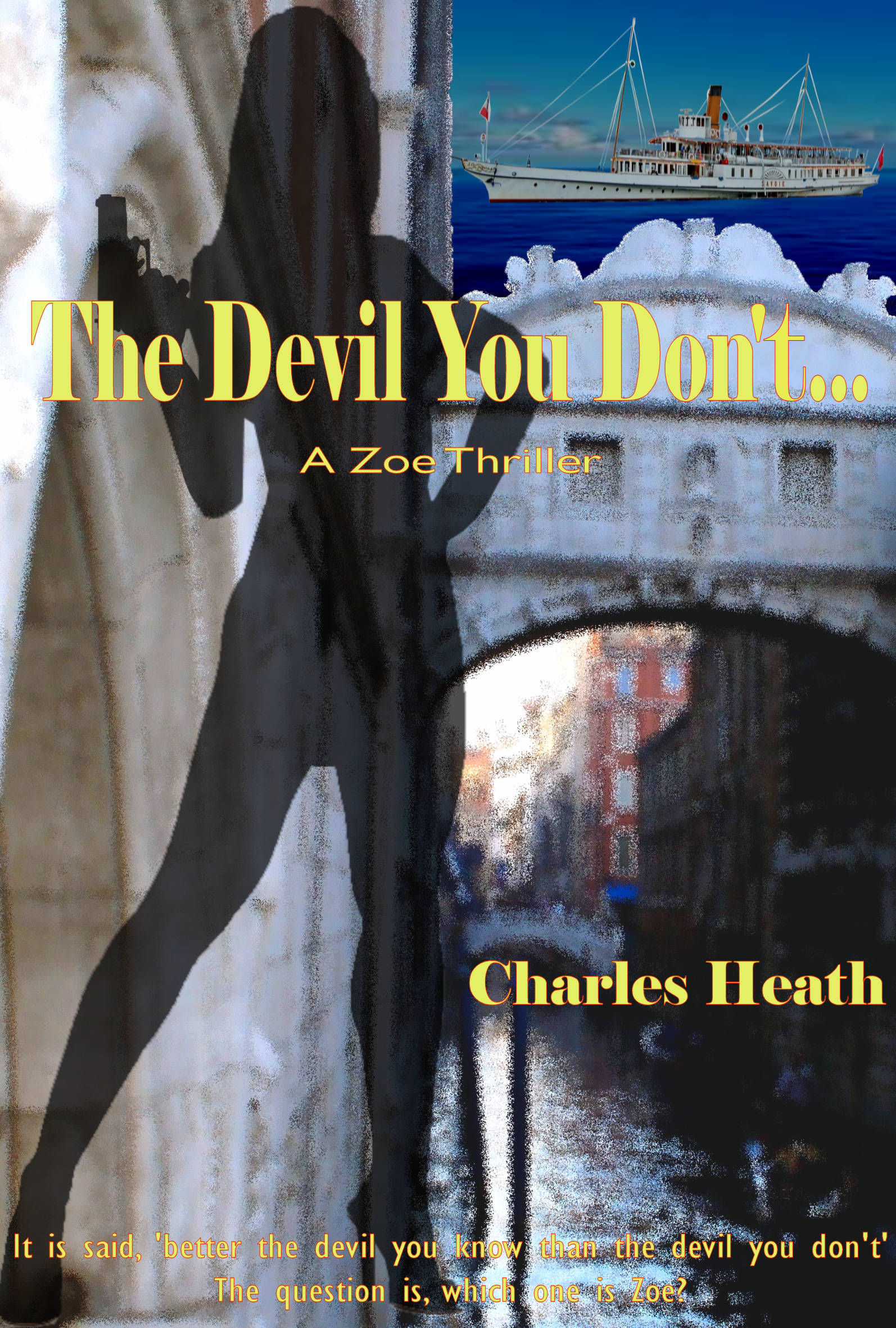
Another excerpt from ‘Betrayal’; a work in progress

My next destination in the quest was the hotel we believed Anne Merriweather had stayed at.

I was, in a sense, flying blind because we had no concrete evidence she had been there, and the message she had left behind didn’t quite name the hotel or where Vladimir was going to take her.

Mindful of the fact that someone might have been following me, I checked to see if the person I’d assumed had followed me to Elizabeth’s apartment was still in place, but I couldn’t see him. Next, I made a mental note of seven different candidates and committed them to memory.

Then I set off to the hotel, hailing a taxi. There was the possibility the cab driver was one of them, but perhaps I was slightly more paranoid than I should be. I’d been watching the queue, and there were two others before me.

The journey took about an hour, during which time I kept an eye out the back to see if anyone had been following us. If anyone was, I couldn’t see them.

I had the cab drop me off a block from the hotel and then spent the next hour doing a complete circuit of the block the hotel was on, checking the front and rear entrances, the cameras in place, and the siting of the driveway into the underground carpark. There was a camera over the entrance, and one we hadn’t checked for footage. I sent a text message to Fritz to look into it.

The hotel lobby was large and busy, which was exactly what you’d want if you wanted to come and go without standing out. It would be different later at night, but I could see her arriving about mid-afternoon, and anonymous among the type of clientele the hotel attracted.

I spent an hour sitting in various positions in the lobby simply observing. I had already ascertained where the elevator lobby for the rooms was, and the elevator down to the car park. Fortunately, it was not ‘guarded’ but there was a steady stream of concierge staff coming and going to the lower levels, and, just from time to time, guests.

Then, when there was a commotion at the front door, what seemed to be a collision of guests and free-wheeling bags, I saw one of the seven potential taggers sitting by the front door. Waiting for me to leave? Or were they wondering why I was spending so much time there?

Taking advantage of that confusion, I picked my moment to head for the elevators that went down to the car park, pressed the down button, and waited.

The was no car on the ground level, so I had to wait, watching, like several others, the guests untangling themselves at the entrance, and an eye on my potential surveillance, still absorbed in the confusion.

The doors to the left car opened, and a concierge stepped out, gave me a quick look, then headed back to his desk. I stepped into the car, pressed the first level down, the level I expected cars to arrive on, and waited what seemed like a long time for the doors to close.

As they did, I was expecting to see a hand poke through the gap, a latecomer. Nothing happened, and I put it down to a television moment.

There were three basement levels, and for a moment, I let my imagination run wild and considered the possibility that there were more levels. Of course, there was no indication on the control panel that there were any other floors, and I’d yet to see anything like it in reality.

With a shake of my head to return to reality, the car arrived, the doors opened, and I stepped out.

A car pulled up, and the driver stepped out, went around to the rear of his car, and pulled out a case. I half expected him to throw me the keys, but the instant glance he gave me told him was not the concierge, and instead brushed past me like I wasn’t there.

He bashed the up button several times impatiently and cursed when the doors didn’t open immediately. Not a happy man.

Another car drove past on its way down to a lower level.

I looked up and saw the CCTV camera, pointing towards the entrance, visible in the distance. A gate that lifted up was just about back in position and then made a clunk when it finally closed. The footage from the camera would not prove much, even if it had been working, because it didn’t cover the life lobby, only in the direction of the car entrance.

The doors to the other elevator car opened, and a man in a suit stepped out.

“Can I help you, sir? You seem lost.”

Security, or something else. “It seems that way. I went to the elevator lobby, got in, and it went down rather than up. I must have been in the wrong place.”

“Lost it is, then, sir.” I could hear the contempt for Americans in his tone. “If you will accompany me, please.”

He put out a hand ready to guide me back into the elevator. I was only too happy to oblige him. There had been a sign near the button panel that said the basement levels were only to be accessed by the guests.

Once inside, he turned a key and pressed the lobby button. The doors closed, and we went up. He stood, facing the door, not speaking. A few seconds later, he was ushering me out to the lobby.

“Now, sir, if you are a guest…”

“Actually, I’m looking for one. She called me and said she would be staying in this hotel and to come down and visit her. I was trying to get to the sixth floor.”

“Good. Let’s go over the the desk and see what we can do for you.”

I followed him over to the reception desk, where he signalled one of the clerks, a young woman who looked and acted very efficiently, and told her of my request, but then remained to oversee the proceeding.

“Name of guest, sir?”

“Merriweather, Anne. I’m her brother, Alexander.” I reached into my coat pocket and pulled out my passport to prove that I was who I said I was. She glanced cursorily at it.

She typed the name into the computer, and then we waited a few seconds while it considered what to output. Then, she said, “That lady is not in the hotel, sir.”

Time to put on my best-confused look. “But she said she would be staying here for the week. I made a special trip to come here to see her.”

Another puzzled look from the clerk, then, “When did she call you?”

An interesting question to ask, and it set off a warning bell in my head. I couldn’t say today, it would have to be the day she was supposedly taken.

“Last Saturday, about four in the afternoon.”

Another look at the screen, then, “It appears she checked out Sunday morning. I’m afraid you have made a trip in vain.”

Indeed, I had. “Was she staying with anyone?”

I just managed to see the warning pass from the suited man to the clerk. I thought he had shown an interest when I mentioned the name, and now I had confirmation. He knew something about her disappearance. The trouble was, he wasn’t going to volunteer any information because he was more than just hotel security.

“No.”

“Odd,” I muttered. “I thought she told me she was staying with a man named Vladimir something or other. I’m not too good at pronouncing those Russian names. Are you sure?”

She didn’t look back at the screen. “Yes.”

“OK, now one thing I do know about staying in hotels is that you are required to ask guests with foreign passports their next destination, just in case they need to be found. Did she say where she was going next?” It was a long shot, but I thought I’d ask.

“Moscow. As I understand it, she lives in Moscow. That was the only address she gave us.”

I smiled. “Thank you. I know where that is. I probably should have gone there first.”

She didn’t answer; she didn’t have to, her expression did that perfectly.

The suited man spoke again, looking at the clerk. “Thank you.” He swivelled back to me. “I’m sorry we can’t help you.”

“No. You have more than you can know.”

“What was your name again, sir, just in case you still cannot find her?”

“Alexander Merriweather. Her brother. And if she is still missing, I will be posting a very large reward. At the moment, you can best contact me via the American Embassy.”

Money is always a great motivator, and that thoughtful expression on his face suggested he gave a moment’s thought to it.

I left him with that offer and left. If anything, the people who were holding her would know she had a brother, that her brother was looking for her, and equally that brother had money.

© Charles Heath – 2018-2025

“Sunday in New York”, a romantic adventure that’s not a walk in the park!

“Sunday in New York” is ultimately a story about trust, and what happens when a marriage is stretched to its limits.

When Harry Steele attends a lunch with his manager, Barclay, to discuss a promotion that any junior executive would accept in a heartbeat, it is the fact his wife, Alison, who previously professed her reservations about Barclay, also agreed to attend, that casts a small element of doubt in his mind.

From that moment, his life, in the company, in deciding what to do, his marriage, his very life, spirals out of control.

There is no one big factor that can prove Harry’s worst fears, that his marriage is over, just a number of small, interconnecting events, when piled on top of each other, points to a cataclysmic end to everything he had believed in.

Trust is lost firstly in his best friend and mentor, Andy, who only hints of impending disaster, Sasha, a woman whom he saved, and who appears to have motives of her own, and then in his wife, Alison, as he discovered piece by piece damning evidence she is about to leave him for another man.

Can we trust what we see with our eyes or trust what we hear?

Haven’t we all jumped to conclusions at least once in our lives?

Can Alison, a woman whose self-belief and confidence is about to be put to the ultimate test, find a way of proving their relationship is as strong as it has ever been?

As they say in the classics, read on!

Purchase:

http://tinyurl.com/Amazon-SundayInNewYork

“Echoes From The Past”, the past doesn’t necessarily stay there


What happens when your past finally catches up with you?

Christmas is just around the corner, a time to be with family. For Will Mason, an orphan since he was fourteen, it is a time for reflection on what his life could have been, and what it could be.

Until a chance encounter brings back to life the reasons for his twenty years of self-imposed exile from a life only normal people could have. From that moment Will’s life slowly starts to unravel and it’s obvious to him it’s time to move on.

This time, however, there is more at stake.

Will has broken his number one rule, don’t get involved.

With his nemesis, Eddie Jamieson, suddenly within reach, and a blossoming relationship with an office colleague, Maria, about to change everything, Will has to make a choice. Quietly leave, or finally, make a stand.

But as Will soon discovers, when other people are involved there is going to be terrible consequences no matter what choice he makes.

https://amzn.to/2CYKxu4

newechocover5rs

An excerpt from “What Sets Us Apart”, a mystery with a twist

See the excerpt from the story below, just a taste of what’s in store…

http://amzn.to/2Eryfth

whatsetscover

McCallister was old school, a man who would most likely fit in perfectly campaigning on the battlefields of Europe during the Second World War. He’d been like a fish out of water in the army, post-Falklands, and while he retired a hero, he still felt he’d more to give.

He’d applied and was accepted as head of a SWAT team, and, watching him now as he and his men disembarked from the truck in almost military precision, a look passed between Annette, the police liaison officer, and I that said she’d seen it all before. I know I had.

There was a one in four chance his team would be selected for this operation, and she had been hoping it would be one of the other three. While waiting for them to arrive she filled me in on the various teams. His was the least co-operative, and the more likely to make ad-hoc decisions rather than adhere to the plan, or any orders that may come from the officer in charge.

This, she said quite bluntly, was going to end badly.

I still had no idea why Prendergast instructed me to attend the scene of what looked to be a normal domestic operation, but as the nominated expert in the field in these types of situations, it was fairly clear he wasn’t taking any chances. It was always a matter of opinion between us, and generally I lost.

In this case, it was an anonymous report identifying what the authorities believed were explosives in one of the dockside sheds where explosives were not supposed to be.

The only reason why the report was given any credence was the man, while not identifying himself by name, said he’d been an explosive expert once and recognized the boxes. That could mean anything, but the Chief Constable was a cautious man.

With his men settled and preparing their weapons, McCallister came over to the command post, not much more than the SUV my liaison and I arrived in, with weapons, bulletproof vests, and rolls of tape to cordon off the area afterward. We both had coffee, steaming in the cold early morning air. Dawn was slowly approaching and although rain had been forecast it had yet to arrive.

A man by the name of Benson was in charge. He too had groaned when he saw McCallister.

“A fine morning for it.” McCallister was the only enthusiastic one here.

He didn’t say what ‘it’ was, but I thought it might eventually be mayhem.

“Let’s hope the rain stays away. It’s going to be difficult enough without it,” Benson said, rubbing his hands together. We had been waiting for the SWAT team to arrive, and another team to take up their position under the wharf, and who was in the final stages of securing their position.

While we were waiting we drew up the plan. I’d go in first to check on what we were dealing with, and what type of explosives. The SWAT team, in the meantime, were to ensure all the exits to the shed were covered. When I gave the signal, they were to enter and secure the building. We were not expecting anyone inside or out, and no movement had been detected in the last hour since our arrival and deployment.

“What’s the current situation?”

“I’ve got eyes on the building, and a team coming in from the waterside, underneath. Its slow progress, but they’re nearly there. Once they’re in place, we’re sending McKenzie in.”

He looked in my direction.

“With due respect sir, shouldn’t it be one of us?” McCallister glared at me with the contempt that only a decorated military officer could.

“No. I have orders from above, much higher than I care to argue with, so, McCallister, no gung-ho heroics for the moment. Just be ready to move on my command, and make sure you have three teams at the exit points, ready to secure the building.”

McCallister opened his mouth, no doubt to question those orders, but instead closed it again. “Yes sir,” he muttered and turned away heading back to his men.

“You’re not going to have much time before he storms the battlements,” Benson quietly said to me, a hint of exasperation in his tone. “I’m dreading the paperwork.”

It was exactly what my liaison officer said when she saw McCallister arriving.

The water team sent their ‘in position’ signal, and we were ready to go.

In the hour or so we’d been on site nothing had stirred, no arrivals, no departures, and no sign anyone was inside, but that didn’t mean we were alone. Nor did it mean I was going to walk in and see immediately what was going on. If it was a cache of explosives then it was possible the building was booby-trapped in any number of ways, there could be sentries or guards, and they had eyes on us, or it might be a false alarm.

I was hoping for the latter.

I put on the bulletproof vest, thinking it was a poor substitute for full battle armor against an exploding bomb, but we were still treating this as a ‘suspected’ case. I noticed my liaison officer was pulling on her bulletproof vest too.

“You don’t have to go. This is my party, not yours,” I said.

“The Chief Constable told me to stick to you like glue, sir.”

I looked at Benson. “Talk some sense into her please, this is not a kindergarten outing.”

He shrugged. Seeing McCallister had taken all the fight out of him. “Orders are orders. If that’s what the Chief Constable requested …”

Madness. I glared at her, and she gave me a wan smile. “Stay behind me then, and don’t do anything stupid.”

“Believe me, I won’t be.” She pulled out and checked her weapon, chambering the first round. It made a reassuring sound.

Suited up, weapons readied, a last sip of the coffee in a stomach that was already churning from nerves and tension, I looked at the target, one hundred yards distant and thought it was going to be the longest hundred yards I’d ever traversed. At least for this week.

A swirling mist rolled in and caused a slight change in plans.

Because the front of the buildings was constantly illuminated by large overhead arc lamps, my intention had been to approach the building from the rear where there was less light and more cover. Despite the lack of movement, if there were explosives in that building, there’d be ‘enemy’ surveillance somewhere, and, after making that assumption, I believed it was going to be easier and less noticeable to use the darkness as a cover.

It was a result of the consultation, and studying the plans of the warehouse, plans that showed three entrances, the main front hangar type doors, a side entrance for truck entry and exit and a small door in the rear, at the end of an internal passage leading to several offices. I also assumed it was the exit used when smokers needed a break. Our entry would be by the rear door or failing that, the side entrance where a door was built into the larger sliding doors. In both cases, the locks would not present a problem.

The change in the weather made the approach shorter, and given the density of the mist now turning into a fog, we were able to approach by the front, hugging the walls, and moving quickly while there was cover. I could feel the dampness of the mist and shivered more than once.

It was nerves more than the cold.

I could also feel rather than see the presence of Annette behind me, and once felt her breath on my neck when we stopped for a quick reconnaissance.

It was the same for McCallister’s men. I could feel them following us, quickly and quietly, and expected, if I turned around, to see him breathing down my neck too.

It added to the tension.

My plan was still to enter by the back door.

We slipped up the alley between the two sheds to the rear corner and stopped. I heard a noise coming from the rear of the building, and the light tap on the shoulder told me Annette had heard it too. I put my hand up to signal her to wait, and as a swirl of mist rolled in, I slipped around the corner heading towards where I’d last seen the glow of a cigarette.

The mist cleared, and we saw each other at the same time. He was a bearded man in battle fatigues, not the average dockside security guard.

He was quick, but my slight element of surprise was his undoing, and he was down and unconscious in less than a few seconds with barely a sound beyond the body hitting the ground. Zip ties secured his hands and legs, and tape his mouth. Annette joined me a minute after securing him.

A glance at the body then me, “I can see why they, whoever they are, sent you.”

She’d asked who I worked for, and I didn’t answer. It was best she didn’t know.

“Stay behind me,” I said, more urgency in my tone. If there was one, there’d be another.

Luck was with us so far. A man outside smoking meant no booby traps on the back door, and quite possibly there’d be none inside. But it indicated there were more men inside, and if so, it appeared they were very well trained. If that were the case, they would be formidable opponents.

The fear factor increased exponentially.

I slowly opened the door and looked in. A pale light shone from within the warehouse itself, one that was not bright enough to be detected from outside. None of the offices had lights on, so it was possible they were vacant. I realized then they had blacked out the windows. Why hadn’t someone checked this?

Once inside, the door closed behind us, progress was slow and careful. She remained directly behind me, gun ready to shoot anything that moved. I had a momentary thought for McCallister and his men, securing the perimeter.

At the end of the corridor, the extent of the warehouse stretched before us. The pale lighting made it seem like a vast empty cavern, except for a long trestle table along one side, and, behind it, stacks of wooden crates, some opened. It looked like a production line.

To get to the table from where we were was a ten-yard walk in the open. There was no cover. If we stuck to the walls, there was equally no cover and a longer walk.

We needed a distraction.

As if on cue, the two main entrances disintegrated into flying shrapnel accompanied by a deafening explosion that momentarily disoriented both Annette and I. Through the smoke and dust kicked up I saw three men appear from behind the wooden crates, each with what looked like machine guns, spraying bullets in the direction of the incoming SWAT members.

They never had a chance, cut down before they made ten steps into the building.

By the time I’d recovered, my head heavy, eyes watering and ears still ringing, I took several steps towards them, managing to take down two of the gunmen but not the third.

I heard a voice, Annette’s I think, yell out, “Oh, God, he’s got a trigger,” just before another explosion, though all I remember in that split second was a bright flash, the intense heat, something very heavy smashing into my chest knocking the wind out of me, and then the sensation of flying, just before I hit the wall.

I spent four weeks in an induced coma, three months being stitched back together and another six learning to do all those basic actions everyone took for granted. It was twelve months almost to the day when I was released from the hospital, physically, except for a few alterations required after being hit by shrapnel, looking the same as I always had.

But mentally? The document I’d signed on release said it all, ‘not fit for active duty; discharged’.

It was in the name of David Cheney. For all intents and purposes, Alistair McKenzie was killed in that warehouse, and for the first time ever, an agent left the Department, the first to retire alive.

I was not sure I liked the idea of making history.

© Charles Heath 2016-2020

Writing about writing a book – Research

Day 24 – The perils of a patrol in the jungle

The Threshold of Contact: A Tactical and Psychological Reconstruction of the U.S. Infantry Patrol in the Vietnam War

This reconstructs the experience of a typical long-range reconnaissance patrol (LRP) undertaken by U.S. combat infantry during the Vietnam War (1965–1973). It moves sequentially through the mission profile: the logistical and psychological dynamics of insertion into the Area of Operations (AO); the gruelling physical and mental challenges posed by the triple-canopy jungle and climate; the sustained tension of anticipating contact with an invisible, adaptable enemy; and the immediate chaos and medical exigencies of the resultant firefight. Drawing on military doctrine, veteran testimony, and historical analysis, the paper argues that the patrol was the fundamental tactical unit defining the conflict, characterised by a unique fusion of high-technology logistical support (air mobility) and primitive small-unit jungle warfare, where the most significant adversary was often not the enemy’s firepower but the pervasive psychological burden of constant, indiscriminate danger.


1. Introduction: The Infantry’s War

The conflict in Southeast Asia was largely fought through small-unit operations, making the infantry patrol the definitive mechanism of engagement. Unlike previous wars defined by linear fronts, Vietnam was characterised by “search and destroy” missions and area denial, mandates that required soldiers to enter remote terrain and actively seek an elusive enemy—the Viet Cong (VC) or the North Vietnamese Army (NVA).

This paper focuses on the sensory, logistical, and traumatic reality of the patrol. It aims to transcend simple narrative by analysing how doctrine, technology, and environment intersect to create a unique combat psychology. The typical patrol was a multi-stage process, beginning with the transition from the relative safety of a Forward Operating Base (FOB) to the hostile solitude of the jungle, a journey that tested the limits of human endurance even before contact was made.

2. Threshold of Engagement: Insertion into the AO

The modern American soldier’s entry into battle was typically mediated by air mobility, primarily the Bell UH-1 Iroquois, or “Huey” helicopter. This stage of the operation, termed the Initial Insertion, was a critical psychological pivot point.

2.1 Logistics and Sensory Overload

The patrol—usually a squad (10–12 men) or platoon (30–40 men), depending on the mission profile—gathered at a designated staging point. Gear loads were immense, often exceeding 70 pounds: M-16s, bandoliers of ammunition, claymore mines, radios (PRC-25), medical supplies, and basic rations.

Insertion occurred via air assault, a rapid deployment designed to minimise exposure to enemy fire. The ride itself was an assault on the senses: the deafening whop-whop-whop of the rotors, the smell of aviation fuel, and the intense scrutiny of the LZ (Landing Zone) below.

Analysis: The helicopter insertion served two tactical purposes: speed and surprise. Psychologically, however, the insertion was a jarring transition. As the slick dipped down and the adrenaline-fueled dash out onto the hot LZ occurred, the pervasive noise suddenly vanished with the aircraft’s departure. The immediate, suffocating silence of the jungle replaced the mechanical roar, marking the psychological shift from external support to absolute self-reliance.

If the AO was coastal or riverine (e.g., the Mekong Delta or I Corps near the coast), insertion might occur via PBR (Patrol Boat, River). This method offered better stealth but was slower and exposed the unit to riverbank ambushes, requiring heavy pre-patrol suppression fire. Regardless of method, the objective was the same: move quickly away from the insertion point, as the enemy monitored all helicopter or boat traffic and would immediately begin converging on the unit’s known location.

3. The Slog: Doctrine, Terrain, and the Invisible Enemy

Once in the jungle, the patrol transitioned into its primary phase: movement through hostile terrain, guided by strict Standard Operating Procedures (SOPs) designed for survival.

3.1 Physical Deterioration and Environmental Adversity

The Vietnamese jungle was an environmental antagonist. Movement was agonizingly slow, often limited to less than 1,000 meters per hour. The terrain was characterised by triple-canopy jungle, creating perpetual gloom, or thick, razor-sharp elephant grass.

The relentless tropical climate (humidity often exceeding 90% and temperatures in the high 90s°F) rapidly induced heat exhaustion and dehydration. Soldiers were routinely soaked, either from sweat, torrential rain, or wading through marshes. This environment severely degraded both equipment and human performance, leading to endemic afflictions like trench foot, immersion syndrome, and severe psychological fatigue.

3.2 Tactical Movement and Psychological Burden

To mitigate the risk of ambush, patrols employed classic small-unit tactics: staggered columns, moving in fire team wedges, maintaining a minimum 10–20 meter separation between men to prevent mass casualties from a single explosion.

The most critical role was the Point Man, who walked 50–100 meters ahead of the main body. The point man was the unit’s eyes and ears, tasked with detecting tripwires, disturbed earth indicating booby traps, or subtle signs of enemy passage (broken branches, cigarette butts). This position carried the highest possibility of initiating contact, making it a role of intense psychological pressure and high casualty risk.

Doctrine meets Psychology: The very nature of the enemy—often unseen, rarely engaging in set-piece battles—forced an aggressive paranoia. The invisible enemy dictated that every step, regardless of noise or environment, carried the potential for lethal contact. This systemic ambiguity, where the soldier was always exposed but never sure when the attack would come, was arguably the most exhausting aspect of the patrol.

4. Anticipation and the Noise of Silence

As the patrol proceeded deeper into the AO, the tactical objective shifted from movement to reconnaissance and the active search for signs of enemy presence (e.g., trails, bunkers, rice caches). This pre-contact phase was defined by hypervigilance.

4.1 The Threat Matrix

The patrol was constantly navigating a complex threat matrix that included:

  1. Snipers: Single shots designed to induce panic and force the unit into a defensive posture.
  2. Booby Traps: Anti-personnel devices (like the Punji stake or buried artillery shells) that inflicted non-lethal but debilitating injuries, creating a requirement for medevac that often lured the patrol into a subsequent ambush.
  3. Ambush Sites: Pre-sited kill zones manned by VC or NVA units, typically placed along known trails or natural chokepoints.

4.2 The Peak of Tension

The hours leading up to contact were marked by sensory distortion. Exhaustion and fear amplified every natural jungle noise—a bird call, a shifting branch—until it registered as a potential threat. Squad leaders continuously communicated via hand signals, minimising radio use to deny the enemy signals intelligence.

The common expectation was that contact would begin with a sudden, overwhelming initiation by the enemy. The VC/NVA doctrine prioritised ambush and swift withdrawal, aiming to inflict maximum casualties in the first 30 seconds before the American unit could bring its superior firepower (artillery and air support) to bear.

5. Contact and the Casualty Toll

The moment of contact shattered the strained silence. It was typically instantaneous, violent, and disorienting.

5.1 The Initiation of Fire

On a typical patrol, contact was initiated by an enemy ambush team concealed along a flank. The trigger was often the point man stepping past a designated firing marker, leading to a sudden burst of automatic fire (AK-47s) and sometimes Rocket-Propelled Grenades (RPGs).

The initial burst was aimed at the front and rear of the column—the lead element (to disable command and radio) and the trailing element (to block withdrawal). This tactic, known as “hugging the belt,” pinned the patrol down.

5.2 The Crucible of the Firefight

The immediate response was dictated by rigorous training:

  1. Go Prone: Drop immediately and seek cover, returning fire to the point of muzzle flash.
  2. Establish a Base of Fire: The patrol’s designated machine gunner (M60) immediately suppressed the enemy position, even before visual confirmation.
  3. Flanking Maneuver: The squad or platoon leader, if not immediately disabled, attempted to coordinate troops to flank the enemy position, thereby escaping the pre-sighted kill zone.

The sensory reality of the firefight was overwhelming: the deafening crack of incoming rounds, the smell of cordite and burning foliage, and the frantic shouts for ammunition and corpsmen.

5.3 Casualties and the Medical Crisis

Within the first minute of contact, casualties inevitably occurred. The sudden transition from movement to medical triage under direct fire defined the immediate outcome of the engagement.

WIA (Wounded in Action): The Corpsman (medic) became the immediate focus of survival. Risking his own life, he assessed the wounded, applying pressure dressings, tourniquets, and administering morphine. The priority was stopping life-threatening hemorrhage and preparing the casualty for evacuation, often necessitating a dangerous move into the line of fire. KIA (Killed in Action): If a soldier was killed, securing his weapon and radio became imperative, secondary only to securing the living.

5.4 The Medevac Lifeline

The U.S. advantage lay in its casualty evacuation system. The patrol leader immediately called for a Dustoff (medevac helicopter) via the Forward Observer (FO) or Radioman. Retrieving the wounded required clearing an LZ nearby or hoisting the casualty through the jungle canopy—a process often undertaken while the firefight was still ongoing, protected by covering fire from the remaining patrol members and supporting air power (gunships). The psychological significance of the Dustoff arriving was immense; it represented the return of technology and support to the isolation of the jungle.

6. Conclusion: The Legacy of the Patrol

The infantry patrol in Vietnam was an ordeal defined by logistical precision, environmental hostility, and profound psychological stress. It was a contradiction: fighting a pre-industrial ambush war with the support of a highly mechanised military machine.

The experience detailed—from the deafening insertion to the silent anticipation, and finally, the violent, chaotic contact—underscores that the true nature of the war was personal and small-scale. Success was measured not in capturing territory, but in surviving the day, inflicting proportional losses, and ensuring the wounded were extracted.

The legacy of the patrol experience is foundational to modern military psychology and small-unit tactics. It highlights the sustained, debilitating toll of jungle warfare and the unique resilience required of soldiers charged with seeking out an invisible enemy in a theatre where every foot of ground was a potential death trap.

The cinema of my dreams – I never wanted to go to Africa – Episode 40

Our hero knows he’s in serious trouble.

The problem is, there are familiar faces and a question of who is a friend and who is foe made all the more difficult because of the enemy, if it was the enemy, simply because it didn’t look or sound or act like the enemy.

Now, it appears, his problems stem from another operation he participated in, and because of it, he has now been roped into what might be called a suicide mission.


I left the others out the front of the hut in Barnes charge, except for Williamson who stayed inside, feigning illness.  If everything went according to plan, a sketchy plan at best, Monroe would slip the diamonds to Williamson, and then melt back into the bush, heading back towards the fork in the road heading to the airstrip.  She would then report on what troops were between us and our objective.

I signaled for Davies to join me.

The commander and the man who’d reported to him earlier strode across the compound to a smaller building that might pass as a jail.  There was a guard out the front who jumped up and snapped to attention when the commander came up the steps.

“Open the door.”

The guard fumbled with a ring of keys, found the one for the door, and unlocked it.

The commander looked at me.  “You may speak to them for five minutes.”

“Alone.  You have my word we’ll not try anything.”

He nodded at the guard.  “Bottom of the steps.  Don’t let them out of your sight.”  To me, he pointed to another building about 50 yards away, “I’ll be there, don’t keep me waiting.”

We waited for him to come down the steps and start striding to his office, then went up the stairs, and I knocked on the door.  “My name is James, and I’m here with Davies to take you home.  We’re coming in.”

I opened the door slowly pulling it towards me, and the odor that came out of the room was that of people who had not been allowed to wash for several days, if not longer.  Once the door was fully open and the interior lit, I could see two stretchers and two men sitting up, struggling with the light in their eyes.

At least they were able to sit up.

Our information was they had been captive now for about seven months, and, looking at them, they didn’t seem to appear to badly off.  They showed signs of weight loss, and pallid skin, but not to the point of being maltreated or starved.

“Who did you say you were?”  The man on the left was about 50ish, grey thinning hair, and I suspect once a lot bulkier than he was now.  There was an air of brashness about him, but that would have been beaten out of him long ago.  Now he was just a shell of his former self.

“Sgt James, and Lieutenant Davies.  Part of the rescue team sent to bring you home.  A Colonel Bamfield sent us.”

“You took your time.”

Th either man spoke.  Younger, a military type, perhaps the other man’s bodyguard.  He had a few scars, so I expect he had offered some resistance and paid for it with the butt of a gun or two.

“We tried once, but it failed.  There were not the people who had been holding you at the time though, were they?”

“No.  If that was an attempt, they were the people who came to ‘rescue’ us, only it was a means for them to use us for ransom.  It’s taken them a while to find the right people.  Bamfield you say?  Who is he?”

“Runs the military’s operations that the military doesn’t want to acknowledge.  We’re here, but we’re not here if you know what I mean.”

The older man shook his head.  “It doesn’t matter.  What happens now?”

“I go and have another chat with the commander.  We exchange gifts, and we leave.”

“You do realize that’s not going to happen,” the military type said with a degree of despondency.

“How so?”

“There are about 50 men here, possibly more, all armed, and all waiting for you to arrive.  I expect they’ll take the ransom and then kill all of us.”

“Yes, I had thought that might be the case.  But, don’t worry.  We have a few tricks up our sleeve.  So, gather your belongings, if you have any, and wait for us to come back and get you.”

“Are you going to drive out of here?”  The military man spoke again.

“A short distance, yes.  There’s an airstrip not far from here, so all we have to do is get there, and we’re halfway home.”

“There’ll be government troops there.  It’s used for people coming in to visit the national park and they provide local security.  Boroko knows the Captain in charge there, and they have an arrangement.  He’ll know what your options are, and you’ll just be walking into a trap.”

That had always been a possibility, but Bamfield wouldn’t send us there unless there was a chance we could use it for our escape.  But, what the man was saying was just another wrinkle in a plan that had lots of wrinkles.

“Provided you get a mile from this place before being attacked.”

“All very interesting points,” I said.  “But, like I said, pack your stuff and let me worry about the details.  Feel free to take in some fresh air while we’re gone.  It won’t be long.”

“I’ll stay,” Davies said.

“OK.”

I took a last look at the two, both now struggling to their feet.  They might not be in as good a condition as the commander had said.  As long as they could cover about half a mile at best, everything would be fine.

I walked slowly back to the hut where Williamson had just emerged, and I went over to him.

He handed me a package that hardly made a dent in my pocket.  It was probably the reason why diamonds were used, small, and easily transportable.  Gold bars would have been a different, and far more difficult, proposition.

From there, I walked more briskly to the commander’s hut and as I approached he came out.

“Everything in order?”

“It is.”

I pulled the package out of my pocket and handed it to him.  “You can check the contents while I wait here.”

A smile, like a cat who swallowed the canary.  A nod to a soldier standing behind me, I could hear the weapon being trained on me.

“I guess this is where…”

A second later the soldier crumpled to the ground, a bloody mess where his head had just been.  A second raised his gun and suffered the same result.

“Call off your dogs’ commander.  I’m sure we both don’t want to see people die needlessly.”

Two hands for a signal to lower weapons.

“Your missing people.”

“Out there, strategically placed.  Excellent marksmen too.  At the moment they’re showing restraint.  It’s up to you how long that lasts.”

He motioned to the guard at the prisoner’s hut to take them to the cars, “Join them, Sargeant James, I’ll be along when I’ve checked the diamonds.”

By the time the two men had joined the rest of the team at the cars, the commander had come out of his office and was walking towards us.

“Three cars, we’ll keep the other.  I assume you’re heading towards the airstrip.”

“It’s one of our options.  I hear the government had a platoon of soldiers there under the command of a Captain.  You might want to warn him we’re coming.  You might also want to warn whoever you have in the field between here and there we’re coming.”

“I can’t guarantee your safety once you leave the compound.  If there is anyone out there, it will not be my men.  We have an agreement remember.”

“Good.”  

While we were talking the others had got themselves into the cars and started the engines.  Time was of the essence.

We walked down to the barrier, and once again he ordered his guards to remove it.

Once they had the cars drove past and then the last car stopped just the other side, waiting for me.

“I wish you good luck, Sargeant James.”

“Let’s hope the atmospherics don’t interfere with my call to my people.  I’d hate to see this place destroyed because of a misunderstanding.”

I hadn’t seen Jacobi since just after we arrived, and he had headed straight to the commander’s hut.  No doubt they had a lot to talk about.

I got in the car, and we drove off.

I was half expecting a hail of bullets, but all I could see was the two guards replacing the barrier and the commander standing behind it, arms crossed, still looking like the cat who swallowed the canary.


© Charles Heath 2020

‘The Devil You Don’t’ – A beta reader’s view

It could be said that of all the women one could meet, whether contrived or by sheer luck, what are the odds it would turn out to be the woman who was being paid a very large sum to kill you.

John Pennington is a man who may be lucky in business, but not so lucky in love. He has just broken up with Phillipa Sternhaven, the woman he thought was the one, but relatives and circumstances, and perhaps because she was a ‘princess’, may also have contributed to the end result.

So, what do you do when you are heartbroken?

That is a story that slowly unfolds, from the first meeting with his nemesis on Lake Geneva, all the way to a hotel room in Sorrento, where he learns the shattering truth.

What should have been solace after disappointment, turns out to be something else entirely, and from that point, everything goes to hell in a handbasket.

He suddenly realizes his so-called friend Sebastian has not exactly told him the truth about a small job he asked him to do, the woman he is falling in love with is not quite who she says she is, and he is caught in the middle of a war between two men who consider people becoming collateral damage as part of their business.

The story paints the characters cleverly displaying all their flaws and weaknesses. The locations add to the story at times taking me back down memory lane, especially to Venice where, in those back streets I confess it’s not all that hard to get lost.

All in all a thoroughly entertaining story with, for once, a satisfying end.

Available on Amazon here: https://amzn.to/2Xyh1ow

Writing about writing a book – Day 24, a missing piece of the puzzle

There’s always the necessity for creating backstories so that the reader doesn’t come across a part of the story that doesn’t make sense.

Perhaps one of my failings is that I have to go over what I’ve already written, sometimes to make sure there is continuity and that what I’ve written makes sense.

This collection of memories our main character is having serves the purpose of setting up later plot points, but more importantly, is supposed to give the reader an idea of what the main character has gone through before arriving at the start of the story.

This part will serve to provide a little more information on the relationship between Bill and Barry, though I rather like the nickname I gave him.

“Bastards,” Killer muttered.

We called him ‘Killer’ because it was the nickname the Army had given him.  We were sharing the guard duty and had spoken briefly over the watch, but up till then, the silence had stretched over an hour or so.  It didn’t take long for anyone to realize he was a man of few words.

He’d been in the regular army for years and asked for the posting.  He’d made Sergeant several times, only to lose those same stripes for fighting, usually after R&R and a bout of heavy drinking.  Now assigned to our platoon to lend his experience, the conscripts were expecting him to ‘look after’ them.  Other than myself and the Lieutenant, he was the only other regular soldier.  Unfortunately for them, he hated both conscripts and the Viet Cong in varying degrees and depending on his mood there was little tolerance left for the rest of us.

“The people who sent us here or the people trying to kill us?” I asked before I realized I’d spoken.

I didn’t hear the reply, the skies opening up with another torrential downpour that lasted for about five minutes and going as fast as it came.  When the sun finally came up, it would make the atmosphere steamy, hot, and unbearable.  It was quite warm now, and I was feeling both uncomfortable, and fatigued.

Killer looked just as stoic as he had before the rain.  He looked at me.  “Damn weather.  Worse than home.”

“Scotland?”

“Scapa Flow, Kirkwall.  I should have been an engineer on ships like my father, but I was too stupid.  Joined the Army and finished here.  What’s your excuse?”

“Square peg in a round hole.  The army handles us in its stride.”  It was more or less the truth.  I joined the Army to get away from my parents.

“That it does.  That it does.”

The rain came and went, during which the rest of the camp roused and went about its business.  It had been a long night for some, still getting over the shock of the attack, and the ever-pervading thought the enemy was still out there, biding their time.  It would be, for them, a waiting game, waiting for the conditions to wear us down, and lose concentration as inevitably we would.

Certainly, by the time we were relieved from sentry duty, I felt I was in no condition to match wits with a donkey, let alone the enemy on his own home ground.  When I stumbled over to the mess area and looked at the tired and haggard looks on the faces of the platoon, I realized that went for all of us.

Killer and I managed to get about an hour’s rest before the call came to move out, rain or no rain, and after a breakfast that would make anyone ill, we left.  For hours it rained.  No one spoke as we strained to listen over the rain spattering on the undergrowth, all the time expecting the unexpected.  That was the benefit of the surprise attack; we no longer took for granted we would be safe.

Water gathered in pools along the trail, hiding any chance of seeing landmines.  Rainwater and sweat ran into our eyes, making it difficult to see.  Water leaked everywhere, making it very uncomfortable.  This was not war.  This was utter stupidity.

I was about to remark on the futility of it all to the Lieutenant, who had taken the lead, when one second, he was talking to me and the next he crashed to the ground, a sniper’s bullet killing him instantly.   Someone yelled “Contact” and we all hit the ground, bullets flying all around us. 

Too late, I thought, as I felt the hit of what seemed to be a large rock, then the searing pain in my leg, just as I hit the ground…


© Charles Heath 2015-2025

The cinema of my dreams – I never wanted to go to Africa – Episode 39

Our hero knows he’s in serious trouble.

The problem is, there are familiar faces and a question of who is a friend and who is foe made all the more difficult because of the enemy, if it was the enemy, simply because it didn’t look or sound or act like the enemy.

Now, it appears, his problems stem from another operation he participated in, and because of it, he has now been roped into what might be called a suicide mission.


“Are there?  How many should I have?”

The only way he could know there was not a full complement as if he had been told by someone how many people were in our group from the outset.  I looked at Jacobi, and he shrugged.

“This is not a good time to be playing games, Sergeant James.”

The guards gripped their weapons a little tighter and looked ready to use them.

“The only one playing games here would be you.  It would be irrelevant if I had more or I had fewer people here because you have more than enough to cover us, and then some.  But you would agree it would be imprudent for me to put all my eggs in one basket as it were, and yes, there are several others, but they are waiting for me to call them, further down the track.  Not to put too fine a point on it, distrust works both ways.  We don’t come back, I can assure you, your losses will be bigger than ours.  Oh, and a word of advice, don’t go looking for them, not unless you want good men to die needlessly.”

Tough talk, and could get us killed, but I was hoping that until he had the diamonds in his hands, he would humor me.  A minute or so passed where I assumed he was making a calculation on what the odds were, then he shrugged.  There was merit in what I’d told him.  Monroe and Shurl had plenty of ammunition and would have a foxhole that wouldn’t be over-run or penetrated.

“I think you might be right, so let’s not get bogged down in an argument that’s going nowhere.  We have what you want, and you have what we want.  Let’s go inside and talk.”

Was that a sigh of relief moment?  Perhaps.  But it was clear he needed us out of the way before his men could search the cars.  I was happy to let him think he had the upper hand.

“Lead the way.”

We all filed into the building and sat down around a large table.  There were bottles of water out, and we might have drunk from them but I could see the seal had been broken on min so it looked like we would be going thirsty.

The commander drank from his, no doubt as a gesture that the water was safe.  None of my people were buying it.

“I’ll kick it off,” I said.  “Are our people in good health?”

“Of course.  Healthy enough to walk out of here of their own accord.  Did you bring the compensation with you?”

“I did.”

“Can I see it?”

“Can I see our people.”

Friendly, and time-consuming double talk.  I could see he was waiting impatiently.  “All in good time.  “Did you have any trouble getting here?” he asked casually.  “I heard there were some local militias on the road collecting road taxes earlier today.”

“If there was, we didn’t see any.  Smooth run, except for the state of the roads.  I hope the road taxes those people are collecting are to fix the roads.”

He smiled.  “It is what it is.  This is the Democratic Republic of the Congo, not the United States of America.  Things are done differently here.  We put the people first, and the roads second.”

There was a discreet knock on the door, followed by a cowering man coming into the room and walking up behind the commander.  He took a few seconds to whisper into his ear, during which the commander’s expression turned very dark.

I had to assume that they had found all the weapons we had left for them to find, and not done a very close inspection to find those we did not want them to find.  It was a bold assumption and could make a difference once we left, and if we were attacked.  I was sure that was part of the message the man had relayed to his commander.

The man almost ran out of the building, slamming the door behind him.

The commander looked at me.  “Where are the diamonds?”

That was as direct as he could get.

“At this point, that’s for me to know until I’m assured you intend to honor your part of the agreement.  Searching our cars for the diamonds tells me you are not a man to be trusted, and, you should have realized in making that discovery, you’re not dealing with fools.”

The dark expression eased, and he tried to look like the man who held all the cards.  He probably did, but it would be interesting to see to what extent he would press his advantage.  We had nothing to lose, though it didn’t send a very good message to the team that I was willing to sacrifice them.  This was after all supposed to be a suicide mission.

“What’s to stop me from just shooting your people one by one until you tell me.”

“The same reason I told you at the gate.  You will lose a lot more than I will.  Something you might not be aware of is that the people who sent me have control over satellites.  You might not be familiar with satellite technology, but be assured that we are being observed, and have been on this little odyssey.  It also means that they, sitting in a bunker somewhere in the world, also have access to nasty drones, you know, the sort that leaves craters where villages and settlements once were.  This place would not withstand a direct hit, and there would be no one left alive after it.  Killing any or all of us will incur wrath you really don’t want to deal with.  Put simply, if I don’t drive out of here with my people within half an hour this whole area will become an uninhabitable crater.”

Bamfield had said as one option, not that he could order such a strike, was to threaten them with a drone strike.  I hadn’t done that in as many words, but the commander looked as though he got the inference.

“You could do that anyway.”

“I could, but that’s not the way I work.  For some odd reason. The people I work for seem to think you might be useful to them in the future, and Jacobi here will be happy to stay and talk about it.  Now, the clock is ticking.”

He took a moment, then stood.  “Let’s go meet your people then.”


Ⓒ Charles Heath  2020

“The Things we do for Love”, the story behind the story

This story has been ongoing since I was seventeen, and just to let you know, I’m 72 this year.

Yes, it’s taken a long time to get it done.

Why, you might ask.

Well, I never gave it much interest because I started writing it after a small incident when I was 17, and working as a book packer for a book distributor in Melbourne

At the end of my first year, at Christmas, the employer had a Christmas party, and that year, it was at a venue in St Kilda.

I wasn’t going to go because at that age, I was an ordinary boy who was very introverted and basically scared of his own shadow and terrified by girls.

Back then, I would cross the street to avoid them

Also, other members of the staff in the shipping department were rough and ready types who were not backwards in telling me what happened, and being naive, perhaps they knew I’d be either shocked or intrigued.

I was both adamant I wasn’t coming and then got roped in on a dare.

Damn!

So, back then, in the early 70s, people looked the other way when it came to drinking, and of course, Dutch courage always takes away the concerns, especially when normally you wouldn’t do half the stuff you wouldn’t in a million years

I made it to the end, not as drunk and stupid as I thought I might be, and St Kilda being a salacious place if you knew where to look, my new friends decided to give me a surprise.

It didn’t take long to realise these men were ‘men about town’ as they kept saying, and we went on an odyssey.  Yes, those backstreet brothels where one could, I was told, have anything they could imagine.

Let me tell you, large quantities of alcohol and imagination were a very bad mix.

So, the odyssey in ‘The things we do’ was based on that, and then the encounter with Diana. Well, let’s just say I learned a great deal about girls that night.

Firstly, not all girls are nasty and spiteful, which seemed to be the case whenever I met one. There was a way to approach, greet, talk to, and behave.

It was also true that I could have had anything I wanted, but I decided what was in my imagination could stay there.  She was amused that all I wanted was to talk, but it was my money, and I could spend it how I liked.

And like any 17-year-old naive fool, I fell in love with her and had all these foolish notions.  Months later, I went back, but she had moved on, to where no one was saying or knew.

Needless to say, I was heartbroken and had to get over that first loss, which, like any 17-year-old, was like the end of the world.

But it was the best hour I’d ever spent in my life and would remain so until I met the woman I have been married to for the last 48 years.

As Henry, he was in part based on a rebel, the son of rich parents who despised them and their wealth, and he used to regale anyone who would listen about how they had messed up his life

If only I’d come from such a background!

And yes, I was only a run away from climbing up the stairs to get on board a ship, acting as a purser.

I worked for a shipping company and they gave their junior staff members an opportunity to spend a year at sea working as a purser on a cargo ship that sailed between Melbourne, Sydney and Hobart in Australia.

One of the other junior staff members’ turn came, and I would visit him on board when he would tell me stories about life on board, the officers, the crew, and other events. These stories, which sounded incredible to someone so impressionable, were a delight to hear.

Alas, by that time, I had tired of office work and moved on to be a tradesman at the place where my father worked.

It proved to be the right move, as that is where I met my wife.  Diana had been right; love would find me when I least expected it.

lovecoverfinal1