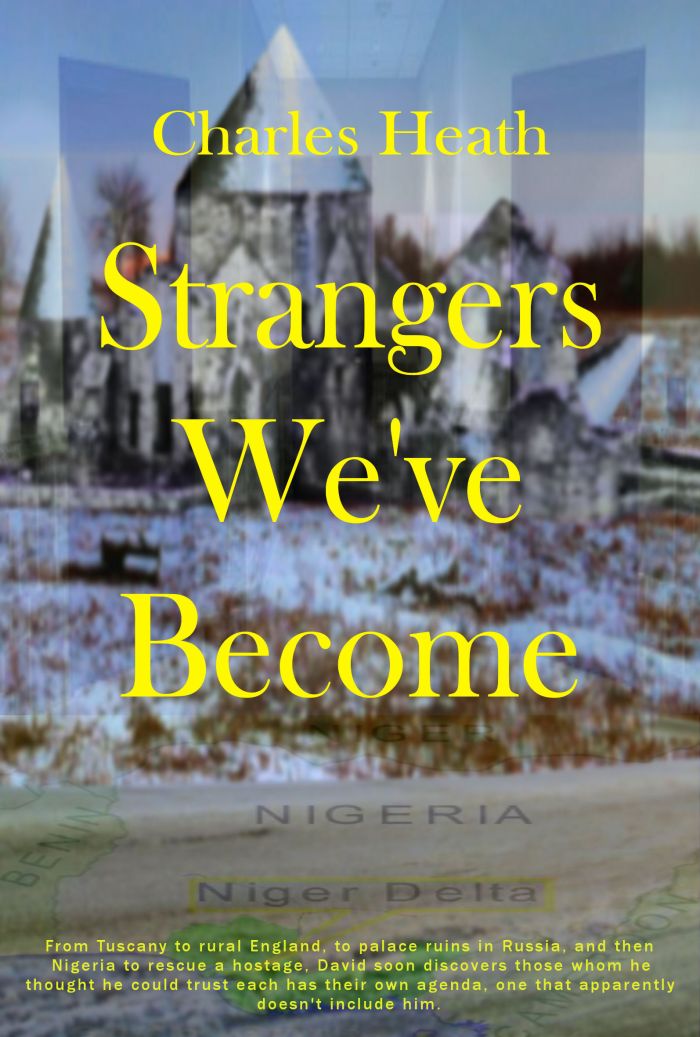
An excerpt from “Strangers We’ve Become” – Coming Soon

I wandered back to my villa.

It was in darkness.  I was sure I had left several lights on, especially over the door so I could see to unlock it.

I looked up and saw the globe was broken.

Instant alert.

I went to the first hiding spot for the gun, and it wasn’t there.  I went to the backup and it wasn’t there either.  Someone had found my carefully hidden stash of weapons and removed them.

Who?

There were four hiding spots and all were empty.  Someone had removed the weapons.  That could only mean one possibility.

I had a visitor, not necessarily here for a social call.

But, of course, being the well-trained agent I’d once been and not one to be caught unawares, I crossed over to my neighbor and relieved him of a weapon that, if found, would require a lot of explaining.

Suitably armed, it was time to return the surprise.

There were three entrances to the villa, the front door, the back door, and a rather strange escape hatch.  One of the more interesting attractions of the villa I’d rented was its heritage.  It was built in the late 1700s, by a man who was, by all accounts, a thief.  It had a hidden underground room which had been in the past a vault but was now a wine cellar, and it had an escape hatch by which the man could come and go undetected, particularly if there was a mob outside the door baying for his blood.

It now gave me the means to enter the villa without my visitors being alerted, unless, of course, they were near the vicinity of the doorway inside the villa, but that possibility was unlikely.  It was not where anyone could anticipate or expect a doorway to be.

The secret entrance was at the rear of the villa behind a large copse, two camouflaged wooden doors built into the ground.  I move aside some of the branches that covered them and lifted one side.  After I’d discovered the doors and rusty hinges, I’d oiled and cleaned them, and cleared the passageway of cobwebs and fallen rocks.  It had a mildew smell, but nothing would get rid of that.  I’d left torches at either end so I could see.

I closed the door after me, and went quietly down the steps, enveloped in darkness till I switched on the torch.  I traversed the short passage which turned ninety degrees about halfway to the door at the other end.  I carried the key to this door on the keyring, found it and opened the door.  It too had been oiled and swung open soundlessly.

I stepped in the darkness and closed the door.

I was on the lower level under the kitchen, now the wine cellar, the ‘door’ doubling as a set of shelves which had very little on them, less to fall and alert anyone in the villa.

Silence, an eerie silence.

I took the steps up to the kitchen, stopping when my head was level with the floor, checking to see if anyone was waiting.  There wasn’t.  It seemed to me to be an unlikely spot for an ambush.

I’d already considered the possibility of someone coming after me, especially because it had been Bespalov I’d killed, and I was sure he had friends, all equally as mad as he was.  Equally, I’d also considered it nigh on impossible for anyone to find out it was me who killed him because the only people who knew that were Prendergast, Alisha, a few others in the Department, and Susan.

That raised the question of who told them where I was.

If I was the man I used to be, my first suspect would be Susan.  The departure this morning, and now this was too coincidental.  But I was not that man.

Or was I?

I reached the start of the passageway that led from the kitchen to the front door and peered into the semi-darkness.  My eyes had got used to the dark, and it was no longer an inky void.  Fragments of light leaked in around the door from outside and through the edge of the window curtains where they didn’t fit properly.  A bone of contention upstairs in the morning, when first light shone and invariably woke me up hours before I wanted to.

Still nothing.

I took a moment to consider how I would approach the visitor’s job.  I would get a plan of the villa in my head, all entrances, where a target could be led to or attacked where there would be no escape.

Coming in the front door.  If I was not expecting anything, I’d just open the door and walk-in.  One shot would be all that was required.

Contract complete.

I sidled quietly up the passage staying close to the wall, edging closer to the front door.  There was an alcove where the shooter could be waiting.  It was an ideal spot to wait.

Crunch.

I stepped on some nutshells.

Not my nutshells.

I felt it before I heard it.  The bullet with my name on it.

And how the shooter missed, from point-blank range, and hit me in the arm, I had no idea.  I fired off two shots before a second shot from the shooter went wide and hit the door with a loud thwack.

I saw a red dot wavering as it honed in on me and I fell to the floor, stretching out, looking up where the origin of the light was coming and pulled the trigger three times, evenly spaced, and a second later I heard the sound of a body falling down the stairs and stopping at the bottom, not very far from me.

Two assassins.

I’d not expected that.

The assassin by the door was dead, a lucky shot on my part.  The second was still breathing.

I checked the body for any weapons and found a second gun and two knives.  Armed to the teeth!

I pulled off the balaclava; a man, early thirties, definitely Italian.  I was expecting a Russian.

I slapped his face, waking him up.  Blood was leaking from several slashes on his face when his head had hit the stairs on the way down.  The awkward angle of his arms and legs told me there were broken bones, probably a lot worse internally.  He was not long for this earth.

“Who employed you?”

He looked at me with dead eyes, a pursed mouth, perhaps a smile.  “Not today my friend.  You have made a very bad enemy.”  He coughed and blood poured out of his mouth.  “There will be more …”

Friends of Bespalov, no doubt.

I would have to leave.  Two unexplainable bodies, I’d have a hard time explaining my way out of this mess.  I dragged the two bodies into the lounge, clearing the passageway just in case someone had heard anything.

Just in case anyone was outside at the time, I sat in the dark, at the foot of the stairs, and tried to breathe normally.  I was trying not to connect dots that led back to Susan, but the coincidence was worrying me.

A half-hour passed and I hadn’t moved.  Deep in thought, I’d forgotten about being shot, unaware that blood was running down my arm and dripping onto the floor.

Until I heard a knock on my front door.

Two thoughts, it was either the police, alerted by the neighbors, or it was the second wave, though why would they be knocking on the door?

I stood, and immediately felt a stabbing pain in my arm.  I took out a handkerchief and turned it into a makeshift tourniquet, then wrapped a kitchen towel around the wound.

If it was the police, this was going to be a difficult situation.  Holding the gun behind my back, I opened the door a fraction and looked out.

No police, just Maria.  I hoped she was not part of the next ‘wave’.

“You left your phone behind on the table.  I thought you might be looking for it.”  She held it out in front of her.

When I didn’t open the door any further, she looked at me quizzically, and then asked, “Is anything wrong?”

I was going to thank her for returning the phone, but I heard her breathe in sharply, and add, breathlessly, “You’re bleeding.”

I looked at my arm and realized it was visible through the door, and not only that, the towel was soaked in blood.

“You need to go away now.”

Should I tell her the truth?  It was probably too late, and if she was any sort of law-abiding citizen she would go straight to the police.

She showed no signs of leaving, just an unnerving curiosity.  “What happened?”

I ran through several explanations, but none seemed plausible.  I went with the truth.  “My past caught up with me.”

“You need someone to fix that before you pass out from blood loss.  It doesn’t look good.”

“I can fix it.  You need to leave.  It is not safe to be here with me.”

The pain in my arm was not getting any better, and the blood was starting to run down my arm again as the tourniquet loosened.  She was right, I needed it fixed sooner rather than later.

I opened the door and let her in.  It was a mistake, a huge mistake, and I would have to deal with the consequences.  Once inside, she turned on the light and saw the pool of blood just inside the door and the trail leading to the lounge.  She followed the trail and turned into the lounge, turned on the light, and no doubt saw the two dead men.

I expected her to scream.  She didn’t.

She gave me a good hard look, perhaps trying to see if I was dangerous.  Killing people wasn’t something you looked the other way about.  She would have to go to the police.

“What happened here?”

“I came home from the cafe and two men were waiting for me.  I used to work for the Government, but no longer.  I suspect these men were here to repay a debt.  I was lucky.”

“Not so much, looking at your arm.”

She came closer and inspected it.

“Sit down.”

She found another towel and wrapped it around the wound, retightening the tourniquet to stem the bleeding.

“Do you have medical supplies?”

I nodded.  “Upstairs.”  I had a medical kit, and on the road, I usually made my own running repairs.  Another old habit I hadn’t quite shaken off yet.

She went upstairs, rummaged, and then came back.  I wondered briefly what she would think of the unmade bed though I was not sure why it might interest her.

She helped me remove my shirt, and then cleaned the wound.  Fortunately, she didn’t have to remove a bullet.  It was a clean wound but it would require stitches.

When she’d finished she said, “Your friend said one day this might happen.”

No prizes for guessing who that friend was, and it didn’t please me that she had involved Maria.

“Alisha?”

“She didn’t tell me her name, but I think she cares a lot about you.  She said trouble has a way of finding you, gave me a phone and said to call her if something like this happened.”

“That was wrong of her to do that.”

“Perhaps, perhaps not.  Will you call her?”

“Yes.  I can’t stay here now.  You should go now.  Hopefully, by the time I leave in the morning, no one will ever know what happened here, especially you.”

She smiled.  “As you say, I was never here.”

…

© Charles Heath 2018-2022
strangerscover9

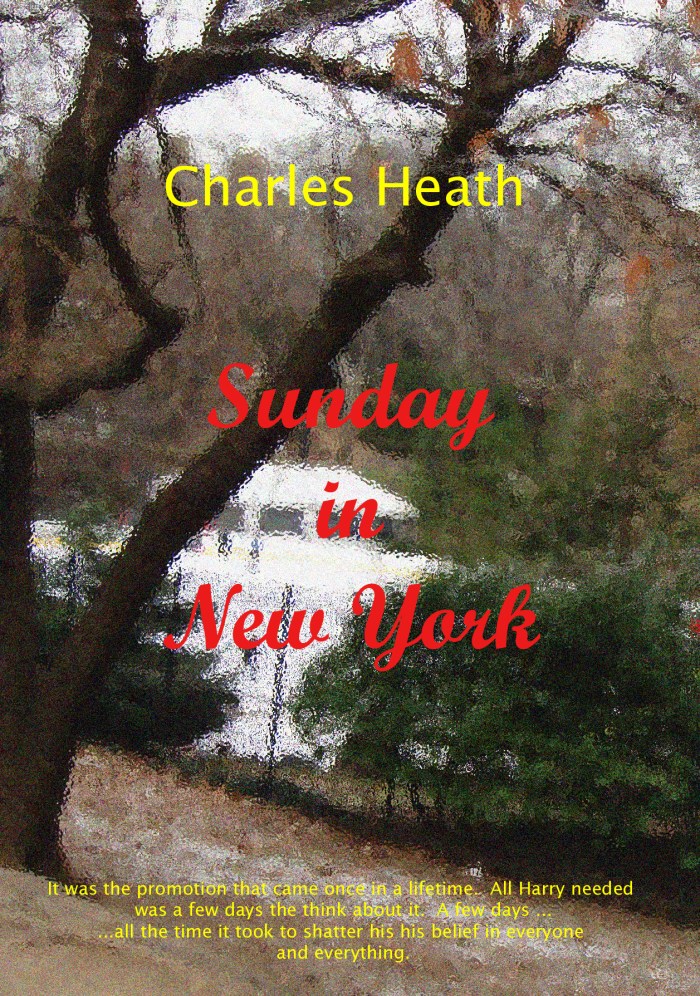
“Sunday in New York”, a romantic adventure that’s not a walk in the park!

“Sunday in New York” is ultimately a story about trust, and what happens when a marriage is stretched to its limits.

When Harry Steele attends a lunch with his manager, Barclay, to discuss a promotion that any junior executive would accept in a heartbeat, it is the fact his wife, Alison, who previously professed her reservations about Barclay, also agreed to attend, that casts a small element of doubt in his mind.

From that moment, his life, in the company, in deciding what to do, his marriage, his very life, spirals out of control.

There is no one big factor that can prove Harry’s worst fears, that his marriage is over, just a number of small, interconnecting events, when piled on top of each other, points to a cataclysmic end to everything he had believed in.

Trust is lost firstly in his best friend and mentor, Andy, who only hints of impending disaster, Sasha, a woman whom he saved, and who appears to have motives of her own, and then in his wife, Alison, as he discovered piece by piece damning evidence she is about to leave him for another man.

Can we trust what we see with our eyes or trust what we hear?

Haven’t we all jumped to conclusions at least once in our lives?

Can Alison, a woman whose self-belief and confidence is about to be put to the ultimate test, find a way of proving their relationship is as strong as it has ever been?

As they say in the classics, read on!

Purchase:

http://tinyurl.com/Amazon-SundayInNewYork

Motive, means, and opportunity – Some background

I’m working on a novella which may boringly be called “Motive, Means and Opportunity” where I will present a chunk of information from which you if you want to, can become the armchair detective.

This might give some clues to the players, and the events.

…

So, the question is, how did I find myself in such a situation.

It came down to choices, as it always does.

And, from the very moment I met Wendy Mauson, I knew life with her, if it came to pass, would be interesting.

She was a popular girl; one of the cheer squad that made their presence felt at most sports.  Her usual boyfriend was Garry Frobish, star quarterback and mainstay of the football team.  I played basketball, after a fashion, because I had not had the necessary growth spurt in those vital teen years, I found myself relegated to guard, of which there were many.

How did we meet?  By accident.  Garry, Wendy, and I were all at the same party, Garry made a mistake, they had a huge fight, and I was there.  It was not one of those right time right-place events, she just picked me as the most level-headed of those on offer that night.  But, I had no illusions, and whilst it was on again and off again over the next year, her real interest, and love of her life was Garry.

So, how did I finish up with Wendy?  Wendy and Garry came together as a couple at the prom, and it looked like it was a perfect match.  Until he got her pregnant, she wouldn’t get rid of the baby and he dumped her.  Who was next, me.  Did I know she was pregnant?  No.  That I discovered much later, at a hospital in tragic circumstances.

But, blissfully ignorant, and universally loved by her family, we were married.  And not long after a son, Dale, was born.

I should have recognised the signs in the few months after the birth, where she was rather self-absorbed for a time.  Had I investigated it, I would have discovered that she had been seeing Garry again, but that, too, wasn’t discovered until much later too.

But despite the ups and downs, we managed to get along as a family once she settled into the idea of being a mother until Dale was old enough to go to school.  Then she went back to work, in the office of the company that was owned by Garry’s parents.

I thought it a coincidence, but, like I said, she managed to keep it all under a shroud of secrecy for many years.

Until the unlikely happened, as it always does.  Secrets are not secrets if more than one person knows about it, and if there are more, well, it doesn’t take long for it to become common knowledge.

One of Dale’s friends told him, under the category of ‘can you keep a secret’, that my wife and Garry were ‘old’ friends, and that it had been going on for years.  How this ‘friend’ knew about it was never explained, but it turned out to be true.

I spoke to her about it, and she assured me that, yes, they did meet, but it was not like ‘that’.  I gave her the benefit of the doubt but followed her a few times observing them together, and it seemed to be as she said.

Then Dale was killed.  It was a senseless accident that in any other situation would have seen him walk away with just a few scratches.   He was rushed to the hospital and since he was a rare blood type, they tested me, and his mother.  Neither of us was a match, which seemed odd.  But even when they found a donor, in actual fact Garry, though I didn’t know it at the time, it was too late.  In fact, when I identified the body, there was not a mark on him.  He had sustained a slight bump to the head which activated an aneurysm.

A week after, when we had the funeral, and everyone came, commiserated, and left, the doctor remained.  An old basketball friend, he gave me a piece of paper and told me to read it later.  I did.  DNA proved that Dale was Garry and Wendy’s son, not mine.

Even then, I was willing to let it go.  Wendy had taken Dale’s death hard and decided the only way she could recover was to go away for a while.  And not with me.  Not a surprise, because we had been arguing a lot, over money, and the way she spent it like it was water, and I thought she had found someone else, and that was who she was going away with.

But, taking her sister was supposed to throw me off the scent.

I guess if you were going to try and continue hiding a secret relationship, you would take steps to prevent the other from finding out.  Perhaps her grief had got in the way and clouded her thinking, or she was just in a hurry to leave.

Three weeks later, a phone bill arrived at home, for a phone I certainly didn’t have, so it had to be hers.  On it were calls and texts to two numbers, one was Garry’s, the other to a man who was simply a code name.  Whilst she had left me numbers of the places she was staying, and with instructions only to call if someone was dying, I did try once, and a man answered.

I put two and two together.

And kept it to myself.  Along with all of the evidence, which consisted of a number of accounts, one from a hotel, several from car rental companies and a rental agreement for a flat, one that cost a considerable amount each month, and, when I checked through the finances, which I left her in charge of, I discovered large discrepancies in what she said we had, and what was there.

And, with all the accounts from her recovery ‘holiday’ put on the ‘no limit’ credit card which had to be paid, it took what was left.  I was left with the choice of going bankrupt or selling assets.  I did the latter, first the condominium in Bermuda, and then the lakeside holiday shack by the lake up country.  We rarely used either, so I took the gamble she wouldn’t find out.

Then she came back, I handed the accounts back to her and said nothing.  As far as she was aware, the main accounts had sufficient funds to pay the bills, and any money I’d earned in her absence had been squirrelled away.

Perhaps, by that time, I could see the end was nigh.

As it was when Garry was found murdered and set off the chain of events that saw me being implicated in his murder, by Wendy, but for reasons she thought I didn’t know about.

That was about to change when I was summoned to a meeting at her lawyer’s office.  I didn’t know she personally had one.  Then, there was a lot about Wendy I knew nothing about.

…

© Charles Heath 2019-2023

The cinema of my dreams – I always wanted to see the planets – Episode 30

Sometimes not knowing can be an advantage

…

“They’re hailing us,” the communications officer said, then turned expecting an order to open a channel.

“What’s the speakers tone?”

I got a blank look in return.

“Does he sound agitated, angry, arrogant…?

“Like a person of authority.”

Not much help in gauging their mood.

“OK, put him on the viewer.” I had one of the crew bring up the data we had on the vessel class.

It was once a personnel transport, one of a dozen that had been taken to the edge of space and dumped, if that was a word that could be used to describe what happened. They should have been destroyed, but another contractor took the cheap option, and abandoned them off Neptune.

The spokesman was dressed in the same suit as those I’d seen before, on the cargo ship, and in the Captains day room. Clearly he didn’t want to be identified.

“What can I do for you,” I asked, after waiting a minute or so after realising he was waiting for me to speak.

“Surrender your ship.”

Of course. They had three ships, we had one. A junior officer came over and gave me a sheet of paper. The names of the ship’s, how many life signs on each, and scans indicating possible weaponry.

Weapons needed power, and if they were anything like ours, they would need auxiliary power sources. No indication yet they intended to use any.

Life signs was interesting, six on each of the smaller ships, roughly half the crew when the ships were commercially used, and 34 for the larger vessel, including the nuclear scientist.

“Why would I do that?”

Number one’s expression was one of surprise, the Lt Colonel not so much.

“We have superior fire power, and will disable the ship if you don’t. That means taking out the life support. You can save your crew an ignominious death.”

No alien would use the word ‘ignominious’.

The two smaller ships were the closest, acting as guards for the bigger ship. I suspect they had the weapons, being smaller and more manoeuvrable.

I’d spoken to the Lt Colonel and the gunnery sergeant when he arrived on the bridge, and we agreed that the best action would be to target the bridges of the enemy vessels. After we retrieved the scientist.

“You do realise you’re targeting a research vessel, not a man of war.”

“Is that what they told you?”

“Define ‘they’.”

“Space command, that bunch on nincompoops who think the rest of the planets believes their lies.”

Well, that was the statement that proved they were not aliens, but working for one of the other countries no so happy with the deal that had been struck over space exploration. The Admiral could work out which one in his own time.

For the operation of removing our crew member, I had a direct line to the cargo bay where ? was setting up the parameters for the transport. All I had to do was keep the ship as steady as possible.

“Ready when you are,” his voice was in my ear.

“Now.”

Ten seconds later, “she’s aboard, safe.”

From the side, “There’s activity…”

“Gunnery sergeant, now,” I said.

The viewer cleared of my counterpart, and showed two explosions, where I would have said were the command centres of the two ships, and then the sudden movement of the larger ship, moving away, and at speed, to a point where it disappeared.

“Can we track that escaping ship?”

“We have sufficient information about it to send it back to HQ and let them deal with it. We achieved what we set out to do.”

The Lt Colonel was right, but it would be good to know where our enemy was.

A crew member said, “we can track it if you like, but it just jumped to high speed and out of scanner range.”

“Life signs?” I asked, looking at the two ships adrift, if that was possible. I didn’t like the idea of using force, and it was going to create a mountain of paperwork, and an investigation, but they were going to attack

“Eleven remaining on board, all deceased “

“Eleven?”

“One transported to the larger ship just before we attacked.”

Number one appeared beside me. “Do you think we should go over to the other ships and verify that the dead crew were the escaped prisoners.”

“For your report? Yes. Take a medical team, and the military.” The Lt Colonel looked over at the mention of the military. “You can arrange a squad,” I asked him.

“Yes sir.”

The third officer, Jacobs, like myself, crossing over from captaining cargo vessels, recently promoted to Second had been at his station for the duration, instead of resting, a man who wanted more experience. And spent as much time as he could on the bridge.

“Jacobs?”

“Sir.” He jumped up out of his seat, whether from fright or enthusiasm I wasn’t sure.

“You have the bridge. Try not to run into those ships out there.”

“Yes sir, I mean, no sir, no crashing sir.”

“I’ll be in medical if there’s any problems.”

…

© Charles Heath 2021

A score to settle – The Second Editor’s draft – Day 32

The time has come to work on the second draft for the editor, taking into account all of the suggested changes, and there are quite a few. So much for thinking I could put in an almost flawless manuscript.

…

I’ve taken some time to work on a few other projects, working through the notes with ideas and getting them into some semblance of a timeline.

It seems taking time away from some of them has helped in getting a better idea of where I’m heading with them.

It seems as though I had hit an impasse on several of the stories in progress, and a lesson could be learned.  I just have to realize I’ve hit a roadblock, which sometimes isn’t readily discernable because when it happens we tend to deny we need to walk away and reset the creative juices.

As for this project, I finally understand what was bugging me for the last few days – I need to make a timeline for the revolution, and figure out where everyone is going to be, and what their role is.

Yes, there is no substitute for proper planning. After all, if this was a real revolution, it would fall apart very quickly if there was no coordination.

It just brings home the magnitude of the exercise, and it will take a few days to pull it all together. It just may be the first revolution planned using Microsoft Project.

The story behind the story – Echoes from the Past

The novel ‘Echoes from the past’ started out as a short story I wrote about 30 years ago, titled ‘The birthday’.

My idea was to take a normal person out of their comfort zone and led on a short but very frightening journey to a place where a surprise birthday party had been arranged.

Thus the very large man with a scar and a red tie was created.

So was the friend with the limousine who worked as a pilot.

So were the two women, Wendy and Angelina, who were Flight Attendants that the pilot friend asked to join the conspiracy.

I was going to rework the short story, then about ten pages long, into something a little more.

And like all re-writes, especially those I have anything to do with, it turned into a novel.

There was motivation.  I had told some colleagues at the place where I worked at the time that I liked writing, and they wanted a sample.  I was going to give them the re-worked short story.  Instead, I gave them ‘Echoes from the past’

Originally it was not set anywhere in particular.

But when considering a location, I had, at the time, recently been to New York in December, and visited Brooklyn and Queens, as well as a lot of New York itself.  We were there for New Years, and it was an experience I’ll never forget.

One evening we were out late, and finished up in Brooklyn Heights, near the waterfront, and there was rain and snow, it was cold and wet, and there were apartment buildings shimmering in the street light, and I thought, this is the place where my main character will live.

It had a very spooky atmosphere, the sort where ghosts would not be unexpected.  I felt more than one shiver go up and down my spine in the few minutes I was there.

I had taken notes, as I always do, of everywhere we went so I had a ready supply of locations I could use, changing the names in some cases.

Fifth Avenue near the Rockefeller center is amazing at first light, and late at night with the Seasonal decorations and lights.

The original main character was a shy and man of few friends, hence not expecting the surprise party.  I enhanced that shyness into purposely lonely because of an issue from his past that leaves him always looking over his shoulder and ready to move on at the slightest hint of trouble.  No friends, no relationships, just a very low profile.

Then I thought, what if he breaks the cardinal rule, and begins a relationship?

But it is also as much an exploration of a damaged soul, as it is the search for a normal life, without having any idea what normal was, and how the understanding of one person can sometimes make all the difference in what we may think or feel.

And, of course, I wanted a happy ending.

Except for the bad guys.

Get it here:  https://amzn.to/2CYKxu4

newechocover5rs

A score to settle – The Second Editor’s draft – Day 32

The time has come to work on the second draft for the editor, taking into account all of the suggested changes, and there are quite a few. So much for thinking I could put in an almost flawless manuscript.

…

I’ve taken some time to work on a few other projects, working through the notes with ideas and getting them into some semblance of a timeline.

It seems taking time away from some of them has helped in getting a better idea of where I’m heading with them.

It seems as though I had hit an impasse on several of the stories in progress, and a lesson could be learned.  I just have to realize I’ve hit a roadblock, which sometimes isn’t readily discernable because when it happens we tend to deny we need to walk away and reset the creative juices.

As for this project, I finally understand what was bugging me for the last few days – I need to make a timeline for the revolution, and figure out where everyone is going to be, and what their role is.

Yes, there is no substitute for proper planning. After all, if this was a real revolution, it would fall apart very quickly if there was no coordination.

It just brings home the magnitude of the exercise, and it will take a few days to pull it all together. It just may be the first revolution planned using Microsoft Project.

The first case of PI Walthenson – “A Case of Working With the Jones Brothers”

This case has everything, red herrings, jealous brothers, femme fatales, and at the heart of it all, greed.

See below for an excerpt from the book…

Coming soon!

PIWalthJones1

An excerpt from the book:

When Harry took the time to consider his position, a rather uncomfortable position at that, he concluded that he was somehow involved in another case that meant very little to him.

Not that it wasn’t important in some way he was yet to determine, it was just that his curiosity had got the better of him, and it had led to this: sitting in a chair, securely bound, waiting for someone one of his captors had called Doug.

It was not the name that worried him so much, it was the evil laugh that had come after the name was spoken.

Doug what? Doug the ‘destroyer’, Doug the ‘dangerous’, Doug the ‘deadly’; there was any number of sinister connotations, and perhaps that was the point of the laugh, to make it more frightening than it was.

But there was no doubt about one thing in his mind right then: he’d made a mistake. A very big. and costly, mistake. Just how big the cost, no doubt he would soon find out.

His mother, and his grandmother, the wisest person he had ever known, had once told him never to eavesdrop.

At the time he couldn’t help himself and instead of minding his own business, listening to a one-sided conversation which ended with a time and a place. The very nature of the person receiving the call was, at the very least, sinister, and, because of the cryptic conversation, there appeared to be, or at least to Harry, criminal activity involved.

For several days he had wrestled with the thought of whether he should go. Stay on the fringe, keep out of sight, observe and report to the police if it was a crime. Instead, he had willingly gone down the rabbit hole.

Now, sitting in an uncomfortable chair, several heat lamps hanging over his head, he was perspiring, and if perspiration could be used as a measure of fear, then Harry’s fear was at the highest level.

Another runnel of sweat rolled into his left eye, and, having his hands tied, literally, it made it impossible to clear it. The burning sensation momentarily took his mind off his predicament. He cursed and then shook his head trying to prevent a re-occurrence. It was to no avail.

Let the stinging sensation be a reminder of what was right and what was wrong.

It was obvious that it was the right place and the right time, but in considering his current perilous situation, it definitely was the wrong place to be, at the worst possible time.

It was meant to be his escape, an escape from the generations of lawyers, what were to Harry, dry, dusty men who had been in business since George Washington said to the first Walthenson to step foot on American soil, ‘Why don’t you become a lawyer?” when asked what he could do for the great man.

Or so it was handed down as lore, though Harry didn’t think Washington meant it literally, the Walthenson’s, then as now, were not shy of taking advice.

Except, of course, when it came to Harry.

He was, Harry’s father was prone to saying, the exception to every rule. Harry guessed his father was referring to the fact his son wanted to be a Private Detective rather than a dry, dusty lawyer. Just the clothes were enough to turn Harry off the profession.

So, with a little of the money Harry inherited from one of his aunts, he leased an office in Gramercy Park and had it renovated to look like the Sam Spade detective agency, you know the one, Spade and Archer, and The Maltese Falcon.

There’s a movie and a book by Dashiell Hammett if you’re interested.

So, there it was, painted on the opaque glass inset of the front door, ‘Harold Walthenson, Private Detective’.

There was enough money to hire an assistant, and it took a week before the right person came along, or, more to the point, didn’t just see his business plan as something sinister. Ellen, a tall cool woman in a long black dress, or so the words of a song in his head told him, fitted in perfectly.

She’d seen the movie, but she said with a grin, Harry was no Humphrey Bogart.

Of course not, he said, he didn’t smoke.

Three months on the job, and it had been a few calls, no ‘real’ cases, nothing but missing animals, and other miscellaneous items. What he really wanted was a missing person. Or perhaps a beguiling, sophisticated woman who was as deadly as she was charming, looking for an errant husband, perhaps one that she had already ‘dispatched’.

Or for a tall, dark and handsome foreigner who spoke in riddles and in heavily accented English, a spy, or perhaps an assassin, in town to take out the mayor. The man was such an imbecile Harry had considered doing it himself.

Now, in a back room of a disused warehouse, that wishful thinking might be just about to come to a very abrupt end, with none of the romanticized trappings of the business befalling him. No beguiling women, no sinister criminals, no stupid policemen.

Just a nasty little man whose only concern was how quickly or how slowly Harry’s end was going to be.

© Charles Heath 2019

Motive, means, and opportunity – Episode 1

…

The Jaded Detective

…

The victim was found just after dawn by a man walking his dog.

Detective Louis Bryson was just about to call it a day, or in this case since he was on the graveyard shift, call it a morning, when the call came in.

Why was it, he thought, that victims were always discovered by someone walking a dog.  Maybe the dog was walking them, because at that hour of the morning, if he owned a dog, he would be on autopilot.

And that was because Detective Louis Bryson was not a morning person.

He hated mornings, he hated traffic, and he hated people, especially in the morning peak hours.  Everyone always seemed angry and irritable.  It was bad enough going home, against the flow.  Worse when he had to drive out to a crime scene.

Like now.  The only thing saving his sanity was classical music.

The crime scene was a car parked in a designated parking area of the Queens Botanical Gardens.  How the car got there, who the victim was, and why the victim was there were questions he was going to ask.

He was stopped at the gate by an officer assigned to keep people out.  He showed his shield and the officer let him pass.

Crime scene investigators and the medical examiner were already on the scene, as was another detective, Sam Worthey, who was usually assigned to work with him.  Bryson was a hard man to work with, but Worthey had become used to his eccentricities.

Worthey had started walking towards the car the moment he saw Bryson pass the cordon and was at the door when Bryson stepped out.

Bryson had seen the lone car sitting off the roadway, back in rather than driven in, telling him the killer knew he had the time to do what he had to and that it was not a quick or opportunistic killing.  At first glance, this looked to be deliberate and planned.

A quick look around showed that it was unlikely there would be any witnesses who could identify the possible killer from the buildings, or the roadway that bordered the park.  He saw the man, and the dog sitting obediently by his side, who discovered the victim.

Worthey followed his eyes and when it stopped on the man he said, “The man who discovered the victim, Jack Bentine.  The dog’s name is Freddie, believe it or not, and they were going for a walk starting shortly after 7 am from a residence three streets away, on their usual early morning exercise in the park, for the dog that is, and found the deceased at approximately 7:15.  Not the best start to the day.”

“Do I need to talk to him?”

“No.  Got the details, and asked him to come to the station to sign a statement.  Pretty shaken up.”

“Then tell him to go.”

Bryson watched Worthey go over to the man, have a brief word, and then come back. 

Bentine shook his head and left with the reluctant dog.  He was going to miss out on his morning exercise.

Bryson walked towards the car and stopped about 20 feet short.  He looked closely at the ground, moving slowly towards the side of the car.  No footprints.  The surface was rough but very hard.  Pity, it hadn’t snowed overnight and left behind some very clear footprints.

He asked the investigators in and around the car to give him a few minutes, and he waited until they moved out of the way.

The door was open.  A closer look showed the man had been shot in the side of the head, blood spatter stretching to the other side of the car.

The victim was still in the driver’s seat.  The driver’s side window hadn’t been wound down, and the bullet had been shot through the glass.

So, had the killer been waiting, either in the parking space or somewhere near?  He looked around.  Nowhere to really hide.  So, was it possible the killer was waiting for the victim to arrive, which could mean the victim knew his killer?  It didn’t seem to fit the facts.  The scene seemed to Bryson to be a little off.

Another look inside the car showed the key to the car was in the driver’s hand, so that meant the victim had arrived, took the key out of the ignition, and was about to get out of the car.  Would he do that if the killer was standing in the spot?  Possibly not.  Bryson thought in the same position, he would just wind the window down, and not get out of the car.

Last night was very, very cold.

So that would mean the killer wasn’t visible to the victim when he arrived.

The victim was dressed in a suit, tie still on, so he had come from somewhere requiring formal clothing, work, a meeting, or dinner?

He took a couple of steps backward where Worthey was waiting.  He motioned the investigators to return.

“Do we know who he is?”

Worthey was holding an evidence bag with a wallet in it.  “Yes.  James Burgman, 45, currently single, but recently exiting from a very nasty divorce, in which his ex-wife is very angry.”

“And you know this because?”

“I read the newspapers.  It’s been in the news.  I didn’t need the wallet to identify him.”

“Approximate time of death?”

“Josie thinks sometime between midnight and two am.  She’ll know more when she gets the body.”

Josie was a good pathologist and was rarely wrong in her first estimation.”

“CCTV?” He had to ask just in case he missed something.

“One camera covering the carpark.” 

Worthey pointed to a spot where there were tree branches and, if he looked carefully, the metal of a pole.  Not easy to see it for the branches.

“And the bad news?”  He could detect the disappointment in Worthey’s tone.

“Casing only.  The unit has been in the repair shop for over a month waiting for a new board.  The fancier they are, the easier for them to fail.”

Or had it been sabotaged by a well-informed or well-prepared killer?  Whoever it was, this wasn’t a crime of opportunity.

“Was there a mobile phone or anything else?”

“We haven’t found one yet.”

Perhaps the killer took it to cover the fact he may have called him or left a message to come to this park.   It might be a break if Burgman had a mobile phone account.

“Right.  I’ll tackle the wife, and let her know what’s happened.  You see if you can track down a mobile phone or account, where he worked, and if possible, what he was supposed to be doing last night.”

Worthey groaned inwardly.  There was another case he was working on, but it looked like it would have to wait.  “On it.”

…

© Charles Heath 2023

The cinema of my dreams – I always wanted to see the planets – Episode 29

Sometimes the easiest solution…

…

If I was to assume the recent visit by one of the so-called pirate ships as a benchmark for transporting a person between ships, then we’d have to get closer to the larger transport vessel where our crew member, logically, was being held.

The fact I was contemplating it was after the discussion with O’Mara, which, quite frankly, was like something out of a science fiction novel.

He’d started it with, “We have been working on a plan “

The same plan, I presumed, that the Lt Colonel had been referring to, only this time with more detail.

“You might not be aware that every member of this crew has a specific marker in their system that both enables us to track where they are, within a reasonable distance, and monitor their well-being.”

I was going to ask exactly what he meant by that, but amongst the reading material I’d been given before boarding, was a paper on the advances in medical science and how this related to space travel.

We all had a series of vaccinations, and I assumed one was to give us that specific marker. I suspect another was to give us nanites that would aid in our recovery as well as maintain our health in somewhat trying circumstances.

And, no, we’re were not meant to become super-soldiers, though work was being progressed on that too.

“It gives us the ability to track our people, and, yes, the two crew members’ life signs came back when we arrived here, and we are currently monitoring the scientist. That’s to say we know where she is, and that she had not been harmed.”

There was only one point about the plan that held any concern, we just didn’t transport people, not because we couldn’t, but because of the risk. Cargo was fine, but people were a little different. There had been testing, and it had worked, but then problems occurred, and it took only the slightest of issues during the transfer, for it to go wrong. After three accidental deaths, it was decided to ban it until the process could be more refined.

Of course, in line with everything else of this ship, the transporters were the latest versions with considerably upgraded hardware. The distance was still a problem, but getting a lock onto an individual was easier with the new markers provided to this crew.

We were, for all intents and purposes, guinea pigs for the new system, something else I didn’t know until now.

The question was, would she want to be transported? The fact the pirate ships were able to transport people with success was interesting given they would only have the old equipment, but they had an incentive to use it, it was a primary means for them to escape.

And that, too, had raised another issue, they had to have a marker, not necessarily the result of a vaccination, it could be a small device, and that could only be given to them by the guards, which meant it was likely the off-world prison authority was corrupt, not unheard of since it had been contracted out. It was just another paragraph in a report that was growing exponentially in size.

The Admiral was surprised to hear from me. I thought it best, in one of those cover your rear moments, to give him a heads up on what we were planning to do.

But to a more important matter I was sure he would be interested in hearing, “The trial for running at a much faster speed was a success, and that we are closer to travelling at the speed of light. But it seems we are not the first people to do so. It seems the people who stole the plutonium have the same capability.”

“The aliens?”

“No. Our scans of their ships and personnel show they are not. We believe the ships are older vessels discarded on the edge of space, refitted, and manned by escaped convicts from the Mars mining prison.” Saying it out loud didn’t quite sound the same as it had in my head.

“Or it is the result of a country that is not exactly playing by the rules that everyone agreed to for the exploration and exploitation of space.”

“So it was known we might run into some people who have another agenda?”

“Not in that direction, no.”

“Well, it seems they have a base on or under the surface of one of Uranus’s moons called Oberon. I suspect the plutonium is to fuel their base, which is far enough out of the mainstream that we might not have discovered it for years.”

“You then have to wonder why they told you about it?”

That answer was provided in a sudden and alarming manner.

“Bridge to Captain, we have three incoming vessels, and I think they are not here for a social visit.”

To the Admiral, “I have to go. Let’s hope the weapons we have are adequate.” I cut the call, saying, “Be there ASAP. Is the gunnery sergeant at her post?”

“Yes.”

“Then tell her she has permission to return fire if they attack.”

“Very good.”

I had considered why they hadn’t attacked when they had the chance earlier, but perhaps that visit was just to return the Captain’s body. If they were privy to information about our vessel, they might know of its capabilities, and not wish to engage. Of course, there was another reason, perhaps they were waiting until all three ships were free, and assume there was safety in numbers.

Whatever the reasons, we’d soon find out.

…

© Charles Heath 2021