For a story that was conceived during those long boring hours flying in a steel cocoon, striving to keep away the thoughts that the plane and everyone in it could just simply disappear as planes have in the past, it has come a long way.
Whilst I have always had a fascination in what happened during the second worlds war, not the battles or fighting, but in the more obscure events that took place, I decided to pen my own little sidebar to what was a long and bitter war.
And, so, it continues…
…
Wallace had not returned upstairs by the normal stairs, but the one by the radio room, far removed from the basement area where the prisoners were kept.
If he had, he might have realised that something was very, very wrong.
There were no more prisoners, except for Martina. The other defectors that had been captured had, on Johannsen’s orders, taken away by the three remaining resistance fighters, to be executed in the woods not far from the castle.
They had gone an hour before Schmidt’s men had departed, but in a different path, and would avoid running into the others. Johannesen had given Fernando’s second-in-command a silenced luger and told him to only use that gun for the execution. And to make as little noise as possible.
When they had left an eerie silence fell over the cellar.
Johannsen passed by Martina’s cell and looked in. She was lying on the ground, still badly injured from the beating Fernando had given her. She let him look at her for a minute, then said, “When is this going to be over. I’m not going to tell you anything.”
“I don’t doubt that for a moment?”
“Where did you send the rest of the prisoners?”
“Back to Germany. Someone else can deal with them.”
She didn’t believe him for one moment, but let it pass. “Why betray your country?”
“England? England wasn’t my country, it’s just where I ended up before the war. Then it seemed a good idea to become a double agent.”
“Germany isn’t winning the war, you know, despite what the fools in Berlin keep telling you.”
“I could have you shot for saying that.”
“Then get on with it. I’m over waiting for whatever you’re going to do to me.”
“All in good time. The new people have brought some very good interrogators and they promise they’ll have you singing like a canary in no time.”
She shrugged, and it hurt.
“Fools.”
“Actually, I’m inclined to agree with you. So much so, I believe, if I can get you out of here, you might put in a good word for me. Atherton is out there, and he’s coming, isn’t he?”
“Atherton is just a boy pretending to be a soldier.”
He smiled. “That’s what he wants everyone to think, but Thompson, the man you take orders from, he thinks Atherton is one of his best agents. And he will have a plan, and being the archaeological major that he was, he’ll know how to breach this place.”
And the fact she didn’t argue or deny what he was suggesting told him she was waiting.
“You expect too much, there are no more resistance fighters except for a few young lads, and that dog of his.” She laughed. “Rescued by three children and a dog. I wonder if Germany will record that piece of history if it comes to pass. Go away, whoever you are, and leave me to die in peace.”
“When the time comes, I’ll be back.”
She ignored him, and rolled over to face the wall.
The two guards had been watching him, though they had not been following the conversation. The officer in charge, Wallace, had told them to keep an eye on everyone who came and went, and though Johannesen was on that watch list because he treated them better than Jackerby or the commandant did, they simply ignored him.
At their peril.
Johannesen wandered up to them, bade them a good evening, and then shot them. He dragged the bodies to a place where no one would look and then headed along to the radio room. The guards and radio men would not be changed for another eight hours, so no one was going to miss them. Unless someone came down top check, but Johannesen had done several nights observation, and no one had.
The two radio men disposed of, it was time to block off the entrances to the basement so no one could come down. These exits or entrances were large iron gates bolted and locked with ancient locks. There was only one key to each, and Johannsen had the key ring with them on it. He’d taken that of one of the dead guards.
Once the entrances were locked, he went back to Martina’s cell and unlocked the door.
At the sound of the key, she turned back.
“Time to go,” he said. “We have a very small wind to escape before they find out upstairs.”
“I cannot save you, if Atherton thinks you are a traitor.”
“Atherton is probably the only level headed person in this area. He’ll appreciate what I;ve done and give me a second chance.”
She shook her head.
“Once a traitor, always a traitor.”
“Be that as it may, just hold that thought. I’m giving you a gun, and I’m hoping you won’t use it on me.”
He went into the cell and assisted her to stand. She was weak, but the thought of escaping death put a little life into her limbs.
“It will not be a quick getaway,” she said.
“Just as long as it is a getaway,” he said, as they headed for the exit.
At the same time, there was a very large explosion from above, the percussive sound almost deafening them.
“What the hell was that?” Johannesen muttered.
“Most likely the diversion we needed, that you forgot to arrange.”
It’s the obvious items in the photograph that you see first, or that your eyes go to first.
The ocean, the beach, the buildings. You can see a shopping mall with MacDonald’s sign above it.
Yes, it’s late afternoon, and you can see long shadows of the buildings.
So, if I asked you what did you see in this photo, what would your reply be?
From a thriller writer or murder mystery writer’s point of view, it’s what you don’t necessarily see.
So, for the purposes of the story, the opening line for the world-weary detective, handing the photo to his partner, “What’s is it you can’t see in this photo?”
A partner that hadn’t been on the job very long, in from the suburbs, and had seen little more than break and enters car theft, and school kids hi-jinks.
“What am I supposed to be looking for?”
“You want to be a detective, or be looking for old ladies cats?”
His partner takes the photo in hand and looks at it again. There has to be a reason why the old man had given it to him, or perhaps there wasn’t and he was just playing with him again.
No, he thought, there has to be something…
And then he saw it, quite by accident. A hand, a gun, and following the line of fire, at the end, what looked like someone in the bushes.
In a photo taken from a higher floor of the building over the road, looking down on what was supposed to be a rooftop recreational area.
Only there had been no report of a missing person or a gunshot wound in the last seven days.
“When was it taken?”
“Two days ago?”
“And no reports of a shooting, or a body?”
“No. And yet the person who took this swears he saw a body, but by the time he came back, there was nothing.”
The detective handed his partner a second photo. Time-stamped five minutes later. With no gun and no body.
I’m back home and this story has been sitting on a back burner for a few months, waiting for some more to be written.
The trouble is, there are also other stories to write, and I’m not very good at prioritizing.
But, here we are, a few minutes opened up and it didn’t take long to get back into the groove.
Chasing leads, maybe
…
She had brought a file. It looked the same as the last one she brought with her, the one with my name on it.
This time it was thicker.
Intelligence gathering at its finest. There’d be stuff in there that even I didn’t know about me.
She didn’t open it, just looked at me.
“What have you been doing?”
“Working?”
“For whom?”
“Nobbin, of course. I am now assigned to his section. Did you do that?”
“He did. He tells me you’re working on the O’Connell investigation.”
“Is that what it’s called. He never told me that. And I had to find out where I’d been assigned by logging onto a computer. An email or a letter would have made my life a little easier.”
“You’re just lucky you’re still working here. Now, tell me more about this Severin character.”
“I told you everything I knew the last time you spoke to me. Apparently, you seemed to know who it was. Perhaps you might tell me, too.”
“It’s…”
“And,” I interrupted, “don’t tell me it’s above my pay grade. I was potentially working for traitors and could have finished up in jail for treason.”
“You might still get there.”
Then why hadn’t she had me arrested and thrown in a dungeon the last time we met? There was an easy answer to that question. She needed me out in the field. Nobbin needed me in the field. They presumably needed me to remain available to Severin for whatever reason.
“What do you want?”
She opened the file, turned a few pages, and stopped at a yellow sheet of paper. I wasn’t able to read it upside down, but it had very small spidery writing on it.
Then she looked at me again.
“Some secret documents appear to have gone missing. We believe that is to say Director Dobbin thinks these may have been on a USB drive that was in the possession of O’Connell at the time of his death. You were there at the time of his death. You can see where this is going…”
No matter which answers I gave it was the wrong one, which led to do not pass go and do not collect two hundred dollars, or pounds as the case may be.
“I haven’t got it, and he didn’t tell me where it was, and I saw him die.”
“If you say so.” She went back to the file and turned some more pagers.
“What do you mean?”
She looked up. “So far, there’s no body been recovered, or any evidence there was a shooting where you said it was.”
“Are you trying to tell me he’s alive, because if you are, then I must be a very poor judge of people who have no pulse. He was not about to get up and walk away.”
“Did you see the body removed?”
Now there’s an interesting point. I had done as I was told and left when told to. I assumed Severin would sort the problem out, in fact, hadn’t he called in the cleaners? I saw a white van.
Actually, when I thought about it, I had no idea what happened after I left. And, now that I remember, I didn’t see anyone get out of the white van.
This story has been ongoing since I was seventeen, and just to let you know, I’m 72 this year.
Yes, it’s taken a long time to get it done.
Why, you might ask.
Well, I never gave it much interest because I started writing it after a small incident when I was 17, and working as a book packer for a book distributor in Melbourne
At the end of my first year, at Christmas, the employer had a Christmas party, and that year, it was at a venue in St Kilda.
I wasn’t going to go because at that age, I was an ordinary boy who was very introverted and basically scared of his own shadow and terrified by girls.
Back then, I would cross the street to avoid them
Also, other members of the staff in the shipping department were rough and ready types who were not backwards in telling me what happened, and being naive, perhaps they knew I’d be either shocked or intrigued.
I was both adamant I wasn’t coming and then got roped in on a dare.
Damn!
So, back then, in the early 70s, people looked the other way when it came to drinking, and of course, Dutch courage always takes away the concerns, especially when normally you wouldn’t do half the stuff you wouldn’t in a million years
I made it to the end, not as drunk and stupid as I thought I might be, and St Kilda being a salacious place if you knew where to look, my new friends decided to give me a surprise.
It didn’t take long to realise these men were ‘men about town’ as they kept saying, and we went on an odyssey. Yes, those backstreet brothels where one could, I was told, have anything they could imagine.
Let me tell you, large quantities of alcohol and imagination were a very bad mix.
So, the odyssey in ‘The things we do’ was based on that, and then the encounter with Diana. Well, let’s just say I learned a great deal about girls that night.
Firstly, not all girls are nasty and spiteful, which seemed to be the case whenever I met one. There was a way to approach, greet, talk to, and behave.
It was also true that I could have had anything I wanted, but I decided what was in my imagination could stay there. She was amused that all I wanted was to talk, but it was my money, and I could spend it how I liked.
And like any 17-year-old naive fool, I fell in love with her and had all these foolish notions. Months later, I went back, but she had moved on, to where no one was saying or knew.
Needless to say, I was heartbroken and had to get over that first loss, which, like any 17-year-old, was like the end of the world.
But it was the best hour I’d ever spent in my life and would remain so until I met the woman I have been married to for the last 48 years.
As Henry, he was in part based on a rebel, the son of rich parents who despised them and their wealth, and he used to regale anyone who would listen about how they had messed up his life
If only I’d come from such a background!
And yes, I was only a run away from climbing up the stairs to get on board a ship, acting as a purser.
I worked for a shipping company and they gave their junior staff members an opportunity to spend a year at sea working as a purser on a cargo ship that sailed between Melbourne, Sydney and Hobart in Australia.
One of the other junior staff members’ turn came, and I would visit him on board when he would tell me stories about life on board, the officers, the crew, and other events. These stories, which sounded incredible to someone so impressionable, were a delight to hear.
Alas, by that time, I had tired of office work and moved on to be a tradesman at the place where my father worked.
It proved to be the right move, as that is where I met my wife. Diana had been right; love would find me when I least expected it.
How many of us have skeletons in the closet that we know nothing about? The skeletons we know about generally stay there, but those we do not, well, they have a habit of coming out of left field when we least expect it.
In this case, when you see your photo on a TV screen with the accompanying text that says you are wanted by every law enforcement agency in Europe, you’re in a state of shock, only to be compounded by those same police, armed and menacing, kicking the door down.
I’d been thinking about this premise for a while after I discovered my mother had a boyfriend before she married my father, a boyfriend who was, by all accounts, the man who was the love of her life.
Then, in terms of coming up with an idea for a story, what if she had a child by him that we didn’t know about, which might mean I had a half brother or sister I knew nothing about. It’s not an uncommon occurrence from what I’ve been researching.
There are many ways of putting a spin on this story.
Then, in the back of my mind, I remembered a story an acquaintance at work was once telling us over morning tea, that a friend of a friend had a mother who had a twin sister and that each of the sisters had a son by the same father, without each knowing of the father’s actions, both growing up without the other having any knowledge of their half brother, only to meet by accident on the other side of the world.
It was an encounter that in the scheme of things might never have happened, and each would have remained oblivious of the other.
For one sister, the relationship was over before she discovered she was pregnant, and therefore had not told the man he was a father. It was no surprise the relationship foundered when she discovered he was also having a relationship with her sister, a discovery that caused her to cut all ties with both of them and never speak to either from that day.
It’s a story with more twists and turns than a country lane!
For a story that was conceived during those long boring hours flying in a steel cocoon, striving to keep away the thoughts that the plane and everyone in it could just simply disappear as planes have in the past, it has come a long way.
Whilst I have always had a fascination in what happened during the second worlds war, not the battles or fighting, but in the more obscure events that took place, I decided to pen my own little sidebar to what was a long and bitter war.
And, so, it continues…
…
Meyer was cramping, having been confined to a relatively small space in the box car for far too long.
He had considered when the train was moving to come out to stretch, but then the train had stopped several times for lengthy periods when soldiers had searched all of the cars.
There had been one time when he had almost been discovered, a soldier getting a little too close for comfort, and had been called away a few moments before he lifted the palings that covered his hiding spot.
Then, at another siding, the soldiers brought dogs, and one had stopped near the carriage sniffing and making moaning sounds before then doing what dogs do against the wheels.
Expletives and laughter from the soldiers, relief from Meyer. He knew if he was caught, the chances were he’d be shot.
Now, it was night, very, very late and the train had arrived at Florence and some time was spent unconnected the wagons then reconnecting to a shunting engine and pushed into a siding one across from the last. From the crack in the back wall, he could see the station platforms in the distance, where only a few lights were on.
Next to where the boxcar sat was a wall, or houses or warehouses he didn’t know, but safety was just 30 meters away. All he had to do was get from the car, and through or over that wall.
He waited, and during the next hour there was a train arrival, where the lights were turned on just before, during and after it left, back the way it had come, most of the time taken putting the locomotive on the other end.
It was going to be a problem if he chose to leave, and a train was arriving. All the advance notice was the whistle.
The other problem was the sporadic nature of the patrols, two German soldiers wandering up and down the tracks, aiming their torches at walls and windows, loading telling each other war stories and crude stories. They were bored, which would work in his favour.
There was, he noted, about an hour between each one.
Figuring it was about three in the morning after the second patrol had returned to the station, he came out of his hiding spot. He tried not to make any noise which meant the harder he tried, the more it happened.
Once out he peered through the rear guard’s window at the station and it was deserted. There were no lights up the lines where the wagons were parked. There was no sign of the shunting locomotive.
He went over to the door and pulled. It was stiff and at first, didn’t move. A harder tug loosened the track and the door slid sideways about 30 centimetres. He put his head out to check. The moon was out, and it was quite light, light enough to see up and down the track.
There were about 20 wagons on the siding. The wall ran for most of that distance, with what appeared to be an opening opposite the tenth or eleventh wagon. That’s where he would go.
He pushed the door open wide enough to squeeze through and climbed down onto the tracks. Once down he closed the door. If anyone had checked, it had been closed before. Keeping close to the side of the wagons, he headed away from the station.
About three wagons along, a light came on almost opposite him, illuminating the tracks,, the wagons and him. Several seconds later, a whistle sounded, not a train whistle but one like a guard.
Then a man yelled out “Halt!”
He looked back towards the station and could see two soldiers running awkwardly in the middle of the tracks towards him.
Meyer started running for the gap in the wall, keeping as close to the wagons as he could.
When he looked back over his shoulder, he could see they were gaining on him. He was still stiff and sore from being in that confined space for so long.
Another light came on further along.
He stopped and looked around. The soldiers were raising their guns.
He saw only one way out, and climbed under the train and over to the other side of the train, away from his objective.
He ran harder and was nearly at the end of the wagons when a man stepped out in front of him. He was not in a uniform.
Meyer almost stumbled and fell trying to stop crashing into him.
“Meyer?”
The man knew his name. He looked Italian, was he from the resistance?
“Who are you?” he asked in halting Italian.
“What is the doe word?”
Code word? What code word? The piece of paper in his pocket, given to him by the British officer. He pulled it out. “Winston.”
“Right, you’re the one I’m here for. Follow me if you want to live.”
The man then ran across the tracks to the opposite side, and Meyer followed as quickly as he could. Then just short of the stone wall, there was an opening in the ground where another man was half in, half out.
“This way,” he said, then disappeared down the hole.
The soldiers had been held up crossing under the train to follow and were now so far behind they were out of sight.
Meyer saw the hold, with a ladder and climbed down. The man who had led him there followed and put the lid back over the top.
“Where are we?” Meyer asked.
“The sewers. A little smelly, but you’re safe. For the moment.”
I’m back home and this story has been sitting on a back burner for a few months, waiting for some more to be written.
The trouble is, there are also other stories to write, and I’m not very good at prioritizing.
But, here we are, a few minutes opened up and it didn’t take long to get back into the groove.
Chasing leads, maybe
Monica, from the last interrogation, had brought a file. It looked the same as the last one she brought with her, the one with my name on it.
This time it was thicker.
Intelligence gathering at its finest. There’d be stuff in there that even I didn’t know about me.
She didn’t open it, just looked at me.
“What have you been doing?”
“Working?”
“For whom?”
“Nobbin, of course. I am now assigned to his section. Did you do that?”
“He did. He tells me you’re working on the O’Connell investigation.”
“Is that what it’s called. He never told me that. And I had to find out where I’d been assigned by logging onto a computer. An email or letter would have made my life a little easier.”
“You’re just lucky you’re still working here. Now, tell me more about this Severin character.”
“I told you everything I knew the last time you spoke to me. Apparently, you seemed to know who it was. Perhaps you might tell me, too.”
“It’s…”
“And,” I interrupted, “don’t tell me it’s above my pay grade. I was potentially working for traitors and could have finished up in jail for treason.”
“You might still get there.”
Then why hadn’t she had me arrested and thrown in a dungeon the last time we met? There was an easy answer to that question. She needed me out in the field. Nobbin needed me in the field. They presumably needed me to remain available to Severin for whatever reason.
“What do you want?”
She opened the file, turned a few pages, and stopped at a yellow sheet of paper. I wasn’t able to read it upside down, but it had very small spidery writing on it.
Then she looked at me again.
“Some secret documents appear to have gone missing. We believe that is to say Director Dobbin thinks these may have been on a USB drive that was in the possession of O’Connell at the time of his death. You were there at the time of his death. You can see where this is going…”
No matter which answers I gave it was the wrong one, which led to do not pass go and do not collect two hundred dollars, or pounds as the case may be.
“I haven’t got it, and he didn’t tell me where it was, and I saw him die.”
“If you say so.” She went back to the file and turned some more pagers.
“What do you mean?”
She looked up. “So far, there’s no body been recovered, or any evidence there was a shooting where you said it was.”
“Are you trying to tell me he’s alive, because if you are, then I must be a very poor judge of people who have no pulse. He was not about to get up and walk away.”
“Did you see the body removed?”
Now there’s an interesting point. I had done as I was told and left when told to. I assumed Severin would sort the problem out, in fact, hadn’t he called in the cleaners? I saw a white van.
Actually, when I thought about it, I had no idea what happened after I left. And, now that I remember, I didn’t see anyone get out of the white van.
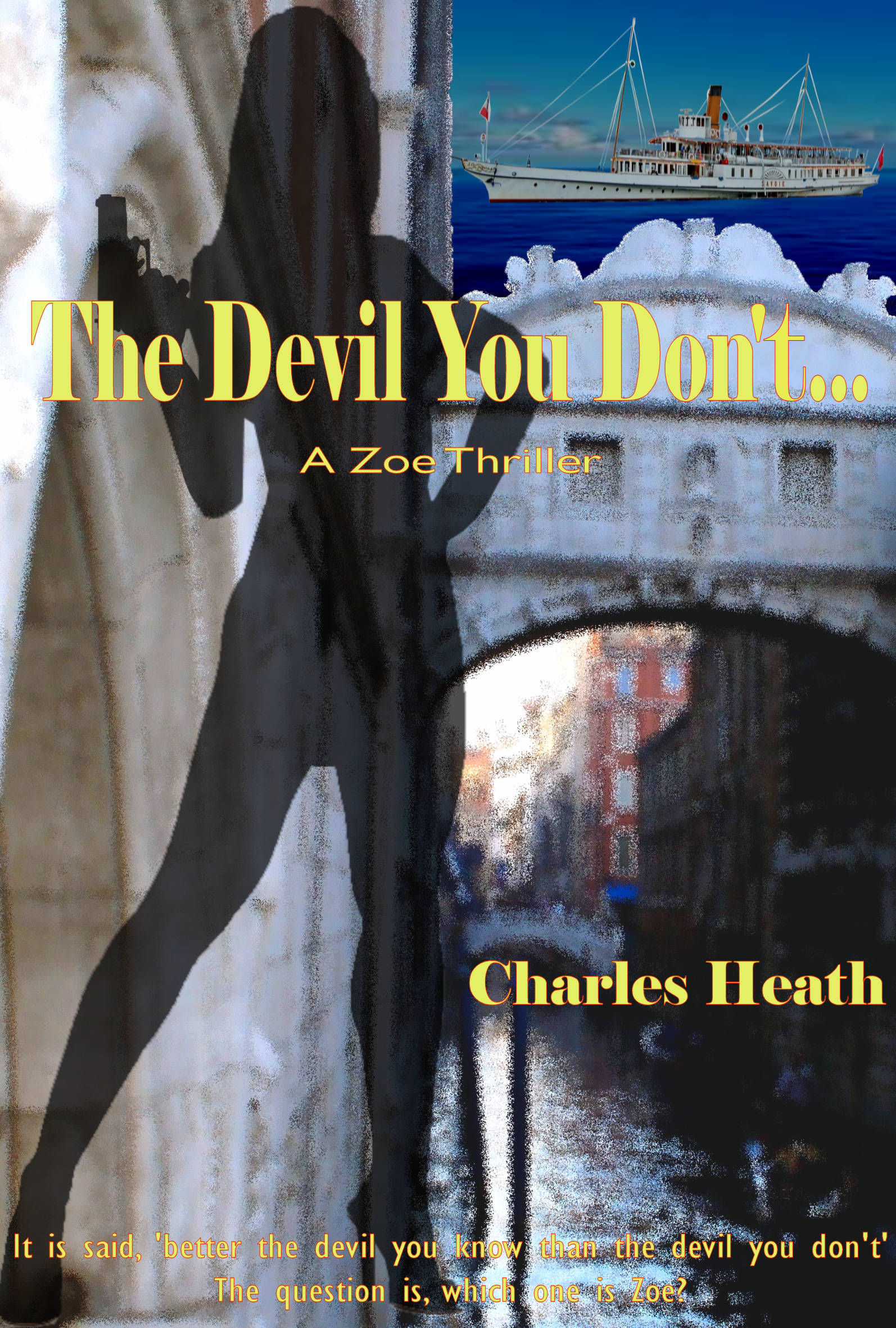
John Pennington’s life is in the doldrums. Looking for new opportunities, and prevaricating about getting married, the only joy on the horizon was an upcoming visit to his grandmother in Sorrento, Italy.
Suddenly he is left at the check-in counter with a message on his phone telling him the marriage is off, and the relationship is over.
If only he hadn’t promised a friend he would do a favour for him in Rome.
At the first stop, Geneva, he has a chance encounter with Zoe, an intriguing woman who captures his imagination from the moment she boards the Savoire, and his life ventures into uncharted territory in more ways than one.
That ‘favour’ for his friend suddenly becomes a life-changing event, and when Zoe, the woman who he knows is too good to be true, reappears, danger and death follow.
Shot at, lied to, seduced, and drawn into a world where nothing is what it seems, John is dragged into an adrenaline-charged undertaking, where he may have been wiser to stay with the ‘devil you know’ rather than opt for the ‘devil you don’t’.
It was the first time in almost a week that I made the short walk to the cafe alone. It was early, and the chill of the morning was still in the air. In summer, it was the best time of the day. When Susan came with me, it was usually much later, when the day was much warmer and less tolerable.
On the morning of the third day of her visit, Susan said she was missing the hustle and bustle of London, and by the end of the fourth she said, in not so many words, she was over being away from ‘civilisation’. This was a side of her I had not seen before, and it surprised me.
She hadn’t complained, but it was making her irritable. The Susan that morning was vastly different to the Susan on the first day. So much, I thought, for her wanting to ‘reconnect’, the word she had used as the reason for coming to Greve unannounced.
It was also the first morning I had time to reflect on her visit and what my feelings were towards her. It was the reason I’d come to Greve: to soak up the peace and quiet and think about what I was going to do with the rest of my life.
I sat in my usual corner. Maria, one of two waitresses, came out, stopped, and there was no mistaking the relief in her manner. There was an air of tension between Susan and Maria I didn’t understand, and it seemed to emanate from Susan rather than the other way around. I could understand her attitude if it was towards Alisha, but not Maria. All she did was serve coffee and cake.
When Maria recovered from the momentary surprise, she said, smiling, “You are by yourself?” She gave a quick glance in the direction of my villa, just to be sure.
“I am this morning. I’m afraid the heat, for one who is not used to it, can be quite debilitating. I’m also afraid it has had a bad effect on her manners, for which I apologise. I cannot explain why she has been so rude to you.”
“You do not have to apologise for her, David, but it is of no consequence to me. I have had a lot worse. I think she is simply jealous.”
It had crossed my mind, but there was no reason for her to be. “Why?”
“She is a woman, I am a woman, she thinks because you and I are friends, there is something between us.”
It made sense, even if it was not true. “Perhaps if I explained…”
Maria shook her head. “If there is a hole in the boat, you should not keep bailing but try to plug the hole. My grandfather had many expressions, David. If I may give you one piece of advice, as much as it is none of my business, you need to make your feelings known, and if they are not as they once were, and I think they are not, you need to tell her. Before she goes home.”
Interesting advice. Not only a purveyor of excellent coffee, but Maria was also a psychiatrist who had astutely worked out my dilemma. What was that expression, ‘not just a pretty face’?
“Is she leaving soon?” I asked, thinking Maria knew more about Susan’s movements than I did.
“You would disappoint me if you had not suspected as much. Susan was having coffee and talking to someone in her office on a cell phone. It was an intense conversation. I should not eavesdrop, but she said being here was like being stuck in hell. It is a pity she does not share your love for our little piece of paradise, is it not?”
“It is indeed. And you’re right. She said she didn’t have a phone, but I know she has one. She just doesn’t value the idea of getting away from the office. Perhaps her role doesn’t afford her that luxury.”
And perhaps Alisha was right about Maria, that I should be more careful. She had liked Maria the moment she saw her. We had sat at this very table, the first day I arrived. I would have travelled alone, but Prendergast, my old boss, liked to know where ex-employees of the Department were, and what they were doing.
She sighed. “I am glad I am just a waitress. Your usual coffee and cake?”
“Yes, please.”
Several months had passed since we had rescued Susan from her despotic father; she had recovered faster than we had thought, and settled into her role as the new Lady Featherington, though she preferred not to use that title, but go by the name of Lady Susan Cheney.
I didn’t get to be a Lord, or have any title, not that I was expecting one. What I had expected was that Susan, once she found her footing as head of what seemed to be a commercial empire, would not have time for details like husbands, particularly when our agreement made before the wedding gave either of us the right to end it.
There was a moment when I visited her recovering in the hospital, where I was going to give her the out, but I didn’t, and she had not invoked it. We were still married, just not living together.
This visit was one where she wanted to ‘reconnect’ as she called it, and invite me to come home with her. She saw no reason why we could not resume our relationship, conveniently forgetting she indirectly had me arrested for her murder, charges both her mother and Lucy vigorously pursued, and had the clone not returned to save me, I might still be in jail.
It was not something I would forgive or forget any time soon.
There were other reasons why I was reluctant to stay with her, like forgetting small details, an irregularity in her character I found odd. She looked the same, she sounded the same, she basically acted the same, but my mind was telling me something was not right. It was not the Susan I first met, even allowing for the ordeal she had been subjected to.
But, despite those misgivings, there was no question in my mind that I still loved her, and her clandestine arrival had brought back all those feelings. But as the days passed, I began to get the impression my feelings were one-sided and she was just going through the motions.
Which brought me to the last argument, earlier, where I said if I went with her, it would be business meetings, social obligations, and quite simply her ‘celebrity’ status that would keep us apart. I reminded her that I had said from the outset I didn’t like the idea of being in the spotlight, and when I reiterated it, she simply brushed it off as just part of the job, adding rather strangely that I always looked good in a suit. The flippancy of that comment was the last straw, and I left before I said something I would regret.
I knew I was not a priority. Maybe somewhere inside me, I had wanted to be a priority, and I was disappointed when I was not.
And finally, there was Alisha. Susan, at the height of the argument, had intimated she believed I had an affair with her, but that elephant was always in the room whenever Alisha was around. It was no surprise when I learned Susan had asked Prendergast to reassign her to other duties.
At least I knew what my feelings for Alisha were, and there were times when I had to remember she was persona non grata. Perhaps that was why Susan had her banished, but, again, a small detail; jealousy was not one of Susan’s traits when I first knew her.
Perhaps it was time to set Susan free.
When I swung around to look in the direction of the lane where my villa was, I saw Susan. She was formally dressed, not in her ‘tourist’ clothes, which she had bought from one of the local clothing stores. We had fun that day, shopping for clothes, a chore I’d always hated. It had been followed by a leisurely lunch, lots of wine and soul searching.
It was the reason why I sat in this corner; old habits die hard. I could see trouble coming from all directions, not that Susan was trouble or at least I hoped not, but it allowed me the time to watch her walking towards the cafe in what appeared to be short, angry steps; perhaps the culmination of the heat wave and our last argument.
She glared at me as she sat, dropping her bag beside her on the ground, where I could see the cell phone sitting on top. She followed my glance down, and then she looked unrepentant back at me.
Maria came back at the exact moment she was going to speak. I noticed Maria hesitate for a second when she saw Susan, then put her smile in place to deliver my coffee.
Neither spoke nor looked at each other. I said, “Susan will have what I’m having, thanks.”
Maria nodded and left.
“Now,” I said, leaning back in my seat, “I’m sure there’s a perfectly good explanation as to why you didn’t tell me about the phone, but that first time you disappeared, I’d guessed you needed to keep in touch with your business interests. I thought it somewhat unwisethat you should come out when the board of one of your companies was trying to remove you, because of what was it, an unexplained absence? All you had to do was tell me there were problems and you needed to remain at home to resolve them.”
My comment elicited a sideways look, with a touch of surprise.
“It was unfortunate timing on their behalf, and I didn’t want you to think everything else was more important than us. There were issues before I came, and I thought the people at home would be able to manage without me for at least a week, but I was wrong.”
“Why come at all. A phone call would have sufficed.”
“I had to see you, talk to you. At least we have had a chance to do that. I’m sorry about yesterday. I once told you I would not become my mother, but I’m afraid I sounded just like her. I misjudged just how much this role would affect me, and truly, I’m sorry.”
An apology was the last thing I expected.
“You have a lot of work to do catching up after being away, and of course, in replacing your mother and gaining the requisite respect as the new Lady Featherington. I think it would be for the best if I were not another distraction. We have plenty of time to reacquaint ourselves when you get past all these teething issues.”
“You’re not coming with me?” She sounded disappointed.
“I think it would be for the best if I didn’t.”
“Why?”
“It should come as no surprise to you that I’ve been keeping an eye on your progress. You are so much better doing your job without me. I told your mother once that when the time came I would not like the responsibilities of being your husband. Now that I have seen what it could possibly entail, I like it even less. You might also want to reconsider our arrangement, after all, we only had a marriage of convenience, and now that those obligations have been fulfilled, we both have the option of terminating it. I won’t make things difficult for you if that’s what you want.”
It was yet another anomaly, I thought; she should look distressed, and I would raise the matter of that arrangement. Perhaps she had forgotten the finer points. I, on the other hand, had always known we would not last forever. The perplexed expression, to me, was a sign she might have forgotten.
Then, her expression changed. “Is that what you want?”
“I wasn’t madly in love with you when we made that arrangement, so it was easy to agree to your terms, but inexplicably, since then, my feelings for you changed, and I would be sad if we parted ways. But the truth is, I can’t see how this is going to work.”
“In saying that, do you think I don’t care for you?”
That was exactly what I was thinking, but I wasn’t going to voice that opinion out loud. “You spent a lot of time finding new ways to make my life miserable, Susan. You and that wretched friend of yours, Lucy. While your attitude improved after we were married, that was because you were going to use me when you went to see your father, and then almost let me go to prison for your murder.”
“I had nothing to do with that, other than to leave, and I didn’t agree with Lucy that you should be made responsible for my disappearance. I cannot be held responsible for the actions of my mother. She hated you; Lucy didn’t understand you, and Millie told me I was stupid for not loving you in return, and she was right. Why do you think I gave you such a hard time? You made it impossible not to fall in love with you, and it nearly changed my mind about everything I’d been planning so meticulously. But perhaps there was a more subliminal reason why I did because after I left, I wanted to believe, if anything went wrong, you would come and find me.”
“How could you possibly know that I’d even consider doing something like that, given what you knew about me?”
“Prendergast made a passing comment when my mother asked him about you; he told us you were very good at finding people and even better at fixing problems.”
“And yet here we are, one argument away from ending it.”
I could see Maria hovering, waiting for the right moment to deliver her coffee, then go back and find Gianna, the café owner, instead. Gianna was more abrupt and, for that reason, was rarely seen serving the customers. Today, she was particularly cantankerous, banging the cake dish on the table and frowning at Susan before returning to her kitchen. Gianna didn’t like Susan either.
Behind me, I heard a car stop, and when she looked up, I knew it was for her. She had arrived with nothing, and she was leaving with nothing.
She stood. “Last chance.”
“Forever?”
She hesitated and then shook away the look of annoyance on her face. “Of course not. I wanted you to come back with me so we could continue working on our relationship. I agree there are problems, but it’s nothing we can’t resolve if we try.”
I had been trying. “It’s too soon for both of us, Susan. I need to be able to trust you, and given the circumstances, and all that water under the bridge, I’m not sure if I can yet.”
She frowned at me. “As you wish.” She took an envelope out of her bag and put it on the table. “When you are ready, it’s an open ticket home. Please make it sooner rather than later. Despite what you think of me, I have missed you, and I have no intention of ending it between us.”
That said, she glared at me for a minute, shook her head, then walked to the car. I watched her get in and the car drive slowly away.
For a story that was conceived during those long boring hours flying in a steel cocoon, striving to keep away the thoughts that the plane and everyone in it could just simply disappear as planes have in the past, it has come a long way.
Whilst I have always had a fascination with what happened during the second world war, not the battles or fighting, but in the more obscure events that took place, I decided to pen my own little sidebar to what was a long and bitter war.
And, so, it continues…
——
SS Standartenfuhrer Wilhelm Schmidt and his men were looking forward to some rest and recreation, after they completed one small but vitally important job for the Reichsfuhrer: retrieve a traitor named Meyer and bring him back to Berlin so an example could be made of him to deter others.
A simple job, several days at best, very much a holiday in itself after several long years in various campaigns.
He always wanted to visit Italy and particularly Tuscany, and they would be staying in a castle, with, he had been told, a very refined wine cellar.
He had also been told there was a possibility that the column might be attacked on its way to the castle, and he had all of his men on high alert. He was almost disappointed nothing happened. He didn’t think it would. Few resistance fighters would hardly go up against the might of a panzer, and his crack troops.
He’d said as much to the castle commander, a double agent by the name of Wallace, known as British to the British and German to the high command. Schmidt had no interest in double agents, or agents of any kind, along with the intelligence services or the Gestapo for that matter. He was here for the traitor and then gone.
They made it without incident, the main gates opened for their arrival, then closed after the panzer and trucks were parked inside.
Wallace was waiting for him.
Salutes, then, “No trouble along the way?”
“No. Should there be? I know we were warned, but all we saw were war-weary Italian women and children, and a few old men.”
“The resistance is out there, led by an Englishman by the name of Atherton. I wouldn’t underestimate him and the few resistance left.”
Schmidt thought Wallace looked rattled, a man at the end of his tether. He’d seen quite a few like him, too long at the front, jumping at shadows.
“It won’t be a problem. I’ll send out a squad of 10 and they’ll mop up anyone left. They’re probably hiding in the woods, or, if they saw the tank, shaking in their boots. Chances are they will have left if they had any sense.”
Wallace hated arrogance, and Schmidt had it in spades. There would be little point telling him that this wasn’t a battlefield, but guerilla warfare against an enemy on their home ground. The fact Jackerby had not come back, or Fernando and his men told him Atherton was picking them off, one by one, if they left the castle.
If Schmidt wanted to go wandering around outside, that was his choice. Wallace was staying inside and waiting until they mounted an attack. Or for them to realise it was going to be a stalemate. He was now no longer interested in Meyer, that was Schmidt’s problem.
Schmidt selected 9 soldiers and put his second in command in charge of them with very specific orders. If anything, other than one of their men moved, shoot it. He did not want prisoners.
The rest of the men were sent to the makeshift barracks, a building that was used as a chapel not far from where the tank and trucks were parked. The rest of the castle’s men were also there, except for those on guard duty on the ramparts, and in the cellars where there were entrances from outside.
Not that anyone could get through the iron gates that were currently locked. Atherton and whomever he had with him would not be gaining entrance to the castle from below, and those on the ramparts would pick them off long before they reached the main gate, or the walls.
At strategic points on the rampart, machine guns had been set up, and a box or two of hand grenades were available. Wallace was fairly confident there was nowhere where Atherton could gain access, despite his clandestine exploration of the castle when he first arrived.
Wallace personally checked the sentry points and alertness of the guards.
Then he went down to the cellar and the gate where the soldiers involved in what was now called ‘operation mop-up’ were waiting for darkness to fall before leaving.
Wallace came down to see them leave, not surprised by the buoyed spirits and camaraderie of men who had been working together for a long time. He envied them. With the sort of work he and the few members of his team did, there was no time for any bonding, and each lived with the fact that they could not really trust anyone, even those they worked with.
Then, in a matter of minutes, in almost silence, they were gone, and the gate was locked. With any luck, the area would be cleared of resistance and locked down in preparation for the arrival of Meyer. His handler would be captured and would inform them of the pipeline further up the chain of command, and then he could put an end to the traitors escaping.
With any luck, he might still get back to Germany as a hero.