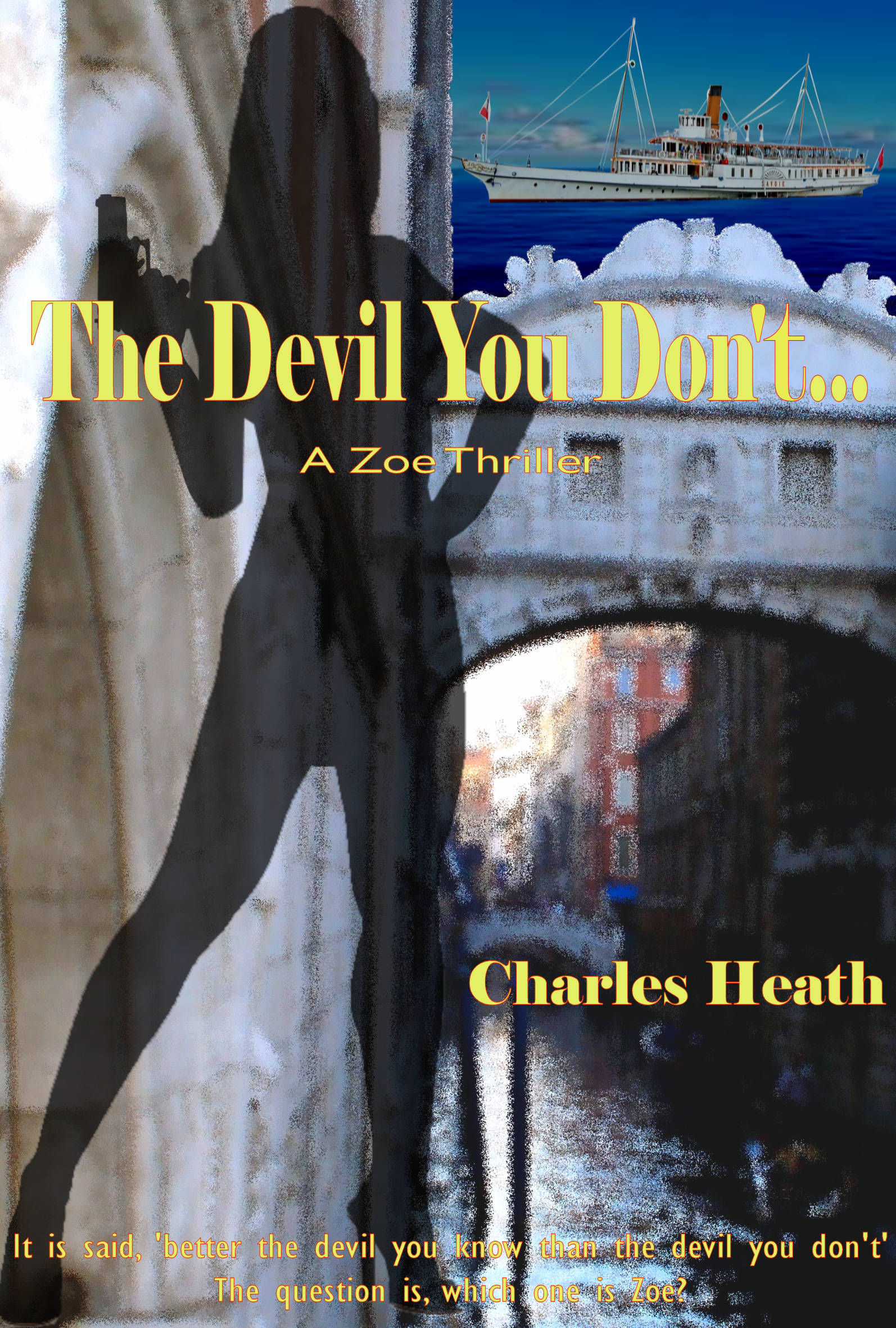
‘The Devil You Don’t’ – A beta reader’s view

It could be said that of all the women one could meet, whether contrived or by sheer luck, what are the odds it would turn out to be the woman who was being paid a very large sum to kill you.

John Pennington is a man who may be lucky in business, but not so lucky in love. He has just broken up with Phillipa Sternhaven, the woman he thought was the one, but relatives and circumstances, and perhaps because she was a ‘princess’, may also have contributed to the end result.

So, what do you do when you are heartbroken?

That is a story that slowly unfolds, from the first meeting with his nemesis on Lake Geneva, all the way to a hotel room in Sorrento, where he learns the shattering truth.

What should have been solace after disappointment, turns out to be something else entirely, and from that point, everything goes to hell in a handbasket.

He suddenly realizes his so-called friend Sebastian has not exactly told him the truth about a small job he asked him to do, the woman he is falling in love with is not quite who she says she is, and he is caught in the middle of a war between two men who consider people becoming collateral damage as part of their business.

The story paints the characters cleverly displaying all their flaws and weaknesses. The locations add to the story at times taking me back down memory lane, especially to Venice where, in those back streets I confess it’s not all that hard to get lost.

All in all a thoroughly entertaining story with, for once, a satisfying end.

…

Available on Amazon here: https://amzn.to/2Xyh1ow

…

Skeletons in the closet, and doppelgangers

A story called “Mistaken Identity”

…

How many of us have skeletons in the closet that we know nothing about? The skeletons we know about generally stay there, but those we do not, well, they have a habit of coming out of left field when we least expect it.

In this case, when you see your photo on a TV screen with the accompanying text that says you are wanted by every law enforcement agency in Europe, you’re in a state of shock, only to be compounded by those same police, armed and menacing, kicking the door down.

I’d been thinking about this premise for a while after I discovered my mother had a boyfriend before she married my father, a boyfriend who was, by all accounts, the man who was the love of her life.

Then, in terms of coming up with an idea for a story, what if she had a child by him that we didn’t know about, which might mean I had a half brother or sister I knew nothing about. It’s not an uncommon occurrence from what I’ve been researching.

There are many ways of putting a spin on this story.

Then, in the back of my mind, I remembered a story an acquaintance at work was once telling us over morning tea, that a friend of a friend had a mother who had a twin sister and that each of the sisters had a son by the same father, without each knowing of the father’s actions, both growing up without the other having any knowledge of their half brother, only to meet by accident on the other side of the world.

It was an encounter that in the scheme of things might never have happened, and each would have remained oblivious of the other.

For one sister, the relationship was over before she discovered she was pregnant, and therefore had not told the man he was a father. It was no surprise the relationship foundered when she discovered he was also having a relationship with her sister, a discovery that caused her to cut all ties with both of them and never speak to either from that day.

It’s a story with more twists and turns than a country lane!

And a great idea for a story.

That story is called ‘Mistaken Identity’.

Motive, means, and opportunity – Episode 5

…

Detective Bryson interviews Wendy Anderson

…

Worthey called Bryson, in the middle of a hamburger, with the owner of the cell phone number in Bergman’s wallet.  A woman, no surprise there, perhaps his latest conquest.  They settled on a time and Worthey texted the address, and said he would meet Bryson at the apartment, after lunch.

Bryson never really felt comfortable when talking to mistresses, perhaps more because of his beliefs than anything else, and it would be good to have Worthey there just in case he made some inappropriate comment.  It wouldn’t be the first time.

In his mind, being married was monogamous and you didn’t play around, certainly not like the overprivileged people he had to deal with.  The trouble was, they were not the only perpetrators, it just seemed more common.

And it was at the top of the list of motives for crime, especially murder.

Between the time between Worthey’s call and arriving at the apartment, the tech team had the phone company supply the text messages off the phone number his PA had supplied, and, it seemed, after a cursory glance at the swath of text messages on Bergman’s phone, there were several women he was involved with in various parts of the country, and overseas, but only one in New York.

Her name:  Wendy Anderson.  And the text messages were salacious, bordering on pornographic.  Except the last few where it seemed the relationship had turned nasty, and several compromising photographs were in play.  It wasn’t blackmail yet, but it was reason enough to get his bank records.  Bergman was not a scrupulous man.

As for phone calls the last between Bergman and Wendy Anderson was at 7:03 pm.  But that was not the last communication, that was a text message at 9:05 pm, after leaving Anderson’s telling her that he was not signing the papers yet until she clarified her situation with Bergman.  Anderson had asked him, and he had said nothing like they agreed.

There was a reply, that she was available if he wanted to see her to discuss the ‘other’ matter but he said he had another appointment at 10pm.  The other matter was, no doubt, the photos.

A quick search on Wendy’s social media by Worthey turned up the fact she also in the middle of a messy divorce, and that her relationship with Bergman had been since school.  It appeared that all three, Wendy’s husband, James, Bergman, and Wendy had all known each other forever, so the question had be bel when did things go south and why?

More digging through the blog entries discovered that Anderson’s only child had died in a car accident, and Wendy had blamed her husband, who had a blazing row with his son just before it happened.

Worthey looked up the details of the accident and found the son had been high on drugs, and no doubt the husband’s argument was about preventing him from driving.  The blog, he noted, not once mentioned the son’s addiction.  The blog also only mentioned Bergman in passing as a family friend, and supportive in her time of grieving.

Another layer to a complex interrogation, Worthey thought, and texted a brief analysis to Bryson so he had a heads up before meeting her.

Worthey met Bryson in the building foyer.

“Nothing is ever straightforward, is it?”

“Not with the rich and infamous, no.  So, we have a couple who suffer the loss of a son, the wife blames the husband, Bergman’s on the scene sensing an opportunity, and she has an affair, you say the texts turned salacious about a month after the accident.  Who initiated it?”

“Bergman.”

“They start an affair, and soon after divorce proceedings begin.  We need to see who started it, so a lawyer’s name.  Make a note.  Ten gets you a dozen this Wendy Anderson tries to implicate her husband in the murder.  Simple enough, they were a happy trio until the son’s death.”

“This Bergman character, we’re not finished digging up shit on him, are we?”

“No.”  Bryson gave him the list he received from the PA.  “Disgruntled businessmen and husbands.  The suspect list gets longer.  Ready?”

She, like the ex-Mrs Bergman, looked to have done well out of an upcoming divorce, living in a very expensive mid-town apartment.

It elicited a shake of the head from Bryson as he and Worthey waited outside the door, standing next to one of the building’s concierges.  He’d never be able to afford such luxury and only served to cement his low opinion of the so-called rich and infamous.

The door opened, not by a maid, but the occupant herself.  There was an element of grief about her that no amount of makeup could hide.  A look, he thought, that could be genuine, but having dealt with a lot of so-called grieving widows, he’d reserve judgement.  He knew most women thought tears were their best friend in situations like this.

A bit cynical, but from his point of view, it was true.

“Mrs Anderson, I presume.”

She nodded.

“Detectives Bryson and Worthey, NYPD.  You spoke to Worthey earlier.”

“Yes.  He said you would be calling to ask some questions about Alex?”

“May we come in?”

She stood to one side and let them pass then after closing the door followed him into a sitting room the walls adorned with not as many expensive paintings as Bergman’s current wife.

She directed him to a chair opposite where she sat.  Worthey hovered.

“We believe given the circumstances and evidence so far that this will most likely become a murder case, so I need to ask you some routine questions.  I will apologise in advance because some of these may be personal given your relationship with the deceased.  You may not be aware that we discovered your phone number on the deceased.”

She had hardly moved or appeared to have registered what he had said, but that might be part of an act.   Bryson’s experience in matters like these interviews, sometimes he got a reaction, and not necessarily what the interviewer wanted to convey.  She seemed grief-stricken, but it seemed odd that a woman having an affair might be unless it was something more serious.

As far as he was concerned, she was high on the list of suspects.

“At this point, we are just ticking the boxes in the process of interviewing those who were acquainted with the deceased, and to ascertain their movements and relationships with the victim.  So, firstly, what is the nature of your relationship with Alex Bergman.”

“We are very good friends and have been since grade school.  That was the extent of it.  He tried to make more of it, but I was a married woman and didn’t think is was appropriate.”

OK, he thought, that’s the first lie.  She blinked first, a slight hesitation before answering, which meant she was picking options as answers.

That was when he noticed her demeanour had changed, from a grieving friend to a steely-eyed, very wary woman.  If he had to guess, she was hoping the phone details would not be discovered.

“OK.  Now, in the last few days up until yesterday, how would you categorise the nature of your relationship with James Bergman?”

“He was strangely distant.  We had me earlier in the day, yesterday, over his impending divorce, and the fact my husband was stalling signing the papers.

“So, you two were considering taking your relationship to the next level?”

“I was a consideration, but I’d been burned badly with my current marriage and wasn’t about to jump into another.”

“You had reservations about Bergman’s character?”

Suddenly her whole manner changed, and she went defensive.  “What are you getting at, Detective?”

“It’s a simple question.  Did you have reservations about Bergman’s character?”

She was quick to notice his expression.  “Not particularly.”

Bryson decided on a change of tack, to keep her off balance.  “When was the last time you saw Bergman?”

“Yesterday.  We had lunch with another friend, Edward Davies, who is a lawyer.  We were talking about my pending divorce.  Alex had said he thought if he went to see my husband, he might be able to persuade him to sign the papers.  They used to be friends.”

“Alex Bergman went to see your husband last night.  Would you have any idea what time that might have been?”

“I last spoke to him about seven, just before he said he was leaving home.  I saw on the news before that he was found dead near Queens Park.  That’s not very far from where my husband is currently staying.”

True to form, Bryson thought.  An attempt to lay the blame for Alex Bergman’s death at her ex-husband’s feet.  If he was convicted of a crime, and especially murder, would benefit her greatly.

Mistaking his thoughtful expression for one that craved answers, she continued, “He has a gun, you know, and I wouldn’t be surprised if they had a fight, James followed him and shot him dead.  He never really liked James, not even in grade school.”

“Are you saying that your husband believed there was something going on between you and Bergman?”

A second’s delay as she reworked the answer in her head, perhaps not quite expressing it the way she should have.

“I cannot speak as to what he was thinking, but his attitude towards me had changed recently, so maybe he thought there was, and his temper got the better of him.”

The hole she was digging for herself was getting deeper.  Now he had a bad temper.  What it did was add to Bryson’s mental notes to ask James Anderson.  The gun, the temper, the wife, and did he know Bergman and Wendy were more seriously involved.  Bergman had indicated it was not serious.

Perhaps it was time to introduce new evidence.

“What was your last communication with Bergman?”  He deliberately didn’t use the word phone.

“About 7pm as I told you earlier.”

“Are you sure?”

Was that panic he saw in her eyes. 

“I think it’s time I called my lawyer.  This interview is over Detective.  Let me know where and when you want to continue this.  Unless you’re going to charge me?”

“This is just a preliminary enquiry.  However, I suggest you seriously consider what you say because if you are not telling us the truth, or of matters that may help in your defence, you might find yourself in a very serios situation.”  He stood.  “I thank you for your cooperation so far.  I’ll send a message with the place and time I will expect to see you to continue this interview.”

Outside Worthey said, “She doesn’t know we have Bergman’s phone records.”

“She’s hoping we haven’t, but I think she does now.  It’s going to be very interesting to see what she comes up with before tomorrow when we get her in.”

At the very least, Bryson thought, she would have to tell them the true extent of her and Bergman’s relationship, the text messages with the veiled threats, and the photographs, which she referred to as the ‘other’; matter.

“Questions still to ask, where was she at the time of the murder, what’s the extent of her knowledge about the gun her husband has, I’m assuming she had access to it as well, and whether it’s legal, something else for you to look at.  I’m going to see the husband, James, just in case she calls him.”

“They’re divorcing, why would she?”

“Desperate people do desperate things, Worthey.  And she was beginning to look desperate.”

“You think she did it?”

“Motive, means and opportunity, circumstantial, but it’s possible.  But in my experience, up close and personal with a gun is not a woman’s style, but she might be the exception.”

…

© Charles Heath 2019-2023

The cinema of my dreams – I always wanted to see the planets – Episode 35

There’s something on the long-range scanner

…

I didn’t make it back to the leafy suburban late-night stroll, as much as I wanted to have that relaxing moment, going back to the bridge.

It was quiet, if not a subdued atmosphere, in other words, normal for the hour.  It was a skeleton crew, mostly volunteers, those without partners or couldn’t sleep. 

Sleep was one of the first problems because there was no real differentiation between night and day, a sort of hangover from those who worked night shift back on earth, only it extended to everyone.  I’d long since given up the notion of getting a good night’s sleep.

“Where are we?”  I asked, after sitting in the chair and casting a glance over the bridge in semi-darkness, and the view of empty, inky black space outside the ship.

The answer to the question, I thought wryly, was ‘in space’, but I doubt any of those on duty would have the desire to use humour in such a situation.

“In direct line with Pluto’s orbit.”

Salaman, the navigating officer, was not a man with a sense of humour, a just the facts sort of person.

“Any chance if seeing the planet?”

“If we sit here for the next 68 years, maybe.”

OK, so Salaman did have some humour in him if a little dry.

“Engineering.”  The Chief Engineer’s voice came over the loudspeaker.

“Good news, I hope?”

“Problem sorted.  Another item to take up with the inspection crew when we get home.  You’re free to resume.”

“Thank you.”  Then to the helmsman, “Let’s take it slowly, quarter speed.”

“Quarter speed it is, sir.”

There was a barely noticeable movement, then it was as if nothing had happened.  That was the disconcerting part, the fact we had no discernible way of knowing we were moving.

“Quarter speed, sir, all systems nominal.”

“Give it five minutes, then move to half, and so on “

“Yes, sir.”

I leaned back in the chair and closed my eyes.  I often tried to remember what it was like back home, before the weather changed for the worse, before people changed, not necessarily for the worse, but not as friendly or happy we once were.

That was a long time ago, though, and I’d spent more of my life in space than on earth now and wasn’t sure how I was going to survive once I had to retire.  That was, hopefully, a long time away.

“Sir, we have a long-range contact, not sure yet if it’s a meteor or a ship.”  The navigator’s voice cut into my reverie.

Did she just add the ship to the report, hoping to make a boring night into something more interesting?

“Should we hold off going to full speed, Sir?”

Probably a good idea until we identified the problem.  “OK.”

I stood, walked over to the window, and looked out, symbolically looking for the object.  Long-range meant, beyond a million or so earth kilometres, barely discernible to the scanners let alone a human eye.

“It’s moving at about half light speed, coming towards us.”

That might be a stretch assuming that we could possibly be on an intercepting course.

“Change our heading five degrees and see if it changes too.”

There was a slight movement as we changed course.  I remained by the window, watching and waiting.  There were a few flecks in the blackness, and I wondered if this was the outer rim of a meteor shower.  Were they too small for the sensors to pick up, or was the navigator concentrating on the one large object?

Five minutes passed, then ten.

“Object still on a collision course, sir.”

Which missed stating the obvious, that whatever was out there had also changed course.  Whoever or whatever was out there wanted to meet us.

“Revert back to the original course.  When will we have a clearer picture of this object?”

“Fifteen minutes, sir.”

I had read the specifications of the long-range sensors and scanners, the former mostly do we could avoid space debris that could damage the hull, though that would take a relatively large chunk.

It was our speed, and that of incoming objects that were the problem, and that’s why we had sn autopilot to help avoid these issues.

The scanners could see objects, magnify them, from a reasonable distance, so we could identify them if we had previous knowledge of them.  Alien spaceships, if we were to encounter one, might make that identification difficult but not impossible.  But, on the other hand, the specifications of every ship in space, that we knew about, of course, was in the database.

Anything else, it could be added.

Nothing more to see, I sat down again.  We were still sitting at half speed, and from what I could see on my console, everything was fine.

Then the screen switched to the long-range scan of the object.

It was a ship.

The scanner was going through the known ships list, looking for a match, until it reached the end, bringing up “unknown”.

The navigator stated the obvious, “it’s a ship sir, but not one in our database.  Do you think it might be the prototype the Russians were talking about making a dozen or so years ago?”

Everyone knew about the famous, if you won’t share we’ll build our own, bigger and better ship when the space alliance at the time baulked at bully tactics the Russians tried to use to take over running the alliance.

They had backed down in the face of a world united against them, but had they really?

“We’ll soon find out.”

…

© Charles Heath 2021-2022

“Sunday in New York”, a romantic adventure that’s not a walk in the park!

“Sunday in New York” is ultimately a story about trust, and what happens when a marriage is stretched to its limits.

When Harry Steele attends a lunch with his manager, Barclay, to discuss a promotion that any junior executive would accept in a heartbeat, it is the fact his wife, Alison, who previously professed her reservations about Barclay, also agreed to attend, that casts a small element of doubt in his mind.

From that moment, his life, in the company, in deciding what to do, his marriage, his very life, spirals out of control.

There is no one big factor that can prove Harry’s worst fears, that his marriage is over, just a number of small, interconnecting events, when piled on top of each other, points to a cataclysmic end to everything he had believed in.

Trust is lost firstly in his best friend and mentor, Andy, who only hints of impending disaster, Sasha, a woman whom he saved, and who appears to have motives of her own, and then in his wife, Alison, as he discovered piece by piece damning evidence she is about to leave him for another man.

Can we trust what we see with our eyes or trust what we hear?

Haven’t we all jumped to conclusions at least once in our lives?

Can Alison, a woman whose self-belief and confidence is about to be put to the ultimate test, find a way of proving their relationship is as strong as it has ever been?

As they say in the classics, read on!

Purchase:

http://tinyurl.com/Amazon-SundayInNewYork

“Echoes From The Past”, the past doesn’t necessarily stay there


What happens when your past finally catches up with you?

…

Christmas is just around the corner, a time to be with family. For Will Mason, an orphan since he was fourteen, it is a time for reflection on what his life could have been, and what it could be.

Until a chance encounter brings back to life the reasons for his twenty years of self-imposed exile from a life only normal people could have. From that moment Will’s life slowly starts to unravel and it’s obvious to him it’s time to move on.

This time, however, there is more at stake.

Will has broken his number one rule, don’t get involved.

With his nemesis, Eddie Jamieson, suddenly within reach, and a blossoming relationship with an office colleague, Maria, about to change everything, Will has to make a choice. Quietly leave, or finally, make a stand.

But as Will soon discovers, when other people are involved there is going to be terrible consequences no matter what choice he makes.

https://amzn.to/2CYKxu4

newechocover5rs

An excerpt from “What Sets Us Apart”, a mystery with a twist

See the excerpt from the story below, just a taste of what’s in store…

http://amzn.to/2Eryfth

whatsetscover

McCallister was old school, a man who would most likely fit in perfectly campaigning on the battlefields of Europe during the Second World War. He’d been like a fish out of water in the army, post-Falklands, and while he retired a hero, he still felt he’d more to give.

He’d applied and was accepted as head of a SWAT team, and, watching him now as he and his men disembarked from the truck in almost military precision, a look passed between Annette, the police liaison officer, and I that said she’d seen it all before. I know I had.

There was a one in four chance his team would be selected for this operation, and she had been hoping it would be one of the other three. While waiting for them to arrive she filled me in on the various teams. His was the least co-operative, and the more likely to make ad-hoc decisions rather than adhere to the plan, or any orders that may come from the officer in charge.

This, she said quite bluntly, was going to end badly.

I still had no idea why Prendergast instructed me to attend the scene of what looked to be a normal domestic operation, but as the nominated expert in the field in these types of situations, it was fairly clear he wasn’t taking any chances. It was always a matter of opinion between us, and generally I lost.

In this case, it was an anonymous report identifying what the authorities believed were explosives in one of the dockside sheds where explosives were not supposed to be.

The only reason why the report was given any credence was the man, while not identifying himself by name, said he’d been an explosive expert once and recognized the boxes. That could mean anything, but the Chief Constable was a cautious man.

With his men settled and preparing their weapons, McCallister came over to the command post, not much more than the SUV my liaison and I arrived in, with weapons, bulletproof vests, and rolls of tape to cordon off the area afterward. We both had coffee, steaming in the cold early morning air. Dawn was slowly approaching and although rain had been forecast it had yet to arrive.

A man by the name of Benson was in charge. He too had groaned when he saw McCallister.

“A fine morning for it.” McCallister was the only enthusiastic one here.

He didn’t say what ‘it’ was, but I thought it might eventually be mayhem.

“Let’s hope the rain stays away. It’s going to be difficult enough without it,” Benson said, rubbing his hands together. We had been waiting for the SWAT team to arrive, and another team to take up their position under the wharf, and who was in the final stages of securing their position.

While we were waiting we drew up the plan. I’d go in first to check on what we were dealing with, and what type of explosives. The SWAT team, in the meantime, were to ensure all the exits to the shed were covered. When I gave the signal, they were to enter and secure the building. We were not expecting anyone inside or out, and no movement had been detected in the last hour since our arrival and deployment.

“What’s the current situation?”

“I’ve got eyes on the building, and a team coming in from the waterside, underneath. Its slow progress, but they’re nearly there. Once they’re in place, we’re sending McKenzie in.”

He looked in my direction.

“With due respect sir, shouldn’t it be one of us?” McCallister glared at me with the contempt that only a decorated military officer could.

“No. I have orders from above, much higher than I care to argue with, so, McCallister, no gung-ho heroics for the moment. Just be ready to move on my command, and make sure you have three teams at the exit points, ready to secure the building.”

McCallister opened his mouth, no doubt to question those orders, but instead closed it again. “Yes sir,” he muttered and turned away heading back to his men.

“You’re not going to have much time before he storms the battlements,” Benson quietly said to me, a hint of exasperation in his tone. “I’m dreading the paperwork.”

It was exactly what my liaison officer said when she saw McCallister arriving.

The water team sent their ‘in position’ signal, and we were ready to go.

In the hour or so we’d been on site nothing had stirred, no arrivals, no departures, and no sign anyone was inside, but that didn’t mean we were alone. Nor did it mean I was going to walk in and see immediately what was going on. If it was a cache of explosives then it was possible the building was booby-trapped in any number of ways, there could be sentries or guards, and they had eyes on us, or it might be a false alarm.

I was hoping for the latter.

I put on the bulletproof vest, thinking it was a poor substitute for full battle armor against an exploding bomb, but we were still treating this as a ‘suspected’ case. I noticed my liaison officer was pulling on her bulletproof vest too.

“You don’t have to go. This is my party, not yours,” I said.

“The Chief Constable told me to stick to you like glue, sir.”

I looked at Benson. “Talk some sense into her please, this is not a kindergarten outing.”

He shrugged. Seeing McCallister had taken all the fight out of him. “Orders are orders. If that’s what the Chief Constable requested …”

Madness. I glared at her, and she gave me a wan smile. “Stay behind me then, and don’t do anything stupid.”

“Believe me, I won’t be.” She pulled out and checked her weapon, chambering the first round. It made a reassuring sound.

Suited up, weapons readied, a last sip of the coffee in a stomach that was already churning from nerves and tension, I looked at the target, one hundred yards distant and thought it was going to be the longest hundred yards I’d ever traversed. At least for this week.

A swirling mist rolled in and caused a slight change in plans.

Because the front of the buildings was constantly illuminated by large overhead arc lamps, my intention had been to approach the building from the rear where there was less light and more cover. Despite the lack of movement, if there were explosives in that building, there’d be ‘enemy’ surveillance somewhere, and, after making that assumption, I believed it was going to be easier and less noticeable to use the darkness as a cover.

It was a result of the consultation, and studying the plans of the warehouse, plans that showed three entrances, the main front hangar type doors, a side entrance for truck entry and exit and a small door in the rear, at the end of an internal passage leading to several offices. I also assumed it was the exit used when smokers needed a break. Our entry would be by the rear door or failing that, the side entrance where a door was built into the larger sliding doors. In both cases, the locks would not present a problem.

The change in the weather made the approach shorter, and given the density of the mist now turning into a fog, we were able to approach by the front, hugging the walls, and moving quickly while there was cover. I could feel the dampness of the mist and shivered more than once.

It was nerves more than the cold.

I could also feel rather than see the presence of Annette behind me, and once felt her breath on my neck when we stopped for a quick reconnaissance.

It was the same for McCallister’s men. I could feel them following us, quickly and quietly, and expected, if I turned around, to see him breathing down my neck too.

It added to the tension.

My plan was still to enter by the back door.

We slipped up the alley between the two sheds to the rear corner and stopped. I heard a noise coming from the rear of the building, and the light tap on the shoulder told me Annette had heard it too. I put my hand up to signal her to wait, and as a swirl of mist rolled in, I slipped around the corner heading towards where I’d last seen the glow of a cigarette.

The mist cleared, and we saw each other at the same time. He was a bearded man in battle fatigues, not the average dockside security guard.

He was quick, but my slight element of surprise was his undoing, and he was down and unconscious in less than a few seconds with barely a sound beyond the body hitting the ground. Zip ties secured his hands and legs, and tape his mouth. Annette joined me a minute after securing him.

A glance at the body then me, “I can see why they, whoever they are, sent you.”

She’d asked who I worked for, and I didn’t answer. It was best she didn’t know.

“Stay behind me,” I said, more urgency in my tone. If there was one, there’d be another.

Luck was with us so far. A man outside smoking meant no booby traps on the back door, and quite possibly there’d be none inside. But it indicated there were more men inside, and if so, it appeared they were very well trained. If that were the case, they would be formidable opponents.

The fear factor increased exponentially.

I slowly opened the door and looked in. A pale light shone from within the warehouse itself, one that was not bright enough to be detected from outside. None of the offices had lights on, so it was possible they were vacant. I realized then they had blacked out the windows. Why hadn’t someone checked this?

Once inside, the door closed behind us, progress was slow and careful. She remained directly behind me, gun ready to shoot anything that moved. I had a momentary thought for McCallister and his men, securing the perimeter.

At the end of the corridor, the extent of the warehouse stretched before us. The pale lighting made it seem like a vast empty cavern, except for a long trestle table along one side, and, behind it, stacks of wooden crates, some opened. It looked like a production line.

To get to the table from where we were was a ten-yard walk in the open. There was no cover. If we stuck to the walls, there was equally no cover and a longer walk.

We needed a distraction.

As if on cue, the two main entrances disintegrated into flying shrapnel accompanied by a deafening explosion that momentarily disoriented both Annette and I. Through the smoke and dust kicked up I saw three men appear from behind the wooden crates, each with what looked like machine guns, spraying bullets in the direction of the incoming SWAT members.

They never had a chance, cut down before they made ten steps into the building.

By the time I’d recovered, my head heavy, eyes watering and ears still ringing, I took several steps towards them, managing to take down two of the gunmen but not the third.

I heard a voice, Annette’s I think, yell out, “Oh, God, he’s got a trigger,” just before another explosion, though all I remember in that split second was a bright flash, the intense heat, something very heavy smashing into my chest knocking the wind out of me, and then the sensation of flying, just before I hit the wall.

I spent four weeks in an induced coma, three months being stitched back together and another six learning to do all those basic actions everyone took for granted. It was twelve months almost to the day when I was released from the hospital, physically, except for a few alterations required after being hit by shrapnel, looking the same as I always had.

But mentally? The document I’d signed on release said it all, ‘not fit for active duty; discharged’.

It was in the name of David Cheney. For all intents and purposes, Alistair McKenzie was killed in that warehouse, and for the first time ever, an agent left the Department, the first to retire alive.

I was not sure I liked the idea of making history.

© Charles Heath 2016-2020
Motive, means, and opportunity – Episode 6

…

Detective Bryson interviews James Anderson

…

Before Bryson visited James Anderson, he checked out the residence, the proximity to the park where Bagman’s body was found, a distance of two and a half miles, which to him didn’t constitute ‘near’, and whether there were any CCTV cameras along the way.

He made a note of several and sent to report back to Worthey who was sinking under the weight of several investigations at once.  His chief was not allocating more men to the case yet unless he found compelling evidence that needed more personnel.

They had also obtained James Anderson’s phone records, and there was little or no damning evidence there.  No calls to or from Bergman, and three in the last month to and from Wendy, his wife.  James had no social media presence, was a high-flying lawyer who came to earth with a thud after a breakdown, after the death of their son coincidentally and was now battling an acrimonious divorce.

He was currently not working, except as a pro bono lawyer at a local courthouse.  A check of his finances showed that he had put away funds when he had them, and made wise investments, but had left himself exposed to what might be described as an opportunistic wife who was seeking an extravagant settlement.

In contrast, Bergman’s financial situation could be best described as distressed, and the company basically insolvent, and a meeting with his lawyer would no doubt confirm the rumours Worthey had found that he was about to declare bankruptcy, a state that would cause a whole new collection of people distress and a motive for murder.

But killing him before then would not do them any good, so he doubted it was one of them.

Perhaps when Wendy fleeced her husband, he was going to blackmail her for the funds to keep his businesses afloat.  Stranger things were known to happen.

The residence was old and decrepit and showed that Anderson was not necessarily a man of means.  Bryson knew otherwise, but it might mean he was just careful with his money.

Bryson had called earlier and was expected.  It was clear from that phone call, the first, that Anderson knew of Bergman’s death; he had seen it on the news.  A point to note, he didn’t seem particularly distressed.

Anderson answered the door, and then showed him into the lounge.  Inside the house was better than the outside, though dated and tired.  It was reasonably clean, but that might be because of the visitor.  It didn’t look like Anderson had many visitors.

“I’m going to say from the outset that I have had a preliminary interview with your wife, Wendy,”  Bryson said this to gauge James’s reaction, which was minimal, as though he expected it.

“Was it interesting?”

An odd response to his statement.  “Not very informative.”

“No.  They have been friends for a long time.  I was included once upon a time, but I’m sure you’ve discovered in your preliminary investigation that the death of our son drove a wedge between Wendy and I and drove her into his arms.”

A different kettle of fish, Bryson thought, with this one.  He sought to get ahead of the narrative.

“How did that make you feel?”

“I don’t feel.  Not since Jimmy died.  I don’t blame myself for his death but regret not doing more to prevent it.  She was always in love with him, or the notion of it because Bergman was never a one-girl guy, he always had a string of them available.”

“Yet she married you,”  Bryson said it, and regretted saying it the moment it left his mouth.  And he was trying so hard not to get involved.

“A moment in time I’m sure she’s regretted many times since.  Except that she had more money to play with while with me.  Bergman was hopeless with money.  His business is on the rocks, and his wife is in for a shock if she expects anything in a settlement, other than a mountain of debt.”

A mental note: how does Anderson intimately know the financial status of Bergman?

“Your relationship with Wendy, I take it it’s over?”

“The moment we left the hospital when Jimmy died.  She blamed me for it and there was no other reason.  Nor could she be told, by the police or by the medical staff.  And whenever drugs were mentioned, it was me who drove him to them.”

“You’re living apart then?”

“She has the apartment we shared.  I moved out.  It was easier that way.  We don’t speak all that often, and since the divorce, rarely.  I’ve been on my own for about a year and a half now.”

“She mentioned you are refusing to sign the divorce papers.”

“I’m still waiting for her to clarify her situation with Bergman.  Once I sign the papers, she gets the settlement.  I don’t have a problem with that, but I do have a problem if Bergman is waiting in the wings to take it off her, or worse, she gives it to him to throw down the drain he calls a business.”

“Which brings us to your relationship with Bergman.”

“None.  That pretty much ended when we separated.  She was seeing him behind my back long before that, though, but it wasn’t a surprise.  I used to care, but like a runaway train, standing in front of it isn’t going to stop it.”

Interesting analogy.

“When did you last see him?”

“Last night.  The bastard turned up on my doorstep and virtually told me to sign the divorce papers or else.”

“Or else what?”

“He didn’t say.  I sent him packing and told him not to come back.”

“What time was this?”

“About 8 pm.  He was making such a noise he roused the neighbours.  You can go and ask them.  Old man Bentley saw him get in his car and leave.”

“Wendy says you own a gun?”

Bryson noted the change in Anderson’s demeanour, not overly defensive, but he knew it was coming.

“We do and both of us had training on how to use it, and as far as I’m aware, it’s still in the safe upstairs.  Has been for a long time because there’s been no reason to take it out.  In fact, I haven’t checked to see if it’s still there for years now.  I don’t like guns, and it’s only there in case we needed to defend ourselves.  It’ll still be in the gun safe here.”

“I thought the apartment was your primary residence.”

“No.  We bought that just before Jimmy died.  I’ve never stayed there.  If I had, I would have moved it there.”

“Can I see it?”

“Of course.”

Anderson led the detective upstairs and into the room where the gun safe was.  Bryson looked into rooms as he passed them, and briefly stopped at one.

“Jimmy’s.  Haven’t touched it since he died.  Too many painful memories in there.”

They moved on to the room at the end of the passage, a study, then Anderson opened it.

Everything else was there, except the gun.

Bryson could see the genuine surprise on Anderson’s face.  That was not something that could be faked..

“It’s been in here forever, still in its packaging, and bullets removed from the clip and stored elsewhere in the house.”

The papers that came with it were still in the safe, so Anderson pulled them out and handed them to Bryson.  It would detail what sort of weapon it was.”

“I can assure you I have no idea where it is, or why it’s missing.”

“Who has the combination to this safe.”

“Only Wendy and I.  Hang on.”  Anderson rummaged through the papers and stopped at a passport.  “Her passport is missing.  She’s been here recently.”

“She has keys to the house?”

“She has the keys to everything.  And all the alarm codes as well.  I can ask the security company to give me the access records for the last year if you like and you can see all the comings and goings.  We both had separate codes, and I never told her mine, and she never told me hers.”

“OK.  I’ll get forensics to come and have a look around.  There might be some prints we can get which might be a help, but that’s doubtful given you just opened it.  If you can think of anyone who might also have had access, or might know where it is, other than your ex-wife, call me.”

“Like I said, it’s been here for years, and it’s the first time I’ve used the safe in about six months when we needed the passports to go on a holiday.

“OK.  That will do for now.  Don’t leave the city.  Make sure that data from the security company gets to me.”

“Certainly.”

…

© Charles Heath 2019-2023

“I was minding my own business when…”, a short story

What do you say, when everything that could be had been said, and then some.

What did marriage counselors know, other than they are right, and you are wrong?

I don’t think either of us, with the same belief, could be wrong.  The marriage was over, and there was no use prolonging the agony.

Except we had to try to at least put some of the pieces back together, if only for the sake of walking away with a sense of closure and peace.

But, peace was the last thing in the atmosphere inside the car, and it had been like that since leaving Vancouver.

There had been a momentary truce in Kamloops where we had to stay, in separate rooms, and polite conversation over breakfast, until I put my foot in my mouth.

Again.

I’m not sure if I knew what to say to her anymore.  To her, everything I said was laced with an agenda or a subliminal plot.  I got it, I’d lied to her once too often, and once she proved one right, and, from there, it didn’t take long for the whole charade to unravel.

I’d been advised against marrying her, that I would not be able to do my job and have some sort of life with Eloise, but I wanted it.

And, fifteen months down the track, my employers had been proved right.
Eloise was driving.  Her parents lived in Banff, and we had made the trip in all of the four seasons, and now winter, she was more used to the icy conditions than I.

It gave me a chance to look at her from my side of the mid-sized SUV.  We were going to take her car, a rather small sedan, but it had broken down, so I hired a Ford Flex.

If you’re going to take on the elements, I wanted a car that could handle the conditions.

In that, I think I’d managed to surprise her, and not in a bad way.

For the first time in a long time.

Then, of course, she had to look sideways, and that ruined it.  The frown followed by the pursed lips.  Something caustic was about to come my way.

Except a very loud bang took us both by surprise, and skewing the car sideways, catching the edge of the ice on the road, and we started spinning.

As good as she was, there would be no containing this calamity.

I looked behind to see what the hell had hit us.

An F350 or RAM 2500, definitely larger than us, definitely deliberate, and definitely with intent to hurt us.

Or me.

My work had finally come home.

There was a scream just on the edge of her terror as the car had spun sideways and the car behind us slammed into it us again, arresting the spin and pushing us towards the edge of the road.

I could see what the pursuer’s intent was.  Down the side, a roll if possible, then pick off the survivors as they scrambled from the wreckage.

Or not have to worry, the roll may do the job for them.
We hit the edge as the other car braked, and we continued on, that stifled scream from Eloise now erupting.

She could see what was going to happen, just as our car tipped.

Six seconds.

Seat belt or not, totally unprepared for what was about to happen, she was not going to walk away from this.

Unless I did something about it.

Seatbelt unhitched I dragged her to me and protected her as best I could.  She didn’t resist, but the look in her eyes, terror laced with something else, no time to think about it now, told me she would do whatever I wanted.

Over on the roof, upside down, I prayed it stayed there, and slide,  The ice, snow, and slush was going to help.

Seconds passed, taking what seemed forever, till we reached the bottom of the hill and hit a rock, arresting the movement with a loud bang and a crunch of bending metal.

Stopped.

Engine still running.

No movement from her.  Yet.

And relief.  No bones were broken, or none that I noticed.

Under me, she stirred.

Just as a bullet smashed the rear passenger window, and the shattered glass splattered the interior.  A moment later, the side window, above my head did the same.
I lifted myself, whispering in her ear, “Slide towards the front window.”  It was buried in the snow and dirt kicked up in the final run to the bottom.  The shooter would not be able to see it, or her.

Above me, I reached up to feel under the seat and found the package.

A gun.  Always be prepared.

Ten seconds since the last shot.  From up top, the shooter would not be able to see us, or any movement.  He was going to have to come down and finish the job.

And hope we were would not be able to fight back.

That was the purpose of running us off the road.

Pity then that he had not been given my file.  If he had he would have driven off and tried again later.

That he was halfway down the hill when I saw him told me this operation had been cobbled together quickly, with no time to find a professional.

And now I knew why Barnes had told me to be careful.

A lone wolf looking to make a name for himself.

And failing.
Ten minutes, the police arrived.

Long enough to bury the body and the weapons under a lot of snow, in a ravine that no one would discover until the thaw.

The car that rammed us had gone.  Soon as he saw his partner go down, he left.  A wise man, he had stayed at the top of the hill, having more sense than his friend.

Live to fight another day,

The policeman asked the questions, and Eloise answered.  Not one mention of being rammed, run off the road, being shot at, or that there was anyone else involved.

As cool as a cucumber.

It took her a minute after I shot our attacker to ask the questions I’d expected a week ago when she finally discovered my other life, prefaced by, “No more lies, just tell me the truth.  What the hell is it you do for a living?”

“Make the world safe for people like you, and in my case right now, for you in particular.  Sorry, I was sworn to secrecy.”

“Even from your wife?”

“Especially from you.  You now know why.”

“Bit late for that now, do you think?”

“Just a little.”

And then I saw the look, the one I had fallen in love with 15 months ago.  The one that made my heart miss a few beats.

“You do realize you are the biggest idiot on the planet, don’t you?”

“Does this mean I can stay?”

She punched me on the arm.,  OK, no broken bones, but there was going to be bruising, major bruising.

“If you promise to tell me only the truth from now on.”

What harm could it do?  She knew enough.

“Good.  We should probably do something with that man out there.  I’m assuming the police do not take too kindly to you working in their jurisdiction.”

Too many thrillers, too much TV, or an educated guess, she was right.  This would be impossible to explain, and Barnes was already angry at me.

I held out my hand and she took it as I helped her out of the wreckage.  Out in the fresh, cold air, she took in a huge breath and let out a slow sigh.

“Is it always this exciting?”

“This is the Sunday in the park stroll.  Wait till you have a hand held rocket boring down on you.”


© Charles Heath 2019-2020

The cinema of my dreams – I always wanted to see the planets – Episode 34

A brief moment of respite

…

The simulation of nighttime on board the ship was as realistic as I remembered it when back on earth.

I was on my usual rounds after midnight, with the 2IC of security, Nancy Woolmer, who had been a NY detective until a better offer came along.

This ship.

Like me, she had little to keep her back home, her husband who had also been a detective, had been killed on the job, and that had been the straw that broke the camel’s back.

Not blessed, or as she put it, cursed, with children, her parents had passed on, and any family left were not enough to keep her home.  This ship, she had said, would be her savior.

But she had the look of a person running away, and that, one day, would come back to bite her.  In the meantime, if we ever needed a detective, she was it.

“They’ve really got this night thing going, haven’t they.  You could almost imagine you’re in a leafy suburb out for a walk at night.”

“I doubt the streets would be as safe.”

The world we had left behind was in crisis, where there were deep divides between those in work and those who were not, and those with wealth and those without, and a bigger fight between countries over the space program.  It had started out with good intentions, but people being people, it didn’t stay that way.  

We had an international crew, but there was always the lingering doubt of what some people’s intentions were.  Out in space where everyone depended on everyone else, a small problem could become a big one very quickly.

“No, perhaps not.  But it’s good to hear the breeze rustling in the trees.”

Though the simulation lacked real trees, the projection on the passage walls of what either side of a street. With pavements, trees and houses, and for the night, the eerie glow of street lamps, was close enough.

The once around the perimeter passage on each deck took about two hours at a leisurely pace, considering there were ten decks.

I could have passed the job onto one of the watch officers, but it was about the only time I got to see the crew, those that were basically out of sight, keeping the ship running.  

I had set the lofty goal of meeting every one of the over 2,000 crew members within the first year, but a few months in, that was looking unlikely.

There was a sudden vibration emanating from the deck, followed by the sort of movement I would have associated with the ship coming off speed, like the jerk in a car when taking the foot off the accelerator.  The dampeners were designed to handle that and make increases and decreases in speed unnoticeable, but there was still an indication it had happened.

Ten seconds later my communicator vibrated.  I didn’t like the ring tone built-in, but it was more likely because most calls were bad news.

“What happened,” I asked, knowing it would be the duty officer of the watch

“Engineering are reporting a glitch, sir.”

There’s a word I hadn’t heard for a long time.  My father used to refer to anything that went wrong around the house as a glitch.

“Serious?”

“Don’t know, but you’re within a stone’s throw, so I thought you might want to pay them a visit.”

He was right, I was on that deck, and not far from the central control room.  The bridge must be tracking me, even though I’d asked them not to.  Standing orders dictated all officers and important personnel whereabouts were known at all times, I’d been told.

“I will.”

To Nancy, “You might want to continue on without me, and I’ll try to catch up later.”

She smiled.  “Tell them they should have bought the premium quality rubber bands.”

Previous conversations had highlighted a certain cynicism towards the fixtures and fittings, some of which were quite shoddy, which was disappointing but there was no doubt corners were cut in order to get the ship into service.

We all just hoped that cost-cutting didn’t extend to the main items, and if there were, it had been picked up in the trials.

As I stepped into the control room, a brightly lit room with banks of control panels and engineers sitting at them, there were a number of people huddled around one in particular, including the chief engineer.

The conversation was quite lively, and one voice stood out above the others, “… and had the builders rep actually listen to someone who knows what they’re talking about, we wouldn’t be in this situation.”

It was the same voice I’d heard in the captain’s day room my first day aboard, pontificating, as the captain put it, over a list of problems he was having with the shipbuilders representative.

“We’re in this situation,” the Chief Engineer said, “because everything we have here is new, and some of it untried.  If you’re going to push boundaries, then sometimes there’s a problem.  Rather than complain, find a resolution.”

The group broke up, and the Chief saw me coming over.  He met me halfway.

“Half this new breed they’ve sent me and more teaches rather than hands-on, always on about the code or some such.  Good, maybe, for diagnostics, but not for problem-solving.  I suspect it’s tainted coolant, seems the original batch wasn’t cleaned out after the first run, and it’s overwhelmed the filters.  It’s down to the bowels I’m afraid, and we’ll be up and running before those nincompoops work out the real problem.”

“Good.  Just let the bridge know when you’re done.”

One last look at the nincompoops, and I headed back out to resume rounds.

…

© Charles Heath 2021