Harry Walthenson, Private Detective – the second case – A case of finding the “Flying Dutchman”

What starts as a search for a missing husband soon develops into an unbelievable story of treachery, lies, and incredible riches.

It was meant to remain buried long enough for the dust to settle on what was once an unpalatable truth, when enough time had passed, and those who had been willing to wait could reap the rewards.

The problem was, no one knew where that treasure was hidden or the location of the logbook that held the secret.

At stake, billions of dollars’ worth of stolen Nazi loot brought to the United States in an anonymous tramp steamer and hidden in a specially constructed vault under a specifically owned plot of land on the once docklands of New York.

It may have remained hidden and unknown to only a few, if it had not been for a mere obscure detail being overheard …

… by our intrepid, newly minted private detective, Harry Walthenson …

… and it would have remained buried.

Now, through a series of unrelated events, or are they, that well-kept secret is out there, and Harry will not stop until the whole truth is uncovered.

Even if it almost costs him his life.  Again.

An excerpt from “Mistaken Identity” – a work in progress

The odds of any one of us having a doppelganger are quite high. Whether or not you got to meet him or her, or be confronted by them was significantly lower. Except of course, unless you are a celebrity.

It was a phenomenon remarkable only for the fact, at times, certain high-profile people, notorious or not, had doubles if only to put off enemies or the general public. Sometimes we see people in the street, people who look like someone we knew, and made the mistake of approaching them like a long lost friend, only to discover an embarrassed individual desperately trying to get away for what they perceive is a stalker or worse.

And then sometimes it is a picture that looms up on a TV screen, an almost exact likeness of you. At first, you are fascinated, and then according to the circumstances, and narrative that is attached to that picture, either flattered or horrified.

For me one turned to the other when I saw an almost likeness of me flash up on the screen when I turned the TV on in my room. What looked to be my photo, with only minor differences, was in the corner of the screen, the newsreader speaking in rapid Italian, so fast I could only translate every second or third word.

But the one word I did recognize was murder. The photo of the man up on the screen was the subject of an extensive manhunt. The crime, the murder of a woman in the very same hotel I was staying, and it was being played out live several floors above me. The gist of the story, the woman had been seen with, and staying with the man who was my double, and, less than an hour ago, the body had been discovered by a chambermaid.

The killer, the announcer said, was believed to be still in the hotel because the woman had died shortly before she had been discovered.

I watched, at first fascinated at what I was seeing. I guess I should have been horrified, but at that moment it didn’t register that I might be mistaken for that man.

Not until another five minutes had passed, and I was watching the police in full riot gear, with a camera crew following behind, coming up a passage towards a room. Live action of the arrest of the suspected killer the breathless commentator said.

Then, suddenly, there was a pounding on the door. On the TV screen, plain to see, was the number of my room.
I looked through the peephole and saw an army of police officers. It didn’t take much to realize what had happened. The hotel staff identified me as the man in the photograph on the TV and called the police.

Horrified wasn’t what I was feeling right then.

It was fear.

My last memory was the door crashing open, the wood splintering, and men rushing into the room, screaming at me, waving guns, and when I put my hands up to defend myself, I heard a gunshot.

And in one very confused and probably near-death experience, I thought I saw my mother and thought what was she doing in Rome?

I was the archetypal nobody.

I lived in a small flat, I drove a nondescript car, had an average job in a low profile travel agency, was single, and currently not involved in a relationship, no children, and according to my workmates, no life.

They were wrong. I was one of those people who preferred their own company, I had a cat, and travelled whenever I could. And I did have a ‘thing’ for Rosalie, one of the reasons why I stayed at the travel agency. I didn’t expect anything to come of it, but one could always hope.

I was both pleased and excited to be going to the conference. It was my first, and the glimpse I had seen of it had whetted my appetite for more information about the nuances of my profession.

Some would say that a travel agent wasn’t much of a job, but to me, it was every bit as demanding as being an accountant or a lawyer. You were providing a customer with a service, and arguably more people needed a travel agent than a lawyer. At least that was what I told myself, as I watched more and more people start using the internet, and our relevance slowly dissipating.

This conference was about countering that trend.

The trip over had been uneventful. I was met at the airport and taken to the hotel where the conference was being held with a number of other delegates who had arrived on the same plane. I had mingled with a number of other delegates at the pre conference get together, including one whose name was Maryanne.

She was an unusual young woman, not the sort that I usually met, because she was the one who was usually surrounded by all the boys, the life of the party. In normal circumstances, I would not have introduced myself to her, but she had approached me. Why did I think that may have been significant? All of this ran through my mind, culminating in the last event on the highlight reel, the door bursting open, men rushing into my room, and then one of the policemen opened fire.

I replayed that last scene again, trying to see the face of my assailant, but it was just a sea of men in battle dress, bullet proof vests and helmets, accompanied by screaming and yelling, some of which I identified as “Get on the floor”.

Then came the shot.

Why ask me to get on the floor if all they were going to do was shoot me. I was putting my hands up at the time, in surrender, not reaching for a weapon.

Then I saw the face again, hovering in the background like a ghost. My mother. Only the hair was different, and her clothes, and then the image was going, perhaps a figment of my imagination brought on by pain killing drugs. I tried to imagine the scene again, but this time it played out, without the image of my mother.

I opened my eyes took stock of my surroundings. What I felt in that exact moment couldn’t be described. I should most likely be dead, the result of a gunshot wound. I guess I should be thankful the shooter hadn’t aimed at anything vital, but that was the only item on the plus side.

I was in a hospital room with a policeman by the door. He was reading a newspaper, and sitting uncomfortably on a small chair. He gave me a quick glance when he heard me move slightly, but didn’t acknowledge me with either a nod, or a greeting, just went back to the paper.

If I still had a police guard, then I was still considered a suspect. What was interesting was that I was not handcuffed to the bed. Perhaps that only happened in TV shows. Or maybe they knew I couldn’t run because my injuries were too serious. Or the guard would shoot me long before my feet hit the floor. I knew the police well enough now to know they would shoot first and ask questions later.

On the physical side, I had a large bandage over the top left corner of my chest, extending over my shoulder. A little poking and prodding determined the bullet had hit somewhere between the top of my rib cage and my shoulder. Nothing vital there, but my arm might be somewhat useless for a while, depending on what the bullet hit on the way in, or through.

It didn’t feel like there were any broken or damaged bones.

That was the good news.

On the other side of the ledger, my mental state, there was only one word that could describe it. Terrified. I was looking at a murder charge and jail time, a lot of it. Murder usually had a long time in jail attached to it.

Whatever had happened, I didn’t do it. I know I didn’t do it, but I had to try and explain this to people who had already made up their minds. I searched my mind for evidence. It was there, but in the confused state brought on by the medication, all I could think about was jail, and the sort of company I was going to have.

I think death would have been preferable.

Half an hour later, maybe longer, I was drifting in an out of consciousness, a nurse, or what I thought was a nurse, came into the room. The guard stood, checked her ID card, and then stood by the door.

She came over and stood beside the bed. “How are you?” she asked, first in Italian, and when I pretended I didn’t understand, she asked the same question in accented English.

“Alive, I guess,” I said. “No one has come and told what my condition is yet. You are my first visitor. Can you tell me?”

“Of course. You are very lucky to be alive. You will be fine and make a full recovery. The doctors here are excellent at their work.”

“What happens now?”

“I check you, and then you have a another visitor. He is from the British Embassy I think. But he will have to wait until I have finished my examination.”

I realized then she was a doctor, not a nurse.

My second visitor was a man, dressed in a suit the sort of which I associated with the British Civil Service.  He was not very old which told me he was probably a recent graduate on his first posting, the junior officer who drew the short straw.

The guard checked his ID but again did not leave the room, sitting back down and going back to his newspaper.

My visitor introduced himself as Alex Jordan from the British Embassy in Rome and that he had been asked by the Ambassador to sort out what he labelled a tricky mess.

For starters, it was good to see that someone cared about what happened to me.  But, equally, I knew the mantra, get into trouble overseas, and there is not much we can do to help you.  So, after that lengthy introduction, I had to wonder why he was here.

I said, “They think I am an international criminal by the name of Jacob Westerbury, whose picture looks just like me, and apparently for them it is an open and shut case.”  I could still hear the fragments of the yelling as the police burst through the door, at the same time telling me to get on the floor with my hands over my head.

“It’s not.  They know they’ve got the wrong man, which is why I’m here.  There is the issue of what had been described as excessive force, and the fact you were shot had made it an all-round embarrassment for them.”

“Then why are you here?  Shouldn’t they be here apologizing?”

“That is why you have another visitor.  I only took precedence because I insisted I speak with you first.  I have come, basically to ask you for a favour.  This situation has afforded us with an opportunity.  We would like you to sign the official document which basically indemnifies them against any legal proceedings.”

Curious.  What sort of opportunity was he talking about?  Was this a matter than could get difficult and I could be charged by the Italian Government, even if I wasn’t guilty, or was it one of those hush hush type deals, you do this for us, we’ll help you out with that.  “What sort of opportunity?”

“We want to get our hands on Jacob Westerbury as much as they do.  They’ve made a mistake, and we’d like to use that to get custody of him if or when he is arrested in this country.  I’m sure you would also like this man brought into custody as soon as possible so you will stop being confused with him.  I can only imagine what it was like to be arrested in the manner you were.  And I would not blame you if you wanted to get some compensation for what they’ve done.  But.  There are bigger issues in play here, and you would be doing this for your country.”

I wondered what would happen if I didn’t agree to his proposal.  I had to ask, “What if I don’t?”

His expression didn’t change.  “I’m sure you are a sensible man Mr Pargeter, who is more than willing to help his country whenever he can.  They have agreed to take care of all your hospital expenses, and refund the cost of the Conference, and travel.  I’m sure I could also get them to pay for a few days at Capri, or Sorrento if you like, before you go home.  What do you say?”

There was only one thing I could say.  Wasn’t it treason if you went against your country’s wishes?

“I’m not an unreasonable man, Alex.  Go do your deal, and I’ll sign the papers.”

“Good man.”

After Alex left, the doctor came back to announce the arrival of a woman, by the way she had announced herself, the publicity officer from the Italian police. When she came into the room, she was not dressed in a uniform.

The doctor left after giving a brief report to the civilian at the door. I understood the gist of it, “The patient has recovered excellently and the wounds are healing as expected. There is no cause for concern.”

That was a relief.

While the doctor was speaking to the civilian, I speculated on who she might be. She was young, not more than thirty, conservatively dressed so an official of some kind, but not necessarily with the police. Did they have prosecutors? I was unfamiliar with the Italian legal system.

She had long wavy black hair and the sort of sultry looks of an Italian movie star, and her presence made me more curious than fearful though I couldn’t say why.

The woman then spoke to the guard, and he reluctantly got up and left the room, closing the door behind him.
She checked the door, and then came back towards me, standing at the end of the bed. Now alone, she said, “A few questions before we begin.” Her English was only slightly accented. “Your name is Jack Pargeter?”

I nodded. “Yes.”

“You are in Rome to attend the Travel Agents Conference at the Hilton Hotel?”

“Yes.”

“You attended a preconference introduction on the evening of the 25th, after arriving from London at approximately 4:25 pm.”

“About that time, yes. I know it was about five when the bus came to collect me, and several others, to take us to the hotel.”

She smiled. It was then I noticed she was reading from a small notepad.

“It was ten past five to be precise. The driver had been held up in traffic. We have a number of witnesses who saw you on the plane, on the bus, at the hotel, and with the aid of closed circuit TV we have established you are not the criminal Jacob Westerbury.”

She put her note book back in her bag and then said, “My name is Vicenza Andretti and I am with the prosecutor’s office. I am here to formally apologize for the situation that can only be described as a case of mistaken identity. I assure you it is not the habit of our police officers to shoot people unless they have a very strong reason for doing so. I understand that in the confusion of the arrest one of our officers accidentally discharged his weapon. We are undergoing a very thorough investigation into the circumstances of this event.”

I was not sure why, but between the time I had spoken to the embassy official and now, something about letting them off so easily was bugging me. I could see why they had sent her. It would be difficult to be angry or annoyed with her.

But I was annoyed.

“Do you often send a whole squad of trigger happy riot police to arrest a single man?” It came out harsher than I intended.

“My men believed they were dealing with a dangerous criminal.”

“Do I look like a dangerous criminal?” And then I realized if it was mistaken identity, the answer would be yes.

She saw the look on my face, and said quietly, “I think you know the answer to that question, Mr. Pargeter.”

“Well, it was overkill.”

“As I said, we are very sorry for the circumstances you now find yourself in. You must understand that we honestly believed we were dealing with an armed and dangerous murderer, and we were acting within our mandate. My department will cover your medical expenses, and any other amounts for the inconvenience this has caused you. I believe you were attending a conference at your hotel. I am very sorry but given the medical circumstances you have, you will have to remain here for a few more days.”

“I guess, then, I should thank you for not killing me.”

Her expression told me that was not the best thing I could have said in the circumstances.

“I mean, I should thank you for the hospital and the care. But a question or two of my own. May I?”

She nodded.

“Did you catch this Jacob Westerbury character?”

“No. In the confusion created by your arrest he escaped. Once we realized we had made a mistake and reviewed the close circuit TV, we tracked him leaving by a rear exit.”

“Are you sure it was one of your men who shot me?”

I watched as her expression changed, to one of surprise.

“You don’t think it was one of my men?”

“Oddly enough no. But don’t ask me why.”

“It is very interesting that you should say that, because in our initial investigation, it appeared none of our officer’s weapons had been discharged. A forensic investigation into the bullet tells us it was one that is used in our weapons, but…”

I could see their dilemma.

“Have you any enemies that would want to shoot you Mr Pargeter?”

That was absurd because I had no enemies, at least none that I knew of, much less anyone who would want me dead.

“Not that I’m aware of.”

“Then it is strange, and will perhaps remain a mystery. I will let you know if anything more is revealed in our investigation.”

She took an envelope out of her briefcase and opened it, pulling out several sheets of paper.

I knew what it was. A verbal apology was one thing, but a signed waiver would cover them legally. They had sent a pretty girl to charm me. Perhaps using anyone else it would not have worked. There was potential for a huge litigation payout here, and someone more ruthless would jump at the chance of making a few million out of the Italian Government.

“We need a signature on this document,” she said.

“Absolving you of any wrong doing?”

“I have apologized. We will take whatever measures are required for your comfort after this event. We are accepting responsibility for our actions, and are being reasonable.”

They were. I took the pen from her and signed the documents.

“You couldn’t add dinner with you on that list of benefits?” No harm in asking.

“I am unfortunately unavailable.”

I smiled. “It wasn’t a request for a date, just dinner. You can tell me about Rome, as only a resident can. Please.”

She looked me up and down, searching for the ulterior motive. When she couldn’t find one, she said, “We shall see once the hospital discharges you in a few days.”

“Then I’ll pencil you in?”

She looked at me quizzically. “What is this pencil me in?”

“It’s an English colloquialism. It means maybe. As when you write something in pencil, it is easy to erase it.”

A momentary frown, then recognition and a smile. “I shall remember that. Thank-you for your time and co-operation Mr. Pargeter. Good morning.”

© Charles Heath 2015-2021

The story behind the story – Echoes from the Past

The novel ‘Echoes from the past’ started out as a short story I wrote about 30 years ago, titled ‘The birthday’.

My idea was to take a normal person out of their comfort zone and led on a short but very frightening journey to a place where a surprise birthday party had been arranged.

Thus the very large man with a scar and a red tie was created.

So was the friend with the limousine who worked as a pilot.

So were the two women, Wendy and Angelina, who were Flight Attendants that the pilot friend asked to join the conspiracy.

I was going to rework the short story, then about ten pages long, into something a little more.

And like all re-writes, especially those I have anything to do with, it turned into a novel.

There was motivation.  I had told some colleagues at the place where I worked at the time that I liked writing, and they wanted a sample.  I was going to give them the re-worked short story.  Instead, I gave them ‘Echoes from the past’

Originally it was not set anywhere in particular.

But when considering a location, I had, at the time, recently been to New York in December, and visited Brooklyn and Queens, as well as a lot of New York itself.  We were there for New Years, and it was an experience I’ll never forget.

One evening we were out late, and finished up in Brooklyn Heights, near the waterfront, and there was rain and snow, it was cold and wet, and there were apartment buildings shimmering in the street light, and I thought, this is the place where my main character will live.

It had a very spooky atmosphere, the sort where ghosts would not be unexpected.  I felt more than one shiver go up and down my spine in the few minutes I was there.

I had taken notes, as I always do, of everywhere we went so I had a ready supply of locations I could use, changing the names in some cases.

Fifth Avenue near the Rockefeller center is amazing at first light, and late at night with the Seasonal decorations and lights.

The original main character was a shy and man of few friends, hence not expecting the surprise party.  I enhanced that shyness into purposely lonely because of an issue from his past that leaves him always looking over his shoulder and ready to move on at the slightest hint of trouble.  No friends, no relationships, just a very low profile.

Then I thought, what if he breaks the cardinal rule, and begins a relationship?

But it is also as much an exploration of a damaged soul, as it is the search for a normal life, without having any idea what normal was, and how the understanding of one person can sometimes make all the difference in what we may think or feel.

And, of course, I wanted a happy ending.

Except for the bad guys.

Get it here:  https://amzn.to/2CYKxu4

newechocover5rs

Writing about writing a book – Research – 13

Background material used in researching the Vietnam was and various other aspects of that period

Were there secret POW camps in Laos and Cambodia

The Shadow Camps: Investigating the Secret POW Holding Areas in Laos and Cambodia

The Vietnam War remains one of the most complex and traumatic conflicts in American history, leaving behind layers of unresolved questions. Few topics are as sensitive, or as persistently debated, as the fate of the American servicemen categorized as Missing in Action (MIA) or unaccounted for.

Among the most enduring and unsettling questions is this: Did the Viet Cong (VC) and the North Vietnamese Army (NVA) operate secret, long-term prisoner of war (POW) camps for captured Allied soldiers deep within the jungles of neutral Cambodia and Laos?

While the official narrative often focuses solely on the well-known prisons of North Vietnam—like the infamous Hỏa Lò Prison (“The Hanoi Hilton”)—the historical and logistical evidence strongly suggests that holding facilities, both temporary and prolonged, did exist far off the map, particularly along the shadowy paths of the Ho Chi Minh Trail.

The Logistical Imperative: The Ho Chi Minh Trail

To understand why prisoners might have been held outside of North Vietnam, we must first look at the geography of the war.

During the conflict, American forces often engaged the VC and NVA not just in South Vietnam, but also in cross-border operations in Cambodia and Laos. These nations were technically neutral, but their territories were essential to the North Vietnamese war effort, serving as the primary pipeline for supplies, troops, and intelligence—the sprawling network known as the Ho Chi Minh Trail.

When Allied soldiers—especially pilots shot down over the Trail or ground troops captured during incursions—were taken prisoner in these areas, their immediate transportation to Hanoi was often impossible due to difficult terrain, limited resources, and intense American aerial bombardment.

The result was a logistical necessity:

  1. Temporary Transit Stations: Prisoners had to be held locally until they were physically able to walk the grueling miles north. These were often rudimentary, heavily camouflaged jungle camps.
  2. Long-Term Holding: For prisoners deemed too sick, too injured, or simply too numerous to move immediately, or for those whose capture was strategically sensitive, these temporary locations occasionally became longer-term holding facilities managed by local NVA or Pathet Lao (Laotian communist) forces.

The Evidence: Testimony and Declassified Findings

While direct official acknowledgement of static, long-term camps outside of Vietnam has always been elusive, the evidence supporting the use of temporary camps and prolonged holding areas is compelling:

1. Returned POW Testimony

Many American prisoners released during Operation Homecoming in 1973 were processed through the official prison system in North Vietnam. However, the testimony of some returnees confirmed that their initial captivity was anything but official.

Survivors recalled being held in remote, often subterranean, holding cells in the jungles of Laos and Cambodia for weeks or months before being marched north. These transit camps were often characterized by extreme isolation, poor sanitation, and brutal conditions designed to keep the prisoner alive but compliant during movement.

2. The Case of Laos and the Pathet Lao

The role of Laos, in particular, is critical. In the Lao Civil War (often dubbed the “Secret War”), the communist Pathet Lao were instrumental in capturing downed American airmen flying missions over the Trail.

Unlike prisoners captured directly by the NVA, those held by the Pathet Lao were often treated differently and were frequently kept in isolation camps entirely separate from the North Vietnamese system.

Crucially, when the Paris Peace Accords were signed in 1973, the Pathet Lao refused to release or even provide a full accounting of the prisoners they held. This refusal cemented the belief among many investigators that a distinct group of American POWs remained unaccounted for within the Lao border.

3. Official Investigations and Live Sightings

The belief that residual prisoners were held in these areas persisted throughout the 1970s and 1980s, fueling extensive investigation into the fate of the missing.

  • Senate Select Committee on POW/MIA Affairs (1991–1993): Chaired by Senator John Kerry, this committee investigated the possibility of residual prisoners. While they ultimately concluded there was “no compelling evidence that any American remains alive in captivity in Southeast Asia,” they did confirm the existence of countless reports regarding short-term holding facilities and detention sites in Laos and Cambodia used during the war.
  • Live Sightings: During the 1980s, numerous “live sighting” reports—many of which were later discredited—emerged. However, the sheer volume of these reports, often pointing toward specific, remote jungle locations in Laos and Cambodia, reinforced the public conviction that secret camps had once existed, and perhaps still did.

The Enduring Mystery of the Unaccounted For

Today, the Defense POW/MIA Accounting Agency (DPAA) maintains that over 1,500 American personnel remain unaccounted for from the Vietnam War, with a significant number having disappeared over the border regions of Laos and Cambodia.

While the consensus among military historians today is that the majority of those men perished, the geographical reality of the war means that the long-term mystery of the unaccounted for is inextricably linked to the hidden battlefields and secret supply lines of the Ho Chi Minh Trail.

The question of whether Viet Cong or NVA forces maintained large, static “POW camps” similar to those in Hanoi seems unlikely. But the evidence overwhelmingly confirms that they relied heavily on a network of clandestine transit camps and smaller, prolonged holding areas in these neutral territories—jungle prisons that served as stopovers on the brutal march north, and which today represent the final resting place for many who never returned home.

The 2am Rant: If it’s Tuesday, it must be Belgium

And probably would be, if I was away on holidays in Europe, simply because I’ve always wanted to be in Belgium on a Tuesday just so I could use that line.

By the way, it’s out of a movie, but I’m not sure which one.  Obviously, it wasn’t that great if I can’t remember it.

But…

Searching for locations for my stories takes a lot of time and effort, using Google Earth and other means like street view.  Finding houses, or apartments required a great deal of real estate research, almost to the point of buying a property.

Is there any better way to see the street it’s in, the neighbors, the neighborhood, and inside the house and gardens.  Almost as if you lived there, which of course you do in the story.

In reality, I’m in Canada on the trans-Canada highway heading towards Banff, on icy roads in winter.  Yes, that’s where we were this year in early January, getting a feel for the place, the roads, the weather, the people, and the places.

Cold, yes.  Atmospheric, yes, exciting, double yes.  Sometimes research is really fun, well, I don’t call it that, otherwise everyone else will think it was not the birthday treat that it was meant to be.

And was.

My wife’s 65th birthday will be one she certainly will never forget.

So..,

Writing is proceeding better now that I’ve knuckled down.  The Trans-Canada experience has been translated into a story attached to a photo and will be posted soon

The treasure hunt has taken shape, now that it’s moved beyond the initial two episodes, and we’re digging in for the long haul.  New players, and contingency plans.  Evil will be lurking behind and under every rock.

And as for the helicopter crash and its aftermath, this morning a new idea and direction came to me, and this saw frantic scribble notes before I lost it.  At least, I was not in the shower this time.

It’s going to have three parts, the first is nearly done, the second, clearly formed in my mind, the third, well isn’t that always about retribution or revenge.

We shall see.

And the Being Inspired series just got 39 and 40 written, and ready to be published.

The first case of PI Walthenson – “A Case of Working With the Jones Brothers”

This case has everything, red herrings, jealous brothers, femme fatales, and at the heart of it all, greed.

See below for an excerpt from the book…

Coming soon!

PIWalthJones1

An excerpt from the book:

When Harry took the time to consider his position, a rather uncomfortable position at that, he concluded that he was somehow involved in another case that meant very little to him.

Not that it wasn’t important in some way he was yet to determine, it was just that his curiosity had got the better of him, and it had led to this: sitting in a chair, securely bound, waiting for someone one of his captors had called Doug.

It was not the name that worried him so much, it was the evil laugh that had come after the name was spoken.

Doug what? Doug the ‘destroyer’, Doug the ‘dangerous’, Doug the ‘deadly’; there was any number of sinister connotations, and perhaps that was the point of the laugh, to make it more frightening than it was.

But there was no doubt about one thing in his mind right then: he’d made a mistake. A very big. and costly, mistake. Just how big the cost, no doubt he would soon find out.

His mother, and his grandmother, the wisest person he had ever known, had once told him never to eavesdrop.

At the time he couldn’t help himself and instead of minding his own business, listening to a one-sided conversation which ended with a time and a place. The very nature of the person receiving the call was, at the very least, sinister, and, because of the cryptic conversation, there appeared to be, or at least to Harry, criminal activity involved.

For several days he had wrestled with the thought of whether he should go. Stay on the fringe, keep out of sight, observe and report to the police if it was a crime. Instead, he had willingly gone down the rabbit hole.

Now, sitting in an uncomfortable chair, several heat lamps hanging over his head, he was perspiring, and if perspiration could be used as a measure of fear, then Harry’s fear was at the highest level.

Another runnel of sweat rolled into his left eye, and, having his hands tied, literally, it made it impossible to clear it. The burning sensation momentarily took his mind off his predicament. He cursed and then shook his head trying to prevent a re-occurrence. It was to no avail.

Let the stinging sensation be a reminder of what was right and what was wrong.

It was obvious that it was the right place and the right time, but in considering his current perilous situation, it definitely was the wrong place to be, at the worst possible time.

It was meant to be his escape, an escape from the generations of lawyers, what were to Harry, dry, dusty men who had been in business since George Washington said to the first Walthenson to step foot on American soil, ‘Why don’t you become a lawyer?” when asked what he could do for the great man.

Or so it was handed down as lore, though Harry didn’t think Washington meant it literally, the Walthenson’s, then as now, were not shy of taking advice.

Except, of course, when it came to Harry.

He was, Harry’s father was prone to saying, the exception to every rule. Harry guessed his father was referring to the fact his son wanted to be a Private Detective rather than a dry, dusty lawyer. Just the clothes were enough to turn Harry off the profession.

So, with a little of the money Harry inherited from one of his aunts, he leased an office in Gramercy Park and had it renovated to look like the Sam Spade detective agency, you know the one, Spade and Archer, and The Maltese Falcon.

There’s a movie and a book by Dashiell Hammett if you’re interested.

So, there it was, painted on the opaque glass inset of the front door, ‘Harold Walthenson, Private Detective’.

There was enough money to hire an assistant, and it took a week before the right person came along, or, more to the point, didn’t just see his business plan as something sinister. Ellen, a tall cool woman in a long black dress, or so the words of a song in his head told him, fitted in perfectly.

She’d seen the movie, but she said with a grin, Harry was no Humphrey Bogart.

Of course not, he said, he didn’t smoke.

Three months on the job, and it had been a few calls, no ‘real’ cases, nothing but missing animals, and other miscellaneous items. What he really wanted was a missing person. Or perhaps a beguiling, sophisticated woman who was as deadly as she was charming, looking for an errant husband, perhaps one that she had already ‘dispatched’.

Or for a tall, dark and handsome foreigner who spoke in riddles and in heavily accented English, a spy, or perhaps an assassin, in town to take out the mayor. The man was such an imbecile Harry had considered doing it himself.

Now, in a back room of a disused warehouse, that wishful thinking might be just about to come to a very abrupt end, with none of the romanticized trappings of the business befalling him. No beguiling women, no sinister criminals, no stupid policemen.

Just a nasty little man whose only concern was how quickly or how slowly Harry’s end was going to be.

© Charles Heath 2019-2024

An excerpt from “Echoes from the Past”

Available on Amazon Kindle here:  https://amzn.to/2CYKxu4

With my attention elsewhere, I walked into a man who was hurrying in the opposite direction.  He was a big man with a scar running down the left side of his face from eye socket to mouth, and who was also wearing a black shirt with a red tie.

That was all I remembered as my heart almost stopped.

He apologized as he stepped to one side, the same way I stepped, as I also muttered an apology.

I kept my eyes down.  He was not the sort of man I wanted to recognize later in a lineup.  I stepped to the other side and so did he.  It was one of those situations.  Finally getting out of sync, he kept going in his direction, and I towards the bus, which was now pulling away from the curb.

Getting my breath back, I just stood riveted to the spot watching it join the traffic.  I looked back over my shoulder, but the man I’d run into had gone.  I shrugged and looked at my watch.  It would be a few minutes before the next bus arrived.

Wait, or walk?  I could also go by subway, but it was a long walk to the station.  What the hell, I needed the exercise.

At the first intersection, the ‘Walk’ sign had just flashed to ‘Don’t Walk’.  I thought I’d save a few minutes by not waiting for the next green light.  As I stepped onto the road, I heard the screeching of tires.

A yellow car stopped inches from me.

It was a high powered sports car, perhaps a Lamborghini.  I knew what they looked like because Marcus Bartleby owned one, as did every other junior executive in the city with a rich father.

Everyone stopped to look at me, then the car.  It was that sort of car.  I could see the driver through the windscreen shaking his fist, and I could see he was yelling too, but I couldn’t hear him.  I stepped back onto the sidewalk, and he drove on.  The moment had passed and everyone went back to their business.

My heart rate hadn’t come down from the last encounter.   Now it was approaching cardiac arrest, so I took a few minutes and several sets of lights to regain composure.

At the next intersection, I waited for the green light, and then a few seconds more, just to be sure.  I was no longer in a hurry.

At the next, I heard what sounded like a gunshot.  A few people looked around, worried expressions on their faces, but when it happened again, I saw it was an old car backfiring.  I also saw another yellow car, much the same as the one before, stopped on the side of the road.  I thought nothing of it, other than it was the second yellow car I’d seen.

At the next intersection, I realized I was subconsciously heading towards Harry’s new bar.   It was somewhere on 6th Avenue, so I continued walking in what I thought was the right direction.

I don’t know why I looked behind me at the next intersection, but I did.  There was another yellow car on the side of the road, not far from me.  It, too, looked the same as the original Lamborghini, and I was starting to think it was not a coincidence.

Moments after crossing the road, I heard the roar of a sports car engine and saw the yellow car accelerate past me.  As it passed by, I saw there were two people in it, and the blurry image of the passenger; a large man with a red tie.

Now my imagination was playing tricks.

It could not be the same man.  He was going in a different direction.

In the few minutes I’d been standing on the pavement, it had started to snow; early for this time of year, and marking the start of what could be a long cold winter.  I shuddered, and it was not necessarily because of the temperature.

I looked up and saw a neon light advertising a bar, coincidentally the one Harry had ‘found’ and, looking once in the direction of the departing yellow car, I decided to go in.  I would have a few drinks and then leave by the back door if it had one.

Just in case.

© Charles Heath 2015-2020

newechocover5rs

Inspiration, maybe – Volume 1

50 photographs, 50 stories, of which there is one of the 50 below.

They all start with –

A picture paints … well, as many words as you like.  For instance:

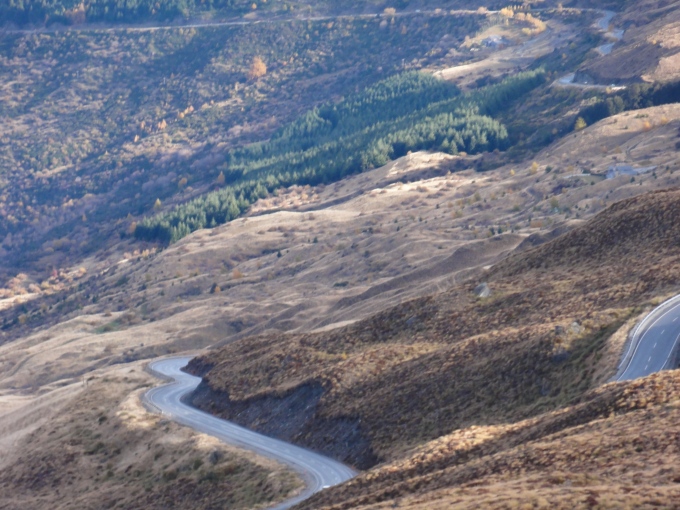
lookingdownfromcoronetpeak

And the story:

It was once said that a desperate man has everything to lose.

The man I was chasing was desperate, but I, on the other hand, was more desperate to catch him.

He’d left a trail of dead people from one end of the island to the other.

The team had put in a lot of effort to locate him, and now his capture was imminent.  We were following the car he was in, from a discrete distance, and, at the appropriate time, we would catch up, pull him over, and make the arrest.

There was nowhere for him to go.

The road led to a dead-end, and the only way off the mountain was back down the road were now on.  Which was why I was somewhat surprised when we discovered where he was.

Where was he going?

“Damn,” I heard Alan mutter.  He was driving, being careful not to get too close, but not far enough away to lose sight of him.

“What?”

“I think he’s made us.”

“How?”

“Dumb bad luck, I’m guessing.  Or he expected we’d follow him up the mountain.  He’s just sped up.”

“How far away?”

“A half-mile.  We should see him higher up when we turn the next corner.”

It took an eternity to get there, and when we did, Alan was right, only he was further on than we thought.”

“Step on it.  Let’s catch him up before he gets to the top.”

Easy to say, not so easy to do.  The road was treacherous, and in places just gravel, and there were no guard rails to stop a three thousand footfall down the mountainside.

Good thing then I had the foresight to have three agents on the hill for just such a scenario.

Ten minutes later, we were in sight of the car, still moving quickly, but we were going slightly faster.  We’d catch up just short of the summit car park.

Or so we thought.

Coming quickly around another corner we almost slammed into the car we’d been chasing.

“What the hell…” Aland muttered.

I was out of the car, and over to see if he was in it, but I knew that it was only a slender possibility.  The car was empty, and no indication where he went.

Certainly not up the road.  It was relatively straightforward for the next mile, at which we would have reached the summit.  Up the mountainside from here, or down.

I looked up.  Nothing.

Alan yelled out, “He’s not going down, not that I can see, but if he did, there’s hardly a foothold and that’s a long fall.”

Then where did he go?

Then a man looking very much like our quarry came out from behind a rock embedded just a short distance up the hill.

“Sorry,” he said quite calmly.  “Had to go if you know what I mean.”

I’d lost him.

It was as simple as that.

I had been led a merry chase up the hill, and all the time he was getting away in a different direction.

I’d fallen for the oldest trick in the book, letting my desperation blind me to the disguise that anyone else would see through in an instant.

It was a lonely sight, looking down that road, knowing that I had to go all that way down again, only this time, without having to throw caution to the wind.

“Maybe next time,” Alan said.

“We’ll get him.  It’s just a matter of time.”

© Charles Heath 2019-2021

Find this and other stories in “Inspiration, maybe”  available soon.

InspirationMaybe1v1

Writing about writing a book – Research – 12

Background material used in researching the Vietnam war and various other aspects of that period

Who were the North Vietnamese, really?

More Than Just Tunnels: Deconstructing North Vietnam’s Winning Strategy

The Vietnam War remains one of the most studied and strategically complex conflicts of the 20th century. Facing the overwhelming technological and logistical might of the United States and its allies, the armed forces of North Vietnam—primarily the People’s Army of Vietnam (PAVN), often referred to as the NVA, supported by the southern irregular forces known as the Viet Cong (VC)—employed a doctrine that defied conventional military wisdom.

Their strategy was not about winning battles in the traditional sense; it was about protracted war and the exhaustion of the enemy’s political will.

Here is a deep dive into how the North deployed its troops and the sophisticated methodology they utilized to take the fight to the Allied soldiers.


1. The Deployment Structure: Two Armies, One Goal

The North’s deployment strategy was inherently flexible, relying on a tiered military structure designed to adapt to any environment, from dense jungle to urban centers.

A. The Viet Cong (VC): The Irregular Force

The Viet Cong served as the political and military instrument in the South. They were not a conventional army but an insurgency operating within South Vietnam’s villages and hamlets.

Deployment Methodology:

  • Decentralization: VC units were deployed locally, focused on small-scale harassment, ambushes, and targeted assassinations of ARVN (South Vietnamese Army) officials.
  • Infiltration by Footprint: VC units were often indistinguishable from the local populace, deploying fighters who worked the rice paddies by day and fought by night.
  • Infrastructure Destruction: Their primary military deployment targets were the infrastructure supporting the US/ARVN presence: supply lines, airbases, and communication centers.

B. The PAVN (NVA): The Main Force

The PAVN was the formal, organized army of North Vietnam. These were well-trained, disciplined, and heavily armed conventional units, often deployed in regimental and divisional strength.

Deployment Methodology:

  • Strategic Infiltration: PAVN forces were primarily deployed via the Ho Chi Minh Trail (see below). They avoided direct, large-scale contact with US forces until the conditions were optimal (e.g., during the Tet Offensive or the 1972 Easter Offensive).
  • The Element of Surprise: When PAVN units were deployed in pitched battles, they focused on achieving total surprise and concentrating overwhelming, temporary firepower before rapidly melting back into the jungle or border sanctuaries.

2. The Logistics Highway: The Ho Chi Minh Trail

The single greatest factor in troop deployment was the elaborate logistical network known as the Ho Chi Minh Trail. This was not a single road but a constantly shifting, 16,000-kilometer web of trails, paths, rivers, and depots running through neutral Laos and Cambodia.

Strategic Impact on Deployment:

  • Bypassing Defenses: The Trail allowed hundreds of thousands of troops and vast amounts of material to bypass the heavily fortified Demilitarized Zone (DMZ) and move deep into the South, often positioning them directly behind US defenses.
  • Sustained Pressure: By keeping the logistics flowing despite intense American air interdiction (Operation Rolling Thunder and others), the North could continually refresh its forces, deploying new units to replace losses and ensuring the insurgency never withered away.
  • Mobility as Fortress: Because the Trail routes changed daily and were covered by dense jungle canopy, the US bombing campaigns often failed to halt troop movement, making mobility itself a form of defense.

3. Methodology in Combat: Neutralizing US Advantages

The North Vietnamese knew they could not win a conventional war against American firepower. Their methodology was designed purely to negate the US technological superiority.

A. The Strategy of “Clinging to the Belt”

This was one of the most effective tactical moves deployed by the PAVN. When engaging American ground forces, NVA units were instructed to deploy forces and fight at extremely close quarters, often termed “grabbing the enemy’s belt.”

Rationale:

  • By fighting nose-to-nose, the Americans could not safely call in their most powerful assets—tactical aircraft, napalm, or heavy artillery—without risking friendly fire casualties.
  • This effectively reduced the battle back to infantry vs. infantry, minimizing the US advantage in technology and maximizing the North’s advantage in tenacity and knowledge of the terrain.

B. Ambushes and Rapid Dispersal

VC and PAVN units specialized in the planned ambush. This was a deployment methodology based on hit-and-run tactics:

  1. Selection of Terrain: Choosing areas where US mobility was constrained (jungles, rice paddies, or remote valleys).
  2. Overwhelming Fire: Deploying all available troops and weapons to achieve a massive initial burst of fire, inflicting maximum casualties in the first minutes.
  3. Rapid Retreat: Before the American command could organize a counter-attack or coordinate air support, the NVA/VC forces would melt away, using prepared escape routes, tunnels, or border sanctuaries (known as Base Areas).

C. The Use of Tunnels and Base Areas

Deployment wasn’t just about moving across the surface; it was under it. The famous Cu Chi Tunnels near Saigon and similar networks served multiple strategic purposes:

  • Sanctuaries: Allowing troops to deploy and stage operations deep inside areas the US considered secured.
  • Hidden Bases: Providing underground logistics hubs, hospitals, and command centers.
  • Evasion: Allowing forces to disappear immediately after an engagement, frustrating US “search and destroy” missions.

4. The Political Dimension: The Protracted War

The PAVN/VC deployment was always dictated by political goals. General Vo Nguyen Giap, the architect of the North Vietnamese struggle, emphasized that the true battlefield was the American political landscape.

The Methodology of Exhaustion:

  • Avoid Annihilation: Troops were deployed carefully to avoid any battle that could lead to a decisive defeat. Their goal was survival, not conquest until the final stages of the war.
  • Inflict Casualties: Every single US casualty inflicted by a sustained troop deployment amplified anti-war sentiment back home. The deployment strategy was therefore calibrated to maximize enemy losses while minimizing the risk to the overall force structure.
  • The Final Phase: Only late in the war, when the US had significantly withdrawn and the ARVN was left struggling, did PAVN change its deployment methodology to focus on large-scale, conventional maneuvers (like the deployment of tank columns and heavy artillery) necessary to secure the final victory in 1975.

The North Vietnamese methodology for deploying troops was a brilliant exercise in adaptability. They transformed their logistical weaknesses into defensive strengths, used geography to neutralize superior air power, and ensured that every soldier deployed served the overarching political mission: convincing the American public that victory was impossible. Their success remains a testament to the strategic power of insurgency and asymmetric warfare.