This story is now on the list to be finished so over the new few weeks, expect a new episode every few days.
The reason why new episodes have been sporadic, there are also other stories to write, and I’m not very good at prioritizing.
But, here we are, a few minutes opened up and it didn’t take long to get back into the groove.
Things are about to get complicated…
There were so many pieces to this puzzle that most of it defied logic.
According to Quigley/O’Connell, Severin and Maury were the security guards at the lab where the USB secrets originated. Their job had been to make sure the data wasn’t stolen and failed miserably. But the inference was made that they had helped the person smuggle the data out.
At that time the data was stolen by a male scientist and put on the USB. That scientist had a wife, Anna. Sometime after the data removal, the male scientist was murdered, and Anna, his wife, got a hold of the USB.
Quigley/O’Connell also asserted that he believed Severin and Maury helped her smuggle the data out of the facility. Was it possible she was having an affair with one or the other, possibly Severin. He seemed the more potential candidate.
So fact: data is stolen, data finds its way to Anna, and Severin let her leave the complex with the data.
The next question: when did the data go up for sale, or, as Quigley/O’Connell said, become available for the newspapers to bid on? And, following that, when did Dobbin find out, and use O’Connell to arrange for the purchase and delivery of the data.
That then led to when Severin and Maury realised that Anna had double-crossed them because that would be the only reason why they would set up an oversight surveillance team to follow the man they assumed was going to buy the data from Anna.
Why was there a six-month hiatus? Was it because Anna had to stay in hiding until the ruckus about the theft blew over. Did the owners of the lab actually tell anyone what had happened? No, it seems.
So, need to find out why it took six months to seal the deal.
Next fact, Severin’s surveillance operation swings into action when O’Connell; goes to pick up the data. The date was specific because it had been on Severin’s calendar at the training facility.
The surveillance goes awry.
The café where the meeting is to take place explodes when a bomb goes off. O’Connell did not go in and was spared. Whoever was in the café was thought to be killed and the USB was lost. Later analysis of the CCTV footage at the time showed Anna rising from the ashes. She still has the USB.
But…
Everyone believed because O’Connell survived the explosion, he had obtained the USB and became the focus of their attention. And forces the continuation of the surveillance operation, when I tracked him to an alley where he was shot and killed.
Question: How did the sniper know to be at that alley for the shot?
It is at this point that O’Connell advises he is working for Dobbin. Thus, Dobbin knows about the USB and the history of it. Dobbin had arranged to meet O’Connell at that alley, and had he been killed by the sniper or not, was taking him away. Dobbin no doubt discovers at this point there is no USB in O’Connell’s hands.
Inference: Dobbin was tracking O’Connell. He had to be, to know where he was and for his squad to get there so quickly.
New Twist: O’Connell discovered something about Dobbin, and disappears, presumably to re-hook up with Anna, who is now Josephine. Dobbin employs me to find O’Connell and the USB but doesn’t say why O’Connell had gone rogue.
Assumption: Josephine/Anna kills both Severin and Maury. Why then does she torture Maury before killing him. He doesn’t have the USB or any information useful to her.
Fact: Dobbin has Jan on secondment from MI6. Why, and for what purpose. Jan is also working with Severin. Why? Dobbin says she is using initiative, but what is she after?
Supposition, did Jan kill Severin and Maury. Based on what I saw at the park when I went to see him, it looked like Jan, but when we caught her, she furiously denied the accusation. A good act or the truth?
And if it wasn’t her, then who did kill them, and then more recently O’Connell, and why?
Fact: Anna still had both the USBs and was running.
Fact: O’Connell was with Anna up to the point where he was killed. Logically it had to be Anna, not wanting to share the five million. Greed trumps common sense.
What was left out of all of this was Monica and what she knew of and was party to, along with her operative, Joanne. She had always been lurking on the fringe of my investigation, but I was beginning to think I’d been tiled by Joanne the whole time.
They were not in the room, so I had only the people in front of me to fill in the gaps.
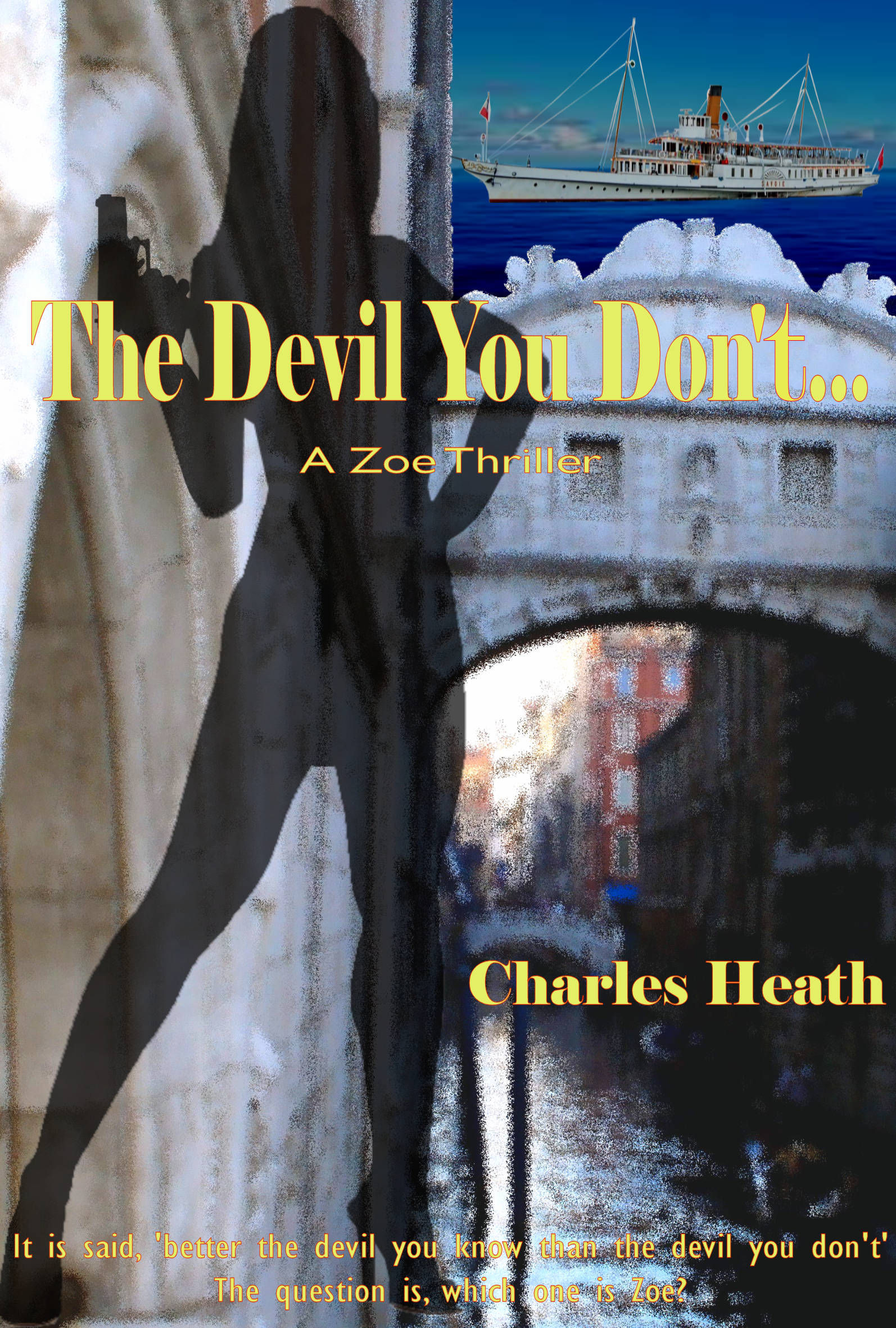
John Pennington’s life is in the doldrums. Looking for new opportunities and prevaricating about getting married, the only joy on the horizon was an upcoming visit to his grandmother in Sorrento, Italy.
Suddenly, he is left at the check-in counter with a message on his phone telling him the marriage is off, and the relationship is over.
If only he hadn’t promised a friend he would do a favour for him in Rome.
At the first stop, Geneva, he has a chance encounter with Zoe, an intriguing woman who captures his imagination from the moment she boards the Savoire, and his life ventures into uncharted territory in more ways than one.
That ‘favour’ for his friend suddenly becomes a life-changing event, and when Zoe, the woman who he knows is too good to be true, reappears, danger and death follow.
Shot at, lied to, seduced, and drawn into a world where nothing is what it seems, John is dragged into an adrenaline-charged undertaking, where he may have been wiser to stay with the ‘devil you know’ rather than opt for the ‘devil you don’t’.
If I was to assume the recent visit by one of the so-called pirate ships as a benchmark for transporting a person between ships, then we’d have to get closer to the larger transport vessel where our crew member, logically, was being held.
The fact I was contemplating it was after the discussion with O’Mara, which, quite frankly, was like something out of a science fiction novel.
He’d started it with, “We have been working on a plan “
The same plan, I presumed, that the Lt Colonel had been referring to, only this time with more detail.
“You might not be aware that every member of this crew has a specific marker in their system that both enables us to track where they are, within a reasonable distance, and monitor their well-being.”
I was going to ask exactly what he meant by that, but amongst the reading material I’d been given before boarding, was a paper on the advances in medical science and how this related to space travel.
We all had a series of vaccinations, and I assumed one was to give us that specific marker. I suspect another was to give us nanites that would aid in our recovery as well as maintain our health in somewhat trying circumstances.
And, no, we’re were not meant to become super-soldiers, though work was being progressed on that too.
“It gives us the ability to track our people, and, yes, the two crew members’ life signs came back when we arrived here, and we are currently monitoring the scientist. That’s to say we know where she is, and that she had not been harmed.”
There was only one point about the plan that held any concern, we just didn’t transport people, not because we couldn’t, but because of the risk. Cargo was fine, but people were a little different. There had been testing, and it had worked, but then problems occurred, and it took only the slightest of issues during the transfer, for it to go wrong. After three accidental deaths, it was decided to ban it until the process could be more refined.
Of course, in line with everything else of this ship, the transporters were the latest versions with considerably upgraded hardware. The distance was still a problem, but getting a lock onto an individual was easier with the new markers provided to this crew.
We were, for all intents and purposes, guinea pigs for the new system, something else I didn’t know until now.
The question was, would she want to be transported? The fact the pirate ships were able to transport people with success was interesting given they would only have the old equipment, but they had an incentive to use it, it was a primary means for them to escape.
And that, too, had raised another issue, they had to have a marker, not necessarily the result of a vaccination, it could be a small device, and that could only be given to them by the guards, which meant it was likely the off-world prison authority was corrupt, not unheard of since it had been contracted out. It was just another paragraph in a report that was growing exponentially in size.
The Admiral was surprised to hear from me. I thought it best, in one of those cover your rear moments, to give him a heads up on what we were planning to do.
But to a more important matter I was sure he would be interested in hearing, “The trial for running at a much faster speed was a success, and that we are closer to travelling at the speed of light. But it seems we are not the first people to do so. It seems the people who stole the plutonium have the same capability.”
“The aliens?”
“No. Our scans of their ships and personnel show they are not. We believe the ships are older vessels discarded on the edge of space, refitted, and manned by escaped convicts from the Mars mining prison.” Saying it out loud didn’t quite sound the same as it had in my head.
“Or it is the result of a country that is not exactly playing by the rules that everyone agreed to for the exploration and exploitation of space.”
“So it was known we might run into some people who have another agenda?”
“Not in that direction, no.”
“Well, it seems they have a base on or under the surface of one of Uranus’s moons called Oberon. I suspect the plutonium is to fuel their base, which is far enough out of the mainstream that we might not have discovered it for years.”
“You then have to wonder why they told you about it?”
That answer was provided in a sudden and alarming manner.
“Bridge to Captain, we have three incoming vessels, and I think they are not here for a social visit.”
To the Admiral, “I have to go. Let’s hope the weapons we have are adequate.” I cut the call, saying, “Be there ASAP. Is the gunnery sergeant at her post?”
“Yes.”
“Then tell her she has permission to return fire if they attack.”
“Very good.”
I had considered why they hadn’t attacked when they had the chance earlier, but perhaps that visit was just to return the Captain’s body. If they were privy to information about our vessel, they might know of its capabilities, and not wish to engage. Of course, there was another reason, perhaps they were waiting until all three ships were free, and assume there was safety in numbers.
It was the first time in almost a week that I made the short walk to the cafe alone. It was early, and the chill of the morning was still in the air. In summer, it was the best time of the day. When Susan came with me, it was usually much later, when the day was much warmer and less tolerable.
On the morning of the third day of her visit, Susan said she was missing the hustle and bustle of London, and by the end of the fourth she said, in not so many words, she was over being away from ‘civilisation’. This was a side of her I had not seen before, and it surprised me.
She hadn’t complained, but it was making her irritable. The Susan that morning was vastly different to the Susan on the first day. So much, I thought, for her wanting to ‘reconnect’, the word she had used as the reason for coming to Greve unannounced.
It was also the first morning I had time to reflect on her visit and what my feelings were towards her. It was the reason I’d come to Greve: to soak up the peace and quiet and think about what I was going to do with the rest of my life.
I sat in my usual corner. Maria, one of two waitresses, came out, stopped, and there was no mistaking the relief in her manner. There was an air of tension between Susan and Maria I didn’t understand, and it seemed to emanate from Susan rather than the other way around. I could understand her attitude if it was towards Alisha, but not Maria. All she did was serve coffee and cake.
When Maria recovered from the momentary surprise, she said, smiling, “You are by yourself?” She gave a quick glance in the direction of my villa, just to be sure.
“I am this morning. I’m afraid the heat, for one who is not used to it, can be quite debilitating. I’m also afraid it has had a bad effect on her manners, for which I apologise. I cannot explain why she has been so rude to you.”
“You do not have to apologise for her, David, but it is of no consequence to me. I have had a lot worse. I think she is simply jealous.”
It had crossed my mind, but there was no reason for her to be. “Why?”
“She is a woman, I am a woman, she thinks because you and I are friends, there is something between us.”
It made sense, even if it was not true. “Perhaps if I explained…”
Maria shook her head. “If there is a hole in the boat, you should not keep bailing but try to plug the hole. My grandfather had many expressions, David. If I may give you one piece of advice, as much as it is none of my business, you need to make your feelings known, and if they are not as they once were, and I think they are not, you need to tell her. Before she goes home.”
Interesting advice. Not only a purveyor of excellent coffee, but Maria was also a psychiatrist who had astutely worked out my dilemma. What was that expression, ‘not just a pretty face’?
“Is she leaving soon?” I asked, thinking Maria knew more about Susan’s movements than I did.
“You would disappoint me if you had not suspected as much. Susan was having coffee and talking to someone in her office on a cell phone. It was an intense conversation. I should not eavesdrop, but she said being here was like being stuck in hell. It is a pity she does not share your love for our little piece of paradise, is it not?”
“It is indeed. And you’re right. She said she didn’t have a phone, but I know she has one. She just doesn’t value the idea of getting away from the office. Perhaps her role doesn’t afford her that luxury.”
And perhaps Alisha was right about Maria, that I should be more careful. She had liked Maria the moment she saw her. We had sat at this very table, the first day I arrived. I would have travelled alone, but Prendergast, my old boss, liked to know where ex-employees of the Department were, and what they were doing.
She sighed. “I am glad I am just a waitress. Your usual coffee and cake?”
“Yes, please.”
Several months had passed since we had rescued Susan from her despotic father; she had recovered faster than we had thought, and settled into her role as the new Lady Featherington, though she preferred not to use that title, but go by the name of Lady Susan Cheney.
I didn’t get to be a Lord, or have any title, not that I was expecting one. What I had expected was that Susan, once she found her footing as head of what seemed to be a commercial empire, would not have time for details like husbands, particularly when our agreement made before the wedding gave either of us the right to end it.
There was a moment when I visited her recovering in the hospital, where I was going to give her the out, but I didn’t, and she had not invoked it. We were still married, just not living together.
This visit was one where she wanted to ‘reconnect’ as she called it, and invite me to come home with her. She saw no reason why we could not resume our relationship, conveniently forgetting she indirectly had me arrested for her murder, charges both her mother and Lucy vigorously pursued, and had the clone not returned to save me, I might still be in jail.
It was not something I would forgive or forget any time soon.
There were other reasons why I was reluctant to stay with her, like forgetting small details, an irregularity in her character I found odd. She looked the same, she sounded the same, she basically acted the same, but my mind was telling me something was not right. It was not the Susan I first met, even allowing for the ordeal she had been subjected to.
But, despite those misgivings, there was no question in my mind that I still loved her, and her clandestine arrival had brought back all those feelings. But as the days passed, I began to get the impression my feelings were one-sided and she was just going through the motions.
Which brought me to the last argument, earlier, where I said if I went with her, it would be business meetings, social obligations, and quite simply her ‘celebrity’ status that would keep us apart. I reminded her that I had said from the outset I didn’t like the idea of being in the spotlight, and when I reiterated it, she simply brushed it off as just part of the job, adding rather strangely that I always looked good in a suit. The flippancy of that comment was the last straw, and I left before I said something I would regret.
I knew I was not a priority. Maybe somewhere inside me, I had wanted to be a priority, and I was disappointed when I was not.
And finally, there was Alisha. Susan, at the height of the argument, had intimated she believed I had an affair with her, but that elephant was always in the room whenever Alisha was around. It was no surprise when I learned Susan had asked Prendergast to reassign her to other duties.
At least I knew what my feelings for Alisha were, and there were times when I had to remember she was persona non grata. Perhaps that was why Susan had her banished, but, again, a small detail; jealousy was not one of Susan’s traits when I first knew her.
Perhaps it was time to set Susan free.
When I swung around to look in the direction of the lane where my villa was, I saw Susan. She was formally dressed, not in her ‘tourist’ clothes, which she had bought from one of the local clothing stores. We had fun that day, shopping for clothes, a chore I’d always hated. It had been followed by a leisurely lunch, lots of wine and soul searching.
It was the reason why I sat in this corner; old habits die hard. I could see trouble coming from all directions, not that Susan was trouble or at least I hoped not, but it allowed me the time to watch her walking towards the cafe in what appeared to be short, angry steps; perhaps the culmination of the heat wave and our last argument.
She glared at me as she sat, dropping her bag beside her on the ground, where I could see the cell phone sitting on top. She followed my glance down, and then she looked unrepentant back at me.
Maria came back at the exact moment she was going to speak. I noticed Maria hesitate for a second when she saw Susan, then put her smile in place to deliver my coffee.
Neither spoke nor looked at each other. I said, “Susan will have what I’m having, thanks.”
Maria nodded and left.
“Now,” I said, leaning back in my seat, “I’m sure there’s a perfectly good explanation as to why you didn’t tell me about the phone, but that first time you disappeared, I’d guessed you needed to keep in touch with your business interests. I thought it somewhat unwisethat you should come out when the board of one of your companies was trying to remove you, because of what was it, an unexplained absence? All you had to do was tell me there were problems and you needed to remain at home to resolve them.”
My comment elicited a sideways look, with a touch of surprise.
“It was unfortunate timing on their behalf, and I didn’t want you to think everything else was more important than us. There were issues before I came, and I thought the people at home would be able to manage without me for at least a week, but I was wrong.”
“Why come at all. A phone call would have sufficed.”
“I had to see you, talk to you. At least we have had a chance to do that. I’m sorry about yesterday. I once told you I would not become my mother, but I’m afraid I sounded just like her. I misjudged just how much this role would affect me, and truly, I’m sorry.”
An apology was the last thing I expected.
“You have a lot of work to do catching up after being away, and of course, in replacing your mother and gaining the requisite respect as the new Lady Featherington. I think it would be for the best if I were not another distraction. We have plenty of time to reacquaint ourselves when you get past all these teething issues.”
“You’re not coming with me?” She sounded disappointed.
“I think it would be for the best if I didn’t.”
“Why?”
“It should come as no surprise to you that I’ve been keeping an eye on your progress. You are so much better doing your job without me. I told your mother once that when the time came I would not like the responsibilities of being your husband. Now that I have seen what it could possibly entail, I like it even less. You might also want to reconsider our arrangement, after all, we only had a marriage of convenience, and now that those obligations have been fulfilled, we both have the option of terminating it. I won’t make things difficult for you if that’s what you want.”
It was yet another anomaly, I thought; she should look distressed, and I would raise the matter of that arrangement. Perhaps she had forgotten the finer points. I, on the other hand, had always known we would not last forever. The perplexed expression, to me, was a sign she might have forgotten.
Then, her expression changed. “Is that what you want?”
“I wasn’t madly in love with you when we made that arrangement, so it was easy to agree to your terms, but inexplicably, since then, my feelings for you changed, and I would be sad if we parted ways. But the truth is, I can’t see how this is going to work.”
“In saying that, do you think I don’t care for you?”
That was exactly what I was thinking, but I wasn’t going to voice that opinion out loud. “You spent a lot of time finding new ways to make my life miserable, Susan. You and that wretched friend of yours, Lucy. While your attitude improved after we were married, that was because you were going to use me when you went to see your father, and then almost let me go to prison for your murder.”
“I had nothing to do with that, other than to leave, and I didn’t agree with Lucy that you should be made responsible for my disappearance. I cannot be held responsible for the actions of my mother. She hated you; Lucy didn’t understand you, and Millie told me I was stupid for not loving you in return, and she was right. Why do you think I gave you such a hard time? You made it impossible not to fall in love with you, and it nearly changed my mind about everything I’d been planning so meticulously. But perhaps there was a more subliminal reason why I did because after I left, I wanted to believe, if anything went wrong, you would come and find me.”
“How could you possibly know that I’d even consider doing something like that, given what you knew about me?”
“Prendergast made a passing comment when my mother asked him about you; he told us you were very good at finding people and even better at fixing problems.”
“And yet here we are, one argument away from ending it.”
I could see Maria hovering, waiting for the right moment to deliver her coffee, then go back and find Gianna, the café owner, instead. Gianna was more abrupt and, for that reason, was rarely seen serving the customers. Today, she was particularly cantankerous, banging the cake dish on the table and frowning at Susan before returning to her kitchen. Gianna didn’t like Susan either.
Behind me, I heard a car stop, and when she looked up, I knew it was for her. She had arrived with nothing, and she was leaving with nothing.
She stood. “Last chance.”
“Forever?”
She hesitated and then shook away the look of annoyance on her face. “Of course not. I wanted you to come back with me so we could continue working on our relationship. I agree there are problems, but it’s nothing we can’t resolve if we try.”
I had been trying. “It’s too soon for both of us, Susan. I need to be able to trust you, and given the circumstances, and all that water under the bridge, I’m not sure if I can yet.”
She frowned at me. “As you wish.” She took an envelope out of her bag and put it on the table. “When you are ready, it’s an open ticket home. Please make it sooner rather than later. Despite what you think of me, I have missed you, and I have no intention of ending it between us.”
That said, she glared at me for a minute, shook her head, then walked to the car. I watched her get in and the car drive slowly away.
Investigations of crimes don’t always go according to plan, nor does the perpetrator get found or punished.
That was particularly true in my case. The murderer was incredibly careful in not leaving any evidence behind, to the extent that the police could not rule out whether it was a male or a female.
At one stage, the police thought I had murdered my own wife, though how I could be on a train at the time of the murder was beyond me. I had witnesses and a cast-iron alibi.
The officer in charge was Detective First Grade Gabrielle Walters. She came to me on the day after the murder seeking answers to the usual questions like, when was the last time you saw your wife, did you argue, the neighbours reckon there were heated discussions the day before.
Routine was the word she used.
Her fellow detective was a surly piece of work whose intention was to get answers or, more likely, a confession by any or all means possible. I could sense the raging violence within him. Fortunately, common sense prevailed.
Over the course of the next few weeks, once I’d been cleared of committing the crime, Gabrielle made a point of keeping me informed of the progress.
After three months, the updates were more sporadic, and when, for lack of progress, it became a cold case, communication ceased.
But it was not the last time I saw Gabrielle.
The shock of finding Vanessa was more devastating than the fact that she was now gone, and those images lived on in the same nightmare that came to visit me every night when I closed my eyes.
For months, I was barely functioning, to the extent that I had all but lost my job and quite a few friends, particularly those who were more attached to Vanessa rather than me.
They didn’t understand how it could affect me so much, and since it had not happened to them, my tart replies of ‘you wouldn’t understand’ were met with equally short retorts. Some questioned my sanity, even, for a time, so did I.
No one, it seemed, could understand what it was like, no one except Gabrielle.
She was by her own admission, damaged goods, having been the victim of a similar incident, a boyfriend who turned out to be an awfully bad boy. Her story varied only in that she had been made to witness his execution. Her nightmare, in reliving that moment in time, was how she was still alive and, to this day, had no idea why she’d been spared.
It was a story she told me one night, some months after the investigation had been scaled down. I was still looking for the bottom of a bottle and an emotional mess. Perhaps it struck a resonance with her; she’d been there and managed to come out the other side.
What happened became our secret, a once-only night together that meant a great deal to me, and by mutual agreement, it was not spoken of again. It was as if she knew exactly what was required to set me on the path to recovery.
And it had.
Since then, we saw each other about once a month in a cafe. I had been surprised to hear from her again shortly after that eventful night when she called to set it up, ostensibly for her to provide me with any updates on the case, but perhaps we had, after that unspoken night, formed a closer bond than either of us wanted to admit.
We generally talked for hours over wine, then dinner and coffee. It took a while for me to realise that all she had was her work; personal relationships were nigh on impossible in a job that left little or no spare time for anything else.
She’d always said that if I had any questions or problems about the case, or if there was anything that might come to me that might be relevant, even after all this time, all I had to do was call her.
I wondered if this text message was in that category. I was certain it would interest the police, and I had no doubt they could trace the message’s origin, but there was that tiny degree of doubt about whether or not I could trust her to tell me what the message meant.
I reached for the phone, then put it back down again. I’d think about it and decide tomorrow.
This story is now on the list to be finished so over the new few weeks, expect a new episode every few days.
The reason why new episodes have been sporadic, there are also other stories to write, and I’m not very good at prioritizing.
But, here we are, a few minutes opened up and it didn’t take long to get back into the groove.
Things are about to get complicated…
Two events happened simultaneously.
The door opened, a figure dressed in black appears and Jennifer grabbed her from behind and took her weapon then shoved her to the ground in the middle of the room, at the same time the USBs exploded in the microwave oven.
I went over to the figure and removed the balaclava, whilst Jennifer closed the door after a quick glance outside.
It was Jan. Why wasn’t I surprised.
“Just whose side are you on,” she said, grimacing, and holding her shoulder after it hit the floor very hard.
“You’re lucky it was Jennifer. If it had been me, I might have strangled you by accident. Why are you here?”
“The same as you?”
“No, in this flat. I never told you anything about Jo.”
Jan looked over at the other woman sitting up against the wall, not exactly looking too well now. She would need an ambulance soon. Jan, probably sooner.
“It might have prevented this if you had. It’s probably the only reason why you’re still alive, we needed you to lead us to her. That’s Anna, isn’t it?”
“Yes.”
“And the data drives?”
“Kind of destroyed, which is where such information should end up.”
“It was not yours to do that.”
“No. But left in the hands of people like you, where would it end up? I’m sorry, but with all the lies and deception going on, I couldn’t trust anyone to do the right thing.”
My phone rang.
I looked at the screen. Private number. No prizes for guessing who.
“Dobbin?”
“What is going on in there?”
“Target practice. Want to come and join the fun?”
“Is Jan alright?”
“She’ll live for now, but she is going to need medical assistance soon. It’s up to you.”
“I’m coming up?”
“If you bring anyone else, they’re dead.” I hung up.
I went over to the microwave, took out the remnants of the drives and flushed them down the toilet. Just in case.
When I came back there was a knock on the door.
“I’ll get it,” I said to Jennifer. “But if there is anyone else, shoot them.
Gun ready, I opened the door. He had his hands where I could see them. “Come in and join the fun.”
Jennifer had him covered, just in case.
I closed the door.
Dobbin looked at Anna. He knew who she was.
“O’Connell is next door, dead. Did Jan shoot him?”
“Hello, I’m in the room, Sam. I did not.”
“Why do I find that hard to believe?”
“You have this all wrong, Sam. We are not the bad guys,” Dobbin said.
“Well, if you are, and you’re lying, which is about all you have done since I first met you, you won’t be. The USBs have been destroyed.”
Of course, in that instant, I realised that I may have been played again. Anna had given up the location too easily, despite the threats of bodily harm, which if push came to shove, I might not have followed through on. And if Anna surmised that, what was to stop her from having decoys just in case she was found? Come to think of it, she didn’t seem very disappointed when I destroyed them.
A woman capable of torturing and murder was capable of anything, and she had proven herself very capable so far.
And, worse, Dobbin didn’t seem too upset at the news.
I’d read about out-of-body experiences, and like everyone else, thought it was nonsense. Some people claimed to see themselves in the operating theatre, medical staff frantically trying to revive them, and being surrounded by white light.
I was definitely looking down, but it wasn’t me I was looking at.
It was two children, a boy and a girl, with their parents, in a park.
The boy was Alan. He was about six or seven. The girl was Louise, and she was five years old. She had long red hair and looked the image of her mother.
I remember it now, it was Louise’s birthday and we went down to Bournemouth to visit our Grandmother, and it was the last time we were all together as a family.
We were flying homemade kites our father had made for us, and after we lay there looking up at the sky, making animals out of the clouds. I saw an elephant, Louise saw a giraffe.
We were so happy then.
Before the tragedy.
When I looked again ten years had passed and we were living in hell. Louise and I had become very adept at survival in a world we really didn’t understand, surrounded by people who wanted to crush our souls.
It was not a life a normal child had, our foster parents never quite the sort of people who were adequately equipped for two broken-hearted children. They tried their best, but their best was not good enough.
Every day it was a battle, to avoid the Bannister’s and Archie in particular, every day he made advances towards Louise and every day she fended him off.
Until one day she couldn’t.
Now I was sitting in the hospital, holding Louise’s hand. She was in a coma, and the doctors didn’t think she would wake from it. The damage done to her was too severe.
The doctors were wrong.
She woke, briefly, to name her five assailants. It was enough to have them arrested. It was not enough to have them convicted.
Justice would have to be served by other means.
I was outside the Bannister’s home.
I’d made my way there without really thinking, after watching Louise die. It was like being on autopilot, and I had no control over what I was doing. I had murder in mind. It was why I was holding an iron bar.
Skulking in the shadows. It was not very different from the way the Bannister’s operated.
I waited till Archie came out. I knew he eventually would. The police had taken him to the station for questioning, and then let him go. I didn’t understand why, nor did I care.
I followed him up the towpath, waiting till he stopped to light a cigarette, then came out of the shadows.
“Wotcha got there Alan?” he asked when he saw me. He knew what it was, and what it was for.
It was the first time I’d seen the fear in his eyes. He was alone.
“Justice.”
“For that slut of a sister of yours. I had nuffing to do with it.”
“She said otherwise, Archie.”
“She never said nuffing, you just made it up.” An attempt at bluster, but there was no confidence in his voice.
I held up the pipe. It had blood on it. Willy’s blood. “She may or may not have Archie, but Willy didn’t make it up. He sang like a bird. That’s his blood, probably brains on the pipe too, Archie, and yours will be there soon enough.”
“He dunnit, not me. Lyin’ bastard would say anything to save his own skin.” Definitely scared now, he was looking to run away.
“No, Archie. He didn’t. I’m coming for you. All of you Bannisters. And everyone who touched my sister.”
It was the recurring nightmare I had for years afterwards.
I closed my eyes and tried to shut out the thoughts, the images of Louise, the phone call, the visit to the hospital and being there when she succumbed to her injuries. Those were the very worst few hours of my life.
She had asked me to come to the railway station and walk home with her, and I was running late. If I had left when I was supposed to, it would never have happened and for years afterwards, I blamed myself for her death.
If only I’d not been late…
When the police finally caught the rapists, I’d known all along who they’d be; antagonists from school, the ring leader, Archie Bannister, a spurned boyfriend, a boy whose parents, ubiquitously known to all as ‘the Bannister’s, dealt in violence and crime and who owned the neighbourhood. The sins of the father had been very definitely passed onto the son.
At school, I used to be the whipping boy, Archie, a few grades ahead of me, made a point of belting me and a few of the other boys, to make sure the rest did as they were told. He liked Louise, but she had no time for a bully like him, even when he promised he would ‘protect’ me.
I knew the gang members, the boys who tow-kowed to save getting beaten up, and after the police couldn’t get enough information to prosecute them because everyone was too afraid to speak out, I went after Willy. There was always a weak link in a group, and he was it.
He worked in a factory, did long hours on a Wednesday and came home after dark alone. It was a half mile walk, through a park. The night I approached him, I smashed the lights and left it in darkness. He nearly changed his mind and went the long way home.
He didn’t.
It took an hour and a half to get the names. At first, when he saw me, he laughed. He said I would be next, and that was four words more than he knew he should have said.
When I found him alone the next morning I showed him the iron bar and told him he was on the list. I didn’t kill him then, he could wait his turn, and worry about what was going to happen to him.
When the police came to visit me shortly after that encounter, no doubt at the behest of the Bannister’s, the neighbourhood closed ranks and gave me an ironclad alibi. The Bannister’s then came to visit me and threatened me. I told them their days were numbered and showed them the door.
At the trial, he and his friends got off on a technicality. The police had failed to do their job properly, but it was not the police, but a single policeman, corrupted by the Bannisters.
Archie could help but rub it in my face. He was invincible.
Joe Collins took 12 bullets and six hours to bleed out. He apologized, he pleaded, he cried, he begged. I didn’t care.
Barry Mills, a strong lad with a mind to hurting people, Archie’s enforcer, almost got the better of me. I had to hit him more times than I wanted to, and in the end, I had to be satisfied that he died a short but agonizing death.
I revisited Willy in the hospital. He’d recovered enough to recognize me, and why I’d come. Suffocation was too good for him.
David Williams, second in command of the gang, was as tough and nasty as the Bannisters. His family were forging a partnership with the Bannister’s to make them even more powerful. Outwardly David was a pleasant sort of chap, affable, polite, and well mannered. A lot of people didn’t believe he could be like, or working with, the Bannisters.
He and I met in the pub. We got along like old friends. He said Willy had just named anyone he could think of, and that he was innocent of any charges. We shook hands and parted as friends.
Three hours later he was sitting in a chair in the middle of a disused factory, blindfolded and scared. I sat and watched him, listened to him, first threatening me, and then finally pleading with me. He’d guessed who it was that had kidnapped him.
When it was dark, I took the blindfold off and shone a very bright light in his eyes. I asked him if the violence he had visited upon my sister was worth it. He told me he was just a spectator.
I’d read the coroner’s report. They all had a turn. He was a liar.
He took nineteen bullets to die.
Then came Archie.
The same factory only this time there were four seats. Anna Bannister, brothel owner, Spike Bannister, head of the family, Emily Bannister, sister, and who had nothing to do with their criminal activities. She just had the misfortune of sharing their name.
Archie’s father told me how he was going to destroy me, and everyone I knew.
A well-placed bullet between the eyes shut him up.
Archie’s mother cursed me. I let her suffer for an hour before I put her out of her misery.
Archie remained stony-faced until I came to Emily. The death of his parents meant he would become head of the family. I guess their deaths meant as little to him as they did me.
He was a little more worried about his sister.
I told him it was confession time.
He told her it was little more than a forced confession and he had done nothing to deserve my retribution.
I shrugged and shot her, and we both watched her fall to the ground screaming in agony. I told him if he wanted her to live, he had to genuinely confess to his crimes. This time he did, it all poured out of him.
I went over to Emily. He watched in horror as I untied her bindings and pulled her up off the floor, suffering only from a small wound in her arm. Without saying a word she took the gun and walked over to stand behind him.
“Louise was my friend, Archie. My friend.”
Then she shot him. Six times.
To me, after saying what looked like a prayer, she said, “Killing them all will not bring her back, Alan, and I doubt she would approve of any of this. May God have mercy on your soul.”
Now I was in jail. I’d spent three hours detailing the deaths of the five boys, everything I’d done; a full confession. Without my sister, my life was nothing. I didn’t want to go back to the foster parents; I doubt they’d take back a murderer.
They were not allowed to.
For a month I lived in a small cell, in solitary, no visitors. I believed I was in the queue to be executed, and I had mentally prepared myself for the end.
Then I was told I had a visitor, and I was expecting a priest.
Instead, it was a man called McTavish. Short, wiry, and with an accent that I could barely understand.
“You’ve been a bad boy, Alan.”
When I saw it was not the priest I told the jailers not to let him in, I didn’t want to speak to anyone. They ignored me. I’d expected he was a psychiatrist, come to see whether I should be shipped off to the asylum.
I was beginning to think I was going mad.
I ignored him.
“I am the difference between you living or dying Alan, it’s as simple as that. You’d be a wise man to listen to what I have to offer.”
Death sounded good. I told him to go away.
He didn’t. Persistent bugger.
I was handcuffed to the table. The prison officers thought I was dangerous. Five, plus two, murders, I guess they had a right to think that. McTavish sat opposite me, ignoring my request to leave.
“Why’d you do it?”
“You know why.” Maybe if I spoke he’d go away.
“Your sister. By all accounts, the scum that did for her deserved what they got.”
“It was murder just the same. No difference between scum and proper people.”
“You like killing?”
“No-one does.”
“No, I dare say you’re right. But you’re different, Alan. As clean and merciless killing I’ve ever seen. We can use a man like you.”
“We?”
“A group of individuals who clean up the scum.”
I looked up to see his expression, one of benevolence, totally out of character for a man like him. It looked like I didn’t have a choice.
Trained, cleared, and ready to go.
I hadn’t realized there were so many people who were, for all intents and purposes, invisible. People that came and went, in malls, in hotels, trains, buses, airports, everywhere, people no one gave a second glance.
People like me.
In a mall, I became a shopper.
In a hotel, I was just another guest heading to his room.
On a bus or a train, I was just another commuter.
At the airport, I became a pilot. I didn’t need to know how to fly; everyone just accepted a pilot in a pilot suit was just what he looked like.
I had a passkey.
I had the correct documents to get me onto the plane.
That walk down the air bridge was the longest of my life. Waiting for the call from the gate, waiting for one of the air bridge staff to challenge me, stepping onto the plane.
Two pilots and a steward. A team. On the plane early before the rest of the crew. A group that was committing a crime, had committed a number of crimes and thought they’d got away with it.
Until the judge, the jury and their executioner arrived.
Me.
Quick, clean, merciless. Done.
I was now an operational field agent.
I was older now, and I could see in the mirror I was starting to go grey at the sides. It was far too early in my life for this, but I expect it had something to do with my employment.
I didn’t recognize the man who looked back at me.
It was certainly not Alan McKenzie, nor was there any part of that fifteen-year-old who had made the decision to exact revenge.
Given a choice; I would not have gone down this path.
Or so I kept telling myself each time a little more of my soul was sold to the devil.
I was Barry Gamble.
I was Lenny Buckman.
I was Jimmy Hosen.
I was anyone but the person I wanted to be.
That’s what I told Louise, standing in front of her grave, and trying to apologize for all the harm, all the people I’d killed for that one rash decision. If she was still alive she would be horrified, and ashamed.
Head bowed, tears streamed down my face.
God had gone on holiday and wasn’t there to hand out any forgiveness. Not that day. Not any day.
New York, New Years Eve.
I was at the end of a long tour, dragged out of a holiday and back into the fray, chasing down another scumbag. They were scumbags, and I’d become an automaton hunting them down and dispatching them to what McTavish called a better place.
This time I failed.
A few drinks to blot out the failure, a blonde woman who pushed my buttons, a room in a hotel, any hotel, it was like being on the merry-go-round, round and round and round…
Her name was Silvia or Sandra, or someone I’d met before, but couldn’t quite place her. It could be an enemy agent for all I knew or all I cared right then.
I was done.
I’d had enough.
I gave her the gun.
I begged her to kill me.
She didn’t.
Instead, I simply cried, letting the pent up emotion loose after being suppressed for so long, and she stayed with me, holding me close, and saying I was safe, that she knew exactly how I felt.
How could she? No one could know what I’d been through.
I remembered her name after she had gone.
Amanda.
I remembered she had an imperfection in her right eye.
Someone else had the same imperfection.
I couldn’t remember who that was.
Not then.
I had a dingy flat in Kensington, a place that I rarely stayed in if I could help it. After five-star hotel rooms, it made me feel shabby.
The end of another mission, I was on my way home, the underground, a bus, and then a walk.
It was late.
People were spilling out of the pub after the last drinks. Most in good spirits, others slightly more boisterous.
A loud-mouthed chap bumped into me, the sort who had one too many, and was ready to take on all comers.
He turned on me, “Watch where you’re going, you fool.”
Two of his friends dragged him away. He shrugged them off, squared up.
I punched him hard, in the stomach, and he fell backwards onto the ground. I looked at his two friends. “Take him home before someone makes mincemeat out of him.”
They grabbed his arms, lifted him off the ground and took him away.
Out of the corner of my eye, I could see a woman, early thirties, quite attractive, but very, very drunk. She staggered from the bar, bumped into me, and finished up sitting on the side of the road.
I looked around to see where her friends were. The exodus from the pub was over and the few nearby were leaving to go home.
She was alone, drunk, and by the look of her, unable to move.
I sat beside her. “Where are your friends?”
“Dunno.”
“You need help?”
She looked up, and sideways at me. She didn’t look the sort who would get in this state. Or maybe she was, I was a terrible judge of women.
“Who are you?” she asked.
“Nobody.” I was exactly how I felt.
“Well Mr Nobody, I’m drunk, and I don’t care. Just leave me here to rot.”
She put her head back between her knees, and it looked to me she was trying to stop the spinning sensation in her head.
Been there before, and it’s not a good feeling.
“Where are your friends?” I asked again.
“Got none.”
“Perhaps I should take you home.”
“I have no home.”
“You don’t look like a homeless person. If I’m not mistaken, those shoes are worth more than my weekly salary.” I’d seen them advertised, in the airline magazine, don’t ask me why the ad caught my attention.
She lifted her head and looked at me again. “You a smart fucking arse are you?”
“I have my moments.”
“Have them somewhere else.”
She rested her head against my shoulder. We were the only two left in the street, and suddenly in darkness when the proprietor turned off the outside lights.
“Take me home,” she said suddenly.
“Where is your place?”
“Don’t have one. Take me to your place.”
“You won’t like it.”
“I’m drunk. What’s not to like until tomorrow.”
I helped her to her feet. “You have a name?”
“Charlotte.”
The wedding was in a small church. We had been away for a weekend in the country, somewhere in the Cotswolds, and found this idyllic spot. Graves going back to the dawn of time, a beautiful garden tended by the vicar and his wife, an astonishing vista over hills and down dales.
On a spring afternoon with the sun, the flowers, and the peacefulness of the country.
I had two people at the wedding, the best man, Bradley, and my boss, Watkins.
Charlotte had her sisters Melissa and Isobel, and Isobel’s husband Giovanni, and their daughter Felicity.
And one more person who was as mysterious as she was attractive, a rather interesting combination as she was well over retirement age. She arrived late and left early.
Aunt Agatha.
She looked me up and down with what I’d call a withering look. “There’s more to you than meets the eye,” she said enigmatically.
“Likewise I’m sure,” I said. It earned me an elbow in the ribs from Charlotte. It was clear she feared this woman.
“Why did you come,” Charlotte asked.
“You know why.”
Agatha looked at me. “I like you. Take care of my granddaughter. You do not want me for an enemy.”
OK, now she officially scared me.
She thrust a cheque into my hand, smiled, and left.
“Who is she,” I asked after we watched her depart.
“Certainly not my fairy godmother.”
Charlotte never mentioned her again.
Zurich in summer, not exactly my favourite place.
Instead of going to visit her sister Isobel, we stayed at a hotel in Beethovenstrasse and Isobel and Felicity came to us. Her husband was not with her this time.
Felicity was three or four and looked very much like her mother. She also looked very much like Charlotte, and I’d remarked on it once before and it received a sharp rebuke.
We’d been twice before, and rather than talk to her sister, Charlotte spent her time with Felicity, and they were, together, like old friends. For so few visits they had a remarkable rapport.
I had not broached the subject of children with Charlotte, not after one such discussion where she had said she had no desire to be a mother. It had not been a subject before and wasn’t once since.
Perhaps like all Aunts, she liked the idea of playing with a child for a while and then give it back.
Felicity was curious as to who I was, but never ventured too close. I believed a child could sense the evil in adults and had seen through my facade of friendliness. We were never close.
But…
This time, when observing the two together, something quite out of left field popped into my head. It was not possible, not by any stretch of the imagination, but I thought she looked like my mother.
And Charlotte had seen me looking in their direction. “You seem distracted,” she said.
“I was just remembering my mother. Odd moment, haven’t done so for a very long time.”
“Why now?” I think she had a look of concern on her face.
“Her birthday, I guess,” I said, the first excuse I could think of.
Another look and I was wrong. She looked like Isobel or Charlotte, or if I wanted to believe it possible, Melissa too.
I was crying, tears streaming down my face.
I was in pain, searing pain from my lower back stretching down into my legs, and I was barely able to breathe.
It was like coming up for air.
It was like Snow White bringing Prince Charming back to life. I could feel what I thought was a gentle kiss and tears dropping on my cheeks, and when I opened my eyes, I saw Charlotte slowly lifting her head, a hand gently stroking the hair off my forehead.
And in a very soft voice, she said, “Hi.”
I could not speak, but I think I smiled. It was the girl with the imperfection in her right eye. Everything fell into place, and I knew, in that instant that we were irrevocably meant to be together.
I’m guessing no one ever wanted to think about criminals in space.
With the Chief Engineer working on the status and availability of our propulsion unit, and the status of the ship’s systems after the jump to a speed that was probably never considered at design time. All the heads of departments had reported back little or no damage other than crew blackouts. And, a systematic check of all crew by the medical staff showed no one had suffered any side effects. Well, none that were showing in the last hour or so.
That gave me some time to consider just how it might be possible for pirates to exist.
The cost was astronomical, to the point where many governments had pooled their resources to get where we were now, scraping at the edges of our so-called known galaxy. There were just too many zeros at the end of the numbers that simply represented the investment in the ship I was on.
But the thought of criminal activity, that wasn’t on the radar, well, not mine anyway.
As we progressed with new ships replacing the old, it was not hard to assume that someone with a lot of money and will could get their hands on an old ship or two, and find people who were willing to commit crimes, particularly if they were already at a penal colony under limited supervision.
Perhaps they had hoped to stay off the radar, but unfortunately ran into us, a ship that could move as fast as they could, and chase them down. Of course, that led to another thought, right at that moment, one that told me that it was not in their best interests to have us reporting their existence.
if what I thought to be true, was, then it would simply be a matter of destroying their ships and sending them back to Mars, but they still had a bargaining chip, our nuclear scientist. We had to rescue her first.
And I thought meeting aliens was going to be difficult.
…
It was time to have a chat with Lt Colonel Baxter about this ship’s capabilities, defense-wise, and rather than summon him to the bridge, I thought a low-key approach might be better.
He was expecting me.
“You’ve spoken to O’Mara?” O’Mara was the scanning specialist.
“I assume the previous captain had been briefed on the possibility we might run into pirates?”
It felt weird calling them pirates because most of history portrayed them as being on the high seas.
“It was mentioned in passing. We were never expected to run into any, but aside from that, there’s very little intelligence on them. We’re only just hearing about the breakout at the Mars mining outpost.”
“Sounds like bad luck. Of all the places in space we can go, we had to end up in the same sector. Have you spoken to your superiors back home?”
From what I had read on the trip to join ship, the military were on board for defense purposes, if we needed to be defended, otherwise our own security people would take care of any problems we encountered. We were not on a mission to seek out trouble, but explore, particularly galaxies beyond our own.
Our mission was not to get involved problems like pirates, labour disputes, or matters that were the providence of the so-called space police. The need for such an authority had only just been recognised, and being new, were still in the throes of getting ships and personnel, and a workable frame of reference.
“I have. Their preference is for us to stay on mission, and not engage, unless of course, we’re attacked.”
“At which point we can retaliate.”
“With full force and effect, yes, but only as a last resort. I recognize the need to rescue our crew member, but if it means compromise, perhaps it’s best not to engage. That being said, I believe O’Mara has a plan to rescue her without causing any problems.”
He could have mentioned that, but I suspect he didn’t want to come to me with something that might not work.
“Just the same, I would like you on the bridge while we’re within hailing distance of what O’Mara informs me, are pirate ships.”
David is a man troubled by a past he is trying to forget.
Susan is rebelling against a life of privilege and an exasperated mother who holds a secret that will determine her daughter’s destiny.
They are two people brought together by chance. Or was it?
When Susan discovers her mother’s secret, she goes in search of the truth that has been hidden from her since the day she was born.
When David realizes her absence is more than the usual cooling off after another heated argument, he finds himself being slowly drawn back into his former world of deceit and lies.
Then, back with his former employers, David quickly discovers nothing is what it seems as he embarks on a dangerous mission to find Susan before he loses her forever.
To write a private detective serial has always been one of the items at the top of my to-do list, though trying to write novels and a serial, as well as a blog, and maintain a social media presence, well, you get the idea.
But I made it happen, from a bunch of episodes I wrote a long, long time ago, used these to start it, and then continued on, then as now, never having much of an idea where it was going to end up, or how long it would take to tell the story.
That, I think, is the joy of ad hoc writing, even you, as the author, have as much of an idea of where it’s going as the reader does.
It’s basically been in the mill since 1990, and although I finished it last year, it looks like the beginning to end will have taken exactly 30 years. Had you asked me 30 years ago if I’d ever get it finished, the answer would be maybe?
My private detective, Harry Walthenson
I’d like to say he’s from that great literary mould of Sam Spade, or Mickey Spillane, or Philip Marlowe, but he’s not.
But I’ve watched Humphrey Bogart play Sam Spade with much interest, and modelled Harry and his office on it. Similarly, I’ve watched Robert Micham play Phillip Marlow with great panache, if not detachment, and added a bit of him to the mix.
Other characters come into play, and all of them, no matter what period they’re from, always seem larger than life. I’m not above stealing a little of Mary Astor, Peter Lorre or Sidney Greenstreet, to breathe life into beguiling women and dangerous men alike.
Then there’s the title, like
The Case of the Unintentional Mummy – this has so many meanings in so many contexts, though I imagine that back in Hollywood in the ’30s and ’40s, this would be excellent fodder for Abbott and Costello
The Case of the Three-Legged Dog – Yes, I suspect there may be a few real-life dogs with three legs, but this plot would involve something more sinister. And if made out of plaster, yes, they’re always something else inside.
But for mine, to begin with, it was “The Case of the …”, because I had no idea what the case was going to be about, well, I did, but not specifically.
Then I liked the idea of calling it “The Case of the Brothers’ Revenge” because I began to have a notion there was a brother no one knew about, but that’s stuff for other stories, not mine, so then it went the way of the others.
Now it’s called ‘A Case of Working With the Jones Brothers’, finished the first three drafts, and I am at the editor for the last reading.
I have high hopes of publishing it in mid-2026. It even has a cover.