The cinema of my dreams – I always wanted to write a war story – Episode 41

For a story that was conceived during those long boring hours flying in a steel cocoon, striving to keep away the thoughts that the plane and everyone in it could just simply disappear as planes have in the past, it has come a long way.

Whilst I have always had a fascination with what happened during the second world war, not the battles or fighting, but in the more obscure events that took place, I decided to pen my own little sidebar to what was a long and bitter war.

And, so, it continues…

——

Jackerby trusted no one.  He had been given orders by someone further up the ranks than Wallace and his people, someone who suspected that some or all of the Englishmen turned German turned Englishmen were traitors. 

The only men he could trust fully were those who had come with him in the glider, a dozen at most.  It’s why he had just completed a secret briefing with his second in command who would take over the operation if anything happened to him.

Not that it would, but he liked the idea of being prepared, and humoring the others into believing they were essential to the operation.  Eckhardt would be a good man in a crisis, battle scarred from the Russian front, and glad to be on this operation for obvious reasons.

He would do anything Jackerby asked, even kill Wallace and Johannsen if he was required to.

That might yet be necessary because Wallace didn’t seem interested in going after Atherton which made him think that Wallace wasn’t all that he appeared to be.  Atherton was a thorn in their operation and had to be eliminated.  The fact Wallace and Johannsen didn’t agree with him raised suspicions as to their motives.

Was there ultimately going to be a triple cross?

He had been lurking in the shadows when Wallace gave the drunken fool Leonardo his orders to go down to the village.  More defectors.  Jackerby couldn’t understand why anyone would want to leave the Reich, especially when they were winning the war, and, if it were up to him, he’d executer the lot of them not send them back.

But, orders were orders.

He went back to Eckhardt and told him he was going down to the village to observe Leonardo and his team in action, and that he was in charge of the men in his absence.

Eckhardt, on the other hand, knew that Jackerby, if he could find a way that would not cause them trouble, was going to eliminate Leonardo because they were a liability.  The plan was once Leonardo and his men were gone, Jackerby would take over rounding up the defectors.  Or, more to the point, they would go missing before reaching the castle.  There was only one that mattered, the rest were dead weight.  And once the prize had been captured, Jackerby would escort him home and collect the kudos for himself and his men.

The ultimate prize; leave to reunite briefly with their families and a cushy job in Berlin, away from the horrors of war in the trenches.

Leonardo and the five others that made up the resistance left the castle by one of the underground tunnels.  Leonardo knew of two, both of them shown to him by Carlo.  He knew that Carlo knew where more were, but Carlo was not particularly helpful at the best of times.

He also knew Carlo might be stupid enough to storm the castle, especially after what Leonardo had done to Martina, and, when it hadn’t happened, he suspected Atherton had appealed to him to wait.

Atherton, too, he knew had some idea of the layout of the castle, have been told to keep an eye on Atherton when he first arrived because he was reportedly an archaeologist.  Leonardo had, and reported back to Wallace that it appeared Atherton had been surveying the castle.  He had simply been told to keep Atherton under surveillance, and make notes of any discoveries, and particularly what Atherton was doing.

He had, not that it amounted to much.  Not when he realized Leonardo was following him.  Leonardo decided not to tell Wallace Atherton had rumbled him, just that he was roaming the passages looking for something.

It had worked so far and kept Wallace off his back, but it wasn’t going to last.

Bottom line, Leonardo had to find and kill Atherton before any trouble started, otherwise, it would be his neck on the block.

Jackerby followed.

It wasn’t hard to follow Leonardo because he and his man were the last people to know what stealth was.  He could hear them crashing through the forest between the castle and the village up to 250 meters away, he was making so much noise.

But, Jackerby thought, perhaps Leonardo didn’t need to worry about alerting his presence to Atherton, not if he was already working with him.

To Jackerby and his paranoia, it made sense.  Maybe he was going to meet with Atherton right now and do a deal with the defectors.  How many others had turned up at the village in the last week or so, and never made it to the castle?

He was right, Jackerby told himself, not to trust them.  Everyone, in the end, was an enemy of the Reich.

It took 20 minutes to reach the outskirts of the village, and when Jackerby could see the edge of the woods, and the barn and remains of the farmhouse just the other side of the tree line, he dropped back, found a suitable observation point, and waited.

Leonardo and his men had stopped at the back of the barn, and one of his men was about to go find the defectors.  The rest of Leonardo’s men would wait with him, and surprise their guests, before taking them back to the castle.

As far as “Jackerby was concerned, they would never reach the castle, and this time, he would take care of Leonardo, and the others.

It would be easy to say that Atherton had killed all the members of the resistance, and then got killed himself in a shootout with Jackerby.  It was a plausible reason for all the deaths, though he would have to come up with a suitable excuse for leaving the castle and following Leonardo and his men when Wallace had expressly forbidden it.

Wallace.

Perhaps if he got his hands on Atherton he’d ask him if Wallace was a traitor.

——-

© Charles Heath 2020-2021
Plots ripped from newspaper headlines

Truth is stranger than fiction

…

I’ve been reading about an anomaly in Google Maps where people are looking at maps that display weird objects in places where they shouldn’t be,

For instance, one of the recent occurrences of this places a plane, either an Airbus A320 or a Boeing 737, is on the ground, in the middle of a clearing of a dense forest with trees all around it.

No one is missing a plane so where did it come from, and how could it possibly get there?

Another occurrence was a car at the bottom of a lake, though there has been more than one occurrence of this. 

But, sometimes those objects actually are there, like, for instance, one of those cars where the body of a man who had been missing for 20-odd years was discovered.

There is a rational reason why people are seeing what are objects that cannot be explained.  It is an instance where two images have been taken, and one is a ‘ghost’, and in the case of the aeroplane, it could have been flying very low over the area in question when the photo was taken.

So.

What if …

Someone was using the map program to look at various places, places that did not get the usual public scrutiny, or perhaps not at all.

After all, what does one do with the leisure hours when there’s nothing else to do?

Mick was a tramper, one of those people who liked to trail blaze, find new paths through forests and make odd discoveries, one of which, several years before, had uncovered a lost village of some archaeological value.

He sees what seems to be wreckage dispersed in the forest, notes the date of the photograph, nearly a year before, and checks newspapers and media sources for any news of missing small lanes, but discovers none.

But just in case his mind is playing tricks, he asks a friend to come and verify the discovery, and, lo and behold, it is no longer there.

Perhaps it was his imagination, wanting to find something.

Until he checked the date of the photograph and notes it’s been updated to another, a year later.

With nothing else to do, perhaps it was time for another walking holiday, and to see what was there.

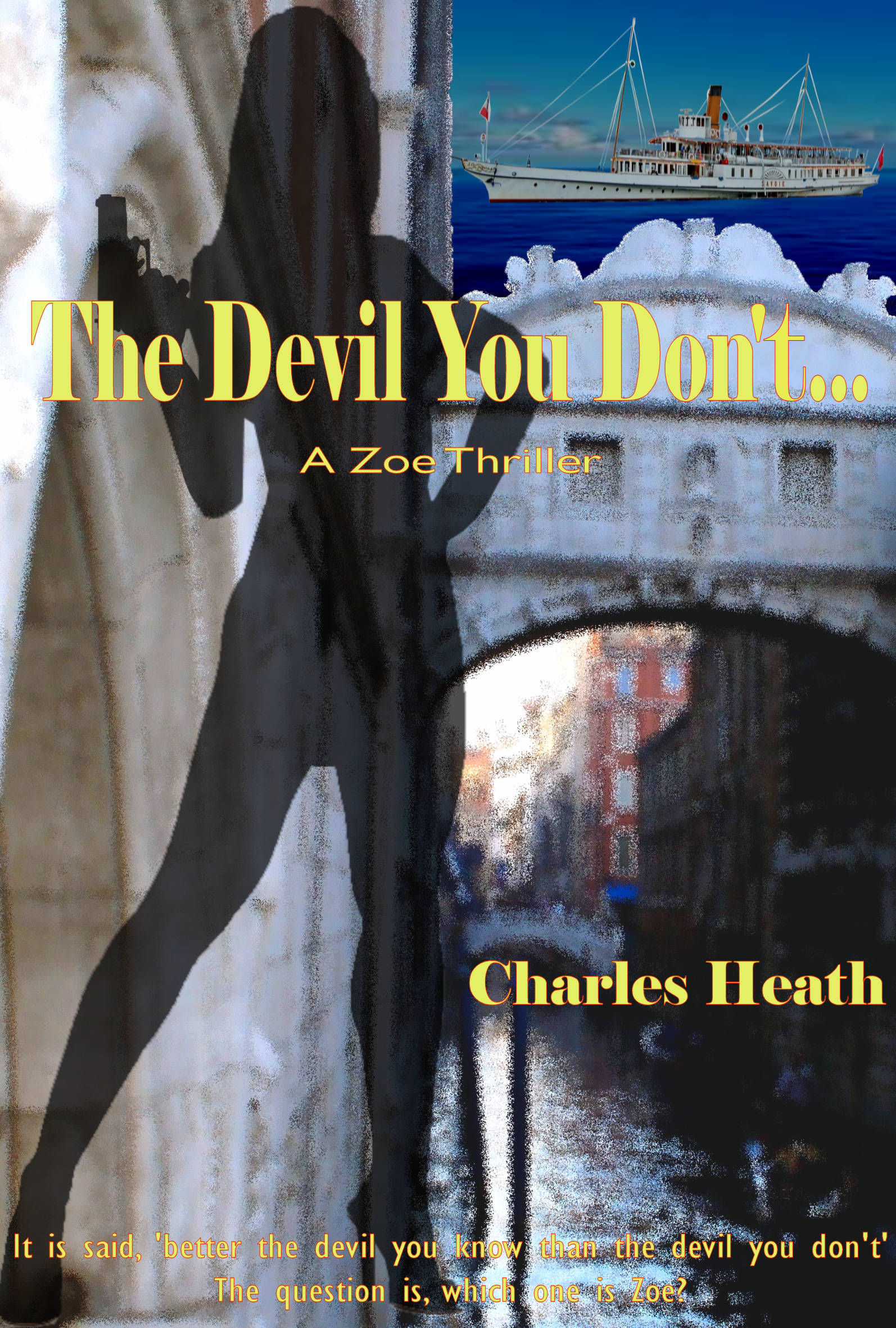
‘The Devil You Don’t’ – A beta reader’s view

It could be said that of all the women one could meet, whether contrived or by sheer luck, what are the odds it would turn out to be the woman who was being paid a very large sum to kill you.

John Pennington is a man who may be lucky in business, but not so lucky in love. He has just broken up with Phillipa Sternhaven, the woman he thought was the one, but relatives and circumstances, and perhaps because she was a ‘princess’, may also have contributed to the end result.

So, what do you do when you are heartbroken?

That is a story that slowly unfolds, from the first meeting with his nemesis on Lake Geneva, all the way to a hotel room in Sorrento, where he learns the shattering truth.

What should have been solace after disappointment, turns out to be something else entirely, and from that point, everything goes to hell in a handbasket.

He suddenly realizes his so-called friend Sebastian has not exactly told him the truth about a small job he asked him to do, the woman he is falling in love with is not quite who she says she is, and he is caught in the middle of a war between two men who consider people becoming collateral damage as part of their business.

The story paints the characters cleverly displaying all their flaws and weaknesses. The locations add to the story at times taking me back down memory lane, especially to Venice where, in those back streets I confess it’s not all that hard to get lost.

All in all a thoroughly entertaining story with, for once, a satisfying end.

…

Available on Amazon here: https://amzn.to/2Xyh1ow

…

The cinema of my dreams – I always wanted to go on a treasure hunt – Episode 65

Here’s the thing…

Every time I close my eyes, I see something different.

I’d like to think the cinema of my dreams is playing a double feature but it’s a bit like a comedy cartoon night on Fox.

But these dreams are nothing to laugh about.

Once again there’s a new installment of an old feature, and we’re back on the treasure hunt.

…

The Ormiston’s from the papers

…

It was a question of what was I looking for.  It would be easy to say I wanted a piece of paper that definitively said where the treasure was or finding a map that led straight to it.

Instead, there was, in one box, a dozen journals filled with the ramblings of a madman.

Searching for treasure had sent Ormiston senior mad.  For an hour, perhaps longer, I tried to decipher the spidery writing, and then gave up when it switched to German.

I assembled the journals in order of his expeditions and found the first easy to follow because it was a time of excitement and expectation, that he would find the treasure.  There were pages on exactly what he thought the treasure was worth, the sort of pieces they would find, and what he would do with the proceeds.

There were drawings of items off the map and his interpretation of what they represented.  It was a rather good description of the coastline and its anomalies as they related to map landmarks.  They were, almost all, the same as the Boggs interpretations.

When the discovery didn’t happen, when the first euphoria wore off and the search became bogged down in acrimony and arguments, and the realization the map they were using was not as clear as first believed, that was where it all began to fall apart.

Reading the words, feeling the disappointment seeping off the page, it must have been quite a blow.

The second expedition didn’t start off with the same fanfare, but almost as if they were expected to fail.  Too little time had been spent analyzing what went wrong and reidentifying the coastal landmarks.

And, when it did fail, the last comment in the diary was fairly succinct.  “What if there is no treasure?”

In another, scrawled heavily on several pages at the back, “look for the big A” was repeated several times, and much underlined.

There were five other boxes with papers, charts, notebooks, and books that belonged on a shelf but instead were neatly stacked.  They’d been in the boxes for some time, and had that aroma books got when left in the damp too long, and, in fact, when I tried to open some, the pages had stuck together.

A lot of the books were about pirates, reference texts, and fiction.  Part of one box was set aside for our particular pirate, and, reading through what could be read, a lot of the information was contradictory.  One book postulated that the said pirate wasn’t a pirate at all, casting doubt on whether he ever existed at all.

The maps were a different story, and, yes, they were all similar except for small details an observation I had made before.  None had what I would have called ‘new’ features, just a rehash of all the others.  Some were old, but most had the appearance of being made to look old.

Then, at the bottom of a box of books, were copies of newspaper articles, aged, stained, and some in various stages of disintegration.  The Bahama Argus, The Barbadian, The Antigua Herald and Gazette, The Bermuda Colonist, and the Dominica Chronicle.  All had references to Captain Johannsson, and his vessel, the Sea Serpent.

There was such a Captain, and there was such a ship, and there were reports of a vessel roving the seas, looking for prey.  And those reports covered a great deal of plunder, definitely the sort that would find its way into a number of sea chests.

But, was this the treasure that Ormiston believed was hidden somewhere in The Grove?

Something caught my attention on the first diary, the way it sat and the light reflected off it, and picking it up and looking at it showed no anomaly in the surface, not until it sat on a certain angle and in the sunlight.

A slight ripple down one edge of the spine, and with careful probing, there was a split in the material of the cover pasted back down, but in the time since it had been glued back, the glue had dissolved and the simple act of picking the book up and parted the split.

Lifting it gently, I could see a piece of paper tucked in and gently coaxed it out.

It was very thin and fragile, but the writing was clear.  Entries from what might have been a logbook.  I knew this only because I had been out of a sailing boat once when at school, and had seen the boat’s logbook, noting where the boat had been.

This page had only a few entries, the location of its departure, in latitude and longitude, a number of the daily distances traveled, and conditions, and the last, another latitude and longitude.

When I put the first coordinates into my GPS, it was near the island of Antigua, and then the destination, just up the coast near the old mall.  The name of the vessel, in almost illegible writing, the Sea Serpent.

So, there was a logbook, although it might not exist now, it did at some point in the past, and Ormiston had either found it or seen it.  The writing on the piece of paper was his. It proved, if it was authentic, there was a ship, and it did come to this coast.

I carefully folded it and hid it in my wallet, then replaced everything where I found it.  Enough research for today.  I tried not to look guilty when I left.

…

© Charles Heath 2020-2022

The cinema of my dreams – I always wanted to write a war story – Episode 40

For a story that was conceived during those long boring hours flying in a steel cocoon, striving to keep away the thoughts that the plane and everyone in it could just simply disappear as planes have in the past, it has come a long way.

Whilst I have always had a fascination with what happened during the second world war, not the battles or fighting, but in the more obscure events that took place, I decided to pen my own little sidebar to what was a long and bitter war.

And, so, it continues…

—

I had to almost restrain Carlo from going up to the castle and singlehandedly kill everyone in it.  I didn’t doubt he could do it, for a short time at least, until they realized what was going on.  There were too many of them to take on alone.

It would need a careful plan, and knowledge of the layout of the castle, and the likely spots where the soldiers were located.  It was a plan that had been slowly formulating in the back of my mind, especially after Carlo’s help with an internal map of the castle, some parts of which I hadn’t got to see in my brief stay.

I forgot that being built back in the middle ages, and the history of cities fighting against each other, there were ways in, out, and around, both inside and in the walls, so that soldiers could travel from one part of the castle to another without being seen, and not having to go inside the castle itself.

There were, also, tunnels, one of which I had inadvertently found, but there were more, and it seems only Carlo knew of those.  Some were useful, others would lead to an early confrontation, and give early notice of our intentions.  Those we would avoid, or use to escape.

We had set up a command center at the church ruins, having found several rooms off the cellar that had two exits.  I didn’t like the idea of being trapped, nor waiting in a location that Fernando was familiar with and was likely to return to.

Which, in a sense, I was hoping he would because we had set a trap and he and his men would be caught in the crossfire.  He was not going to get a chance to explain, nor would I ask any questions, or show him any mercy.

Especially when I found out what he had done to Martina.  If it was as bad as Chiara, he would be repaid in kind, if the opportunity arose.  I tentatively agreed to give Carlo five minutes in the room alone with him, but he knew that expediency might not give him that luxury.  Blinky was not happy about it, but he hadn’t been here long enough to know what the man or his people were like.

We’d also worked out the surveillance system so that we would know when anyone turned up in the village, particularly our prized defector Meyer, and whether anyone left the castle to come down to the village because it was possible there would be more defectors passing through, and they needed to be warned.

What was particularly useful was finding the radio that Martina had been using.  It was in the church grounds, which was not entirely unexpected, but one of Blink’s men had stumbled over it when looking to set up a latrine.

Blinky had brought a radioman, but his radio had been damaged in the parachute landing.  Now he had a new toy to tinker with, and got a connection back to Thompson, after some initial difficulty in translation.  That I could help him with, my Italian was marginally better than a schoolboy.

Thompson was relieved to hear from me, as I was to talk to him.

“It’s been difficult to get a clear picture with Martina, but I got the impression you had to be precise with your questions.”

“A case of getting lost in translation, perhaps.”  I had not had similar problems, but Thompson was from the aristocracy, and his version of English was sometimes quaint.

“The situation is bad, I understand.”

“It is.  The castle is over-run with British-German double agents.  The three you sent out, and reinforcements that followed.  I get the impression we have about 20 odd dead soldiers languishing in shallow graves somewhere on the Italian countryside.”

It hadn’t been hard to realize that while the officers were known British officers, the soldiers were substituted Germans whose English language and mannerisms were impeccable.  I had no doubt once they’d reeled in Meyer, they would move on, integrating into invasion forces and creating havoc from within, unless of course, we stopped them.

A sigh at the other end, perhaps a lamentation of such needless loss of life.  This war was getting tiresome for both of us.

“How close is Meyer?  We last heard he was in Gaole, waiting for a courier to take him to the village.  His arrival is anticipated to be any time from tomorrow onwards.”

“We’ve got men out keeping tabs on everyone.”

“Blinky arrive with his team?”

“All bar the radio, but as you can hear, we have access to one do it will not be a problem.  I think we might finish this and talk again tomorrow.  Don’t want the Germans tracking the radio waves.”

“Good.  Tomorrow, and hour before today.”

I’d almost forgotten that the Germans were good at tracking radio signals, especially when they thought the enemy was using them, as those at the castle would.  That radio unit could also be used to trace other radio signals, and no doubt they had picked up the signal.  Hopefully, we had not been on long enough for them to run the trace.

That was not going to be a problem.  One of Blinky’s soldiers on village reconnaissance was waiting for us as we approached the church ruins.”

“What is it, man?”

“There are four people at the village, looking for someone or something.”

“More defectors,” I said.  “We’d better get to them before Leonardo and his men get to them first.”

—

© Charles Heath 2020-2021

What I learned about writing – The importance of book reviews

Self-published authors are fully aware that perhaps the easiest part of the writing journey is the actual writing.  Well, compared to the marketing aspect I believe it is.

I have read a lot of articles, suggestions, and tips and tricks to market the book to the reading public.  It is, to say the least, a lot harder to market eBooks than perhaps their hard or paper-back relatives.

This is despite the millions of eReaders out there.

Then there is that other fickle part of the publishing cycle, the need for reviews.

Proper reviews of course.

As we are learning, reviews can be bought.  And Amazon is out there seeking what it calls unverified reviews and reviewers and it had brought with it very strict control over who can leave a review, especially on Amazon.

Another site where reviews are taken seriously is the Goodreads website where I have established a presence, and expect in due course, some reviews.

But, all the advice I have seen and read tells me that reviews should not be paid for, and that reviews will come with sales.  It might be a difficult cycle, more reviews mean more sales, etc.

And getting those first sales …

Therein lies the conundrum.  It is a question of paying for advertising or working it out for ourselves.  I guess if I were to get more sales, I could afford the advertising … yes, back on the merry-go-round!

And yet, the harder the road, the more I enjoy what I do.  It is exhilarating while writing, it is a joy to finish the first draft, it is an accomplishment when it is published, but when you sell that first book, well, there is no other feeling like it.

An excerpt from “The Things We Do For Love”; In love, Henry was all at sea!

In the distance, he could hear the dinner bell ringing and roused himself.  Feeling the dampness of the pillow, and fearing the ravages of pent-up emotion, he considered not going down but thought it best not to upset Mrs. Mac, especially after he said he would be dining.

In the event, he wished he had reneged, especially when he discovered he was not the only guest staying at the hotel.

Whilst he’d been reminiscing, another guest, a young lady, had arrived.  He’d heard her and Mrs. Mac coming up the stairs and then shown to a room on the same floor, perhaps at the other end of the passage.

Henry caught his first glimpse of her when she appeared at the door to the dining room, waiting for Mrs. Mac to show her to a table.

She was in her mid-twenties, slim, with long brown hair, and the grace and elegance of a woman associated with countless fashion magazines.  She was, he thought, stunningly beautiful with not a hair out of place, and make-up flawlessly applied.  Her clothes were black, simple, elegant, and expensive, the sort an heiress or wife of a millionaire might condescend to wear to a lesser occasion than dinner.

Then there was her expression; cold, forbidding, almost frightening in its intensity.  And her eyes, piercingly blue and yet laced with pain.  Dracula’s daughter was his immediate description of her.

All in all, he considered, the only thing they had in common was, like him, she seemed totally out of place.

Mrs. Mac came out of the kitchen, wiping her hands on her apron.  She was, she informed him earlier, chef, waitress, hotelier, barmaid, and cleaner all rolled into one.  Coming up to the new arrival she said, “Ah, Miss Andrews, I’m glad you decided to have dinner.  Would you like to sit with Mr. Henshaw, or would you like to have a table of your own?”

Henry could feel her icy stare as she sized up his appeal as a dining companion, making the hair on the back of his neck stand up.  He purposely didn’t look back.  In his estimation, his appeal rating was minus six.  Out of a thousand!

“If Mr. Henshaw doesn’t mind….”  She looked at him, leaving the query in mid-air.

He didn’t mind and said so.  Perhaps he’d underestimated his rating.

“Good.”  Mrs. Mac promptly ushered her over.  Henry stood, made sure she was seated properly and sat.

“Thank you.  You are most kind.”  The way she said it suggested snobbish overtones.

“I try to be when I can.”  It was supposed to nullify her sarcastic tone but made him sound a little silly, and when she gave him another of her icy glares, he regretted it.

Mrs. Mac quickly intervened, asking, “Would you care for the soup?”

They did, and, after writing the order on her pad, she gave them each a look, imperceptibly shook her head, and returned to the kitchen.

Before Michelle spoke to him again, she had another quick look at him, trying to fathom who and what he might be.  There was something about him.

His eyes, they mirrored the same sadness she felt, and, yes, there was something else, that it looked like he had been crying?  There was a tinge of redness.

Perhaps, she thought, he was here for the same reason she was.

No.  That wasn’t possible.

Then she said, without thinking, “Do you have any particular reason for coming here?”  Seconds later she realized she’d spoken it out loud, had hadn’t meant to actually ask, it just came out.

It took him by surprise, obviously not the first question he was expecting her to ask of him.

“No, other than it is as far from civilization, and home, as I could get.”

At least we agree on that, she thought.

It was obvious he was running away from something as well.

Given the isolation of the village and lack of geographic hospitality, it was, from her point of view, ideal.  All she had to do was avoid him, and that wouldn’t be difficult.

After getting through this evening first.

“Yes,” she agreed.  “It is that.”

A few seconds passed, and she thought she could feel his eyes on her and wasn’t going to look up.

Until he asked, “What’s your reason?”

Slightly abrupt in manner, perhaps, because of her question and how she asked it.

She looked up.  “Rest.  And have some time to myself.”

She hoped he would notice the emphasis she had placed on the word ‘herself’ and take due note.  No doubt, she thought, she had completely different ideas of what constituted a holiday than he, not that she had said she was here for a holiday.

Mrs. Mac arrived at a fortuitous moment to save them from further conversation.

Over the entree, she wondered if she had made a mistake coming to the hotel.  Of course, there had been no conceivable way she could know that anyone else might have booked the same hotel, but realized it was foolish to think she might end up in it by herself.

Was that what she was expecting?

Not a mistake then, but an unfortunate set of circumstances, which could be overcome by being sensible.

Yet, there he was, and it made her curious, not that he was a man, by himself, in the middle of nowhere, hiding like she was, but for quite varied reasons.

On discreet observance, whilst they ate, she gained the impression his air of light-heartedness was forced, and he had no sense of humour.

This feeling was engendered by his looks, unruly dark hair, and permanent frown.  And then there was his abysmal taste in clothes on a tall, lanky frame.  They were quality but totally unsuited to the wearer.

Rebellion was written all over him.

The only other thought crossing her mind, and incongruously, was he could do with a decent feed.  In that respect, she knew now from the mountain of food in front of her, he had come to the right place.

“Mr. Henshaw?”

He looked up.  “Henshaw is too formal.  Henry sounds much better,” he said, with a slight hint of gruffness.

“Then my name is Michelle.”

Mrs. Mac came in to take their order for the only main course, gather up the entree dishes, and then return to the kitchen.

“Staying long?” she asked.

“About three weeks.  Yourself?”

“About the same.”

The conversation dried up.

Neither looked at the other, rather at the walls, out the window, towards the kitchen, anywhere.  It was, she thought, unbearably awkward.

Mrs. Mac returned with a large tray with dishes on it, setting it down on the table next to theirs.

“Not as good as the usual cook,” she said, serving up the dinner expertly, “but it comes a good second, even if I do say so myself.  Care for some wine?”

Henry looked at Michelle.  “What do you think?”

“I’m used to my dining companions making the decision.”

You would, he thought.  He couldn’t help but notice the cutting edge of her tone.  Then, to Mrs. Mac, he named a particular White Burgundy he liked, and she bustled off.

“I hope you like it,” he said, acknowledging her previous comment with a smile that had nothing to do with humour.

“Yes, so do I.”

Both made a start on the main course, a concoction of chicken and vegetables that were delicious, Henry thought when compared to the bland food he received at home and sometimes aboard my ship.

It was five minutes before Mrs Mac returned with the bottle and two glasses.  After opening it and pouring the drinks, she left them alone again.

Henry resumed the conversation.  “How did you arrive?  I came by train.”

“By car.”

“Did you drive yourself?”

And he thought, a few seconds later, that was a silly question, otherwise she would not be alone, and certainly not sitting at this table. With him.

“After a fashion.”

He could see that she was formulating a retort in her mind, then changed it, instead, smiling for the first time, and it served to lighten the atmosphere.

And in doing so, it showed him she had another more pleasant side despite the fact she was trying not to look happy.

“My father reckons I’m just another of ‘those’ women drivers,” she added.

“Whatever for?”

“The first and only time he came with me I had an accident.  I ran up the back of another car.  Of course, it didn’t matter to him the other driver was driving like a startled rabbit.”

“It doesn’t help,” he agreed.

“Do you drive?”

“Mostly people up the wall.”  His attempt at humour failed.  “Actually,” he added quickly, “I’ve got a very old Morris that manages to get me where I’m going.”

The apple pie and cream for dessert came and went and the rapport between them improved as the wine disappeared and the coffee came.  Both had found, after getting to know each other better, their first impressions were not necessarily correct.

“Enjoy the food?” Mrs. Mac asked, suddenly reappearing.

“Beautifully cooked and delicious to eat,” Michelle said, and Henry endorsed her remarks.

“Ah, it does my heart good to hear such genuine compliments,” she said, smiling.  She collected the last of the dishes and disappeared yet again.

“What do you do for a living,” Michelle asked in an off-hand manner.

He had a feeling she was not particularly interested, and it was just making conversation.

“I’m a purser.”

“A what?”

“A purser.  I work on a ship doing the paperwork, that sort of thing.”

“I see.”

“And you?”

“I was a model.”

“Was?”

“Until I had an accident, a rather bad one.”

“Oh, I’m sorry.”

So that explained the odd feeling he had about her.

As the evening wore on, he began to think there might be something wrong, seriously wrong with her because she didn’t look too well.  Even the carefully applied makeup, from close, didn’t hide the very pale, and tired look, or the sunken, dark-ringed eyes.

“I try not to think about it, but it doesn’t necessarily work.  I’ve come here for peace and quiet, away from doctors and parents.”

“Then you will not have to worry about me annoying you.  I’m one of those fall-asleep-reading-a-book types.”

Perhaps it would be like ships passing in the night and then smiled to himself about the analogy.

Dinner over, they separated.

Henry went back to the lounge to read a few pages of his book before going to bed, and Michelle went up to her room to retire for the night.

But try as he might, he was unable to read, his mind dwelling on the unusual, yet compellingly mysterious person he would be sharing the hotel with.

Overlaying that original blurred image of her standing in the doorway was another of her haunting expressions that had, he finally conceded, taken his breath away, and a look that had sent more than one tingle down his spine.

She may not have thought much of him, but she had certainly made an impression on him.

…

© Charles Heath 2015-2024

lovecoverfinal1

An excerpt from “If Only” – a work in progress

Investigation of crimes doesn’t always go according to plan, nor does the perpetrator get either found or punished.

That was particularly true in my case.  The murderer was incredibly careful in not leaving any evidence behind, to the extent that the police could not rule out whether it was a male or a female.

At one stage the police thought I had murdered my own wife though how I could be on a train at the time of the murder was beyond me.  I had witnesses and a cast-iron alibi.

The officer in charge was Detective First Grade Gabrielle Walters.  She came to me on the day after the murder seeking answers to the usual questions like, when was the last time you saw your wife, did you argue, the neighbors reckon there were heated discussions the day before.

Routine was the word she used.

Her fellow detective was a surly piece of work whose intention was to get answers or, more likely, a confession by any or all means possible.  I could sense the raging violence within him.  Fortunately, common sense prevailed.

Over the course of the next few weeks, once I’d been cleared of committing the crime, Gabrielle made a point of keeping me informed of the progress.

After three months the updates were more sporadic, and when, for lack of progress, it became a cold case, communication ceased.

But it was not the last I saw of Gabrielle.

The shock of finding Vanessa was more devastating than the fact she was now gone, and those images lived on in the same nightmare that came to visit me every night when I closed my eyes.

For months I was barely functioning, to the extent I had all but lost my job, and quite a few friends, particularly those who were more attached to Vanessa rather than me.

They didn’t understand how it could affect me so much, and since it had not happened to them, my tart replies of ‘you wouldn’t understand’ were met with equally short retorts.  Some questioned my sanity, even, for a time, so did I.

No one, it seemed, could understand what it was like, no one except Gabrielle.

She was by her own admission, damaged goods, having been the victim of a similar incident, a boyfriend who turned out to be an awfully bad boy.  Her story varied only in she had been made to witness his execution.  Her nightmare, in reliving that moment in time, was how she was still alive and, to this day, had no idea why she’d been spared.

It was a story she told me one night, some months after the investigation had been scaled down.  I was still looking for the bottom of a bottle and an emotional mess.  Perhaps it struck a resonance with her; she’d been there and managed to come out the other side.

What happened become our secret, a once-only night together that meant a great deal to me, and by mutual agreement, it was not spoken of again.  It was as if she knew exactly what was required to set me on the path to recovery.

And it had.

Since then, we saw each about once a month in a cafe.   I had been surprised to hear from her again shortly after that eventful night when she called to set it up, ostensibly for her to provide me with any updates on the case, but perhaps we had, after that unspoken night, formed a closer bond than either of us wanted to admit.

We generally talked for hours over wine, then dinner and coffee.  It took a while for me to realize that all she had was her work, personal relationships were nigh on impossible in a job that left little or no spare time for anything else.

She’d always said that if I had any questions or problems about the case, or if there was anything that might come to me that might be relevant, even after all this time, all I had to do was call her.

I wondered if this text message was in that category.  I was certain it would interest the police and I had no doubt they could trace the message’s origin, but there was that tiny degree of doubt, about whether or not I could trust her to tell me what the message meant.

I reached for the phone then put it back down again.  I’d think about it and decide tomorrow.

© Charles Heath 2018-2020

‘What Sets Us Apart’ – A beta readers view

There’s something to be said for a story that starts like a James Bond movie, throwing you straight in the deep end, a perfect way of getting to know the main character, David, or is that Alistair?

A retired spy, well not so much a spy as a retired errand boy, David’s rather wry description of his talents, and a woman that most men would give their left arm for, not exactly the ideal couple, but there is a spark in a meeting that may or may not have been a setup.

But as the story progressed, the question I kept asking myself was why he’d bother.

And, page after unrelenting page, you find out.

Susan is exactly the sort of woman to pique his interest.  Then, inexplicably, she disappears.  That might have been the end to it, but Prendergast, that shadowy enigma, David’s ex-boss who loves playing games with real people, gives him an ultimatum, find her or come back to work.

Nothing like an offer that’s a double-edged sword!

A dragon for a mother, a sister he didn’t know about, Susan’s BFF who is not what she seems or a friend indeed, and Susan’s father who, up till David meets her, couldn’t be less interested, his nemesis proves to be the impossible dream, and he’s always just that one step behind.

When the rollercoaster finally came to a halt, and I could start breathing again, it was an ending that was completely unexpected.

I’ve been told there’s a sequel in the works.

Bring it on!

…

The book can be purchased here:  http://amzn.to/2Eryfth

…

The story behind the story: A Case of Working With the Jones Brothers

To write a private detective serial has always been one of the items at the top of my to-do list, though trying to write novels and a serial, as well as a blog, and maintain a social media presence, well, you get the idea.

But I made it happen, from a bunch of episodes I wrote a long, long time ago, used these to start it, and then continue on, then as now, never having much of an idea where it was going to end up, or how long it would take to tell the story.

That, I think is the joy of ad hoc writing, even you, as the author, have as much idea of where it’s going as the reader does.

It’s basically been in the mill since 1990, and although I finished it last year, it looks like the beginning to end will have taken exactly 30 years.  Had you asked me 30 years ago if I’d ever get it finished, the answer would be maybe?

My private detective, Harry Walthenson

I’d like to say he’s from that great literary mold of Sam Spade, or Mickey Spillane, or Phillip Marlow, but he’s not.

But, I’ve watched Humphrey Bogart play Sam Spade with much interest, and modelled Harry and his office on it.  Similarly, I’ve watched Robert Micham play Phillip Marlow with great panache, if not detachment, and added a bit of him to the mix.

Other characters come into play, and all of them, no matter what period they’re from, always seem larger than life.  I’m not above stealing a little of Mary Astor, Peter Lorre or Sidney Greenstreet, to breathe life into beguiling women and dangerous men alike.

Then there’s the title, like

The Case of the Unintentional Mummy – this has so many meanings in so many contexts, though I imagine that back in Hollywood in the ’30s and ’40s, this would be excellent fodder for Abbott and Costello

The Case of the Three-Legged Dog – Yes, I suspect there may be a few real-life dogs with three legs, but this plot would involve something more sinister.  And if made out of plaster, yes, they’re always something else inside.

But for mine, to begin with, it was “The Case of the …”, because I had no idea what the case was going to be about, well, I did, but not specifically.

Then I liked the idea of calling it “The Case of the Brother’s Revenge” because I began to have a notion there was a brother no one knew about, but that’s stuff for other stories, not mine, so then went the way of the others.

Now it’s called ‘A Case of Working With the Jones Brothers’, finished the first three drafts, and at the editor for the last.

I have high hopes of publishing it in early 2021.  It even has a cover.

PIWalthJones1