Every time I close my eyes, I see something different.
I’d like to think the cinema of my dreams is playing a double feature but it’s a bit like a comedy cartoon night on Fox.
But these dreams are nothing to laugh about.
Once again there’s a new instalment of an old feature, and we’re back on the treasure hunt.
…
Five minutes past the appointed time, I sat on the end of the clean bed and waited. The single chair didn’t look very comfortable.
It didn’t worry me she was late, she had not specifically stated how long she would be, but to be there in an hour. If she had business with dark glasses, then she might be a while. Giving me the key to her room suggested she was not bringing him back with her.
There was a light rapping on the door, hinting at a sense of urgency. Without looking,. I opened the door, and she slid through and I closed it quickly and quietly.
“I thought you might not be coming?”
I went to switch on the light, but heard her say, “No lights.”
My eyes were already adjusted to the light, or lack of light, and I could see her standing by the door to the bathroom. Everything about her manner suggested she was ill at ease, or perhaps frightened of something or someone.
Or waiting for Vince, and had to string me along until he arrived.
“Why?”
“No one knows I’m here.”
“Not even Vince?”
“No. Especially him.”
“He was here about twenty minutes ago, went into the office and came out with a briefcase.”
“I suggest you forget you ever saw that.”
Drugs then, or protection money, or… OK forgotten. “Duly forgotten as requested.”
“Is this pace one of the Cossatino’s places?”
“If you saw Vince, then it is. It never used to be. The Benderby’s used to bring their clients here, back in the day. Vince had some of the rooms wired, you know, blackmail, that kind of stuff.”
I could imagine. I’m sure the ‘clients’ never brought their wives here to have a good time.
“Why are you staying here?”
“Can’t stay at home. Things have changed. I’m not interested in working with the family business. It’s why I left in the first place.”
Imagination running wild, I think I began feeling sorry for her. Beautiful girl, stupid men, caught in a seedy hotel. My respect for old man Cossatino just took a dive.
“Why come back then?”
“Alex. He’s a bastard, just like his father. All those Benderby’s are the same. You say you’ve got a plan that might help get him off my back?”
She took off her coat and threw it on the bed with the other clothes. It wasn’t that dark I couldn’t see her outline and had to look away.
“A possible plan. One that might kill two birds with one stone. I have to look out for Boggs because he had got himself into a mess that he doesn’t realise the full potential of yet.”
“The treasure map?”
“I wish people would stop calling it that. It’s just a piece of paper with a drawing on it. I’m sure the whole myth was concocted by Boggs’ father as another one of his schemes.”
Everyone knew Boggs father was a touch crazy and had come up with a number of schemes, some even calling the ‘get rich quick’ schemes, and one had landed him in jail. He never quite understood the nature of the schemes he’d bought off other people in the hope of getting rich himself. The treasure map, that was a new one for him, but one of his previous customers had caught up with him, and he’d not lived long enough to play this one out.
Boggs unfortunately, was doing it for him.
“You don’t think it’s real?”
“What I think is irrelevant.”
She moved closer and sat on the side of the bed, not far from me.
“So what is this plan?”
“I get you a copy of the map, you give it to Alex, see what he says. You know you can’t trust him, or anything he says.”
She was too close, so I moved, trying to look like I was not moving. But at the same moment, I had no idea what it was about her that scared me. It was apparent she hadn’t told Vince about this meeting.
“It’s a chance I have to take, and you are right, I don’t want to cosy up to Rico. I have had previous dealings with him, and he is not nice. But, if you are willing to do this for me, what do you want in return?”
The inevitable question and I think I could guess what she thought I might want. And that thought did cross my mind.
“Nothing.”
“That is not possible. All men want something.”
“I’m not all men. I owe Alex a little payback and this will be a small cog in a big wheel. If it helps you, good, but I know the Benderby’s and nothing is easy with them.”
“This plan…”
“The less you know the better.” I stood, and then moved to the door. “I’m only going to be able to see you in the early hours of the morning. I’m working an afternoon shift till midnight, and I don’t want to come here in the daylight.”
She stood and came over to join me.
“You are going to have to do something about Rico because Alex will ask him.”
It was something that also occurred to me just before she raised it. I knew there was going to be a problem, I just hadn’t realised it at the time. Now, it seemed like another of those insurmountable things.
“I’ll think of something.”
“Then soon.” She put a piece of paper in my hand. “My cell number. Send me a text before you come.”
Our hands touched briefly and it sent a shiver down my spine.
“I will.”
There was a moment, looking into her eyes where I didn’t want to leave, but fortunately, common sense kicked in, I opened the door and slipped out in the cold night air. As it shut behind me I shivered.
It could be said that of all the women one could meet, whether contrived or by sheer luck, what are the odds it would turn out to be the woman who was being paid a very large sum to kill you?
John Pennington is a man who may be lucky in business, but not so lucky in love. He has just broken up with Phillipa Sternhaven, the woman he thought was the one, but relatives and circumstances, and perhaps because she was a ‘princess’, may also have contributed to the end result.
So, what do you do when you are heartbroken?
That is a story that slowly unfolds, from the first meeting with his nemesis on Lake Geneva, all the way to a hotel room in Sorrento, where he learns the shattering truth.
What should have been solace after disappointment turns out to be something else entirely, and from that point, everything goes to hell in a handbasket.
He suddenly realises his so-called friend Sebastian has not exactly told him the truth about a small job he asked him to do, the woman he is falling in love with is not quite who she says she is, and he is caught in the middle of a war between two men who consider people becoming collateral damage as part of their business.
The story paints the characters, cleverly displaying all their flaws and weaknesses. The locations add to the story at times, taking me back down memory lane, especially to Venice, where, in those back streets, I confess it’s not all that hard to get lost.
All in all, a thoroughly entertaining story with, for once, a satisfying end.
For a story that was conceived during those long boring hours flying in a steel cocoon, striving to keep away the thoughts that the plane and everyone in it could just simply disappear as planes have in the past, it has come a long way.
Whilst I have always had a fascination in what happened during the second worlds war, not the battles or fighting, but in the more obscure events that took place, I decided to pen my own little sidebar to what was a long and bitter war.
And, so, it continues…
…
I remained on the spot, not moving, for at least five minutes before I let out a sigh of relief. It would be relatively safe because I had heard them walk off, following the river, and Jack, as my eyes and ears, had been out and had come back,. tail wagging slightly.
I was hoping he was not in league with Jackerby.
“So,” I said quietly to him, “you think it is safe out there?” To be honest, I was not sure why I was asking the dog, or, for that matter, if he understood a word I was saying.
I took tail wagging as a good sign.
Until, all of a sudden he went quiet and very still again, ears up and listening.
Then, I heard what he had heard. The cracking sound of a foot on a twig or dry branch.
From behind me.
We both turned slowly.
An Italian man, about mid 30’s with a dated rifle in his hands, aimed at my head, not twenty feet away. I was not going to take the chance he couldn’t hit the broadside of a barn.
“Who are you?” He started with schoolboy German, obviously not his first language.
The problem I had was deciding whether he was the traitor, or with the resistance that hadn’t been betrayed.
“Not a German for starters,” I said.
I noticed Jack was standing very still with teeth bared. He didn’t like this man. Perhaps he too didn’t like the odds of rushing the man with the gun.
“Englander?”
The way a German would call an Englishman.
“In a manner of speaking.”
“Are you from the castle?”
That was a trick question if I say no, he wouldn’t believe me, and if I said yes, I’d be tarred with the German brush.
“I escaped from there, so in a manner of speaking, yes I am from the castle.”
“Name?”
It couldn’t hurt to tell him. “Sam Atherton.”
He let the gun drop, but it was still in a position to shoot me if I tried anything.
“Are you from the resistance? I mean the group that hasn’t been compromised by a traitor?”
“I don’t know anything about the resistance if there is one. I’m a farmer, trying to go about his business in the middle of a war. What are you doing here?”
It might seem to anyone rather odd to be standing around in the woods. “Hiding from two men who have come from the castle to follow me.”
He looked around. “Where are they now?”
“Supposedly following me into the village, in that direction,” I pointed to where I thought the village was, “where I’m supposed to be leading them to the resistance, which, you said, doesn’t exist.”
“I didn’t say it didn’t exist, only that I don’t know anything about it. What makes you think there is a resistance unit in these parts?”
Good question. And, depending on what side he was on, still to be determined, I was not going to give them away. “I’m acting on some sketchy intelligence we got in London, along with the possibility that the men in the castle, who are supposed to be Englanders, as you call them, but who are actually working with the Germans. Seems they were right on one count, because they caught me and put me in a cell, and possibly wrong, according to you, on the other.”
“How did you manage to get away, if you were in a cell.”
So, here comes the part that sounds totally improbable. “One of the two men following me broke me out.”
Yes, the look on his face said it all.
I shrugged. “Ask the dog. He’ll tell you. His name is Jack by the way, but I’m not sure if he understands English.”
The dog went still again and turned his head.
Another crack, another person in the undergrowth, coming from the other side of the bushes. My first thought, my two pursuers, realizing they’d lost me, had circled back to find me.
The man in front didn’t raise his gun, so it was someone he knew.
“Who is he?”
A woman’s voice. I turned my head slightly. She was older, perhaps this man’s mother. She had a pistol in her left hand.
“Claims he escaped from the castle.”
“They all do.”
I heard a soft bang, and then something in my back, like a needle.
Seconds later my heard started spinning, and few more seconds later my legs gave out, and darkness followed.
Every time I close my eyes, I see something different.
I’d like to think the cinema of my dreams is playing a double feature but it’s a bit like a comedy cartoon night on Fox.
But these dreams are nothing to laugh about.
Once again there’s a new instalment of an old feature, and we’re back on the treasure hunt.
…
Before the waterfront cleanup, the Shingle Inn was another of those places respectable people didn’t go to. And those from out of town only stayed there if everything else was taken, or they were looking for a reason to visit a hospital.
I knew this not because it was advertised on the radio or television, or it was in the newspapers, or it probably was but I never read any of them, but because several of my senior year classmates went there on a dare to sample ‘the fare’.
They learned the lesson the hard way so all the rest of us wouldn’t make the same mistake.
So, the question I had to ask myself when I reached the safety of a bus shelter about 100 yards from the bar, was the reason Nadia was staying there, or if she was not, how did she have a room key.
I was hoping she had not fallen into the ways some of the girls did, going down the path of drugs, loans they couldn’t pay, and ending being owned by some seedy man. That had happened too, and to girls, I had believed knew better.
I guess I was no judge of character, then or now.
Should I go there now and wait for her, perhaps check the place out, and the room, and see if she was staying there.
Or should I read between the lines, and consider this might be a trap of some sort, and that her brother, Vince, would turn up and ‘teach me a lesson not to meddle in their affairs’. The latter seemed more likely.
And yet it was the dumb ass stupid streak I had that was telling me to go, just to see what happened. I wasn’t looking for nor did I expect that she was offering me anything, so, giving her the benefit of the doubt, it might mean she was entertaining my suggestion of getting the map to get her off Alex’s hook.
That would then leave only one question, what did I want from her in return.
Fifteen minuted before the hour was up, I was standing in the shadows watching the Inn. In the hour since the bar, the sun had gone down, and now the Inn, shrouded in gaudy colours from broken neon lights, and a sign that made it look like a hotel in paradise, looked like it was, a den of iniquity.
The girls for hire were still there. The rooms had different lights above the door of each room that I could see, one red one green which I guessed let others know the room was free or occupied.
The room the key Nadia had given me had no lights on, so I was not sure what that meant.
Ten minutes to go, a car pulled up outside the office, and I saw Vince get out.
Illusion shattered. It was a setup, she was upset by my appearance at the bar and had called in the punishment crew. Two minutes later he came back out of the office with a briefcase, got in the car, and drove off.
Was the Inn one of the Cossatino’s establishments, or was that for protection, or picking up drugs? Or all three?
I shrugged. Time to find out what Nadia’s intentions were.
I kept to the shadows, crossed the road where it was darkest, and came upon the room from the rear fire stairs. The room was the second from the end, so I would not have to walk along the balcony very far, and risk being seen.
At the door, a look in either direction, I unlocked the door, opened it, and waited to see if there were any surprises inside waiting, nothing stirred, so I went in and closed the door behind me.
There were no surprises inside; it was just a room with two beds and a bathroom. A suitcase was beside one of the beds, and its contents spread over the bed.
The aroma of some recognisable perfume came from the bathroom, looking a mess with worn clothes on the floor in one corner, and used towels in the other.
She was staying here. One of the questions I was going to ask was why?
This story has been ongoing since I was seventeen, and just to let you know, I’m 72 this year.
Yes, it’s taken a long time to get it done.
Why, you might ask.
Well, I never gave it much interest because I started writing it after a small incident when I was 17, and working as a book packer for a book distributor in Melbourne
At the end of my first year, at Christmas, the employer had a Christmas party, and that year, it was at a venue in St Kilda.
I wasn’t going to go because at that age, I was an ordinary boy who was very introverted and basically scared of his own shadow and terrified by girls.
Back then, I would cross the street to avoid them
Also, other members of the staff in the shipping department were rough and ready types who were not backwards in telling me what happened, and being naive, perhaps they knew I’d be either shocked or intrigued.
I was both adamant I wasn’t coming and then got roped in on a dare.
Damn!
So, back then, in the early 70s, people looked the other way when it came to drinking, and of course, Dutch courage always takes away the concerns, especially when normally you wouldn’t do half the stuff you wouldn’t in a million years
I made it to the end, not as drunk and stupid as I thought I might be, and St Kilda being a salacious place if you knew where to look, my new friends decided to give me a surprise.
It didn’t take long to realise these men were ‘men about town’ as they kept saying, and we went on an odyssey. Yes, those backstreet brothels where one could, I was told, have anything they could imagine.
Let me tell you, large quantities of alcohol and imagination were a very bad mix.
So, the odyssey in ‘The things we do’ was based on that, and then the encounter with Diana. Well, let’s just say I learned a great deal about girls that night.
Firstly, not all girls are nasty and spiteful, which seemed to be the case whenever I met one. There was a way to approach, greet, talk to, and behave.
It was also true that I could have had anything I wanted, but I decided what was in my imagination could stay there. She was amused that all I wanted was to talk, but it was my money, and I could spend it how I liked.
And like any 17-year-old naive fool, I fell in love with her and had all these foolish notions. Months later, I went back, but she had moved on, to where no one was saying or knew.
Needless to say, I was heartbroken and had to get over that first loss, which, like any 17-year-old, was like the end of the world.
But it was the best hour I’d ever spent in my life and would remain so until I met the woman I have been married to for the last 48 years.
As Henry, he was in part based on a rebel, the son of rich parents who despised them and their wealth, and he used to regale anyone who would listen about how they had messed up his life
If only I’d come from such a background!
And yes, I was only a run away from climbing up the stairs to get on board a ship, acting as a purser.
I worked for a shipping company and they gave their junior staff members an opportunity to spend a year at sea working as a purser on a cargo ship that sailed between Melbourne, Sydney and Hobart in Australia.
One of the other junior staff members’ turn came, and I would visit him on board when he would tell me stories about life on board, the officers, the crew, and other events. These stories, which sounded incredible to someone so impressionable, were a delight to hear.
Alas, by that time, I had tired of office work and moved on to be a tradesman at the place where my father worked.
It proved to be the right move, as that is where I met my wife. Diana had been right; love would find me when I least expected it.
How many of us have skeletons in the closet that we know nothing about? The skeletons we know about generally stay there, but those we do not, well, they have a habit of coming out of left field when we least expect them.
In this case, when you see your photo on a TV screen with the accompanying text that says you are wanted by every law enforcement agency in Europe, you’re in a state of shock, only to be compounded by those same police, armed and menacing, kicking the door down.
I’d been thinking about this premise for a while after I discovered my mother had a boyfriend before she married my father, a boyfriend who was, by all accounts, the man who was the love of her life.
Then, in terms of coming up with an idea for a story, what if she had a child by him that we didn’t know about, which might mean I had a half-brother or sister I knew nothing about. It’s not an uncommon occurrence from what I’ve been researching.
There are many ways of putting a spin on this story.
Then, in the back of my mind, I remembered a story an acquaintance at work was once telling us over morning tea, that a friend of a friend had a mother who had a twin sister and that each of the sisters had a son by the same father, without each knowing of the father’s actions, both growing up without the other having any knowledge of their half brother, only to meet by accident on the other side of the world.
It was an encounter that in the scheme of things might never have happened, and each would have remained oblivious of the other.
For one sister, the relationship was over before she discovered she was pregnant, and therefore had not told the man he was a father. It was no surprise the relationship foundered when she discovered he was also having a relationship with her sister, a discovery that caused her to cut all ties with both of them and never speak to either from that day.
It’s a story with more twists and turns than a country lane!
For a story that was conceived during those long boring hours flying in a steel cocoon, striving to keep away the thoughts that the plane and everyone in it could just simply disappear as planes have in the past, it has come a long way.
Whilst I have always had a fascination in what happened during the second worlds war, not the battles or fighting, but in the more obscure events that took place, I decided to pen my own little sidebar to what was a long and bitter war.
And, so, it continues…
…
I had walked quite fast in my attempt to distance myself from our pursuers if they were, in fact, chasing me. In doing so I had tried to make my escape as quiet as possible.
Now, between Jack and I, hiding in the undergrowth, the only noise I could hear was our laboured breathing, and mine in particular. I hadn’t been expecting to be doing this sort of exercise when I signed on for the job.
Now, I think, exercise was going to become a priority.
If I made it back alive.
A crack and I saw Jack go very still, ears cocked, and looking in what was the direction of the sound. He’d know, better than me, where the noise came from.
Another minute before I could hear muffled voices, then as if they had stepped into a room, I could hear them.
“So, you’re telling me you let him hit you?”
“I had to, for the sake of making it look good. I was told he was no fool.”
The voice of the man who had orchestrated my departure. I shook my head, very disappointed in myself for not seeing through what could have been a very cunning plan. It also explained why they hadn’t summarily shot me. I could see Jackerby gloating over the cleverness of his plan.
So perhaps for a few moments there, I was a fool. Not anymore.
“What do we do if we find him?”
“We’re not supposed to find him, remember. You were at the same meeting, or was that your ghost I saw with me?”
“Observe and report back.”
“Exactly.”
The voices were very close, and I could hear their boots of the rocky path until they stopped.
“Which way?”
The voice sounded very close, in fact, I thought they were just on the other side of the undergrowth, but that couldn’t be right, I could see through it in places, and no one was standing on the other side.
Sound must travel very good in this part of the forest.
“Follow the main river. He won’t be looking to deviate from his objective, which by now would be to find the other members of the resistance and organise his departure.”
“And leave alone what he saw?”
“There isn’t much he could do about it. By the time he’s reported back to London, we will have found the underground members and eliminated any threat.”
“Aha, so he’s leading us to the resistance?”
“That’s the plan.”
“And it was your idea?”
“I do have my moments, thank you. Now, let’s get on, or he’ll get too much of a start on us, and I don’t want to be the one to explain how we lost him to Jackerby in particular.”
A minute passed, then two before I heard the sound of boots receding. Johansson, or maybe Jackerby, had correctly guessed I might know where the other resistance members were, and, after escaping, go straight to them.
Every time I close my eyes, I see something different.
I’d like to think the cinema of my dreams is playing a double feature but it’s a bit like a comedy cartoon night on Fox.
But these dreams are nothing to laugh about.
Once again there’s a new instalment of an old feature, and we’re back on the treasure hunt.
…
I stood at the entrance and counted to ten, then pushed the door open and went in.
I was not sure what I was expecting, but it was not what I saw. A country and western bar, with decorations that made you think you were in Texas, booths and tables elegantly set under subdued lighting, and well dressed serving staff serving customers.
Across the back was a long bar, and a bottle of every known drink known to mankind behind it, and two bartenders, looking busy. Several people were sitting at the bar, including Nadia, who was by herself, having a shot glass, no doubt with tequila, and beer put in front of her.
No one even looked up to note my arrival.
It took a minute to scan the customers I could see, and not recognise any of them, except they were not of the scoundrel variety, and whether or not there was another exit if I needed one.
Always an emergency exit near the restrooms and I could see them in the distance.
Another look around, then I crossed the room, weaving through the tables, to where Nadia was sitting. She hadn’t noticed my arrival.
“This seat taken?” I asked.
A quick turn of the head and I could see the rebuke on her lips. Then surprise on her face.
“Smidge. What are you doing here?”
“You keep asking me that question every time we meet.”
“Perhaps we should stop meeting like this.” She turned back to the bar and downed the shot glass contents. “Sit if you must.”
I had expected the back of her hand to slap me to the floor for daring to talk to her, but instead sat before she changed her mind.
“Same question,” she said, still not looking at me.
I’d try flippancy first and see how that went. “Always wanted to come and see the famous Lantern Inn, but it doesn’t seem to be famous any more, well, not in that respect.”
She looked sideways at me. “What if it had been?”
“Then I’m guessing this would have been a short encounter.”
“It still might be.”
OK, try not to be too brave, she could still beat me to a pulp with one hand tied behind her back. “I doubt you want to cause a scene, and especially not with someone like me.”
She turned and looked at me. Admittedly I was not the skinny assed punk I used to be, but still not her type.
“When did you go and grow up?” At least, now, she didn’t tower over me, I could see eye to eye, literally and figuratively.
“While you were away. Amazing what some sunshine and fertilizer will do.”
Was that a hint of a smile, or a grimace?
“Still a smart ass though.”
“You haven’t changed much either.” Short skirt, low cut top, she’d been wearing a coat when she came in. Hair was shorter and with a fringe. Didn’t suit her. “What happened to this place?”
“The last Mayor cleaned up the waterfront, most of it anyway.”
And died, rather ironically, in the crossfire between the two rival gangs in this very place. Nothing like killing a public official, corrupt or not, to precipitate a cleanup. It just sent the gangs into darker corners.
“Why are you here, then?” I had to ask.
“I’m respectable.” A nod to the bartended got another shot of tequila.
For me, a Budweiser.
“So does that mean you’re dating a Benderby?” For her, it would be the only type of respectability she could have in a town like ours unless she moved away to somewhere no one knew who she was.
“Not if they were the last family on earth.”
“So, what’s he got on you?”
She turned much faster this time to look at me, sliding off the chair and standing over me. There was not a pretty look on her face.
I tried not to exhibit signs of fear and failed.
“Who told you that?”
“No one.” I took a deep breath to get the tremor out of my voice. “They got the dirt on everyone, so why should you be an exception?”
I slipped of my chair and stood toe to toe with her.
For a person with an ugly soul, she had beautiful eyes.
Then she leaned forward those last six inches and kissed me briefly on the lips. Hers was cold.
“What do you really want Smidge?” She pulled back, and sat down again, picking up the beer and taking a sip.
“To get payback on Alex.”
“And you think I’ll help you?”
“Well, you need a map, and I don’t think you want to cosy up to Rico, do you?”
I had just put together a plan, shaky at best, highly dangerous at worst, but it might work. It didn’t have to be the real map, just one that was close enough to the real thing.
She reached into her purse and pulled out a key, and slid it across the bar towards me.
Room 14 at the Shingle Hotel. Where they used to have rooms to rent by the hour. And cockroaches, people not the bugs, in every corner.
“One hour. Now leave.”
I heard the door open and close and looked back through the mirror behind the bar. A large man with a beard and dark glasses. In a gloomy restaurant.
Her date?
I took the key and left, trying to look like I was not leaving in a hurry.
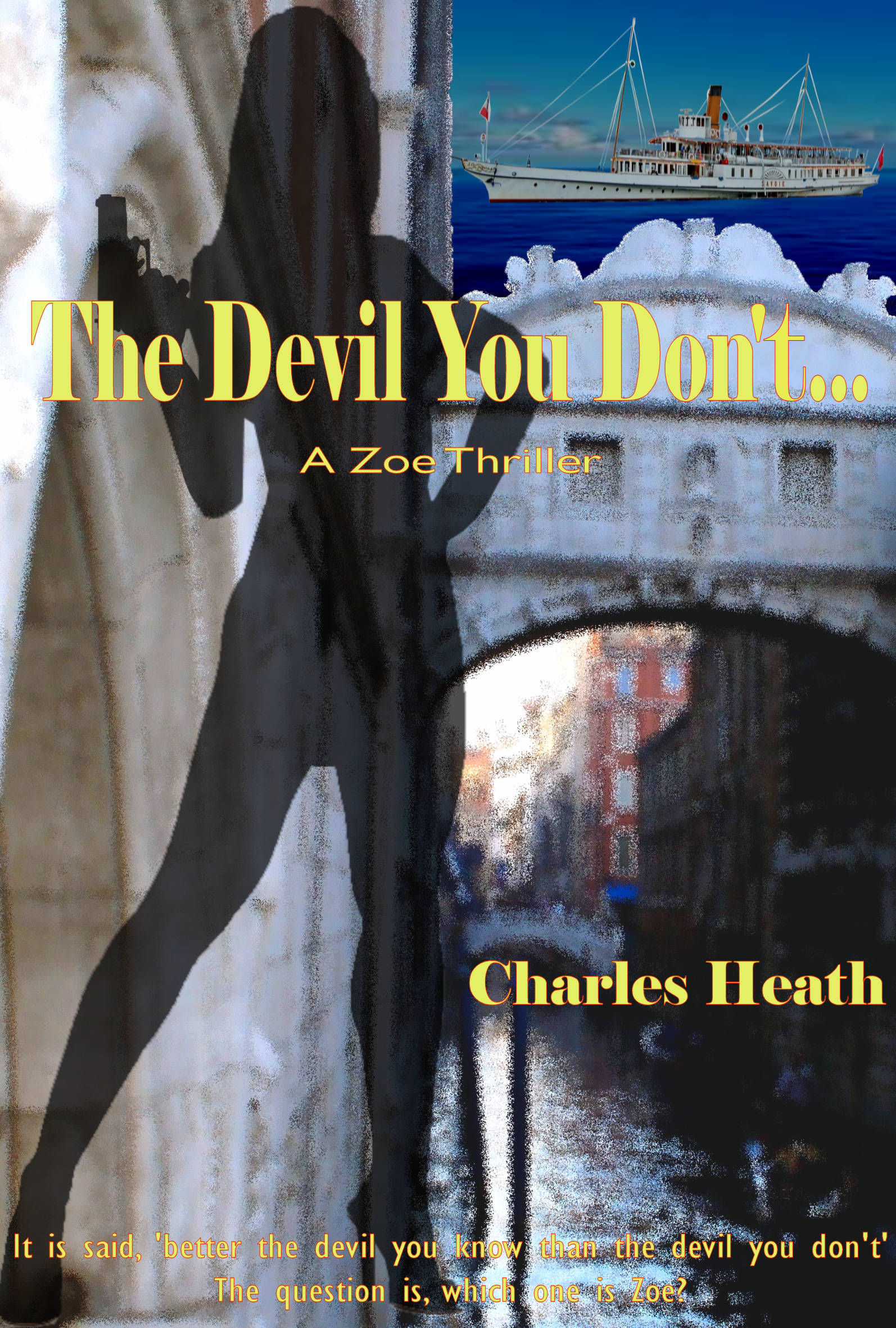
John Pennington’s life is in the doldrums. Looking for new opportunities and prevaricating about getting married, the only joy on the horizon was an upcoming visit to his grandmother in Sorrento, Italy.
Suddenly, he is left at the check-in counter with a message on his phone telling him the marriage is off, and the relationship is over.
If only he hadn’t promised a friend he would do a favour for him in Rome.
At the first stop, Geneva, he has a chance encounter with Zoe, an intriguing woman who captures his imagination from the moment she boards the Savoire, and his life ventures into uncharted territory in more ways than one.
That ‘favour’ for his friend suddenly becomes a life-changing event, and when Zoe, the woman who he knows is too good to be true, reappears, danger and death follow.
Shot at, lied to, seduced, and drawn into a world where nothing is what it seems, John is dragged into an adrenaline-charged undertaking, where he may have been wiser to stay with the ‘devil you know’ rather than opt for the ‘devil you don’t’.
It was the first time in almost a week that I made the short walk to the cafe alone. It was early, and the chill of the morning was still in the air. In summer, it was the best time of the day. When Susan came with me, it was usually much later, when the day was much warmer and less tolerable.
On the morning of the third day of her visit, Susan said she was missing the hustle and bustle of London, and by the end of the fourth she said, in not so many words, she was over being away from ‘civilisation’. This was a side of her I had not seen before, and it surprised me.
She hadn’t complained, but it was making her irritable. The Susan that morning was vastly different to the Susan on the first day. So much, I thought, for her wanting to ‘reconnect’, the word she had used as the reason for coming to Greve unannounced.
It was also the first morning I had time to reflect on her visit and what my feelings were towards her. It was the reason I’d come to Greve: to soak up the peace and quiet and think about what I was going to do with the rest of my life.
I sat in my usual corner. Maria, one of two waitresses, came out, stopped, and there was no mistaking the relief in her manner. There was an air of tension between Susan and Maria I didn’t understand, and it seemed to emanate from Susan rather than the other way around. I could understand her attitude if it was towards Alisha, but not Maria. All she did was serve coffee and cake.
When Maria recovered from the momentary surprise, she said, smiling, “You are by yourself?” She gave a quick glance in the direction of my villa, just to be sure.
“I am this morning. I’m afraid the heat, for one who is not used to it, can be quite debilitating. I’m also afraid it has had a bad effect on her manners, for which I apologise. I cannot explain why she has been so rude to you.”
“You do not have to apologise for her, David, but it is of no consequence to me. I have had a lot worse. I think she is simply jealous.”
It had crossed my mind, but there was no reason for her to be. “Why?”
“She is a woman, I am a woman, she thinks because you and I are friends, there is something between us.”
It made sense, even if it was not true. “Perhaps if I explained…”
Maria shook her head. “If there is a hole in the boat, you should not keep bailing but try to plug the hole. My grandfather had many expressions, David. If I may give you one piece of advice, as much as it is none of my business, you need to make your feelings known, and if they are not as they once were, and I think they are not, you need to tell her. Before she goes home.”
Interesting advice. Not only a purveyor of excellent coffee, but Maria was also a psychiatrist who had astutely worked out my dilemma. What was that expression, ‘not just a pretty face’?
“Is she leaving soon?” I asked, thinking Maria knew more about Susan’s movements than I did.
“You would disappoint me if you had not suspected as much. Susan was having coffee and talking to someone in her office on a cell phone. It was an intense conversation. I should not eavesdrop, but she said being here was like being stuck in hell. It is a pity she does not share your love for our little piece of paradise, is it not?”
“It is indeed. And you’re right. She said she didn’t have a phone, but I know she has one. She just doesn’t value the idea of getting away from the office. Perhaps her role doesn’t afford her that luxury.”
And perhaps Alisha was right about Maria, that I should be more careful. She had liked Maria the moment she saw her. We had sat at this very table, the first day I arrived. I would have travelled alone, but Prendergast, my old boss, liked to know where ex-employees of the Department were, and what they were doing.
She sighed. “I am glad I am just a waitress. Your usual coffee and cake?”
“Yes, please.”
Several months had passed since we had rescued Susan from her despotic father; she had recovered faster than we had thought, and settled into her role as the new Lady Featherington, though she preferred not to use that title, but go by the name of Lady Susan Cheney.
I didn’t get to be a Lord, or have any title, not that I was expecting one. What I had expected was that Susan, once she found her footing as head of what seemed to be a commercial empire, would not have time for details like husbands, particularly when our agreement made before the wedding gave either of us the right to end it.
There was a moment when I visited her recovering in the hospital, where I was going to give her the out, but I didn’t, and she had not invoked it. We were still married, just not living together.
This visit was one where she wanted to ‘reconnect’ as she called it, and invite me to come home with her. She saw no reason why we could not resume our relationship, conveniently forgetting she indirectly had me arrested for her murder, charges both her mother and Lucy vigorously pursued, and had the clone not returned to save me, I might still be in jail.
It was not something I would forgive or forget any time soon.
There were other reasons why I was reluctant to stay with her, like forgetting small details, an irregularity in her character I found odd. She looked the same, she sounded the same, she basically acted the same, but my mind was telling me something was not right. It was not the Susan I first met, even allowing for the ordeal she had been subjected to.
But, despite those misgivings, there was no question in my mind that I still loved her, and her clandestine arrival had brought back all those feelings. But as the days passed, I began to get the impression my feelings were one-sided and she was just going through the motions.
Which brought me to the last argument, earlier, where I said if I went with her, it would be business meetings, social obligations, and quite simply her ‘celebrity’ status that would keep us apart. I reminded her that I had said from the outset I didn’t like the idea of being in the spotlight, and when I reiterated it, she simply brushed it off as just part of the job, adding rather strangely that I always looked good in a suit. The flippancy of that comment was the last straw, and I left before I said something I would regret.
I knew I was not a priority. Maybe somewhere inside me, I had wanted to be a priority, and I was disappointed when I was not.
And finally, there was Alisha. Susan, at the height of the argument, had intimated she believed I had an affair with her, but that elephant was always in the room whenever Alisha was around. It was no surprise when I learned Susan had asked Prendergast to reassign her to other duties.
At least I knew what my feelings for Alisha were, and there were times when I had to remember she was persona non grata. Perhaps that was why Susan had her banished, but, again, a small detail; jealousy was not one of Susan’s traits when I first knew her.
Perhaps it was time to set Susan free.
When I swung around to look in the direction of the lane where my villa was, I saw Susan. She was formally dressed, not in her ‘tourist’ clothes, which she had bought from one of the local clothing stores. We had fun that day, shopping for clothes, a chore I’d always hated. It had been followed by a leisurely lunch, lots of wine and soul searching.
It was the reason why I sat in this corner; old habits die hard. I could see trouble coming from all directions, not that Susan was trouble or at least I hoped not, but it allowed me the time to watch her walking towards the cafe in what appeared to be short, angry steps; perhaps the culmination of the heat wave and our last argument.
She glared at me as she sat, dropping her bag beside her on the ground, where I could see the cell phone sitting on top. She followed my glance down, and then she looked unrepentant back at me.
Maria came back at the exact moment she was going to speak. I noticed Maria hesitate for a second when she saw Susan, then put her smile in place to deliver my coffee.
Neither spoke nor looked at each other. I said, “Susan will have what I’m having, thanks.”
Maria nodded and left.
“Now,” I said, leaning back in my seat, “I’m sure there’s a perfectly good explanation as to why you didn’t tell me about the phone, but that first time you disappeared, I’d guessed you needed to keep in touch with your business interests. I thought it somewhat unwisethat you should come out when the board of one of your companies was trying to remove you, because of what was it, an unexplained absence? All you had to do was tell me there were problems and you needed to remain at home to resolve them.”
My comment elicited a sideways look, with a touch of surprise.
“It was unfortunate timing on their behalf, and I didn’t want you to think everything else was more important than us. There were issues before I came, and I thought the people at home would be able to manage without me for at least a week, but I was wrong.”
“Why come at all. A phone call would have sufficed.”
“I had to see you, talk to you. At least we have had a chance to do that. I’m sorry about yesterday. I once told you I would not become my mother, but I’m afraid I sounded just like her. I misjudged just how much this role would affect me, and truly, I’m sorry.”
An apology was the last thing I expected.
“You have a lot of work to do catching up after being away, and of course, in replacing your mother and gaining the requisite respect as the new Lady Featherington. I think it would be for the best if I were not another distraction. We have plenty of time to reacquaint ourselves when you get past all these teething issues.”
“You’re not coming with me?” She sounded disappointed.
“I think it would be for the best if I didn’t.”
“Why?”
“It should come as no surprise to you that I’ve been keeping an eye on your progress. You are so much better doing your job without me. I told your mother once that when the time came I would not like the responsibilities of being your husband. Now that I have seen what it could possibly entail, I like it even less. You might also want to reconsider our arrangement, after all, we only had a marriage of convenience, and now that those obligations have been fulfilled, we both have the option of terminating it. I won’t make things difficult for you if that’s what you want.”
It was yet another anomaly, I thought; she should look distressed, and I would raise the matter of that arrangement. Perhaps she had forgotten the finer points. I, on the other hand, had always known we would not last forever. The perplexed expression, to me, was a sign she might have forgotten.
Then, her expression changed. “Is that what you want?”
“I wasn’t madly in love with you when we made that arrangement, so it was easy to agree to your terms, but inexplicably, since then, my feelings for you changed, and I would be sad if we parted ways. But the truth is, I can’t see how this is going to work.”
“In saying that, do you think I don’t care for you?”
That was exactly what I was thinking, but I wasn’t going to voice that opinion out loud. “You spent a lot of time finding new ways to make my life miserable, Susan. You and that wretched friend of yours, Lucy. While your attitude improved after we were married, that was because you were going to use me when you went to see your father, and then almost let me go to prison for your murder.”
“I had nothing to do with that, other than to leave, and I didn’t agree with Lucy that you should be made responsible for my disappearance. I cannot be held responsible for the actions of my mother. She hated you; Lucy didn’t understand you, and Millie told me I was stupid for not loving you in return, and she was right. Why do you think I gave you such a hard time? You made it impossible not to fall in love with you, and it nearly changed my mind about everything I’d been planning so meticulously. But perhaps there was a more subliminal reason why I did because after I left, I wanted to believe, if anything went wrong, you would come and find me.”
“How could you possibly know that I’d even consider doing something like that, given what you knew about me?”
“Prendergast made a passing comment when my mother asked him about you; he told us you were very good at finding people and even better at fixing problems.”
“And yet here we are, one argument away from ending it.”
I could see Maria hovering, waiting for the right moment to deliver her coffee, then go back and find Gianna, the café owner, instead. Gianna was more abrupt and, for that reason, was rarely seen serving the customers. Today, she was particularly cantankerous, banging the cake dish on the table and frowning at Susan before returning to her kitchen. Gianna didn’t like Susan either.
Behind me, I heard a car stop, and when she looked up, I knew it was for her. She had arrived with nothing, and she was leaving with nothing.
She stood. “Last chance.”
“Forever?”
She hesitated and then shook away the look of annoyance on her face. “Of course not. I wanted you to come back with me so we could continue working on our relationship. I agree there are problems, but it’s nothing we can’t resolve if we try.”
I had been trying. “It’s too soon for both of us, Susan. I need to be able to trust you, and given the circumstances, and all that water under the bridge, I’m not sure if I can yet.”
She frowned at me. “As you wish.” She took an envelope out of her bag and put it on the table. “When you are ready, it’s an open ticket home. Please make it sooner rather than later. Despite what you think of me, I have missed you, and I have no intention of ending it between us.”
That said, she glared at me for a minute, shook her head, then walked to the car. I watched her get in and the car drive slowly away.



 Thrills, Spills, and just a dash of Romance