Every time I close my eyes, I see something different.
I’d like to think the cinema of my dreams is playing a double feature but it’s a bit like a comedy cartoon night on Fox.
But these dreams are nothing to laugh about.
Once again there’s a new installment of an old feature, and we’re back on the treasure hunt.
…
Charlene, and speaking to Boggs
…
She had been one of the few nice girls at school and we had got along better than most. Boggs had once told me she liked me but was disappointed I hadn’t noticed her. I suppose, back then, I didn’t recognize the signs, and even now, I was still all at sea with girls.
Was she Boggs’s girlfriend? If she was, it was the best-kept secret.
“Hello Charlene,” I said when she also looked up to see who had entered the room.
“Sam.”
“Are you…”
Before I could finish she interrupted, “I’m working in the sheriff’s office, and dad asked me to keep a watch over Boggs.”
“You don’t have to be in the room,” Boggs growled. “It’s not as if I’m going anywhere.”
It was hardly a conciliatory tone. And a mental note, Boggs was uncharacteristically angry. With her, or with me?
“My father asked me to do a job, so here I stay. It’s for your protection as much as anything else.” Then, to me, “how are you, Sam?”
“Good.”
“I understand you found him on the beach belonging to the Cossatino’s. Odd place to be, Sam, for you at least?”
“Nadia and I were searching the coastline for coins with metal detectors when we stumbled over a body. Thought at first it was a beached shark.”
Boggs turned his head back. “Whose idea was it?”
Curious response and I thought about telling him it was mine, but something told me to tell the truth. “Nadia. And before you ask, no, I don’t think she had any other idea in mind because as you and I both know, there’s no access from the ocean to the shore through the reef. That much I ascertained for myself, and that goes for the whole coastline of The Grove.”
If he had looked down from the top of the cliff face, at any point along the coastline he would have seen that for himself. But, that might not always have been the case because there were almost two centuries and a lot of seismic activity in between. I’d seen the big A, but no other evidence it might be the spot, but Boggs had been there, and it was likely he knew it a likely spot too.
He nodded, which meant he had checked himself, which gave him a reason for being at The Grove, but not finishing up where he’d landed. There was something else in his expression and had I not had the knowledge I had, I would have ignored it.
“Why look for coins then?”
“Something to do, I guess, since you’ve stopped asking me to help you. That and doing a little investigation on the side. I’m amazed at just how much information there is out there, and it’s a battle to sort fact from fiction. And I didn’t have the head start you have.”
“You do realize Nadia is a Cossatino. You can’t be consorting with the enemy.”
“I thought she was just someone to hang out with since we hadn’t hit it off at school. In case you didn’t notice, she hasn’t been around these parts for several years, going to Italy to get away from the family. But, I get it, she’s still a Cossatino, or so everyone keeps telling me, and not someone I should be associating with. You’re not the only one issuing dire warnings.”
“That’s your problem, Sam, you see the good in everyone, even if they’re bad.”
“Should I apply that theory to you. You don’t finish up unconscious on a beach where you’re not supposed to be. What happened?”
I could practically see the wheels turning while he formulated an excuse he thought I would buy, then said, “I slipped and fell, something that shouldn’t have happened?”
“Not unless you’d been seen and the Cossatino’s were either coming to get you or were chasing you?”
He didn’t answer perhaps knowing Charlene was there to get answers, but his expression told me it was close to the truth.
“No. Slipped, a fundamental error setting up. I was simply sloppy.”
“You were trespassing.”
“I was practicing my skills, and it’s the best rockface along the coast for exactly that. It’s not the first time I’ve tried.”
OK, we weren’t going to get past the ‘I was practicing mantra’, so I moved on to the next question, “Where have you been lately?”
“The caves in the hills, and trying a bit of climbing there, too.”
“You shouldn’t be doing it alone.”
“I wouldn’t have to if my so-called friend wasn’t cavorting with a snake.”
Being confined to home because despite the conquering of COVID, it’s still out there and we have to live with it – something in my condition I can’t take too many risks with – not only gives me, and a lot of others more time to write, it also enables us to explore a few more leisure options to fill in the time.
After all, we can hardly just keep writing endlessly.
Well, perhaps some of us could.
At first, I decided I would do some virtual travelling, you know, go to places I would never go in person, like South Africa, Kenya, Egypt, South America, you know the sort of places I mean, the ones where you can’t get travel insurance cover, or not without mortgaging your home.
That lasted about a day. Seeing the pyramids online was not the same as being there, getting the sand blown in your face, or the tour bus being hijacked, and you spend the next three months in a dark, hot, hell hole while the kidnappers negotiate with governments that refuse to negotiate with terrorists.
So far, I’m not filling in my time very well.
There are weeds to be pulled, lawns to be cut, shrubs and trees to be pruned, painting to be done, you know, all of those chores that you put off until tomorrow, knowing tomorrow will never come.
Don’t ask me to explain that.
So, we’re left with television.
Firstly there was a series called Yellowstone, a western in a modern setting, three series worth. Yes, we watched all of them, no, didn’t like the swearing, or Beth Dutton, Rip was channelling the Duke (John Wayne), and Kevin Costner, well, his stint in Dances with Wolves stood him in good stead.
Geez though, how much trouble can one ranch attract? Indians, speculators, developers, and an international airport? To be honest, at times it spiralled out of control, but for sheer entertainment value, it was slightly better than I thought it might be. As for Jamie, how could one person be so complicated?
Then there was another series, Away. OK, this was about as far-fetched as a premise could get, and the characters, as diverse, and sometimes as obtuse as any I’ve seen thrown together for over eight months. Thank god we didn’t have to suffer eight months of it.
It was good, I guess, with people being the way they are, and I’d expected in the confines of that small space for so long, they might have killed each other off one at a time, like in Lord of the Flies, but no such luck.
My favourite? The Russian. He might have been blind but he was interesting. Just would have liked a few subtitles for us non-Ghana, Chinese, Russian, and Indian people.
As for White House Farm, I’m still trying to work out who killed them all, because it definitely wasn’t the daughter. It had to be the indifferent son, or at his behest. Full marks to the dogged detective, who, the last time I saw him, he was a rather improbable Hercules. Funny how your impression of a performance goes back to one you’ve seen him before.
Which is another of our viewing interests, watching a show and trying to work out where we’ve seen the actors before. Some are familiar and seem to be in everything, others rarely seen, or remembered. I hope this is not a sign of their acting talent, or more to the point, lack of it.
At the moment we are in the middle of Young Wallender. Those who may have seen Branagh in the Wallender series would remember this as being the most stultifying of series, filmed bleakly in a bleak country with bleak characters, and bleak crimes.
Fortunately, the Young Wallender series is not as bleak, but it has dark undertones. Some might call this gritty. There are four more to go so it can only get better.
Like jumping off a ten-storey building, it’s so far so good…
This story has been ongoing since I was seventeen, and just to let you know, I’m 72 this year.
Yes, it’s taken a long time to get it done.
Why, you might ask.
Well, I never gave it much interest because I started writing it after a small incident when I was 17, and working as a book packer for a book distributor in Melbourne
At the end of my first year, at Christmas, the employer had a Christmas party, and that year, it was at a venue in St Kilda.
I wasn’t going to go because at that age, I was an ordinary boy who was very introverted and basically scared of his own shadow and terrified by girls.
Back then, I would cross the street to avoid them
Also, other members of the staff in the shipping department were rough and ready types who were not backwards in telling me what happened, and being naive, perhaps they knew I’d be either shocked or intrigued.
I was both adamant I wasn’t coming and then got roped in on a dare.
Damn!
So, back then, in the early 70s, people looked the other way when it came to drinking, and of course, Dutch courage always takes away the concerns, especially when normally you wouldn’t do half the stuff you wouldn’t in a million years
I made it to the end, not as drunk and stupid as I thought I might be, and St Kilda being a salacious place if you knew where to look, my new friends decided to give me a surprise.
It didn’t take long to realise these men were ‘men about town’ as they kept saying, and we went on an odyssey. Yes, those backstreet brothels where one could, I was told, have anything they could imagine.
Let me tell you, large quantities of alcohol and imagination were a very bad mix.
So, the odyssey in ‘The things we do’ was based on that, and then the encounter with Diana. Well, let’s just say I learned a great deal about girls that night.
Firstly, not all girls are nasty and spiteful, which seemed to be the case whenever I met one. There was a way to approach, greet, talk to, and behave.
It was also true that I could have had anything I wanted, but I decided what was in my imagination could stay there. She was amused that all I wanted was to talk, but it was my money, and I could spend it how I liked.
And like any 17-year-old naive fool, I fell in love with her and had all these foolish notions. Months later, I went back, but she had moved on, to where no one was saying or knew.
Needless to say, I was heartbroken and had to get over that first loss, which, like any 17-year-old, was like the end of the world.
But it was the best hour I’d ever spent in my life and would remain so until I met the woman I have been married to for the last 48 years.
As Henry, he was in part based on a rebel, the son of rich parents who despised them and their wealth, and he used to regale anyone who would listen about how they had messed up his life
If only I’d come from such a background!
And yes, I was only a run away from climbing up the stairs to get on board a ship, acting as a purser.
I worked for a shipping company and they gave their junior staff members an opportunity to spend a year at sea working as a purser on a cargo ship that sailed between Melbourne, Sydney and Hobart in Australia.
One of the other junior staff members’ turn came, and I would visit him on board when he would tell me stories about life on board, the officers, the crew, and other events. These stories, which sounded incredible to someone so impressionable, were a delight to hear.
Alas, by that time, I had tired of office work and moved on to be a tradesman at the place where my father worked.
It proved to be the right move, as that is where I met my wife. Diana had been right; love would find me when I least expected it.
I’m back home and this story has been sitting on a back burner for a few months, waiting for some more to be written.
The trouble is, there are also other stories to write, and I’m not very good at prioritising.
But, here we are, a few minutes opened up and it didn’t take long to get back into the groove.
Was I working for a ghost?
The question that was foremost in my mind was whether I should call Nobbin, and let him know that I’d met Severin and that his ‘information’ was on a USB.
When I’d mentioned the fact O’Connor said the evidence was somewhere, I knew this evidence was on a USB and could be in one of the hiding places O’Connor had set up with Nobbin. If not, then it had to be somewhere else, somewhere only O’Connor would know about.
Somehow, I got the impression O’Connor had not trusted either side. Yes, he was about to tell me where the evidence was, but if that was the case, it meant it was not anywhere where anyone else would know about.
Severin should have curbed his desire for execution a little, and taken O’Connor into custody, and then interrogated him. It made me wonder, briefly, why Severin would want him dead. In cases like that, it was because Severin didn’t want O’Connor to talk to me, or anyone else.
Still, he could have tranquilized O’Connor. I would not have known the difference.
That meant I had to find out more information on O’Connor.
Of course, in just saying that out loud, over a half-full glass of scotch, just to steady the nerves after seeing Severin again, made it sound almost like a running joke.
As if I would be able to find someone who was, for all intents and purposes, a ghost. That was how we were supposed to be, ghosts, to everyone we knew, including family. We could no longer talk to anyone because they might become a target used as leverage against us.
That part of my training had been the scariest. I didn’t have any friends, not real friends anyway, and no family, other than a half-brother who hated me. I had toyed with the idea of meeting him, after I’d completed the training, just to see if anyone would try to use him as leverage, and then tell them he meant nothing to me.
It was an idea, I doubt if I could do it in reality. But the thought of it gave me some measure of revenge for all the bullying he had inflicted on me when I was young. Perhaps that was why I took this job, to prove I was nothing like the person he considered me to be.
Enough of the delving into the shadowy past.
I had a problem that needed solving. How to find O’Connor.
After a long night of fitful sleep, I woke the next morning with the shreds of a plan. I’d go into the office and use their computer system to look for him. Of course, I didn’t expect that there would be any information available to an agent with my security clearance, which was basically to get in and out of the front door and log on to the computer to fill out reports and a timesheet.
It was a surprise, after what Nobbin had said about my employment, that my pass got me in the door. It did, but I had no doubt somewhere it had register my name in a log somewhere. I figured I had about half an hour before someone came checking up on me.
The same went for the computer system. There was a bank of about a dozen computers in a room where the agents could do information searches, and private work, such as reports. Three others were occupied, and none of those using them looked up when I entered the room.
Not a surprise. We were taught to keep to ourselves and say nothing about the missions we were attached to anyone else. In our line of work, secrets were paramount. We were to become consummate liars because we could never tell anyone the truth about what we did. If we wanted a cover story, we were to say we were international confidential couriers of documents for legal institutions.
It sounded interesting, but it was quite boring, or at least that was how I described it if anyone asked.
So, ignoring the others, I logged in and found I was still on the employee list. And, I still had the same level of access I had before.
I ran a search on the name O’Connor.
It came back with five documents, the first of which was his personnel record. First name, Donald. A date of birth that made him 27 years old, and an address, in Putney. I wrote it down. Marital status, single. Status, deceased. Section worked for: Eight.
There were supposedly eight sections, and the one I worked for was Seven. Out of interest, I brought up my records. It was how Severin had found me because my address was on file. But more interesting was my status, transferred, and my section, three. Was Nobbin’s section three?
I would ask if I got an opportunity to.
The other four documents were reports, most of which were redacted, or marked restricted. Or above my pay grade, whatever that was.
But, at least one thing was clear, I had not been fired, just transferred. I guess I would have to call Nobbin after all. After I visited O’Connor’s last known residence.
I wasn’t holding my breath expecting to find anything.
How many of us have skeletons in the closet that we know nothing about? The skeletons we know about generally stay there, but those we do not, well, they have a habit of coming out of left field when we least expect them.
In this case, when you see your photo on a TV screen with the accompanying text that says you are wanted by every law enforcement agency in Europe, you’re in a state of shock, only to be compounded by those same police, armed and menacing, kicking the door down.
I’d been thinking about this premise for a while after I discovered my mother had a boyfriend before she married my father, a boyfriend who was, by all accounts, the man who was the love of her life.
Then, in terms of coming up with an idea for a story, what if she had a child by him that we didn’t know about, which might mean I had a half-brother or sister I knew nothing about. It’s not an uncommon occurrence from what I’ve been researching.
There are many ways of putting a spin on this story.
Then, in the back of my mind, I remembered a story an acquaintance at work was once telling us over morning tea, that a friend of a friend had a mother who had a twin sister and that each of the sisters had a son by the same father, without each knowing of the father’s actions, both growing up without the other having any knowledge of their half brother, only to meet by accident on the other side of the world.
It was an encounter that in the scheme of things might never have happened, and each would have remained oblivious of the other.
For one sister, the relationship was over before she discovered she was pregnant, and therefore had not told the man he was a father. It was no surprise the relationship foundered when she discovered he was also having a relationship with her sister, a discovery that caused her to cut all ties with both of them and never speak to either from that day.
It’s a story with more twists and turns than a country lane!
Every time I close my eyes, I see something different.
I’d like to think the cinema of my dreams is playing a double feature but it’s a bit like a comedy cartoon night on Fox.
But these dreams are nothing to laugh about.
Once again there’s a new installment of an old feature, and we’re back on the treasure hunt.
…
In a cave, Nadia is a surprise
…
Now the helicopter had gone, the sounds of the sea had returned, along with the muffled sound of the wind which had picked up, along with swirling clouds that looked like they would be bringing rain. I’d heard how the weather could change suddenly, and dangerously along this coastline.
I saw the lightning, and a minute or so later, the cracking of thunder. We were about to get very wet.
‘Look for the big A’. It had been there, heavily underscored in Ormiston’s notebooks. It had also been on the cliff face, crudely, but there.
“We need to go,” I heard Nadia say, over the ambient noise all around us.
Her words were being swept away by the wind, and I could barely hear her.
Another glance up at the cliff to confirm what I’d seen, and, yes, it was a big A, I went over to her.
“We can’t outrun it. And it will be treacherous on those rocks in a downpour.”
“We also have the tide to contend with.”
I could see the high-water line, and it didn’t leave much to the imagination. We needed higher ground. It was one of those situations where we might get caught by the tide. It was a pity there wasn’t room for two of us on the helicopter.
Back the way we’d come I remembered seeing an outcrop that looked like it might provide shelter from the rain. “We should go, there’s a spot a way back that might save us from getting too wet.”
It was about a hundred yards, not far from where the shore rocks started and would require climbing back up. At the very least, we could stay there until the tide dropped. We collected the metal detectors and made it to the base of the rocky outcrop just as the first drops of rain fell.
The overhang I’d seen turned out to be a shallow cave, going back into the rockface about 10 yards or so, carved out by the sea over a very long period.
Then the rain came, so heavy, we could not see through it. Every few minutes a gust of wind blew water into the cave, but standing back from the entrance basically kept us dry.
Nadia sat down and looked despondent. I’d never seen her like this, she was normally more cheerful.
I took a few minutes to explore inside using the torchlight on my phone. I could see the layers of sandstone compressed over the years, and if I had remembered more from the geology part of science at school I might have been able to make sense of it. Was I hoping for fossils, like from long-extinct dinosaurs?
Or perhaps I could imagine this was the entrance to Aladdin’s cave, also reputed to have hidden treasures, and briefly wondered if I’d found a lantern with a genie, what my three wishes might be?
“They’re only walls, Sam.” Nadia had come silently up behind me, and was just behind my left shoulder, the sound of her voice so near startling me.
Also noted, when my potential heart attack passed, she called me Sam, not Smidge. I was not going to write anything into it, she didn’t seem herself.
“You never know. If I say open sesame, or whatever the password is…”
It sounded lame.
I could hear rather than see her shake her head.
“What do you think Boggs was doing climbing up or down that particular rockface, and for that matter, poking around The Grove?”
I turned around to look at her. If I didn’t know her better, I might have said there was at that moment an angelic quality about her. It only reinforced the notion that she was very much out of my league, and whatever we seemed to have going, it was more in my head than hers.
“I think you can make as educated a guess as I can.”
“He thinks the treasure is here?”
“Somewhere in The Grove, yes. His approach might have been different from ours, but the conclusion is the same.”
“We didn’t find anything.”
“That doesn’t mean it didn’t come ashore somewhere near here, or somewhere along the coast despite the reefs because they might have once been navigable in an abnormally high tide. And those coins found near the old marina tells me that they landed somewhere there, but it was not the final resting place.”
I was going to say anything was possible.
“I can assure you my father and his cronies spent years turning over this whole property, one way or another, and found nothing.”
I believed her. Had he not won the bidding war for the property, sold by the remaining Ormiston’s to settle the debts racked up by successive treasure hunts, Benderby, or anyone else for that matter, would have done the same. Everyone was aware of the obsession, and the possibility of making a fortune.
But, my money was on the fact it was in The Grove, somewhere. The question was, would I be completely honest with her?
When I didn’t say anything, she added, “you think it’s still here, don’t you?”
I shrugged. “Why else would Boggs be here? I’m sure his deductions from the resources he has, and I’m sure he hadn’t told me everything for obvious reasons, told him when all else has been eliminated, the last possibility however improbable must be true.”
“Occam’s razor?”
“Ish. When we can get back to the cabin, I’ll go and see him, see what he has to say. If he wants to see me, that is.”
I could see her processing what I just said, and thought perhaps I could have said it better.
“He doesn’t trust you because of me?”
Again I shrugged. “I got that impression when I last spoke to him. I don’t think he quite understands the nature of our friendship. I’m assuming that’s what it is because I’m hardly the sort of boy your parents would consider suitable for you.”
“My parents have no idea what I want or care about. It’s why I left.”
“Why did you come back then?”
“My mother said she had cancer and wasn’t expected to live.”
“I’m sorry.”
“Don’t be. It was a lie. Their whole life is a lie. I’ve always known about the family, I just chose to ignore it, even bask in some of the glory of it, until it got a friend of mine killed. Vince did it, I know he did, but they all lied. It’s just one of many reasons I wanted to getaway. I was going to go back to Italy until you popped up. I always liked you, you know.”
I didn’t. I thought I was just another pawn in a game of terror and ridicule she played on all of us boys.
“You had a funny way of showing it.”
“I was stupid back then, but that was no excuse. If it’s any consolation I’m sorry, but words never seem to be enough, and besides that, no one I’ve apologized to really believes me, and I get it. My name is a curse. That’s why when I go back I’m going to disappear, a whole change of identity. That’s how much I trust you, Sam, you’re the only one I’ve told.”
“You shouldn’t tell me anything. I’m sure if you disappear, I’ll be the first one your family will come after.”
I didn’t need to know, I certainly didn’t want to know. If she did disappear, I’m sure my doorstep would be the Cossatino’s first stop, and I’d easily fold under pressure.
“Maybe you could come with me, then you wouldn’t have to worry about them.”
Perhaps she could read my mind. Even so, it was an interesting thought, not that I could just up and leave my mother, or worry the Cossatino’s would come after her if I went missing.
“I don’t speak Italian.” Lame excuse.
“I could teach you. We could work in the vineyard, and live a simple life.”
It was hard to tell if she was serious or not. I had to think she wasn’t. I don’t think I could handle someone like her, that anyone could.
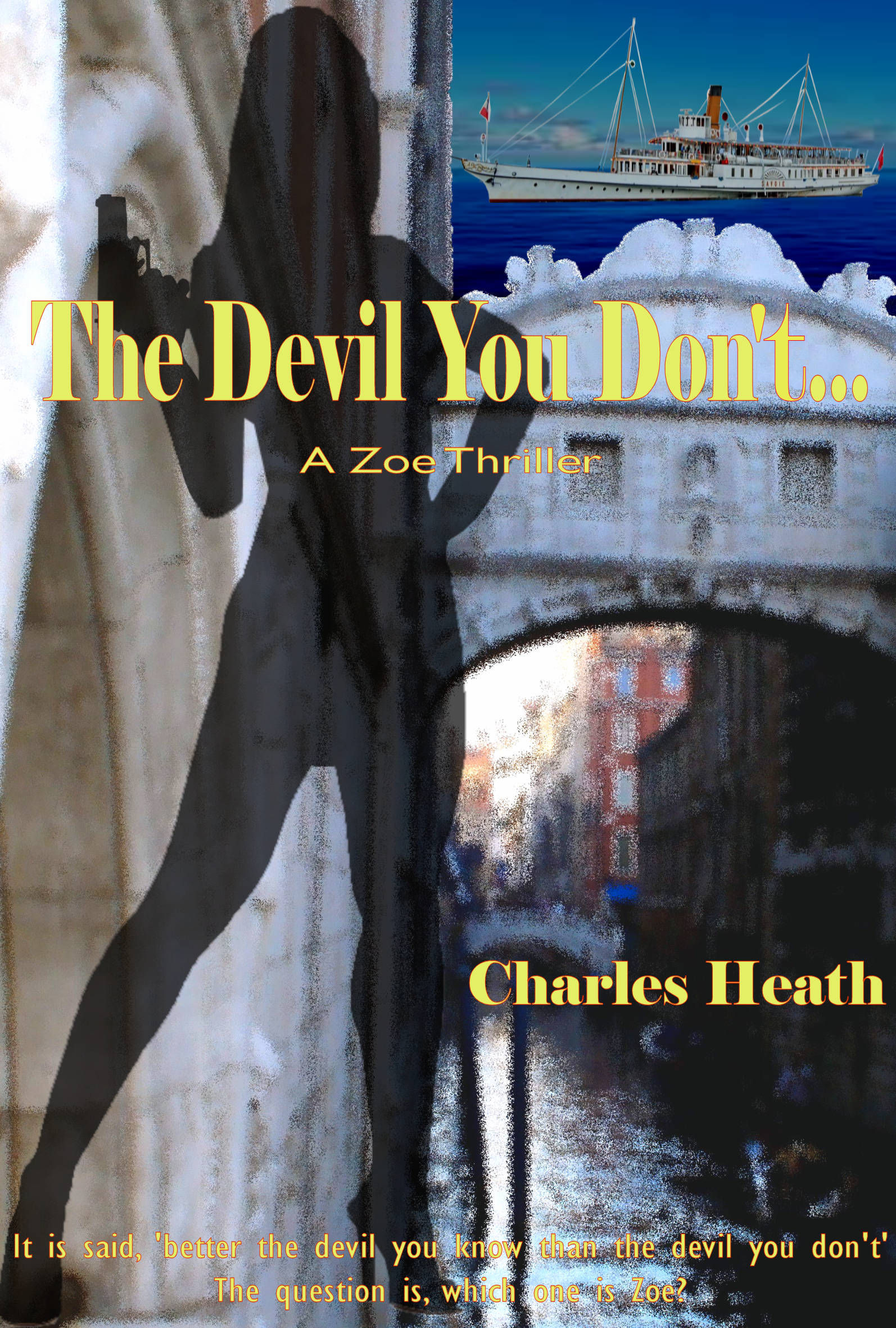
John Pennington’s life is in the doldrums. Looking for new opportunities and prevaricating about getting married, the only joy on the horizon was an upcoming visit to his grandmother in Sorrento, Italy.
Suddenly, he is left at the check-in counter with a message on his phone telling him the marriage is off, and the relationship is over.
If only he hadn’t promised a friend he would do a favour for him in Rome.
At the first stop, Geneva, he has a chance encounter with Zoe, an intriguing woman who captures his imagination from the moment she boards the Savoire, and his life ventures into uncharted territory in more ways than one.
That ‘favour’ for his friend suddenly becomes a life-changing event, and when Zoe, the woman who he knows is too good to be true, reappears, danger and death follow.
Shot at, lied to, seduced, and drawn into a world where nothing is what it seems, John is dragged into an adrenaline-charged undertaking, where he may have been wiser to stay with the ‘devil you know’ rather than opt for the ‘devil you don’t’.
It was the first time in almost a week that I made the short walk to the cafe alone. It was early, and the chill of the morning was still in the air. In summer, it was the best time of the day. When Susan came with me, it was usually much later, when the day was much warmer and less tolerable.
On the morning of the third day of her visit, Susan said she was missing the hustle and bustle of London, and by the end of the fourth she said, in not so many words, she was over being away from ‘civilisation’. This was a side of her I had not seen before, and it surprised me.
She hadn’t complained, but it was making her irritable. The Susan that morning was vastly different to the Susan on the first day. So much, I thought, for her wanting to ‘reconnect’, the word she had used as the reason for coming to Greve unannounced.
It was also the first morning I had time to reflect on her visit and what my feelings were towards her. It was the reason I’d come to Greve: to soak up the peace and quiet and think about what I was going to do with the rest of my life.
I sat in my usual corner. Maria, one of two waitresses, came out, stopped, and there was no mistaking the relief in her manner. There was an air of tension between Susan and Maria I didn’t understand, and it seemed to emanate from Susan rather than the other way around. I could understand her attitude if it was towards Alisha, but not Maria. All she did was serve coffee and cake.
When Maria recovered from the momentary surprise, she said, smiling, “You are by yourself?” She gave a quick glance in the direction of my villa, just to be sure.
“I am this morning. I’m afraid the heat, for one who is not used to it, can be quite debilitating. I’m also afraid it has had a bad effect on her manners, for which I apologise. I cannot explain why she has been so rude to you.”
“You do not have to apologise for her, David, but it is of no consequence to me. I have had a lot worse. I think she is simply jealous.”
It had crossed my mind, but there was no reason for her to be. “Why?”
“She is a woman, I am a woman, she thinks because you and I are friends, there is something between us.”
It made sense, even if it was not true. “Perhaps if I explained…”
Maria shook her head. “If there is a hole in the boat, you should not keep bailing but try to plug the hole. My grandfather had many expressions, David. If I may give you one piece of advice, as much as it is none of my business, you need to make your feelings known, and if they are not as they once were, and I think they are not, you need to tell her. Before she goes home.”
Interesting advice. Not only a purveyor of excellent coffee, but Maria was also a psychiatrist who had astutely worked out my dilemma. What was that expression, ‘not just a pretty face’?
“Is she leaving soon?” I asked, thinking Maria knew more about Susan’s movements than I did.
“You would disappoint me if you had not suspected as much. Susan was having coffee and talking to someone in her office on a cell phone. It was an intense conversation. I should not eavesdrop, but she said being here was like being stuck in hell. It is a pity she does not share your love for our little piece of paradise, is it not?”
“It is indeed. And you’re right. She said she didn’t have a phone, but I know she has one. She just doesn’t value the idea of getting away from the office. Perhaps her role doesn’t afford her that luxury.”
And perhaps Alisha was right about Maria, that I should be more careful. She had liked Maria the moment she saw her. We had sat at this very table, the first day I arrived. I would have travelled alone, but Prendergast, my old boss, liked to know where ex-employees of the Department were, and what they were doing.
She sighed. “I am glad I am just a waitress. Your usual coffee and cake?”
“Yes, please.”
Several months had passed since we had rescued Susan from her despotic father; she had recovered faster than we had thought, and settled into her role as the new Lady Featherington, though she preferred not to use that title, but go by the name of Lady Susan Cheney.
I didn’t get to be a Lord, or have any title, not that I was expecting one. What I had expected was that Susan, once she found her footing as head of what seemed to be a commercial empire, would not have time for details like husbands, particularly when our agreement made before the wedding gave either of us the right to end it.
There was a moment when I visited her recovering in the hospital, where I was going to give her the out, but I didn’t, and she had not invoked it. We were still married, just not living together.
This visit was one where she wanted to ‘reconnect’ as she called it, and invite me to come home with her. She saw no reason why we could not resume our relationship, conveniently forgetting she indirectly had me arrested for her murder, charges both her mother and Lucy vigorously pursued, and had the clone not returned to save me, I might still be in jail.
It was not something I would forgive or forget any time soon.
There were other reasons why I was reluctant to stay with her, like forgetting small details, an irregularity in her character I found odd. She looked the same, she sounded the same, she basically acted the same, but my mind was telling me something was not right. It was not the Susan I first met, even allowing for the ordeal she had been subjected to.
But, despite those misgivings, there was no question in my mind that I still loved her, and her clandestine arrival had brought back all those feelings. But as the days passed, I began to get the impression my feelings were one-sided and she was just going through the motions.
Which brought me to the last argument, earlier, where I said if I went with her, it would be business meetings, social obligations, and quite simply her ‘celebrity’ status that would keep us apart. I reminded her that I had said from the outset I didn’t like the idea of being in the spotlight, and when I reiterated it, she simply brushed it off as just part of the job, adding rather strangely that I always looked good in a suit. The flippancy of that comment was the last straw, and I left before I said something I would regret.
I knew I was not a priority. Maybe somewhere inside me, I had wanted to be a priority, and I was disappointed when I was not.
And finally, there was Alisha. Susan, at the height of the argument, had intimated she believed I had an affair with her, but that elephant was always in the room whenever Alisha was around. It was no surprise when I learned Susan had asked Prendergast to reassign her to other duties.
At least I knew what my feelings for Alisha were, and there were times when I had to remember she was persona non grata. Perhaps that was why Susan had her banished, but, again, a small detail; jealousy was not one of Susan’s traits when I first knew her.
Perhaps it was time to set Susan free.
When I swung around to look in the direction of the lane where my villa was, I saw Susan. She was formally dressed, not in her ‘tourist’ clothes, which she had bought from one of the local clothing stores. We had fun that day, shopping for clothes, a chore I’d always hated. It had been followed by a leisurely lunch, lots of wine and soul searching.
It was the reason why I sat in this corner; old habits die hard. I could see trouble coming from all directions, not that Susan was trouble or at least I hoped not, but it allowed me the time to watch her walking towards the cafe in what appeared to be short, angry steps; perhaps the culmination of the heat wave and our last argument.
She glared at me as she sat, dropping her bag beside her on the ground, where I could see the cell phone sitting on top. She followed my glance down, and then she looked unrepentant back at me.
Maria came back at the exact moment she was going to speak. I noticed Maria hesitate for a second when she saw Susan, then put her smile in place to deliver my coffee.
Neither spoke nor looked at each other. I said, “Susan will have what I’m having, thanks.”
Maria nodded and left.
“Now,” I said, leaning back in my seat, “I’m sure there’s a perfectly good explanation as to why you didn’t tell me about the phone, but that first time you disappeared, I’d guessed you needed to keep in touch with your business interests. I thought it somewhat unwisethat you should come out when the board of one of your companies was trying to remove you, because of what was it, an unexplained absence? All you had to do was tell me there were problems and you needed to remain at home to resolve them.”
My comment elicited a sideways look, with a touch of surprise.
“It was unfortunate timing on their behalf, and I didn’t want you to think everything else was more important than us. There were issues before I came, and I thought the people at home would be able to manage without me for at least a week, but I was wrong.”
“Why come at all. A phone call would have sufficed.”
“I had to see you, talk to you. At least we have had a chance to do that. I’m sorry about yesterday. I once told you I would not become my mother, but I’m afraid I sounded just like her. I misjudged just how much this role would affect me, and truly, I’m sorry.”
An apology was the last thing I expected.
“You have a lot of work to do catching up after being away, and of course, in replacing your mother and gaining the requisite respect as the new Lady Featherington. I think it would be for the best if I were not another distraction. We have plenty of time to reacquaint ourselves when you get past all these teething issues.”
“You’re not coming with me?” She sounded disappointed.
“I think it would be for the best if I didn’t.”
“Why?”
“It should come as no surprise to you that I’ve been keeping an eye on your progress. You are so much better doing your job without me. I told your mother once that when the time came I would not like the responsibilities of being your husband. Now that I have seen what it could possibly entail, I like it even less. You might also want to reconsider our arrangement, after all, we only had a marriage of convenience, and now that those obligations have been fulfilled, we both have the option of terminating it. I won’t make things difficult for you if that’s what you want.”
It was yet another anomaly, I thought; she should look distressed, and I would raise the matter of that arrangement. Perhaps she had forgotten the finer points. I, on the other hand, had always known we would not last forever. The perplexed expression, to me, was a sign she might have forgotten.
Then, her expression changed. “Is that what you want?”
“I wasn’t madly in love with you when we made that arrangement, so it was easy to agree to your terms, but inexplicably, since then, my feelings for you changed, and I would be sad if we parted ways. But the truth is, I can’t see how this is going to work.”
“In saying that, do you think I don’t care for you?”
That was exactly what I was thinking, but I wasn’t going to voice that opinion out loud. “You spent a lot of time finding new ways to make my life miserable, Susan. You and that wretched friend of yours, Lucy. While your attitude improved after we were married, that was because you were going to use me when you went to see your father, and then almost let me go to prison for your murder.”
“I had nothing to do with that, other than to leave, and I didn’t agree with Lucy that you should be made responsible for my disappearance. I cannot be held responsible for the actions of my mother. She hated you; Lucy didn’t understand you, and Millie told me I was stupid for not loving you in return, and she was right. Why do you think I gave you such a hard time? You made it impossible not to fall in love with you, and it nearly changed my mind about everything I’d been planning so meticulously. But perhaps there was a more subliminal reason why I did because after I left, I wanted to believe, if anything went wrong, you would come and find me.”
“How could you possibly know that I’d even consider doing something like that, given what you knew about me?”
“Prendergast made a passing comment when my mother asked him about you; he told us you were very good at finding people and even better at fixing problems.”
“And yet here we are, one argument away from ending it.”
I could see Maria hovering, waiting for the right moment to deliver her coffee, then go back and find Gianna, the café owner, instead. Gianna was more abrupt and, for that reason, was rarely seen serving the customers. Today, she was particularly cantankerous, banging the cake dish on the table and frowning at Susan before returning to her kitchen. Gianna didn’t like Susan either.
Behind me, I heard a car stop, and when she looked up, I knew it was for her. She had arrived with nothing, and she was leaving with nothing.
She stood. “Last chance.”
“Forever?”
She hesitated and then shook away the look of annoyance on her face. “Of course not. I wanted you to come back with me so we could continue working on our relationship. I agree there are problems, but it’s nothing we can’t resolve if we try.”
I had been trying. “It’s too soon for both of us, Susan. I need to be able to trust you, and given the circumstances, and all that water under the bridge, I’m not sure if I can yet.”
She frowned at me. “As you wish.” She took an envelope out of her bag and put it on the table. “When you are ready, it’s an open ticket home. Please make it sooner rather than later. Despite what you think of me, I have missed you, and I have no intention of ending it between us.”
That said, she glared at me for a minute, shook her head, then walked to the car. I watched her get in and the car drive slowly away.
I’m back home and this story has been sitting on a back burner for a few months, waiting for some more to be written.
The trouble is, there are also other stories to write, and I’m not very good at prioritising.
But, here we are, a few minutes opened up and it didn’t take long to get back into the groove.
Was I working for a ghost?
Training sometimes was one of those things that went in one ear and came out the other. That accounted for the boring bits, but our instructors called it tradecraft.
I guess I should have taken more notice at the time.
Home was a bedsit in Bloomsbury, Not far from the Russell Square underground station, on the ground floor overlooking the small park. Sometimes, in summer I would sit there and watch the world go by, thinking there had to be more to life than waiting for an opportunity.
To do what, at the time, I didn’t know. But, when this opportunity presented itself, oddly as a rather strange ad in the help wanted pages of the newspaper, I guess the people who put it there were looking for the curious sort, with a sense of adventure.
My first impression of the job was that of a courier who would be required to travel a lot. It said, in part, “must be prepared to travel to different locations worldwide, understand the requirement of confidentiality, and must be able to respond to emergencies that might occur in the carrying out of your duties.”
To me, it spelled courier, though I rather hoped it wasn’t the briefcase handcuffed to a wrist sort and no guns.
After the first interview, I think I had guessed correctly, though, in subsequent training, the word tradecraft put a slightly different slant to the job. That, and the surveillance module, sold to us as “you need to know if you are being followed, recognise hostiles, and be able to deal with them.”
But, it was the notion that we should get out of any habits we had, those that made us predictable to an enemy, yes, they actually used the word, enemy. Like for instance, if we caught the same train, or bus, into the city. If we went to the same cafe for coffee, restaurant for lunch or dinner, met people in a pub on the same day, same time, each week.
Before all this, I found comfort in a regular schedule. I hated being late, except when the transport system let me down. I had a regular stop off on the way to the office for coffee, and usually went to the same cafe for lunch at the same time.
Inevitably I would leave home at the same time and quite often return home at the same time. OK, I was boring and predictable. Now it was a little different, with some variation in departure and arrival times, as well as the places I stopped for coffee, and lunch or dinner.
This day I was very late, after dark in fact, getting back to the flat.
I went in after checking for mail, not that anyone ever sent letters these days, unlocked my door, went in and switched on the light.
The whole of the living space had been trashed. Well, more to the point, someone had checked everywhere it was possible to hide anything, which I didn’t, and hadn’t bothered cleaning up after them.
Had they been interrupted?
If that had happened the landlady would be down in a flash the moment I walked in the door, not to commiserate on my bad luck, but to issue me with an eviction notice. Very little was tolerated in her establishment.
That she hadn’t told me that whoever did this had done it very quietly, and without anyone knowing. We had been taught the same procedures which is why I recognised the signs. This had to be done by my previous employers. The only question I had was why?
I had nothing they could possibly want.
I took a few minutes to clean up the mess so that instead of a thorough trashing, it just looked like the aftermath of a wild party, then went out to get a coffee and think about why this had happened.
Not far up the road was a cafe I went to for dinner if I wasn’t doing something else, and, lo and behold, the minute I walked in the door, there was Severin, sitting at the back half disguised by the evening newspaper.
Obviously, he’d been waiting for me.
Yes, now I understood the implications of being someone who did the same thing over and over.
There was no mistaking the invitation, and, after briefly considering ignoring him, realised that was not going to work. After seeing what happened to O’Connor at their hand, I didn’t want to join him.
I sat down. “I have to say this is an unexpected surprise.”
He put the paper down. “For both of us, I can assure you. I’ll get straight to the point. I want the USB.”
“What USB?”
“That your target was carrying, it wasn’t on him, so by elimination, not being anywhere at the crime scene, you must have it. He either gave it to you, or you took it from him. Where is it?”
I took a minute to process what he was saying. I had not seen a USB, not had he given me one, not was there one nearby. I would have seen it. No need to pretend to be surprised. I was.
“I haven’t got it.”
“He didn’t give you anything?”
“How could he, you were there just about the same time as I was. And after you shot him, he had nothing on him. Whatever you’re looking for, it must still be in the alley, or he hid it somewhere else. And since you shot him, I doubt whether you’ll ever find out.”
He shook his head and folded his paper. “If you’ve got it we’ll find out. and it will not bode well for you. And if you accidentally find it, here’s my card. Call me.”
He dropped a card on the table as he got up.
I picked it up just as he stopped and turned to give me a last look before walking out the door. There was no mistaking the intent, if they thought I had it, I’d be dead now.”
And it meant that the evidence O’Conner was referring to was on a USB. All I had to do was find it. Or Nobbin did.
Every time I close my eyes, I see something different.
I’d like to think the cinema of my dreams is playing a double feature but it’s a bit like a comedy cartoon night on Fox.
But these dreams are nothing to laugh about.
Once again there’s a new installment of an old feature, and we’re back on the treasure hunt.
…
The beach, and a body
…
I had expected to find the rocks we were slowly and carefully chambering over to be smooth, worn down by the constant washing over by the waves.
They were, to a certain extent, but there were places where the jagged edges were as sharp as a knife, and I had more than one cut on my hand.
Even with the stiff breeze coming in off the water, it was still hot, laborious work and it took over an hour to reach the first part of Sandy Beach, a thin strip below the rock line, and soaring behind it, a rocky cliff face that would required rock climb training to scale, and then notwithstanding a lot of safety gear.
It didn’t surprise me that Nadia was an expert rock climber. She was built like a finely tuned cat, as lithe and graceful moving across the hazards.
At times she held my hand, keeping me from falling off, or worse, into danger, and certain injury. At times, I didn’t want to let go.
Then on the windswept beach, she looked every bit the conqueror, hair blowing in the breeze, completely ignoring the conditions. She belonged here, I didn’t.
The beach stretched for 200 yards or so and was, at times, up to 50 feet wide. Nothing had walked on this beach since the last tide, but more than likely, not for a long time because it was inaccessible from the shoreline unless you were a rock climber
But it was private land, and a fading sign, with Ormistons fading name at the bottom, told anyone who came ashore that trespassers would be prosecuted.
And, I thought. If they survived the reefs, at this tide semi-exposed and covered the whole of the distance. No boat could get through.
That also meant it was highly unlikely that the pirate had landed here, but we did a sweep with the metal detectors. I had my hopes built up where my detector started making a lot of noise, but it was only a cupboard door with a metal hinge that had set it off, a bit of flotsam washed ashore.
We were both disappointed, then lamenting our luck or lack of it, we started heading towards the neck stretch of sand, barely discernable in the distance, but not before another hazardous trek across the rocks.
It took half an hour carefully picking our across the rocks before it was good to be on the sand again. I helped her down from the rock perch and took a moment to rest.
“Did you see something further up the beach, just before you jumped?”
I had, but I thought it was the carcass of a beached fish. Perhaps a dolphin that had been savaged by sharks. Or just a lump of kelp, of which some was scattered along the Highgate line.
“It might be just kelp. Or more flotsam. I’m sure we’ll soon find out.”
We also had to keep an eye on the tide, having started out just ashore or so before low tide, giving ourselves sufficient time to search and get back.
This part of the shoreline was longer, and closer to the edge of the property line, accessible only by climbing the rocks that jutted out into the sea, not exactly the easiest of tasks. In fact, it served as a deterrent, and as far as Nadia was aware, no one had ever scaled that cliff face.
The object on the ground was no closer to being identified from a distance, but now, closer, it looked to me like it might be a body, my first thought, another of the Cossatino’s hit jobs, the shore being so remote it would never be discovered.
“That’s a body,” I heard the panic in her tone, right behind me.
We both dropped the detectors and ran, discovering as we came up to it, that we were both right.
It was covered from head to toe in black, including a balaclava covering the face. It was impossible to tell what sex it was, lying front down with the head tilted to one side as if the ocean had washed it ashore.
The fact there were no tears in the clothing told me, I’d there were reefs out there, the body had not been washed ashore. Just how did it get there.
These were all momentary thoughts because there was a more urgent thing to be done
“Help me roll it over,” I said.
She took the bottom half and I the top and gently lifted it just enough to turn it over onto the back, then I slowly pulled the balaclava off.
As soon as I saw the face, bruised and swollen, I knew who it was.
Nadia shrieked, then said, “What the hell is he doing here?”
The missing Boggs.
I could tell by the look on her face she was assuming her family had something to do with him being here.
But, all that aside, I tried not to panic, or let my surprise or shock take over, letting the medical training I’d received during a stint with the local fire station take over, first checking to see if he had a pulse.
It was faint, but there. That meant we needed medical help. And fast. I pulled my phone out and checked for a signal. Then, with maps, got our location. There was something familiar about the numbers, but their significance eluded me. There were bigger problems to worry about.
Then I dialed 911, and when they answered, described the situation, gave them the location, and with a few other instructions to me from the dispatcher, I went back to Boggs.
By this time Nadia was beside him, wiping his face gently with tissues she must have had in her pocket. I tried not to give her the impression I blamed her family for his situation, simply because that might not be the case.
The last time I saw him he had a rope and his mother had said he was an experienced climber. And with his proximity to the cliff face, it wasn’t hard to put two and two together.
I checked his pulse again and listened closely to his breathing, shallow with a slight rattle. I unzipped his jacket and lifted his shirt, and could see the discoloration from bruising. It was possible he slipped, or lost his footing, and crashed against an outcrop, knocking himself out, or falling to the ground with the same effect. A closer inspection showed the bare minimum of climbing equipment set up, and now, looking closer at the cliff face, I could see the rope dangling, but stopping short by about 20 feet.
Nadia didn’t speak, but I could see she was scared.
I touched her on the shoulder and she jumped.
“It’s not your fault,” I said.
“But it could be…”
“I don’t think so. He looks like he tried coming down the side of the cliff and slipped or fell. I think he may have collapsed here, but the tide has removed any foot or drag marks so it’s hard to tell what happened.”
“Why not go the way we did?”
“He might not know about it or considered it too far. Or the climbing fanatic in him took over. I have to say, I never knew he was a climber, in fact, there’s probably a lot I don’t know. Maybe if I’d spent more time with him this mightn’t have happened.”
While waiting I called Boggs mother and relayed what had happened, where he’d been taken and the prognosis, which was good. He was in no danger of dying, though had he not been found, that would have been a different story. Then I called the sheriff’s office to let them know, but he had already had the news passed on, and I said I would drip in and answer any questions they might have. I guess Boggs might have to explain why he was trespassing.
Not long after that, I turned to look back towards the way we’d just come in response to the sound of a helicopter. If it was, that was a remarkably quick response time. When it came closer I could see it was one of the Coast Guards’ distinctive red Sikorski’s, which was surprising.
The helicopter veered inland and the sound of the approach was somewhat muffled. I had thought they might come on on a sea approach, but then it occurred to me it might be an opportunity to fly over the Cossatino kingdom, having a legitimate excuse to do so. Then it crossed the cliff line with a roar, and hovered while the pilot assessed a landing spot.
I could see several people at the side door making preparations as the pilot brought it down, gently landing on the sand. As soon as it touched down two men jumped out, one, I assumed, a medic.
“You were quick.”
It had been less than a half-hour since I called.
“We just wrapped up at another accident. What do we have here?”
I went through all the things I’d done and ended by showing him the chest bruising.
His was a more thorough check and confirmed what I’d discovered, no broken bones, possible cracked ribs, or sprains to both ankles, indicating he had fallen a short distance.
A stretcher was brought over, and they carefully put Boggs on it, then took him to the helicopter, the whole operation taking no more than ten minutes. I declined the offer of going back with him, there being space only for one other passenger. He gave me the name of the hospital they would be taking him to, and I watched the helicopter leave.
The whole time Nadia had kept her distance, and, I’d noticed, glanced up the cliff. Did she think the arrival of a helicopter on their beach would summon a posse of Cossatinos? That thought had also occurred to me, especially where there were signs, now somewhat faded, that said trespassers would be shot on sight.