Inspiration, maybe – Volume 1

50 photographs, 50 stories, of which there is one of the 50 below.

They all start with –

A picture paints … well, as many words as you like.  For instance:

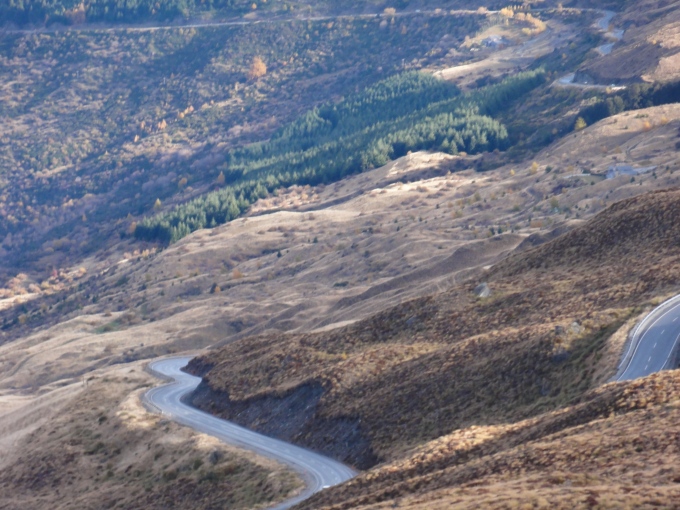
lookingdownfromcoronetpeak

And the story:

It was once said that a desperate man has everything to lose.

The man I was chasing was desperate, but I, on the other hand, was more desperate to catch him.

He’d left a trail of dead people from one end of the island to the other.

The team had put in a lot of effort to locate him, and now his capture was imminent.  We were following the car he was in, from a discrete distance, and, at the appropriate time, we would catch up, pull him over, and make the arrest.

There was nowhere for him to go.

The road led to a dead-end, and the only way off the mountain was back down the road were now on.  Which was why I was somewhat surprised when we discovered where he was.

Where was he going?

“Damn,” I heard Alan mutter.  He was driving, being careful not to get too close, but not far enough away to lose sight of him.

“What?”

“I think he’s made us.”

“How?”

“Dumb bad luck, I’m guessing.  Or he expected we’d follow him up the mountain.  He’s just sped up.”

“How far away?”

“A half-mile.  We should see him higher up when we turn the next corner.”

It took an eternity to get there, and when we did, Alan was right, only he was further on than we thought.”

“Step on it.  Let’s catch him up before he gets to the top.”

Easy to say, not so easy to do.  The road was treacherous, and in places just gravel, and there were no guard rails to stop a three thousand footfall down the mountainside.

Good thing then I had the foresight to have three agents on the hill for just such a scenario.

Ten minutes later, we were in sight of the car, still moving quickly, but we were going slightly faster.  We’d catch up just short of the summit car park.

Or so we thought.

Coming quickly around another corner we almost slammed into the car we’d been chasing.

“What the hell…” Aland muttered.

I was out of the car, and over to see if he was in it, but I knew that it was only a slender possibility.  The car was empty, and no indication where he went.

Certainly not up the road.  It was relatively straightforward for the next mile, at which we would have reached the summit.  Up the mountainside from here, or down.

I looked up.  Nothing.

Alan yelled out, “He’s not going down, not that I can see, but if he did, there’s hardly a foothold and that’s a long fall.”

Then where did he go?

Then a man looking very much like our quarry came out from behind a rock embedded just a short distance up the hill.

“Sorry,” he said quite calmly.  “Had to go if you know what I mean.”

I’d lost him.

It was as simple as that.

I had been led a merry chase up the hill, and all the time he was getting away in a different direction.

I’d fallen for the oldest trick in the book, letting my desperation blind me to the disguise that anyone else would see through in an instant.

It was a lonely sight, looking down that road, knowing that I had to go all that way down again, only this time, without having to throw caution to the wind.

“Maybe next time,” Alan said.

“We’ll get him.  It’s just a matter of time.”

© Charles Heath 2019-2021

Find this and other stories in “Inspiration, maybe”  available soon.

InspirationMaybe1v1

An excerpt from “Strangers We’ve Become” – Coming Soon

I wandered back to my villa.

It was in darkness.  I was sure I had left several lights on, especially over the door so I could see to unlock it.

I looked up and saw the globe was broken.

Instant alert.

I went to the first hiding spot for the gun, and it wasn’t there.  I went to the backup and it wasn’t there either.  Someone had found my carefully hidden stash of weapons and removed them.

Who?

There were four hiding spots and all were empty.  Someone had removed the weapons.  That could only mean one possibility.

I had a visitor, not necessarily here for a social call.

But, of course, being the well-trained agent I’d once been and not one to be caught unawares, I crossed over to my neighbor and relieved him of a weapon that, if found, would require a lot of explaining.

Suitably armed, it was time to return the surprise.

There were three entrances to the villa, the front door, the back door, and a rather strange escape hatch.  One of the more interesting attractions of the villa I’d rented was its heritage.  It was built in the late 1700s, by a man who was, by all accounts, a thief.  It had a hidden underground room which had been in the past a vault but was now a wine cellar, and it had an escape hatch by which the man could come and go undetected, particularly if there was a mob outside the door baying for his blood.

It now gave me the means to enter the villa without my visitors being alerted, unless, of course, they were near the vicinity of the doorway inside the villa, but that possibility was unlikely.  It was not where anyone could anticipate or expect a doorway to be.

The secret entrance was at the rear of the villa behind a large copse, two camouflaged wooden doors built into the ground.  I move aside some of the branches that covered them and lifted one side.  After I’d discovered the doors and rusty hinges, I’d oiled and cleaned them, and cleared the passageway of cobwebs and fallen rocks.  It had a mildew smell, but nothing would get rid of that.  I’d left torches at either end so I could see.

I closed the door after me, and went quietly down the steps, enveloped in darkness till I switched on the torch.  I traversed the short passage which turned ninety degrees about halfway to the door at the other end.  I carried the key to this door on the keyring, found it and opened the door.  It too had been oiled and swung open soundlessly.

I stepped in the darkness and closed the door.

I was on the lower level under the kitchen, now the wine cellar, the ‘door’ doubling as a set of shelves which had very little on them, less to fall and alert anyone in the villa.

Silence, an eerie silence.

I took the steps up to the kitchen, stopping when my head was level with the floor, checking to see if anyone was waiting.  There wasn’t.  It seemed to me to be an unlikely spot for an ambush.

I’d already considered the possibility of someone coming after me, especially because it had been Bespalov I’d killed, and I was sure he had friends, all equally as mad as he was.  Equally, I’d also considered it nigh on impossible for anyone to find out it was me who killed him because the only people who knew that were Prendergast, Alisha, a few others in the Department, and Susan.

That raised the question of who told them where I was.

If I was the man I used to be, my first suspect would be Susan.  The departure this morning, and now this was too coincidental.  But I was not that man.

Or was I?

I reached the start of the passageway that led from the kitchen to the front door and peered into the semi-darkness.  My eyes had got used to the dark, and it was no longer an inky void.  Fragments of light leaked in around the door from outside and through the edge of the window curtains where they didn’t fit properly.  A bone of contention upstairs in the morning, when first light shone and invariably woke me up hours before I wanted to.

Still nothing.

I took a moment to consider how I would approach the visitor’s job.  I would get a plan of the villa in my head, all entrances, where a target could be led to or attacked where there would be no escape.

Coming in the front door.  If I was not expecting anything, I’d just open the door and walk-in.  One shot would be all that was required.

Contract complete.

I sidled quietly up the passage staying close to the wall, edging closer to the front door.  There was an alcove where the shooter could be waiting.  It was an ideal spot to wait.

Crunch.

I stepped on some nutshells.

Not my nutshells.

I felt it before I heard it.  The bullet with my name on it.

And how the shooter missed, from point-blank range, and hit me in the arm, I had no idea.  I fired off two shots before a second shot from the shooter went wide and hit the door with a loud thwack.

I saw a red dot wavering as it honed in on me and I fell to the floor, stretching out, looking up where the origin of the light was coming and pulled the trigger three times, evenly spaced, and a second later I heard the sound of a body falling down the stairs and stopping at the bottom, not very far from me.

Two assassins.

I’d not expected that.

The assassin by the door was dead, a lucky shot on my part.  The second was still breathing.

I checked the body for any weapons and found a second gun and two knives.  Armed to the teeth!

I pulled off the balaclava; a man, early thirties, definitely Italian.  I was expecting a Russian.

I slapped his face, waking him up.  Blood was leaking from several slashes on his face when his head had hit the stairs on the way down.  The awkward angle of his arms and legs told me there were broken bones, probably a lot worse internally.  He was not long for this earth.

“Who employed you?”

He looked at me with dead eyes, a pursed mouth, perhaps a smile.  “Not today my friend.  You have made a very bad enemy.”  He coughed and blood poured out of his mouth.  “There will be more …”

Friends of Bespalov, no doubt.

I would have to leave.  Two unexplainable bodies, I’d have a hard time explaining my way out of this mess.  I dragged the two bodies into the lounge, clearing the passageway just in case someone had heard anything.

Just in case anyone was outside at the time, I sat in the dark, at the foot of the stairs, and tried to breathe normally.  I was trying not to connect dots that led back to Susan, but the coincidence was worrying me.

A half-hour passed and I hadn’t moved.  Deep in thought, I’d forgotten about being shot, unaware that blood was running down my arm and dripping onto the floor.

Until I heard a knock on my front door.

Two thoughts, it was either the police, alerted by the neighbors, or it was the second wave, though why would they be knocking on the door?

I stood, and immediately felt a stabbing pain in my arm.  I took out a handkerchief and turned it into a makeshift tourniquet, then wrapped a kitchen towel around the wound.

If it was the police, this was going to be a difficult situation.  Holding the gun behind my back, I opened the door a fraction and looked out.

No police, just Maria.  I hoped she was not part of the next ‘wave’.

“You left your phone behind on the table.  I thought you might be looking for it.”  She held it out in front of her.

When I didn’t open the door any further, she looked at me quizzically, and then asked, “Is anything wrong?”

I was going to thank her for returning the phone, but I heard her breathe in sharply, and add, breathlessly, “You’re bleeding.”

I looked at my arm and realized it was visible through the door, and not only that, the towel was soaked in blood.

“You need to go away now.”

Should I tell her the truth?  It was probably too late, and if she was any sort of law-abiding citizen she would go straight to the police.

She showed no signs of leaving, just an unnerving curiosity.  “What happened?”

I ran through several explanations, but none seemed plausible.  I went with the truth.  “My past caught up with me.”

“You need someone to fix that before you pass out from blood loss.  It doesn’t look good.”

“I can fix it.  You need to leave.  It is not safe to be here with me.”

The pain in my arm was not getting any better, and the blood was starting to run down my arm again as the tourniquet loosened.  She was right, I needed it fixed sooner rather than later.

I opened the door and let her in.  It was a mistake, a huge mistake, and I would have to deal with the consequences.  Once inside, she turned on the light and saw the pool of blood just inside the door and the trail leading to the lounge.  She followed the trail and turned into the lounge, turned on the light, and no doubt saw the two dead men.

I expected her to scream.  She didn’t.

She gave me a good hard look, perhaps trying to see if I was dangerous.  Killing people wasn’t something you looked the other way about.  She would have to go to the police.

“What happened here?”

“I came home from the cafe and two men were waiting for me.  I used to work for the Government, but no longer.  I suspect these men were here to repay a debt.  I was lucky.”

“Not so much, looking at your arm.”

She came closer and inspected it.

“Sit down.”

She found another towel and wrapped it around the wound, retightening the tourniquet to stem the bleeding.

“Do you have medical supplies?”

I nodded.  “Upstairs.”  I had a medical kit, and on the road, I usually made my own running repairs.  Another old habit I hadn’t quite shaken off yet.

She went upstairs, rummaged, and then came back.  I wondered briefly what she would think of the unmade bed though I was not sure why it might interest her.

She helped me remove my shirt, and then cleaned the wound.  Fortunately, she didn’t have to remove a bullet.  It was a clean wound but it would require stitches.

When she’d finished she said, “Your friend said one day this might happen.”

No prizes for guessing who that friend was, and it didn’t please me that she had involved Maria.

“Alisha?”

“She didn’t tell me her name, but I think she cares a lot about you.  She said trouble has a way of finding you, gave me a phone and said to call her if something like this happened.”

“That was wrong of her to do that.”

“Perhaps, perhaps not.  Will you call her?”

“Yes.  I can’t stay here now.  You should go now.  Hopefully, by the time I leave in the morning, no one will ever know what happened here, especially you.”

She smiled.  “As you say, I was never here.”

© Charles Heath 2018-2022

strangerscover9

The cinema of my dreams – It all started in Venice – Episode 11

Verbal sparring with Juliet

I had expected Juliet would try and maneuver the conversation in the direction Larry wanted, and I thought about whether I would be obtuse in simply ignoring her and talking about anything else, or just have fun with Larry who, no doubt, would be listening in.

Her first question was hardly surprising, an effort to see if I would tell her what my work was.  I couldn’t even if I wanted to, but I could intimate certain things.  But not straight away, Juliet was going to give to ask the right questions.

“Since retirement, I spent most of my time looking after Violetta.”

“Was she unwell?”

A natural assumption that everyone made, but nothing could be further from the truth.   She had given me purpose after so long in a trade that traded in endless lies and deception.

And it had been on one of those missions she had been caught in the crossfire, as I pretended to be, and got her out.  We found each other again, by accident, literally, and it developed from there.

I was done with that job and wandering aimlessly around Europe at the time.  She knew something was wrong with me, but never pushed, just accepted that everything would be better in time.

And it was.

It was a while before I answered, several vivid memories of her rising to the surface as they did, unexpectedly at times.

“No.  I often think she was exactly what she thought I needed to be for her.  She had come from a family that had servants all their lives, and there were certain expectations.”

I could see it in her expression, that Violetta treated me like a servant.   Good, let her.

“I had always wondered what it was you did, that you could end up I’m my hospital in such bad shape.  I never bought that car accident excuse we were given, because the injuries were inconsistent.”

“You were an expert on car injuries?”

“As a matter of fact, yes, I had made it a hobby if you like, to treat as many as possible, cataloging the injuries so that other doctors might treat patients with such injuries more efficiently.”

“So, having said that, what in your humble opinion was the cause of my injuries?”

“Being tossed out of a moving car, but more likely the result of a bar fight, the sort they had in the old wild west.”

And she’d be right.  It was six against two, and at a disadvantage, and, yes, I had been thrown a short distance, but not by the enemy.  It was a gesture to save me from a worse beating.  I had been lucky that night, my partner had not.

“Well, always an interesting topic for doctors sitting around a campfire talking shop.  But I will say this, I was a policeman once, with a blue uniform too.  I did spend time on the streets, but mostly doing paperwork, as I keep telling everyone.”

“And what caused your injuries?”

She was persistent, I’ll give her that.

“Getting involved in a domestic argument.  It’s not the sort of work anyone wants to get in the middle of, and my partner at the time was killed.  You saw what happened to me.  We were just in the wrong place at the wrong time.”

She gave me a measured look, one that seemed to say she didn’t believe a word of it, and I was fine with that.  In any other circumstance, we would not be talking about it, and I had tried to put the real events of that day behind me.

It wasn’t easy.  Not when you lose someone.  It becomes that situation where at first you blame yourself for the death, and then after enough people tell you it wasn’t your fault, you begin to wonder what you could have done better to prevent it.

A lot, perhaps, but I’d been younger then, and not as wise.  That came layer with experience.

“Tell me about you,” I said, changing the focus.

“Nothing to tell.”

“I read newspapers Juliet, and I know what happened.  It might have been on page 16, but it leaped off the page.  I wanted to believe it wasn’t true.”

If she thought she was going to escape the inquisition, she was wrong.

I had been surprised to see her name, more surprised at the circumstances, a dalliance with drugs, a bad call, an avoidable death, and the downward spiral from there.

The photo of her in the paper after her arrest was not pretty.  She went to jail for a short period, lost her license to practice medicine, and lost a whole lot more.

“If you read the news, then there’s nothing left to tell.  I’m clean now, have been for a few years.”

The admission came almost reluctantly, for someone in her situation, it was like an evening ender when the truth was out.

“You were a good doctor.  What happened?”

“Too many hours, not enough sleep.  A husband who was too consumed in his own career, I took the easy way out.  Life is a series of choices, and I made a few bad ones.  Shit happens.”

“So, what do you do now?”

“Forensic medicine, assisting coroners.  I work with the dead.  I figure I can’t hurt them anymore.  I try to see the people who don’t survive car crashes, and continue my work in the hope some of the death and mayhem can be prevented.”

As well as doing Larry’s dirty work.  Had she done this before?

Sparring suspended, the main courses arrived.

© Charles Heath 2022

The cinema of my dreams – Was it just another surveillance job – Episode 13

I’m back home and this story has been sitting on a back burner for a few months, waiting for some more to be written.

The trouble is, there are also other stories to write, and I’m not very good at prioritising.

But, here we are, a few minutes opened up and it didn’t take long to get back into the groove.

Am I working for anyone now?


So, there I was, walking along the street, hands in pockets, trying to look like my whole world hadn’t come crashing down on me when a car pulled over to the side of the road.

I may have been down in the dumps but not that far that I wasn’t still aware of what was going on around me, the training had been that good, so I hung back a little from the curb and waited to see if was me they were after, or just some lucky rich person being dropped off.

And ready to disappear into the crowd, not that there was one, but there were three exits available and within momentary reach if necessary.

I watched the rear window go down slowly then saw a familiar face.

Nobbin.

“Get in Mr Jackson.  We have more to talk about.”

I hesitated like anyone with the training I had would, as any person with common sense would too, I guess.

“It’s perfectly safe, I assure you.”  He sounded reassuring.

A glance into the car showed only him and the driver, who was getting out of the car.  I watched him come around to the curbside and put his hand on the door handle.

“Sir,” he said.

He opened the door.  Nobbin had moved to the other side.

I shrugged, then got in.  A thought: how many people had got into cars such as this, and were never seen again?”

It was not a statistic that reached any of the newspapers.  Only the end result, a body washed down the Thames, with no indication of who it was, or where they came from, and no identification, or means of identification available.

The door closed, the driver went back to the front of the car, and then gently eased the car out into the traffic.

“I’m sorry for the theatrics surrounding this meeting, but it is necessary.  I’m sure you were told of the need for secrecy in this matter, and I’m just reinforcing that.”

“Just who are you?  And, for that matter, those people back in that building?  Or, if it’s not too hard to wrap your head around, who the hell have I been working for?”

“Good questions, all.  At least now I can speak freely.  As you can, Mr Jackson.”

“Except I have no idea who’s side you’re on, I’m on, or anyone for that matter.  This is not what I signed up for.”

“Well, to put some perspective on your situation, Mr Jackson, you were not supposed to live to tell about it.  It was an operation that was created with one purpose in mind, to find an agent named

William O’Connor, and kill him.  And everyone in the team assigned to the task.”

“By Severin and Maury?  If so, why didn’t they kill me in the alley along with this O’Connor?”

“That is a mystery to all of us.”

“And those people back in the room.  Who the hell were they?”

“Operations.  Trying to find out how a sub-section could be created and function within their purview and not be detected.  That’s what it was, run by two agents who had been expelled a few months back, but who were clever enough to work around all of the safeguards, recruit four agents, and then go after the man who caused the end of their careers.”

“Simple, it seems.”

“Very.  And, if it had not been for you, we would never have known who or why.”

“Perhaps we should be thankful there was an explosion then, otherwise we’d all be dead.”

“Or not, because as far as I know, that was part of the operation, designed to take the target, you and the surveillance member behind you.  It only did a third the job.  It didn’t go off at the critical moment.  No one was seriously hurt, by the way.”

“The policeman?”

“Critical but stable.  He’ll survive.”

“The police who were accusing me of being the bomber?”

“Our people trying to delay you, so our man could get away.  Seems they trained you better than we expected.  Did O’Connor say anything to you?”

“There wasn’t much time before I found him, and Severin shot him.”

“Anything at all?”

“He knew who I was.”

“Then he knew the whole team, and who was running it.”

“He killed two of them.”

“In self-defence.  They were not only surveillance but also assassins.  Different training before they joined your group.”

I had thought there was something odd about them.

“Anything else,” he asked again.

“Yes.  He said to tell you he found something he should, and that the evidence is…  And that’s when he was shot.  He didn’t tell me where it was.”

“He didn’t have to.  We had set up three prearranged drop sites, so it must be in one of those.  Here’s my card.”

He handed me a white card with a name and a phone number.  The name was not Nobbin.

“If this Severin contacts you again, call me.  I am available any hour of the day or night on that number.”

“If he doesn’t?”

“Then you will hear from me in the not too distant future.  The fact you’re a survivor tells me you are resourceful and have the makings of a good agent, one I can use in my department.”

“And those others back at the office?”

“You won’t hear from them again.”

The car stopped outside an underground staircase.

“This is your stop, Mr Jackson.  Thank you for your co-operation.”

Perhaps my career wasn’t in tatters.  I got out of the car, and watched it leave before heading for the underground, his card safely tucked away in my pocket.


© Charles Heath 2019

A photograph from the inspirational bin – 8

A picture can paint a thousand words, or more, or less, but…

The interesting thing about a place in the dark, in the distance, and behind a chain wire fence usually means something. Especially when there are mysterious lights involved.

We were at a night sports event, watching over a thousand screaming and yelling kids from five to eighteen pretending to compete in a variety of athletic events.

I was there to nominally to support my granddaughter in her endeavours, but right at that moment, on the far side of the track, what I was really there to see was what was behind the wire fence

“Are you watching, Poppy?”

Well, at that moment I wasn’t, but I did turn just in time to see her clear a meter high high jump and execute an elegent backflip, a result no doubt of the ballet training she had since the age of four. Seven years later those lessons had transformed into a high jumper with a great future.

Except, she couldn’t really care less. It was more about the parents and athletic organisers expectations, than hers. I was there, she told me in a secretive tone, to tell everyone to back off.

if you think spying was a dangerous occupation, then let me tell you trying to navigate a safe path between child and parents, and then the rest of the word, forget it.

So, with my trusty phone camera, slightly modified, I was pretending to take pictures of surrounding trees in the high density lighting for the athletics oval, whilst zooming in on the real target.

And, about to take the money shot, I could feel a tugging on the side of my jacket.

I looked down to see the petulant face of a child not happy.

“You said you were coming to see me perform.”

I had. I looked over at the woman the boss had assigned as my ‘date’, Nancy, and whom I’d introduced as a long time friend who deigned to suffer my invitation so she could meet the girl I was always talking about.

“Yes, Poppy,” she said with an evil undertone. “You said you wanted to see her high jumps. You’d better get over there, while I take some pictures of the trees for you.”

“Why do you want pictures of dumb old trees?” That was a question I would have asked myself, and I didn’t quite have an answer for it.

Nancy did. “Because he’s odd like that. It’s one of the quirks I like about him.” She took the camera out of my hand and shooed us off.

And, heading back to the high jump, she asked, “What’s a quirk?”

“Just ask your father later. He knows all about quirks.”

© Charles Heath 2021

Writing about writing a book – Day 32

I used to have these strange ideas about upper management, and in some cases, how they lived in offices up in the clouds.

The perks, I guess, of making it to the top, a combination, sometimes, of good luck and in others hard work.

Perhaps I make too much of it, but it is only an observation from someone who never quite made it to the top of the pile.  Alas, I didn’t have that killer instinct, nor the desire to use others on my way to the top.

But, those notions stuck with me and had found their way into this story.

It also introduces a new character, one that has an idea he might be in trouble though not quite why.

I stopped for a moment to take in the vista   It was like stepping into a different world.  Everything was new, clean and fresh.  Strategically placed flowers, carpets deep piled and clean, expensive landscape paintings adorned the walls, and the support staff tucked away on various nooks and crannies, usually smiling and happy.  And why not?  They were far, far away from the problematic day to day running of the company.  Here the tea, coffee, and sugar didn’t come from tiny paper packets and taste like floor sweepings.

Merrilyn, Aitchison’s personal assistant, had the gift of being able to dress to suit the weather or mood.  This particular day, the bright colors were in deference to the coming of spring.  Added to this was her impeccable manner and attitude.  It was hard to believe she was still in her early twenties.

She smiled as I turned the corner and headed towards Aitchison’s office, in a manner that infused all who came near her with equal joy and enthusiasm.  It brightened my morning.

“How do you di it?” I asked.  It was a standard question.

“Do what?”  It was the standard reply.

“Manage to look so good on a Monday morning.”

“It’s called grooming, Bill.  “What can we do for you?”

“Mr. Aitchison wishes to see me.  Perhaps it will finally be a promotion to these lofty heights.”

“There’s a long queue before you.”

“Sad, but true.”  I shrugged.  “But you never know. I live in hope if only to be near you.”

She smiled again.  “Perhaps one day.”  Then, in an instant, she switched to somber, efficient, business mode, “Go on in.  I’m sure he’s expecting you.”

I knocked on his door, waited for the muffled “Enter”, and went in.

Thick carpet, velvet wallpaper, mahogany furniture, the best examples of comfortable easy chairs arranged around a coffee table, the office was one of the perks of the job.  There was a carefully hidden private bar somewhere in the room, and the subject of much lower floor speculation.  Everyone who lived on the lower floors aspired to this level of luxury and recognition of personal achievement.

He pointed to the chair in front of his desk without looking up from the file he was reading.  On his desk were two glasses and a bottle of Scotch.  He leaned forward, took a sip out of one, and then returned his original position, leaning back as far as the large, leather-covered and padded seat would let him.  He looked agitated, far from his usual self-assured and calm demeanor.

He was one of the very few in the executive who frequently came down to visit us, and always had an amicable manner, whether the news was good or bad.  That amiable manner was missing this morning, replaced by something I’d not seen in him before.

Or in anyone else for a long, long time.  Fear.

He looked up, took his reading glasses off and placed them carefully on the desk.  “Did Benton tell you what happened?”  His tone was constricted, tinged with worry.  Yes.  The eyes gave it away.  I’d seen the look before, in a momentary flash, a detail in memory rising to the surface.

“Yes.  Briefly.  He said it was something to do with Richardson.  Rather melodramatic to be suiciding in his office, or words to that effect.”

“Well, the police might be calling it a suicide, and that fool Benton would like it to be suicide, but in my opinion, it’s a case of murder.”  He emptied the glass and poured another.  The rim of the bottle rattled on the rim of the glass.  He was shaking and trying to keep it under control.  “He’s dead.  Very dead.”

It took a few moments before I realized the importance of his statement.  Dead was serious, very dead was very serious.

“How?”  My voice moved up one octave.  I wondered where this was heading.  Why he was telling me?

“One shot to the head.  He was supposedly holding the gun when they found him, making it look a perfectly normal suicide.”

I quickly reviewed the rest of what I knew about Richardson, albeit second hand.

His wife had walked out on him.  He spent a few months trying to climb into the bottle, came out of it fairly well, and had recently struck up a friendship with one of the many middle-aged women who worked in the office.  Speculation had it she was already married.  It was not a course I would take in similar circumstances, but he was closer to a number of them than most.  Suicide seemed a bit out of character.

Was Aitchison also suggesting that might be the case?

Or did he know something about Richardson the rest of us didn’t?

“He didn’t seem the type,” I said, expecting a rebuke.  I was not sure if Aitchison was asking for an opinion.

“No he was not, and I agree with you.  Everyone seems to have thrown caution to the wind, and want this case settled, and the police out of here.  But, not at the expense of a good man’s name.”

“So, I take it you think otherwise?”

© Charles Heath 2015-2025

“Sunday in New York”, a romantic adventure that’s not a walk in the park!

“Sunday in New York” is ultimately a story about trust, and what happens when a marriage is stretched to its limits.

When Harry Steele attends a lunch with his manager, Barclay, to discuss a promotion that any junior executive would accept in a heartbeat, it is the fact his wife, Alison, who previously professed her reservations about Barclay, also agreed to attend, that casts a small element of doubt in his mind.

From that moment, his life, in the company, in deciding what to do, his marriage, his very life, spirals out of control.

There is no one big factor that can prove Harry’s worst fears, that his marriage is over, just a number of small, interconnecting events, when piled on top of each other, points to a cataclysmic end to everything he had believed in.

Trust is lost firstly in his best friend and mentor, Andy, who only hints of impending disaster, Sasha, a woman whom he saved, and who appears to have motives of her own, and then in his wife, Alison, as he discovered piece by piece damning evidence she is about to leave him for another man.

Can we trust what we see with our eyes or trust what we hear?

Haven’t we all jumped to conclusions at least once in our lives?

Can Alison, a woman whose self-belief and confidence is about to be put to the ultimate test, find a way of proving their relationship is as strong as it has ever been?

As they say in the classics, read on!

Purchase:

http://tinyurl.com/Amazon-SundayInNewYork

Searching for locations: Shaolin Kung Fu, near Zhengzhou City, Henan Province, China

After leaving the hotel in Zhengzhou, which was once one of the eight ancient capitals of China, we are going to Dengfeng city, the home of China’s most famous martial art – Shaolin Kung Fu.

The Shaolin Temple nearby is the origin of Chinese Zen Buddhism, and the Songyang Academy, called “the Centre of Heaven and Earth” is located 87 Km from Zhengzhou, or, as we were advised, a 2-hour drive.  It will be scenic because we are heading towards the mountains.

As one of the four ancient Song Dynasty Academies, Songyang Academy is one of many schools in the province.  It is both on a large scale, is quite spectacular, and is a comprehensive Wushu training base where students are trained to spread the Shaolin Wushu Kung fu style at home and abroad.

There is a 500-seat demonstration hall where you are able to observe 30 minutes of various martial arts in shows starting on the hour.

Outside there is a specific area that generally has about 600 trainees learning kung fu elements during the day but can hold 5,000 people when outdoor performances are required.

The kung fu school

The thing you notice most about the kung fu school is its size and then the number of buses which tells you that it is a popular tourist stop.

And with that size comes long distances between the car park and the venues we need to go to, the first of which is about half a km, and that’s just to get to the ticket plaza.

But, it is pleasantly set out and is quite a large number of shops for both souvenirs and food

We pass by some of the students going through their paces

From there it’s another long, long walk to the show arena, where we’re supposed to see various kung fu elements on display.  We watched this for a few minutes, then headed off towards the hall for a more intense demonstration of kung fu, and because there is limited seating we have to start lining up at the head of the queue to get a seat.

But…

Everyone else has the same idea and we join the throng which then becomes a ride, and true to the Chinese they start finding ways to push in, even using the imaginary friend somewhere ahead in the queue.

The doors open and then it’s open slather, with the hoards pushing from behind and sliding up the side to get in first.  We go with the tide, and manage to get in and find a seat though we were separated from three of our group.

It was an interesting show even though not one word of English was spoken, which from our point of view was a disappointment because we had no idea what was going on.

However…

It wasn’t hard to follow

What the performers were doing was relatively self-explanatory, and quite fascinating, especially the guy who broke a sword over his head, and the guy who stopped two spears penetrating the neck, both examples of very disciplined men.

Boys gave a demonstration of kung fu moves, and intensity and age increased as this progressed to the end.

Next, we were taken in hand by an instructor in Tai chi or an equivalent, I was not quite sure what it was called, and went through the twelve or maybe more moves that constituted a morning or afternoon exercise session or it could be just for relaxation.  I lasted the first session but it was a little difficult to do with my sore limbs and a bad back.

Not that I could remember any of it now other than hands overhead, hands in front, bent knees, and a few gentle kung fu hand moves.

Perhaps when I get home I might seek out someone to show me the moves.

Whilst the others were following their training instructor, I wandered about, finding a large statue


And some smaller statues

Lunch in the Zen Restaurant

After all that exercise it was time to have lunch purportedly the same food as the king fu masters.
It’s in the Zen restaurant, aptly named, and the food when it came, came thick and fast, but some of it wasn’t very nice, meat with bones, tofu, a tasteless soup, but some good dishes like the vegetables and noodles with meat, without bones.

The only problem was nothing to drink except a pot of hot water.  No tea, no cold water, and if you wanted a cold drink you had to pay for it.  After paying 550 yuan why should we have to pay more for a drink when we have not had to so far.

But no cold water?  That was just not on, and when we brought this to the attention of the tour guide she just simply ignored us.  We just didn’t get anything.

That basically tainted the whole experience.

After lunch, there was the Shaolin Temple and the Pogoda Forest to visit.

“Echoes From The Past”, the past doesn’t necessarily stay there


What happens when your past finally catches up with you?

Christmas is just around the corner, a time to be with family. For Will Mason, an orphan since he was fourteen, it is a time for reflection on what his life could have been, and what it could be.

Until a chance encounter brings back to life the reasons for his twenty years of self-imposed exile from a life only normal people could have. From that moment Will’s life slowly starts to unravel and it’s obvious to him it’s time to move on.

This time, however, there is more at stake.

Will has broken his number one rule, don’t get involved.

With his nemesis, Eddie Jamieson, suddenly within reach, and a blossoming relationship with an office colleague, Maria, about to change everything, Will has to make a choice. Quietly leave, or finally, make a stand.

But as Will soon discovers, when other people are involved there is going to be terrible consequences no matter what choice he makes.

https://amzn.to/2CYKxu4

newechocover5rs

Writing about writing a book – Day 32

I used to have these strange ideas about upper management, and in some cases, how they lived in offices up in the clouds.

The perks, I guess, of making it to the top, a combination, sometimes, of good luck and in others hard work.

Perhaps I make too much of it, but it is only an observation from someone who never quite made it to the top of the pile.  Alas, I didn’t have that killer instinct, nor the desire to use others on my way to the top.

But, those notions stuck with me and had found their way into this story.

It also introduces a new character, one that has an idea he might be in trouble though not quite why.

I stopped for a moment to take in the vista   It was like stepping into a different world.  Everything was new, clean and fresh.  Strategically placed flowers, carpets deep piled and clean, expensive landscape paintings adorned the walls, and the support staff tucked away on various nooks and crannies, usually smiling and happy.  And why not?  They were far, far away from the problematic day to day running of the company.  Here the tea, coffee, and sugar didn’t come from tiny paper packets and taste like floor sweepings.

Merrilyn, Aitchison’s personal assistant, had the gift of being able to dress to suit the weather or mood.  This particular day, the bright colors were in deference to the coming of spring.  Added to this was her impeccable manner and attitude.  It was hard to believe she was still in her early twenties.

She smiled as I turned the corner and headed towards Aitchison’s office, in a manner that infused all who came near her with equal joy and enthusiasm.  It brightened my morning.

“How do you di it?” I asked.  It was a standard question.

“Do what?”  It was the standard reply.

“Manage to look so good on a Monday morning.”

“It’s called grooming, Bill.  “What can we do for you?”

“Mr. Aitchison wishes to see me.  Perhaps it will finally be a promotion to these lofty heights.”

“There’s a long queue before you.”

“Sad, but true.”  I shrugged.  “But you never know. I live in hope if only to be near you.”

She smiled again.  “Perhaps one day.”  Then, in an instant, she switched to somber, efficient, business mode, “Go on in.  I’m sure he’s expecting you.”

I knocked on his door, waited for the muffled “Enter”, and went in.

Thick carpet, velvet wallpaper, mahogany furniture, the best examples of comfortable easy chairs arranged around a coffee table, the office was one of the perks of the job.  There was a carefully hidden private bar somewhere in the room, and the subject of much lower floor speculation.  Everyone who lived on the lower floors aspired to this level of luxury and recognition of personal achievement.

He pointed to the chair in front of his desk without looking up from the file he was reading.  On his desk were two glasses and a bottle of Scotch.  He leaned forward, took a sip out of one, and then returned his original position, leaning back as far as the large, leather-covered and padded seat would let him.  He looked agitated, far from his usual self-assured and calm demeanor.

He was one of the very few in the executive who frequently came down to visit us, and always had an amicable manner, whether the news was good or bad.  That amiable manner was missing this morning, replaced by something I’d not seen in him before.

Or in anyone else for a long, long time.  Fear.

He looked up, took his reading glasses off and placed them carefully on the desk.  “Did Benton tell you what happened?”  His tone was constricted, tinged with worry.  Yes.  The eyes gave it away.  I’d seen the look before, in a momentary flash, a detail in memory rising to the surface.

“Yes.  Briefly.  He said it was something to do with Richardson.  Rather melodramatic to be suiciding in his office, or words to that effect.”

“Well, the police might be calling it a suicide, and that fool Benton would like it to be suicide, but in my opinion, it’s a case of murder.”  He emptied the glass and poured another.  The rim of the bottle rattled on the rim of the glass.  He was shaking and trying to keep it under control.  “He’s dead.  Very dead.”

It took a few moments before I realized the importance of his statement.  Dead was serious, very dead was very serious.

“How?”  My voice moved up one octave.  I wondered where this was heading.  Why he was telling me?

“One shot to the head.  He was supposedly holding the gun when they found him, making it look a perfectly normal suicide.”

I quickly reviewed the rest of what I knew about Richardson, albeit second hand.

His wife had walked out on him.  He spent a few months trying to climb into the bottle, came out of it fairly well, and had recently struck up a friendship with one of the many middle-aged women who worked in the office.  Speculation had it she was already married.  It was not a course I would take in similar circumstances, but he was closer to a number of them than most.  Suicide seemed a bit out of character.

Was Aitchison also suggesting that might be the case?

Or did he know something about Richardson the rest of us didn’t?

“He didn’t seem the type,” I said, expecting a rebuke.  I was not sure if Aitchison was asking for an opinion.

“No he was not, and I agree with you.  Everyone seems to have thrown caution to the wind, and want this case settled, and the police out of here.  But, not at the expense of a good man’s name.”

“So, I take it you think otherwise?”

© Charles Heath 2015-2025