Inspiration, maybe – Volume 1

50 photographs, 50 stories, of which there is one of the 50 below.

They all start with –

A picture paints … well, as many words as you like.  For instance:

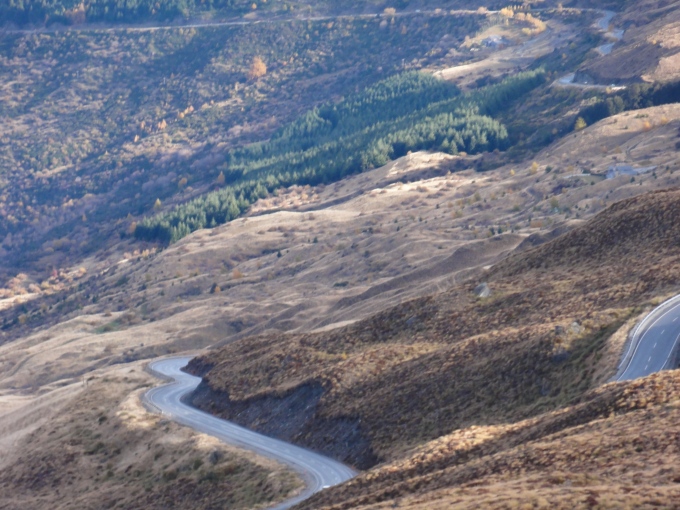
lookingdownfromcoronetpeak

And the story:

It was once said that a desperate man has everything to lose.

The man I was chasing was desperate, but I, on the other hand, was more desperate to catch him.

He’d left a trail of dead people from one end of the island to the other.

The team had put in a lot of effort to locate him, and now his capture was imminent.  We were following the car he was in, from a discrete distance, and, at the appropriate time, we would catch up, pull him over, and make the arrest.

There was nowhere for him to go.

The road led to a dead-end, and the only way off the mountain was back down the road were now on.  Which was why I was somewhat surprised when we discovered where he was.

Where was he going?

“Damn,” I heard Alan mutter.  He was driving, being careful not to get too close, but not far enough away to lose sight of him.

“What?”

“I think he’s made us.”

“How?”

“Dumb bad luck, I’m guessing.  Or he expected we’d follow him up the mountain.  He’s just sped up.”

“How far away?”

“A half-mile.  We should see him higher up when we turn the next corner.”

It took an eternity to get there, and when we did, Alan was right, only he was further on than we thought.”

“Step on it.  Let’s catch him up before he gets to the top.”

Easy to say, not so easy to do.  The road was treacherous, and in places just gravel, and there were no guard rails to stop a three thousand footfall down the mountainside.

Good thing then I had the foresight to have three agents on the hill for just such a scenario.

Ten minutes later, we were in sight of the car, still moving quickly, but we were going slightly faster.  We’d catch up just short of the summit car park.

Or so we thought.

Coming quickly around another corner we almost slammed into the car we’d been chasing.

“What the hell…” Aland muttered.

I was out of the car, and over to see if he was in it, but I knew that it was only a slender possibility.  The car was empty, and no indication where he went.

Certainly not up the road.  It was relatively straightforward for the next mile, at which we would have reached the summit.  Up the mountainside from here, or down.

I looked up.  Nothing.

Alan yelled out, “He’s not going down, not that I can see, but if he did, there’s hardly a foothold and that’s a long fall.”

Then where did he go?

Then a man looking very much like our quarry came out from behind a rock embedded just a short distance up the hill.

“Sorry,” he said quite calmly.  “Had to go if you know what I mean.”

I’d lost him.

It was as simple as that.

I had been led a merry chase up the hill, and all the time he was getting away in a different direction.

I’d fallen for the oldest trick in the book, letting my desperation blind me to the disguise that anyone else would see through in an instant.

It was a lonely sight, looking down that road, knowing that I had to go all that way down again, only this time, without having to throw caution to the wind.

“Maybe next time,” Alan said.

“We’ll get him.  It’s just a matter of time.”

© Charles Heath 2019-2021

Find this and other stories in “Inspiration, maybe”  available soon.

InspirationMaybe1v1

An excerpt from “Strangers We’ve Become” – Coming Soon

I wandered back to my villa.

It was in darkness.  I was sure I had left several lights on, especially over the door so I could see to unlock it.

I looked up and saw the globe was broken.

Instant alert.

I went to the first hiding spot for the gun, and it wasn’t there.  I went to the backup and it wasn’t there either.  Someone had found my carefully hidden stash of weapons and removed them.

Who?

There were four hiding spots and all were empty.  Someone had removed the weapons.  That could only mean one possibility.

I had a visitor, not necessarily here for a social call.

But, of course, being the well-trained agent I’d once been and not one to be caught unawares, I crossed over to my neighbor and relieved him of a weapon that, if found, would require a lot of explaining.

Suitably armed, it was time to return the surprise.

There were three entrances to the villa, the front door, the back door, and a rather strange escape hatch.  One of the more interesting attractions of the villa I’d rented was its heritage.  It was built in the late 1700s, by a man who was, by all accounts, a thief.  It had a hidden underground room which had been in the past a vault but was now a wine cellar, and it had an escape hatch by which the man could come and go undetected, particularly if there was a mob outside the door baying for his blood.

It now gave me the means to enter the villa without my visitors being alerted, unless, of course, they were near the vicinity of the doorway inside the villa, but that possibility was unlikely.  It was not where anyone could anticipate or expect a doorway to be.

The secret entrance was at the rear of the villa behind a large copse, two camouflaged wooden doors built into the ground.  I move aside some of the branches that covered them and lifted one side.  After I’d discovered the doors and rusty hinges, I’d oiled and cleaned them, and cleared the passageway of cobwebs and fallen rocks.  It had a mildew smell, but nothing would get rid of that.  I’d left torches at either end so I could see.

I closed the door after me, and went quietly down the steps, enveloped in darkness till I switched on the torch.  I traversed the short passage which turned ninety degrees about halfway to the door at the other end.  I carried the key to this door on the keyring, found it and opened the door.  It too had been oiled and swung open soundlessly.

I stepped in the darkness and closed the door.

I was on the lower level under the kitchen, now the wine cellar, the ‘door’ doubling as a set of shelves which had very little on them, less to fall and alert anyone in the villa.

Silence, an eerie silence.

I took the steps up to the kitchen, stopping when my head was level with the floor, checking to see if anyone was waiting.  There wasn’t.  It seemed to me to be an unlikely spot for an ambush.

I’d already considered the possibility of someone coming after me, especially because it had been Bespalov I’d killed, and I was sure he had friends, all equally as mad as he was.  Equally, I’d also considered it nigh on impossible for anyone to find out it was me who killed him because the only people who knew that were Prendergast, Alisha, a few others in the Department, and Susan.

That raised the question of who told them where I was.

If I was the man I used to be, my first suspect would be Susan.  The departure this morning, and now this was too coincidental.  But I was not that man.

Or was I?

I reached the start of the passageway that led from the kitchen to the front door and peered into the semi-darkness.  My eyes had got used to the dark, and it was no longer an inky void.  Fragments of light leaked in around the door from outside and through the edge of the window curtains where they didn’t fit properly.  A bone of contention upstairs in the morning, when first light shone and invariably woke me up hours before I wanted to.

Still nothing.

I took a moment to consider how I would approach the visitor’s job.  I would get a plan of the villa in my head, all entrances, where a target could be led to or attacked where there would be no escape.

Coming in the front door.  If I was not expecting anything, I’d just open the door and walk-in.  One shot would be all that was required.

Contract complete.

I sidled quietly up the passage staying close to the wall, edging closer to the front door.  There was an alcove where the shooter could be waiting.  It was an ideal spot to wait.

Crunch.

I stepped on some nutshells.

Not my nutshells.

I felt it before I heard it.  The bullet with my name on it.

And how the shooter missed, from point-blank range, and hit me in the arm, I had no idea.  I fired off two shots before a second shot from the shooter went wide and hit the door with a loud thwack.

I saw a red dot wavering as it honed in on me and I fell to the floor, stretching out, looking up where the origin of the light was coming and pulled the trigger three times, evenly spaced, and a second later I heard the sound of a body falling down the stairs and stopping at the bottom, not very far from me.

Two assassins.

I’d not expected that.

The assassin by the door was dead, a lucky shot on my part.  The second was still breathing.

I checked the body for any weapons and found a second gun and two knives.  Armed to the teeth!

I pulled off the balaclava; a man, early thirties, definitely Italian.  I was expecting a Russian.

I slapped his face, waking him up.  Blood was leaking from several slashes on his face when his head had hit the stairs on the way down.  The awkward angle of his arms and legs told me there were broken bones, probably a lot worse internally.  He was not long for this earth.

“Who employed you?”

He looked at me with dead eyes, a pursed mouth, perhaps a smile.  “Not today my friend.  You have made a very bad enemy.”  He coughed and blood poured out of his mouth.  “There will be more …”

Friends of Bespalov, no doubt.

I would have to leave.  Two unexplainable bodies, I’d have a hard time explaining my way out of this mess.  I dragged the two bodies into the lounge, clearing the passageway just in case someone had heard anything.

Just in case anyone was outside at the time, I sat in the dark, at the foot of the stairs, and tried to breathe normally.  I was trying not to connect dots that led back to Susan, but the coincidence was worrying me.

A half-hour passed and I hadn’t moved.  Deep in thought, I’d forgotten about being shot, unaware that blood was running down my arm and dripping onto the floor.

Until I heard a knock on my front door.

Two thoughts, it was either the police, alerted by the neighbors, or it was the second wave, though why would they be knocking on the door?

I stood, and immediately felt a stabbing pain in my arm.  I took out a handkerchief and turned it into a makeshift tourniquet, then wrapped a kitchen towel around the wound.

If it was the police, this was going to be a difficult situation.  Holding the gun behind my back, I opened the door a fraction and looked out.

No police, just Maria.  I hoped she was not part of the next ‘wave’.

“You left your phone behind on the table.  I thought you might be looking for it.”  She held it out in front of her.

When I didn’t open the door any further, she looked at me quizzically, and then asked, “Is anything wrong?”

I was going to thank her for returning the phone, but I heard her breathe in sharply, and add, breathlessly, “You’re bleeding.”

I looked at my arm and realized it was visible through the door, and not only that, the towel was soaked in blood.

“You need to go away now.”

Should I tell her the truth?  It was probably too late, and if she was any sort of law-abiding citizen she would go straight to the police.

She showed no signs of leaving, just an unnerving curiosity.  “What happened?”

I ran through several explanations, but none seemed plausible.  I went with the truth.  “My past caught up with me.”

“You need someone to fix that before you pass out from blood loss.  It doesn’t look good.”

“I can fix it.  You need to leave.  It is not safe to be here with me.”

The pain in my arm was not getting any better, and the blood was starting to run down my arm again as the tourniquet loosened.  She was right, I needed it fixed sooner rather than later.

I opened the door and let her in.  It was a mistake, a huge mistake, and I would have to deal with the consequences.  Once inside, she turned on the light and saw the pool of blood just inside the door and the trail leading to the lounge.  She followed the trail and turned into the lounge, turned on the light, and no doubt saw the two dead men.

I expected her to scream.  She didn’t.

She gave me a good hard look, perhaps trying to see if I was dangerous.  Killing people wasn’t something you looked the other way about.  She would have to go to the police.

“What happened here?”

“I came home from the cafe and two men were waiting for me.  I used to work for the Government, but no longer.  I suspect these men were here to repay a debt.  I was lucky.”

“Not so much, looking at your arm.”

She came closer and inspected it.

“Sit down.”

She found another towel and wrapped it around the wound, retightening the tourniquet to stem the bleeding.

“Do you have medical supplies?”

I nodded.  “Upstairs.”  I had a medical kit, and on the road, I usually made my own running repairs.  Another old habit I hadn’t quite shaken off yet.

She went upstairs, rummaged, and then came back.  I wondered briefly what she would think of the unmade bed though I was not sure why it might interest her.

She helped me remove my shirt, and then cleaned the wound.  Fortunately, she didn’t have to remove a bullet.  It was a clean wound but it would require stitches.

When she’d finished she said, “Your friend said one day this might happen.”

No prizes for guessing who that friend was, and it didn’t please me that she had involved Maria.

“Alisha?”

“She didn’t tell me her name, but I think she cares a lot about you.  She said trouble has a way of finding you, gave me a phone and said to call her if something like this happened.”

“That was wrong of her to do that.”

“Perhaps, perhaps not.  Will you call her?”

“Yes.  I can’t stay here now.  You should go now.  Hopefully, by the time I leave in the morning, no one will ever know what happened here, especially you.”

She smiled.  “As you say, I was never here.”

© Charles Heath 2018-2022

strangerscover9

The cinema of my dreams – I always wanted to write a war story – Episode 53

For a story that was conceived during those long boring hours flying in a steel cocoon, striving to keep away the thoughts that the plane and everyone in it could just simply disappear as planes have in the past, it has come a long way.

Whilst I have always had a fascination with what happened during the Second world war, not the battles or fighting, but in the more obscure events that took place, I decided to pen my own little sidebar to what was a long and bitter war.

And, so, it continues…

War is hell. 

I remembered an old Sargeant Major was telling us that going to war was not fun, that the very real possibility of getting killed should be the only thing on our minds.

Along with keeping your head down and being very aware of your surroundings.

Apparently, he had been at a place called Gallipoli, and from what I had read, that was a special kind of hell.

He had also said fifty per cent of us wouldn’t return.  I hoped to be in the fifty per cent that did.  Just to spite the old bastard.

I knew it was going to get problematical sooner than we thought, I could smell the aroma of burning bush on the air, and as we got closer to the castle, the smoke got denser.

Wallace had a cunning plan, he’d used flame throwers to set the bush on fire so we couldn’t get to the castle under the cover of the forest.  It was a plan he hadn’t me about.

Carlo had stopped, also understanding what Wallace had done.  Would this interfere with us getting to the external entrances, or if the other three were unattainable, could we get to the secret entrance?

I caught up to him.  “Not exactly what we envisaged.  I had no idea Wallace was planning this?”

“It is a logical move.  He can’t leave the castle, and as it was, he knew the forest would give us cover until the very last moment.”

“And now?”

“Now we use another entrance.  Take longer, but we’ll get there.  Only problem, they will be expecting us, and waiting.”

The others joined me, just as Carlo did an about-face and started going back the way we came.

“Where is he going?” Blinky asked.

“Another way.  Wallace is burning our cover.”

He shrugged.  “I suppose it would be too much to ask for some rain?”

“Sadly no.  Fine and clear with a touch of fog, well, smoke maybe.”

He didn’t think it was funny.  War I guess could do that to you.

When Thompson and company were planning the operation that was set up primarily to get defecting Germans out of the country, there was only so much research that could be done.

It was one of the reasons I got a seat at the table, my exploits in Italy looking at ancient buildings suddenly became a red-hot reason to be included.  The war had all but petered out in that part of the country, the Germans were shoring up the Italians, and the Allies had bigger plans to invade via Sicily, or one of those islands.

Someone mentioned something hush-hush about Italy and the road back to peace, but at that point in time, the end of the war was not in sight.

The point was, the castle was in a strategic location, it was only being held by a small garrison, according to the resistance, ideal for what Thompson wanted.  Approvals gained, he sent in a team of German-speaking soldiers to replace those there, as if nothing had happened and then set up the pipeline.

It worked.

For a while anyway.  Several months after the new team had set themselves up and the personnel was moving through, it all stopped.

First thought was the Germans had discovered what was going on and switched the team again.  Until Thompson noted we were still getting reports from Wallace, one of his men on the ground.

That’s when Thompson decided to send me.

And. No, it was not just a matter of saying, great, I always wanted to holiday in Italy, and particularly Tuscany.  My excuse, I was not trained to be a commando or a secret agent.

Of course, I made that one fatal mistake, I had enlisted to fight in the war, and it was not my decision where they sent me.

So, I was on the next plane to Tuscany.

The trouble was, Thompson and I both agreed that it was more likely the men we selected had not changed their allegiances, they just went back to what they were before.  Wallace, Johannesen and Jackerby had all been extricated from blown missions, and Thompson had been left scratching his head as to who the mole was in his office.

Too many coincidences proved it wasn’t.

Except coincidentally, Thompson had teamed up all the traitors in one place.

So, my mission was twofold, first to ascertain if they were traitors, and, if they were, to execute them.

The next problem, the mission was almost over before it started, because even though Thompson had told Wallace the wrong pick-up point where my plane would be landing, cloud cover made it impossible to guarantee I’d be jumping at the correct spot.

As it turned out, the resistance had planned a huge ambush in exactly the same place my plane landed, and I was in the middle of it.  The rest as they say is history.

The thing is, ever since I landed, I had the benefit of a huge amount of good luck.

That couldn’t last.

Carlo seemed unfazed about the fire, perhaps he had expected it, but his only concern was time.  We had to be in the castle just as the explosions started.

With 23 minutes to go, Carlo stepped up the pace.  For a big man, he didn’t make much noise.  I wished I could say the same for myself.

© Charles Heath 2021-2023

That word: Home – in sayings

I’m always on the lookout for inspiration for stories, especially the short stories I attach to photographs in my Being Inspired series, and one of the topics that has been suggested is along the lines of the following.

There is certainly a lot of scope with these.

Home is where the heart is

One’s home is the preferred place to all others, the one you are most emotionally attached, i.e. you have the deepest affection for. It may not necessarily be a physical place though.

I must say I tend to agree with this because every time I go away, I’m always looking forward to coming home.

Even when I’ve had to stay away for a few months, it’s not possible to call that home, it’s just another place to stay.

On the other hand…

It’s the name of a song by Elvis Presley.

And it has been the title of several films.

The Hallmark channel presses this point home time and time again.

Pliny the Elder is credited with coming up with the saying.

Home is what you make it

This is a similar saying, but, to me, it means something completely different

Though many will say this means that it’s where family and friends can come to, a place where memories can be made, I don’t believe it’s the same as the first saying.

What you make of it depends on your circumstances, you can hate it because it might be because you’re stuck with one parent with perhaps a step-parent. Or you might love it because you’ve escaped a bad situation.

But it’s not necessarily where your heart is.

Wherever I hang my hat I call home

Barbra Streisand made this song famous, and probably means that no matter where you are, it is home to you. It would be more fitting for someone who doesn’t necessarily see their true home very often, ie you work in the diplomatic service or in the military and you move around a lot.

Home away from home

This is a place that is as good as your real home.

The cinema of my dreams – I always wanted to go on a treasure hunt – Episode 1

My mind will not rest.

Down here, it is summer, and the last few days have been rather hot, well, it is summer after all, but tonight it is particularly hot.

So, as I can’t sleep, I’m lying on the couch staring at the ceiling, otherwise known as the cinema of my dreams.

Where am I?

Well, it has to be someplace cool, of course.


I have no idea where or when I got sucked into this game of searching for treasure.  Boggs had been reading some newspaper article relating to a Spaniard who had survived a shipwreck off the coast and had supposedly come ashore dragging his treasure chest, all that he could save from the sinking ship.

I think my priorities may have been slightly different.

Standing on the beach where Boggs believed the man came ashore, we looked inland at the coastal plain now overbuilt with holiday houses and apartments, behind that, some parkland, under threat from the developers, and behind that, the mountains.

I could guess what Boggs was going to say next.

“It has to be somewhere in the mountains, a cave perhaps.”

My map told me there was a mountain face for about 25 miles in either direction and rising to two to three thousand feet up.  I didn’t calculate the area, I just considered it big.

“If he came ashore here, dragging a heavy chest, and barring all of this building, he would take the most direct route inland.”

He pointed in the direction he thought the Spaniard took.

My eyes followed his arm and stopped at a beacon halfway up the hillside. 

That was a long way, pulling a heavy chest.

“Not up the hill, maybe, but somewhere along the base.”

“And don’t you think every man and his dog would have made the same assumption, and covered the ground already.”  The treasure hunt was beginning to bore me.

His expression changed, the sort that told me he might not have considered that possibility.  Boggs was like that, always thinking he had the original idea.

“Perhaps, then, a drink and more thought on the matter.”

We trudged through the soft sand to the bar just off the sand, a small place called The Spaniard.  A sign on the window said ‘Treasure Maps for sale’.


Well, the bar was air-conditioned, and the beer was cold.  I have one myself and see where this cinematic experience goes


“Sunday in New York”, a romantic adventure that’s not a walk in the park!

“Sunday in New York” is ultimately a story about trust, and what happens when a marriage is stretched to its limits.

When Harry Steele attends a lunch with his manager, Barclay, to discuss a promotion that any junior executive would accept in a heartbeat, it is the fact his wife, Alison, who previously professed her reservations about Barclay, also agreed to attend, that casts a small element of doubt in his mind.

From that moment, his life, in the company, in deciding what to do, his marriage, his very life, spirals out of control.

There is no one big factor that can prove Harry’s worst fears, that his marriage is over, just a number of small, interconnecting events, when piled on top of each other, points to a cataclysmic end to everything he had believed in.

Trust is lost firstly in his best friend and mentor, Andy, who only hints of impending disaster, Sasha, a woman whom he saved, and who appears to have motives of her own, and then in his wife, Alison, as he discovered piece by piece damning evidence she is about to leave him for another man.

Can we trust what we see with our eyes or trust what we hear?

Haven’t we all jumped to conclusions at least once in our lives?

Can Alison, a woman whose self-belief and confidence is about to be put to the ultimate test, find a way of proving their relationship is as strong as it has ever been?

As they say in the classics, read on!

Purchase:

http://tinyurl.com/Amazon-SundayInNewYork

“Echoes From The Past”, the past doesn’t necessarily stay there


What happens when your past finally catches up with you?

Christmas is just around the corner, a time to be with family. For Will Mason, an orphan since he was fourteen, it is a time for reflection on what his life could have been, and what it could be.

Until a chance encounter brings back to life the reasons for his twenty years of self-imposed exile from a life only normal people could have. From that moment Will’s life slowly starts to unravel and it’s obvious to him it’s time to move on.

This time, however, there is more at stake.

Will has broken his number one rule, don’t get involved.

With his nemesis, Eddie Jamieson, suddenly within reach, and a blossoming relationship with an office colleague, Maria, about to change everything, Will has to make a choice. Quietly leave, or finally, make a stand.

But as Will soon discovers, when other people are involved there is going to be terrible consequences no matter what choice he makes.

https://amzn.to/2CYKxu4

newechocover5rs

An excerpt from “What Sets Us Apart”, a mystery with a twist

See the excerpt from the story below, just a taste of what’s in store…

http://amzn.to/2Eryfth

whatsetscover

McCallister was old school, a man who would most likely fit in perfectly campaigning on the battlefields of Europe during the Second World War. He’d been like a fish out of water in the army, post-Falklands, and while he retired a hero, he still felt he’d more to give.

He’d applied and was accepted as head of a SWAT team, and, watching him now as he and his men disembarked from the truck in almost military precision, a look passed between Annette, the police liaison officer, and I that said she’d seen it all before. I know I had.

There was a one in four chance his team would be selected for this operation, and she had been hoping it would be one of the other three. While waiting for them to arrive she filled me in on the various teams. His was the least co-operative, and the more likely to make ad-hoc decisions rather than adhere to the plan, or any orders that may come from the officer in charge.

This, she said quite bluntly, was going to end badly.

I still had no idea why Prendergast instructed me to attend the scene of what looked to be a normal domestic operation, but as the nominated expert in the field in these types of situations, it was fairly clear he wasn’t taking any chances. It was always a matter of opinion between us, and generally I lost.

In this case, it was an anonymous report identifying what the authorities believed were explosives in one of the dockside sheds where explosives were not supposed to be.

The only reason why the report was given any credence was the man, while not identifying himself by name, said he’d been an explosive expert once and recognized the boxes. That could mean anything, but the Chief Constable was a cautious man.

With his men settled and preparing their weapons, McCallister came over to the command post, not much more than the SUV my liaison and I arrived in, with weapons, bulletproof vests, and rolls of tape to cordon off the area afterward. We both had coffee, steaming in the cold early morning air. Dawn was slowly approaching and although rain had been forecast it had yet to arrive.

A man by the name of Benson was in charge. He too had groaned when he saw McCallister.

“A fine morning for it.” McCallister was the only enthusiastic one here.

He didn’t say what ‘it’ was, but I thought it might eventually be mayhem.

“Let’s hope the rain stays away. It’s going to be difficult enough without it,” Benson said, rubbing his hands together. We had been waiting for the SWAT team to arrive, and another team to take up their position under the wharf, and who was in the final stages of securing their position.

While we were waiting we drew up the plan. I’d go in first to check on what we were dealing with, and what type of explosives. The SWAT team, in the meantime, were to ensure all the exits to the shed were covered. When I gave the signal, they were to enter and secure the building. We were not expecting anyone inside or out, and no movement had been detected in the last hour since our arrival and deployment.

“What’s the current situation?”

“I’ve got eyes on the building, and a team coming in from the waterside, underneath. Its slow progress, but they’re nearly there. Once they’re in place, we’re sending McKenzie in.”

He looked in my direction.

“With due respect sir, shouldn’t it be one of us?” McCallister glared at me with the contempt that only a decorated military officer could.

“No. I have orders from above, much higher than I care to argue with, so, McCallister, no gung-ho heroics for the moment. Just be ready to move on my command, and make sure you have three teams at the exit points, ready to secure the building.”

McCallister opened his mouth, no doubt to question those orders, but instead closed it again. “Yes sir,” he muttered and turned away heading back to his men.

“You’re not going to have much time before he storms the battlements,” Benson quietly said to me, a hint of exasperation in his tone. “I’m dreading the paperwork.”

It was exactly what my liaison officer said when she saw McCallister arriving.

The water team sent their ‘in position’ signal, and we were ready to go.

In the hour or so we’d been on site nothing had stirred, no arrivals, no departures, and no sign anyone was inside, but that didn’t mean we were alone. Nor did it mean I was going to walk in and see immediately what was going on. If it was a cache of explosives then it was possible the building was booby-trapped in any number of ways, there could be sentries or guards, and they had eyes on us, or it might be a false alarm.

I was hoping for the latter.

I put on the bulletproof vest, thinking it was a poor substitute for full battle armor against an exploding bomb, but we were still treating this as a ‘suspected’ case. I noticed my liaison officer was pulling on her bulletproof vest too.

“You don’t have to go. This is my party, not yours,” I said.

“The Chief Constable told me to stick to you like glue, sir.”

I looked at Benson. “Talk some sense into her please, this is not a kindergarten outing.”

He shrugged. Seeing McCallister had taken all the fight out of him. “Orders are orders. If that’s what the Chief Constable requested …”

Madness. I glared at her, and she gave me a wan smile. “Stay behind me then, and don’t do anything stupid.”

“Believe me, I won’t be.” She pulled out and checked her weapon, chambering the first round. It made a reassuring sound.

Suited up, weapons readied, a last sip of the coffee in a stomach that was already churning from nerves and tension, I looked at the target, one hundred yards distant and thought it was going to be the longest hundred yards I’d ever traversed. At least for this week.

A swirling mist rolled in and caused a slight change in plans.

Because the front of the buildings was constantly illuminated by large overhead arc lamps, my intention had been to approach the building from the rear where there was less light and more cover. Despite the lack of movement, if there were explosives in that building, there’d be ‘enemy’ surveillance somewhere, and, after making that assumption, I believed it was going to be easier and less noticeable to use the darkness as a cover.

It was a result of the consultation, and studying the plans of the warehouse, plans that showed three entrances, the main front hangar type doors, a side entrance for truck entry and exit and a small door in the rear, at the end of an internal passage leading to several offices. I also assumed it was the exit used when smokers needed a break. Our entry would be by the rear door or failing that, the side entrance where a door was built into the larger sliding doors. In both cases, the locks would not present a problem.

The change in the weather made the approach shorter, and given the density of the mist now turning into a fog, we were able to approach by the front, hugging the walls, and moving quickly while there was cover. I could feel the dampness of the mist and shivered more than once.

It was nerves more than the cold.

I could also feel rather than see the presence of Annette behind me, and once felt her breath on my neck when we stopped for a quick reconnaissance.

It was the same for McCallister’s men. I could feel them following us, quickly and quietly, and expected, if I turned around, to see him breathing down my neck too.

It added to the tension.

My plan was still to enter by the back door.

We slipped up the alley between the two sheds to the rear corner and stopped. I heard a noise coming from the rear of the building, and the light tap on the shoulder told me Annette had heard it too. I put my hand up to signal her to wait, and as a swirl of mist rolled in, I slipped around the corner heading towards where I’d last seen the glow of a cigarette.

The mist cleared, and we saw each other at the same time. He was a bearded man in battle fatigues, not the average dockside security guard.

He was quick, but my slight element of surprise was his undoing, and he was down and unconscious in less than a few seconds with barely a sound beyond the body hitting the ground. Zip ties secured his hands and legs, and tape his mouth. Annette joined me a minute after securing him.

A glance at the body then me, “I can see why they, whoever they are, sent you.”

She’d asked who I worked for, and I didn’t answer. It was best she didn’t know.

“Stay behind me,” I said, more urgency in my tone. If there was one, there’d be another.

Luck was with us so far. A man outside smoking meant no booby traps on the back door, and quite possibly there’d be none inside. But it indicated there were more men inside, and if so, it appeared they were very well trained. If that were the case, they would be formidable opponents.

The fear factor increased exponentially.

I slowly opened the door and looked in. A pale light shone from within the warehouse itself, one that was not bright enough to be detected from outside. None of the offices had lights on, so it was possible they were vacant. I realized then they had blacked out the windows. Why hadn’t someone checked this?

Once inside, the door closed behind us, progress was slow and careful. She remained directly behind me, gun ready to shoot anything that moved. I had a momentary thought for McCallister and his men, securing the perimeter.

At the end of the corridor, the extent of the warehouse stretched before us. The pale lighting made it seem like a vast empty cavern, except for a long trestle table along one side, and, behind it, stacks of wooden crates, some opened. It looked like a production line.

To get to the table from where we were was a ten-yard walk in the open. There was no cover. If we stuck to the walls, there was equally no cover and a longer walk.

We needed a distraction.

As if on cue, the two main entrances disintegrated into flying shrapnel accompanied by a deafening explosion that momentarily disoriented both Annette and I. Through the smoke and dust kicked up I saw three men appear from behind the wooden crates, each with what looked like machine guns, spraying bullets in the direction of the incoming SWAT members.

They never had a chance, cut down before they made ten steps into the building.

By the time I’d recovered, my head heavy, eyes watering and ears still ringing, I took several steps towards them, managing to take down two of the gunmen but not the third.

I heard a voice, Annette’s I think, yell out, “Oh, God, he’s got a trigger,” just before another explosion, though all I remember in that split second was a bright flash, the intense heat, something very heavy smashing into my chest knocking the wind out of me, and then the sensation of flying, just before I hit the wall.

I spent four weeks in an induced coma, three months being stitched back together and another six learning to do all those basic actions everyone took for granted. It was twelve months almost to the day when I was released from the hospital, physically, except for a few alterations required after being hit by shrapnel, looking the same as I always had.

But mentally? The document I’d signed on release said it all, ‘not fit for active duty; discharged’.

It was in the name of David Cheney. For all intents and purposes, Alistair McKenzie was killed in that warehouse, and for the first time ever, an agent left the Department, the first to retire alive.

I was not sure I liked the idea of making history.

© Charles Heath 2016-2020
What do these mean?

I’ve been reading the latest headlines and picked out a few:

The seems to be a currency war,

Oil prices are set to rise in line with a cut in production,

Some tankers will not be plying the Hormuz strait,

There was a massive power outage in the UK,

Gold prices are rising,

North Korea is shooting missiles into the sea

The USA needs more missiles,

There are Chinese survey vessels in the South China Sea,

In Russia there is an explosion on a secret base with nuclear implications, and,

There might be a global recession coming.

What do all these events mean?  Nothing really when taken individually, but when you start combining them, then the thriller writer in me starts to see all sorts of conspiracies and plotlines for stories.

For instance

Take that explosion in Russia, and the fact the word nuclear is attached to it, and then look at the massive power outage in the UK.  What if that site was a laboratory, working on small,  powerful bombs that can easily be carried, installed, in or around vital infrastructure, and in that quest for smaller and more powerful something goes wrong.

After all, isn’t that what testing is for?

And the fact there’s been one major event involving vital infrastructure, should we be looking for more?  Then there are a few problems with bombs being attached to tankers in the Hormuz Strait.  Does anyone see the potential for an apocalyptic event coming on?

Then the North Koreans are firing test missiles, and the US calling for more missiles to add to their arsenal.  Are they using North Korea as an excuse?  Or is there something more sinister going on with Chinese survey vessels in the South China Sea?  What if they’re not survey vessels?

Then there’s a small matter of rising oil prices.  Whilst the same report might say that the rise is due to OPEC cutting output, there could be other reasons, such as the currency war that’s about to erupt, and will this pre-emp a global recession.  A good indicator of impending disaster, wars, and other maladies is the rising price of gold.

The gold market goes into overdrive when currency starts to lose value, recessions are coming or have arrived, or there is about to be a war, or there is one.  The US and China are facing off, the US and half the middle east are a disaster waiting to happen, and, hang on, North Korea is being provocative, and in a late development, India and Pakistan are facing off over Kashmir.

Are we surprised people are turning to gold?

Maybe I should go back to doing the crossword, and ignoring the news.

The cinema of my dreams – I always wanted to write a war story – Episode 52

For a story that was conceived during those long boring hours flying in a steel cocoon, striving to keep away the thoughts that the plane and everyone in it could just simply disappear as planes have in the past, it has come a long way.

Whilst I have always had a fascination with what happened during the Second world war, not the battles or fighting, but in the more obscure events that took place, I decided to pen my own little sidebar to what was a long and bitter war.

And, so, it continues…

Carlo had returned, as promised, just over an hour later, and over the map, he showed where the explosives had been placed, under the tank, and where the men were camped.

They were set to go off in the early morning, giving them several hours before they had to assemble for the assault.  According to Carlo, the explosives would neutralise the tank and immobilise about 30 of the enemy.

That was only one problem.

The other was the men that the new commandant had sent out of the castle to presumably hunt down Atherton and whatever resistance was left.  They were noisy and failed to see Carlo following them, listening to their conversation.

It was obvious they were not trained for stealth.

The first mission was to take those men out of the equation.

Then there was a third problem, the last of the resistance in the castle, those left behind by Fernando, had taken all the prisoners out of the castle and executed them.

Carlo had then killed those men and left them with the bodies of the murdered defectors, and, unlike his German counterparts, he had undertaken it swiftly and silently.

Our force of eight moved quietly in the direction Carlo last saw the soldiers heading, he assumed towards the underground wine cellar where Martina had taken me after I had been captured.

We managed to hide Chiara in a spot where the enemy if they came to the church, would not find her.  The plan was to find them before they got to or left the cellar.

Of course, like any plan, it could always be guaranteed to go wrong.

The last time I went from the cellar to the church, it had been by an old truck, and by my estimation, it would take us about half an hour by foot.  It might, by the time we got there, and found them missing, make us late for the main event.

I looked at my watch about a dozen times on that trek, fretting about time which for some odd reason seemed to be passing faster than usual.

Then, Carlo was waving his hands, a signal I assumed was to tell us to stop.  We were not far from the cellar.  I recognised the landmark used to find it.  We formed up in a line just inside the thicket line, a bunch of overgrown bushes providing excellent cover.

Beyond that, we could see intermittent flashes of light from torches.  The soldiers were making no attempt to hide their presence.

Blinky was beside me.  “What the hell are they playing at?”

“Perhaps they thought if they made a bold attack we’d wilt under the surprise.”

“Or just shoot them.  Why are we waiting?”

“Carlo is ascertaining their position.”

“You trust this Carlo.  He could be leading us into a trap up at the castle.”

I was surprised he’d taken this long to express his reservations.  “Don’t be surprised if he kills everyone in the German squad himself.  His home was in that castle.  It was his life.  They killed his friends.  He is not forgiving.”

Jack chose that moment to return from wherever he’d gone soon after we reached the thicket.  He had come with me from the church, and I wondered if he knew just how dangerous it could be.  He flopped down beside me, waiting.

“What’s with the dog?”

“We found each other at an ambush.  Been with me ever since.  I have no idea if he’s German, or Italian, or if he understands English.  But there’s no questioning his loyalty, he helped me take down Jackerby.

“Well, just as long as I don’t trip over him in the fray of battle.”

We watched the German soldiers who remained on sentry duty when I thought the entrance to the cellar was, and I assumed the others were down in the cellar.

It was what Carlo said was the case when he returned.

Ten in the cellar, two on guard, though I would not call what they were doing sentry duty.  They were smoking and talking, guns leaning up against a tree.

Easy shots for our sniper who at this moment had both in his sights.

Carlo kneeled beside me and said, “Cover your ears, pass it on.”

I did, and thirty seconds later there was a huge explosion followed by a storm of soil particles falling on his.  The sniper, in the instance following the boom, shot the two sentries.

German forces were eliminated.

The only issue was the castle was now alerted to our presence, so our arrival at the castle was going to be a little more difficult.

© Charles Heath 2021-2023