The first case of PI Walthenson – “A Case of Working With the Jones Brothers”

This case has everything, red herrings, jealous brothers, femme fatales, and at the heart of it all, greed.

See below for an excerpt from the book…

Coming soon!

PIWalthJones1

An excerpt from the book:

When Harry took the time to consider his position, a rather uncomfortable position at that, he concluded that he was somehow involved in another case that meant very little to him.

Not that it wasn’t important in some way he was yet to determine, it was just that his curiosity had got the better of him, and it had led to this: sitting in a chair, securely bound, waiting for someone one of his captors had called Doug.

It was not the name that worried him so much, it was the evil laugh that had come after the name was spoken.

Doug what? Doug the ‘destroyer’, Doug the ‘dangerous’, Doug the ‘deadly’; there was any number of sinister connotations, and perhaps that was the point of the laugh, to make it more frightening than it was.

But there was no doubt about one thing in his mind right then: he’d made a mistake. A very big. and costly, mistake. Just how big the cost, no doubt he would soon find out.

His mother, and his grandmother, the wisest person he had ever known, had once told him never to eavesdrop.

At the time he couldn’t help himself and instead of minding his own business, listening to a one-sided conversation which ended with a time and a place. The very nature of the person receiving the call was, at the very least, sinister, and, because of the cryptic conversation, there appeared to be, or at least to Harry, criminal activity involved.

For several days he had wrestled with the thought of whether he should go. Stay on the fringe, keep out of sight, observe and report to the police if it was a crime. Instead, he had willingly gone down the rabbit hole.

Now, sitting in an uncomfortable chair, several heat lamps hanging over his head, he was perspiring, and if perspiration could be used as a measure of fear, then Harry’s fear was at the highest level.

Another runnel of sweat rolled into his left eye, and, having his hands tied, literally, it made it impossible to clear it. The burning sensation momentarily took his mind off his predicament. He cursed and then shook his head trying to prevent a re-occurrence. It was to no avail.

Let the stinging sensation be a reminder of what was right and what was wrong.

It was obvious that it was the right place and the right time, but in considering his current perilous situation, it definitely was the wrong place to be, at the worst possible time.

It was meant to be his escape, an escape from the generations of lawyers, what were to Harry, dry, dusty men who had been in business since George Washington said to the first Walthenson to step foot on American soil, ‘Why don’t you become a lawyer?” when asked what he could do for the great man.

Or so it was handed down as lore, though Harry didn’t think Washington meant it literally, the Walthenson’s, then as now, were not shy of taking advice.

Except, of course, when it came to Harry.

He was, Harry’s father was prone to saying, the exception to every rule. Harry guessed his father was referring to the fact his son wanted to be a Private Detective rather than a dry, dusty lawyer. Just the clothes were enough to turn Harry off the profession.

So, with a little of the money Harry inherited from one of his aunts, he leased an office in Gramercy Park and had it renovated to look like the Sam Spade detective agency, you know the one, Spade and Archer, and The Maltese Falcon.

There’s a movie and a book by Dashiell Hammett if you’re interested.

So, there it was, painted on the opaque glass inset of the front door, ‘Harold Walthenson, Private Detective’.

There was enough money to hire an assistant, and it took a week before the right person came along, or, more to the point, didn’t just see his business plan as something sinister. Ellen, a tall cool woman in a long black dress, or so the words of a song in his head told him, fitted in perfectly.

She’d seen the movie, but she said with a grin, Harry was no Humphrey Bogart.

Of course not, he said, he didn’t smoke.

Three months on the job, and it had been a few calls, no ‘real’ cases, nothing but missing animals, and other miscellaneous items. What he really wanted was a missing person. Or perhaps a beguiling, sophisticated woman who was as deadly as she was charming, looking for an errant husband, perhaps one that she had already ‘dispatched’.

Or for a tall, dark and handsome foreigner who spoke in riddles and in heavily accented English, a spy, or perhaps an assassin, in town to take out the mayor. The man was such an imbecile Harry had considered doing it himself.

Now, in a back room of a disused warehouse, that wishful thinking might be just about to come to a very abrupt end, with none of the romanticized trappings of the business befalling him. No beguiling women, no sinister criminals, no stupid policemen.

Just a nasty little man whose only concern was how quickly or how slowly Harry’s end was going to be.

…

© Charles Heath 2019-2024

An excerpt from “Echoes from the Past”

Available on Amazon Kindle here:  https://amzn.to/2CYKxu4

…

With my attention elsewhere, I walked into a man who was hurrying in the opposite direction.  He was a big man with a scar running down the left side of his face from eye socket to mouth, and who was also wearing a black shirt with a red tie.

That was all I remembered as my heart almost stopped.

He apologized as he stepped to one side, the same way I stepped, as I also muttered an apology.

I kept my eyes down.  He was not the sort of man I wanted to recognize later in a lineup.  I stepped to the other side and so did he.  It was one of those situations.  Finally getting out of sync, he kept going in his direction, and I towards the bus, which was now pulling away from the curb.

Getting my breath back, I just stood riveted to the spot watching it join the traffic.  I looked back over my shoulder, but the man I’d run into had gone.  I shrugged and looked at my watch.  It would be a few minutes before the next bus arrived.

Wait, or walk?  I could also go by subway, but it was a long walk to the station.  What the hell, I needed the exercise.

At the first intersection, the ‘Walk’ sign had just flashed to ‘Don’t Walk’.  I thought I’d save a few minutes by not waiting for the next green light.  As I stepped onto the road, I heard the screeching of tires.

A yellow car stopped inches from me.

It was a high powered sports car, perhaps a Lamborghini.  I knew what they looked like because Marcus Bartleby owned one, as did every other junior executive in the city with a rich father.

Everyone stopped to look at me, then the car.  It was that sort of car.  I could see the driver through the windscreen shaking his fist, and I could see he was yelling too, but I couldn’t hear him.  I stepped back onto the sidewalk, and he drove on.  The moment had passed and everyone went back to their business.

My heart rate hadn’t come down from the last encounter.   Now it was approaching cardiac arrest, so I took a few minutes and several sets of lights to regain composure.

At the next intersection, I waited for the green light, and then a few seconds more, just to be sure.  I was no longer in a hurry.

At the next, I heard what sounded like a gunshot.  A few people looked around, worried expressions on their faces, but when it happened again, I saw it was an old car backfiring.  I also saw another yellow car, much the same as the one before, stopped on the side of the road.  I thought nothing of it, other than it was the second yellow car I’d seen.

At the next intersection, I realized I was subconsciously heading towards Harry’s new bar.   It was somewhere on 6th Avenue, so I continued walking in what I thought was the right direction.

I don’t know why I looked behind me at the next intersection, but I did.  There was another yellow car on the side of the road, not far from me.  It, too, looked the same as the original Lamborghini, and I was starting to think it was not a coincidence.

Moments after crossing the road, I heard the roar of a sports car engine and saw the yellow car accelerate past me.  As it passed by, I saw there were two people in it, and the blurry image of the passenger; a large man with a red tie.

Now my imagination was playing tricks.

It could not be the same man.  He was going in a different direction.

In the few minutes I’d been standing on the pavement, it had started to snow; early for this time of year, and marking the start of what could be a long cold winter.  I shuddered, and it was not necessarily because of the temperature.

I looked up and saw a neon light advertising a bar, coincidentally the one Harry had ‘found’ and, looking once in the direction of the departing yellow car, I decided to go in.  I would have a few drinks and then leave by the back door if it had one.

Just in case.

© Charles Heath 2015-2020

newechocover5rs

Inspiration, maybe – Volume 1

50 photographs, 50 stories, of which there is one of the 50 below.

They all start with –

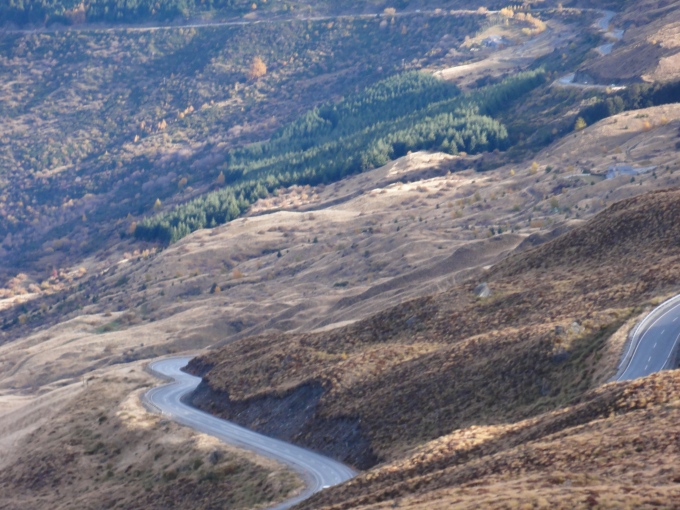
A picture paints … well, as many words as you like.  For instance:

lookingdownfromcoronetpeak

And the story:

It was once said that a desperate man has everything to lose.

The man I was chasing was desperate, but I, on the other hand, was more desperate to catch him.

He’d left a trail of dead people from one end of the island to the other.

The team had put in a lot of effort to locate him, and now his capture was imminent.  We were following the car he was in, from a discrete distance, and, at the appropriate time, we would catch up, pull him over, and make the arrest.

There was nowhere for him to go.

The road led to a dead-end, and the only way off the mountain was back down the road were now on.  Which was why I was somewhat surprised when we discovered where he was.

Where was he going?

“Damn,” I heard Alan mutter.  He was driving, being careful not to get too close, but not far enough away to lose sight of him.

“What?”

“I think he’s made us.”

“How?”

“Dumb bad luck, I’m guessing.  Or he expected we’d follow him up the mountain.  He’s just sped up.”

“How far away?”

“A half-mile.  We should see him higher up when we turn the next corner.”

It took an eternity to get there, and when we did, Alan was right, only he was further on than we thought.”

“Step on it.  Let’s catch him up before he gets to the top.”

Easy to say, not so easy to do.  The road was treacherous, and in places just gravel, and there were no guard rails to stop a three thousand footfall down the mountainside.

Good thing then I had the foresight to have three agents on the hill for just such a scenario.

Ten minutes later, we were in sight of the car, still moving quickly, but we were going slightly faster.  We’d catch up just short of the summit car park.

Or so we thought.

Coming quickly around another corner we almost slammed into the car we’d been chasing.

“What the hell…” Aland muttered.

I was out of the car, and over to see if he was in it, but I knew that it was only a slender possibility.  The car was empty, and no indication where he went.

Certainly not up the road.  It was relatively straightforward for the next mile, at which we would have reached the summit.  Up the mountainside from here, or down.

I looked up.  Nothing.

Alan yelled out, “He’s not going down, not that I can see, but if he did, there’s hardly a foothold and that’s a long fall.”

Then where did he go?

Then a man looking very much like our quarry came out from behind a rock embedded just a short distance up the hill.

“Sorry,” he said quite calmly.  “Had to go if you know what I mean.”

I’d lost him.

It was as simple as that.

I had been led a merry chase up the hill, and all the time he was getting away in a different direction.

I’d fallen for the oldest trick in the book, letting my desperation blind me to the disguise that anyone else would see through in an instant.

It was a lonely sight, looking down that road, knowing that I had to go all that way down again, only this time, without having to throw caution to the wind.

“Maybe next time,” Alan said.

“We’ll get him.  It’s just a matter of time.”

© Charles Heath 2019-2021

Find this and other stories in “Inspiration, maybe”  available soon.

InspirationMaybe1v1

Writing about writing a book – Research – 12

Background material used in researching the Vietnam war and various other aspects of that period

…

Who were the North Vietnamese, really?

…

More Than Just Tunnels: Deconstructing North Vietnam’s Winning Strategy

The Vietnam War remains one of the most studied and strategically complex conflicts of the 20th century. Facing the overwhelming technological and logistical might of the United States and its allies, the armed forces of North Vietnam—primarily the People’s Army of Vietnam (PAVN), often referred to as the NVA, supported by the southern irregular forces known as the Viet Cong (VC)—employed a doctrine that defied conventional military wisdom.

Their strategy was not about winning battles in the traditional sense; it was about protracted war and the exhaustion of the enemy’s political will.

Here is a deep dive into how the North deployed its troops and the sophisticated methodology they utilized to take the fight to the Allied soldiers.


1. The Deployment Structure: Two Armies, One Goal

The North’s deployment strategy was inherently flexible, relying on a tiered military structure designed to adapt to any environment, from dense jungle to urban centers.

A. The Viet Cong (VC): The Irregular Force

The Viet Cong served as the political and military instrument in the South. They were not a conventional army but an insurgency operating within South Vietnam’s villages and hamlets.

Deployment Methodology:

  • Decentralization: VC units were deployed locally, focused on small-scale harassment, ambushes, and targeted assassinations of ARVN (South Vietnamese Army) officials.
  • Infiltration by Footprint: VC units were often indistinguishable from the local populace, deploying fighters who worked the rice paddies by day and fought by night.
  • Infrastructure Destruction: Their primary military deployment targets were the infrastructure supporting the US/ARVN presence: supply lines, airbases, and communication centers.

B. The PAVN (NVA): The Main Force

The PAVN was the formal, organized army of North Vietnam. These were well-trained, disciplined, and heavily armed conventional units, often deployed in regimental and divisional strength.

Deployment Methodology:

  • Strategic Infiltration: PAVN forces were primarily deployed via the Ho Chi Minh Trail (see below). They avoided direct, large-scale contact with US forces until the conditions were optimal (e.g., during the Tet Offensive or the 1972 Easter Offensive).
  • The Element of Surprise: When PAVN units were deployed in pitched battles, they focused on achieving total surprise and concentrating overwhelming, temporary firepower before rapidly melting back into the jungle or border sanctuaries.

2. The Logistics Highway: The Ho Chi Minh Trail

The single greatest factor in troop deployment was the elaborate logistical network known as the Ho Chi Minh Trail. This was not a single road but a constantly shifting, 16,000-kilometer web of trails, paths, rivers, and depots running through neutral Laos and Cambodia.

Strategic Impact on Deployment:

  • Bypassing Defenses: The Trail allowed hundreds of thousands of troops and vast amounts of material to bypass the heavily fortified Demilitarized Zone (DMZ) and move deep into the South, often positioning them directly behind US defenses.
  • Sustained Pressure: By keeping the logistics flowing despite intense American air interdiction (Operation Rolling Thunder and others), the North could continually refresh its forces, deploying new units to replace losses and ensuring the insurgency never withered away.
  • Mobility as Fortress: Because the Trail routes changed daily and were covered by dense jungle canopy, the US bombing campaigns often failed to halt troop movement, making mobility itself a form of defense.

3. Methodology in Combat: Neutralizing US Advantages

The North Vietnamese knew they could not win a conventional war against American firepower. Their methodology was designed purely to negate the US technological superiority.

A. The Strategy of “Clinging to the Belt”

This was one of the most effective tactical moves deployed by the PAVN. When engaging American ground forces, NVA units were instructed to deploy forces and fight at extremely close quarters, often termed “grabbing the enemy’s belt.”

Rationale:

  • By fighting nose-to-nose, the Americans could not safely call in their most powerful assets—tactical aircraft, napalm, or heavy artillery—without risking friendly fire casualties.
  • This effectively reduced the battle back to infantry vs. infantry, minimizing the US advantage in technology and maximizing the North’s advantage in tenacity and knowledge of the terrain.

B. Ambushes and Rapid Dispersal

VC and PAVN units specialized in the planned ambush. This was a deployment methodology based on hit-and-run tactics:

  1. Selection of Terrain: Choosing areas where US mobility was constrained (jungles, rice paddies, or remote valleys).
  2. Overwhelming Fire: Deploying all available troops and weapons to achieve a massive initial burst of fire, inflicting maximum casualties in the first minutes.
  3. Rapid Retreat: Before the American command could organize a counter-attack or coordinate air support, the NVA/VC forces would melt away, using prepared escape routes, tunnels, or border sanctuaries (known as Base Areas).

C. The Use of Tunnels and Base Areas

Deployment wasn’t just about moving across the surface; it was under it. The famous Cu Chi Tunnels near Saigon and similar networks served multiple strategic purposes:

  • Sanctuaries: Allowing troops to deploy and stage operations deep inside areas the US considered secured.
  • Hidden Bases: Providing underground logistics hubs, hospitals, and command centers.
  • Evasion: Allowing forces to disappear immediately after an engagement, frustrating US “search and destroy” missions.

4. The Political Dimension: The Protracted War

The PAVN/VC deployment was always dictated by political goals. General Vo Nguyen Giap, the architect of the North Vietnamese struggle, emphasized that the true battlefield was the American political landscape.

The Methodology of Exhaustion:

  • Avoid Annihilation: Troops were deployed carefully to avoid any battle that could lead to a decisive defeat. Their goal was survival, not conquest until the final stages of the war.
  • Inflict Casualties: Every single US casualty inflicted by a sustained troop deployment amplified anti-war sentiment back home. The deployment strategy was therefore calibrated to maximize enemy losses while minimizing the risk to the overall force structure.
  • The Final Phase: Only late in the war, when the US had significantly withdrawn and the ARVN was left struggling, did PAVN change its deployment methodology to focus on large-scale, conventional maneuvers (like the deployment of tank columns and heavy artillery) necessary to secure the final victory in 1975.

The North Vietnamese methodology for deploying troops was a brilliant exercise in adaptability. They transformed their logistical weaknesses into defensive strengths, used geography to neutralize superior air power, and ensured that every soldier deployed served the overarching political mission: convincing the American public that victory was impossible. Their success remains a testament to the strategic power of insurgency and asymmetric warfare.

What I learned about writing – Monday is just another day of the week

I don’t like Mondays – a song lingering on the periphery of my memory, and I’m not sure who sung it.

But it’s official, I don’t like Mondays.

I’ve been procrastinating since last Thursday, telling myself I have to get the next part of one of my stories written, but I keep putting it off.  I’m not sure why but it always seems like this, and I have to force myself to sit in front of the computer screen, and come up with the goods.

I didn’t do anything on Sunday, and, as a writer, I guess that’s not very good.  I’m supposed to be writing a page, or a hundred or thousand words a day, just to keep the juices flowing.

I’m not in the mood.  I sit and stare at the computer screen, and nothing is coming.  Is this the first sign of writer’s block?

I dig out several articles on how to overcome it and start putting their suggestions into action.  No.  No.  Maybe.  No.  I don’t think it’s writer’s block.

Perhaps I need some inspiration so I go to my tablet playlist, spend 10 minutes trying to find the headphones that were carelessly discarded on a seat that had a lot of other stuff on it, by one of my grandchildren the last time they were here.

And, yes, the tablet was left in the middle of playing a Minecraft video which has drained the battery.  Now I can’t find the charger!

Back at the computer, holding a dead tablet, and a pair of headphones, inspiration is as far away as the mythical light at the end of the tunnel.  Today perhaps it will be an oncoming express train.

Perhaps a pen and paper will work.

An idea pops into my head…

…

Is it possible the passing of a weekend could change the course of your life?

 An interesting question, one to ponder as I sat on the floor of a concrete cell, with only the sound of my breathing, and the incessant screams coming from a room at the end of the corridor.

It was my turn next.  That was what the grinning ape of a guard said in broken English.  He looked like a man who relished his job.

What goes through your mind at a time like this, waiting, waiting for the inevitable?  Will I survive, what will they do to me, will it hurt?

The screaming stops abruptly, and a terrible silence falls over the facility.

Then, looking in the direction of where the screams had come from, I hear the clunk of the door latch being opened, and then the slow nerve-tingling screech of rusty metal as the door opens slowly.

Oh God, Oh God, Oh God, no.

….

No writer’s block.  But I have to stop watching late-night television.

First Dig Two Graves

A sequel to “The Devil You Don’t”

…

Revenge is a dish best served cold – or preferably so when everything goes right

Of course, it rarely does, as Alistair, Zoe’s handler, discovers to his peril. Enter a wildcard, John, and whatever Alistair’s plan for dealing with Zoe was dies with him.

It leaves Zoe in completely unfamiliar territory.

…

John’s idyllic romance with a woman who is utterly out of his comfort zone is on borrowed time. She is still trying to reconcile her ambivalence, after being so indifferent for so long.

They agree to take a break, during which she disappears. John, thinking she has left without saying goodbye, refuses to accept the inevitable, calls on an old friend for help in finding her.

After the mayhem and being briefly reunited, she recognises an inevitable truth: there is a price to pay for taking out Alistair; she must leave and find them first, and he would be wise to keep a low profile.

But keeping a low profile just isn’t possible, and enlisting another friend, a private detective and his sister, a deft computer hacker, they track her to the border between Austria and Hungary.

What John doesn’t realise is that another enemy is tracking him to find her too. It could have been a grand tour of Europe. Instead, it becomes a race against time before enemies old and new converge for what will be an inevitable showdown.

An excerpt from “Strangers We’ve Become” – Coming Soon

I wandered back to my villa.

It was in darkness.  I was sure I had left several lights on, especially over the door so I could see to unlock it.

I looked up and saw the globe was broken.

Instant alert.

I went to the first hiding spot for the gun, and it wasn’t there.  I went to the backup and it wasn’t there either.  Someone had found my carefully hidden stash of weapons and removed them.

Who?

There were four hiding spots and all were empty.  Someone had removed the weapons.  That could only mean one possibility.

I had a visitor, not necessarily here for a social call.

But, of course, being the well-trained agent I’d once been and not one to be caught unawares, I crossed over to my neighbor and relieved him of a weapon that, if found, would require a lot of explaining.

Suitably armed, it was time to return the surprise.

There were three entrances to the villa, the front door, the back door, and a rather strange escape hatch.  One of the more interesting attractions of the villa I’d rented was its heritage.  It was built in the late 1700s, by a man who was, by all accounts, a thief.  It had a hidden underground room which had been in the past a vault but was now a wine cellar, and it had an escape hatch by which the man could come and go undetected, particularly if there was a mob outside the door baying for his blood.

It now gave me the means to enter the villa without my visitors being alerted, unless, of course, they were near the vicinity of the doorway inside the villa, but that possibility was unlikely.  It was not where anyone could anticipate or expect a doorway to be.

The secret entrance was at the rear of the villa behind a large copse, two camouflaged wooden doors built into the ground.  I move aside some of the branches that covered them and lifted one side.  After I’d discovered the doors and rusty hinges, I’d oiled and cleaned them, and cleared the passageway of cobwebs and fallen rocks.  It had a mildew smell, but nothing would get rid of that.  I’d left torches at either end so I could see.

I closed the door after me, and went quietly down the steps, enveloped in darkness till I switched on the torch.  I traversed the short passage which turned ninety degrees about halfway to the door at the other end.  I carried the key to this door on the keyring, found it and opened the door.  It too had been oiled and swung open soundlessly.

I stepped in the darkness and closed the door.

I was on the lower level under the kitchen, now the wine cellar, the ‘door’ doubling as a set of shelves which had very little on them, less to fall and alert anyone in the villa.

Silence, an eerie silence.

I took the steps up to the kitchen, stopping when my head was level with the floor, checking to see if anyone was waiting.  There wasn’t.  It seemed to me to be an unlikely spot for an ambush.

I’d already considered the possibility of someone coming after me, especially because it had been Bespalov I’d killed, and I was sure he had friends, all equally as mad as he was.  Equally, I’d also considered it nigh on impossible for anyone to find out it was me who killed him because the only people who knew that were Prendergast, Alisha, a few others in the Department, and Susan.

That raised the question of who told them where I was.

If I was the man I used to be, my first suspect would be Susan.  The departure this morning, and now this was too coincidental.  But I was not that man.

Or was I?

I reached the start of the passageway that led from the kitchen to the front door and peered into the semi-darkness.  My eyes had got used to the dark, and it was no longer an inky void.  Fragments of light leaked in around the door from outside and through the edge of the window curtains where they didn’t fit properly.  A bone of contention upstairs in the morning, when first light shone and invariably woke me up hours before I wanted to.

Still nothing.

I took a moment to consider how I would approach the visitor’s job.  I would get a plan of the villa in my head, all entrances, where a target could be led to or attacked where there would be no escape.

Coming in the front door.  If I was not expecting anything, I’d just open the door and walk-in.  One shot would be all that was required.

Contract complete.

I sidled quietly up the passage staying close to the wall, edging closer to the front door.  There was an alcove where the shooter could be waiting.  It was an ideal spot to wait.

Crunch.

I stepped on some nutshells.

Not my nutshells.

I felt it before I heard it.  The bullet with my name on it.

And how the shooter missed, from point-blank range, and hit me in the arm, I had no idea.  I fired off two shots before a second shot from the shooter went wide and hit the door with a loud thwack.

I saw a red dot wavering as it honed in on me and I fell to the floor, stretching out, looking up where the origin of the light was coming and pulled the trigger three times, evenly spaced, and a second later I heard the sound of a body falling down the stairs and stopping at the bottom, not very far from me.

Two assassins.

I’d not expected that.

The assassin by the door was dead, a lucky shot on my part.  The second was still breathing.

I checked the body for any weapons and found a second gun and two knives.  Armed to the teeth!

I pulled off the balaclava; a man, early thirties, definitely Italian.  I was expecting a Russian.

I slapped his face, waking him up.  Blood was leaking from several slashes on his face when his head had hit the stairs on the way down.  The awkward angle of his arms and legs told me there were broken bones, probably a lot worse internally.  He was not long for this earth.

“Who employed you?”

He looked at me with dead eyes, a pursed mouth, perhaps a smile.  “Not today my friend.  You have made a very bad enemy.”  He coughed and blood poured out of his mouth.  “There will be more …”

Friends of Bespalov, no doubt.

I would have to leave.  Two unexplainable bodies, I’d have a hard time explaining my way out of this mess.  I dragged the two bodies into the lounge, clearing the passageway just in case someone had heard anything.

Just in case anyone was outside at the time, I sat in the dark, at the foot of the stairs, and tried to breathe normally.  I was trying not to connect dots that led back to Susan, but the coincidence was worrying me.

A half-hour passed and I hadn’t moved.  Deep in thought, I’d forgotten about being shot, unaware that blood was running down my arm and dripping onto the floor.

Until I heard a knock on my front door.

Two thoughts, it was either the police, alerted by the neighbors, or it was the second wave, though why would they be knocking on the door?

I stood, and immediately felt a stabbing pain in my arm.  I took out a handkerchief and turned it into a makeshift tourniquet, then wrapped a kitchen towel around the wound.

If it was the police, this was going to be a difficult situation.  Holding the gun behind my back, I opened the door a fraction and looked out.

No police, just Maria.  I hoped she was not part of the next ‘wave’.

“You left your phone behind on the table.  I thought you might be looking for it.”  She held it out in front of her.

When I didn’t open the door any further, she looked at me quizzically, and then asked, “Is anything wrong?”

I was going to thank her for returning the phone, but I heard her breathe in sharply, and add, breathlessly, “You’re bleeding.”

I looked at my arm and realized it was visible through the door, and not only that, the towel was soaked in blood.

“You need to go away now.”

Should I tell her the truth?  It was probably too late, and if she was any sort of law-abiding citizen she would go straight to the police.

She showed no signs of leaving, just an unnerving curiosity.  “What happened?”

I ran through several explanations, but none seemed plausible.  I went with the truth.  “My past caught up with me.”

“You need someone to fix that before you pass out from blood loss.  It doesn’t look good.”

“I can fix it.  You need to leave.  It is not safe to be here with me.”

The pain in my arm was not getting any better, and the blood was starting to run down my arm again as the tourniquet loosened.  She was right, I needed it fixed sooner rather than later.

I opened the door and let her in.  It was a mistake, a huge mistake, and I would have to deal with the consequences.  Once inside, she turned on the light and saw the pool of blood just inside the door and the trail leading to the lounge.  She followed the trail and turned into the lounge, turned on the light, and no doubt saw the two dead men.

I expected her to scream.  She didn’t.

She gave me a good hard look, perhaps trying to see if I was dangerous.  Killing people wasn’t something you looked the other way about.  She would have to go to the police.

“What happened here?”

“I came home from the cafe and two men were waiting for me.  I used to work for the Government, but no longer.  I suspect these men were here to repay a debt.  I was lucky.”

“Not so much, looking at your arm.”

She came closer and inspected it.

“Sit down.”

She found another towel and wrapped it around the wound, retightening the tourniquet to stem the bleeding.

“Do you have medical supplies?”

I nodded.  “Upstairs.”  I had a medical kit, and on the road, I usually made my own running repairs.  Another old habit I hadn’t quite shaken off yet.

She went upstairs, rummaged, and then came back.  I wondered briefly what she would think of the unmade bed though I was not sure why it might interest her.

She helped me remove my shirt, and then cleaned the wound.  Fortunately, she didn’t have to remove a bullet.  It was a clean wound but it would require stitches.

When she’d finished she said, “Your friend said one day this might happen.”

No prizes for guessing who that friend was, and it didn’t please me that she had involved Maria.

“Alisha?”

“She didn’t tell me her name, but I think she cares a lot about you.  She said trouble has a way of finding you, gave me a phone and said to call her if something like this happened.”

“That was wrong of her to do that.”

“Perhaps, perhaps not.  Will you call her?”

“Yes.  I can’t stay here now.  You should go now.  Hopefully, by the time I leave in the morning, no one will ever know what happened here, especially you.”

She smiled.  “As you say, I was never here.”

…

© Charles Heath 2018-2022

strangerscover9

Another excerpt from ‘Betrayal’; a work in progress

…

My next destination in the quest was the hotel we believed Anne Merriweather had stayed at.

I was, in a sense, flying blind because we had no concrete evidence she had been there, and the message she had left behind didn’t quite name the hotel or where Vladimir was going to take her.

Mindful of the fact that someone might have been following me, I checked to see if the person I’d assumed had followed me to Elizabeth’s apartment was still in place, but I couldn’t see him. Next, I made a mental note of seven different candidates and committed them to memory.

Then I set off to the hotel, hailing a taxi. There was the possibility the cab driver was one of them, but perhaps I was slightly more paranoid than I should be. I’d been watching the queue, and there were two others before me.

The journey took about an hour, during which time I kept an eye out the back to see if anyone had been following us. If anyone was, I couldn’t see them.

I had the cab drop me off a block from the hotel and then spent the next hour doing a complete circuit of the block the hotel was on, checking the front and rear entrances, the cameras in place, and the siting of the driveway into the underground carpark. There was a camera over the entrance, and one we hadn’t checked for footage. I sent a text message to Fritz to look into it.

The hotel lobby was large and busy, which was exactly what you’d want if you wanted to come and go without standing out. It would be different later at night, but I could see her arriving about mid-afternoon, and anonymous among the type of clientele the hotel attracted.

I spent an hour sitting in various positions in the lobby simply observing. I had already ascertained where the elevator lobby for the rooms was, and the elevator down to the car park. Fortunately, it was not ‘guarded’ but there was a steady stream of concierge staff coming and going to the lower levels, and, just from time to time, guests.

Then, when there was a commotion at the front door, what seemed to be a collision of guests and free-wheeling bags, I saw one of the seven potential taggers sitting by the front door. Waiting for me to leave? Or were they wondering why I was spending so much time there?

Taking advantage of that confusion, I picked my moment to head for the elevators that went down to the car park, pressed the down button, and waited.

The was no car on the ground level, so I had to wait, watching, like several others, the guests untangling themselves at the entrance, and an eye on my potential surveillance, still absorbed in the confusion.

The doors to the left car opened, and a concierge stepped out, gave me a quick look, then headed back to his desk. I stepped into the car, pressed the first level down, the level I expected cars to arrive on, and waited what seemed like a long time for the doors to close.

As they did, I was expecting to see a hand poke through the gap, a latecomer. Nothing happened, and I put it down to a television moment.

There were three basement levels, and for a moment, I let my imagination run wild and considered the possibility that there were more levels. Of course, there was no indication on the control panel that there were any other floors, and I’d yet to see anything like it in reality.

With a shake of my head to return to reality, the car arrived, the doors opened, and I stepped out.

A car pulled up, and the driver stepped out, went around to the rear of his car, and pulled out a case. I half expected him to throw me the keys, but the instant glance he gave me told him was not the concierge, and instead brushed past me like I wasn’t there.

He bashed the up button several times impatiently and cursed when the doors didn’t open immediately. Not a happy man.

Another car drove past on its way down to a lower level.

I looked up and saw the CCTV camera, pointing towards the entrance, visible in the distance. A gate that lifted up was just about back in position and then made a clunk when it finally closed. The footage from the camera would not prove much, even if it had been working, because it didn’t cover the life lobby, only in the direction of the car entrance.

The doors to the other elevator car opened, and a man in a suit stepped out.

“Can I help you, sir? You seem lost.”

Security, or something else. “It seems that way. I went to the elevator lobby, got in, and it went down rather than up. I must have been in the wrong place.”

“Lost it is, then, sir.” I could hear the contempt for Americans in his tone. “If you will accompany me, please.”

He put out a hand ready to guide me back into the elevator. I was only too happy to oblige him. There had been a sign near the button panel that said the basement levels were only to be accessed by the guests.

Once inside, he turned a key and pressed the lobby button. The doors closed, and we went up. He stood, facing the door, not speaking. A few seconds later, he was ushering me out to the lobby.

“Now, sir, if you are a guest…”

“Actually, I’m looking for one. She called me and said she would be staying in this hotel and to come down and visit her. I was trying to get to the sixth floor.”

“Good. Let’s go over the the desk and see what we can do for you.”

I followed him over to the reception desk, where he signalled one of the clerks, a young woman who looked and acted very efficiently, and told her of my request, but then remained to oversee the proceeding.

“Name of guest, sir?”

“Merriweather, Anne. I’m her brother, Alexander.” I reached into my coat pocket and pulled out my passport to prove that I was who I said I was. She glanced cursorily at it.

She typed the name into the computer, and then we waited a few seconds while it considered what to output. Then, she said, “That lady is not in the hotel, sir.”

Time to put on my best-confused look. “But she said she would be staying here for the week. I made a special trip to come here to see her.”

Another puzzled look from the clerk, then, “When did she call you?”

An interesting question to ask, and it set off a warning bell in my head. I couldn’t say today, it would have to be the day she was supposedly taken.

“Last Saturday, about four in the afternoon.”

Another look at the screen, then, “It appears she checked out Sunday morning. I’m afraid you have made a trip in vain.”

Indeed, I had. “Was she staying with anyone?”

I just managed to see the warning pass from the suited man to the clerk. I thought he had shown an interest when I mentioned the name, and now I had confirmation. He knew something about her disappearance. The trouble was, he wasn’t going to volunteer any information because he was more than just hotel security.

“No.”

“Odd,” I muttered. “I thought she told me she was staying with a man named Vladimir something or other. I’m not too good at pronouncing those Russian names. Are you sure?”

She didn’t look back at the screen. “Yes.”

“OK, now one thing I do know about staying in hotels is that you are required to ask guests with foreign passports their next destination, just in case they need to be found. Did she say where she was going next?” It was a long shot, but I thought I’d ask.

“Moscow. As I understand it, she lives in Moscow. That was the only address she gave us.”

I smiled. “Thank you. I know where that is. I probably should have gone there first.”

She didn’t answer; she didn’t have to, her expression did that perfectly.

The suited man spoke again, looking at the clerk. “Thank you.” He swivelled back to me. “I’m sorry we can’t help you.”

“No. You have more than you can know.”

“What was your name again, sir, just in case you still cannot find her?”

“Alexander Merriweather. Her brother. And if she is still missing, I will be posting a very large reward. At the moment, you can best contact me via the American Embassy.”

Money is always a great motivator, and that thoughtful expression on his face suggested he gave a moment’s thought to it.

I left him with that offer and left. If anything, the people who were holding her would know she had a brother, that her brother was looking for her, and equally that brother had money.

…

© Charles Heath – 2018-2025

“Sunday in New York”, a romantic adventure that’s not a walk in the park!

“Sunday in New York” is ultimately a story about trust, and what happens when a marriage is stretched to its limits.

When Harry Steele attends a lunch with his manager, Barclay, to discuss a promotion that any junior executive would accept in a heartbeat, it is the fact his wife, Alison, who previously professed her reservations about Barclay, also agreed to attend, that casts a small element of doubt in his mind.

From that moment, his life, in the company, in deciding what to do, his marriage, his very life, spirals out of control.

There is no one big factor that can prove Harry’s worst fears, that his marriage is over, just a number of small, interconnecting events, when piled on top of each other, points to a cataclysmic end to everything he had believed in.

Trust is lost firstly in his best friend and mentor, Andy, who only hints of impending disaster, Sasha, a woman whom he saved, and who appears to have motives of her own, and then in his wife, Alison, as he discovered piece by piece damning evidence she is about to leave him for another man.

Can we trust what we see with our eyes or trust what we hear?

Haven’t we all jumped to conclusions at least once in our lives?

Can Alison, a woman whose self-belief and confidence is about to be put to the ultimate test, find a way of proving their relationship is as strong as it has ever been?

As they say in the classics, read on!

Purchase:

http://tinyurl.com/Amazon-SundayInNewYork

Writing about writing a book – Research – 11

Background material used in researching the Vietnam war and various other aspects of that period

…

Agent Orange

…

Agent Orange: The Poisonous Legacy of Environmental Warfare in Vietnam

The Vietnam War was a conflict defined by brutal jungle warfare, unconventional tactics, and an enemy often indistinguishable from the dense landscape. As the war escalated, the U.S. military faced a massive tactical roadblock: the triple-canopy jungle provided impenetrable concealment for Viet Cong forces, allowing ambushes and safeguarding critical supply routes like the Ho Chi Minh Trail.

In response, the U.S. authorized a controversial initiative known as Operation Ranch Hand (1962–1971), a large-scale program of chemical warfare—specifically, the deployment of toxic herbicides designed to strip the jungle bare. At the peak of this effort stood a compound with lasting, devastating consequences: Agent Orange.

This post explores precisely what Agent Orange was, how it was deployed, and the indelible mark it left on both the soldiers who sprayed it and the people whose homeland was poisoned.


1. What Was Agent Orange?

Agent Orange was not a typical battlefield weapon designed to kill immediately. It was a tactical herbicide, an effort in environmental warfare designed to achieve two strategic goals:

  1. Defoliation: Stripping the jungle canopy to deny the Viet Cong cover and increase visibility for aerial surveillance and ground patrols.
  2. Crop Destruction: Eliminating enemy food sources in rural areas to disrupt supply chains and pressure the civilian population.

The Chemical Composition

The compound was a fifty-fifty mix of two powerful, commercially available herbicides: 2,4-D and 2,4,5-T. It was named “Agent Orange” simply because of the distinctive orange stripe painted on the 55-gallon drums used for storage.

The true source of its lethal long-term danger, however, was a byproduct of the manufacturing process for 2,4,5-T: TCDD Dioxin (2,3,7,8-tetrachlorodibenzo-p-dioxin). Dioxin is one of the most toxic substances known to man. Even trace amounts are highly carcinogenic and teratogenic (capable of causing birth defects).

Crucially, when Agent Orange was first deployed, many U.S. personnel were told the chemical was harmless, simply a strong form of weed killer.


2. Deployment: Operation Ranch Hand

The goal of Operation Ranch Hand was summarized chillingly by its crews: “Only you can prevent forests.”

Deployment required a massive, coordinated logistical effort across South Vietnam, Cambodia, and Laos.

Methods of Application

The vast majority of Agent Orange—over 11 million gallons—was deployed via aerial spraying from 1965 to 1970.

  • Fixed-Wing Aircraft: The primary spray platform was the C-123 Provider transport plane. These planes were modified with large tanks and external spray booms, flying low (often just 150 feet above the canopy) and at slow speeds to ensure maximum coverage.
  • Helicopters and Ground Vehicles: Smaller quantities were sprayed by helicopters and applied from backpacks and trucks around base perimeters, supply depots, and waterways.
  • Massive Quantities: The spraying was not targeted or precise. To achieve the required defoliation, the herbicide was often applied at concentrations 6 to 25 times higher than the levels recommended by the manufacturers for ordinary use.

The chemicals soaked the vegetation, the soil, the waterways, and, inevitably, the people and animals caught below.

Environmental Impact

The operational scope resulted in catastrophic ecological damage. Over 10% of South Vietnam’s territory—including vast tracts of dense mangrove forests and inland forests—was sprayed, often multiple times. This not only destroyed the existing ecosystem but contaminated the food chain and rendered countless acres of land useless for agriculture for decades.


3. The Hidden Wound: Effects on Those Deploying It

For U.S. servicemen—whether pilots flying the C-123s, ground crews mixing and loading the drums, or infantry patrolling recently sprayed areas—exposure was unavoidable. They breathed the mist, swam in contaminated rivers, and handled leaking barrels.

The tragic revelation for these veterans was that the “harmless weed killer” they were exposed to led to devastating, delayed-onset health crises decades later.

Recognized Health Conditions

The Department of Veterans Affairs (VA) now recognizes a long list of presumptive illnesses linked to Agent Orange exposure. These include:

  • Cancers: Prostate cancer, respiratory cancers, multiple myeloma, Hodgkin’s and non-Hodgkin’s lymphoma.
  • Systemic Diseases: Parkinson’s disease, Type 2 diabetes, peripheral neuropathy, and ischemic heart disease.
  • Chloracne: A severe, persistent skin disorder caused by dioxin exposure.

Intergenerational Tragedy

Perhaps the most heartbreaking effect on American veterans was the impact on their children and grandchildren. The VA recognizes that veterans’ children may suffer from certain birth defects, particularly Spina Bifida. This realization transformed Agent Orange from a personal battle into an intergenerational health crisis for thousands of American families.

Recognition and compensation for these illnesses were slow, often requiring decades of legal battles and scientific research to confirm the painful connection between their service and their sickness.


4. The Lasting Scars: Effects on the Enemy and Local Population

While U.S. personnel suffered delayed exposure, Vietnamese citizens—especially those living in heavily sprayed areas or near former U.S. bases where chemicals were stored—suffered direct and sustained exposure, leading to environmental disaster and a profound humanitarian crisis that continues today.

Human Health Catastrophe

The effects of high-level dioxin exposure in Vietnam were immediate and catastrophic. Generations have been born with severe and debilitating birth defects, resulting in conditions often referred to collectively as Agent Orange Defects (AO-related disabilities). These include severe cognitive and physical disabilities, missing limbs, profound intellectual impairment, and complex medical issues.

Estimates suggest that up to three million Vietnamese people have been affected by Agent Orange, including hundreds of thousands of children born with birth defects. The physical and economic burden on families caring for severely disabled relatives is immense.

Contamination Hotspots

The dioxin contaminant is highly persistent, bonding closely with soil and sediment. Even decades after the war, high concentrations of dioxin remain in certain “hotspots,” primarily former U.S. airbases (like Bien Hoa and Da Nang) where barrels were handled, spilled, and often buried. These areas continue to poison the local environment and population, contaminating fish, poultry, and crops.


The Enduring Poison

Agent Orange represented a radical departure in modern warfare, relying not on explosions but on systematic environmental destruction. It was intended to be a swift tactical solution to end a jungle war. Instead, it created an enduring humanitarian crisis that continues to plague Vietnam and the U.S. veteran community.

The legacy of Agent Orange serves as a dark reminder that some weapons continue to inflict wounds long after the final shots are fired, forcing governments and societies to reckon with the profound, catastrophic cost of environmental warfare.